REVIEW 2 major objections 4 minor 15 references
FCFGS-CV-Based Channel Estimation for Wideband MmWave Massive MIMO Systems with Low-Resolution ADCs
T0 review · 2 major / 4 minor · reviewed 2026-08-14 · deepseek-v4-flash
Pith's one-line read A greedy sparse-recovery estimator with cross-validation-based stopping estimates wideband mmWave massive MIMO channels from low-resolution ADC outputs more accurately than existing message-passing and sparse Bayesian learning methods, at…
desk verdict A plausible algorithm combination, but the NMSE superiority claim is confounded by unequal dictionary resolution. read the letter →
The pith
A machine-rendered reading of the paper's core claim, the machinery that carries it, and where it could break.
The reading
What carries the argument
The load-bearing object is the FCFGS-CV iterative loop (Algorithm 1): at each step, the index with the largest $|\nabla f_E(x)_j|$ is added to the support, coefficients are re-optimized over the enlarged support by maximizing the concave estimation objective $f_E$, and the held-out objective $f_{\mathrm{CV}}$ decides whether the previous iterate was overfit. FCFGS is a generalized orthogonal matching pursuit for concave objectives; cross-validation is a model-selection technique that detects the point where adding more support stops improving generalization. The high-resolution dictionaries $B$ and $P$, with $R_{\mathrm{AoA}}=2M$ and $R_{\mathrm{delay}}=2D$, are what make the virtual channel sparse enough for the greedy search to succeed.
What would settle it
Run FCFGS-CV over many random channel realizations at each tested SNR and ADC combination, recording the iteration of minimum NMSE and the iteration where the held-out objective first decreases; if the two indices disagree by more than one iteration for any configuration, the cross-validation stopping rule is not a reliable proxy for NMSE.
Extended reading notes
Core claim
The paper's central claim is that the FCFGS-CV estimator, rather than Bayesian message-passing machinery, delivers accurate channel estimates under coarse quantization in wideband mmWave massive MIMO. In its formulation, the log-posterior $f(x)=\log\ell(x)-\|x\|^2$ is concave, and the true virtual channel is approximately $L$-sparse when the angular and delay dictionaries are oversampled to $R_{\mathrm{AoA}}=2M$ and $R_{\mathrm{delay}}=2D$. FCFGS greedily grows the support by selecting the gradient coordinate with the largest magnitude and then re-optimizes the nonzero coefficients; the cross-validation rule uses the held-out objective $f_{\mathrm{CV}}$ to detect overfitting and stop. The paper attributes its NMSE advantage over GAMP, GVAMP, GEC-SR, and Gr-SBL to this high grid resolution, which keeps the sparse-distribution assumptions valid, whereas the benchmarks either need lower-resolution grids to avoid divergence or mismatch the channel distribution.
Load-bearing premise
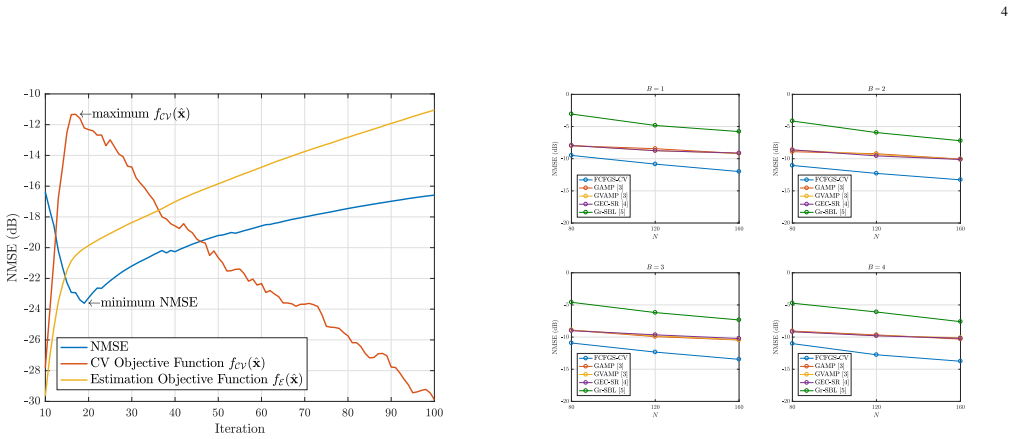
The load-bearing premise is that the score computed on held-out training data rises and then falls in exact step with the true estimation error, so the first iteration where the score decreases is also the iteration with minimum estimation error; the paper demonstrates this alignment in a single illustrative instance.
Editorial extensions
If this is right
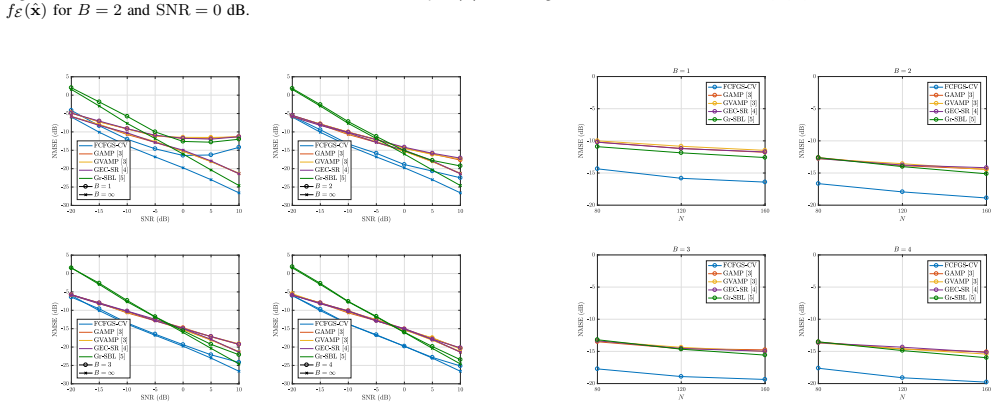
- At every tested SNR and ADC resolution from 1 to 4 bits, FCFGS-CV reports the lowest normalized mean squared error among the compared estimators at training length N=160.
- The same NMSE advantage holds at the shorter training length N=80 for SNR=-10 dB and 0 dB, so the method does not require long pilots.
- Per-iteration complexity is $O(M^2NDK+MNkt)$, the same order as GAMP and GVAMP, and lower than GEC-SR and Gr-SBL by a factor of $O(MDK)$.
- The cross-validation termination rule makes the estimator usable when the number of propagation paths is unknown, which is the normal operating condition.
Reading between the lines
- If the CV/NMSE alignment holds beyond the tested settings, the same held-out-score stopping rule could be transplanted to other greedy sparse-recovery problems with unknown sparsity, after per-problem validation.
- Because the accuracy story depends on nearly on-grid sparsity, adaptive dictionary refinement for off-grid angles and delays is a natural next step that could close the residual leakage gap the paper acknowledges.
- The complexity analysis leaves a quadratic dependence on the number of antennas; hierarchical grids or randomized support selection are plausible ways to keep the greedy-plus-CV structure at lower cost, though the paper does not explore them.
Signed reviews
Editorial analysis
A structured set of objections, weighed in public.
Referee Report
Summary. The paper proposes FCFGS-CV, a channel estimator for wideband mmWave massive MIMO systems with low-resolution ADCs. The authors formulate maximum a posteriori (MAP) channel estimation as a sparsity-constrained optimization with a concave objective, solve it approximately using the fully corrective forward greedy selection (FCFGS) algorithm, and employ cross-validation to determine the stopping iteration when the sparsity level is unknown. Simulation results report NMSE improvements over GAMP, GVAMP, GEC-SR, and Gr-SBL across SNRs, ADC resolutions (B=1,2,3,4), and training lengths N, with per-iteration complexity comparable to AMP-based methods.
Significance. The contribution is potentially useful: the MAP derivation leading to a concave objective with a sparsity constraint is logically sound, the CV-based termination rule addresses a practical issue of unknown sparsity, and the authors explicitly acknowledge that leakage breaks the FCFGS recovery guarantees and that the prior is an approximation. If the numerical comparison is made fair, the proposed method could be a practical contribution to low-resolution ADC channel estimation. However, the central numerical claim is not currently established because the simulation setup varies both the algorithm and the dictionary resolution simultaneously, and the paper itself attributes the gain to the high-resolution grid rather than to the estimator.
major comments (2)
- [Section IV, simulation setup] The central claim that FCFGS-CV 'outperforms other benchmarks for all SNRs and B' is confounded by unequal dictionary resolutions. FCFGS-CV is configured with RAoA=2M and Rdelay=2D, while GAMP, GVAMP, and GEC-SR use RAoA=M and Rdelay=D because they diverge at higher resolutions; only Gr-SBL shares the high-resolution grid. Since Remark 1 states that higher grid resolution reduces off-grid error, and the paper itself attributes the gain to 'high grid resolution guarantees the validity of the assumption established from (22) and (23)', the observed NMSE advantage could be entirely a dictionary-resolution effect rather than an algorithmic property of FCFGS-CV. The simulation should include matched-resolution benchmarks (e.g., running GAMP/GVAMP/GEC-SR at RAoA=2M, Rdelay=2D when possible, or FCFGS-CV at RAoA=M, Rdelay=D), and the discussion should separate the benefit of the estimator from that of the grid.
- [Section III-B, Algorithm 1] The CV termination rule assumes that the iteration at which fCV starts to decrease coincides with the minimum NMSE. This is demonstrated only for a single problem instance (Fig. 1, B=2, SNR=0 dB). No statistical evidence is provided to show that the alignment holds across the SNRs, B, and N values reported in Figs. 2-4. Because the final NMSE depends on this stopping heuristic, a systematic validation (e.g., average NMSE versus iteration for several settings) is needed before the reported performance can be attributed to the full algorithm.
minor comments (4)
- [Section IV, Figs. 2-4] The simulation curves are presented without error bars or confidence intervals; since the number of Monte Carlo runs is not stated, the claim 'for all N and B' would be more convincing with error bars or a statement of the number of realizations.
- [Section III-A, Eqs. (24)-(27)] The notation is inconsistent between the complex variable x in C^R and the real representation x_R used in the likelihood (15)-(17); the paper should clarify that f(x) and its gradient are evaluated on the real embedding.
- [Section III-B, Eqs. (30)-(31)] The CV objective fCV includes the same -||x||^2 penalty as fE, so the validation criterion is not a pure data-fit measure; a brief discussion of why this is appropriate for detecting the NMSE minimum would help.
- [Throughout] There are several typographical and formatting issues, such as the spacing in 'FCFGS-CV -based' in the abstract and inconsistent use of 'overfitting' and 'overfitting'; these should be cleaned up.
Circularity Check
No significant circularity: the proposed FCFGS-CV estimator is derived from explicit channel priors and external algorithms, with no fitted-input or self-citation reduction.
full rationale
The paper's derivation chain is not circular. The MAP estimator is built from explicit stochastic assumptions: i.i.d. path gains, uniform AoAs and delays in (12)-(14), the quantized likelihood in (21), and the discrete sparsity prior in (22)-(23). Maximizing f(x) in (27) is a genuine optimization formulation whose inputs are these modeling assumptions, not the NMSE results or the algorithm's output. The FCFGS solver is adopted from the external reference [6], and the CV termination rule from [8]; neither is a self-citation, and the paper does not present either as a novel derivation. The termination heuristic in Algorithm 1 is justified by one illustrative simulation in Fig. 1 rather than by an equivalence between fCV and NMSE, which is a weakness in empirical support but not a circular construction: the stopping rule is not used to fit any parameter of the channel model, and the paper's performance claims come from separate Monte Carlo simulations against external benchmarks. The observation that GAMP, GVAMP, and GEC-SR are run on lower-resolution dictionaries while FCFGS-CV uses RAoA=2M and Rdelay=2D is a legitimate comparison-fairness concern, and the paper itself explains that the resolution mismatch is deliberate ('these algorithms diverge when RAoA >> M and Rdelay >> D with ill-conditioned sensing matrices'), but varying two factors in a benchmark does not make the proposed method's derivation equivalent to its inputs. No fitted parameter is renamed as a prediction, no self-citation chain carries the central claim, and no known result is repackaged under new coordinates. Therefore the circularity score is 0.
Assumptions & free parameters
free parameters (2)
- Dictionary grid oversampling rates =
RAoA=2M, Rdelay=2D (M=64, D=8 gives 128 and 16)
- CV holdout size =
KD signals out of N (e.g., 32 of 160)
assumptions (5)
- domain assumption The mmWave virtual channel is L-sparse on the chosen dictionary grid (RAoA=2M, Rdelay=2D).
- domain assumption The discrete prior (22)-(23) approximates the true channel distribution closely enough for MAP estimation.
- standard math The function ℓ(x) in (21) is log-concave, so the objective f(x)=log ℓ(x)-||x||^2 is concave.
- ad hoc to paper The FCFGS algorithm [6] converges to a good solution for the concave objective with a support constraint, despite the breakdown of its recovery guarantees due to leakage.
- ad hoc to paper The CV objective fCV(·) is a valid indicator of overfitting; the iteration that maximizes fCV yields minimum NMSE.
Cite this review
Pith. "Pith review of FCFGS-CV-Based Channel Estimation for Wideband MmWave Massive MIMO Systems with Low-Resolution ADCs." pith.science (2026). https://pith.science/paper/QZ4S6ENC
@misc{pith2026190800532,
  author       = {Pith},
  title        = {Pith review of: FCFGS-CV-Based Channel Estimation for Wideband MmWave Massive MIMO Systems with Low-Resolution ADCs},
  year         = {2026},
  howpublished = {\url{https://pith.science/paper/QZ4S6ENC}},
  note         = {Machine review of arXiv:1908.00532}
}
read the original abstract
In this paper, the fully corrective forward greedy selection-cross validation-based (FCFGS-CV-based) channel estimator is proposed for wideband millimeter wave (mmWave) massive multiple-input multiple-output (MIMO) systems with low-resolution analog-to-digital converters (ADCs). The sparse nature of the mmWave virtual channel in the angular and delay domains is exploited to convert the maximum a posteriori (MAP) channel estimation problem to an optimization problem with a concave objective function and sparsity constraint. The FCFGS algorithm, which is the generalized orthogonal matching pursuit (OMP) algorithm, is used to solve the sparsity-constrained optimization problem. Furthermore, the CV technique is adopted to determine the proper termination condition by detecting overfitting when the sparsity level is unknown.
Figures
Reference graph
Works this paper leans on
-
[1]
Millimeter-wave massive MIMO: the next wireless revoluti on?
A. L. Swindlehurst, E. Ayanoglu, P . Heydari, and F. Capol ino, “Millimeter-wave massive MIMO: the next wireless revoluti on?” IEEE Commun. Mag. , vol. 52, no. 9, pp. 56–62, Sep. 2014
2014
-
[2]
Analog-to-digital converter survey and a nalysis,
R. H. Walden, “Analog-to-digital converter survey and a nalysis,” IEEE J. Sel. Areas Commun. , vol. 17, no. 4, pp. 539–550, Apr. 1999
1999
-
[3]
A unified bayesian inference fr amework for generalized linear models,
X. Meng, S. Wu, and J. Zhu, “A unified bayesian inference fr amework for generalized linear models,” IEEE Signal Process. Lett. , vol. 25, no. 3, pp. 398–402, Mar. 2018
work page 2018
-
[4]
Bayesian optimal data detector for hybrid mmWave MIMO-OFDM systems with low-resolution ADCs,
H. He, C. Wen, and S. Jin, “Bayesian optimal data detector for hybrid mmWave MIMO-OFDM systems with low-resolution ADCs,” IEEE J. Sel. Topics Signal Process. , vol. 12, no. 3, pp. 469–483, June 2018
work page 2018
-
[5]
A generalized sparse bayesian learni ng algorithm for 1-bit DOA estimation,
X. Meng and J. Zhu, “A generalized sparse bayesian learni ng algorithm for 1-bit DOA estimation,” IEEE Commun. Lett. , vol. 22, no. 7, pp. 1414–1417, July 2018
work page 2018
-
[6]
Trading acc uracy for sparsity in optimization problems with sparsity constrain ts,
S. Shalev-Shwartz, N. Srebro, and T. Zhang, “Trading acc uracy for sparsity in optimization problems with sparsity constrain ts,” SIAM Journal on Optimization , vol. 20, no. 6, pp. 2807–2832, 2010
work page 2010
-
[7]
Signal recovery from rando m mea- surements via orthogonal matching pursuit,
J. A. Tropp and A. C. Gilbert, “Signal recovery from rando m mea- surements via orthogonal matching pursuit,” IEEE Trans. Inf. Theory , vol. 53, no. 12, pp. 4655–4666, Dec. 2007
work page 2007
-
[8]
Sparse si gnal recon- struction from noisy compressive measurements using cross validation,
P . Boufounos, M. F. Duarte, and R. G. Baraniuk, “Sparse si gnal recon- struction from noisy compressive measurements using cross validation,” in 2007 IEEE/SP 14th W orkshop on Statistical Signal Processin g, Aug. 2007, pp. 299–303
work page 2007
Show all 15 references
-
[9]
Channel estimation i n broadband millimeter wave MIMO systems with few-bit ADCs,
J. Mo, P . Schniter, and R. W. Heath, “Channel estimation i n broadband millimeter wave MIMO systems with few-bit ADCs,” IEEE Trans. Signal Process. , vol. 66, no. 5, pp. 1141–1154, Mar. 2018
2018
-
[10]
Deconstructing multiantenna fading cha nnels,
A. M. Sayeed, “Deconstructing multiantenna fading cha nnels,” IEEE Trans. Signal Process. , vol. 50, no. 10, pp. 2563–2579, Oct. 2002
2002
-
[11]
Multiple pa rameter estimation with quantized channel output,
A. Mezghani, F. Antreich, and J. A. Nossek, “Multiple pa rameter estimation with quantized channel output,” in 2010 International ITG W orkshop on Smart Antennas (WSA) , Feb. 2010, pp. 143–150
2010
-
[12]
Channel estimation via ort hogonal matching pursuit for hybrid MIMO systems in millimeter wave com- munications,
J. Lee, G. Gil, and Y . H. Lee, “Channel estimation via ort hogonal matching pursuit for hybrid MIMO systems in millimeter wave com- munications,” IEEE Trans. Commun. , vol. 64, no. 6, pp. 2370–2386, June 2016
2016
-
[13]
Generalized approximate message passing f or estimation with random linear mixing,
S. Rangan, “Generalized approximate message passing f or estimation with random linear mixing,” in 2011 IEEE International Symposium on Information Theory Proceedings , July 2011, pp. 2168–2172
2011
-
[14]
V ector appr oximate message passing for the generalized linear model,
P . Schniter, S. Rangan, and A. K. Fletcher, “V ector appr oximate message passing for the generalized linear model,” in 2016 50th Asilomar Conference on Signals, Systems and Computers , Nov. 2016, pp. 1525– 1529
2016
-
[15]
Bayesian channel estima tion algo- rithms for massive MIMO systems with hybrid analog-digital processing and low-resolution ADCs,
Y . Ding, S. Chiu, and B. D. Rao, “Bayesian channel estima tion algo- rithms for massive MIMO systems with hybrid analog-digital processing and low-resolution ADCs,” IEEE J. Sel. Topics Signal Process. , vol. 12, no. 3, pp. 499–513, June 2018
2018
Reviewed August 14, 2026 · model on record in the stance chip above.
Discussion (0). Continue with ORCID to comment.