Hidden-charm and -bottom tetraquark states with J^(PC)=1⁻⁺ via QCD sum rules
Pith reviewed 2026-05-17 02:25 UTC · model grok-4.3
The pith
QCD sum rules predict four 1^{-+} hidden-charm tetraquarks with masses of 4.72 to 4.88 GeV and hidden-bottom counterparts near 11 GeV.
A machine-rendered reading of the paper's core claim, the machinery that carries it, and where it could break.
Core claim
The authors use QCD sum rules to investigate 1^{-+} hidden-charm and hidden-bottom tetraquark states. Their calculations, performed with condensates up to dimension eight, produce mass predictions of (4.83 ± 0.15) GeV, (4.88 ± 0.18) GeV, (4.72 ± 0.16) GeV, and (4.79 ± 0.12) GeV for the four hidden-charm states. The corresponding hidden-bottom states are estimated at (11.08 ± 0.16) GeV, (11.16 ± 0.14) GeV, (10.99 ± 0.16) GeV, and (11.03 ± 0.15) GeV. The work also identifies possible decay modes that could be observed at BESIII, Belle II, LHCb, and the future STCF.
What carries the argument
QCD sum rules applied to suitable interpolating currents for tetraquarks, with the operator product expansion truncated at dimension eight.
If this is right
- The mass values supply specific search windows for exotic 1^{-+} states in the charm and bottom sectors.
- Possible decay channels of these states become accessible to current and planned experiments including BESIII, Belle II, LHCb, and the future STCF.
- The results support the existence of tetraquarks with exotic quantum numbers beyond the conventional meson spectrum.
Where Pith is reading between the lines
- If these states are found, their mass pattern could help distinguish diquark-antidiquark configurations from other proposed internal structures.
- The same sum-rule framework could be reapplied to neighboring exotic quantum numbers to map a fuller spectrum of tetraquarks.
- Observed discrepancies between predicted and measured widths in related charmonium-like resonances might be explained by mixing with these states.
Load-bearing premise
The chosen interpolating currents couple strongly to the physical tetraquark states and that the operator product expansion truncated at dimension eight, together with the selected Borel window and continuum threshold, isolates the ground-state pole contribution.
What would settle it
Experimental detection or clear absence of resonances with the predicted masses, 1^{-+} quantum numbers, and suggested decay modes in the 4.7-4.9 GeV charm region or the 11 GeV bottom region at facilities such as LHCb or Belle II.
Figures
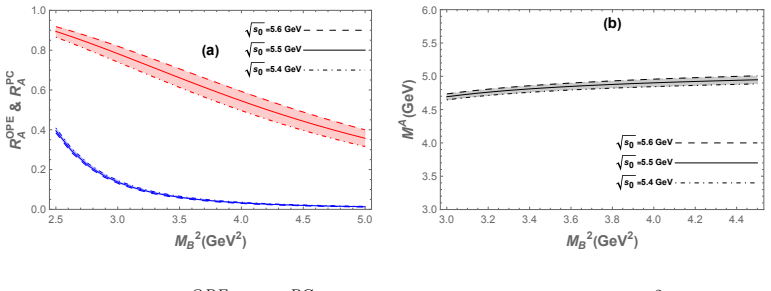


read the original abstract
We investigate the $1^{-+}$ hidden-charm and hidden-bottom tetraquark states within the framework of QCD sum rules. The mass spectra are computed by including condensates up to dimension eight in the operator product expansion. Our results indicate the possible existence of four $1^{-+}$ hidden-charm tetraquark states, with predicted masses of $(4.83 \pm 0.15)$ GeV, $(4.88 \pm 0.18)$ GeV, $(4.72 \pm 0.16)$ GeV, and $(4.79 \pm 0.12)$ GeV, while their hidden-bottom counterparts are estimated to have masses of $(11.08 \pm 0.16)$ GeV, $(11.16 \pm 0.14)$ GeV, $(10.99 \pm 0.16)$ GeV, and $(11.03 \pm 0.15)$ GeV, respectively. We also analyze the possible decay modes of these tetraquark states, which may be accessible in future experiments at BESIII, Belle~II, LHCb, and future STCF. These findings provide valuable guidance for the experimental search for exotic $1^{-+}$ tetraquark states in both the charm and bottom sectors.
Editorial analysis
A structured set of objections, weighed in public.
Referee Report
Summary. The manuscript applies the QCD sum-rule method to hidden-charm and hidden-bottom tetraquarks with J^{PC}=1^{-+}. Interpolating currents are constructed, the OPE is evaluated up to dimension 8, and masses are extracted from the ratio of moments after choosing Borel windows and continuum thresholds. Four states are predicted in each sector with masses (4.83±0.15) GeV, (4.88±0.18) GeV, (4.72±0.16) GeV, (4.79±0.12) GeV for charm and (11.08±0.16) GeV, (11.16±0.14) GeV, (10.99±0.16) GeV, (11.03±0.15) GeV for bottom; possible decay channels are also discussed.
Significance. If the numerical stability and pole-dominance criteria are satisfied, the work supplies concrete mass predictions and decay-mode suggestions that can guide experimental searches at BESIII, Belle II, LHCb and future STCF. The inclusion of dimension-8 condensates is a positive technical step relative to many earlier tetraquark sum-rule studies.
major comments (2)
- [§4] §4 (numerical analysis): Borel-window stability plots and the pole-contribution fractions (ground-state over total) are not shown for any of the four 1^{-+} currents. Without explicit demonstration that the pole fraction exceeds ~50 % inside the chosen M^2 windows and that the extracted masses vary by less than the quoted ±0.12–0.18 GeV uncertainties, the central mass values cannot be regarded as robust.
- [§3] §3 (sum-rule construction): The continuum thresholds s_0 are treated as auxiliary parameters optimized for stability, yet no quantitative scan or sensitivity table is provided showing how the predicted masses shift when s_0 is varied by the conventional ±0.5 GeV. This directly affects the reliability of the four quoted mass values.
minor comments (2)
- The correspondence between the four listed currents and the four quoted mass values should be stated explicitly in the text or in a table.
- [§3] A short paragraph summarizing the relative size of the dimension-8 condensate contributions versus lower-dimensional terms would help readers assess OPE convergence.
Simulated Author's Rebuttal
We thank the referee for the careful reading and constructive comments on our manuscript. We address each major comment below and will revise the manuscript to incorporate the requested clarifications and additional material.
read point-by-point responses
-
Referee: [§4] §4 (numerical analysis): Borel-window stability plots and the pole-contribution fractions (ground-state over total) are not shown for any of the four 1^{-+} currents. Without explicit demonstration that the pole fraction exceeds ~50 % inside the chosen M^2 windows and that the extracted masses vary by less than the quoted ±0.12–0.18 GeV uncertainties, the central mass values cannot be regarded as robust.
Authors: We agree that explicit demonstration of Borel-window stability and pole dominance is necessary to substantiate the robustness of the mass predictions. In the original analysis the chosen windows satisfy pole contributions above 50% with mass variations smaller than the quoted uncertainties, but these were not displayed. In the revised manuscript we will add the Borel stability plots and pole-fraction values for all four currents, allowing direct verification of the criteria. revision: yes
-
Referee: [§3] §3 (sum-rule construction): The continuum thresholds s_0 are treated as auxiliary parameters optimized for stability, yet no quantitative scan or sensitivity table is provided showing how the predicted masses shift when s_0 is varied by the conventional ±0.5 GeV. This directly affects the reliability of the four quoted mass values.
Authors: We acknowledge that a quantitative sensitivity analysis for s_0 strengthens the presentation. While the central s_0 values were chosen to ensure stability, we will include a table in the revised manuscript that reports the mass shifts obtained when s_0 is varied by ±0.5 GeV; these shifts remain within the quoted uncertainties. revision: yes
Circularity Check
No significant circularity: standard QCD sum-rule mass extraction from OPE matching
full rationale
The paper constructs explicit interpolating currents for the 1^{-+} tetraquarks, performs the OPE to dimension 8, applies the Borel transform, and extracts masses from the ratio of moments after choosing auxiliary parameters (Borel window M^2 and continuum threshold s0) for stability and pole dominance. These auxiliary choices are optimized on the basis of internal consistency criteria (plateau behavior and pole fraction) rather than being fitted to the final mass values; the masses emerge as derived outputs. No self-definitional loop, no renaming of known results, and no load-bearing self-citation that reduces the central claim to an unverified prior result appear in the derivation chain. The procedure is therefore self-contained against external benchmarks such as known condensate values and the dispersion relation.
Axiom & Free-Parameter Ledger
free parameters (2)
- continuum threshold s0
- Borel mass M^2
axioms (2)
- standard math Operator product expansion of the correlation function is valid in the deep Euclidean region
- domain assumption Existence of local interpolating currents with J^{PC}=1^{-+} that couple to the tetraquark states
Lean theorems connected to this paper
-
IndisputableMonolith/Foundation/AbsoluteFloorClosure.leanreality_from_one_distinction unclear?
unclearRelation between the paper passage and the cited Recognition theorem.
We investigate the 1^{-+} hidden-charm and hidden-bottom tetraquark states within the framework of QCD sum rules. The mass spectra are computed by including condensates up to dimension eight in the operator product expansion.
-
IndisputableMonolith/Cost/FunctionalEquation.leanwashburn_uniqueness_aczel unclear?
unclearRelation between the paper passage and the cited Recognition theorem.
Mk(s0, M2B) = sqrt( - L1 / L0 ) after Borel transform and continuum subtraction
What do these tags mean?
- matches
- The paper's claim is directly supported by a theorem in the formal canon.
- supports
- The theorem supports part of the paper's argument, but the paper may add assumptions or extra steps.
- extends
- The paper goes beyond the formal theorem; the theorem is a base layer rather than the whole result.
- uses
- The paper appears to rely on the theorem as machinery.
- contradicts
- The paper's claim conflicts with a theorem or certificate in the canon.
- unclear
- Pith found a possible connection, but the passage is too broad, indirect, or ambiguous to say the theorem truly supports the claim.
Forward citations
Cited by 4 Pith papers
-
Spectrum of $J^{PC} = 0^{\pm\pm}$ Gluonic Hidden-Charm Tetraquark States
QCD sum rule analysis predicts six stable gluonic hidden-charm tetraquark states with J^PC = 0^{±±} and estimates masses for their hidden-bottom partners.
-
Spectroscopy of hidden-heavy tetraquark states with $J^{PC}=0^{--}$ in a color-octet configuration
QCD sum rules yield mass predictions of 10.8-11.1 GeV for four hidden-bottom 0-- tetraquarks and 4.3-4.6 GeV for their hidden-charm partners in color-octet setups.
-
QCD sum rule analysis of local meson-meson currents for the $K(1690)$ state
QCD sum rules with local meson-meson currents for the K(1690) consistently predict masses around 2 GeV or above, disfavoring a molecular interpretation in favor of a compact multiquark state.
-
Study of $\chi_{cJ}\to \eta \eta \eta^\prime$ via intermediate charmed meson loop mechanisms and its implications for non-observation of $\eta_1(1855)$ in $\chi_{cJ}$ decays
Charmed-meson loop calculations reproduce the branching fractions of chi_cJ to eta eta eta' and the absence of eta1(1855) signal in the eta eta' spectrum.
Reference graph
Works this paper leans on
-
[1]
S. K. Choiet al.[Belle Collaboration], Phys. Rev. Lett.91, 262001 (2003)
work page 2003
-
[2]
N. Brambilla, S. Eidelman, C. Hanhart, A. Nefediev, C. P. Shen, C. E. Thomas, A. Vairo and C. Z. Yuan, Phys. Rept.873, 1-154 (2020)
work page 2020
-
[3]
H. X. Chen, W. Chen, X. Liu and S. L. Zhu, Phys. Rept.639, 1-121 (2016)
work page 2016
-
[4]
Y. R. Liu, H. X. Chen, W. Chen, X. Liu and S. L. Zhu, Prog. Part. Nucl. Phys.107, 237-320 (2019)
work page 2019
-
[5]
F. K. Guo, C. Hanhart, U. G. Meißner, Q. Wang, Q. Zhao and B. S. Zou, Rev. Mod. Phys.90, 015004 (2018) [erratum: Rev. Mod. Phys.94, 029901 (2022)]
work page 2018
- [6]
-
[7]
M. Ablikimet al.[BESIII], Phys. Rev. Lett.129, 192002 (2022)
work page 2022
- [8]
-
[9]
M.A. Shifman, A.I. Vainshtein and V.I. Zakharov, Nucl. Phys. B147, 385 (1979); ibid, Nucl. Phys. B147, 448 (1979)
work page 1979
- [10]
-
[11]
R. M. Albuquerque, arXiv:1306.4671 [hep-ph]
work page internal anchor Pith review Pith/arXiv arXiv
-
[12]
Z. G. Wang and T. Huang, Phys. Rev. D89, 054019 (2014)
work page 2014
-
[13]
L. J. Reinders, H. Rubinstein and S. Yazaki, Phys. Rept.127, 1 (1985)
work page 1985
-
[14]
QCD Sum Rules, a Modern Perspective
P. Colangelo and A. Khodjamirian, inAt the frontier of particle physics / Handbook of QCD, edited by M. Shifman (World Scientific, Singapore, 2001), arXiv:hep-ph/0010175
work page internal anchor Pith review Pith/arXiv arXiv 2001
- [15]
- [16]
-
[17]
C. F. Qiao and L. Tang, Eur. Phys. J. C74, 2810 (2014)
work page 2014
-
[18]
C. F. Qiao and L. Tang, Eur. Phys. J. C74, 3122 (2014)
work page 2014
-
[19]
B. D. Wan and C. F. Qiao, Nucl. Phys. B968, 115450 (2021)
work page 2021
-
[20]
B. D. Wan and C. F. Qiao, Phys. Lett. B817, 136339 (2021)
work page 2021
-
[21]
L. Tang, B. D. Wan, K. Maltman and C. F. Qiao, Phys. Rev. D101, 094032 (2020)
work page 2020
-
[22]
H. X. Chen, E. L. Cui, W. Chen, T. G. Steele and S. L. Zhu, Phys. Rev. C91, 025204 (2015)
work page 2015
- [23]
-
[24]
Z. G. Wang, Eur. Phys. J. C77, 642 (2017). 11
work page 2017
-
[25]
J. Govaerts, L. J. Reinders, H. R. Rubinstein and J. Weyers, Nucl. Phys. B258, 215-229 (1985)
work page 1985
-
[26]
C. M. Tang, Y. C. Zhao and L. Tang, Phys. Rev. D105, 114004 (2022)
work page 2022
-
[27]
C. F. Qiao and L. Tang, Phys. Rev. Lett.113, 221601 (2014)
work page 2014
- [28]
- [29]
- [30]
-
[31]
Y. C. Zhao, C. M. Tang and L. Tang, Eur. Phys. J. C83, 654 (2023)
work page 2023
-
[32]
B. D. Wan, S. Q. Zhang and C. F. Qiao, Phys. Rev. D106, 074003 (2022)
work page 2022
-
[33]
S. Q. Zhang, B. D. Wan, L. Tang and C. F. Qiao, Phys. Rev. D106, 074010 (2022)
work page 2022
-
[34]
F. H. Yin, W. Y. Tian, L. Tang and Z. H. Guo, Eur. Phys. J. C81, 818 (2021)
work page 2021
-
[35]
B. C. Yang, L. Tang and C. F. Qiao, Eur. Phys. J. C81, 324 (2021)
work page 2021
-
[36]
B. D. Wan, Nucl. Phys. B1004, 116538 (2024)
work page 2024
-
[37]
B. D. Wan and H. T. Xu, Chin. Phys. C44, 093105 (2024)
work page 2024
-
[38]
B. D. Wan and S. Yang, Eur. Phys. J. A61, 11 (2025)
work page 2025
-
[39]
B. D. Wan and Y. R. Wang, Eur. Phys. J. A60, 179 (2024)
work page 2024
-
[40]
B. D. Wan and J. C. Yang, [arXiv:2507.11874 [hep-ph]]
work page internal anchor Pith review Pith/arXiv arXiv
- [41]
-
[42]
B. D. Wan, [arXiv:2508.07822 [hep-ph]]
work page internal anchor Pith review Pith/arXiv arXiv
-
[43]
B. D. Wan, S. Q. Zhang and C. F. Qiao, Phys. Rev. D105, 014016 (2022)
work page 2022
-
[44]
B. D. Wan, Eur. Phys. J. C84, 760 (2024)
work page 2024
- [45]
-
[46]
B. D. Wan, L. Tang and C. F. Qiao, Eur. Phys. J. C80, 121 (2020)
work page 2020
- [47]
- [48]
- [49]
-
[50]
B. D. Wan, Eur. Phys. J. Plus140, 873 (2025)
work page 2025
-
[51]
B. D. Wan, M. Y. Yuan, J. H. Zhang and Y. Zhang, [arXiv:2512.12310 [hep-ph]]
work page internal anchor Pith review Pith/arXiv arXiv
-
[52]
Z. G. Wang, Phys. Rev. D101, 074011 (2020)
work page 2020
-
[53]
S. S. Agaev, K. Azizi and H. Sundu, Phys. Rev. D107, 054017 (2023)
work page 2023
-
[54]
S. S. Agaev, K. Azizi and H. Sundu, Phys. Rev. D112, 014003 (2025)
work page 2025
- [55]
- [56]
-
[57]
Z. G. Wang, Nucl. Phys. B973, 115592 (2021)
work page 2021
-
[58]
Z. G. Wang, Nucl. Phys. B1002, 116514 (2024). 12
work page 2024
-
[59]
M. Achasov, X. C. Ai, R. Aliberti, L. P. An, Q. An, X. Z. Bai, Y. Bai, O. Bakina, A. Barnyakov and V. Blinov,et al.Front. Phys. (Beijing)19, 14701 (2024). Appendix A: The spectral densities for1 −+ hidden-charm tetraquark states
work page 2024
-
[60]
The spectral densities for current in Eq. (1) ρpert(s) = Z αmax αmin dα Z 1−α βmin dβ − F3 αβ(α+β−1) 3072π6α3β3 × 3Fαβ(α+β+ 1) + 2m 2 Q(α+β−1) 2 ,(A1) ρ⟨¯qq⟩(s) = Z αmax αmin dα Z 1−α βmin dβ − F2 αβmQ⟨¯qq⟩(α+β−1)(α+β) 32π4α2β2 ,(A2) ρ⟨G2⟩(s) = ⟨G2⟩ π6 Z αmax αmin dα Z 1−α βmin dβ Fαβ 73728α2β2 (α+β−1) 2m2 Q(17α + 17β−5)−12F αβ(2α2 +β(2β−1) +α(4β−1)) + (α...
-
[61]
The spectral densities for current in Eq. (2) ρpert(s) = Z αmax αmin dα Z 1−α βmin dβ − F3 αβ(α+β−1) 1024π6α3β3 × 3Fαβ(α+β+ 1) + 2m 2 Q(α+β−1) 2 ,(A12) ρ⟨¯qq⟩(s) = Z αmax αmin dα Z 1−α βmin dβ 3F2 αβmQ⟨¯qq⟩(α+β−1)(α+β) 32π4α2β2 ,(A13) ρ⟨G2⟩(s) = ⟨G2⟩ π6 Z αmax αmin dα Z 1−α βmin dβ Fαβ 73728α2β2 −m 2 Q(13α3 + (13β+ 29)(β−1) 2 +α 2(51β+ 3) +α(51β 2 −54β−45...
-
[62]
The spectral densities for current in Eq. (3) ρpert(s) = Z αmax αmin dα Z 1−α βmin dβ F3 αβ(α+β−1) 3072π6α3β3 × 3Fαβ(α+β+ 1) + 2m 2 Q(α+β−1) 2 ,(A20) ρ⟨¯qq⟩(s) = Z αmax αmin dα Z 1−α βmin dβ − F2 αβmQ⟨¯qq⟩(α+β−1)(α+β) 32π4α2β2 ,(A21) ρ⟨G2⟩(s) = ⟨G2⟩ π6 Z αmax αmin dα Z 1−α βmin dβ − Fαβ 73728α2β2 (α+β−1) 2m2 Q(17α + 17β−5)−12F αβ(2α2 +β(2β−1) +α(4β−1)) + ...
-
[63]
The spectral densities for current in Eq. (4) ρpert(s) = Z αmax αmin dα Z 1−α βmin dβ F3 αβ(α+β−1) 1024π6α3β3 × 3Fαβ(α+β+ 1) + 2m 2 Q(α+β−1) 2 ,(A28) ρ⟨¯qq⟩(s) = Z αmax αmin dα Z 1−α βmin dβ 3F2 αβmQ⟨¯qq⟩(α+β−1)(α+β) 32π4α2β2 ,(A29) ρ⟨G2⟩(s) = ⟨G2⟩ π6 Z αmax αmin dα Z 1−α βmin dβ Fαβ 73728α2β2 m2 Q(13α3 + (13β+ 29)(β−1) 2 +α 2(51β+ 3) +α(51β 2 −54β−45)) +...
discussion (0)
Sign in with ORCID, Apple, or X to comment. Anyone can read and Pith papers without signing in.