REVIEW 3 major objections 6 minor 45 references
GAdaBoost: An Efficient and Robust AdaBoost Algorithm Based on Granular-Ball Structure
T0 review · 3 major / 6 minor · reviewed 2026-08-07 · deepseek-v4-flash
Pith's one-line read Granular-ball compression turns multiclass AdaBoost into a faster, label-noise-robust algorithm whose multiclass exponential loss still decreases monotonically.
desk verdict Granular-ball boosting is a genuinely new idea with extensive experiments, but the Section 4.3 convergence proof is algebraically invalid and the promised SVM experiments are missing. read the letter →
The pith
A machine-rendered reading of the paper's core claim, the machinery that carries it, and where it could break.
The reading
What carries the argument
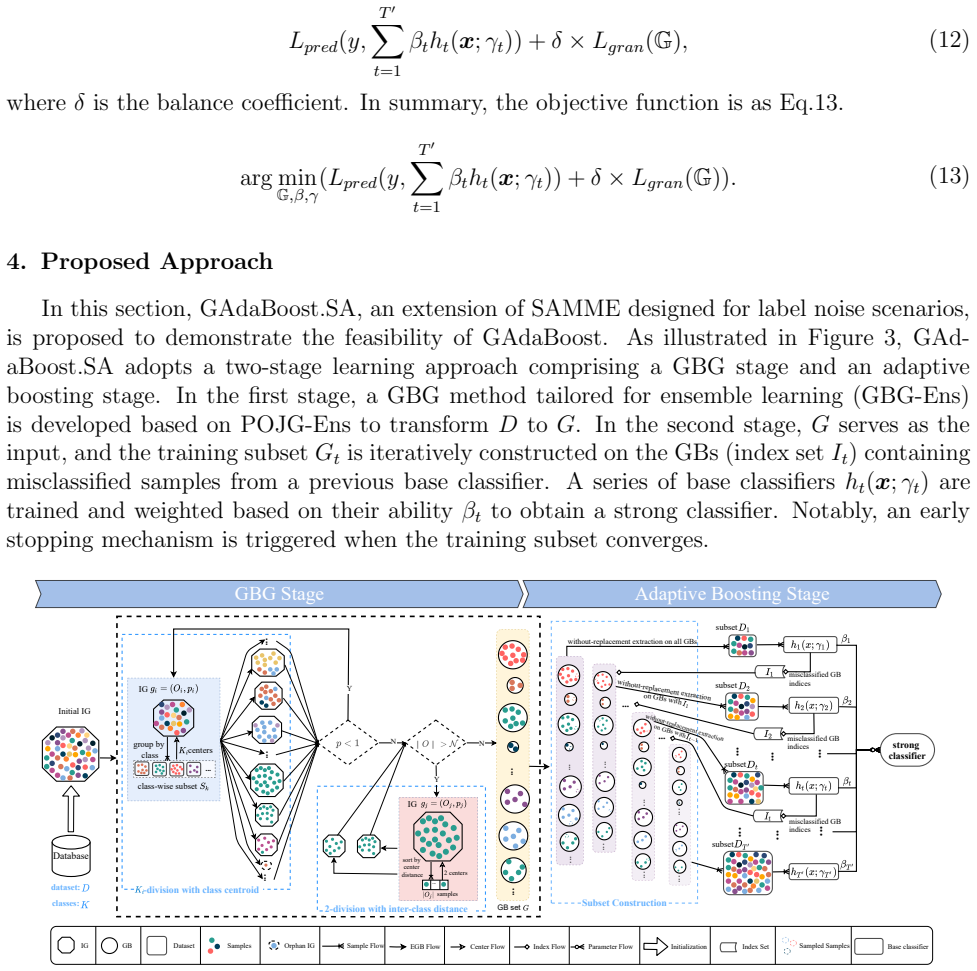
The load-bearing object is the granular ball: a cluster of samples stored as its center $c$, the radial distance set $\Omega$ of every sample from $c$, and a purity $p \in [0,1]$ equal to the fraction of samples holding the majority label. The GBG-Ens method builds these balls by splitting impure balls along class centroids, removing non-majority-class samples in split results that collapse into one group, discarding singleton balls, and further splitting pure balls whose size exceeds a capacity tied to $\sqrt{N}$, balancing coverage, specificity, and diversity. The boosting stage then uses the balls' geometry: samples far from a ball's center are treated as boundary evidence, the initial subset takes the farthest $\min(\lfloor 0.5N\rfloor, q)$ samples from every ball, and later iterations add the farthest unsampled sample from each ball containing a misclassified sample. This ball-centric subset construction is what claims to deliver both robustness, because noise is deleted during granulation, and efficiency, because subsets are small and stop growing.
What would settle it
On a synthetic clean dataset where two classes touch only through a thin, noiseless corridor of minority-class points, run Algorithm 1 alone and measure how many corridor points survive; if the number remaining is far below what is needed to reconstruct the corridor from the granular balls, the claim that compression preserves boundary information while removing only noise is falsified.
Extended reading notes
Core claim
On the paper's own terms, the discovery is that replacing sample-level weights with ball-level attention preserves the boosting dynamic while removing the mechanism that makes AdaBoost chase label noise. GAdaBoost.SA granulates the data into a granular-ball set, deletes singleton balls and minority-class samples in ambiguous splits to suppress noise, and then builds each training subset from samples far from ball centers, starting with about half the data and adding the farthest unsampled sample from every ball whose samples were misclassified. Because the subset grows only where the previous learner failed, the base classifiers are forced toward class boundaries, and because the subset stops growing once no misclassifications remain, training terminates early. Experiments across 12 KEEL datasets and four image datasets report accuracy and F1 gains over SAMME and RobSAMME that widen as noise increases, and the theoretical analysis in Section 4.3 concludes that the multiclass exponential loss decreases monotonically when each base error rate is below $(K-1)/K$.
Load-bearing premise
The method assumes that compressing the data into granular balls and deleting minority-class samples from ambiguous splits removes only noise, leaving the true class boundary intact.
Editorial extensions
If this is right
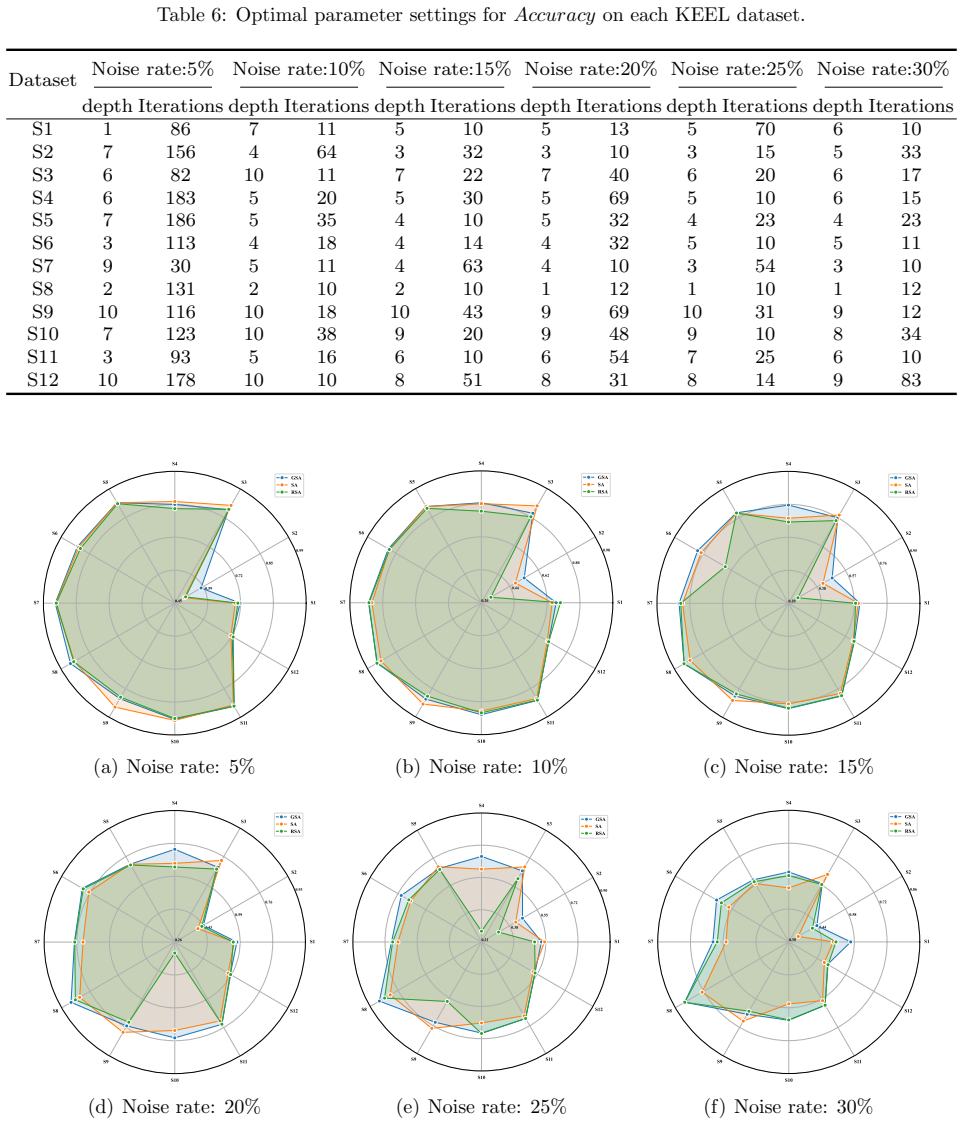
- On the reported KEEL benchmarks, GAdaBoost.SA wins more accuracy comparisons than it loses against SAMME and RobSAMME at noise rates from 5% to 30%, with statistically significant gains over RobSAMME at most noise levels.
- Runtime is reduced from several times to hundreds of times because weighting operates on balls, each iteration adds only a few new samples, and early stopping ends training once the subset converges.
- Base learners without native sample-weight support, such as MLP and SVM, can be boosted without modifying their internals, because the algorithm only changes which samples form the training subset.
- The multiclass exponential loss decreases monotonically across boosting iterations when base error rates stay below $(K-1)/K$, preserving SAMME's convergence property in the granular setting.
Reading between the lines
- A testable consequence the authors do not run: if label noise is injected only into minority classes rather than uniformly, the deletion step in Algorithm 1 should lose much of its protective effect, and the accuracy gap over SAMME should shrink; that experiment would isolate where the robustness actually comes from.
- The same granulation could serve as a general instance-selection preprocessor for other ensembles, such as bagging or gradient boosting, since the compression step is independent of the SAMME weighting scheme.
- The Section 4.3 monotonicity argument compares $L(f_{t+1})$ with $L(f_t)$ while the training subset is changing, so the proof as written does not fully model the adaptive-subset mechanism; a reader should treat the convergence guarantee as established only under the paper's stated assumptions.
Editorial analysis
A structured set of objections, weighed in public.
Referee Report
Summary. The paper proposes GAdaBoost, a two-stage boosting framework in which a data granulation stage replaces individual samples with information granules, and an adaptive boosting stage trains base classifiers on dynamically constructed subsets. The concrete instantiation, GAdaBoost.SA, first compresses the training set into granular balls (GBG-Ens), then runs a SAMME-like procedure that incrementally adds unsampled samples from GBs containing misclassified samples. The paper claims that GAdaBoost.SA is substantially faster than SAMME and RobSAMME, more robust to label noise, agnostic to the base learner, and that its multiclass exponential loss decreases monotonically (Section 4.3). The experimental section compares GAdaBoost.SA with SAMME and RobSAMME on 12 KEEL datasets at six label-noise rates and on four image datasets with MLP, together with runtime comparisons and an ablation over granulation methods.
Significance. If the empirical claims hold, the paper makes a useful practical contribution: a multiclass boosting algorithm that is orders of magnitude faster than SAMME and RobSAMME, more robust to mislabeled data, and applicable to different base learners. The experimental evaluation is extensive and includes 12 KEEL datasets, four image datasets, six noise levels, runtime measurements, and an ablation of the granulation method; the win/loss analysis over baselines is a reasonable way to summarize the results. The main weakness is that the theoretical justification in Section 4.3 is invalid as written, and the noise-removal heuristic in Algorithm 1 rests on an unverified assumption about discarded samples. Because both issues are load-bearing for the paper's central claims, the manuscript needs substantial revision before it can be accepted.
major comments (3)
- [§4.3, Eqs. (18)–(22)] The proof of monotonic convergence is algebraically invalid. In Eq. (18), the term L(f_t(x)) is factored out of the sum over D_{t+1}, but L(f_t(x)) is itself a sum over the same samples (Eq. (2)); it cannot be pulled out because each summand is multiplied by a factor exp(−(1/K)β_{t+1} I(h_{t+1}(x)=y)) that depends on the sample. The equality used is essentially Σ_i a_i b_i = (Σ_i a_i)(Σ_i b_i), which is false. This invalidates Eqs. (20)–(22) and the conclusion in Eq. (24). In addition, the loss in Eq. (18) is evaluated on the changing training subset D_{t+1}, whereas the claimed convergence is for the loss on the original training set D in Eq. (2); a decrease on the current subset does not imply a decrease on the original distribution. A pointwise argument may repair monotonicity on the current subset (each term is multiplied by a factor at most 1 when β ≥ 0), but the printed derivation does not establish the advertised convergence.
- [§4.3, Eq. (22)] Even if the factorization in Eq. (18) were corrected, Eq. (22) would still not follow. The true ratio L(f_{t+1})/L(f_t) on D_{t+1} is a weighted average of exp(−β_{t+1}/K) for correctly classified samples and 1 for misclassified samples, with weights proportional to exp(−(1/K)Σ_k I(y=k) f_t^k(x)). The error rate ε_{t+1} in Eq. (17) is an unweighted fraction of errors over D_{t+1}, so it cannot replace this weighted average; the derivation implicitly assumes that all samples carry equal current loss, which is exactly the step that the invalid factorization smuggles in. Consequently, the stated rate R(ε_{t+1}) is not the actual loss-reduction factor, and the derivation of β via Eq. (4) from this loss is not justified as written.
- [§4.1, Algorithm 1 (lines 5–7 and 13–14)] The paper asserts that granular-ball compression removes only noise while preserving class-boundary information, but this is not analyzed. Algorithm 1 deletes every singleton ball (lines 5–7) and, in ambiguous splits, deletes all non-majority-class samples (lines 13–14); the text justifies this by saying that such samples are likely to be outliers or label noise. No experiment or statistical analysis measures how many informative minority-class or boundary samples are discarded, nor how the deletion changes the class-conditional density near decision boundaries. Because the claimed robustness advantage of GAdaBoost.SA is attributed to this preprocessing, the paper should either provide evidence that discarded samples are predominantly noise or bound the effect of the deletion on the learned boundary.
minor comments (6)
- [Table 5] Table 5 marks p-values of 0.0640 and 0.0771 with ↑ as 'statistically significant', although these values exceed 0.05; please clarify the significance level used or correct the markers.
- [References] References [5] and [6] are the same paper, and references [28] and [31] are also duplicates; these should be deduplicated.
- [Section 4.1 and Algorithm 1] The text introduces a scaling factor μ to control the maximum number of clusters, but μ does not appear in Algorithm 1 nor in the experimental settings; please clarify whether μ is set to 1 or is otherwise omitted from the reported algorithm.
- [Eqs. (12)–(13)] The combined objective with the balance coefficient δ is introduced but no value or sensitivity analysis for δ is reported, and the granulation stage is not optimized jointly with the boosting stage; please clarify the role of these equations in the actual algorithm.
- [Section 5.1.2 and Section 5.5] Section 5.1.2 states that SVM is used as a base classifier in Section 5.5, but the presented Section 5.5 contains only the GBG ablation; no SVM results are visible, so the base-learner-agnostic claim is currently supported only for CART and MLP.
- [Section 5.2] The reported accuracies are averages over 5 runs, but no standard deviations or per-run variability are reported; adding error bars or variance information would strengthen the comparison.
Circularity Check
No circularity found: the robustness and efficiency claims are benchmarked externally, and the Section 4.3 proof problem is an algebraic invalidity rather than a circular dependency.
full rationale
The derivation chain is not circular. GAdaBoost.SA inherits its beta-weight formula (Eq.4) directly from SAMME, and the error rate (Eq.15) is defined on the current training subset; neither is fitted to the reported test accuracies, so no fitted parameter is relabeled as a prediction. The theoretical claim in Section 4.3 is problematic, but the problem is algebraic invalidity, not circularity: Eq.18 rewrites a sum of products as a product of sums, which is false, and Eq.22 then substitutes an unweighted error fraction into the loss ratio. That makes the convergence proof incorrect as written, but it does not make the conclusion equal to an input or to a self-citation. Self-citations to [27], [36], and [37] supply standard granular-ball definitions and split heuristics; they are background and not load-bearing for the robustness/efficiency findings, which are benchmarked against SAMME and RobSAMME on external datasets. The empirical claims are therefore self-contained and falsifiable, so the circularity score is 0.
Assumptions & free parameters
free parameters (5)
- GB size limit N_cap =
⌊√N/(K−1)⌋
- Initial sampling fraction per GB =
0.5
- Purity threshold =
1.0
- Balance coefficient δ =
not specified
- Scaling factor μ =
not specified
assumptions (4)
- domain assumption Granular balls of pure label with size capped by √N/(K−1) preserve the class-boundary information of the original dataset.
- ad hoc to paper Samples that form singleton balls or appear as non-majority samples in ambiguous splits are predominantly label noise or outliers.
- domain assumption The unweighted error rate on the current training subset D_t is a valid substitute for the weighted error in the SAMME convergence analysis.
- domain assumption Base classifiers trained on an initial subset of at most q samples per ball provide a sufficiently accurate starting point.
Cite this review
Pith. "Pith review of GAdaBoost: An Efficient and Robust AdaBoost Algorithm Based on Granular-Ball Structure." pith.science (2026). https://pith.science/paper/QZCOVE43
@misc{pith2026250602390,
  author       = {Pith},
  title        = {Pith review of: GAdaBoost: An Efficient and Robust AdaBoost Algorithm Based on Granular-Ball Structure},
  year         = {2026},
  howpublished = {\url{https://pith.science/paper/QZCOVE43}},
  note         = {Machine review of arXiv:2506.02390}
}
read the original abstract
Adaptive Boosting (AdaBoost) faces significant challenges posed by label noise, especially in multiclass classification tasks. Existing methods either lack mechanisms to handle label noise effectively or suffer from high computational costs due to redundant data usage. Inspired by granular computing, this paper proposes granular adaptive boosting (GAdaBoost), a novel two-stage framework comprising a data granulation stage and an adaptive boosting stage, to enhance efficiency and robustness under noisy conditions. To validate its feasibility, an extension of SAMME, termed GAdaBoost.SA, is proposed. Specifically, first, a granular-ball generation method is designed to compress data while preserving diversity and mitigating label noise. Second, the granular ball-based SAMME algorithm focuses on granular balls rather than individual samples, improving efficiency and reducing sensitivity to noise. Experimental results on some noisy datasets show that the proposed approach achieves superior robustness and efficiency compared with existing methods, demonstrating that this work effectively extends AdaBoost and SAMME.
Figures


Figures from the paper (4 more)


Reference graph
Works this paper leans on
-
[1]
A. Meiseles, L. Rokach, Iterative feature exclusion (ifx): Mitigating feature starvation in gradient boosted decision trees, Knowledge-Based Systems 289 (2024) 111546
work page 2024
-
[2]
R. E. Schapire, Y. Freund, Boosting: Foundations and Algorithms, MIT Press, 2012
work page 2012
- [3]
-
[4]
J. Friedman, T. Hastie, R. Tibshirani, Additive logistic regression: a statistical view of boosting (with discussion and a rejoinder by the authors), The annals of statistics 28 (2) (2000) 337–407
work page 2000
-
[5]
A. J. Ferreira, M. A. Figueiredo, Boosting algorithms: A review of methods, theory, and applications, Ensemble machine learning: Methods and applications (2012) 35–85. 23
work page 2012
-
[6]
A. J. Ferreira, M. A. Figueiredo, Boosting algorithms: A review of methods, theory, and applications, Ensemble machine learning: Methods and applications (2012) 35–85
work page 2012
-
[7]
Z. Mehmood, S. Asghar, Customizing svm as a base learner with adaboost ensemble to learn from multi-class problems: A hybrid approach adaboost-msvm, Knowledge-Based Systems 217 (2021) 106845
work page 2021
-
[8]
R. E. Schapire, Y. Singer, Improved boosting algorithms using confidence-rated predic- tions, in: Proceedings of the eleventh annual conference on Computational learning theory, 1998, pp. 80–91
work page 1998
Show all 45 references
-
[9]
X. Jin, X. Hou, C.-L. Liu, Multi-class adaboost with hypothesis margin, in: 2010 20th international conference on pattern recognition, IEEE, 2010, pp. 65–68
2010
-
[10]
Mukherjee, R
I. Mukherjee, R. E. Schapire, A theory of multiclass boosting, Advances in Neural Infor- mation Processing Systems 23 (2010)
2010
-
[12]
B. Liu, X. Li, Y. Xiao, P. Sun, S. Zhao, T. Peng, Z. Zheng, Y. Huang, Adaboost-based svdd for anomaly detection with dictionary learning, Expert Systems with Applications 238 (2024) 121770
2024
-
[13]
W. Dou, J. Sun, D. Niu, J. Peng, Adaboost-based 3d object classification from surface and depth map descriptors, in: Proceedings of the 2024 16th International Conference on Machine Learning and Computing, 2024, pp. 441–446
2024
-
[14]
B. Liu, C. Liu, Y. Xiao, L. Liu, W. Li, X. Chen, Adaboost-based transfer learning method for positive and unlabelled learning problem, Knowledge-Based Systems 241 (2022) 108162
2022
-
[15]
M. Jain, S. Gupta, G. Agarwal, K. Bansal, Adaboost based hybrid concept drift detection approach for mental health prediction, in: Proceedings of the 2023 Fifteenth International Conference on Contemporary Computing, 2023, pp. 345–351
2023
-
[16]
Q. Miao, Y. Cao, G. Xia, M. Gong, J. Liu, J. Song, Rboost: Label noise-robust boosting algorithm based on a nonconvex loss function and the numerically stable base learners, IEEE transactions on neural networks and learning systems 27 (11) (2015) 2216–2228
2015
-
[17]
Y. Sun, S. Todorovic, J. Li, D. O. Wu, A robust linear programming based boosting algorithm, in: 2005 IEEE Workshop on Machine Learning for Signal Processing, IEEE, 2005, pp. 49–54
2005
-
[18]
Wang, Robust boosting with truncated loss functions, Electronic Journal of Statistics 12 (2018) 599–650
Z. Wang, Robust boosting with truncated loss functions, Electronic Journal of Statistics 12 (2018) 599–650
2018
-
[19]
Kanamori, T
T. Kanamori, T. Takenouchi, S. Eguchi, N. Murata, Robust loss functions for boosting, Neural Computation 19 (8) (2007) 2183–2244
2007
-
[20]
J. Cao, S. Kwong, R. Wang, A noise-detection based adaboost algorithm for mislabeled data, Pattern recognition 45 (12) (2012) 4451–4465
2012
-
[21]
Sabzevari, G
M. Sabzevari, G. Mart ´ ınez-Mu˜ noz, A. Su´ arez, Vote-boosting ensembles, Pattern Recogni- tion 83 (2018) 119–133. 24
2018
-
[22]
K. Wang, Y. Wang, Q. Zhao, D. Meng, X. Liao, Z. Xu, Splboost: An improved robust boosting algorithm based on self-paced learning, IEEE Transactions on Cybernetics 51 (3) (2019) 1556–1570
2019
-
[23]
X. Liu, S. Luo, L. Pan, Robust boosting via self-sampling, Knowledge-Based Systems 193 (2020) 105424
2020
-
[24]
B. Sun, S. Chen, J. Wang, H. Chen, A robust multi-class adaboost algorithm for mislabeled noisy data, Knowledge-Based Systems 102 (2016) 87–102
2016
-
[25]
L. A. Zadeh, Fuzzy sets and information granularity, in: Fuzzy sets, fuzzy logic, and fuzzy systems: selected papers by Lotfi A Zadeh, World Scientific, 1996, pp. 433–448
1996
-
[26]
J. Y. Liang, Y. H. Qian, D. Li, Q. Hu, Theory and method of granular computing for big data mining, Scientia sinica informationis 45 (11) (2015) 1355–1369
2015
-
[27]
S. Xia, Y. Liu, X. Ding, G. Wang, H. Yu, Y. Luo, Granular ball computing classifiers for efficient, scalable and robust learning, Information Sciences 483 (2019) 136–152
2019
-
[29]
C. Fu, W. Lu, W. Pedrycz, J. Yang, Fuzzy granular classification based on the principle of justifiable granularity, Knowledge-Based Systems 170 (2019) 89–101
2019
-
[30]
Pedrycz, W
W. Pedrycz, W. Homenda, Building the fundamentals of granular computing: A principle of justifiable granularity, Applied Soft Computing 13 (10) (2013) 4209–4218
2013
-
[31]
Pedrycz, R
W. Pedrycz, R. Al-Hmouz, A. Morfeq, A. Balamash, The design of free structure gran- ular mappings: The use of the principle of justifiable granularity, IEEE Transactions on Cybernetics 43 (6) (2013) 2105–2113
2013
-
[32]
Pedrycz, X
W. Pedrycz, X. Wang, Designing fuzzy sets with the use of the parametric principle of justifiable granularity, IEEE Transactions on Fuzzy Systems 24 (2) (2015) 489–496
2015
-
[33]
C. Wu, Q. Zhang, L. Yin, Q. Xie, N. Luo, G. Wang, Data-driven interval granulation approach based on uncertainty principle for efficient classification, IEEE Transactions on Fuzzy Systems 32 (1) (2023) 12–26
2023
-
[34]
T. T. Nguyen, X. C. Pham, A. W.-C. Liew, W. Pedrycz, Aggregation of classifiers: a jus- tifiable information granularity approach, IEEE transactions on cybernetics 49 (6) (2018) 2168–2177
2018
-
[35]
Ouyang, F
C. Ouyang, F. Yu, Y. Hao, Y. Tang, Y. Jiang, Build interval-valued time series fore- casting model with interval cognitive map trained by principle of justifiable granularity, Information Sciences 652 (2024) 119756
2024
-
[36]
S. Xia, X. Dai, G. Wang, X. Gao, E. Giem, An efficient and adaptive granular-ball gen- eration method in classification problem, IEEE Transactions on Neural Networks and Learning Systems 35 (4) (2024) 5319–5331. 25
2024
-
[37]
Q. Xie, Q. Zhang, S. Xia, F. Zhao, C. Wu, G. Wang, W. Ding, Gbg++: A fast and stable granular ball generation method for classification, IEEE Transactions on Emerging Topics in Computational Intelligence 8 (2) (2024) 2022–2036
2024
-
[38]
J. C. Bezdek, N. R. Pal, Some new indexes of cluster validity, IEEE Transactions on Systems, Man, and Cybernetics, Part B (Cybernetics) 28 (3) (1998) 301–315
1998
-
[39]
J. Yu, Q. Cheng, The upper bound of the optimal number of clusters in fuzzy clustering, Science in China Series: Information Sciences 44 (2001) 119–125
2001
-
[40]
Cheng, Y
D. Cheng, Y. Li, S. Xia, G. Wang, J. Huang, S. Zhang, A fast granular-ball-based density peaks clustering algorithm for large-scale data, IEEE Transactions on Neural Networks and Learning Systems 35 (12) (2024) 17202–17215
2024
-
[41]
Hastie, S
T. Hastie, S. Rosset, J. Zhu, H. Zou, Multi-class adaboost, Statistics and its Interface 2 (3) (2009) 349–360
2009
-
[42]
Derrac, S
J. Derrac, S. Garcia, L. Sanchez, F. Herrera, Keel data-mining software tool: Data set repository, integration of algorithms and experimental analysis framework, J. Mult. Valued Logic Soft Comput 17 (2015) 255–287
2015
-
[43]
D. Cai, X. He, J. Han, Speed up kernel discriminant analysis, The VLDB Journal 20 (2011) 21–33
2011
-
[44]
J. Yang, R. Shi, B. Ni, Medmnist classification decathlon: A lightweight automl benchmark for medical image analysis, in: 2021 IEEE 18th International Symposium on Biomedical Imaging (ISBI), IEEE, 2021, pp. 191–195
2021
-
[45]
D. Cai, X. He, J. Han, T. S. Huang, Graph regularized nonnegative matrix factorization for data representation, IEEE transactions on pattern analysis and machine intelligence 33 (8) (2010) 1548–1560
2010
-
[46]
H. Xiao, K. Rasul, R. Vollgraf, Fashion-mnist: a novel image dataset for benchmarking machine learning algorithms, arXiv preprint arXiv:1708.07747 (2017)
2017 arXiv
-
[47]
Akiba, S
T. Akiba, S. Sano, T. Yanase, T. Ohta, M. Koyama, Optuna: A next-generation hyperpa- rameter optimization framework, in: Proceedings of the 25th ACM SIGKDD international conference on knowledge discovery & data mining, 2019, pp. 2623–2631. 26
2019
Reviewed August 7, 2026 · model on record in the stance chip above.
Discussion (0). Sign in to comment.