REVIEW 2 major objections 5 minor 3 cited by
Trading oxygen for iron II. Oxygen- versus iron-dependent cosmic star formation history
T0 review · 2 major / 5 minor · reviewed 2026-08-03 · deepseek-v4-flash
Pith's one-line read At least 70% of cosmic stellar mass formed with non-solar oxygen-to-iron ratios.
desk verdict The first iron-based cosmic star formation history is a useful, honest extension of the authors' earlier framework, but its central '≥70% non-solar O/Fe' claim leans on a redshift-invariant [O/Fe]–sSFR relation that the paper does not test. read the letter →
The pith
A machine-rendered reading of the paper's core claim, the machinery that carries it, and where it could break.
The reading
What carries the argument
The key machinery is the empirically calibrated [O/Fe]–specific star formation rate relation, introduced in the companion Paper I. It links the alpha-enhancement of a galaxy's star-forming gas to its sSFR, because sSFR sets how recently star formation has been producing iron via Type Ia supernovae relative to oxygen from core-collapse supernovae. The relation is parameterized by the CCSN oxygen-to-iron yield, the SN Ia formation efficiency, the SN Ia delay-time distribution, and the average iron mass ejected per CCSN. Combined with empirical distributions of galaxy sSFR, gas-phase oxygen abundance (through the mass-metallicity and fundamental metallicity relations), and the galaxy stellar ma
What would settle it
Measure gas-phase [Fe/H] directly in a sample of star-forming galaxies at z~2–3 using rest-frame UV iron transitions or X-ray spectroscopy, and compare the SFRD-weighted mean to the predicted ~0.4–0.5 dex offset below [O/H]; finding [Fe/H] ≈ [O/H] (i.e., near-solar O/Fe) in such galaxies would falsify the framework. Alternatively, a large LGRB absorption sample at z>4 yielding a mean [Fe/H] systematically above the model predictions would challenge the central claim.
Extended reading notes
Core claim
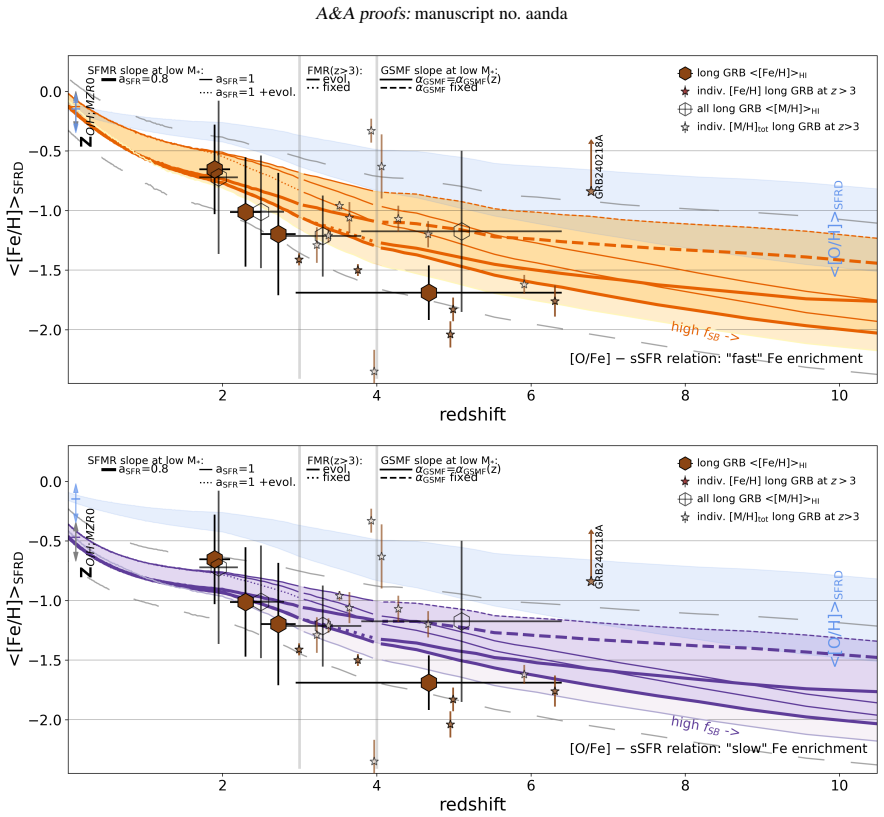
On the paper's own terms, the central claim is that 'star formation with a near-solar [O/Fe] abundance is rare throughout cosmic history; the bulk (at least 70% across our variations) of the integrated stellar mass formed with O/Fe larger than the solar abundance ratio.' Across the explored model variations, the SFRD-weighted mean [Fe/H] is lower than the mean [O/H] at essentially all redshifts, the offset grows toward z~3 and then approaches a roughly constant value of [O/Fe]~0.4–0.5 dex, corresponding to the core-collapse enrichment ratio. The difference between iron- and oxygen-based cosmic star formation histories is largest in the low-metallicity, high-redshift regime, and the paper val
Load-bearing premise
The entire iron-dependent cosmic star formation history rests on assuming the [O/Fe]–sSFR relation is redshift-invariant and fully determined by sSFR, even though it is calibrated mainly at low redshift and anchored to Milky Way metal-poor stars; if the relation evolves with redshift or depends on additional galaxy properties, the derived iron distribution, the factor-of-three [Fe/H] deficit, and the 'at least 70% non-solar' fraction would all change.
Editorial extensions
If this is right
- If correct, solar-scaled stellar evolution and spectral synthesis models misrepresent the majority of star formation: iron-scaled effects such as hot-star winds, opacities, and feedback would be underpredicted by up to a factor of ~3, while oxygen-scaled cooling would be only slightly overpredicted.
- The low-metallicity cosmic star formation history is larger and peaks at lower redshift when defined in [Fe/H] rather than [O/H], shifting the expected redshift distribution of metal-poor stellar populations.
- Rates of events linked to metal-poor progenitors, such as long gamma-ray bursts and stellar black hole mergers, are underestimated when oxygen-based cosmic star formation histories are used instead of iron-based ones, by a redshift-dependent factor.
- The Sun's abundances are consistent with formation in Milky Way-like galaxies at the solar birth epoch, but a slow-iron-enrichment scenario would make solar-O/Fe stars atypical even there, disfavoring that scenario if the Milky Way is representative.
- Absorption-derived iron abundances from long gamma-ray burst hosts are broadly consistent with the model's iron-based SFRD-weighted averages, whereas oxygen-based averages lie systematically higher.
Reading between the lines
- A concrete, testable extension the authors leave implicit: population synthesis and stellar spectral models should be re-run with separate O and Fe abundance scalings rather than a single Z/Z_sun, which would likely change predicted black hole masses and ionizing spectra in high-redshift galaxies.
- The assumption that the [O/Fe]–sSFR relation is redshift-invariant and set only by sSFR could be tested directly with JWST-era rest-frame optical iron measurements in z>3 star-forming galaxies; any detected evolution would require recalibrating the framework.
- The framework can be inverted: a larger sample of LGRB hosts at z>4, with robust dust-corrected [Fe/H], could constrain the Type Ia supernova delay-time distribution and core-collapse iron yields, since those parameters drive the model spread.
- Gravitational-wave merger rate evolution should show a different redshift dependence than oxygen-based predictions; current and near-future detectors could distinguish these scenarios if the local merger rate is calibrated.
Editorial analysis
A structured set of objections, weighed in public.
Referee Report
Summary. The paper presents a phenomenological framework to derive the iron-dependent cosmic star formation history (cSFH) from the oxygen-based cSFH of Chruślińska & Nelemans (2019) and Chruślińska et al. (2021), using the empirical [O/Fe]–sSFR relation from Chruślińska et al. (2024, Ch24). The key result is that star formation with near-solar O/Fe is rare: across model variations, at most 30% of the integrated stellar mass since z=10 formed with −0.15<[O/Fe]<0.05, so at least 70% formed non-solar. The model also predicts that the SFRD-weighted average [Fe/H] is lower than [O/H] by up to ∼0.5 dex, with the offset peaking near z=3, and that using oxygen-based metallicities biases stellar evolution, spectral, and transient-rate predictions. The framework is tested against RR Lyrae stars, Milky Way globular clusters, and absorption-based LGRB metallicities, and is accompanied by a large set of model variations and an explicit discussion of uncertainties.
Significance. If the central claim holds, it implies that solar-scaled abundance modeling is systematically biased for most of cosmic star formation, with consequences for stellar evolution models, population synthesis, galaxy spectral interpretation, and compact-object merger rates. The paper's strengths are its transparent construction from empirical scaling relations, the explicit bracketing of uncertainties through model variations, the sensitivity analysis of the intra-galaxy metallicity scatter (Appendix D), and the qualitative cross-checks against three independent samples. The redshift-invariance of the [O/Fe]–sSFR relation, however, is a load-bearing assumption that is not yet empirically tested at z≳2.
major comments (2)
- [Sec. 2.1, Eq. (1); Sec. 4, Fig. 4] The headline claim (≥70% integrated stellar mass with non-solar O/Fe) rests on the [O/Fe]–sSFR relation (Eq. 1), assumed redshift-invariant (Sec. 2, ingredient 1). The empirical constraints in Fig. 1 are mostly local; the high-sSFR plateau is anchored to old MW stars. The fast/mixed/slow variations do not test a systematic redshift dependence. A −0.2 dex offset at fixed sSFR for z>2 would shift the sensitive log10(sSFR)≈−9 locus (Sec. 4) toward the near-solar band and could push the near-solar fraction above the 30% cap. The LGRB comparison (Sec. 6) is admitted to be non-constraining. Please add a redshift-dependent normalisation variation (e.g., −0.2 dex at z>2) and show its effect on Fig. 4 and the integrated fraction.
- [Sec. 3.1, Sec. 6] The independent cross-checks do not yet validate the Fe-dependent cSFH in the redshift and mass regime that drives the integrated fraction. RR Lyrae and globular clusters probe old, low-metallicity populations in low-mass galaxies, which contribute only a small part of the cosmic SFRD; the LGRB ⟨[Fe/H]⟩_HI comparison is explicitly non-constraining at z>3 (Sec. 6). Thus the main conclusion is an extrapolation of a locally-calibrated relation. The authors should state clearly what observations would be needed to verify the relation at z≈2–4, or demonstrate that the result is insensitive to the plausible range of redshift evolution.
minor comments (5)
- [Fig. G.3 caption] 'Same as Fig. G.3' should read 'Same as Fig. G.2' (self-reference typo).
- [Sec. 2.2] 'SMFR' should be 'SFMR' in the first paragraph; 'Sec. 2 3' is missing a dot.
- [Sec. 5.1] The consistency check against literature SFRD estimates uses a factor-of-10 tolerance; this is very generous and could hide real discrepancies. Please justify or tighten.
- [Appendix D] The fiducial choice σ_∇O/Fe = σ_∇O/H/4 is described as arbitrary. The paper handles this correctly, but a physical motivation (e.g., from MW star scatter at fixed [Fe/H]) would strengthen the analysis.
- [Abstract] The 'factor 3' deficit refers to linear abundance, not dex; consider stating 'logarithmic offset of ~0.5 dex' to avoid confusion.
Circularity Check
No circularity: the Fe-dependent cSFH is a forward application of an empirically constrained [O/Fe]–sSFR relation from prior work, with independent validation; sensitivity is not circularity.
full rationale
The paper's central claim (≥70% of cosmic stellar mass formed with non-solar O/Fe) is derived by combining an assumed [O/Fe]–sSFR relation (Sec. 2.1, Eq. 1, from Ch24) with independent empirical distributions of sSFR, Z_O/H, and galaxy mass functions. The output is not an input in disguise: Ch24's relation is empirically constrained by galaxy observations and theoretical expectations, and is not fitted to the cosmic near-solar fraction. The paper explicitly treats this relation as an uncertain input ('The [O/Fe]–sSFR relation represents the dominant source of uncertainty in the ⟨[O/Fe]⟩_SFRD and in the fraction of the SFRD with near-solar O/Fe abundance ratios,' Sec. 4), and it cross-checks the resulting f_SFR(Z_Fe/H, z) against independent samples (RR Lyrae, MW globular clusters, LGRB hosts). The authors even note that the LGRB comparison is 'not constraining for our models' (Sec. 6), which is a stated limitation rather than a circular step. No equation reduces the output to the input by construction: the [O/Fe]–sSFR relation is not defined in terms of the cSFH, and the cSFH is not used to set the relation's normalization. Self-citation of Ch24 is load-bearing, but Ch24 is independently supported and externally falsifiable, so per the reviewing rules this does not constitute circularity. The sensitivity of the 'at least 70%' conclusion to the assumed redshift-invariance and normalization of the [O/Fe]–sSFR relation is a robustness/correctness concern, not a circularity concern.
Assumptions & free parameters
free parameters (10)
- [O/Fe]_CCSN =
0.52 dex
- m_Fe^CCSN (CCSN iron yield) =
0.03 / 0.05 / 0.10 M_sun
- τ_Ia,min (minimum SN Ia delay) =
40 Myr / 400 Myr / Greggio mixed
- ∇_FMR0 =
0.27 dex
- Z_O/H;MZR0 (MZR normalization) =
+0.2 dex relative to Curti et al. 2020; fiducial 9.0
- σ_∇O/H (intragalaxy O scatter) =
0.14 dex
- σ_∇O/Fe =
σ_∇O/H/4 ≈ 0.035 dex
- a_SFR (SFMR slope) =
1.0 or 0.8
- α_GSMF(z) (low-mass slope) =
-1.4 - 0.08 z (or fixed -1.45)
- FMR normalization evolution at z>3 =
-0.0357 dex per z
assumptions (8)
- domain assumption The [O/Fe]-sSFR relation is redshift-invariant and depends only on sSFR.
- domain assumption The fundamental metallicity relation (FMR) is z-invariant at z≲3; at z>3 only an optional linear normalization decrease is applied.
- domain assumption SN Ia delay-time distribution is a power law f_Ia ∝ t^-1 (or Greggio 2010) with minimum delay τ_Ia,min, and CCSN yields set C_Ia/CC.
- ad hoc to paper Within a 'galaxy' the SFR spreads normally in Z_O/H and Z_Fe/H with σ=0.14 dex; the O-Fe scatter σ_O/Fe is an arbitrary input.
- domain assumption The low-mass end of the galaxy stellar mass function is extrapolated as a power law to M*=10^6 M_sun.
- domain assumption Absorption-based [M/H]_tot of LGRB hosts with Zn-based dust corrections equals [Fe/H].
- domain assumption Mean [Fe/H] of RR Lyrae in local dwarfs represents iron enrichment of low-mass galaxies at z≳2-5.
- domain assumption MW globular clusters probe high-SFRD regions of f_SFR(Z_Fe/H,z).
Cite this review
Pith. "Pith review of Trading oxygen for iron II. Oxygen- versus iron-dependent cosmic star formation history." pith.science (2026). https://pith.science/paper/QZNBJ6XT
@misc{pith2026251115782,
  author       = {Pith},
  title        = {Pith review of: Trading oxygen for iron II. Oxygen- versus iron-dependent cosmic star formation history},
  year         = {2026},
  howpublished = {\url{https://pith.science/paper/QZNBJ6XT}},
  note         = {Machine review of arXiv:2511.15782}
}
read the original abstract
Due to their different nucleosynthetic origin, a stellar population produces oxygen (O) and iron (Fe) on different timescales and their relative abundance can deviate strongly from solar. Galaxy formation models should treat these elements separately, as they play a distinct role in shaping physical phenomena. For example, oxygen mainly sets the gas cooling rate, while the iron abundance sets stellar atmosphere opacities impacting stellar evolution, spectra and feedback. Observations of star-forming galaxies usually only constrain gas-phase oxygen abundance, vastly limiting our capabilities of separating the cosmic evolution of oxygen and iron. Here, we present an observationally-motivated framework to scale the cosmic evolution of O and Fe abundances. We apply the relation between the alpha-enhancement and galaxies' specific star formation rate ([O/Fe]-sSFR; Chruslinska et al. 2024) to derive the Fe and O-dependent cosmic star formation history (cSFH). We find that star formation with near-solar O/Fe is rare: at least 70% of the integrated cosmic stellar mass forms at non-solar O/Fe. The cosmic average metallicity is generally lower in [Fe/H] than in [O/H] (by up to a factor 3), with the offset increasing from redshifts z=0 to z~3 and then approaching the core-collapse O/Fe ratio. We validate our results against samples that probe the Fe-dependent cSFH in different regimes such as absorption-derived <[Fe/H]> from long gamma-ray bursts. Our results impact the interpretations of stellar and galaxy spectra and the predicted rates of transients, especially those linked to metal-poor progenitors (e.g., black hole mergers).
Figures


Figures from the paper (6 more)



Forward citations
Cited by 3 Pith papers
-
The impact of stellar binaries and star cluster dynamics on pair-instability supernovae
Binary interactions and cluster dynamics boost PISN rates by up to 3x versus single stars, enabling constraints on stellar-wind mass loss and galaxy metallicity distributions.
-
The Stellar Winds Atlas II: Black Hole Formation at Solar Metallicity
Black hole masses at solar metallicity are set by whether a star becomes a Wolf-Rayet star before collapse, and cool supergiant winds control that split.
-
Can current models predict the local black hole merger rate?
Theoretical predictions for local BBH merger rates exceed observations by a factor >10 under conservative SFRD and metallicity assumptions, indicating need for revisions in stellar evolution.
Reference graph
Works this paper leans on
-
[1]
Algera, H. S. B., Inami, H., Oesch, P. A., et al. 2023, MNRAS, 518, 6142
2023
-
[2]
M., Nissen, P
Amarsi, A. M., Nissen, P. E., & Skúladóttir, Á. 2019, A&A, 630, A104
2019
-
[3]
Andrews, B. H. & Martini, P. 2013, ApJ, 765, 140 Arellano-Córdova, K. Z., Esteban, C., García-Rojas, J., & Méndez-Delgado, J. E. 2020, MNRAS, 496, 1051
2013
-
[4]
M., & Grevesse, N
Asplund, M., Amarsi, A. M., & Grevesse, N. 2021, A&A, 653, A141
2021
-
[5]
J., & Scott, P
Asplund, M., Grevesse, N., Sauval, A. J., & Scott, P. 2009, ARA&A, 47, 481 Astropy Collaboration, Robitaille, T. P., Tollerud, E. J., et al. 2013, A&A, 558, A33
2009
-
[6]
K., Driver, S
Baldry, I. K., Driver, S. P., Loveday, J., et al. 2012, MNRAS, 421, 621
2012
-
[7]
E., Bulik, T., & O’Shaughnessy, R
Belczynski, K., Holz, D. E., Bulik, T., & O’Shaughnessy, R. 2016, Nature, 534, 512
2016
-
[8]
2025, arXiv e-prints, arXiv:2503.04925
Bellazzini, M., Muraveva, T., & Garofalo, A. 2025, arXiv e-prints, arXiv:2503.04925
arXiv 2025
Show all 238 references
-
[9]
& Kravtsov, A
Belokurov, V . & Kravtsov, A. 2024, MNRAS, 528, 3198
2024
-
[10]
E., Cenko, S
Berger, E., Penprase, B. E., Cenko, S. B., et al. 2006, ApJ, 642, 979
2006
-
[11]
E., et al
Bezanson, R., Labbe, I., Whitaker, K. E., et al. 2024, ApJ, 974, 92
2024
-
[12]
J., & Dopita, M
Bian, F., Kewley, L. J., & Dopita, M. A. 2018, ApJ, 859, 175
2018
-
[13]
& Fritze-v
Bicker, J. & Fritze-v. Alvensleben, U. 2005, Astronomy & Astrophysics, 443, L19
2005
-
[14]
I., Grogin, N., & Koekemoer, A
Bisigello, L., Caputi, K. I., Grogin, N., & Koekemoer, A. 2018, A&A, 609, A82 Björklund, R., Sundqvist, J. O., Singh, S. M., Puls, J., & Najarro, F. 2023, A&A, 676, A109
2018
-
[15]
2021, ApJ, 907, 110
Boco, L., Lapi, A., Chruslinska, M., et al. 2021, ApJ, 907, 110
2021
-
[16]
A., Brinchmann, J., Bouché, N., et al
Boogaard, L. A., Brinchmann, J., Bouché, N., et al. 2018, A&A, 619, A27
2018
-
[17]
Bresolin, F., Kudritzki, R.-P., & Urbaneja, M. A. 2022, ApJ, 940, 32
2022
-
[18]
A., et al
Bresolin, F., Kudritzki, R.-P., Urbaneja, M. A., et al. 2016, ApJ, 830, 64
2016
-
[19]
M., Fragos, T., Salafia, O
Briel, M. M., Fragos, T., Salafia, O. S., et al. 2025, A&A, 701, A84
2025
-
[20]
Brinchmann, J., Charlot, S., White, S. D. M., et al. 2004, MNRAS, 351, 1151
2004
-
[21]
S., Berger, E., Stevenson, S., et al
Broekgaarden, F. S., Berger, E., Stevenson, S., et al. 2022, MNRAS, 516, 5737
2022
-
[22]
& Loeb, A
Bromm, V . & Loeb, A. 2003, Nature, 425, 812
2003
-
[23]
mixed Fe en- richment
Bromm, V . & Loeb, A. 2003, Nature, 425, 812 Article number, page 18 of 21 M. Chru´sli´nska , M. Curti, R. Pakmor, A. De Cia, J. Matthee, A. Bhagwat, S. Monty: cosmic evolution of O & Fe abundances Fig. G.2.Distribution of the cosmic SFRD at different [O/Fe] and look- back tim...
2003
-
[24]
J., Saxena, A., Cameron, A
Bunker, A. J., Saxena, A., Cameron, A. J., et al. 2023, A&A, 677, A88
2023
-
[25]
M., Eldridge, J
Byrne, C. M., Eldridge, J. J., & Stanway, E. R. 2025, MNRAS, 537, 2433
2025
-
[26]
M., Stanway, E
Byrne, C. M., Stanway, E. R., Eldridge, J. J., McSwiney, L., & Townsend, O. T. 2022, MNRAS, 512, 5329
2022
-
[27]
I., Deshmukh, S., Ashby, M
Caputi, K. I., Deshmukh, S., Ashby, M. L. N., et al. 2017, ApJ, 849, 45
2017
-
[28]
2009, A&A, 505, 139
Carretta, E., Bragaglia, A., Gratton, R., & Lucatello, S. 2009, A&A, 505, 139
2009
-
[29]
2011, A&A, 530, A138
Casagrande, L., Schönrich, R., Asplund, M., et al. 2011, A&A, 530, A138
2011
-
[30]
M., Zavala, J
Casey, C. M., Zavala, J. A., Spilker, J., et al. 2018, ApJ, 862, 77
2018
-
[31]
2004, in Astronomical Society of the Pacific Conference Series, V ol
Catelan, M. 2004, in Astronomical Society of the Pacific Conference Series, V ol. 310, IAU Colloq. 193: Variable Stars in the Local Group, ed. D. W. Kurtz & K. R. Pollard, 113
2004
-
[32]
2009, Ap&SS, 320, 261
Catelan, M. 2009, Ap&SS, 320, 261
2009
-
[33]
2024, arXiv e-prints, arXiv:2407.17110
Chemerynska, I., Atek, H., Dayal, P., et al. 2024, arXiv e-prints, arXiv:2407.17110
2024 arXiv
-
[34]
A., Stanway, E
Chrimes, A. A., Stanway, E. R., & Eldridge, J. J. 2020, MNRAS, 491, 3479
2020
-
[35]
2004, A&A, 425, 913 Chru´sli´nska, M
Christensen, L., Hjorth, J., & Gorosabel, J. 2004, A&A, 425, 913 Chru´sli´nska, M. & Nelemans, G. 2019, MNRAS, 488, 5300
2004
-
[36]
2019, MNRAS, 482, 5012 Chru´sli´nska, M., Nelemans, G., Boco, L., & Lapi, A
Chruslinska, M., Nelemans, G., & Belczynski, K. 2019, MNRAS, 482, 5012 Chru´sli´nska, M., Nelemans, G., Boco, L., & Lapi, A. 2021, MNRAS, 508, 4994 Chru´sli´nska, M., Pakmor, R., Matthee, J., & Matsuno, T. 2024a, A&A, 686, A186 Chru´sli´nska, M., Pakmor, R., Matthee, J., & Mat...
2019
-
[37]
2023, A&A, 674, A18
Clementini, G., Ripepi, V ., Garofalo, A., et al. 2023, A&A, 674, A18
2023
-
[38]
Coelho, P. R. T. 2014, MNRAS, 440, 1027
2014
-
[39]
A., Price-Whelan, A
Collaboration, T. A., Price-Whelan, A. M., Sip ˝ocz, B. M., et al. 2018, The As- tronomical Journal, 156, 123
2018
-
[40]
L., Margutti, R., Terreran, G., et al
Coppejans, D. L., Margutti, R., Terreran, G., et al. 2020, ApJ, 895, L23
2020
-
[41]
2024, in Black Holes in the Era of Gravitational-Wave Astronomy, ed
Costa, G., Chrušli´nska, M., Klencki, J., et al. 2024, in Black Holes in the Era of Gravitational-Wave Astronomy, ed. M. Arca Sedda, E. Bortolas, & M. Spera, 1–148
2024
-
[42]
G., Bressan, A., et al
Costa, G., Shepherd, K. G., Bressan, A., et al. 2025, Astronomy & Astrophysics, 694, A193
2025
-
[43]
2019, A&A, 627, A42
Cresci, G., Mannucci, F., & Curti, M. 2019, A&A, 627, A42
2019
-
[44]
E., McLure, R
Cullen, F., Shapley, A. E., McLure, R. J., et al. 2021, MNRAS, 505, 903
2021
-
[45]
2017, MNRAS, 465, 1384
Curti, M., Cresci, G., Mannucci, F., et al. 2017, MNRAS, 465, 1384
2017
-
[46]
2023, MNRAS, 518, 425
Curti, M., D’Eugenio, F., Carniani, S., et al. 2023, MNRAS, 518, 425
2023
-
[47]
2024, A&A, 684, A75
Curti, M., Maiolino, R., Curtis-Lake, E., et al. 2024, A&A, 684, A75
2024
-
[48]
2020, MNRAS, 491, 944 Davé, R., Finlator, K., & Oppenheimer, B
Curti, M., Mannucci, F., Cresci, G., & Maiolino, R. 2020, MNRAS, 491, 944 Davé, R., Finlator, K., & Oppenheimer, B. D. 2011, MNRAS, 416, 1354 De Cia, A., Ledoux, C., Mattsson, L., et al. 2016, A&A, 596, A97 De Cia, A., Ledoux, C., Petitjean, P., & Savaglio, S. 2018, A&A, 611, ...
2020
-
[49]
2025, arXiv e-prints, arXiv:2510.16307
Disberg, P., Lankreijer, A., Chru ´sli´nska, M., et al. 2025, arXiv e-prints, arXiv:2510.16307
2025
-
[50]
T., McLure, R
Donnan, C. T., McLure, R. J., Dunlop, J. S., et al. 2024, MNRAS, 533, 3222
2024
-
[51]
Eldridge, J. J. & Stanway, E. R. 2022, Annual Review of Astronomy and Astro- physics, 60, 455
2022
-
[52]
L., Patton, D
Ellison, S. L., Patton, D. R., Simard, L., & McConnachie, A. W. 2008, ApJ, 672, L107
2008
-
[53]
K., Frankel, N., Lind, K., et al
Feuillet, D. K., Frankel, N., Lind, K., et al. 2019, MNRAS, 489, 1742
2019
-
[54]
L., Bagley, M
Finkelstein, S. L., Bagley, M. B., Ferguson, H. C., et al. 2023, ApJ, 946, L13
2023
-
[55]
M., Civano, F., & Suh, H
Fornasini, F. M., Civano, F., & Suh, H. 2020, MNRAS, 495, 771
2020
-
[56]
S., Levan, A
Fruchter, A. S., Levan, A. J., Strolger, L., et al. 2006, Nature, 441, 463
2006
-
[57]
J., Vreeswijk, P
Galama, T. J., Vreeswijk, P. M., Van Paradijs, J., et al. 1998, Nature, 395, 670
1998
-
[58]
Gallazzi, A., Charlot, S., Brinchmann, J., White, S. D. M., & Tremonti, C. A. 2005, MNRAS, 362, 41
2005
-
[59]
M., Torrey, P., Ellison, S
Garcia, A. M., Torrey, P., Ellison, S. L., et al. 2024, arXiv e-prints, arXiv:2407.06254
2024 arXiv
-
[60]
J., Bestenlehner, J
Garcia, M., Evans, C. J., Bestenlehner, J. M., et al. 2021, Experimental Astron- omy, 51, 887
2021
-
[61]
2018, MNRAS, 474, 2959
Giacobbo, N., Mapelli, M., & Spera, M. 2018, MNRAS, 474, 2959
2018
-
[62]
2022, A&A, 663, A1 Götberg, Y ., de Mink, S
Goswami, S., Silva, L., Bressan, A., et al. 2022, A&A, 663, A1 Götberg, Y ., de Mink, S. E., Groh, J. H., Leitherer, C., & Norman, C. 2019, A&A, 629, A134 Götberg, Y ., de Mink, S. E., McQuinn, M., et al. 2020, A&A, 634, A134 Gräfener, G. & Hamann, W. R. 2008, A&A, 482, 945
2022
-
[63]
F., Schady, P., & Fruchter, A
Graham, J. F., Schady, P., & Fruchter, A. S. 2023, ApJ, 954, 13
2023
-
[64]
S., & Kewley, L
Grasha, K., Roy, A., Sutherland, R. S., & Kewley, L. J. 2021, ApJ, 908, 241
2021
-
[65]
2005, A&A, 441, 1055
Greggio, L. 2005, A&A, 441, 1055
2005
-
[66]
2010, MNRAS, 406, 22
Greggio, L. 2010, MNRAS, 406, 22
2010
-
[67]
& Sauval, A
Grevesse, N. & Sauval, A. J. 1998, Space Sci. Rev., 85, 161 Grudi´c, M. Y ., Kruijssen, J. M. D., Faucher-Giguère, C.-A., et al. 2021, MNRAS, 506, 3239
1998
-
[68]
2020, A&A, 643, A8
Gruppioni, C., Béthermin, M., Loiacono, F., et al. 2020, A&A, 643, A8
2020
-
[69]
L., McLure, R
Hamadouche, M. L., McLure, R. J., Carnall, A., et al. 2024, arXiv e-prints, arXiv:2412.09592
2024 arXiv
-
[70]
C., J., Johnson, B
Hao, C.-N., Kennicutt, R. C., J., Johnson, B. D., Calzetti, D., et al. 2011, The Astrophysical Journal, 741, 124
2011
-
[71]
R., Millman, K
Harris, C. R., Millman, K. J., van der Walt, S. J., et al. 2020, Nature, 585, 357
2020
-
[72]
R., Bovy, J., Holtzman, J
Hayden, M. R., Bovy, J., Holtzman, J. A., et al. 2015, ApJ, 808, 132 Article number, page 19 of 21 A&A proofs:manuscript no. aanda
2015
-
[73]
L., Woosley, S
Heger, A., Fryer, C. L., Woosley, S. E., Langer, N., & Hartmann, D. H. 2003, ApJ, 591, 288
2003
-
[74]
2023, in The Encyclopedia of Cosmology
Heger, A., Müller, B., & Mandel, I. 2023, in The Encyclopedia of Cosmology. Set 2: Frontiers in Cosmology. V olume 3: Black Holes, ed. Z. Haiman, 61– 111
2023
-
[75]
E., Brammer, G
Heintz, K. E., Brammer, G. B., Giménez-Arteaga, C., et al. 2023, Nature Astron- omy, 7, 1517
2023
-
[76]
2021, ApJ, 919, 143
Henry, A., Rafelski, M., Sunnquist, B., et al. 2021, ApJ, 919, 143
2021
-
[77]
L., et al
Hernandez, S., Aloisi, A., James, B. L., et al. 2021, ApJ, 908, 226
2021
-
[78]
2013, ApJS, 208, 19
Hinshaw, G., Larson, D., Komatsu, E., et al. 2013, ApJS, 208, 19
2013
-
[79]
2005, A&A, 443, 581
Hirschi, R., Meynet, G., & Maeder, A. 2005, A&A, 443, 581
2005
-
[80]
2003, Nature, 423, 847
Hjorth, J., Sollerman, J., Møller, P., et al. 2003, Nature, 423, 847
2003
-
[81]
Hunter, J. D. 2007, Computing in Science & Engineering, 9, 90
2007
-
[82]
& Tutukov, A
Iben, I., J. & Tutukov, A. V . 1984, ApJS, 54, 335
1984
-
[83]
Iglesias, C. A. & Rogers, F. J. 1996, ApJ, 464, 943
1996
-
[84]
2025, MN- RAS[arXiv:2506.08114]
Inkenhaag, A., Schady, P., Wiseman, P., et al. 2025, MN- RAS[arXiv:2506.08114]
2025 arXiv
-
[85]
2023, MNRAS, 524, 426
Iorio, G., Mapelli, M., Costa, G., et al. 2023, MNRAS, 524, 426
2023
-
[86]
T., Langanke, K., Marek, A., Martínez-Pinedo, G., & Müller, B
Janka, H. T., Langanke, K., Marek, A., Martínez-Pinedo, G., & Müller, B. 2007, Phys. Rep., 442, 38
2007
-
[87]
D., Salvaterra, R., et al
Japelj, J., Vergani, S. D., Salvaterra, R., et al. 2016, A&A, 590, A129
2016
-
[88]
Jenkins, E. B. 2009, ApJ, 700, 1299
2009
-
[89]
J., Renzini, A., et al
Kashino, D., Lilly, S. J., Renzini, A., et al. 2022, ApJ, 925, 82
2022
-
[90]
D., & Daddi, E
Kashino, D., Renzini, A., Silverman, J. D., & Daddi, E. 2016, ApJ, 823, L24
2016
-
[91]
2022, PRISM: A Non-Equilibrium, Multi- phase Interstellar Medium Model for Radiation Hydrodynamics Simulations of Galaxies
Katz, H., Liu, S., Kimm, T., et al. 2022, PRISM: A Non-Equilibrium, Multi- phase Interstellar Medium Model for Radiation Hydrodynamics Simulations of Galaxies
2022
-
[92]
J., et al
Katz, H., Saxena, A., Cameron, A. J., et al. 2023, MNRAS, 518, 592
2023
-
[93]
& Evans, Neal J., I
Kennicutt, Robert C., J. & Evans, Neal J., I. 2012, Annual Review of Astronomy and Astrophysics, 50, 531
2012
-
[94]
Kewley, L. J. & Ellison, S. L. 2008, ApJ, 681, 1183
2008
-
[95]
J., Nicholls, D
Kewley, L. J., Nicholls, D. C., & Sutherland, R. S. 2019, ARA&A, 57, 511
2019
-
[96]
2021, A&A, 649, A152
Khusanova, Y ., Bethermin, M., Le Fèvre, O., et al. 2021, A&A, 649, A152
2021
-
[97]
2012, Stellar Structure and Evolution, 2nd edn
Kippenhahn, R., Weigert, A., & Weiss, A. 2012, Stellar Structure and Evolution, 2nd edn. (Springer)
2012
- [98]
-
[99]
2018, A&A, 619, A77
Klencki, J., Moe, M., Gladysz, W., et al. 2018, A&A, 619, A77
2018
-
[100]
T., Sansom, A
Knowles, A. T., Sansom, A. E., Vazdekis, A., & Allende Prieto, C. 2023, MN- RAS, 523, 3450
2023
-
[101]
2020, ApJ, 895, 138
Kobayashi, C., Leung, S.-C., & Nomoto, K. 2020, ApJ, 895, 138
2020
- [102]
-
[103]
2024, A&A, 691, A129
Konstantopoulou, C., De Cia, A., Krogager, J.-K., et al. 2024, A&A, 691, A129
2024
-
[104]
2025, arXiv e-prints, arXiv:2510.19959
Kotiwale, G., Matthee, J., Kashino, D., et al. 2025, arXiv e-prints, arXiv:2510.19959
2025
-
[105]
J., et al
Kovlakas, K., Zezas, A., Andrews, J. J., et al. 2020, Monthly Notices of the Royal Astronomical Society, 498, 4790
2020
-
[106]
E., et al
Krogager, J.-K., De Cia, A., Heintz, K. E., et al. 2024, MNRAS, 535, 561
2024
-
[107]
2001, MNRAS, 322, 231 Krtiˇcka, J
Kroupa, P. 2001, MNRAS, 322, 231 Krtiˇcka, J. & Kubát, J. 2018, A&A, 612, A20
2001
-
[108]
Kruijssen, J. M. D. 2025, arXiv e-prints, arXiv:2501.16438
2025 arXiv
-
[109]
R., McKee, C
Krumholz, M. R., McKee, C. F., & Bland-Hawthorn, J. 2019, ARA&A, 57, 227
2019
-
[110]
Kudritzki, R. P. 2002, ApJ, 577, 389
2002
-
[111]
Lagos, C. d. P., Theuns, T., Schaye, J., et al. 2016, MNRAS, 459, 2632
2016
-
[112]
2012, ARA&A, 50, 107
Langer, N. 2012, ARA&A, 50, 107
2012
-
[113]
& Norman, C
Langer, N. & Norman, C. A. 2006, ApJ, 638, L63
2006
-
[114]
& Hjorth, J
Langeroodi, D. & Hjorth, J. 2023, arXiv e-prints, arXiv:2307.06336 Lara-López, M. A., Cepa, J., Bongiovanni, A., et al. 2010, A&A, 521, L53
2023 arXiv
-
[115]
H., Maseda, M
Laseter, I. H., Maseda, M. V ., Bunker, A. J., et al. 2025, arXiv e-prints, arXiv:2510.15024
2025
-
[116]
H., Maseda, M
Laseter, I. H., Maseda, M. V ., Curti, M., et al. 2024, A&A, 681, A70
2024
-
[117]
V ., Milone, A
Legnardi, M. V ., Milone, A. P., Armillotta, L., et al. 2022, MNRAS, 513, 735
2022
-
[118]
V ., Milone, A
Legnardi, M. V ., Milone, A. P., Cordoni, G., et al. 2024, A&A, 687, A160
2024
-
[119]
D., Eufrasio, R
Lehmer, B. D., Eufrasio, R. T., Basu-Zych, A., et al. 2021, ApJ, 907, 17
2021
-
[120]
D., et al
Leitherer, C., Schaerer, D., Goldader, J. D., et al. 1999, ApJS, 123, 3
1999
-
[121]
G., Franx, M., & Whitaker, K
Leja, J., van Dokkum, P. G., Franx, M., & Whitaker, K. E. 2015, ApJ, 798, 115 LIGO Scientific Collaboration, Virgo Collaboration, & KAGRA Collaboration. 2025, arXiv e-prints [arXiv:2508.18082]
2015 arXiv
-
[122]
& Mazzali, P
Livio, M. & Mazzali, P. 2018, Phys. Rep., 736, 1
2018
-
[123]
Lodders, K., Palme, H., & Gail, H. P. 2009, Landolt Börnstein, 4B, 712
2009
-
[124]
2021, A&A, 646, A76
Loiacono, F., Decarli, R., Gruppioni, C., et al. 2021, A&A, 646, A76
2021
-
[125]
2014, ApJ, 787, 138
Lunnan, R., Chornock, R., Berger, E., et al. 2014, ApJ, 787, 138
2014
-
[126]
& Dickinson, M
Madau, P. & Dickinson, M. 2014, ARA&A, 52, 415
2014
-
[127]
& Fragos, T
Madau, P. & Fragos, T. 2017, ApJ, 840, 39
2017
-
[128]
& Mannucci, F
Maiolino, R. & Mannucci, F. 2019, A&A Rev., 27, 3
2019
-
[129]
2008, A&A, 488, 463
Maiolino, R., Nagao, T., Grazian, A., et al. 2008, A&A, 488, 463
2008
-
[130]
& de Mink, S
Mandel, I. & de Mink, S. E. 2016, Monthly Notices of the Royal Astronomical Society, 458, 2634
2016
-
[131]
2010, MN- RAS, 408, 2115
Mannucci, F., Cresci, G., Maiolino, R., Marconi, A., & Gnerucci, A. 2010, MN- RAS, 408, 2115
2010
-
[132]
Mannucci, F., Salvaterra, R., & Campisi, M. A. 2011, MNRAS, 414, 1263
2011
-
[133]
& Mannucci, F
Maoz, D. & Mannucci, F. 2012, PASA, 29, 447
2012
-
[134]
2014, ARA&A, 52, 107
Maoz, D., Mannucci, F., & Nelemans, G. 2014, ARA&A, 52, 107
2014
-
[135]
M., & Moriya, T
Marchant, P., Langer, N., Podsiadlowski, P., Tauris, T. M., & Moriya, T. J. 2016, Astronomy & Astrophysics, 588, A50
2016
-
[136]
2025, A&A, 698, A262
Martins, F., Palacios, A., Schaerer, D., & Marques-Chaves, R. 2025, A&A, 698, A262
2025
-
[137]
2025, arXiv e-prints, arXiv:2503.01579
Martis, N., Withers, S., Felicioni, G., et al. 2025, arXiv e-prints, arXiv:2503.01579
2025 arXiv
-
[138]
2025, Research Notes of the American Astronomical Society, 9, 64
Massari, D. 2025, Research Notes of the American Astronomical Society, 9, 64
2025
-
[139]
H., & Helmi, A
Massari, D., Koppelman, H. H., & Helmi, A. 2019, A&A, 630, L4
2019
-
[140]
& Greggio, L
Matteucci, F. & Greggio, L. 1986, A&A, 154, 279
1986
-
[141]
& Bekki, K
McKenzie, M. & Bekki, K. 2021, MNRAS, 507, 834 Mérida, R. M., Pérez-González, P. G., Sánchez-Blázquez, P., et al. 2023, ApJ, 950, 125
2021
-
[142]
2025, arXiv e-prints, arXiv:2507.17052
Merritt, J., Stevenson, S., Sander, A., et al. 2025, arXiv e-prints, arXiv:2507.17052
2025 arXiv
-
[143]
2015, A&A, 575, A60
Meynet, G., Chomienne, V ., Ekström, S., et al. 2015, A&A, 575, A60
2015
-
[144]
L., et al
Monty, S., Belokurov, V ., Sanders, J. L., et al. 2024, MNRAS, 533, 2420
2024
-
[145]
L., Stanton, T
Monty, S., Strom, A. L., Stanton, T. M., et al. 2025, MNRAS, 542, 1443
2025
-
[146]
F., et al
Monty, S., Yong, D., Marino, A. F., et al. 2023, MNRAS, 518, 965
2023
-
[147]
2024, arXiv e-prints, arXiv:2402.14084
Morishita, T., Stiavelli, M., Grillo, C., et al. 2024, arXiv e-prints, arXiv:2402.14084
2024 arXiv
-
[148]
2025, MNRAS, 536, 2749
Muraveva, T., Giannetti, A., Clementini, G., Garofalo, A., & Monti, L. 2025, MNRAS, 536, 2749
2025
-
[149]
2013, ApJ, 777, 18
Muzzin, A., Marchesini, D., Stefanon, M., et al. 2013, ApJ, 777, 18
2013
-
[150]
2023, arXiv e-prints, arXiv:2301.12825
Nakajima, K., Ouchi, M., Isobe, Y ., et al. 2023, arXiv e-prints, arXiv:2301.12825
2023 arXiv
-
[151]
2022, ApJS, 262, 3
Nakajima, K., Ouchi, M., Xu, Y ., et al. 2022, ApJS, 262, 3
2022
-
[152]
2021, A&A, 647, A135
Narloch, W., Pietrzy´nski, G., Gieren, W., et al. 2021, A&A, 647, A135
2021
-
[153]
I., et al
Navarro-Carrera, R., Rinaldi, P., Caputi, K. I., et al. 2024, ApJ, 961, 207
2024
-
[154]
J., Vigna-Gómez, A., Stevenson, S., et al
Neijssel, C. J., Vigna-Gómez, A., Stevenson, S., et al. 2019, MNRAS, 490, 3740
2019
-
[155]
Nissen, P. E. 2015, A&A, 579, A52
2015
-
[156]
1982, ApJ, 253, 798
Nomoto, K. 1982, ApJ, 253, 798
1982
-
[157]
1997, Nucl
Nomoto, K., Iwamoto, K., Nakasato, N., et al. 1997, Nucl. Phys. A, 621, 467
1997
-
[158]
D., et al
Park, M., Conroy, C., Johnson, B. D., et al. 2024, arXiv e-prints, arXiv:2410.21375
2024 arXiv
-
[159]
Pauldrach, A. W. A., Feldmeier, A., Puls, J., & Kudritzki, R. P. 1993, Space Sci. Rev., 66, 105
1993
-
[160]
A., Tanvir, N
Perley, D. A., Tanvir, N. R., Hjorth, J., et al. 2016, ApJ, 817, 8
2016
-
[161]
B., & Ferguson, J
Pietrinferni, A., Cassisi, S., Salaris, M., Percival, S. B., & Ferguson, J. W. 2009, The Astrophysical Journal, 697, 275
2009
-
[162]
2021, ApJ, 908, 102
Pietrinferni, A., Hidalgo, S., Cassisi, S., et al. 2021, ApJ, 908, 102
2021
-
[163]
2023, MNRAS, 519, 1526
Popesso, P., Concas, A., Cresci, G., et al. 2023, MNRAS, 519, 1526
2023
-
[164]
S., & Najarro, F
Puls, J., Vink, J. S., & Najarro, F. 2008, A&A Rev., 16, 209
2008
-
[165]
W., Kruijssen, J
Reina-Campos, M., Keller, B. W., Kruijssen, J. M. D., et al. 2022, MNRAS, 517, 3144
2022
-
[166]
2018, New A Rev., 81, 1
Renaud, F. 2018, New A Rev., 81, 1
2018
-
[167]
2024, ApJ, 966, 228
Revalski, M., Rafelski, M., Henry, A., et al. 2024, ApJ, 966, 228
2024
-
[168]
J., Schaye, J., & Oppenheimer, B
Richings, A. J., Schaye, J., & Oppenheimer, B. D. 2014, Monthly Notices of the Royal Astronomical Society, 440, 3349–3369
2014
-
[169]
I., van Mierlo, S
Rinaldi, P., Caputi, K. I., van Mierlo, S. E., et al. 2022, ApJ, 930, 128
2022
-
[170]
I., et al
Rinaldi, P., Navarro-Carrera, R., Caputi, K. I., et al. 2025, ApJ, 981, 161
2025
-
[171]
2011, ApJ, 739, L40
Rodighiero, G., Daddi, E., Baronchelli, I., et al. 2011, ApJ, 739, L40
2011
-
[172]
C., & Belczynski, K
Romagnolo, A., Gormaz-Matamala, A. C., & Belczynski, K. 2023, arXiv e-prints [arXiv:2311.18841]
2023 arXiv
-
[173]
2008, A&A, 488, 731
Romaniello, M., Primas, F., Mottini, M., et al. 2008, A&A, 488, 731
2008
-
[174]
N., Shapley, A
Runco, J. N., Shapley, A. E., Sanders, R. L., et al. 2021, MNRAS, 502, 2600
2021
-
[175]
N., Vink, J
Sabhahit, G. N., Vink, J. S., Sander, A. A. C., & Higgins, E. R. 2023, MNRAS, 524, 1529
2023
-
[176]
D., De Cia, A., et al
Saccardi, A., Vergani, S. D., De Cia, A., et al. 2023, A&A, 671, A84
2023
-
[177]
D., Izzo, L., et al
Saccardi, A., Vergani, S. D., Izzo, L., et al. 2025, arXiv e-prints, arXiv:2506.04340 Sánchez-Menguiano, L., Sánchez, S. F., Pérez, I., et al. 2017, A&A, 603, A113 Sánchez-Menguiano, L., Sánchez, S. F., Pérez, I., et al. 2016, A&A, 587, A70
2025 arXiv
-
[178]
L., Shapley, A
Sanders, R. L., Shapley, A. E., Jones, T., et al. 2021, ApJ, 914, 19
2021
-
[179]
L., Shapley, A
Sanders, R. L., Shapley, A. E., Kriek, M., et al. 2018, ApJ, 858, 99
2018
-
[180]
L., Shapley, A
Sanders, R. L., Shapley, A. E., Reddy, N. A., et al. 2020, MNRAS, 491, 1427
2020
-
[181]
L., Shapley, A
Sanders, R. L., Shapley, A. E., Topping, M. W., Reddy, N. A., & Brammer, G. B. 2024, ApJ, 962, 24
2024
-
[182]
T., Béthermin, M., Daddi, E., & Elbaz, D
Sargent, M. T., Béthermin, M., Daddi, E., & Elbaz, D. 2012, ApJ, 747, L31
2012
-
[183]
Schaerer, D., Fragos, T., & Izotov, Y . I. 2019, Astronomy & Astrophysics, 622, L10
2019
-
[184]
Schneider, F. R. N., Podsiadlowski, P., & Müller, B. 2021, A&A, 645, A5
2021
-
[185]
2024, MNRAS, 535, 2341
Scholte, D., Saintonge, A., Moustakas, J., et al. 2024, MNRAS, 535, 2341
2024
-
[186]
2015, A&A, 575, A74
Schreiber, C., Pannella, M., Elbaz, D., et al. 2015, A&A, 575, A74
2015
-
[187]
2018, Monthly Notices of the Royal Astronomical Society, 473, 1258
Schulze, S., Krühler, T., Leloudas, G., et al. 2018, Monthly Notices of the Royal Astronomical Society, 473, 1258
2018
-
[188]
P., Vidal-García, A., et al
Senchyna, P., Stark, D. P., Vidal-García, A., et al. 2017, MNRAS, 472, 2608
2017
-
[189]
R., Cohen, J
Sesar, B., Banholzer, S. R., Cohen, J. G., et al. 2014, ApJ, 793, 135
2014
-
[190]
M., Grasha, K., et al
Sharda, P., Amarsi, A. M., Grasha, K., et al. 2023, Monthly Notices of the Royal Astronomical Society, 518, 3985 Article number, page 20 of 21 M. Chru´sli´nska , M. Curti, R. Pakmor, A. De Cia, J. Matthee, A. Bhagwat, S. Monty: cosmic evolution of O & Fe abundances
2023
-
[191]
2025, arXiv e-prints, arXiv:2508.04410
Simmonds, C., Tacchella, S., McClymont, W., et al. 2025, arXiv e-prints, arXiv:2508.04410
2025
-
[192]
J., Norris, R
Smith, L. J., Norris, R. P. F., & Crowther, P. A. 2002, Monthly Notices of the Royal Astronomical Society, 337, 1309
2002
-
[193]
2014, ARA&A, 52, 487
Smith, N. 2014, ARA&A, 52, 487
2014
-
[194]
S., Steinhardt, C
Speagle, J. S., Steinhardt, C. L., Capak, P. L., & Silverman, J. D. 2014, ApJS, 214, 15
2014
-
[195]
S., De Silva, G
Spina, L., Ting, Y . S., De Silva, G. M., et al. 2021, MNRAS, 503, 3279
2021
-
[196]
M., Cullen, F., McLure, R
Stanton, T. M., Cullen, F., McLure, R. J., et al. 2024, arXiv e-prints, arXiv:2405.00774
2024 arXiv
-
[197]
Stanway, E. R. & Eldridge, J. J. 2018, MNRAS, 479, 75
2018
-
[198]
R., Eldridge, J
Stanway, E. R., Eldridge, J. J., & Becker, G. D. 2016, Monthly Notices of the Royal Astronomical Society, 456, 485
2016
-
[199]
J., Labbé, I., et al
Stefanon, M., Bouwens, R. J., Labbé, I., et al. 2021, ApJ, 922, 29
2021
-
[200]
C., Strom, A
Steidel, C. C., Strom, A. L., Pettini, M., et al. 2016, ApJ, 826, 159
2016
-
[201]
2019, The Astrophysical Journal, 882, 121
Stevenson, S., Sampson, M., Powell, J., et al. 2019, The Astrophysical Journal, 882, 121
2019
-
[202]
L., Rudie, G
Strom, A. L., Rudie, G. C., Steidel, C. C., & Trainor, R. F. 2022, ApJ, 925, 116
2022
-
[203]
L., Steidel, C
Strom, A. L., Steidel, C. C., Rudie, G. C., Trainor, R. F., & Pettini, M. 2018, ApJ, 868, 117
2018
-
[204]
L., Steidel, C
Strom, A. L., Steidel, C. C., Rudie, G. C., et al. 2017, ApJ, 836, 164 Szécsi, D., Langer, N., Yoon, S.-C., et al. 2015, Astronomy & Astrophysics, 581, A15
2017
-
[205]
R., Fox, D
Tanvir, N. R., Fox, D. B., Levan, A. J., et al. 2009, Nature, 461, 1254
2009
-
[206]
G., Badenes, C., Eldridge, J
Telford, O. G., Badenes, C., Eldridge, J. J., Stanway, E. R., et al. 2023, The Astrophysical Journal, 943, 65
2023
-
[207]
G., Dalcanton, J
Telford, O. G., Dalcanton, J. J., Skillman, E. D., & Conroy, C. 2016, ApJ, 827, 35
2016
-
[208]
& Maraston, C
Thomas, D. & Maraston, C. 2003, A&A, 401, 429
2003
-
[209]
Tinsley, B. M. 1979, ApJ, 229, 1046
1979
-
[210]
R., Quadri, R
Tomczak, A. R., Quadri, R. F., Tran, K.-V . H., et al. 2016, ApJ, 817, 118
2016
-
[211]
W., Shapley, A
Topping, M. W., Shapley, A. E., Reddy, N. A., et al. 2020, MNRAS, 495, 4430
2020
-
[212]
2018, MNRAS, 477, L16
Torrey, P., V ogelsberger, M., Hernquist, L., et al. 2018, MNRAS, 477, L16
2018
-
[213]
C., Faber, S
Trager, S. C., Faber, S. M., Worthey, G., & González, J. J. 2000, AJ, 119, 1645
2000
-
[214]
F., Strom, A
Trainor, R. F., Strom, A. L., Steidel, C. C., & Rudie, G. C. 2016, ApJ, 832, 171
2016
-
[215]
A., Heckman, T
Tremonti, C. A., Heckman, T. M., Kauffmann, G., et al. 2004, ApJ, 613, 898
2004
-
[216]
A., Bergbusch, P
VandenBerg, D. A., Bergbusch, P. A., Dotter, A., et al. 2012, ApJ, 755, 15
2012
-
[217]
A., Brogaard, K., Leaman, R., & Casagrande, L
VandenBerg, D. A., Brogaard, K., Leaman, R., & Casagrande, L. 2013, ApJ, 775, 134
2013
-
[218]
2015, MNRAS, 449, 1177
Vazdekis, A., Coelho, P., Cassisi, S., et al. 2015, MNRAS, 449, 1177
2015
-
[219]
D., Salvaterra, R., Japelj, J., et al
Vergani, S. D., Salvaterra, R., Japelj, J., et al. 2015, A&A, 581, A102
2015
-
[220]
Vink, J. S. 2022, ARA&A, 60, 203
2022
-
[221]
Vink, J. S. & de Koter, A. 2005, A&A, 442, 587
2005
-
[222]
S., de Koter, A., & Lamers, H
Vink, J. S., de Koter, A., & Lamers, H. J. G. L. M. 2001, A&A, 369, 574
2001
-
[223]
S., Muijres, L
Vink, J. S., Muijres, L. E., Anthonisse, B., et al. 2011, A&A, 531, A132
2011
-
[224]
S., Sabhahit, G
Vink, J. S., Sabhahit, G. N., Higgins, E. R., et al. 2024, Astronomy & Astro- physics, 689, A24, see also arXiv:2407.07204
2024 arXiv
-
[225]
Vink, J. S. & Sander, A. A. C. 2021, MNRAS, 504, 2051
2021
-
[226]
E., et al
Virtanen, P., Gommers, R., Oliphant, T. E., et al. 2020, Nature Methods, 17, 261
2020
-
[227]
M., Ellison, S
Vreeswijk, P. M., Ellison, S. L., Ledoux, C., et al. 2004, A&A, 419, 927
2004
-
[228]
& Han, Z
Wang, B. & Han, Z. 2012, New A Rev., 56, 122
2012
-
[229]
Webbink, R. F. 1984, ApJ, 277, 355
1984
-
[230]
A., Barrufet, L., et al
Weibel, A., Oesch, P. A., Barrufet, L., et al. 2024, MNRAS, 533, 1808
2024
-
[231]
C., Sneden, C., & Truran, Jr., J
Wheeler, J. C., Sneden, C., & Truran, Jr., J. W. 1989, ARA&A, 27, 279
1989
-
[232]
P., Topping, M
Whitler, L., Stark, D. P., Topping, M. W., et al. 2025, arXiv e-prints, arXiv:2501.00984
2025
-
[233]
Woosley, S. E. & Heger, A. 2006, ApJ, 637, 914
2006
-
[234]
E., Heger, A., & Weaver, T
Woosley, S. E., Heger, A., & Weaver, T. A. 2002, Reviews of Modern Physics, 74, 1015
2002
-
[235]
Xin, C., Renzo, M., & Metzger, B. D. 2022, MNRAS, 516, 5816
2022
-
[236]
M., Kauffmann, G., & Guo, Q
Yates, R. M., Kauffmann, G., & Guo, Q. 2012, MNRAS, 422, 215
2012
-
[237]
Yoon, S. C. & Langer, N. 2005, A&A, 443, 643
2005
-
[238]
2006, Astronomy & Astrophysics, 460, 199 Article number, page 21 of 21
Yoon, S.-C., Langer, N., & Norman, C. 2006, Astronomy & Astrophysics, 460, 199 Article number, page 21 of 21
2006
Reviewed August 3, 2026 · model on record in the stance chip above.
Discussion (0). Continue with ORCID to comment.