Can current models predict the local black hole merger rate?
Pith reviewed 2026-06-28 12:58 UTC · model grok-4.3
The pith
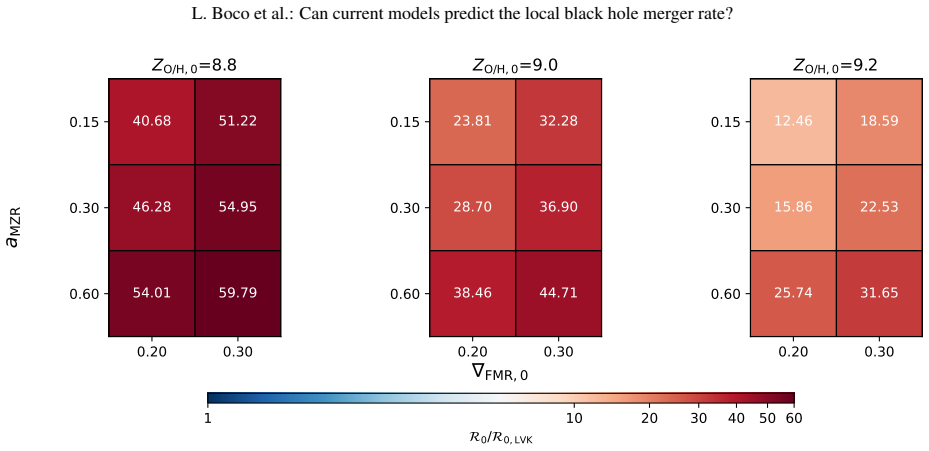
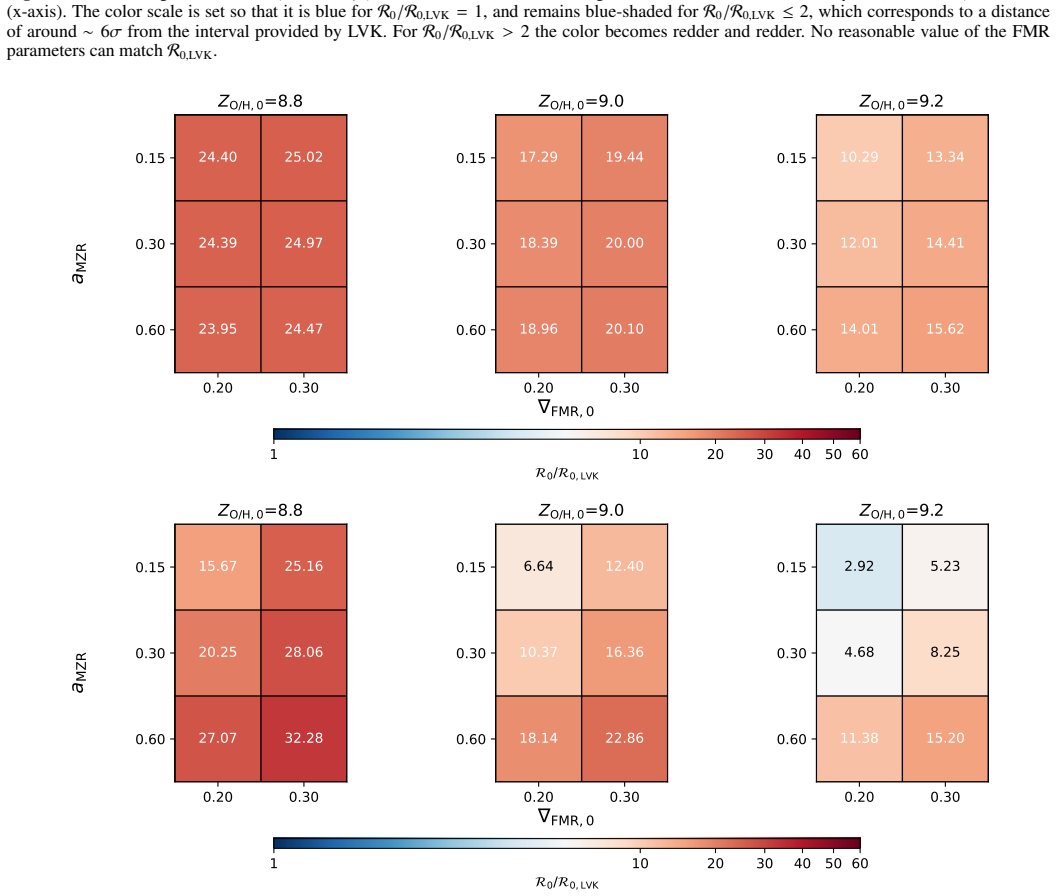
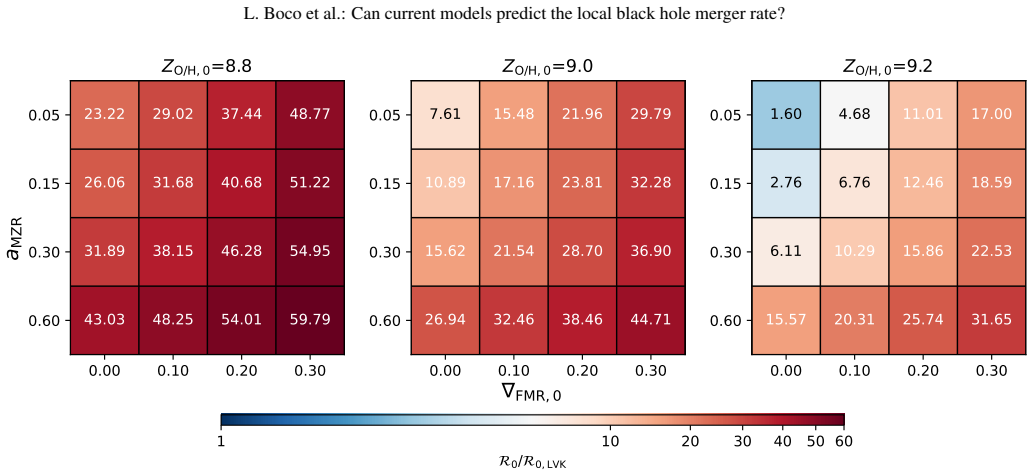
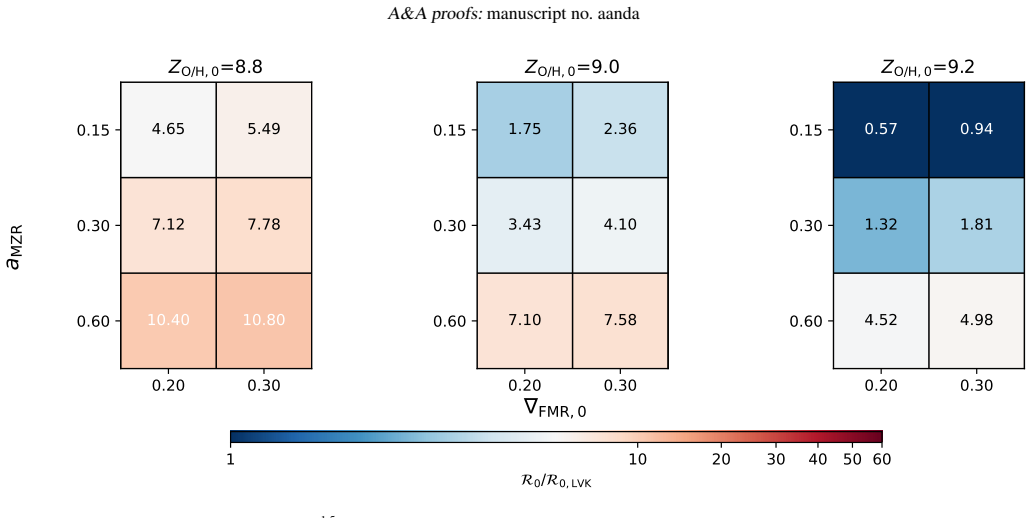
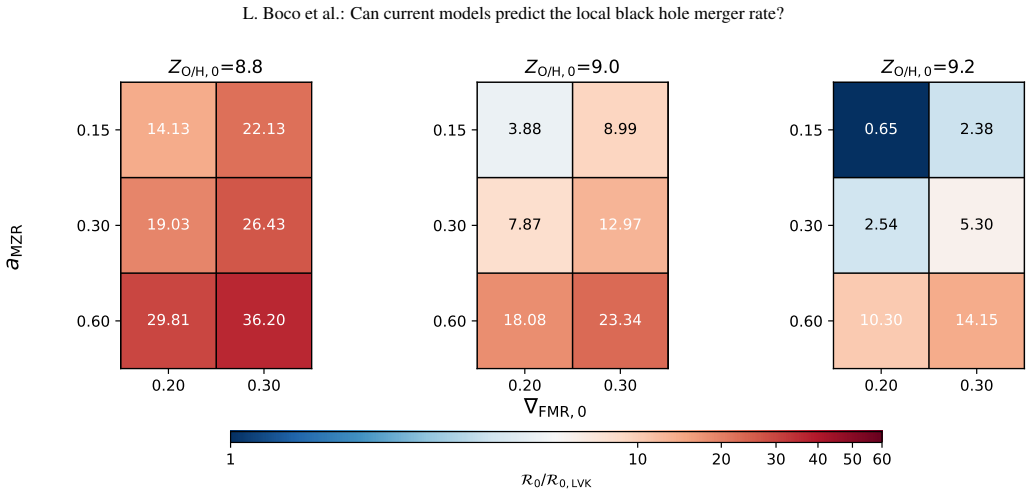
Theoretical models overestimate the local binary black hole merger rate by more than a factor of 10 even under conservative assumptions on star formation and metallicity.
A machine-rendered reading of the paper's core claim, the machinery that carries it, and where it could break.
Core claim
By constructing an empirical model for the metallicity-dependent cosmic star formation rate density including an iron abundance correction that is flexible enough to bracket observational uncertainties, we demonstrate that even under the most conservative assumptions the local BBH merger rate density is overestimated by a factor >10. Attempts to reconcile the predicted and observed merger rates by modifying only the metallicity-dependent SFRD would require unrealistically high metallicities (Z>Z_⊙) even in low-mass galaxies at high redshift. This finding indicates that revisions to the treatment of stellar and binary evolution are necessary to achieve consistency between theoretical predicti
What carries the argument
Empirical model for the SFRD and metallicity evolution with iron abundance correction, used to compute the local BBH merger rate density while bracketing observational uncertainties.
If this is right
- The local BBH merger rate density is overestimated by a factor greater than 10 under the most conservative assumptions on SFRD and metallicity.
- Reconciling rates by changing only the metallicity-dependent SFRD requires unrealistically high metallicities (Z > Z_⊙) in low-mass galaxies at high redshift.
- Revisions to the treatment of stellar and binary evolution are necessary for consistency with observations.
- A modest steepening of the delay-time distribution could alleviate part of the tension between predictions and the observed rate.
Where Pith is reading between the lines
- Population synthesis codes may need recalibration of binary interaction parameters such as common-envelope efficiency to reduce the number of merging systems formed at low metallicity.
- Future metallicity surveys at z > 2 could directly test whether the high metallicities required for reconciliation are physically plausible.
- The same tension may appear in predictions for other compact-object mergers, suggesting a broader need to revisit how initial mass functions and supernova physics are implemented.
Load-bearing premise
The empirical model for SFRD and metallicity evolution brackets observational uncertainties such that no adjustment to only the metallicity-dependent SFRD can reconcile rates without requiring unrealistically high metallicities in low-mass galaxies at high redshift.
What would settle it
A direct measurement showing that average metallicities in low-mass galaxies at redshift greater than 2 are substantially below the values needed to suppress the predicted merger rate would confirm that evolutionary revisions are required.
Figures
read the original abstract
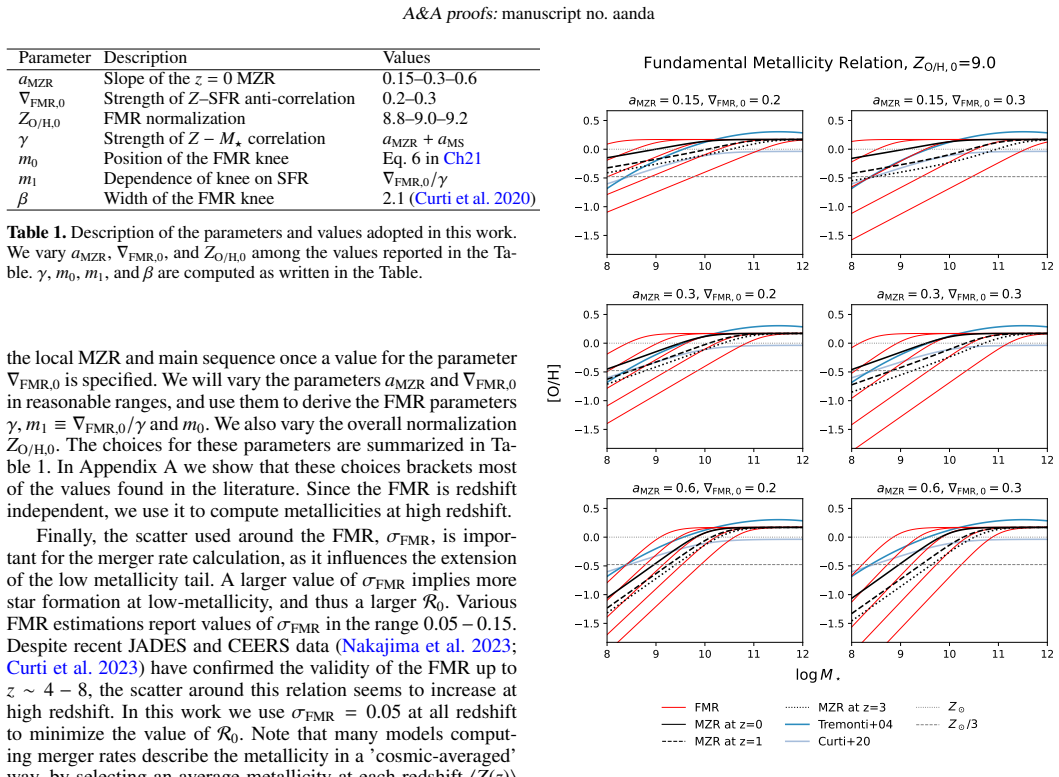
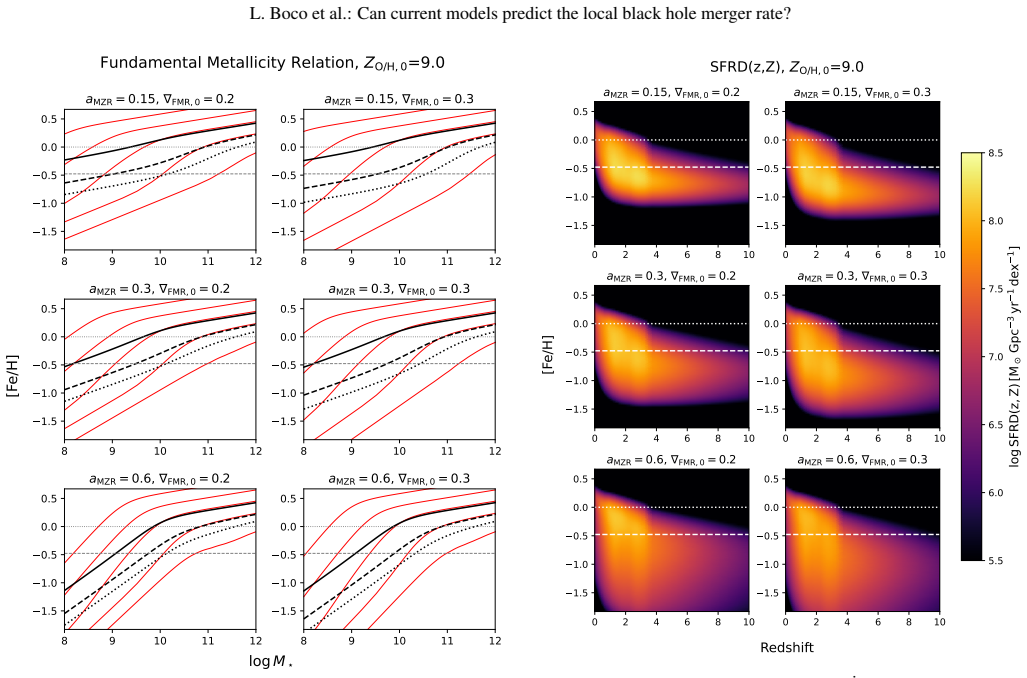
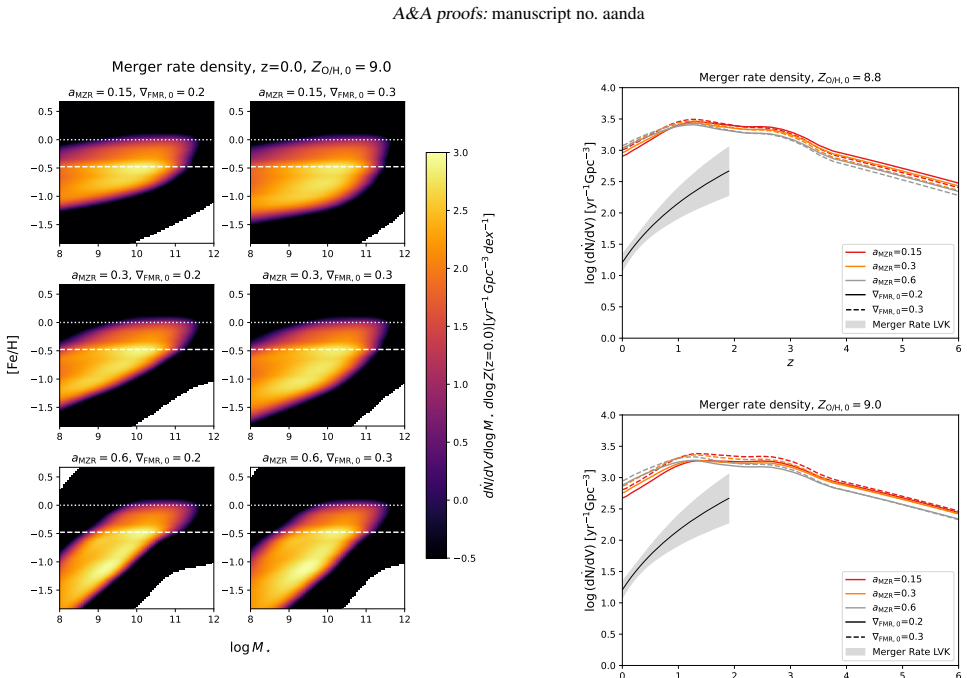
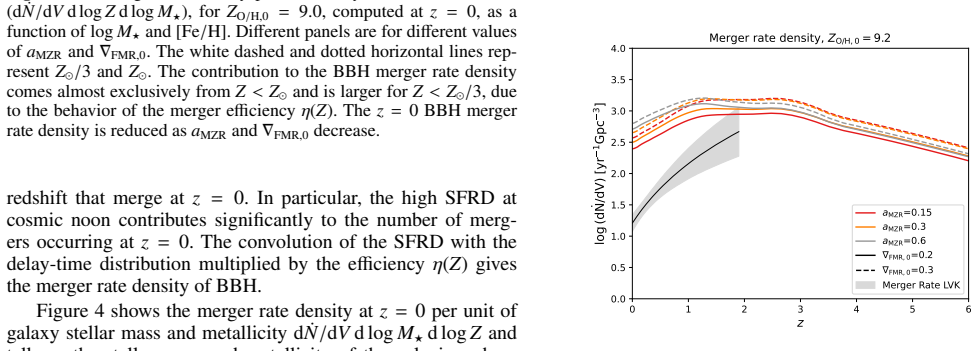
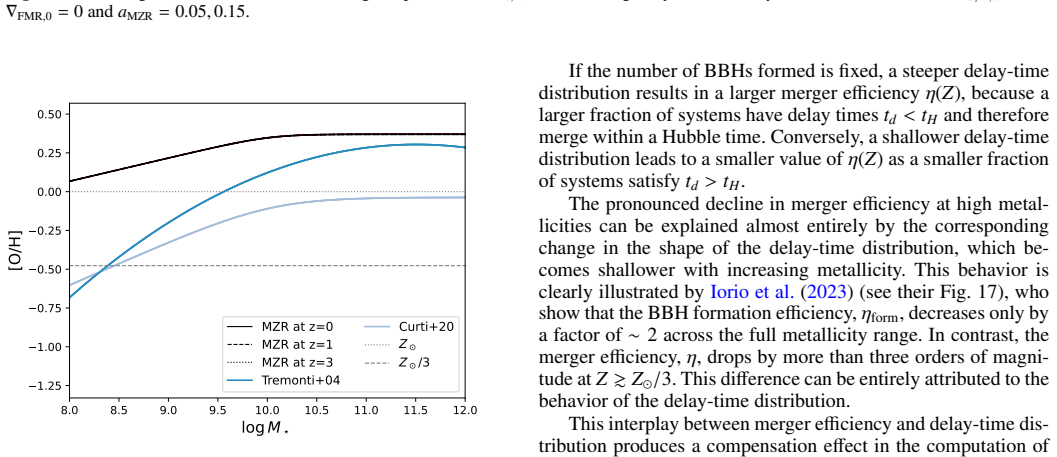
After four observational runs, the Ligo-Virgo-Kagra collaboration estimated a local binary black hole (BBH) merger rate density of $R_{0,\textrm{LVK}}\simeq 14-26\,\textrm{Gpc}^{-3}\,\textrm{yr}^{-1}$ within the 90% credible interval. Some previous studies already pointed out that, when a realistic evolution of the metallicity-dependent cosmic star formation rate density (SFRD) is adopted, theoretical models predict a local BBH merger rate density that exceeds the observed value by at least a factor of $\sim 10$ (Sgalletta et al. 2025). In this paper, we confirm and strengthen this claim by constructing an empirical model for the SFRD and metallicity evolution that includes a correction accounting for iron abundance. The adopted metallicity relation is flexible, enabling us to bracket the wide range of observational uncertainties. We show that, even under the most conservative assumptions regarding both the SFRD and the metallicity relation, the local BBH merger rate density is overestimated by a factor $> 10$. Attempts to reconcile the predicted and observed merger rates by modifying only the metallicity-dependent SFRD would require unrealistically high metallicities ($Z>Z_\odot$) even in low-mass galaxies at high redshift. This finding indicates that revisions to the treatment of stellar and binary evolution are necessary to achieve consistency between theoretical predictions and observations. We suggest that even a modest steepening of the delay-time distribution could help alleviate this tension.
Editorial analysis
A structured set of objections, weighed in public.
Referee Report
Summary. The manuscript constructs a flexible empirical model for the cosmic star formation rate density (SFRD) and metallicity evolution (including an iron-abundance correction) to predict the local binary black hole (BBH) merger rate density. It claims that even the most conservative assumptions on both SFRD and the metallicity relation still yield a predicted local rate exceeding the LIGO-Virgo-KAGRA value (R_{0,LVK} ≃ 14–26 Gpc^{-3} yr^{-1}) by more than a factor of 10. The authors conclude that reconciling the discrepancy by adjusting only the metallicity-dependent SFRD would require unrealistically high metallicities (Z > Z_⊙) in low-mass galaxies at high redshift, implying that revisions to stellar and binary evolution (e.g., a steeper delay-time distribution) are necessary.
Significance. If the quantitative results hold, the work would demonstrate a robust tension between population-synthesis predictions and gravitational-wave constraints that cannot be resolved within current metallicity-dependent SFRD frameworks, thereby motivating targeted updates to massive-star wind prescriptions, binary-interaction physics, or common-envelope efficiency. The use of a flexible empirical model explicitly designed to bracket observational uncertainties is a methodological strength that strengthens the overestimation claim relative to earlier studies.
major comments (1)
- [Abstract] Abstract: the assertion that reconciliation via metallicity-dependent SFRD adjustments alone would require 'unrealistically high metallicities (Z > Z_⊙) even in low-mass galaxies at high redshift' lacks any citation or tabulation of the specific observational upper limits (e.g., from strong-line or UV-absorption diagnostics) that define the model's conservative Z envelope. Without this comparison it is impossible to verify whether the adopted upper bound on Z(z, M*) already exhausts the highest values permitted by data or whether higher observationally allowed metallicities could further suppress the BBH formation efficiency enough to remove the factor-of-10 tension.
minor comments (1)
- [Abstract] Abstract: the summary states the factor >10 overestimation but supplies no quantitative details on the empirical model parametrization, the specific SFRD and metallicity data sources, the iron-abundance correction implementation, or the numerical outputs of the rate calculation, hindering immediate assessment of the central result.
Simulated Author's Rebuttal
We thank the referee for their constructive feedback. We address the single major comment below and will incorporate the suggested clarifications in the revised manuscript.
read point-by-point responses
-
Referee: [Abstract] Abstract: the assertion that reconciliation via metallicity-dependent SFRD adjustments alone would require 'unrealistically high metallicities (Z > Z_⊙) even in low-mass galaxies at high redshift' lacks any citation or tabulation of the specific observational upper limits (e.g., from strong-line or UV-absorption diagnostics) that define the model's conservative Z envelope. Without this comparison it is impossible to verify whether the adopted upper bound on Z(z, M*) already exhausts the highest values permitted by data or whether higher observationally allowed metallicities could further suppress the BBH formation efficiency enough to remove the factor-of-10 tension.
Authors: We agree that the abstract statement would be clearer with explicit support from the literature. Our flexible empirical metallicity model is constructed precisely to bracket the full range of current observational uncertainties, with the conservative upper envelope on Z(z, M*) set at the highest values still consistent with existing strong-line and UV-absorption measurements for high-redshift, low-mass galaxies. In the revised manuscript we will (i) add citations to the key observational papers that define these upper limits and (ii) include a short tabulation or explicit comparison in the methods section demonstrating that our adopted Z upper bound already reaches or exceeds the highest observationally permitted metallicities. This addition will confirm that even maximal metallicities do not remove the factor-of-10 tension. revision: yes
Circularity Check
No significant circularity; derivation uses new empirical bracketing model compared to external observations
full rationale
The paper constructs a flexible empirical model for SFRD and metallicity evolution (including iron correction) explicitly to bracket observational uncertainties, then compares the resulting local BBH merger rate density to the independent LVK observational constraint R_{0,LVK}. The central result—that even the most conservative assumptions still yield an overestimate by a factor >10—does not reduce by construction to any fitted parameter, self-definition, or prior self-citation. The reference to Sgalletta et al. 2025 supplies background context for an earlier claim but is not load-bearing for the present analysis, which introduces its own model and reaches a strengthened conclusion. No equations or steps in the provided text exhibit a prediction that is statistically forced by the inputs or equivalent to them by renaming.
Axiom & Free-Parameter Ledger
Reference graph
Works this paper leans on
-
[1]
Array programming with NumPy. , keywords =. doi:10.1038/s41586-020-2649-2 , archivePrefix =. 2006.10256 , primaryClass =
work page internal anchor Pith review Pith/arXiv arXiv doi:10.1038/s41586-020-2649-2 2006
-
[2]
SciPy 1.0--Fundamental Algorithms for Scientific Computing in Python
SciPy 1.0: fundamental algorithms for scientific computing in Python. Nature Methods , keywords =. doi:10.1038/s41592-019-0686-2 , archivePrefix =. 1907.10121 , primaryClass =
work page internal anchor Pith review Pith/arXiv arXiv doi:10.1038/s41592-019-0686-2 1907
-
[3]
doi:10.5281/zenodo.10697587 , version =
pandas-dev/pandas: Pandas. doi:10.5281/zenodo.10697587 , version =
-
[4]
Computing in Science and Engineering , keywords =
Matplotlib: A 2D Graphics Environment. Computing in Science and Engineering , keywords =. doi:10.1109/MCSE.2007.55 , adsurl =
-
[5]
doi:10.1007/978-3-642-30304-3 , adsurl =
Stellar Structure and Evolution. doi:10.1007/978-3-642-30304-3 , adsurl =
-
[6]
Modules for Experiments in Stellar Astrophysics (MESA)
Modules for Experiments in Stellar Astrophysics (MESA). , keywords =. doi:10.1088/0067-0049/192/1/3 , archivePrefix =. 1009.1622 , primaryClass =
work page internal anchor Pith review Pith/arXiv arXiv doi:10.1088/0067-0049/192/1/3
-
[7]
Modules for Experiments in Stellar Astrophysics (MESA): Planets, Oscillations, Rotation, and Massive Stars. , keywords =. doi:10.1088/0067-0049/208/1/4 , archivePrefix =. 1301.0319 , primaryClass =
work page internal anchor Pith review Pith/arXiv arXiv doi:10.1088/0067-0049/208/1/4
-
[8]
Modules for Experiments in Stellar Astrophysics (MESA): Binaries, Pulsations, and Explosions
Modules for Experiments in Stellar Astrophysics (MESA): Binaries, Pulsations, and Explosions. , keywords =. doi:10.1088/0067-0049/220/1/15 , archivePrefix =. 1506.03146 , primaryClass =
work page internal anchor Pith review Pith/arXiv arXiv doi:10.1088/0067-0049/220/1/15
-
[9]
Modules for Experiments in Stellar Astrophysics (MESA): Convective Boundaries, Element Diffusion, and Massive Star Explosions. , keywords =. doi:10.3847/1538-4365/aaa5a8 , archivePrefix =. 1710.08424 , primaryClass =
work page internal anchor Pith review Pith/arXiv arXiv doi:10.3847/1538-4365/aaa5a8
-
[10]
Modules for Experiments in Stellar Astrophysics (MESA): Pulsating Variable Stars, Rotation, Convective Boundaries, and Energy Conservation. , keywords =. doi:10.3847/1538-4365/ab2241 , archivePrefix =. 1903.01426 , primaryClass =
work page internal anchor Pith review Pith/arXiv arXiv doi:10.3847/1538-4365/ab2241 1903
-
[11]
Very massive stars, pair-instability supernovae and intermediate-mass black holes with the SEVN code
Very massive stars, pair-instability supernovae and intermediate-mass black holes with the sevn code. , keywords =. doi:10.1093/mnras/stx1576 , archivePrefix =. 1706.06109 , primaryClass =
work page internal anchor Pith review Pith/arXiv arXiv doi:10.1093/mnras/stx1576
-
[12]
Merging black hole binaries with the SEVN code
Merging black hole binaries with the SEVN code. , keywords =. doi:10.1093/mnras/stz359 , archivePrefix =. 1809.04605 , primaryClass =
work page internal anchor Pith review Pith/arXiv arXiv doi:10.1093/mnras/stz359
-
[13]
Impact of the Rotation and Compactness of Progenitors on the Mass of Black Holes. , keywords =. doi:10.3847/1538-4357/ab584d , archivePrefix =. 1909.01371 , primaryClass =
-
[14]
Binary black hole mergers: formation and populations. Frontiers in Astronomy and Space Sciences , keywords =. doi:10.3389/fspas.2020.00038 , archivePrefix =. 2105.12455 , primaryClass =
-
[15]
Compact object mergers: exploring uncertainties from stellar and binary evolution with SEVN. , keywords =. doi:10.1093/mnras/stad1630 , archivePrefix =. 2211.11774 , primaryClass =
-
[16]
The cosmic merger rate density of compact objects: impact of star formation, metallicity, initial mass function, and binary evolution. , keywords =. doi:10.1093/mnras/stab280 , archivePrefix =. 2009.03911 , primaryClass =
-
[17]
Very massive stars and pair-instability supernovae: mass-loss framework for low metallicity. , keywords =. doi:10.1093/mnras/stad1888 , archivePrefix =. 2306.11785 , primaryClass =
-
[18]
Principles of stellar structure
-
[19]
, year = 1947, month = mar, volume =
Stellar Models with Convection and with Discontinuity of the Mean Molecular Weight. , year = 1947, month = mar, volume =. doi:10.1086/144905 , adsurl =
-
[20]
Mass-loss implementation and temperature evolution of very massive stars. , keywords =. doi:10.1093/mnras/stac1410 , archivePrefix =. 2205.09125 , primaryClass =
-
[21]
The evolution of AGB stars with convective overshoot
The evolution of AGB stars with convective overshoot. , keywords =. doi:10.48550/arXiv.astro-ph/0007139 , archivePrefix =. astro-ph/0007139 , primaryClass =
work page internal anchor Pith review Pith/arXiv arXiv doi:10.48550/arxiv.astro-ph/0007139
-
[22]
Stellar evolution models for Z = 0.0001 to 0.03. , keywords =. doi:10.1046/j.1365-8711.1998.01658.x , adsurl =
-
[23]
Bulletin d'Information du Centre de Donnees Stellaires , year = 1988, month = dec, volume =
Mass Loss Rates in the Hertzprung-Russell Diagram. Bulletin d'Information du Centre de Donnees Stellaires , year = 1988, month = dec, volume =
1988
-
[24]
On the nature of massive helium star winds and Wolf-Rayet-type mass-loss. , keywords =. doi:10.1093/mnras/staa2712 , archivePrefix =. 2009.01849 , primaryClass =
-
[25]
Massive Stars Near and Far , year = 2024, editor =
The enigmatic winds of Wolf-Rayet stars: Results from dynamically consistent atmosphere modelling. Massive Stars Near and Far , year = 2024, editor =. doi:10.1017/S1743921322002071 , archivePrefix =. 2209.00312 , primaryClass =
-
[26]
Hot Star Winds. arXiv e-prints , keywords =. doi:10.48550/arXiv.2410.12484 , archivePrefix =. 2410.12484 , primaryClass =
-
[27]
2001, MNRAS, 322, 231, doi: 10.1046/j.1365-8711.2001.04022.x
On the variation of the initial mass function. , keywords =. doi:10.1046/j.1365-8711.2001.04022.x , archivePrefix =. astro-ph/0009005 , primaryClass =
-
[28]
Pulsational Pair-Instability Supernovae
Pulsational Pair-instability Supernovae. , keywords =. doi:10.3847/1538-4357/836/2/244 , archivePrefix =. 1608.08939 , primaryClass =
work page internal anchor Pith review Pith/arXiv arXiv doi:10.3847/1538-4357/836/2/244
-
[29]
Mass-loss predictions for O and B stars as a function of metallicity
Mass-loss predictions for O and B stars as a function of metallicity. , keywords =. doi:10.1051/0004-6361:20010127 , archivePrefix =. astro-ph/0101509 , primaryClass =
work page internal anchor Pith review Pith/arXiv arXiv doi:10.1051/0004-6361:20010127
-
[30]
Mixing by overshooting and rotation in intermediate mass stars
Mixing by overshooting and rotation in intermediate-mass stars. , keywords =. doi:10.1093/mnras/stz728 , archivePrefix =. 1903.04368 , primaryClass =
work page internal anchor Pith review Pith/arXiv arXiv doi:10.1093/mnras/stz728 1903
-
[31]
New clues from Cepheids and colour-magnitude diagram
Multiple stellar populations in NGC 1866. New clues from Cepheids and colour-magnitude diagram. , keywords =. doi:10.1051/0004-6361/201936409 , archivePrefix =. 1909.01907 , primaryClass =
-
[32]
PARSEC V2.0: Stellar tracks and isochrones of low- and intermediate-mass stars with rotation. , keywords =. doi:10.1051/0004-6361/202244166 , archivePrefix =. 2207.08642 , primaryClass =
-
[33]
2012, MNRAS, 422, 1263, doi: 10.1111/j.1365-2966.2012.20702.x
PARSEC: stellar tracks and isochrones with the PAdova and TRieste Stellar Evolution Code. , keywords =. doi:10.1111/j.1365-2966.2012.21948.x , archivePrefix =. 1208.4498 , primaryClass =
-
[34]
GOLDRUSH. IV. Luminosity Functions and Clustering Revealed with 4,000,000 Galaxies at z 2-7: Galaxy-AGN Transition, Star Formation Efficiency, and Implication for Evolution at z > 10. , keywords =. doi:10.3847/1538-4365/ac3dfc , archivePrefix =. 2108.01090 , primaryClass =
-
[35]
The Hyper Suprime-Cam SSP Survey: Overview and Survey Design
The Hyper Suprime-Cam SSP Survey: Overview and survey design. , keywords =. doi:10.1093/pasj/psx066 , archivePrefix =. 1704.05858 , primaryClass =
work page internal anchor Pith review Pith/arXiv arXiv doi:10.1093/pasj/psx066
-
[36]
The CFHT large area U-band deep survey (CLAUDS). , keywords =. doi:10.1093/mnras/stz2522 , archivePrefix =. 1909.05898 , primaryClass =
-
[37]
2014, ARA&A, 52, 415, doi: 10.1146/annurev-astro-081811-125615
Cosmic Star-Formation History. , keywords =. doi:10.1146/annurev-astro-081811-125615 , archivePrefix =. 1403.0007 , primaryClass =
work page internal anchor Pith review Pith/arXiv arXiv doi:10.1146/annurev-astro-081811-125615
-
[38]
Radiation Backgrounds at Cosmic Dawn: X-Rays from Compact Binaries
Radiation Backgrounds at Cosmic Dawn: X-Rays from Compact Binaries. , keywords =. doi:10.3847/1538-4357/aa6af9 , archivePrefix =. 1606.07887 , primaryClass =
work page internal anchor Pith review Pith/arXiv arXiv doi:10.3847/1538-4357/aa6af9
-
[39]
The FMOS-COSMOS Survey of Star-forming Galaxies at z -0.5ex 1.6. II. The Mass-Metallicity Relation and the Dependence on Star Formation Rate and Dust Extinction. , keywords =. doi:10.1088/0004-637X/792/1/75 , archivePrefix =. 1310.4950 , primaryClass =
work page internal anchor Pith review Pith/arXiv arXiv doi:10.1088/0004-637x/792/1/75
-
[40]
2012, MNRAS, 422, 1263, doi: 10.1111/j.1365-2966.2012.20702.x
Galaxy And Mass Assembly (GAMA): the galaxy stellar mass function at z < 0.06. , keywords =. doi:10.1111/j.1365-2966.2012.20340.x , archivePrefix =. 1111.5707 , primaryClass =
-
[41]
MOIRCS Deep Survey. IV. Evolution of Galaxy Stellar Mass Function Back to z -0.5ex 3. , keywords =. doi:10.1088/0004-637X/702/2/1393 , archivePrefix =. 0907.0133 , primaryClass =
work page internal anchor Pith review Pith/arXiv arXiv doi:10.1088/0004-637x/702/2/1393
-
[42]
How Do Star-Forming Galaxies at Z>3 Assemble Their Masses?
How Do Star-forming Galaxies at z > 3 Assemble Their Masses?. , keywords =. doi:10.1088/0004-637X/752/1/66 , archivePrefix =. 1111.1233 , primaryClass =
work page internal anchor Pith review Pith/arXiv arXiv doi:10.1088/0004-637x/752/1/66
-
[43]
The galaxy stellar mass function at 3.5<z<7.5 in the CANDELS/UDS, GOODS-South, and HUDF fields
The galaxy stellar mass function at 3.5 z 7.5 in the CANDELS/UDS, GOODS-South, and HUDF fields. , keywords =. doi:10.1051/0004-6361/201424750 , archivePrefix =. 1412.0532 , primaryClass =
work page internal anchor Pith review Pith/arXiv arXiv doi:10.1051/0004-6361/201424750
-
[44]
Compact Remnant Mass Function: Dependence on the Explosion Mechanism and Metallicity
Compact Remnant Mass Function: Dependence on the Explosion Mechanism and Metallicity. , keywords =. doi:10.1088/0004-637X/749/1/91 , archivePrefix =. 1110.1726 , primaryClass =
work page internal anchor Pith review Pith/arXiv arXiv doi:10.1088/0004-637x/749/1/91
-
[45]
The best pair-instability supernova candidate, to date
1100 days in the life of the supernova 2018ibb. The best pair-instability supernova candidate, to date. , keywords =. doi:10.1051/0004-6361/202346855 , archivePrefix =. 2305.05796 , primaryClass =
-
[46]
The Nucleosynthetic Signature of Population III
The Nucleosynthetic Signature of Population III. , keywords =. doi:10.1086/338487 , archivePrefix =. astro-ph/0107037 , primaryClass =
work page internal anchor Pith review Pith/arXiv arXiv doi:10.1086/338487
-
[47]
Pulsational Pair-instability Supernovae in Very Close Binaries. , keywords =. doi:10.3847/1538-4357/ab3426 , archivePrefix =. 1810.13412 , primaryClass =
-
[48]
The more accurately we model the metal-dependent star formation rate, the larger the predicted excess of binary black hole mergers. arXiv e-prints , keywords =. doi:10.48550/arXiv.2410.21401 , archivePrefix =. 2410.21401 , primaryClass =
-
[49]
The transition mass-loss rate: Calibrating the role of line-driven winds in massive star evolution
The Transition Mass-loss Rate: Calibrating the Role of Line-driven Winds in Massive Star Evolution. , keywords =. doi:10.1088/2041-8205/751/2/L34 , archivePrefix =. 1205.0394 , primaryClass =
work page internal anchor Pith review Pith/arXiv arXiv doi:10.1088/2041-8205/751/2/l34 2041
-
[50]
The Eddington factor as the key to understand the winds of the most massive stars. Evidence for a -dependence of Wolf-Rayet type mass loss. , keywords =. doi:10.1051/0004-6361/201116701 , archivePrefix =. 1106.5361 , primaryClass =
work page internal anchor Pith review Pith/arXiv arXiv doi:10.1051/0004-6361/201116701
-
[51]
The VLT-FLAMES Tarantula Survey. XVII. Physical and wind properties of massive stars at the top of the main sequence. , keywords =. doi:10.1051/0004-6361/201423643 , archivePrefix =. 1407.1837 , primaryClass =
work page internal anchor Pith review Pith/arXiv arXiv doi:10.1051/0004-6361/201423643
-
[52]
2011, MNRAS, 412, 2603, doi: 10.1111/j.1365-2966.2010.18080.x
The R136 star cluster hosts several stars whose individual masses greatly exceed the accepted 150M _ solar stellar mass limit. , keywords =. doi:10.1111/j.1365-2966.2010.17167.x , archivePrefix =. 1007.3284 , primaryClass =
-
[53]
Rotating massive main-sequence stars. I. Grids of evolutionary models and isochrones. , keywords =. doi:10.1051/0004-6361/201016113 , archivePrefix =. 1102.0530 , primaryClass =
work page internal anchor Pith review Pith/arXiv arXiv doi:10.1051/0004-6361/201016113
-
[54]
Spectral classification of O2-3.5 If*/WN5-7 stars. , keywords =. doi:10.1111/j.1365-2966.2011.19129.x , archivePrefix =. 1105.4757 , primaryClass =
-
[55]
Grids of stellar models with rotation. III. Models from 0.8 to 120 M _ at a metallicity Z = 0.002. , keywords =. doi:10.1051/0004-6361/201322178 , archivePrefix =. 1308.2914 , primaryClass =
work page internal anchor Pith review Pith/arXiv arXiv doi:10.1051/0004-6361/201322178
-
[56]
Presupernova Evolution and Explosive Nucleosynthesis of Rotating Massive Stars in the Metallicity Range -3 [Fe/H] 0. , keywords =. doi:10.3847/1538-4365/aacb24 , archivePrefix =. 1805.09640 , primaryClass =
work page internal anchor Pith review Pith/arXiv arXiv doi:10.3847/1538-4365/aacb24
-
[57]
Pulsational pair instability as an explanation for the most luminous supernovae
Pulsational pair instability as an explanation for the most luminous supernovae. , keywords =. doi:10.1038/nature06333 , archivePrefix =. 0710.3314 , primaryClass =
work page internal anchor Pith review Pith/arXiv arXiv doi:10.1038/nature06333
-
[58]
Supernova 2007bi as a pair-instability explosion
Supernova 2007bi as a pair-instability explosion. , keywords =. doi:10.1038/nature08579 , archivePrefix =. 1001.1156 , primaryClass =
work page internal anchor Pith review Pith/arXiv arXiv doi:10.1038/nature08579
-
[59]
The Astronomer's Telegram , keywords =
Discovery of a Luminous Supernova, PTF11rks. The Astronomer's Telegram , keywords =
-
[60]
Super-luminous supernovae at redshifts of 2.05 and 3.90
Superluminous supernovae at redshifts of 2.05 and 3.90. , keywords =. doi:10.1038/nature11521 , archivePrefix =. 1211.2003 , primaryClass =
work page internal anchor Pith review Pith/arXiv arXiv doi:10.1038/nature11521 2003
-
[61]
Can pair-instability supernova models match the observations of superluminous supernovae?
Can pair-instability supernova models match the observations of superluminous supernovae?. , keywords =. doi:10.1093/mnras/stv2287 , archivePrefix =. 1510.00439 , primaryClass =
work page internal anchor Pith review Pith/arXiv arXiv doi:10.1093/mnras/stv2287
-
[62]
OGLE14-073 - a promising pair-instability supernova candidate
OGLE14-073 - a promising pair-instability supernova candidate. , keywords =. doi:10.1093/mnras/sty983 , archivePrefix =. 1804.05791 , primaryClass =
work page internal anchor Pith review Pith/arXiv arXiv doi:10.1093/mnras/sty983
-
[63]
The nature of PISN candidates: clues from nebular spectra
The nature of PISN candidates: clues from nebular spectra. , keywords =. doi:10.1093/mnras/stz177 , archivePrefix =. 1901.07629 , primaryClass =
work page internal anchor Pith review Pith/arXiv arXiv doi:10.1093/mnras/stz177 1901
-
[64]
Evolution and fate of very massive stars
Evolution and fate of very massive stars. , keywords =. doi:10.1093/mnras/stt794 , archivePrefix =. 1305.2099 , primaryClass =
work page internal anchor Pith review Pith/arXiv arXiv doi:10.1093/mnras/stt794 2099
-
[65]
Evolution and Nucleosynthesis of Very Massive Stars
Evolution and Nucleosynthesis of Very Massive Stars. Very Massive Stars in the Local Universe , year = 2015, editor =. doi:10.1007/978-3-319-09596-7_6 , archivePrefix =. 1409.7053 , primaryClass =
work page internal anchor Pith review Pith/arXiv arXiv doi:10.1007/978-3-319-09596-7_6 2015
-
[66]
Very massive stars and nitrogen-emitting galaxies. , keywords =. doi:10.1051/0004-6361/202347827 , archivePrefix =. 2310.10725 , primaryClass =
-
[67]
Galactic Archaeology: Near-Field Cosmology and the Formation of the Milky Way , year = 2012, editor =
Contribution of Very Massive Population III Stars to the Chemical Enrichment. Galactic Archaeology: Near-Field Cosmology and the Formation of the Milky Way , year = 2012, editor =
2012
-
[68]
Impact of very massive stars on the chemical evolution of extremely metal-poor galaxies. , keywords =. doi:10.1051/0004-6361/202142031 , archivePrefix =. 2205.03402 , primaryClass =
-
[69]
Core-Collapse Very Massive Stars: Evolution, Explosion, and Nucleosynthesis of Population III 500-1000 M _ solar Stars. , keywords =. doi:10.1086/504578 , archivePrefix =. astro-ph/0507593 , primaryClass =
work page internal anchor Pith review Pith/arXiv arXiv doi:10.1086/504578
-
[70]
EMPRESS. II. Highly Fe-enriched Metal-poor Galaxies with 1.0 (Fe/O) _ and 0.02 (O/H) _ : Possible Traces of Supermassive (>300 M _ ) Stars in Early Galaxies. , keywords =. doi:10.3847/1538-4357/abec3d , archivePrefix =. 2006.03831 , primaryClass =
-
[71]
On the Evolutionary Phase and Mass Loss of the Wolf-Rayet--like Stars in R136a. , keywords =. doi:10.1086/303736 , adsurl =
-
[72]
Missing Link Found? --- The ``runaway'' path to supermassive black holes
Missing Link Found? The ``Runaway'' Path to Supermassive Black Holes. , keywords =. doi:10.1086/338118 , archivePrefix =. astro-ph/0106252 , primaryClass =
work page internal anchor Pith review Pith/arXiv arXiv doi:10.1086/338118
-
[73]
Formation and Evolution of Intermediate Mass Black Hole X-Ray Binaries. , keywords =. doi:10.1007/s10509-005-1176-9 , adsurl =
-
[74]
Merging black holes in young star clusters
Merging black holes in young star clusters. , keywords =. doi:10.1093/mnras/stz1453 , archivePrefix =. 1901.00863 , primaryClass =
work page internal anchor Pith review Pith/arXiv arXiv doi:10.1093/mnras/stz1453 1901
-
[75]
Formation of black holes in the pair-instability mass gap: Evolution of a post-collision star. , keywords =. doi:10.1093/mnras/stac2222 , archivePrefix =. 2204.03492 , primaryClass =
-
[76]
The runaway growth of intermediate-mass black holes in dense star clusters
The Runaway Growth of Intermediate-Mass Black Holes in Dense Star Clusters. , keywords =. doi:10.1086/341798 , archivePrefix =. astro-ph/0201055 , primaryClass =
work page internal anchor Pith review Pith/arXiv arXiv doi:10.1086/341798
-
[77]
The formation of massive black holes through collision runaway in dense young star clusters
Formation of massive black holes through runaway collisions in dense young star clusters. , keywords =. doi:10.1038/nature02448 , archivePrefix =. astro-ph/0402622 , primaryClass =
work page internal anchor Pith review Pith/arXiv arXiv doi:10.1038/nature02448
-
[78]
, year = 1967, month = mar, volume =
Dynamics of Supernova Explosion Resulting from Pair Formation. , year = 1967, month = mar, volume =. doi:10.1103/PhysRevLett.18.379 , adsurl =
-
[79]
The evolution and fate of Very Massive Objects. , keywords =. doi:10.1086/162057 , adsurl =
-
[80]
Supernovae Explosions Induced by Pair-Production Instability. , keywords =. doi:10.1007/BF00651498 , adsurl =
discussion (0)
Sign in with ORCID, Apple, or X to comment. Anyone can read and Pith papers without signing in.