REVIEW 4 major objections 4 minor 44 references
The understanding of the penetration and clusterization of 1-alkanol in bilayer membrane: An open outlook based on atomistic molecular dynamics simulation
T0 review · 4 major / 4 minor · reviewed 2026-08-07 · deepseek-v4-flash
Pith's one-line read Simulations show 1-alkanols with chains longer than 12 carbons cluster in a DOPC membrane and enter it far more slowly than shorter ones.
desk verdict A potentially useful cutoff observation at n=12 for 1-alkanol penetration and clustering in DOPC, but the clustering evidence is compromised by a two-leaflet projection artifact and the paper needs major revision before the mechanism can stand. read the letter →
The pith
A machine-rendered reading of the paper's core claim, the machinery that carries it, and where it could break.
The reading
What carries the argument
The load-bearing object is the cutoff chain length n = 12 of a 1-alkanol (CnH2n+1OH) in a DOPC bilayer, together with the cluster analysis that identifies it. The paper detects clusters by projecting all 1-alkanol centers of mass onto the membrane plane, building Voronoi cells from those points, keeping cells denser than the mean, and measuring the polygonal areas of the connected high-density regions; this is coupled with radial distribution functions to show that long chains prefer alkanol–alkanol contacts (peak near 0.5 nm) whereas short chains prefer alkanol–lipid contacts (peak near 0.25 nm). Penetration time is defined as the time for the alkanol's depth of penetration to reach its asymptotic value, read from the time evolution of the center-of-mass separation between alkanol and lipid head groups. The hydrophobic effect of long acyl chains is the physical mechanism invoked to explain why n ≥ 12 alkanols cluster and therefore enter slowly.
What would settle it
Re-run the cluster analysis separately for the upper and lower leaflet of the bilayer, using three-dimensional distances or leaflet-resolved projections; if the reported clusters for n = 12, 14, and 16 disappear or shrink dramatically when leaflets are separated, the cutoff-clustering claim would be an artifact of the projection, whereas if they persist, the claim is supported.
Extended reading notes
Core claim
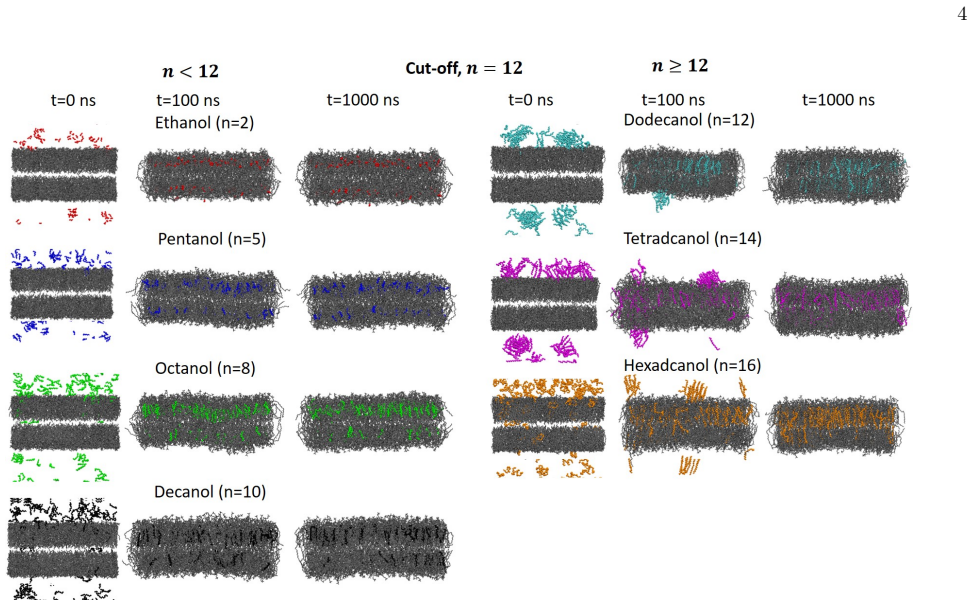
The paper's central claim is a cutoff at dodecanol: 1-alkanols with n ≤ 12 penetrate a DOPC bilayer within about 100–200 ns, whereas n = 14 and n = 16 alkanols need roughly 300–500 ns. The slower entry is attributed to self-clustering: Voronoi-tessellation analysis of molecular centers of mass shows distinct clusters for n = 12, 14, and 16, with typical cluster areas near 20, 30, and 45 nm², while shorter alkanols show no clusters and are homogeneously distributed. Radial distribution functions support the same split, with a 0.5 nm alkanol–alkanol peak for long chains and a 0.25 nm alkanol–lipid peak for short chains. The paper further reports that penetration depth increases monotonically with chain length and that the DOPC deuterium order parameter decreases as alkanol chains grow longer. Together these observations are offered as a mechanism for the anesthetic cutoff effect in 1-alkanols.
Load-bearing premise
The clustering claim rests on a two-dimensional Voronoi analysis that projects centers of mass of alkanols from both leaflets of the bilayer onto one plane, so molecules sitting at similar x,y positions in opposite leaflets could be counted as a cluster without actually touching.
Editorial extensions
If this is right
- Long-chain alkanols (n ≥ 12) enter the bilayer as clustered aggregates, so their slow uptake is a kinetic effect of self-association rather than a thermodynamic inability to partition.
- The experimentally observed anesthetic cutoff near dodecanol could reflect this kinetic barrier, since clustered alkanols take hundreds of nanoseconds longer to reach the membrane interior.
- Short-chain alkanols (n < 12) disperse uniformly and interact more with lipid molecules, matching their faster penetration and known potency.
- Chain length modulates DOPC acyl-chain order and penetration depth monotonically, linking molecular size to membrane packing even below the clustering threshold.
- The Voronoi-based cluster-detection method can be applied to other simulation trajectories and imaging experiments that report spatial positions of membrane components.
Reading between the lines
- If the cutoff is kinetic, anesthetic potency could be tuned by anything that breaks up alkanol clusters, such as surfactants or local heating; the paper does not test this.
- A leaflet-resolved cluster analysis would test whether the reported cluster areas are inflated by the single-plane projection; this is a direct extension of the paper's method.
- The reported cluster areas (roughly 20, 30, and 45 nm² for n = 12, 14, 16) imply aggregates of many molecules; estimating cluster sizes and lifetimes would connect the simulation to fluorescence experiments on membrane heterogeneity.
- The density threshold used in the Voronoi analysis (the mean density) sets the apparent cluster boundary; varying this threshold would reveal whether the n = 12 cutoff is sharp or gradual.
Editorial analysis
A structured set of objections, weighed in public.
Referee Report
Summary. The paper reports atomistic molecular dynamics simulations of 1-alkanols with chain lengths n = 2, 5, 8, 10, 12, 14, and 16 in DOPC bilayers, with four 1-µs replicas per system. The authors report three main findings: penetration depth increases with alkanol chain length, the DOPC deuterium order parameter changes monotonically with chain length, and there is a cutoff at n = 12, above which alkanols take longer to penetrate the membrane and form clusters. The cluster analysis is based on a two-dimensional Voronoi tessellation of projected molecular centers of mass, and the penetration-time analysis defines τ_p as the time until the penetration depth reaches an asymptotic value. The paper concludes that the cutoff and clusterization may explain aspects of the anesthetic cutoff effect.
Significance. If the n = 12 cutoff and the associated clusterization claim are correct, the results would provide a concrete molecular-scale mechanism relevant to the long-standing anesthetic cutoff problem and to membrane partitioning of amphiphiles. The study has clear strengths: four independent 1-µs trajectories per system, an internally consistent force-field protocol built from previously validated parameters, and a direct simulation-based result rather than a fitted model. The penetration-depth and order-parameter trends are plausible and well aligned with existing literature. However, the central clusterization claim currently rests on a methodological choice that can create apparent in-plane clusters from molecules in opposite leaflets, and the penetration-time cutoff lacks statistical uncertainty quantification. These issues are load-bearing because the clusterization is invoked as the mechanism for the penetration-time cutoff. The stress-test concern about the two-leaflet projection is confirmed by a direct reading of Sec. III.D and does land.
major comments (4)
- [III.D] The cluster analysis projects the (x,y) centers of mass of all 1-alkanol molecules from both leaflets onto a single plane, as stated in Sec. III.D ('We collect the (x,y) positional coordinates of all 1-alkanol molecules for each frame'), while Sec. III.C explicitly partitions molecules into upper and lower leaflets using z_com relative to the membrane COM. In a symmetric bilayer loaded on both sides, two molecules in opposite leaflets with similar (x,y) coordinates will produce a small Voronoi cell and be counted as a cluster even though they are separated by several nanometers in z. The P(Acluster) peaks in Fig. 7 can therefore arise from a projection artifact. Please repeat the Voronoi analysis separately for each leaflet, using the same upper/lower grouping defined in Sec. III.C, and report per-leaflet cluster-size distributions.
- [III.C and Fig. 5(b)] The penetration-time cutoff n = 12 rests on τ_p values reported as '100-200 ns' for short chains and '300-500 ns' for long chains, but Fig. 5(b) shows no error bars or replica-to-replica spread, and Fig. 4 defines τ_p only by grey shading until 'asymptotic values' without a quantitative convergence criterion. Please provide the standard deviation or interquartile range of τ_p over the four replicas and a reproducible definition of asymptotic depth, for example the first time the running average of d_p remains within a stated tolerance of its final value.
- [III.D] The Voronoi cluster pipeline selects cells with density greater than the mean density and then merges them with image-based bwlabel. For any reasonably uniform random distribution, a large fraction of Voronoi cells will exceed the mean by construction, so the apparent cluster peaks at roughly 20, 30, and 45 nm² in Fig. 7 need to be compared against a null model. A concrete control is to randomly permute the (x,y) positions of the 1-alkanol molecules within each leaflet, rerun the entire Voronoi/bwlabel pipeline, and show that the observed P(Acluster) peaks are not reproduced by the randomized distributions.
- [III.E] The radial distribution in Fig. 9(b) provides useful independent evidence for short-range association of long-chain alkanols, but it is computed without error bars and, like the cluster analysis, does not appear to distinguish same-leaflet from cross-leaflet pairs. Please provide per-leaflet g(r) with replica-based uncertainties, and if possible a three-dimensional or leaflet-resolved RDF, to connect the 0.5 nm peak in g(r) to the specific P(Acluster) peaks used to define n = 12.
minor comments (4)
- [Fig. 7 caption] The caption refers to 'hexanol (red square)', but hexanol (n = 6) is not among the simulated systems; this appears to be a typo and should be corrected.
- [II] The text says '128 number (25% of total number of lipids)' and 'total 8 bilayer membranes'; please clarify that 128 refers to 1-alkanol molecules and specify how the control membrane is counted among the eight systems.
- [II] Reference [29] cites GROMACS 3.0, but the Methods state GROMACS-2025.1; please cite the actual software version used.
- [General] There are numerous typographical and grammatical errors, including 'z−asix', 'bilayetr', and 'time evaluation' in place of 'time evolution'; a careful proofread is needed throughout.
Circularity Check
No significant circularity: MD observables are directly measured, and the self-citations are non-load-bearing inputs.
full rationale
This is a direct atomistic molecular dynamics study. The central outputs—penetration depth dp, penetration time tau_p, deuterium order parameter Scd, and cluster areas—are computed from simulated trajectories using the operational definitions in Secs. III.A–III.E. No parameter is fitted to a subset of data and then renamed as a prediction; the n=12 cutoff is read off the computed penetration-time curve (Fig. 5(b)), and the clustering distinction is read off the computed P(A_cluster) distributions (Fig. 7) and supported by the 1-alkanol–1-alkanol radial distribution in Sec. III.E. The force-field parameters are taken from prior publications, some by the same author, but these are inputs used to run the simulations, and the cited works do not contain the alkanol-chain-length cutoff result. No uniqueness theorem, hidden ansatz, or equation-level identity makes the conclusion equivalent to the inputs. The Voronoi cluster analysis in Sec. III.D does raise a methodological concern: the (x,y) coordinates are collected from all molecules without separating the two leaflets, so cross-leaflet coincidences could be counted as in-plane clusters. That is a potential correctness artifact, but it is not circularity, because the cluster assignment is not forced by construction and the conclusion is not built into the threshold definition.
Assumptions & free parameters
free parameters (1)
- Voronoi mean-density threshold =
mean of inverse Voronoi cell areas per frame
assumptions (3)
- domain assumption Force-field parameters for DOPC and 1-alkanols are transferable to the simulated conditions
- domain assumption 1 microsecond trajectories are long enough for equilibrium and for penetration of the longest alkanols
- ad hoc to paper Projecting molecular centers of mass from both leaflets onto a single xy-plane is a valid basis for cluster analysis
Cite this review
Pith. "Pith review of The understanding of the penetration and clusterization of 1-alkanol in bilayer membrane: An open outlook based on atomistic molecular dynamics simulation." pith.science (2026). https://pith.science/paper/QZSYJRTN
@misc{pith2026250524152,
  author       = {Pith},
  title        = {Pith review of: The understanding of the penetration and clusterization of 1-alkanol in bilayer membrane: An open outlook based on atomistic molecular dynamics simulation},
  year         = {2026},
  howpublished = {\url{https://pith.science/paper/QZSYJRTN}},
  note         = {Machine review of arXiv:2505.24152}
}
read the original abstract
1-alkanols are well known to have anesthetic and penetration properties, though the mode of operation remains enigmatic. We perform extensive atomistic molecular dynamics simulation to study the penetration of 1-alkanols of different chain lengths in the dioleoyl-phosphatidylcholine (DOPC) bilayer model membrane. Our simulations show that the depth of penetration of 1-alkanol increases with chain length, n, and the deuterium order of the DOPC tail increases with the chain length of the acyl-chain of the 1-alkanol. We find a cut-off value for the length of the acyl-chain of 1-alkanol, n = 12, where 1-alkanol with a chain length greater than the cut-off value takes longer to penetrate the membrane. Our simulation study also demonstrates that the membrane exhibits clusters of 1-alkanols with acyl chains longer than the cut-off value, whereas 1-alkanols with acyl-chain shorter than the cut-off value are distributed homogeneously in the membrane and penetrate the membrane in a shorter time than longer-acyl-chain 1-alkanols. These findings add to our understanding of the anomalies in anesthetic molecule partitioning in the cell membrane and may have implications for general anesthesia.
Figures


Figures from the paper (6 more)


Reference graph
Works this paper leans on
-
[1]
The membrane actions of anesthetics and tranquilizers
P. Seeman, “The membrane actions of anesthetics and tranquilizers.” Pharmacol Rev. 24, 583 (1972)
work page 1972
-
[2]
Molecular and cellular mechanisms of general anaesthesia,
N. P. Franks and W. R. Lieb, “Molecular and cellular mechanisms of general anaesthesia,” Nature 367, 607 (1997)
work page 1997
-
[3]
Selectivity of general anes- thetics: A new dimension
N. P. Franks and W. R. Lieb, “Selectivity of general anes- thetics: A new dimension.” Nat. Med. 3, 377 (1997)
work page 1997
-
[4]
The depth of the penetration, dp of the 1-alkanol is de- fined as,dupper(lower) p =|(zupper(lower)−dopc−head−group com − zupper(lower)−alkanol com )|. As shown in Fig. 5 (a), the pene- tration depth of 1-alkanols, dp, increases with the value 3 FIG. 1. The density profile of the head and tail of 1-alkanol in the DOPC bilayer, respectively are shown, where...
-
[5]
I. Ueda and A. Suzuki, “Does pressure antagonize anes- thesia? opposite effects on specific and nonspecific in- hibitors of firefly luciferase.” Biophys. J. 75, 1052 (1998)
work page 1998
-
[6]
Third, from the Voronoi-cells of the 1-alkanol, we cal- culate the density by inverting the area of each cell, as each Voronoi-cell contains one 1-alkanol molecule, and we calculate the mean density of the 1-alkanol. Now, only Voronoi-cells with densities greater than the mean den- sity are selected and the Voronoi-cells in different colors with high dens...
work page 2022
-
[7]
Loosening and reorganization of fluid phospholipid bilayers by chloroform
S. Turkyilmaz, W. H. Chen, H. Mitomo, and S. L. J. Re- gen, “Loosening and reorganization of fluid phospholipid bilayers by chloroform.” J. Am. Chem. Soc. 131, 5068 (2009)
work page 2009
-
[8]
Molecular mechanisms of anes- thesia
I. Ueda and A. Suzuki, “Molecular mechanisms of anes- thesia.” Keio J.Med. 50, 20 (2001)
work page 2001
Show all 44 references
-
[9]
Anaes- thetic potencies of primary alkanols: implications for the molecular dimensions of the anaesthetic site
J. Alifimoff, L. Firestone, and K. W. Miller, “Anaes- thetic potencies of primary alkanols: implications for the molecular dimensions of the anaesthetic site.” Br J Phar- macol. 96, 9 (1989)
1989
-
[10]
Nuclear overhauser enhancement spectroscopy cross- relaxation rates and ethanol distribution across mem- branes
S. E. Feller, C. A. Brown, D. T. Nizza, and K. Gawrisch, “Nuclear overhauser enhancement spectroscopy cross- relaxation rates and ethanol distribution across mem- branes.” Biophys. J. 82, 15 (2002)
2002
-
[11]
Determining ethanol distri- bution in phospholipid multilayers with mas-noesy spec- tra
L. Holte and K. Gawrisch, “Determining ethanol distri- bution in phospholipid multilayers with mas-noesy spec- tra.” Biochem. 36, 4669 (1997)
1997
-
[12]
Effects of ethanol on lipid bilayers containing cholesterol, gangliosides and sphin- gomyelin
J. A. Barry and K. Gawrisch, “Effects of ethanol on lipid bilayers containing cholesterol, gangliosides and sphin- gomyelin.” Biochem. 34, 8852 (1995)
1995
-
[13]
Under the influence of alcohol: the effect of ethanol and methanol on lipid bilayers
M. Patra, E. Salonen, E. Terama, I. Vattulainen, R. Faller, B. W. Lee, J. Holopainen, and M. Karttunen, “Under the influence of alcohol: the effect of ethanol and methanol on lipid bilayers.” Biophys. J. 90, 1121 (2006.)
2006
-
[14]
Ethanol effects on binary and ternary sup- ported lipid bilayers with gel/fluid domains and lipid rafts
J. T. Marquˆ es, A. S. Viana, and F. M. Rodrigo de Almeida, “Ethanol effects on binary and ternary sup- ported lipid bilayers with gel/fluid domains and lipid rafts.” Biochim. Biophys. Acta. 1808, 405 (2011)
2011
-
[15]
The role of atomic polarization in the thermodynamics of chloroform partitioning to lipid bilayers
I. Vorobyov, W. F. Drew Bennett, P. D. Tieleman, T. W. Allen, and S. Noskov, “The role of atomic polarization in the thermodynamics of chloroform partitioning to lipid bilayers.” J. Chem. Theory. Comput. 8, 307 (2012)
2012
-
[16]
The lateral pressure profile in membranes: a physical mechanism of general anesthesia
R. S. Cantor, “The lateral pressure profile in membranes: a physical mechanism of general anesthesia.” Biochem. 36, 2339 (1997)
1997
-
[17]
Lateral pressures in cell membranes: a mechanism for modula- tion of protein function
R. S. Cantor, “Lateral pressures in cell membranes: a mechanism for modula- tion of protein function.” J. Phys. Chem. B 101, 1723 (1997)
1997
-
[18]
The lateral pressure profile in membranes: a physical mechanism of general anesthesia
R. S. Cantor, “The lateral pressure profile in membranes: a physical mechanism of general anesthesia.” Toxicol. Lett. 100, 451 (1998)
1998
-
[19]
Partitioning of ethanol in multi-component membranes: Effects on membrane structure
A. Polley and S. Vemparala, “Partitioning of ethanol in multi-component membranes: Effects on membrane structure.” Chem Phys Lipids. 166, 1 (2013)
2013
-
[20]
Distribution of ethanol in a model membrane: a computer simulation study
J. Chanda and S. Bandyopadhyay, “Distribution of ethanol in a model membrane: a computer simulation study.” Chem. Phys. Lett. 392, 249 (2004)
2004
-
[21]
Perturbation of phos- pholipid bilayer properties by ethanol at a high concen- tration
J. Chanda and S. Bandyopadhyay, “Perturbation of phos- pholipid bilayer properties by ethanol at a high concen- tration.” Langmuir 22, 3775 (2006)
2006
-
[22]
Simulating the effect of alcohol on the structure of a membrane
M. Kranenburg and B. Smit, “Simulating the effect of alcohol on the structure of a membrane.” FEBS Lett. 568, 15 (2004)
2004
-
[23]
Simulating the effect of alcohol on the structure of a membrane
E. Terama, O. H. Ollila, E. Salonen, A. C. Rowat, C. Trandum, P. Westh, M. Patra, M. Karttunen, and I. Vattulainen, “Simulating the effect of alcohol on the structure of a membrane.” J. Phys. Chem. B. 112, 4131 (2008). 9
2008
-
[24]
1-alkanols and mem- branes: a story of attraction
B. Griepernau, S. Leis, M. F. Schneider, M. Sikor, D. Steppich, and R. A. B¨ ockmann, “1-alkanols and mem- branes: a story of attraction.” Biochim. Biophys. Acta. 1768, 2899 (2007)
2007
-
[25]
How alcohol chain-length and concentration modulate hydrogen bond formation in a lipid bilayer
R. Dickey, A. N.and Faller, “How alcohol chain-length and concentration modulate hydrogen bond formation in a lipid bilayer.” Biophys. J. 92, 2366 (2007)
2007
-
[26]
Solute effects on the colloidal and phase behavior of lipid bilayer membranes: ethanol–dipalmitoylphosphatidylcholine mixtures
U. Vierl, L. Lobbecke, N. Nagel, and G. Cevc, “Solute effects on the colloidal and phase behavior of lipid bilayer membranes: ethanol–dipalmitoylphosphatidylcholine mixtures.” Biophys. J. 67, 1067 (1994)
1994
-
[27]
The thermodynamics of general anesthesia
T. Heimburg and A. D. Jackson, “The thermodynamics of general anesthesia.” Biophys. J. 92, 3159–3165 (2007)
2007
-
[28]
Effects of ethanol on lipid bilayers containing cholesterol, gangliosides, and sphin- gomyelin
J. A. Barry and K. Gawrisch, “Effects of ethanol on lipid bilayers containing cholesterol, gangliosides, and sphin- gomyelin.” Biochem. 34, 8852 (1995)
1995
-
[29]
Submicron structure in l-alpha-dipalmitoylphosphati- dylcholine monolayers and bilayers probed with confocal, atomic force, and near field microscopy
C. W. Hollars and R. C. Dunn, “Submicron structure in l-alpha-dipalmitoylphosphati- dylcholine monolayers and bilayers probed with confocal, atomic force, and near field microscopy.” Biophys. J. 75, 342 (1998)
1998
-
[30]
Interdigitated hydro- carbon chain packing causes the biphasic transition be- havior in lipid alcohol suspensions
S. A. Simon and T. J. Mcintosh, “Interdigitated hydro- carbon chain packing causes the biphasic transition be- havior in lipid alcohol suspensions.” Biochim. Biophys. Acta. 773, 169 (1984)
1984
-
[31]
Gromacs 3.0: a package for molecular simulation and trajectory analysis,
E. Lindahl, B. Hess, and D. van der Spoel, “Gromacs 3.0: a package for molecular simulation and trajectory analysis,” Journal of Molecular Modeling 7, 306 (2001)
2001
-
[32]
Packmol: a package for building initial configurations for molecular dynamics simulations
L. Mart´ ınez, R. Andrade, E. Birgin, and J. Mart´ ınez, “Packmol: a package for building initial configurations for molecular dynamics simulations.” J Comput Chem. 30(13), 2157 (2009)
2009
-
[33]
Atomistic sim- ulation of cholesterol effects on miscibility of satu- rated and unsaturated phospholipids: implications for liquid-ordered/liquid-disordered phase coexistence
J. de Joannis, P. S. Coppock, F. Yin, M. Mori, A. Zamorano, and J. T. Kindt, “Atomistic sim- ulation of cholesterol effects on miscibility of satu- rated and unsaturated phospholipids: implications for liquid-ordered/liquid-disordered phase coexistence.” J Am Chem Soc. 133, 36...
2011
-
[34]
Atomistic simu- lations of a multicomponent asymmetric lipid bilayer
A. Polley, S. Vemparala, and M. Rao, “Atomistic simu- lations of a multicomponent asymmetric lipid bilayer.” J Phys Chem B. 116(45), 13403 (2012)
2012
-
[35]
A molecular dy- namics study of the pores formed by escherichia coli ompf porin in a fully hydrated palmitoyloleoylphosphatidyl- choline bilayer
D. P. Tieleman and H. J. Berendsen, “A molecular dy- namics study of the pores formed by escherichia coli ompf porin in a fully hydrated palmitoyloleoylphosphatidyl- choline bilayer.” Biophys J. 74(6), 2786 (1998)
1998
-
[36]
Assessing the nature of lipid raft membranes,
P. S. Niemel¨ a, S. Ollila, M. T. Hyv¨ onen, M. Karttunen, and I. Vattulainen, “Assessing the nature of lipid raft membranes,” PLoS Comput Biol. 3(2), e34 (2007)
2007
-
[37]
The influence of 1-alkanols and external pressure on the lateral pressure profiles of lipid bilayers
B. Griepernau and R. A. B ´’ockmann, “The influence of 1-alkanols and external pressure on the lateral pressure profiles of lipid bilayers.” Biophys J. 95, 5766 (2008)
2008
-
[38]
Under the influence of alcohol: The effect of ethanol and methanol on lipid bilayers
M. Patra, E. Salonen, E. Terama, I. Vattulainen, R. Faller, B. W. Lee, J. Holopainen, and M. Karttunen, “Under the influence of alcohol: The effect of ethanol and methanol on lipid bilayers.” Biophys. J. 90, 1121 (2006)
2006
-
[39]
Influence of chloroform in liquid-ordered and liquid-disordered phases in lipid membranes
R. Reigada, “Influence of chloroform in liquid-ordered and liquid-disordered phases in lipid membranes.” J. Phys. Chem. B. 115, 2527 (2011)
2011
-
[40]
Atomistic study of lipid membranes con- taining chloroform: Looking for a lipid-mediated mech- anism of anesthesia
R. Reigada, “Atomistic study of lipid membranes con- taining chloroform: Looking for a lipid-mediated mech- anism of anesthesia.” PLoS Comput Biol. 8, e52631 (2013)
2013
-
[41]
Bilayer registry in a multicomponent asymmetric membrane: dependence on lipid composition and chain length,
A. Polley, S. Mayor, and M. Rao, “Bilayer registry in a multicomponent asymmetric membrane: dependence on lipid composition and chain length,” J. chem. physics. 141, 064903 (2014)
2014
-
[42]
Lipid bilayers driven to a wrong lane in molecular dynamics simulations by subtle changes in long-range electrostatic interactions,
M. Patra and M. Karttunen, “Lipid bilayers driven to a wrong lane in molecular dynamics simulations by subtle changes in long-range electrostatic interactions,” J. Phys. Chem. B 108 (14) , 4485 (2004)
2004
-
[43]
Transbilayer lipid interactions mediate nanoclustering of lipid-anchored proteins,
R. Raghupathy, A. A. Anilkumar, A. Polley, P. P. Singh, M. Yadav, C. Johnson, S. Suryawanshi, V. Saikam, S. D. Sawant, A. Panda, Z. Guo, R. A. Vishwakarma, M. Rao, and S. Mayor, “Transbilayer lipid interactions mediate nanoclustering of lipid-anchored proteins,” Cell 161 (3), ...
2015
-
[44]
Phase segregation of passive advective particles in an active medium,
A. Das, A. Polley, and M. Rao, “Phase segregation of passive advective particles in an active medium,” Phys. Rev. Lett. 116, 068306 (2016). The understanding of the penetration and clusterization of 1-alkanol in bilayer membrane: An open outlook based on atomistic molecular dy...
2016 arXiv
Reviewed August 7, 2026 · model on record in the stance chip above.
Discussion (0). Sign in to comment.