Fair Classification with Efficient and Post-hoc Controllable Fairness-Accuracy Trade-off
Pith reviewed 2026-06-29 05:04 UTC · model grok-4.3
The pith
Gradient-based feature learning makes post-processing fair classifiers achieve efficient trade-offs without retraining.
A machine-rendered reading of the paper's core claim, the machinery that carries it, and where it could break.
Core claim
By applying gradient-based optimization to learn effective feature representations, the algorithm improves the fairness-accuracy trade-off efficiency of post-processing fair classifiers, reaching performance levels comparable to or exceeding those of in-processing methods on real-world datasets while preserving post-hoc controllability and requiring no retraining.
What carries the argument
Gradient-based optimization of feature representations to raise the efficiency of post-processing fair classifiers.
If this is right
- Post-processing classifiers can be made competitive with in-processing methods on efficiency without altering their core logic.
- Fairness-accuracy ratios can be adjusted after training at negligible extra cost.
- The same learned representations support multiple fairness definitions without retraining.
- No additional accuracy loss is introduced beyond the baseline post-processing degradation.
Where Pith is reading between the lines
- The same representation-learning step could be tested on regression or ranking tasks that already use post-processing.
- Hybrid pipelines could freeze the learned features and swap only the post-processor for different regulatory requirements.
- If the optimization is architecture-agnostic it may reduce the need for multiple fairness-tuned model copies in production.
- A natural next measurement is wall-clock time to reach a target fairness level when the trade-off ratio changes frequently.
Load-bearing premise
Gradient-based optimization of feature representations will reliably raise the fairness-accuracy trade-off efficiency of existing post-processing classifiers across datasets and fairness definitions without causing new performance problems.
What would settle it
On a held-out real-world dataset the method's fairness-accuracy curve lies strictly below the curve of a standard in-processing baseline.
Figures

read the original abstract
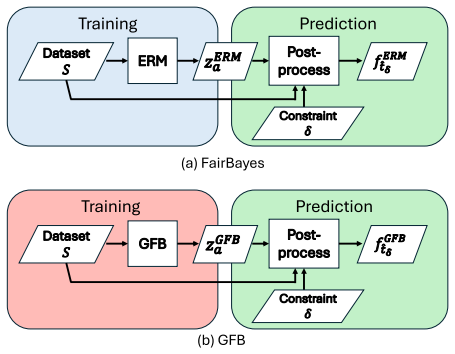
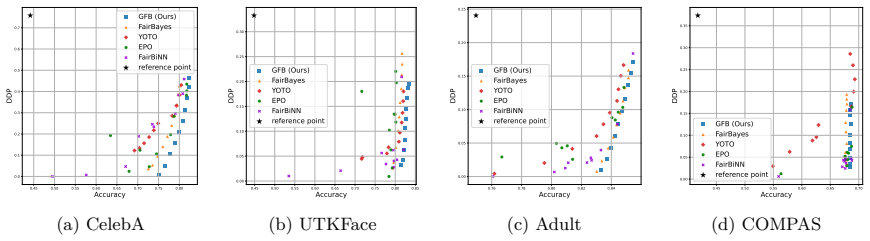
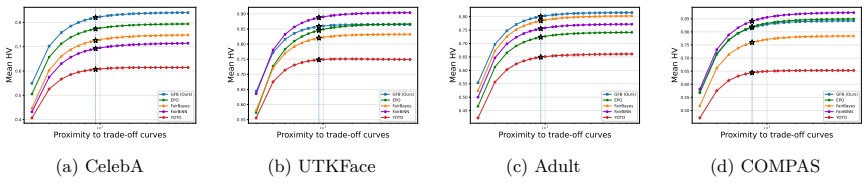
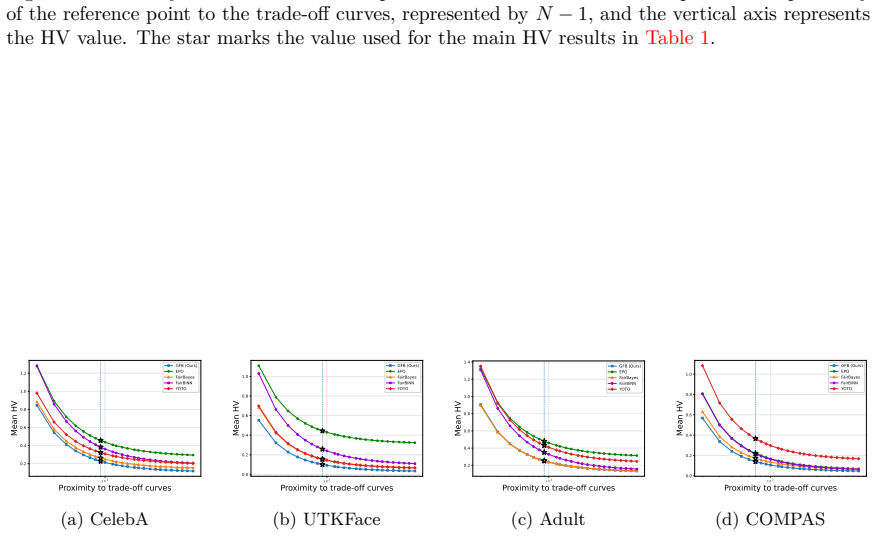
Post-hoc controllability of fair machine learning models, the ability to control the trade-off between fairness and accuracy after training, is valuable for practical deployment. Existing post-processing methods provide such post-hoc controllability but often suffer from significant accuracy degradation, whereas in-processing methods achieve efficient trade-offs but require computationally expensive retraining for each change in trade-off ratio. To achieve both post-hoc controllability and efficient trade-offs, we propose a novel fair classification algorithm that learns effective feature representations to improve the trade-off efficiency of post-processing fair classifiers, by a gradient-based optimization approach. Experimental results on real-world datasets demonstrate that our method achieves trade-off efficiency comparable to, or even surpassing, in-processing methods, without requiring any retraining.
Editorial analysis
A structured set of objections, weighed in public.
Referee Report
Summary. The paper proposes a gradient-based optimization procedure to learn feature representations that improve the fairness-accuracy trade-off efficiency of existing post-processing fair classifiers. This is claimed to achieve trade-off performance comparable to or better than in-processing methods while preserving post-hoc controllability and avoiding any retraining when the trade-off ratio changes. The central claim is supported by experimental results on real-world datasets.
Significance. If the experimental results hold under rigorous evaluation, the work would provide a practical bridge between post-processing (controllable but often inefficient) and in-processing (efficient but requiring retraining) approaches to fair classification, which is valuable for deployment scenarios where fairness-accuracy preferences must be adjusted after initial training.
major comments (2)
- [Abstract] Abstract: the assertion that 'experiments demonstrate' the efficiency claim provides no information on baselines, metrics, statistical significance, data splits, or number of runs, so the degree to which the data supports the central claim cannot be assessed.
- [Method / Optimization objective] The gradient-based optimization of feature representations is presented as reliably enhancing the fairness-accuracy frontier of arbitrary post-processors without introducing new degradations. No theoretical argument or explicit experimental verification is given that the learned representations remain compatible across fairness definitions (e.g., demographic parity versus equalized odds) or held-out distributions.
Simulated Author's Rebuttal
We thank the referee for the detailed feedback. We address each major comment below, clarifying experimental details from the manuscript and the scope of our claims.
read point-by-point responses
-
Referee: [Abstract] Abstract: the assertion that 'experiments demonstrate' the efficiency claim provides no information on baselines, metrics, statistical significance, data splits, or number of runs, so the degree to which the data supports the central claim cannot be assessed.
Authors: We agree the abstract is concise and omits these specifics. Section 4 of the manuscript details the evaluation: baselines include standard post-processing (e.g., Hardt et al.) and in-processing methods; metrics are fairness-accuracy trade-off curves (e.g., via AUC of the frontier); results are averaged over 5 independent runs with standard deviations for statistical significance; data uses standard train/validation/test splits on real-world datasets (Adult, COMPAS, etc.). We will revise the abstract to briefly reference this evaluation protocol for better context. revision: yes
-
Referee: [Method / Optimization objective] The gradient-based optimization of feature representations is presented as reliably enhancing the fairness-accuracy frontier of arbitrary post-processors without introducing new degradations. No theoretical argument or explicit experimental verification is given that the learned representations remain compatible across fairness definitions (e.g., demographic parity versus equalized odds) or held-out distributions.
Authors: The optimization objective is formulated to be independent of any specific fairness constraint, focusing instead on improving the general efficiency of the post-processor’s frontier via representation learning; this design supports compatibility by construction. Experiments in Section 4 explicitly evaluate on both demographic parity and equalized odds, demonstrating consistent gains without degradation. Held-out evaluation uses standard test splits, though we do not provide formal guarantees or tests for arbitrary distribution shifts. We will add a clarifying remark on the empirical scope in the method section. revision: partial
Circularity Check
No significant circularity; method and claims rest on novel optimization plus external empirical validation
full rationale
The paper proposes a gradient-based optimization procedure to learn feature representations that enhance the fairness-accuracy frontier of existing post-processing classifiers. The central claim is that this yields trade-off efficiency comparable or superior to in-processing methods without retraining, supported by experimental results on real-world datasets. No equations, self-citations, or derivations are shown that reduce the claimed result to a fitted parameter, self-definition, or prior author work by construction. The derivation chain is therefore self-contained against external benchmarks and does not exhibit any of the enumerated circularity patterns.
Axiom & Free-Parameter Ledger
Reference graph
Works this paper leans on
-
[1]
2018 , url =
Dastin, Jeffrey , title =. 2018 , url =
2018
-
[2]
Men Also Like Shopping: Reducing Gender Bias Amplification using Corpus-level Constraints
Zhao, Jieyu and Wang, Tianlu and Yatskar, Mark and Ordonez, Vicente and Chang, Kai-Wei. Men Also Like Shopping: Reducing Gender Bias Amplification using Corpus-level Constraints. Proceedings of the 2017 Conference on Empirical Methods in Natural Language Processing. 2017. doi:10.18653/v1/D17-1323
-
[3]
Zafar, Muhammad Bilal and Valera, Isabel and Gomez Rodriguez, Manuel and Gummadi, Krishna P. , title =. 2017 , isbn =. doi:10.1145/3038912.3052660 , booktitle =
-
[4]
Proceedings of the 2017 Conference on Learning Theory , pages =
Learning Non-Discriminatory Predictors , author =. Proceedings of the 2017 Conference on Learning Theory , pages =. 2017 , editor =
2017
-
[5]
Data Mining and Knowledge Discovery , volume =
Calders, Toon and Verwer, Sicco , title =. Data Mining and Knowledge Discovery , volume =. 2010 , doi =
2010
-
[6]
A Fair Classifier Using Kernel Density Estimation , volume =
Cho, Jaewoong and Hwang, Gyeongjo and Suh, Changho , booktitle =. A Fair Classifier Using Kernel Density Estimation , volume =
-
[7]
2024 , eprint=
Bayes-Optimal Classifiers under Group Fairness , author=. 2024 , eprint=
2024
-
[8]
Tsybakov , title =
Alexander B. Tsybakov , title =. The Annals of Statistics , number =. 2004 , doi =
2004
-
[9]
Proceedings of the 1st Conference on Fairness, Accountability and Transparency , pages =
The cost of fairness in binary classification , author =. Proceedings of the 1st Conference on Fairness, Accountability and Transparency , pages =. 2018 , editor =
2018
-
[10]
Knowledge and Information Systems , volume =
Kamiran, Faisal and Calders, Toon , title =. Knowledge and Information Systems , volume =. 2012 , doi =
2012
-
[11]
Pareto Multi-Task Learning , url =
Lin, Xi and Zhen, Hui-Ling and Li, Zhenhua and Zhang, Qing-Fu and Kwong, Sam , booktitle =. Pareto Multi-Task Learning , url =
-
[12]
Proceedings of the 37th International Conference on Machine Learning , pages =
Multi-Task Learning with User Preferences: Gradient Descent with Controlled Ascent in Pareto Optimization , author =. Proceedings of the 37th International Conference on Machine Learning , pages =. 2020 , editor =
2020
-
[13]
Multiclass Confidence and Localization Calibration for Object Detection , year=
Pathiraja, Bimsara and Gunawardhana, Malitha and Khan, Muhammad Haris , booktitle=. Multiclass Confidence and Localization Calibration for Object Detection , year=
-
[14]
Proceedings of the Second International Conference on Knowledge Discovery and Data Mining , pages =
Kohavi, Ron , title =. Proceedings of the Second International Conference on Knowledge Discovery and Data Mining , pages =. 1996 , publisher =
1996
-
[15]
2016 , url =
Angwin, Julia and Larson, Jeff and Mattu, Surya and Kirchner, Lauren , title =. 2016 , url =
2016
-
[16]
Deep Learning Face Attributes in the Wild , year=
Liu, Ziwei and Luo, Ping and Wang, Xiaogang and Tang, Xiaoou , booktitle=. Deep Learning Face Attributes in the Wild , year=
-
[17]
Age Progression/Regression by Conditional Adversarial Autoencoder , year=
Zhang, Zhifei and Song, Yang and Qi, Hairong , booktitle=. Age Progression/Regression by Conditional Adversarial Autoencoder , year=
-
[18]
Fairness-Aware Classifier with Prejudice Remover Regularizer
Kamishima, Toshihiro and Akaho, Shotaro and Asoh, Hideki and Sakuma, Jun. Fairness-Aware Classifier with Prejudice Remover Regularizer. Machine Learning and Knowledge Discovery in Databases. 2012
2012
-
[19]
Empirical Risk Minimization Under Fairness Constraints , volume =
Donini, Michele and Oneto, Luca and Ben-David, Shai and Shawe-Taylor, John S and Pontil, Massimiliano , booktitle =. Empirical Risk Minimization Under Fairness Constraints , volume =
-
[20]
Computational Management Science , volume =
Liu, Suyun and Vicente, Luis Nunes , title =. Computational Management Science , volume =. 2022 , doi =
2022
-
[21]
Journal of Machine Learning Research , year =
Shizhou Xu and Thomas Strohmer , title =. Journal of Machine Learning Research , year =
-
[22]
2024 , doi =
Badar, Maryam and Sikdar, Sandipan and Nejdl, Wolfgang and Fisichella, Marco , booktitle =. 2024 , doi =
2024
-
[23]
Journal of Machine Learning Research , year =
Xuxing Chen and Tesi Xiao and Krishnakumar Balasubramanian , title =. Journal of Machine Learning Research , year =
-
[24]
Proceedings of the 35th International Conference on Machine Learning , pages =
A Reductions Approach to Fair Classification , author =. Proceedings of the 35th International Conference on Machine Learning , pages =. 2018 , editor =
2018
-
[25]
, booktitle =
Zafar, Muhammad Bilal and Valera, Isabel and Rogriguez, Manuel Gomez and Gummadi, Krishna P. , booktitle =. 2017 , editor =
2017
-
[26]
f-FERM: A Scalable Framework for Robust Fair Empirical Risk Minimization , url =
Baharlouei, Sina and Patel, Shivam and Razaviyayn, Meisam , booktitle =. f-FERM: A Scalable Framework for Robust Fair Empirical Risk Minimization , url =
-
[27]
Yazdani-Jahromi, Mehdi and Yalabadi, Ali Khodabandeh and Rajabi, AmirArsalan and Tayebi, Aida and Garibay, Ivan and Garibay, Ozlem , booktitle =. Fair Bilevel Neural Network (FairBiNN): On Balancing fairness and accuracy via Stackelberg Equilibrium , volume =. doi:10.52202/079017-3355 , editor =
-
[28]
Proceedings of the 38th International Conference on Machine Learning , pages =
Fair Classification with Noisy Protected Attributes: A Framework with Provable Guarantees , author =. Proceedings of the 38th International Conference on Machine Learning , pages =. 2021 , editor =
2021
-
[29]
Flexible Regularization Approaches for Fairness in Deep Learning , year=
Olfat, Matt and Mintz, Yonatan , booktitle=. Flexible Regularization Approaches for Fairness in Deep Learning , year=
-
[30]
Scalable and Stable Surrogates for Flexible Classifiers with Fairness Constraints , volume =
Bendekgey, Henry C and Sudderth, Erik , booktitle =. Scalable and Stable Surrogates for Flexible Classifiers with Fairness Constraints , volume =
-
[31]
Yang, Jenny and Soltan, Andrew A. S. and Eyre, David W. and Yang, Yang and Clifton, David A. , title =. npj Digital Medicine , volume =. 2023 , doi =
2023
-
[32]
Achievable Fairness on Your Data With Utility Guarantees , volume =
Taufiq, Muhammad Faaiz and Ton, Jean-Fran. Achievable Fairness on Your Data With Utility Guarantees , volume =. Advances in Neural Information Processing Systems , doi =
-
[33]
Proceedings of the 5th International Conference on Parallel Problem Solving from Nature (PPSN V) , pages=
Multiobjective optimization using evolutionary algorithms—A comparative case study , author=. Proceedings of the 5th International Conference on Parallel Problem Solving from Nature (PPSN V) , pages=
-
[35]
Evolutionary Computation , volume =
Ishibuchi, Hisao and Imada, Ryo and Setoguchi, Yu and Nojima, Yusuke , title =. Evolutionary Computation , volume =. 2018 , month =. doi:10.1162/evco_a_00226 , eprint =
-
[36]
Jovanovic, Raka and Sanfilippo, Antonio P. and Vo. Fixed Set Search Applied to the Multi-Objective Minimum Weighted Vertex Cover Problem , journal =. 2022 , issn =
2022
-
[37]
Transactions on Machine Learning Research , issn=
Table Foundation Models: on knowledge pre-training for tabular learning , author=. Transactions on Machine Learning Research , issn=. 2025 , url=
2025
-
[38]
2018 , doi =
Perez, Ethan and Strub, Florian and de Vries, Harm and Dumoulin, Vincent and Courville, Aaron , booktitle =. 2018 , doi =
2018
-
[39]
A framework for bilevel optimization that enables stochastic and global variance reduction algorithms , volume =
Dagr\'. A framework for bilevel optimization that enables stochastic and global variance reduction algorithms , volume =. Advances in Neural Information Processing Systems , editor =
-
[40]
Fabris, Alessandro and Baranowska, Nina and Dennis, Matthew J. and Graus, David and Hacker, Philipp and Saldivar, Jorge and Zuiderveen Borgesius, Frederik and Biega, Asia J. , title =. 2025 , publisher =. doi:10.1145/3696457 , journal =
-
[41]
International Conference on Learning Representations , year=
You Only Train Once: Loss-Conditional Training of Deep Networks , author=. International Conference on Learning Representations , year=
-
[42]
Building Classifiers with Independency Constraints , year=
Calders, Toon and Kamiran, Faisal and Pechenizkiy, Mykola , booktitle=. Building Classifiers with Independency Constraints , year=
-
[43]
Classifying without discriminating , year=
Kamiran, Faisal and Calders, Toon , booktitle=. Classifying without discriminating , year=
-
[44]
Focal Loss for Dense Object Detection , year=
Lin, Tsung-Yi and Goyal, Priya and Girshick, Ross and He, Kaiming and Dollár, Piotr , journal=. Focal Loss for Dense Object Detection , year=
-
[45]
Multiobjective optimization using evolutionary algorithms --- A comparative case study
Zitzler, Eckart and Thiele, Lothar. Multiobjective optimization using evolutionary algorithms --- A comparative case study. Parallel Problem Solving from Nature --- PPSN V. 1998. doi:10.1007/BFb0056872
-
[46]
Journal of Machine Learning Research , year =
Andrew Cotter and Heinrich Jiang and Maya Gupta and Serena Wang and Taman Narayan and Seungil You and Karthik Sridharan , title =. Journal of Machine Learning Research , year =
-
[47]
Prediction with Model-Based Neutrality
Fukuchi, Kazuto and Sakuma, Jun and Kamishima, Toshihiro. Prediction with Model-Based Neutrality. Machine Learning and Knowledge Discovery in Databases. 2013
2013
-
[48]
The Annals of Statistics , volume =
A Minimax Framework for Quantifying Risk-Fairness Trade-off in Regression , author =. The Annals of Statistics , volume =
-
[49]
Proceedings of the 40th International Conference on Machine Learning , pages =
Fair and Optimal Classification via Post-Processing , author =. Proceedings of the 40th International Conference on Machine Learning , pages =. 2023 , editor =
2023
-
[50]
Pedreshi, Dino and Ruggieri, Salvatore and Turini, Franco , title =. 2008 , isbn =. doi:10.1145/1401890.1401959 , booktitle =
-
[51]
Demographic Parity Constrained Minimax Optimal Regression under Linear Model , volume =
Fukuchi, Kazuto and Sakuma, Jun , booktitle =. Demographic Parity Constrained Minimax Optimal Regression under Linear Model , volume =
-
[52]
Proceedings of the 42nd International Conference on Machine Learning , pages =
Meta Optimality for Demographic Parity Constrained Regression via Post-Processing , author =. Proceedings of the 42nd International Conference on Machine Learning , pages =. 2025 , editor =
2025
-
[53]
Gordon , title =
Han Zhao and Geoffrey J. Gordon , title =. Journal of Machine Learning Research , year =
-
[54]
Equality of Opportunity in Supervised Learning , volume =
Hardt, Moritz and Price, Eric and Srebro, Nati , booktitle =. Equality of Opportunity in Supervised Learning , volume =
-
[55]
doi:10.1145/3097983.309809 , url =
Corbett-Davies, Sam and Pierson, Emma and Feller, Avi and Goel, Sharad and Huq, Aziz , title =. 2017 , isbn =. doi:10.1145/3097983.3098095 , booktitle =
discussion (0)
Sign in with ORCID, Apple, or X to comment. Anyone can read and Pith papers without signing in.