Imitation Learning for Elder-Facing Speech Synthesis
Pith reviewed 2026-06-26 13:22 UTC · model grok-4.3
The pith
Imitation learning from expert demonstrations with two-stage OPRL produces TTS models that better serve older adults than standard GRPO or supervised training.
A machine-rendered reading of the paper's core claim, the machinery that carries it, and where it could break.
Core claim
A novel imitation learning framework learns TTS models from expert demonstrations; when GRPO is augmented with two-stage on-policy reward learning, the resulting models outperform both plain GRPO and supervised baselines on objective and subjective metrics for elder-facing speech synthesis, thereby reducing dependence on large volumes of preference data from older adults.
What carries the argument
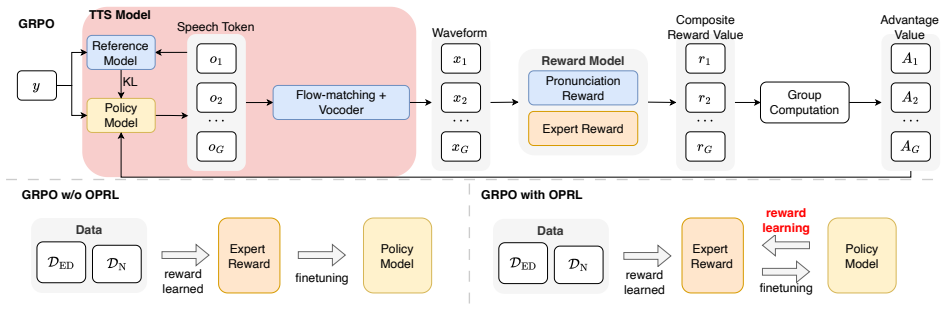
Two-stage on-policy reward learning (OPRL) applied inside Group Relative Policy Optimization (GRPO) to stabilize imitation learning from expert demonstrations under limited supervision.
If this is right
- GRPO w/ OPRL achieves higher objective and subjective scores than GRPO alone or supervised training.
- The approach lowers the amount of preference feedback needed from older adults.
- Imitation from demonstrations can substitute for direct preference tuning in TTS adaptation.
- Two-stage OPRL mitigates reward hacking when expert data is scarce.
Where Pith is reading between the lines
- The same imitation-plus-OPRL pattern could transfer to other domains where direct feedback from the target users is fatiguing or limited.
- Expert demonstrations could be sourced from speech-language pathologists or trained clear-speech actors rather than from the target older adults themselves.
- If the method scales, it might cut data-collection costs for other accessibility adaptations such as child-directed or hearing-impaired speech synthesis.
Load-bearing premise
Sufficient high-quality expert demonstrations exist and the two-stage OPRL step actually prevents reward hacking when supervision is limited.
What would settle it
A listening test with older adults in which GRPO w/ OPRL models score no better than GRPO or supervised baselines on naturalness or comprehension, or where reward hacking is observed despite the OPRL stage.
Figures
read the original abstract
Recent advances in text-to-speech (TTS) synthesis have achieved highly natural and expressive speech generation. However, these systems are designed for general adults and overlook older adults' speech comprehension needs due to age-related sensory and cognitive decline. Prior work involves older adults by collecting preference feedback to tune model parameters. However, obtaining sufficient preference data is costly and difficult, as older adults quickly become fatigued during collection. In this paper, we propose a novel imitation learning (IL) framework to learn TTS models from expert demonstrations. We further improve Group Relative Policy Optimization (GRPO) with two-stage on-policy reward learning (OPRL) to mitigate reward hacking under limited supervision from expert demonstration. Experimental results show that GRPO w/ OPRL outperforms GRPO and supervised baselines in objective and subjective metrics. Audio samples are available at https://dongru1.github.io/demo/im-efss
Editorial analysis
A structured set of objections, weighed in public.
Referee Report
Summary. The paper proposes an imitation learning framework for elder-facing text-to-speech synthesis that learns from expert demonstrations by older adults. It augments Group Relative Policy Optimization (GRPO) with a two-stage on-policy reward learning (OPRL) procedure intended to mitigate reward hacking when expert data are limited due to fatigue, and claims that GRPO w/ OPRL outperforms both plain GRPO and supervised baselines on objective and subjective metrics.
Significance. If the outperformance holds and the OPRL stage is shown to block reward hacking rather than merely mask implementation artifacts, the work would meaningfully advance accessible TTS for older adults by lowering the cost of preference data collection. The combination of imitation learning with on-policy reward refinement in a domain where demonstrations are scarce is a plausible technical contribution.
major comments (2)
- [Experimental results (and abstract)] The central claim that the two-stage OPRL prevents reward hacking under limited expert demonstrations is load-bearing for the headline result, yet the manuscript supplies no targeted validation (ablations, reward-model diagnostics, or policy divergence metrics) showing that the second stage forces genuine improvement in elder-facing synthesis rather than exploitation of gaps in the scarce IL data.
- [Abstract and §4 (Experiments)] Abstract and evaluation sections assert outperformance in objective and subjective metrics but report neither concrete metric values, statistical significance tests, dataset sizes, number of expert demonstrations, nor details of the supervised and GRPO baselines, preventing assessment of whether the claimed gains are reliable.
minor comments (1)
- [Methods] The audio demo link is provided, which aids reproducibility; ensure the methods section explicitly defines the GRPO and OPRL stages with pseudocode or equations so that the two-stage procedure can be replicated.
Simulated Author's Rebuttal
Thank you for the constructive feedback. We address each major comment below and will revise the manuscript to incorporate additional validation and detailed experimental reporting.
read point-by-point responses
-
Referee: [Experimental results (and abstract)] The central claim that the two-stage OPRL prevents reward hacking under limited expert demonstrations is load-bearing for the headline result, yet the manuscript supplies no targeted validation (ablations, reward-model diagnostics, or policy divergence metrics) showing that the second stage forces genuine improvement in elder-facing synthesis rather than exploitation of gaps in the scarce IL data.
Authors: We acknowledge the referee's point that targeted validation of the OPRL mechanism is needed to substantiate the claim of mitigating reward hacking. The two-stage procedure is motivated by the need to refine rewards on-policy after imitation learning when expert demonstrations are limited by fatigue, and the overall results show outperformance over GRPO and supervised baselines. However, the manuscript does not include specific ablations, reward-model diagnostics, or policy divergence metrics to isolate the effect of the second stage. We will add these analyses in revision, including reward accuracy comparisons and divergence metrics before/after OPRL. revision: yes
-
Referee: [Abstract and §4 (Experiments)] Abstract and evaluation sections assert outperformance in objective and subjective metrics but report neither concrete metric values, statistical significance tests, dataset sizes, number of expert demonstrations, nor details of the supervised and GRPO baselines, preventing assessment of whether the claimed gains are reliable.
Authors: The referee is correct that the abstract and §4 lack concrete numerical values, statistical significance tests, dataset sizes, number of expert demonstrations, and baseline implementation details. This limits evaluation of the reported gains. We will revise the abstract and experimental section to include specific metric values (e.g., MOS, objective scores such as MCD/WER), p-values from significance tests, exact dataset and demonstration counts, and full descriptions of the supervised and GRPO baselines. revision: yes
Circularity Check
No significant circularity; result is empirical comparison
full rationale
The paper advances an imitation learning framework for elder-facing TTS and reports that GRPO with two-stage OPRL outperforms baselines on objective and subjective metrics. No equations, derivations, or parameter-fitting steps are described in the provided text that could reduce a claimed prediction to its own inputs by construction. The central claim rests on experimental outcomes rather than any self-definitional, fitted-input, or self-citation load-bearing chain. This is the most common honest finding for purely empirical ML papers.
Axiom & Free-Parameter Ledger
Reference graph
Works this paper leans on
-
[1]
Introduction Text-to-speech (TTS) has advanced rapidly in recent years, reaching highly natural speech generation in many settings [1, 2, 3, 4], enabling speech-based interaction in various daily sce- narios, for example, voice assistants, train announcements, and grocery self-checkouts [5]. Meanwhile, human populations are rapidly ageing worldwide due to...
Pith/arXiv arXiv 2026
-
[2]
Methodology 2.1. Imitation Learning Defining an appropriate reward function is challenging for speech synthesis targeting older adults, as quality is subjec- tive and depends on multiple interacting factors (e.g., natural- ness, intelligibility). Moreover, poorly specified rewards are prone to reward hacking, motivating the use of imitation learn- ing to ...
-
[3]
Experimental Setup Datasets.We use an internal expert demonstration dataset com- prising125pairs of speech samples, with a total duration of1.5 hours
Experiments 3.1. Experimental Setup Datasets.We use an internal expert demonstration dataset com- prising125pairs of speech samples, with a total duration of1.5 hours. Each pair consists of two speech samples of the same content recorded by healthcare professionals from a local hos- pital: one sample is intended for older adults, and the other is in a neu...
-
[4]
Conclusion This paper presents a novel imitation learning framework for elder-facing speech synthesis based on expert demonstrations. We propose the on-policy reward learning (OPRL) strategy, which iteratively refines the reward model with generated speech, for the GRPO pipeline to alleviate the reward hacking problem. The developed elder-facing TTS syste...
-
[5]
Acknowledgement This work is partially supported by the National Natural Science Foundation of China (62306260) and the Centre for Perceptual and Interactive Intelligence, a CUHK-led InnoCentre under the InnoHK initiative of the Innovation and Technology Commis- sion, of the Hong Kong Special Administrative Region Govern- ment
-
[6]
These tools were not used to generate any core scientific ideas, experimen- tal data, or technical contributions
Use of Generative AI Disclosure During the preparation of this manuscript, the authors used gen- erative AI tools exclusively for the purpose of language editing and manuscript polishing to improve readability. These tools were not used to generate any core scientific ideas, experimen- tal data, or technical contributions. All authors have thoroughly revi...
-
[7]
DrawSpeech: Expressive speech synthesis using prosodic sketches as control conditions,
W. Chen, S. Yang, G. Li, and X. Wu, “DrawSpeech: Expressive speech synthesis using prosodic sketches as control conditions,” inICASSP 2025 - 2025 IEEE International Conference on Acous- tics, Speech and Signal Processing (ICASSP). IEEE, 2025, pp. 1–5
2025
-
[8]
CosyV oice 3: Towards In-the-wild Speech Generation via Scaling-up and Post-training,
Z. Du, C. Gao, Y . Wang, F. Yu, T. Zhao, H. Wang, X. Lv, H. Wang, C. Ni, X. Shi, K. An, G. Yang, Y . Li, Y . Chen, Z. Gao, Q. Chen, Y . Gu, M. Chen, Y . Chen, S. Zhang, W. Wang, and J. Ye, “CosyV oice 3: Towards In-the-wild Speech Generation via Scaling-up and Post-training,” May 2025
2025
-
[9]
F5R-TTS: Improving Flow-Matching based Text-to-Speech with Group Rel- ative Policy Optimization,
X. Sun, R. Xiao, J. Mo, B. Wu, Q. Yu, and B. Wang, “F5R-TTS: Improving Flow-Matching based Text-to-Speech with Group Rel- ative Policy Optimization,” Apr. 2025
2025
-
[10]
TTSDS2: Resources and benchmark for evaluating human-quality text to speech systems,
C. Minixhofer, O. Klejch, and P. Bell, “TTSDS2: Resources and benchmark for evaluating human-quality text to speech systems,” inThe Fourteenth International Conference on Learning Representations, 2026. [Online]. Available: https: //openreview.net/forum?id=uGai5lYHlV
2026
-
[11]
The perception of artificial-intelligence (AI) based synthesized speech in younger and older adults,
B. Herrmann, “The perception of artificial-intelligence (AI) based synthesized speech in younger and older adults,”International Journal of Speech Technology, vol. 26, no. 2, pp. 395–415, Jul. 2023
2023
-
[12]
Public Health Chal- lenges and Responses to the Growing Ageing Populations,
H. T. A. Khan, K. M. Addo, and H. Findlay, “Public Health Chal- lenges and Responses to the Growing Ageing Populations,”Pub- lic Health Challenges, vol. 3, no. 3, p. e213, Sep. 2024
2024
-
[13]
Younger and older adults’ rate performance when listening to synthetic speech,
B. Sutton, J. King, K. Hux, and D. Beukelman, “Younger and older adults’ rate performance when listening to synthetic speech,”Augmentative and Alternative Communication, vol. 11, no. 3, pp. 147–153, 1995
1995
-
[14]
Making speech synthesis more accessible to older people,
M. Wolters, P. Campbell, C. DePlacido, A. Liddell, and D. Owens, “Making speech synthesis more accessible to older people,” in Sixth ISCA Workshop on Speech Synthesis, Aug. 2007
2007
-
[15]
Speaking clearly for older adults with normal hearing: The role of speaking rate,
J. C. Krause and A. P. Panagiotopoulos, “Speaking clearly for older adults with normal hearing: The role of speaking rate,”Jour- nal of Speech, Language, and Hearing Research, vol. 62, no. 10, pp. 3851–3859, 2019
2019
-
[16]
HILvoice:Human-in-the-Loop Style Selection for Elder-Facing Speech Synthesis,
X. Chen, Q. Huang, X. Wu, Z. Wu, and H. Meng, “HILvoice:Human-in-the-Loop Style Selection for Elder-Facing Speech Synthesis,” in2022 13th International Symposium on Chi- nese Spoken Language Processing (ISCSLP). Singapore, Singa- pore: IEEE, Dec. 2022, pp. 86–90
2022
-
[17]
Imitation learning by reinforcement learning,
K. Ciosek, “Imitation learning by reinforcement learning,” inInternational Conference on Learning Representations,
-
[18]
Available: https://openreview.net/forum?id= 1zwleytEpYx
[Online]. Available: https://openreview.net/forum?id= 1zwleytEpYx
-
[19]
Algorithms for inverse reinforcement learning,
A. Y . Ng and S. J. Russell, “Algorithms for inverse reinforcement learning,” inProceedings of the Seventeenth International Con- ference on Machine Learning, ser. ICML ’00. San Francisco, CA, USA: Morgan Kaufmann Publishers Inc., 2000, p. 663–670
2000
-
[20]
Advances and applications in inverse reinforcement learning: A comprehensive review,
S. Deshpande, R. Walambe, K. Kotecha, G. Selvachandran, and A. Abraham, “Advances and applications in inverse reinforcement learning: A comprehensive review,”Neural Computing and Ap- plications, vol. 37, no. 17, pp. 11 071–11 123, Jun. 2025
2025
-
[21]
Speechalign: Aligning speech generation to human preferences,
D. Zhang, Z. Li, S. Li, X. Zhang, P. Wang, Y . Zhou, and X. Qiu, “Speechalign: Aligning speech generation to human preferences,” inThe Thirty-eighth Annual Conference on Neural Information Processing Systems, 2024. [Online]. Available: https://openreview.net/forum?id=SKCbZR8Pyd
2024
-
[22]
P. Anastassiou, J. Chen, J. Chen, Y . Chen, Z. Chen, Z. Chen, J. Cong, L. Deng, C. Ding, L. Gao, M. Gong, P. Huang, Q. Huang, Z. Huang, Y . Huo, D. Jia, C. Li, F. Li, H. Li, J. Li, X. Li, X. Li, L. Liu, S. Liu, S. Liu, X. Liu, Y . Liu, Z. Liu, L. Lu, J. Pan, X. Wang, Y . Wang, Y . Wang, Z. Wei, J. Wu, C. Yao, Y . Yang, Y . Yi, J. Zhang, Q. Zhang, S. Zhang...
-
[23]
Preference alignment improves language model- based TTS,
J. Tian, C. Zhang, J. Shi, H. Zhang, J. Yu, S. Watanabe, and D. Yu, “Preference alignment improves language model- based TTS,” inICASSP 2025 - 2025 IEEE International Conference on Acoustics, Speech and Signal Processing (ICASSP). IEEE, 2025, pp. 1–5. [Online]. Available: https: //ieeexplore.ieee.org/document/10890510/
arXiv 2025
-
[24]
Emo- DPO: Controllable emotional speech synthesis through direct preference optimization,
X. Gao, C. Zhang, Y . Chen, H. Zhang, and N. F. Chen, “Emo- DPO: Controllable emotional speech synthesis through direct preference optimization,” inICASSP 2025 - 2025 IEEE Inter- national Conference on Acoustics, Speech and Signal Processing (ICASSP), 2025, pp. 1–5
2025
-
[25]
Fine- Tuning Text-to-Speech Diffusion Models Using Reinforcement Learning with Human Feedback,
J. Chen, J. S. Byun, M. Elsner, P. Wang, and A. Perrault, “Fine- Tuning Text-to-Speech Diffusion Models Using Reinforcement Learning with Human Feedback,” inInterspeech 2025. ISCA, Aug. 2025, pp. 3454–3458
2025
-
[26]
Ad- vancing zero-shot text-to-speech intelligibility across diverse do- mains via preference alignment,
X. Zhang, Y . Wang, C. Wang, Z. Li, Z. Chen, and Z. Wu, “Ad- vancing zero-shot text-to-speech intelligibility across diverse do- mains via preference alignment,” inProceedings of the 63rd An- nual Meeting of the Association for Computational Linguistics (Volume 1: Long Papers), W. Che, J. Nabende, E. Shutova, and M. T. Pilehvar, Eds. Vienna, Austria: Asso...
2025
-
[27]
Group Relative Policy Optimization for Text-to-Speech with Large Lan- guage Models,
C. Liu, Y .-J. Hu, Y .-Y . Gao, S.-L. Zhang, and Z.-H. Ling, “Group Relative Policy Optimization for Text-to-Speech with Large Lan- guage Models,” Sep. 2025
2025
-
[28]
Defining and characterizing reward gaming,
J. M. V . Skalse, N. H. R. Howe, D. Krasheninnikov, and D. Krueger, “Defining and characterizing reward gaming,” in Advances in Neural Information Processing Systems, A. H. Oh, A. Agarwal, D. Belgrave, and K. Cho, Eds., 2022. [Online]. Available: https://openreview.net/forum?id=yb3HOXO3lX2
2022
-
[29]
Reward hacking in reinforcement learning and rlhf: A multidisciplinary examination of vulnerabili- ties, mitigation strategies, and alignment challenges,
T. Hu, W. Zhu, and Y . Yan, “Reward hacking in reinforcement learning and rlhf: A multidisciplinary examination of vulnerabili- ties, mitigation strategies, and alignment challenges,” in2025 5th Intelligent Cybersecurity Conference (ICSC). IEEE, 2025, pp. 272–275
2025
-
[30]
Exploring data scaling trends and effects in reinforcement learning from human feedback,
W. Shen, G. Liu, YuYue, R. Zhu, Q. Yang, C. Xin, and L. Yan, “Exploring data scaling trends and effects in reinforcement learning from human feedback,” inThe Thirty- ninth Annual Conference on Neural Information Processing Systems, 2025. [Online]. Available: https://openreview.net/ forum?id=UQT2inkLmb
2025
-
[31]
Fine-tuning language models with reward learning on policy,
H. Lang, F. Huang, and Y . Li, “Fine-tuning language models with reward learning on policy,” inProceedings of the 2024 Confer- ence of the North American Chapter of the Association for Com- putational Linguistics: Human Language Technologies (Volume 1: Long Papers), K. Duh, H. Gomez, and S. Bethard, Eds. Mex- ico City, Mexico: Association for Computationa...
2024
-
[32]
Learning robust rewards with adver- sarial inverse reinforcement learning,
J. Fu, K. Luo, and S. Levine, “Learning robust rewards with adver- sarial inverse reinforcement learning,” in6th International Con- ference on Learning Representations, ICLR 2018, Vancouver, BC, Canada, April 30 - May 3, 2018, Conference Track Proceedings. OpenReview.net, 2018
2018
-
[33]
StyleTTS 2: Towards human-level text-to-speech through style diffusion and adversarial training with large speech lan- guage models,
Y . A. Li, C. Han, V . S. Raghavan, G. Mischler, and N. Mes- garani, “StyleTTS 2: Towards human-level text-to-speech through style diffusion and adversarial training with large speech lan- guage models,”Advances in neural information processing sys- tems, vol. 36, pp. 19 594–19 621, 2023
2023
-
[34]
Layer Normalization,
J. L. Ba, J. R. Kiros, and G. E. Hinton, “Layer Normalization,” Jul. 2016
2016
-
[35]
Deep Residual Learning for Image Recognition,
K. He, X. Zhang, S. Ren, and J. Sun, “Deep Residual Learning for Image Recognition,” in2016 IEEE Conference on Computer Vision and Pattern Recognition (CVPR). Las Vegas, NV , USA: IEEE, Jun. 2016, pp. 770–778
2016
-
[36]
Rank Analysis of Incom- plete Block Designs: I. The Method of Paired Comparisons,
R. A. Bradley and M. E. Terry, “Rank Analysis of Incom- plete Block Designs: I. The Method of Paired Comparisons,” Biometrika, vol. 39, no. 3/4, p. 324, Dec. 1952
1952
-
[37]
Guide to lshk cantonese romanization of chi- nese characters,
S.-W. Tang, F. Kwok, T. H.-T. Lee, C. Lun, K. K. Luke, P. Tung, and K. H. Cheung, “Guide to lshk cantonese romanization of chi- nese characters,”Hong Kong: Linguistic Society of Hong Kong, 2002
2002
-
[38]
DeepSeekMath: Pushing the Limits of Mathematical Reasoning in Open Language Mod- els,
Z. Shao, P. Wang, Q. Zhu, R. Xu, J. Song, X. Bi, H. Zhang, M. Zhang, Y . K. Li, Y . Wu, and D. Guo, “DeepSeekMath: Pushing the Limits of Mathematical Reasoning in Open Language Mod- els,” Apr. 2024
2024
-
[39]
CosyV oice 2: Scal- able Streaming Speech Synthesis with Large Language Models,
Z. Du, Y . Wang, Q. Chen, X. Shi, X. Lv, T. Zhao, Z. Gao, Y . Yang, C. Gao, H. Wang, F. Yu, H. Liu, Z. Sheng, Y . Gu, C. Deng, W. Wang, S. Zhang, Z. Yan, and J. Zhou, “CosyV oice 2: Scal- able Streaming Speech Synthesis with Large Language Models,” Dec. 2024
2024
-
[40]
WenetSpeech-Yue: A Large-scale Cantonese Speech Corpus with Multi-dimensional Annotation,
L. Li, Z. Guo, H. Chen, Y . Dai, Z. Zhang, H. Xue, T. Zuo, C. Wang, S. Wang, J. Li, J. Kang, X. Xu, H. Bu, B. Zhang, R. Yuan, Z. Zhou, W. Xue, and L. Xie, “WenetSpeech-Yue: A Large-scale Cantonese Speech Corpus with Multi-dimensional Annotation,” Sep. 2025
2025
-
[41]
FunAudioLLM: V oice Understanding and Genera- tion Foundation Models for Natural Interaction Between Humans and LLMs,
K. An, Q. Chen, C. Deng, Z. Du, C. Gao, Z. Gao, Y . Gu, T. He, H. Hu, K. Hu, S. Ji, Y . Li, Z. Li, H. Lu, H. Luo, X. Lv, B. Ma, Z. Ma, C. Ni, C. Song, J. Shi, X. Shi, H. Wang, W. Wang, Y . Wang, Z. Xiao, Z. Yan, Y . Yang, B. Zhang, Q. Zhang, S. Zhang, N. Zhao, and S. Zheng, “FunAudioLLM: V oice Understanding and Genera- tion Foundation Models for Natural ...
2024
-
[42]
Dynamic programming algorithm op- timization for spoken word recognition,
H. Sakoe and S. Chiba, “Dynamic programming algorithm op- timization for spoken word recognition,”IEEE transactions on acoustics, speech, and signal processing, vol. 26, no. 1, pp. 43– 49, 2003
2003
-
[43]
Mel-cepstral distance measure for objective speech quality assessment,
R. Kubichek, “Mel-cepstral distance measure for objective speech quality assessment,” inProceedings of IEEE Pacific Rim Con- ference on Communications Computers and Signal Processing, vol. 1, 1993, pp. 125–128 vol.1
1993
-
[44]
Location-Relative Atten- tion Mechanisms for Robust Long-Form Speech Synthesis,
E. Battenberg, R. Skerry-Ryan, S. Mariooryad, D. Stanton, D. Kao, M. Shannon, and T. Bagby, “Location-Relative Atten- tion Mechanisms for Robust Long-Form Speech Synthesis,” in ICASSP 2020 - 2020 IEEE International Conference on Acous- tics, Speech and Signal Processing (ICASSP). Barcelona, Spain: IEEE, May 2020, pp. 6194–6198
2020
-
[45]
Melody Extraction From Polyphonic Music Signals Using Pitch Contour Characteristics,
J. Salamon and E. Gomez, “Melody Extraction From Polyphonic Music Signals Using Pitch Contour Characteristics,”IEEE Trans- actions on Audio, Speech, and Language Processing, vol. 20, no. 6, pp. 1759–1770, Aug. 2012
2012
-
[46]
CAM++: A Fast and Efficient Network for Speaker Verification Using Context-Aware Masking,
H. Wang, S. Zheng, Y . Chen, L. Cheng, and Q. Chen, “CAM++: A Fast and Efficient Network for Speaker Verification Using Context-Aware Masking,” inInterspeech 2023, 2023, pp. 5301– 5305
2023
-
[47]
R. F. Woolson,Wilcoxon Signed-Rank Test. John Wiley & Sons, Ltd, 2005
2005
-
[48]
A simple sequentially rejective multiple test proce- dure,
S. Holm, “A simple sequentially rejective multiple test proce- dure,”Scandinavian journal of statistics, pp. 65–70, 1979
1979
discussion (0)
Sign in with ORCID, Apple, or X to comment. Anyone can read and Pith papers without signing in.