REVIEW 3 major objections 4 minor 51 references
Living on the edge of instability
T0 review · 3 major / 4 minor · reviewed 2026-08-14 · deepseek-v4-flash
Pith's one-line read For the same unstable potential, 'never diverging' trajectories are exponential-tailed while 'alive at a fixed time' trajectories are power-law-tailed.
desk verdict Generalizes the authors' earlier Q-process results for the cubic potential to all monomial unstable potentials; the light/heavy-tailed dichotomy is the key new result, but the spectral-gap proof for the full class is sketched rather than rigorous and the similarity transformation has a sign typo. read the letter →
The pith
A machine-rendered reading of the paper's core claim, the machinery that carries it, and where it could break.
The reading
What carries the argument
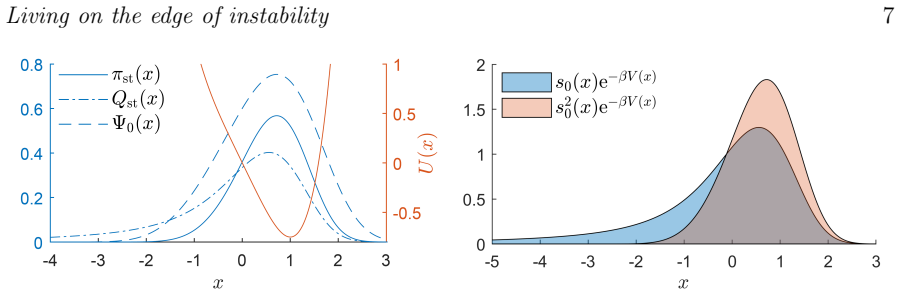
The argument is carried by transforming the non-Hermitian Fokker-Planck operator into a Hermitian Hamiltonian $\hat H = \mathrm{e}^{\beta V/2}\hat L^\dagger \mathrm{e}^{-\beta V/2} = -D\partial_x^2 + U(x)$ with $U(x)=[V'(x)/\gamma]^2/(4D)-V''(x)/(2\gamma)$. Since $U$ is confining whenever $V$ is highly unstable, the spectrum is discrete, and the ground state wave function $\Psi_0$ encodes the two relevant eigenfunctions through $p_0=Z^{-1/2}\mathrm{e}^{-\beta V/2}\Psi_0$ and $s_0=\sqrt{Z}\,\mathrm{e}^{\beta V/2}\Psi_0$. Substituting these relations into the two normalization conditions yields the identity that turns normalization into tail information, and differentiating the left-eigenfunction equation converts the same identity into the asymptotic formulas for both tails. The h-transform then generates an effective statistical force $F_s=2k_BT\,s_0'/s_0$ that confines non-diverging trajectories; its mean-square value is $4\gamma k_BT\lambda_0$.
What would settle it
Compute the two lowest eigenvalues of the transformed Hamiltonian for a family of monomial potentials $V(x)=-\mu|x|^n/n$ with $n$ decreasing toward $2$. If for any $n>2$ with finite mean first-passage time the gap $\lambda_1-\lambda_0$ vanishes, or the spectrum becomes continuous, then the claimed exponential tail for $\pi_{\mathrm{st}}$ and power-law tail for $Q_{\mathrm{st}}$ cannot hold in that regime.
Extended reading notes
Core claim
For potentials $V(x)\sim -|x|^n$ with $n>2$, the paper establishes a dichotomy between the two natural conditional ensembles. The limit distribution of the Q-process is $\pi_{\mathrm{st}}(x)=s_0(x)p_0(x)=\Psi_0^2(x)$, where $p_0$ and $s_0$ are the right and left eigenfunctions of the slowest Fokker-Planck mode and $\Psi_0$ is the ground state of the transformed Hamiltonian; on the unstable side it decays as $\pi_{\mathrm{st}}(x)\sim Z[\lambda_0\gamma/V'(x)]^2 e^{\beta V(x)}$, an exponential tail. The quasi-stationary distribution is $Q_{\mathrm{st}}(x)=p_0(x)$ and decays on the same side as $Q_{\mathrm{st}}(x)\sim \lambda_0\gamma/V'(x)$, which for monomial potentials means the power law $|x|^{-(n-1)}$. The two formulas are forced by a single identity, $\int e^{-\beta V(x)}s_0(x)\,dx = \int e^{-\beta V(x)}s_0^2(x)\,dx$, that follows from the simultaneous normalization of the two eigenfunctions, so the exponential-versus-power-law split is not an accident of a particular potential.
Load-bearing premise
Everything rests on the assumption that, in the long-time limit, one slowest decay mode is cleanly separated from all faster modes; the paper's Section 3 argues for such a spectral gap via the transformed Hamiltonian, but a complete proof for every potential satisfying its defining finite-divergence condition is not given.
Editorial extensions
If this is right
- For monomial unstable potentials, the quasi-stationary left tail is $|x|^{-(n-1)}$, so for a cubic trap no integer moments exist and moment-based averages of the surviving ensemble are undefined.
- The Q-process distribution is localized with an exponential left tail and a logarithmic effective barrier that is impenetrable for $n>2$, so never-diverging trajectories effectively avoid the unstable region.
- Both stationary laws and the generalized partition function depend on the friction constant $\gamma$ through $s_0$, meaning they are kinetic quantities, not purely thermodynamic equilibrium distributions.
- The mean-square effective force obeys $\langle F_s^2\rangle=4\gamma k_BT\lambda_0$, which for monomial potentials scales as $\mu^{1/n}(k_BT)^{(n-1)/n}$; stronger instability and higher temperature both strengthen the confining force.
- On the stable right side, both distributions approach the ordinary tail $\mathrm{e}^{-\beta V(x)}/Z$, so the two conditionings differ visibly only on the unstable side.
Reading between the lines
- A direct experimental test would compare two conditioning protocols on colloid trajectories in a cubic optical trap—conditioning on survival to a fixed observation time versus conditioning on eventual divergence—and check that the log-log slope of the left tail is $-(n-1)$ only in the first protocol.
- The paper's dependence on the order of limits suggests that the crossover from the localized to the heavy-tailed law is observable: an ensemble conditioned at a finite final time should pass from $\pi_{\mathrm{st}}$ to $Q_{\mathrm{st}}$ on a time scale set by $1/(\lambda_1-\lambda_0)$.
- The equal-area identity $\int e^{-\beta V}s_0=\int e^{-\beta V}s_0^2$ may be a useful design principle in higher-dimensional unstable systems: any variational approximation to $s_0$ would immediately yield both tails without a full spectral solution.
- As $n\to 2^+$, the effective force weakens, and the paper itself raises the question of when the Q-process ceases to be stationary; one could test this at potentials just above $n=2$ and look for the disappearance of a normalizable $\pi_{\mathrm{st}}$.
Signed reviews
Editorial analysis
A structured set of objections, weighed in public.
Referee Report
Summary. The paper studies one-dimensional overdamped Brownian motion in potentials that decrease to -∞ so rapidly that the particle reaches infinity in finite time ('highly unstable' potentials). Using the spectral decomposition of the Fokker-Planck operator, it analyzes two conditional ensembles: the Q-process (trajectories conditioned to never diverge) and the quasi-stationary distribution (trajectories conditioned to survive up to the observation time). It derives explicit tail asymptotics: the Q-process limit distribution is light-tailed with exponential decay e^{βV} on the unstable side, while the quasi-stationary distribution is heavy-tailed with a power law ~ |x|^{-(n-1)} for monomial potentials V ~ -|x|^n with n > 2. The paper also derives an exact identity for the generalized partition function, an exact formula for the mean squared effective force, and a scaling law for that force in terms of μ, kBT, and n. The central claim is that the two natural conditional ensembles have fundamentally different statistical properties for all highly unstable systems.
Significance. If correct, the dichotomy established here is conceptually important and practically useful: it distinguishes two natural conditional ensembles in unstable stochastic dynamics and gives explicit, parameter-free asymptotic predictions. The derivations are elegant and largely self-contained: the identity (24) follows from eigenfunction normalization, the tail asymptotics follow from the adjoint eigenvalue equation, and the mean-squared-force result (50) is an exact integration-by-parts identity. The paper provides falsifiable predictions, such as the power-law exponent n-1 and the scaling (54), which are checkable in the colloidal experiments mentioned in the introduction. The connection to Q-process theory and Doob's h-transform is well explained. The monomial results are clean and convincing; the main weakness is the generality of the spectral-gap claim.
major comments (3)
- [Sec. 3, Eqs. (18a)-(18c)] The similarity transformation is mis-signed. Acting on a smooth test function yields e^{βV/2} L† e^{-βV/2} = -(-D∂² + U), not (-D∂² + U) as written; the same sign error is present in Eq. (18b). The correct statement is H = -e^{βV/2} L† e^{-βV/2} = -e^{-βV/2} L e^{βV/2} = -D∂² + U. As written, Eq. (18a) combined with Eq. (20) (H Ψ_n = λ_n Ψ_n) would imply Fokker-Planck eigenvalues +λ_n, contradicting Eq. (6). This is a local sign error, but it appears in the proof of the discrete spectrum and should be corrected.
- [Sec. 3, Eq. (19) and the sentence 'U(x) is always confining for all highly unstable potentials'] The assertion that U(x) is confining for all highly unstable potentials is not proved from the defining finite-mean-first-passage-time condition in Sec. 2. Finite MFPT does not by itself rule out oscillatory potentials for which U(x) has infinitely many deep negative wells and the associated Schrödinger operator has a non-discrete spectrum. Consequently, the discrete-spectrum claim (5), which is load-bearing for the propagator asymptotics (16)-(17), the Q-process propagator (31), and the tail results (48) and (62), is not established for the full class as defined. The monomial potentials (for which U ~ |x|^{2n-2}) are fine, but the 'for all' claims in the abstract and Sec. 7 need either a rigorous proof of discrete spectrum under the stated definition or a more precisely restricted class of potentials.
- [Sec. 6, Eq. (62)] The tail expression Q_st(x) ~ λ0 γ / V'(x) is written without an absolute value. For a potential that decreases to -∞ as x → -∞, V'(x) is negative on that side, which would make the right-hand side negative. The subsequent monomial formula in Eq. (63) correctly uses |x|^{n-1}. Please replace V'(x) by |V'(x)| (or explicitly state that V'(x) is taken in the direction where it is positive).
minor comments (4)
- [Sec. 3, Eq. (18b)] This equation has the same sign issue as Eq. (18a); both should be corrected as described in the major comment.
- [Sec. 6, after Eq. (59)] The cross-reference to '(eq:Qsts0)' is a broken LaTeX label; it should refer to Eq. (59).
- [Sec. 4 and Sec. 6] 'Chapmann-Kolmogorov' should be 'Chapman-Kolmogorov', and 'absorbed Marov chains' should be 'absorbed Markov chains'.
- [Figure 1 caption] The caption labels both the left and right axes of panel (d) with '(d)'; it should read '(d) Left axis: ...' and '(d) Right axis: ...'.
Circularity Check
No significant circularity; central tail predictions follow from spectral decomposition with no fitted constants, though the Sec. 3 spectral-gap argument is incomplete (a correctness issue, not circularity).
full rationale
The paper's derivation chain starts from the Fokker-Planck spectral problem: propagator expansion (9), long-time asymptotics (16)-(17), Q-process propagator (31), and definitions of pi_st and Q_st. The two limit distributions are computed directly from the leading eigenfunction pair (p0, s0) and are not assumed as inputs. The tail asymptotics (48) and (62)-(63) are obtained by integrating the eigenvalue equation for s0 and using the normalization identity (24); the power-law exponent n-1 follows from the assumed monomial form V(x) = mu x^n/n without any fitted parameters. Self-citations ([2,5,24,46]) supply context, earlier cubic-potential results, and references, but do not carry the general derivation; the load-bearing spectral and normalization arguments are carried out in the text. The reviewer-flagged sign inconsistency around Eqs. (18a)-(18b) and the unproved assertion that U(x) is confining for all finite-MFPT potentials are mathematical-rigor and correctness concerns, not circularity: even if the proof of the spectral gap is incomplete, the target results are not being assumed as premises. No equation in the paper reduces to its own input by construction, and no fitted parameter is renamed as a prediction. Hence a low score is appropriate.
Assumptions & free parameters
assumptions (4)
- domain assumption The Fokker-Planck operator for a highly unstable potential has a discrete, well-separated spectrum with positive gap.
- domain assumption The potential V(x) decreases to -∞ at least as -|x|^n with n>2, so that the particle reaches infinity in finite time.
- standard math The eigenfunction expansion (9) converges and the boundary terms in integrations by parts vanish.
- standard math The ground-state wave function Ψ0 is positive and belongs to L^2, so that s0 and p0 are well-defined via (21)-(22).
Cite this review
Pith. "Pith review of Living on the edge of instability." pith.science (2026). https://pith.science/paper/R3RAAU33
@misc{pith2026190804062,
  author       = {Pith},
  title        = {Pith review of: Living on the edge of instability},
  year         = {2026},
  howpublished = {\url{https://pith.science/paper/R3RAAU33}},
  note         = {Machine review of arXiv:1908.04062}
}
read the original abstract
Statistical description of stochastic dynamics in highly unstable potentials is strongly affected by properties of divergent trajectories, that quickly leave meta-stable regions of the potential landscape and never return. Using ideas from theory of Q-processes and quasi-stationary distributions, we analyze position statistics of non-diverging trajectories. We discuss two limit distributions which can be considered as (formal) generalizations of the Gibbs canonical distribution to highly unstable systems. Even though the associated effective potentials differ only slightly, properties of the two distributions are fundamentally different for all highly unstable system. The distribution for trajectories conditioned to diverge in an infinitely distant future is localized and light-tailed. The other distribution, describing trajectories surviving in the meta-stable region at the instant of conditioning, is heavy-tailed. The exponent of the corresponding power-law tail is determined by the leading divergent term of the unstable potential. We discuss different equivalent forms of the two distributions and derive properties of the effective statistical force arising in the ensemble of non-diverging trajectories after the Doob h-transform. The obtained explicit results generically apply to non-linear dynamical models with meta-stable states and fast kinetic transitions.
Figures

Reference graph
Works this paper leans on
-
[1]
ˇSiler M, J´ akl P, Brzobohat O, Ryabov A, Filip R and Zem´ anek P 2017 Sci. Rep. 7 1697 URL https://doi.org/10.1038/s41598-017-01848-4
-
[2]
ˇSiler M, Ornigotti L, Brzobohat´ y O, J´ akl P, Ryabov A, Holubec V, Zem´ anek P and Filip R 2018 Phys. Rev. Lett. 121 230601 URL https://doi.org/10.1103/PhysRevLett.121.230601
-
[3]
Filip R and Zem´ anek P 2016J. Opt. 18 065401 URL https://doi.org/10.1088/2040-8978/18/ 6/065401
-
[4]
Zem´ anek P,ˇSiler M, Brzobohat´ y O, J´ akl P and Filip R 2016 J. Opt. 18 065402 URL https: //doi.org/10.1088/2040-8978/18/6/065402
-
[5]
Ornigotti L, Ryabov A, Holubec V and Filip R 2018 Phys. Rev. E 97 032127 URL http: //doi.org/10.1103/PhysRevE.97.032127
-
[6]
Henri Poincar´ e16 2005 URL https://doi.org/10.1007/ s00023-014-0375-8
Chetrite R and Touchette H 2015 Ann. Henri Poincar´ e16 2005 URL https://doi.org/10.1007/ s00023-014-0375-8
work page 2015
-
[7]
Collet P, Mart´ ınez S and San Mart´ ın J 2013 Quasi-Stationary Distributions: Markov Chains, Diffusions and Dynamical Systems (Springer-Verlag Berlin Heidelberg) ISBN 978-3-642-33130-5 URL https://doi.org/10.1007/978-3-642-33131-2
-
[8]
Doob J L 2001 Classical Potential Theory and Its Probabilistic Counterpart (Springer-Verlag Berlin Heidelberg) ISBN 978-3-540-41206-9 URL https://doi.org/10.1007/978-3-642-56573-1
Show all 51 references
-
[9]
Redner S 2001 A Guide to First-Passage Processes (Cambridge University Press) ISBN 9780511606014 URL https://doi.org/10.1017/CBO9780511606014
2001 doi
-
[10]
H¨ anggi P, Talkner P and Borkovec M 1990Rev. Mod. Phys. 62 251–341 URL https://doi.org/ 10.1103/RevModPhys.62.251
-
[11]
Arecchi F T, Politi A and Ulivi L 1982 Il Nuovo Cimento B (1971-1996) 71 119–154 URL http://dx.doi.org/10.1007/BF02721698
1982 doi
-
[12]
Young M R and Singh S 1985 Phys. Rev. A 31(2) 888–891 URL https://doi.org/10.1103/ PhysRevA.31.888
1985
-
[13]
Colet P, San Miguel M, Casademunt J and Sancho J M 1989 Phys. Rev. A 39 149–156 URL https://doi.org/10.1103/PhysRevA.39.149
1989 doi
-
[14]
Hirsch J E, Huberman B A and Scalapino D J 1982 Phys. Rev. A 25 519–532 URL https: //doi.org/10.1103/PhysRevA.25.519
1982 doi
-
[15]
Sigeti D and Horsthemke W 1989 J. Stat. Phys. 54 1217–1222 URL http://dx.doi.org/10. 1007/BF01044713
1989
-
[16]
Ram´ ırez-Piscina L and Sancho J M 1991 Phys. Rev. A 43 663–668 URL https://doi.org/10. 1103/PhysRevA.43.663
1991
-
[17]
C´ aceres M O, Budde C E and Sibona G J 1995 J. Phys. A: Math. Gen. 28 3877 URL https://doi.org/10.1088/0305-4470/28/14/009
1995 doi
-
[18]
Mantegna R N and Spagnolo B 1996 Phys. Rev. Lett. 76 563–566 URL https://doi.org/10. 1103/PhysRevLett.76.563
1996
-
[19]
Agudov N V 1998 Phys. Rev. E 57 2618–2625 URL https://doi.org/10.1103/PhysRevE.57. 2618 Living on the edge of instability 18
1998 doi
-
[20]
15 1761–1788 URL https://doi.org/ 10.1162/08997660360675035
Lindner B, Longtin A and Bulsara A 2003 Neural Comput. 15 1761–1788 URL https://doi.org/ 10.1162/08997660360675035
2003 doi
-
[21]
15 2281–2306 URL https://doi.org/10.1162/ 089976603322362365
Brunel N and Latham P E 2003 Neural Comput. 15 2281–2306 URL https://doi.org/10.1162/ 089976603322362365
2003
-
[22]
Fiasconaro A, Spagnolo B and Boccaletti S 2005 Phys. Rev. E 72 061110 URL https://doi. org/10.1103/PhysRevE.72.061110
2005 doi
-
[23]
C´ aceres M O 2008 J. Stat. Phys. 132 487–500 URL http://dx.doi.org/10.1007/ s10955-008-9554-7
2008
-
[24]
Ryabov A, Zem´ anek P and Filip R 2016Phys. Rev. E 94 042108 URL http://doi.org/10.1103/ PhysRevE.94.042108
-
[25]
Agudov N V and Malakhov A N 1999 Phys. Rev. E 60 6333–6342 URL https://doi.org/10. 1103/PhysRevE.60.6333
1999
-
[26]
Dubkov A A, Agudov N V and Spagnolo B 2004 Phys. Rev. E 69 061103
2004
-
[27]
Gardiner C 2009 Stochastic Methods: A Handbook for the Natural and Social Sciences 4th ed (Springer, Berlin, Heidelberg) ISBN 978-3-540-70712-7 URL http://www.springer.com/ 978-3-540-70712-7
2009
-
[28]
Haken H 2004 Synergetics: Introduction and Advanced Topics (Springer, Berlin, Heidelberg) ISBN 978-3-642-07405-9 URL https://doi.org/10.1007/978-3-662-10184-1
2004 doi
-
[29]
Risken H 1996 The Fokker-Planck Equation: Methods of Solution and Applications 2nd ed (Springer, Berlin, Heidelberg) ISBN 978-3-540-61530-9 URL https://doi.org/10.1007/ 978-3-642-61544-3
1996
-
[30]
Van Kampen N G 2007 Stochastic Processes in Physics and Chemistry 3rd ed (North Holland) ISBN 978-0-444-52965-7 URL https://doi.org/10.1016/B978-0-444-52965-7.X5000-4
2007 doi
-
[31]
Berezin F A and Shubin M 1991 The Schr¨ odinger Equation(Springer Netherlands) ISBN 978-0- 7923-1218-5 URL https://doi.org/10.1007/978-94-011-3154-4
1991 doi
-
[32]
Lambert A 2007 Electron. J. Probab. 12 420 URL https://doi.org/10.1214/EJP.v12-402
2007 doi
-
[33]
Surveys 9 340 URL https://doi.org/10.1214/ 11-PS191
M´ el´ eard S and Villemonais D 2012 Probab. Surveys 9 340 URL https://doi.org/10.1214/ 11-PS191
2012
-
[34]
Jack R L and Sollich P 2010 Prog. Theor. Phys. Suppl. 184 304 URL https://doi.org/10.1143/ PTPS.184.304
2010
-
[35]
Chetrite R and Touchette H 2013 Phys. Rev. Lett. 111 120601 URL https://doi.org/10.1103/ PhysRevLett.111.120601
2013
-
[36]
Nyawo P T and Touchette H 2016 Phys. Rev. E 94 032101 URL https://doi.org/10.1103/ PhysRevE.94.032101
2016
-
[37]
Nyawo P T and Touchette H 2018 Phys. Rev. E 98 052103 URL https://doi.org/10.1103/ PhysRevE.98.052103
2018
-
[38]
Tiz´ on-Escamilla N, Lecomte V and Bertin E 2019 J. Stat. Mech. 2019 013201 URL https: //doi.org/10.1088/1742-5468/aaeda3
2019 doi
-
[39]
Lazarescu A, Cossetto T, Falasco G and Esposito M 2019 arXiv e-prints arXiv:1902.08416 URL https://arxiv.org/abs/1902.08416
2019 arXiv
-
[40]
Basu U, Maes C and Netoˇ cn´ y K 2015Phys. Rev. Lett. 114 250601 URL https://doi.org/10. 1103/PhysRevLett.114.250601
-
[41]
Basu U, Krger M, Lazarescu A and Maes C 2015 Phys. Chem. Chem. Phys. 17 6653 URL http://dx.doi.org/10.1039/C4CP04977B
2015 doi
-
[42]
Maes C 2016 Math. Mech. Complex Syst. 4 275 URL http://dx.doi.org/10.2140/memocs.2016. 4.275
2016 doi
-
[43]
Maes C 2018 Non-Dissipative Effects in Nonequilibrium Systems (Springer International Publishing) ISBN 978-3-319-67779-8 URL https://doi.org/10.1007/978-3-319-67780-4
2018 doi
-
[44]
Rold´ an´E and Vivo P 2019 arXiv e-prints arXiv:1903.08271 URL https://arxiv.org/abs/1903. 08271
2019 arXiv
-
[45]
Bray A J 2000 Phys. Rev. E 62 103 URL https://doi.org/10.1103/PhysRevE.62.103 Living on the edge of instability 19
2000 doi
-
[46]
Ryabov A, Berestneva E and Holubec V 2015 J. Chem. Phys. 143 114117 URL https://doi. org/10.1063/1.4931474
2015 doi
-
[47]
Yaglom A M 1947 Dokl. Acad. Nauk SSSR (in Russian) 56 795
1947
-
[48]
Mandl P 1961 Czechoslovak Math. J. 11 558 URL http://eudml.org/doc/12097
1961
-
[49]
Darroch J N and Seneta E 1965 J. Appl. Probab. 2 88 URL https://doi.org/10.2307/3211876
1965 doi
-
[50]
Seneta E and Vere-Jones D 1966 J. Appl. Probab. 3 403 URL https://doi.org/10.2307/3212128
1966 doi
-
[51]
Aghion E, Kessler D A and Barkai E 2019 Phys. Rev. Lett. 122 010601 URL https://doi.org/ 10.1103/PhysRevLett.122.010601
2019 doi
Reviewed August 14, 2026 · model on record in the stance chip above.
Discussion (0). Continue with ORCID to comment.