REVIEW 4 major objections 4 minor 24 references
The Role of Vacuum Fluctuations and Symmetry in the Hydrogen Atom in Quantum Mechanics and Stochastic Electrodynamics (SED)
T0 review · 4 major / 4 minor · reviewed 2026-08-14 · deepseek-v4-flash
Pith's one-line read Stochastic electrodynamics cannot reproduce the hydrogen atom because its extra forces break the exact O(4) symmetry that fixes quantum levels.
desk verdict A fair, clearly written review of SED's hydrogen-atom problem; the pessimistic conclusion rests on simulation evidence that the paper itself flags as numerically uncertain, so treat it as an informed judgment rather than a theorem. read the letter →
The pith
A machine-rendered reading of the paper's core claim, the machinery that carries it, and where it could break.
The reading
What carries the argument
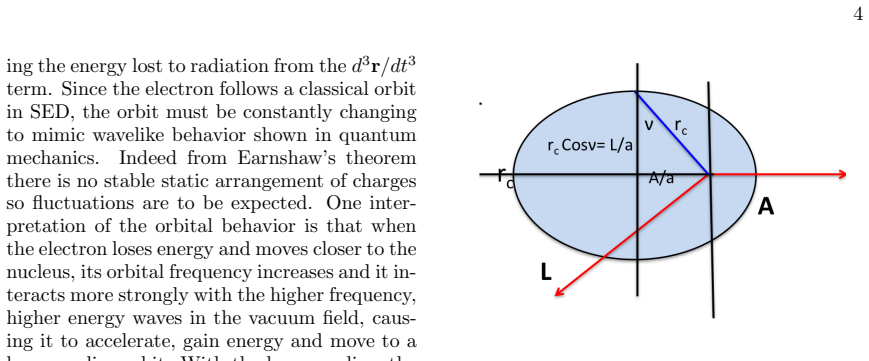
The central object is the $O(4)$ symmetry group of the hydrogen Hamiltonian, generated by the angular momentum $\mathbf{L}$ and the Runge-Lenz vector $\mathbf{A}$, with the identity $L^2 + A^2 + 1 = n^2$ fixing the $n^2$-fold degenerate levels. In quantum mechanics this symmetry survives because the vacuum and radiation-reaction effects are renormalized away; in SED the opposed machinery is the Abraham-Lorentz equation, $$m\,\frac{$d^{2}$\mathbf{r}}{$dt^{2}$} = -\frac{$Ze^{2}$\mathbf{r}}{$r^{3}$} + \frac{$2e^{2}$}{$3c^{2}$}\frac{$d^{3}$\mathbf{r}}{$dt^{3}$} - e(\mathbf{E}+\mathbf{v}\times\mathbf{B}),$$ a third-order equation whose radiative-reaction term and random field explicitly break the conservation of $\mathbf{L}$ and $\mathbf{A}$ and drive the energy toward zero at long times. The contrast between these two objects carries the whole argument.
What would settle it
Run the 2015 three-dimensional SED simulation beyond $10^7$ Bohr times in double precision with a fixed ultraviolet cutoff and monitor the energy: if the electron remains bound with energy hovering near $-0.5$ Bohr units and the radial density approaches the quantum ground-state distribution, the claim that SED inevitably ionizes is falsified; if ionization persists, the claim survives.
Extended reading notes
Core claim
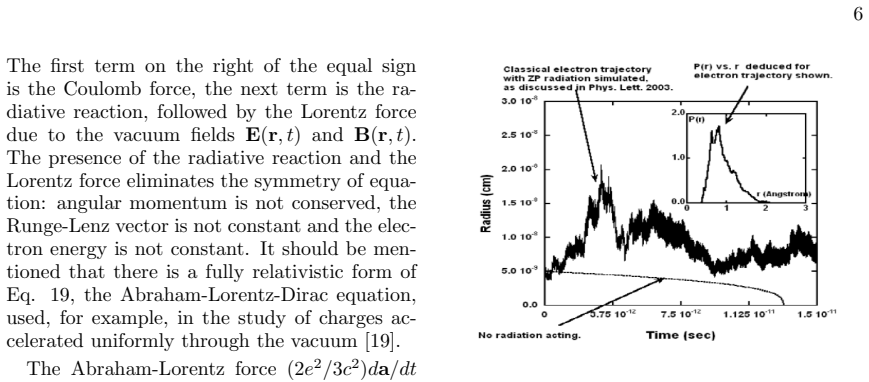
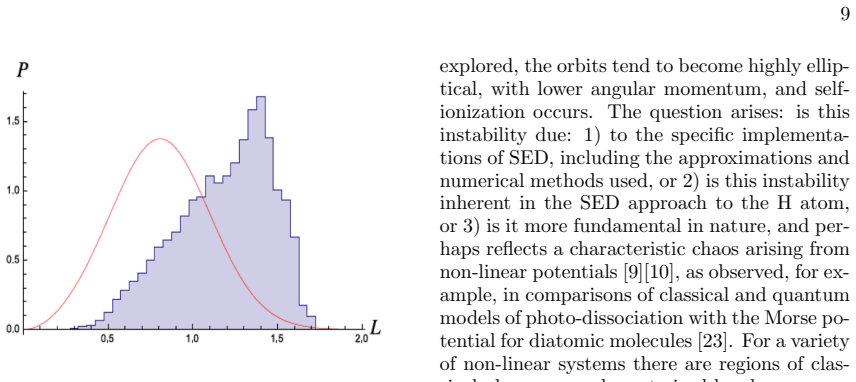
The central claim is that the current SED program is unlikely to produce a stable hydrogen ground state, let alone quantized angular momentum, correct degeneracies, or transitions. Earlier simulations and later higher-powered simulations both found that the stochastic zero-point field prevents the classical electron from spiraling into the proton on short time scales, but that on longer time scales the energy rises toward zero and the orbit becomes so eccentric that self-ionization occurs. The paper locates the difficulty in the equations of motion: the Abraham-Lorentz force and the fluctuating field break time-translation, rotational, and Runge-Lenz symmetries of the Coulomb Hamiltonian, so angular momentum, energy, and eccentricity are no longer conserved quantities. In QED these effects are separated and renormalized, preserving the symmetry that determines the spectrum; in SED they are lumped together and overwhelm it. The paper concludes that with the current SED approach it is very difficult to see a path to the quantum ground state, which is spherically symmetric with zero angular momentum, and that achieving such a state would likely push SED toward becoming a reformulation of quantum mechanics.
Load-bearing premise
The argument assumes the long-time ionizations in the simulations reflect genuine SED dynamics and not artifacts of frequency cutoffs, replacement of 3d sums by 1d sums, or numerical integration error; the paper itself flags this as an open question.
Editorial extensions
If this is right
- If the argument is right, the long-time ionization seen in SED simulations is not a numerical accident but a structural feature of the theory.
- If the argument is right, adding more plane waves or more computing power will not cure the instability, because the symmetry-breaking terms themselves are responsible.
- If the argument is right, any viable SED model of hydrogen must either restore the conserved quantities by construction or modify SED until it is essentially a reformulation of quantum mechanics.
- If the argument is right, the short-time agreement with the quantum radial distribution found in early simulations is a transient, not a convergence to the ground state.
Reading between the lines
- A testable extension would be to run SED simulations with the radiative-reaction term artificially suppressed to see whether the ionization time and eccentricity growth are governed by the Abraham-Lorentz force or by the field statistics; the paper's symmetry argument predicts the former.
- The same symmetry-breaking diagnosis likely applies beyond hydrogen: any SED attempt to model atoms whose spectra are fixed by an enhanced symmetry group will face the same instability.
- The low-angular-momentum ionization threshold identified near $0.588\hbar$ suggests a possible analytic target: proving that the SED stochastic process is non-recurrent for the $1/r$ potential would convert the numerical instability into a theorem.
- If SED were modified to preserve $O(4)$ by construction, it might reproduce the quantum spectrum, but it would then have to explain why the modified dynamics is not simply a hidden-variable rendering of the Schrödinger equation.
Signed reviews
Editorial analysis
A structured set of objections, weighed in public.
Referee Report
Summary. The paper reviews the status of stochastic electrodynamics (SED) as a model of the hydrogen atom. It contrasts the O(4)/Runge-Lenz symmetry of the Coulomb Hamiltonian in quantum mechanics with the symmetry-breaking terms in the Abraham-Lorentz equation used in SED, and summarizes numerical simulations by Cole and Zou and by Nieuwenhuizen and Liska. These simulations show that the stochastic zero-point field can prevent the classical electron from collapsing for tens to hundreds of thousands of orbits, but that the atom eventually ionizes at longer times. The paper concludes that, although SED has had successes elsewhere, the current SED approach faces serious difficulties in producing a stable hydrogen ground state with quantized angular momentum, the correct degeneracy, and transitions. The paper is a critical review rather than a new derivation or simulation.
Significance. If its assessment is correct, the paper is a useful checkpoint for the SED program. It provides a clear inventory of the gap between the symmetry structure of the quantum hydrogen atom and the dynamics of the Abraham-Lorentz equation with a stochastic field, and its summary of the prior simulations appears accurate. The paper is also honest: it explicitly lists the possibility that the long-time ionization may be an artifact of numerical implementation, and it does not claim to have proven a no-go theorem. The symmetry discussion is standard material and independently verifiable, and no new fitted parameters or invented entities are introduced. Its value is therefore primarily as a critical review; it does not supply a quantitative argument, such as an invariant-measure or Fokker-Planck analysis, that would establish the impossibility of a stationary SED hydrogen ground state.
major comments (4)
- [Section VI, Sections III-IV] The central conclusion that the 'current SED approach' cannot model the hydrogen atom is broader than the evidence presented. The symmetry analysis shows that L and A are not conserved along individual Abraham-Lorentz trajectories, but a stochastic dissipative system can have a stationary probability distribution even when no single trajectory conserves L or A; the quantum ground state is an ensemble property. The paper itself acknowledges in Section VI that the long-time instability could be due to implementation, could be inherent to SED, or could reflect a more fundamental chaos. Since the conclusion is not a theorem, it should be scoped to the reported simulations, with an explicit statement that no no-go result has been established, unless the author supplies a quantitative argument against a stationary distribution with the correct radial density and zero mean angular momentum.
- [Section V, Fig. 6] The decisive empirical evidence for the paper's main claim is the long-time ionization seen in the simulations, but the numerical sensitivity of that result is not resolved. The paper reports that changing to double precision with a fixed cutoff made ionization occur at an earlier time and states that it is not clear why the computational upgrades led to earlier ionization. Since a truncated stochastic spectrum, a finite box, the replacement of the 3D k-sum by a 1D frequency sum, an approximate radiation-reaction term, and a fourth-order Runge-Kutta scheme with interpolation can all introduce long-time drift, the review should either report the convergence and robustness tests that are available in the cited works or explicitly conclude that the long-time fate of SED hydrogen is currently unknown. Without such an assessment, the empirical foundation for the strongest conclusion is missing.
- [Section IV, Eq. (19)] There is a dimensional error in the central equation of motion. The Abraham-Lorentz term is written as (2e^2/3c^2) d^3r/dt^3, which in Gaussian units has dimensions of g cm^2/s^3 rather than force; the standard radiation-reaction force is (2e^2/3c^3) d^3r/dt^3. Because Eq. (19) is the equation whose symmetry properties the paper critiques and is quoted as the basis of the SED simulations, the factor should be corrected and checked against the equations actually used in the Cole-Zou and Nieuwenhuizen-Liska simulations.
- [Sections I and VI] The paper treats 'SED' as a single approach, but SED contains distinct formulations, including those of de la Peña and Cetto [16], Puthoff [5], and Claverie and Soto [6]. The critique in Section VI is directed at the specific combination of the Abraham-Lorentz equation with a truncated finite-sum stochastic field used in the cited simulations. The conclusion should be scoped to that implementation unless the author explains why the alternative formulations are equivalent for the hydrogen-atom problem; as written, the paper overstates the reach of its analysis.
minor comments (4)
- [Section II, Eq. (1)] The quantity in Eq. (1) is labeled E but is described in the text as 'the vector potential'; the notation should be made consistent, and the gradient/sign convention for the fields from the vector potential should be stated correctly, since E = -∂A/∂t - ∇φ is not the same as -∂A/∂r.
- [Section III, Eq. (13)] The right-hand side of Eq. (13) has a sign error: L^2 + A^2 is positive, so the expression should be m(Ze^2)^2/(2|E|), not -m(Ze^2)^2/(2|E|). The later equations are consistent with the positive sign.
- [Section III, Eq. (7)] The definition of the Runge-Lenz vector in Eq. (7) appears dimensionally inconsistent as printed; if a is defined as (-2mE)^{1/2}, the first term p×L/(2a) has different dimensions from the second term mZe^2 r/r. The standard definition or the chosen units should be stated explicitly.
- [Abstract and keywords] There is a misspelling of 'fluctuations' in the abstract, and the keywords line repeats 'Key words'; the PACS codes should be listed as separate items rather than run together.
Circularity Check
No circularity: the review's symmetry analysis is standard and its critical conclusion rests on external simulations, not on self-defined or fitted inputs.
full rationale
The paper is a critical review that contrasts the O(4) symmetry of the Coulomb Hamiltonian with SED simulations; it does not fit parameters and then rename them as predictions. The symmetry derivation in Section III is a standard textbook treatment (commutators of L and A, O(4) algebra, quantized levels), and the claim that adding the Abraham-Lorentz and stochastic-force terms breaks conservation of L, A, and E follows directly from the form of Eq. (19), not from a circular fit. The main conclusion that current SED approaches are unlikely to yield a stable hydrogen atom is supported by external simulations (Cole-Zou, Nieuwenhuizen-Liska) and is explicitly qualified by the paper's own list of possible causes of the simulated instability. The only self-citation is Ref. [18] for the SO(4,2) enlargement and radiative level-shift calculation; this is a peripheral group-theoretic remark, not load-bearing for the central claim. No equation reduces to its input by construction, and no fitted quantity is presented as an independent prediction. Accordingly, the finding is no significant circularity, with score 0.
Assumptions & free parameters
assumptions (4)
- domain assumption The Abraham-Lorentz equation (Eq. 19) correctly describes the motion of a classical electron in SED, including radiative reaction and the Lorentz force from the stochastic field.
- domain assumption The stochastic zero-point field has the same spectral energy density as the QED vacuum, rho(omega) = hbar omega^3 / (2 pi^2 c^3), and the simulations' finite frequency cutoffs do not alter the essential physics.
- standard math The Runge-Lenz vector and O(4) symmetry results for the Coulomb Hamiltonian are valid as standard quantum and classical mechanics.
- domain assumption The cited numerical simulations (Cole & Zou 2003, Nieuwenhuizen & Liska 2015-2016) faithfully represent the behavior of SED equations.
Cite this review
Pith. "Pith review of The Role of Vacuum Fluctuations and Symmetry in the Hydrogen Atom in Quantum Mechanics and Stochastic Electrodynamics (SED)." pith.science (2026). https://pith.science/paper/R3ZMBIVD
@misc{pith2026190807343,
  author       = {Pith},
  title        = {Pith review of: The Role of Vacuum Fluctuations and Symmetry in the Hydrogen Atom in Quantum Mechanics and Stochastic Electrodynamics (SED)},
  year         = {2026},
  howpublished = {\url{https://pith.science/paper/R3ZMBIVD}},
  note         = {Machine review of arXiv:1908.07343}
}
read the original abstract
Stochastic Electrodynamics (SED) has had success modeling black body radiation, the harmonic oscillator, the Casimir effect, van der Waals forces, diamagnetism, and uniform acceleration of electrodynamic systems using the stochastic zero-point fluctuations of the electromagnetic field with classical mechanics. However the hydrogen atom, with its 1/r potential remains a critical challenge. Cole and Zou in 2003 and Nieuwenhuizen and Liska in 2015 found that the SED field prevented the electron orbit from collapsing into the proton but eventually the atom became ionized. We look at the issues of the H atom and SED from the perspective of symmetry of the quantum mechanical Hamiltonian which is used to obtain the quantum mechanical results, and the Abraham-Lorentz equation, which is a force equation that includes the effects of radiation reaction and is used to obtain the SED simulations. We contrast the physical computed effects of the quantized electromagnetic vacuum flucuations with the role of the real stochastic electromagnetic field.
Figures

Figures from the paper (3 more)


Reference graph
Works this paper leans on
-
[16]
de la Pena, L. and Cetto, A. The Quantum Dice: An Introduction to Stochastic Electro- dynamics, 1996 Kluwer Publishers, Dortrecht
work page 1996
-
[5]
Ground state of hydrogen as a zero- point-fluctuation-determined state
Puthoff, H. Ground state of hydrogen as a zero- point-fluctuation-determined state. Phys. Rev. D 1987 35, 3266; Puthoff, H. Quantum ground states as equilibrium particle-vacuum inter- action states. Quantum Stud.:Math. Found. 2016 3:5-10
work page 1987
-
[6]
Claverie, P. and Soto, F. Nonrecurrence of the stochastic process for the hydrogen atom problem in stochastic electrodynamics. Math. Phys.1982 23, 753
work page 1982
-
[1]
Atomic spectra and atomic structure, Dover Publications, New York, USA, 1944
Hertzberg, G. Atomic spectra and atomic structure, Dover Publications, New York, USA, 1944
work page 1944
-
[2]
et al, The Rydberg constant and pro- ton size from atomic hydrogen
Beyer, A. et al, The Rydberg constant and pro- ton size from atomic hydrogen. Science 2017 358, 89
work page 2017
-
[3]
Cole, D. and Zou, Y. Quantum mechanical ground state of hydrogen obtained from clas- sical electrodynamics. Physics Letters A 2003 317, 14-20
work page 2003
-
[4]
Cole, D. and Zou, Y. Perturbation Analysis and Simulation Study of the Effects of Phase on the Classical Hydrogen Atom Interacting with Circularly Polarized Electromagnetic Ra- diation. J.Sci. Computing 2004 21, 145; Cole, D and Zou, Y, Simulation Study of Aspects of the Classical Hydrogen Atom Interacting with Electromagnetic Radiation:Elliptical Orbits. ...
work page 2004
-
[7]
Boyer, T. H. (1975). Random electrodynamics: The theory of classical electrodynamics with classical electromagnetic zero-point radiation. 1975 Phys. Rev. D 11(4), 790–808
work page 1975
Show all 24 references
-
[8]
Simulation Results Related to Stochastic Electrodynamics
Cole, D. Simulation Results Related to Stochastic Electrodynamics. AIP Conf. Proc. 2006 No. 810,p.99-113. https://doi.org/10.1063/1.2158714
2006 doi
-
[9]
Classical Electrodynamic Systems In- teracting with Classical Electromagnetic Ran- dom Radiation
Cole, D. Classical Electrodynamic Systems In- teracting with Classical Electromagnetic Ran- dom Radiation. 1989 Foundations of Physics 20, 225
1989
-
[10]
Subharmonic resonance and critical ec- centricity for the classical hydrogen atomic sys- tem, Eur
Cole D. Subharmonic resonance and critical ec- centricity for the classical hydrogen atomic sys- tem, Eur. Phys. J. D. 2018, vol. 72 (11) 200
2018
-
[11]
and Zou, Y
Cole D. and Zou, Y. Subharmonic resonance behavior for the classical hydrogen atomic sys- tem. J. Sci. Computing 2009 39, 1
2009
-
[12]
and Liska, M
Niewenhuizen, T. and Liska, M. Simulation of the hydrogen ground state in Stochastic Electrodynamics 2015. Physica Scripta T165: 014006; Niewenhuizen, T. and Liska, M
2015
-
[13]
and Liska, M
Niewenhuizen, T. and Liska, M. Simulation of the hydrogen ground state in Stochas- tic Electrodynamics-2 2016 Foundations of Physics 45, 1190
2016
-
[14]
Classical phase space density for the relativistic hydrogen atom
Niewenhuizen, T. Classical phase space density for the relativistic hydrogen atom. 2006 AIP Conf. Proc. 810,p 198. 11
2006
-
[15]
On the stability of classical orbits of the hydrogen ground state in Stochas- tic Electrodynamics
Niewenhuizen, T. On the stability of classical orbits of the hydrogen ground state in Stochas- tic Electrodynamics. 2016 Entropy 18,p.136
2016
-
[17]
An Introduction to Quantum Op- tics and Quantum Fluctuations, Oxford Uni- versity Press 2019, p
Milonni, P. An Introduction to Quantum Op- tics and Quantum Fluctuations, Oxford Uni- versity Press 2019, p. 137, 372
2019
-
[18]
Maclay, J. The Symmetry of the Energy Levels of the Hydrogen Atom and the Application of the Symmetry to the Calculation of Radiative Level Shifts, PhD Thesis, 1972 Yale Univer- sity, New Haven, CN, USA
1972
-
[19]
Properties of a Classical Charged Har- monic Oscillator Accelerated Through Classi- cal Electromagnetic Zero-point Radiation, Phy
Cole, D. Properties of a Classical Charged Har- monic Oscillator Accelerated Through Classi- cal Electromagnetic Zero-point Radiation, Phy. Rev. D 31, 1972 (1985)
1985
-
[20]
Splitting of the Maxwell Tensor: Radiation Reaction without Advanced Fields, Phys
Teitelboim, C. Splitting of the Maxwell Tensor: Radiation Reaction without Advanced Fields, Phys. Rev. D 1, 1572 (1970)
1970
-
[21]
Classical Electrodynamics, John Wiley and Sons, New York, 1962, p
Jackson, D. Classical Electrodynamics, John Wiley and Sons, New York, 1962, p. 579
1962
-
[22]
The Quantum Vacuum, An Intro- duction to Electrodynamics, Academic Press, San Diego, CA USA 1994, p
Milonni, P. The Quantum Vacuum, An Intro- duction to Electrodynamics, Academic Press, San Diego, CA USA 1994, p. 156
1994
-
[23]
and Milonni, P
Goggin, M. and Milonni, P. Driven Morse os- cillator: Classical chaos, quantum theory, and photodissociation, Phy. Rev. A 1988 37. 796
1988
-
[24]
The Quantum Theory of Motion, An account of the de Broglie-Bohm Causal Interpretation of Quantum Mechanics, Cam- bridge University Press, Cambridge, England 1993
Holland, P. The Quantum Theory of Motion, An account of the de Broglie-Bohm Causal Interpretation of Quantum Mechanics, Cam- bridge University Press, Cambridge, England 1993
1993
Reviewed August 14, 2026 · model on record in the stance chip above.
Discussion (0). Continue with ORCID to comment.