REVIEW 3 major objections 4 minor 33 references
Test-time Conditional Text-to-Image Synthesis Using Diffusion Models
T0 review · 3 major / 4 minor · reviewed 2026-08-12 · deepseek-v4-flash
Pith's one-line read TINTIN conditions Stable Diffusion outputs on color palettes and edge maps entirely at test time, with no retraining or extra modules.
desk verdict TINTIN's color-palette loss and Conditioning Zone analysis are genuinely novel and the color evidence looks credible, but the edge-control SOTA claim rests on a table with inverted metric arrows, and key hyperparameters are tuned on the evaluation set. read the letter →
The pith
A machine-rendered reading of the paper's core claim, the machinery that carries it, and where it could break.
The reading
What carries the argument
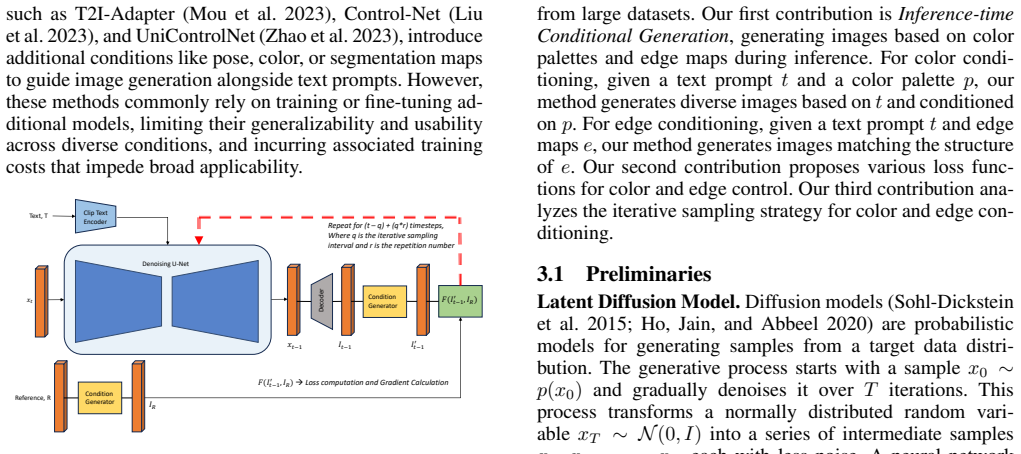
The central object is the energy-gradient interpretation of noise predictions, combined with the Conditioning Zone and iterative resampling. The update rule is $x_{t-1} = r_t - \alpha_t \nabla_{x_t} E(c, x_t)$, where $r_t$ is the standard DDPM update and $E$ is an energy function measuring mismatch between the current latent and the condition $c$. For color, $E$ is a weighted sum of a LAB-space Euclidean loss and the color-distribution matching loss $\mathcal{L}_{\text{DS}}$; for edge, $E$ is an IoU loss on thresholded edge maps. The Conditioning Zone specifies the timestep interval in which these gradients are applied (70 to 40 for color, 95 to 90 for edge), together with a repetition count per step, and the iterative sampling strategy moves back $q$ steps and resamples to tighten conditioning. This zone placement is what lets structure-level conditions act early and appearance-level conditions act mid-sampling.
What would settle it
Run TINTIN on a non-COCO benchmark with novel color palettes and edge maps while keeping the COCO-tuned zone and repetition counts fixed; if the color-distribution score or edge IoU drops sharply relative to COCO, the claimed general test-time conditioning fails. A more targeted test is to feed edge maps that are not natural-image edges, such as sketches or line drawings, and check whether the IoU loss still drives the structure toward the reference.
Extended reading notes
Core claim
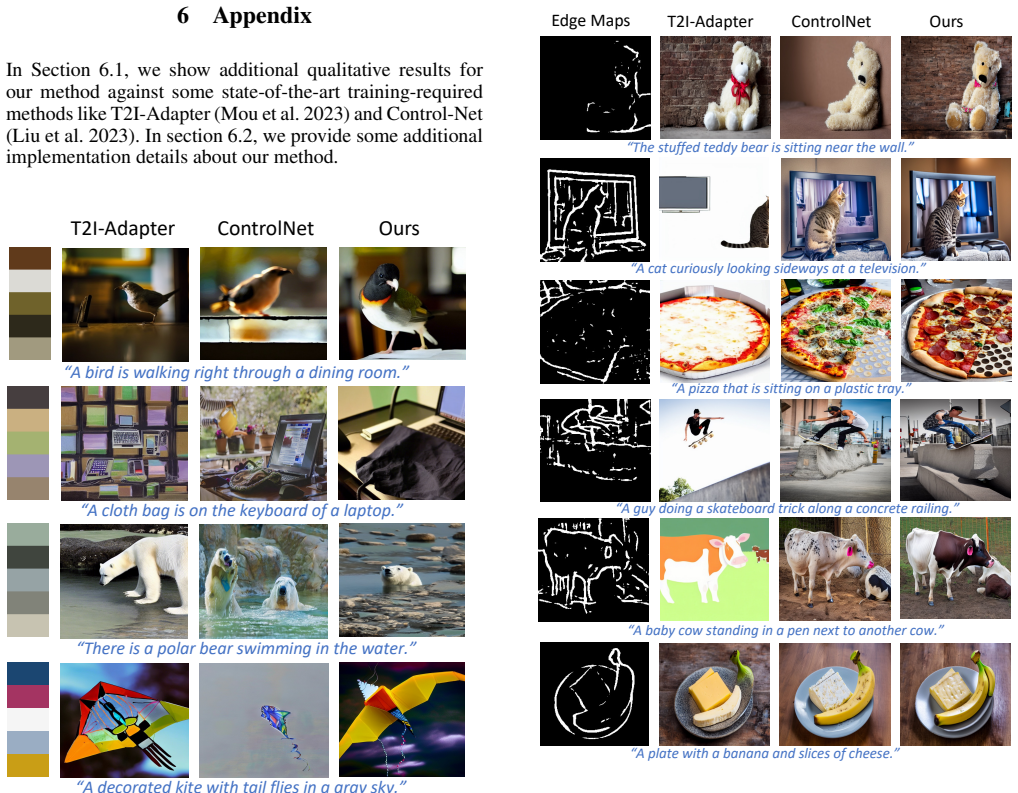
TINTIN treats the diffusion sampler as an energy-guided process: the conditional score is the unconditional score plus a gradient that pushes the sample toward the desired condition. For color palettes, it decodes the noisy latent to RGB, maps both image and palette into LAB space, and combines a Euclidean loss on the LAB features with a new color-distribution matching loss that soft-assigns each pixel to the palette's nearest color and minimizes cross-entropy between the predicted and target distributions. For edge maps, it passes the decoded image through an off-the-shelf edge detector, thresholds the result, and applies an Intersection-over-Union loss against the reference edge map. Both loss gradients are applied only inside a Conditioning Zone—timesteps 70 to 40 with about 20 iterations per step for color, and 95 to 90 with about 50 iterations for edge—where each condition acts. On the COCO validation set the paper reports that TINTIN reaches a color-distribution score of 8.43, ahead of T2I-Adapter's 5.55, ControlNet's 3.23, and FreeDoM's 2.12, and an FID of 18.34 for edge conditioning, below T2I-Adapter's 19.73 and ControlNet's 20.65.
Load-bearing premise
The load-bearing premise is that the empirically chosen Conditioning Zone boundaries and repetition counts—color at timesteps 70 to 40 with about 20 iterations per step, edges at 95 to 90 with about 50—transfer across prompts, domains, and conditions; they were tuned on COCO and then used to compute the reported COCO results.
Editorial extensions
If this is right
- A single base diffusion model can be steered by arbitrary color palettes at test time, the first reported capability of its kind without retraining.
- Edge-map conditioning matches or beats training-dependent adapters on COCO metrics while keeping generation diversity.
- New condition types, such as style, segmentation maps, or pose, become achievable by plugging in a suitable loss and a Conditioning Zone, with no training run.
- Deployment becomes faster in wall-clock terms because the multi-day training phase is eliminated and inference time remains comparable to existing training-free methods.
Reading between the lines
- The Conditioning Zone pattern suggests a general heuristic: conditions that fix global structure act in the earliest denoising steps, conditions that fix appearance act mid-sampling; a new condition could be placed empirically by checking where its loss first responds.
- The color-distribution loss $\mathcal{L}_{\text{DS}}$ is a differentiable soft palette quantizer, so it could be reused for test-time recoloring or image harmonization beyond full image generation.
- Because the zone boundaries and repetition counts were tuned on COCO, a self-terminating variant that stops iterating when the condition loss plateaus would be a natural robustness upgrade; without it, transfer to other domains is the main open risk.
- If the energy-gradient view is correct, the same update rule should extend to other conditioning signals by swapping the distance network, a direction the paper mentions but does not test.
Signed reviews
Editorial analysis
A structured set of objections, weighed in public.
Referee Report
Summary. The paper proposes TINTIN, a training-free, test-time method for conditioning text-to-image diffusion models on color palettes and edge maps. The method interprets denoising predictions as energy gradients (following FreeDoM), applies newly designed color-distribution and IoU losses during a chosen "Conditioning Zone" of the reverse process, and uses iterative resampling to strengthen adherence. Experiments on the COCO validation set compare against T2I-Adapter, ControlNet, PITI, MaGIC, MasaCtrl, and FreeDoM, reporting FID/CLIP/CDS for color and FID/CLIP/SSIM/MSE for edges, plus an ablation and user study.
Significance. The central formulation is standard in spirit: conditional sampling via an added energy-gradient term is grounded in Eq. (1)-(7), and the color loss LDS is a plausible, non-circular mechanism (the palette is user-specified, not fitted). If the quantitative claims survive correction, the paper would provide a useful training-free alternative for palette and edge control, with an ablation showing each loss component contributes. The paper is, however, currently weakened by an internally inconsistent edge-metric table and by validation-set hyperparameter selection, so the empirical state-of-the-art claim is not yet established.
major comments (3)
- [§4, Table 2] Table 2 reports SSIM↓ and MSE↑, which are the reverse of standard conventions (and of Table 3's SSIM↑ and MSE↓). With the correct conventions, TINTIN's edge SSIM of 0.40 is lower than T2I-Adapter's 0.41 and ControlNet's 0.43, and its MSE of 0.19 is worse than ControlNet's 0.18. The text's statement that "our approach consistently outperforms others, except for MSE" is therefore unsupported, and the edge-control superiority claim must be re-derived from corrected numbers.
- [§3.2, §4] The Conditioning Zone and iteration counts (color 70-40 with ≈20 iterations; edge 95-90 with ≈50 iterations) are stated to have been "determined through rigorous experimentation on the COCO dataset," and the quantitative evaluation is then reported on the COCO validation set. Because these hyperparameters were selected on the same set used for the headline numbers, the performance claims are potentially optimistically biased. The paper should report results on a held-out split, or at least give standard deviations and a sensitivity analysis over these hyperparameters.
- [§3.2, Eq. (12)] The edge objective is written as LIoU = A(ext ∩ erf)/A(ext ∪ erf), which is an IoU similarity to be maximized, not a loss to be minimized. If this quantity is used directly as the energy Dθ in the update of Eq. (7), gradient descent on it would reduce overlap rather than increase it. The paper should state explicitly whether the implemented loss is 1−IoU or whether the gradient sign is reversed, since edge conditioning is one of the two central demonstrations.
minor comments (4)
- [Tables 1-3] Add standard deviations or confidence intervals to the reported scores; averages over seven seeds without any spread make it impossible to judge whether differences between methods are significant.
- [§1, Related Work] Clarify the relation to the cited Vavilala and Forsyth (2023) work: the paper cites it as inspiration for LDS yet also claims to be the first to condition on color palettes; a sentence distinguishing the settings would avoid an apparent contradiction.
- [§4, Table 4] The runtime discussion says TINTIN is "significantly faster" than training-dependent methods, but Table 4 shows T2I-Adapter's per-image inference time (8 s) is lower than TINTIN's (15 s); qualify the claim as total time including training, or correct the wording.
- [Throughout] Several typos and notation issues need cleanup: the abstract has "Co nditional"; §3.2 uses q both for the Conditioning Zone interval and for the step-back in iterative sampling; Eq. (10) should define the cross-entropy and the normalized distribution d̂ explicitly.
Circularity Check
No central circularity; the conditioning losses match externally supplied palettes/edges. Mild self-supporting loop: the Conditioning Zone and repetition counts were tuned on the same COCO validation set used for the reported SOTA numbers.
-
fitted input called prediction
[Section 3.2 (Iterative Sampling Strategy) and Section 4 (Quantitative Results)]
"Determined through rigorous experimentation on the COCO dataset (Lin et al. 2015), CZ marks the most effective conditioning period... our experimentation reveals optimal conditioning outcomes when applying the iterative sampling strategy between 70 and 40 timesteps, with a repetition number of ≈ 20. ... We evaluate these methods on the COCO validation set comprising 5000 images, using the provided captions as text prompts."
The Conditioning Zone boundaries (70-40 for color, 95-90 for edge) and repetition counts (about 20 and 50) are load-bearing hyperparameters of the iterative sampling strategy. The paper states these were 'determined through rigorous experimentation on the COCO dataset' and then reports all headline quantitative results (FID, CLIP, CDS, SSIM, MSE) on the COCO validation set. Thus the reported state-of-the-art numbers are produced by parameters selected on the same evaluation set; the quantitative claim is not an independent test of the method but a report of performance after dataset-specific tuning. This is a mild fitted-input-called-prediction loop, though the core algorithm itself is not circular because the losses still optimize against externally specified conditions.
full rationale
TINTIN's core derivation is not circular. The conditioning signal is an externally supplied color palette or edge map, and the proposed losses (LDS, LEuclidean, LIoU) are computed between the decoded denoised image and this external condition; optimizing them steers generation toward the condition. The energy-guided sampling framework follows FreeDoM's score-based formulation, which is cited as prior work and is not derived from the paper's own outputs. The self-citation to Agarwal et al. (overlapping authors) is used only as supporting motivation for applying color control in the middle of sampling; the actual CZ boundaries are claimed to be determined by experimentation, so the citation is not the load-bearing derivation. The one genuine self-supporting element is that the Conditioning Zone and repetition counts were tuned on the COCO dataset and the headline quantitative results (Tables 1 and 2) are reported on the COCO validation set. This means the reported SOTA performance is in-sample with respect to those hyperparameters, a mild fitted-input/called-prediction loop. It does not make the method's definition circular, because the losses still match the user-provided condition rather than a fitted constant. Note also that Table 2's inverted SSIM/MSE arrow conventions are a consistency issue in the empirical claim, not a circularity of the derivation; it is out of scope for this pass.
Assumptions & free parameters
free parameters (6)
- lambda_1, lambda_2 =
1, 0.1
- rho =
100
- color_CZ_timesteps =
70 to 40 with about 20 iterations per step
- edge_CZ_timesteps =
95 to 90 with about 50 iterations per step
- edge_threshold =
0.9
- q_steps_for_resampling =
not specified
assumptions (5)
- standard math Conditional score decomposes via Bayes rule as the gradient of the unconditional score plus the gradient of the condition likelihood.
- domain assumption Noise prediction can be interpreted as an energy gradient, and the time-independent approximation D_phi is valid near the final sampling stages.
- domain assumption Gradients computed by decoding latent xt to RGB and passing through pretrained color or edge feature networks meaningfully pull the latent toward the condition.
- domain assumption Colorization details are determined in the intermediate part of the denoising schedule.
- domain assumption Stable Diffusion v1.4 latent space and DDIM sampling provide a faithful image representation at intermediate denoising steps.
Cite this review
Pith. "Pith review of Test-time Conditional Text-to-Image Synthesis Using Diffusion Models." pith.science (2026). https://pith.science/paper/R43EQKTS
@misc{pith2026241110800,
  author       = {Pith},
  title        = {Pith review of: Test-time Conditional Text-to-Image Synthesis Using Diffusion Models},
  year         = {2026},
  howpublished = {\url{https://pith.science/paper/R43EQKTS}},
  note         = {Machine review of arXiv:2411.10800}
}
read the original abstract
We consider the problem of conditional text-to-image synthesis with diffusion models. Most recent works need to either finetune specific parts of the base diffusion model or introduce new trainable parameters, leading to deployment inflexibility due to the need for training. To address this gap in the current literature, we propose our method called TINTIN: Test-time Conditional Text-to-Image Synthesis using Diffusion Models which is a new training-free test-time only algorithm to condition text-to-image diffusion model outputs on conditioning factors such as color palettes and edge maps. In particular, we propose to interpret noise predictions during denoising as gradients of an energy-based model, leading to a flexible approach to manipulate the noise by matching predictions inferred from them to the ground truth conditioning input. This results in, to the best of our knowledge, the first approach to control model outputs with input color palettes, which we realize using a novel color distribution matching loss. We also show this test-time noise manipulation can be easily extensible to other types of conditioning, e.g., edge maps. We conduct extensive experiments using a variety of text prompts, color palettes, and edge maps and demonstrate significant improvement over the current state-of-the-art, both qualitatively and quantitatively.
Figures


Figures from the paper (5 more)



Reference graph
Works this paper leans on
- [3]
-
[4]
Instruct- Pix2Pix: Learning to Follow Image Editing Instructions. arXiv:2211.09800. Cao, M.; Wang, X.; Qi, Z.; Shan, Y .; Qie, X.; and Zheng, Y
-
[5]
MasaCtrl: Tuning-Free Mutual Self- Attention Control for Consistent Image Synthesis and Edit- ing. arXiv:2304.08465. Dhariwal, P.; and Nichol, A
-
[7]
Make-A-Scene: Scene-Based Text- to-Image Generation with Human Priors. arXiv:2203.13131. Gal, R.; Alaluf, Y .; Atzmon, Y .; Patashnik, O.; Bermano, A. H.; Chechik, G.; and Cohen-Or, D
-
[8]
An Image is Worth One Word: Personalizing Text-to-Image Generation using Textual Inversion. arXiv:2208.01618. Hertz, A.; Mokady, R.; Tenenbaum, J.; Aberman, K.; Pritch, Y .; and Cohen-Or, D
-
[9]
Prompt-to-Prompt Image Edit- ing with Cross Attention Control. arXiv:2208.01626. Ho, J.; Jain, A.; and Abbeel, P
-
[12]
Imagic: Text-Based Real Image Editing with Diffusion Models. arXiv:2210.09276. Kim, G.; Kwon, T.; and Ye, J. C
-
[13]
DiffusionCLIP: Text- Guided Diffusion Models for Robust Image Manipulation. arXiv:2110.02711. Lin, T.-Y .; Maire, M.; Belongie, S.; Bourdev, L.; Girshick, R.; Hays, J.; Perona, P.; Ramanan, D.; Zitnick, C. L.; and Doll´ar, P
Show all 33 references
-
[15]
arXiv:2108.01073
SDEdit: Guided Image Syn- thesis and Editing with Stochastic Differential Equations. arXiv:2108.01073. Mou, C.; Wang, X.; Xie, L.; Wu, Y .; Zhang, J.; Qi, Z.; Shan, Y .; and Qie, X
-
[16]
arXiv:2302.08453
T2I-Adapter: Learning Adapters to Dig out More Controllable Ability for Text-to-Image Diffu- sion Models. arXiv:2302.08453. Nichol, A.; Dhariwal, P.; Ramesh, A.; Shyam, P.; Mishkin, P.; McGrew, B.; Sutskever, I.; and Chen, M
-
[17]
arXiv preprint arXiv:2112.10741
Glide: To- wards photorealistic image generation and editing with text- guided diffusion models. arXiv preprint arXiv:2112.10741. Parmar, G.; Singh, K. K.; Zhang, R.; Li, Y .; Lu, J.; and Zhu, J.-Y
-
[18]
arXiv:2302.03027
Zero-shot Image-to-Image Translation. arXiv:2302.03027. Radford, A.; Kim, J. W.; Hallacy, C.; Ramesh, A.; Goh, G.; Agarwal, S.; Sastry, G.; Askell, A.; Mishkin, P.; Clark, J.; Krueger, G.; and Sutskever, I
-
[19]
arXiv:2103.00020
Learning Transfer- able Visual Models From Natural Language Supervision. arXiv:2103.00020. Radford, A.; Metz, L.; and Chintala, S
-
[21]
arXiv:2204.06125
Hierarchical Text-Conditional Image Generation with CLIP Latents. arXiv:2204.06125. Rombach, R.; Blattmann, A.; Lorenz, D.; Esser, P.; and Om- mer, B
-
[22]
arXiv:2205.11487
Photorealistic Text-to-Image Diffusion Models with Deep Language Understanding. arXiv:2205.11487. Seitzer, M
-
[23]
arXiv:1503.03585
Deep Unsupervised Learning using Nonequilibrium Thermodynamics. arXiv:1503.03585. Song, Y .; and Ermon, S
-
[25]
arXiv:2111.08005
Solv- ing Inverse Problems in Medical Imaging with Score-Based Generative Models. arXiv:2111.08005. Song, Y .; Sohl-Dickstein, J.; Kingma, D. P.; Kumar, A.; Ermon, S.; and Poole, B
-
[26]
arXiv:2011.13456
Score-Based Genera- tive Modeling through Stochastic Differential Equations. arXiv:2011.13456. Vavilala, V .; and Forsyth, D
2011 arXiv
-
[27]
arXiv:2307.02698
Applying a Color Palette with Local Control using Diffusion Models. arXiv:2307.02698. Wang, H.; Yu, Y .; Luo, T.; Fan, H.; and Zhang, L
-
[28]
arXiv preprint arXiv:2205.12952
Pretraining is all you need for image-to-image translation. arXiv preprint arXiv:2205.12952. Wang, Y .; Yu, J.; and Zhang, J
-
[29]
arXiv:2104.05703
Adversarial Open Domain Adaptation for Sketch-to-Photo Synthesis. arXiv:2104.05703. Yu, J.; Wang, Y .; Zhao, C.; Ghanem, B.; and Zhang, J
-
[30]
arXiv:2303.09833
FreeDoM: Training-Free Energy-Guided Conditional Diffu- sion Model. arXiv:2303.09833. Zhang, Y .; Dong, W.; Tang, F.; Huang, N.; Huang, H.; Ma, C.; Lee, T.-Y .; Deussen, O.; and Xu, C
-
[31]
arXiv:2305.16225
ProSpect: Expanded Conditioning for the Personalization of Attribute- aware Image Generation. arXiv:2305.16225. Zhao, J.; Mathieu, M.; and LeCun, Y
-
[32]
arXiv:1609.03126
Energy-based Generative Adversarial Network. arXiv:1609.03126. Zhao, M.; Bao, F.; Li, C.; and Zhu, J
-
[33]
arXiv:2305.16322
Uni-ControlNet: All-in-One Con- trol to Text-to-Image Diffusion Models. arXiv:2305.16322
-
[2015]
arXiv:1405.0312
Microsoft COCO: Common Objects in Con- text. arXiv:1405.0312. Liu, X.; Park, D. H.; Azadi, S.; Zhang, G.; Chopikyan, A.; Hu, Y .; Shi, H.; Rohrbach, A.; and Darrell, T
-
[2016]
arXiv:1511.06434
Unsupervised Representation Learning with Deep Convolutional Genera- tive Adversarial Networks. arXiv:1511.06434. Ramesh, A.; Dhariwal, P.; Nichol, A.; Chu, C.; and Chen, M
- [2017]
-
[2018]
arXiv:1710.10196
Pro- gressive Growing of GANs for Improved Quality, Stability, and Variation. arXiv:1710.10196. Kawar, B.; Zada, S.; Lang, O.; Tov, O.; Chang, H.; Dekel, T.; Mosseri, I.; and Irani, M
-
[2020]
arXiv:1907.05600
Generative Model- ing by Estimating Gradients of the Data Distribution. arXiv:1907.05600. Song, Y .; Shen, L.; Xing, L.; and Ermon, S
1907 arXiv
-
[2021]
arXiv:2105.05233
Diffusion Models Beat GANs on Image Synthesis. arXiv:2105.05233. Gafni, O.; Polyak, A.; Ashual, O.; Sheynin, S.; Parikh, D.; and Taigman, Y
-
[2022]
In 2022 IEEE/CVF Conference on Computer Vision and Pat- tern Recognition (CVPR)
Blended Diffusion for Text-driven Editing of Natural Images. In 2022 IEEE/CVF Conference on Computer Vision and Pat- tern Recognition (CVPR). IEEE. Bansal, A.; Chu, H.-M.; Schwarzschild, A.; Sengupta, S.; Goldblum, M.; Geiping, J.; and Goldstein, T
2022
-
[2023]
arXiv:2311.11919
An Image is Worth Multiple Words: Multi- attribute Inversion for Constrained Text-to-Image Synthesis. arXiv:2311.11919. Avrahami, O.; Lischinski, D.; and Fried, O
Reviewed August 12, 2026 · model on record in the stance chip above.
Discussion (0). Continue with ORCID to comment.