REVIEW 2 major objections 5 minor 29 references
The Pound-Drever-Hall Method for Superconducting-Qubit Readout
T0 review · 2 major / 5 minor · reviewed 2026-08-03 · deepseek-v4-flash
Pith's one-line read Pound-Drever-Hall readout makes transmon qubit state detection immune to microwave phase drift and tolerant of sidebands 28 dB above the carrier.
desk verdict Phase-stability demonstration is solid and worth citing; the 14 dB gain claim is a reasonable projection but not yet a measured result. read the letter →
The pith
A machine-rendered reading of the paper's core claim, the machinery that carries it, and where it could break.
The reading
What carries the argument
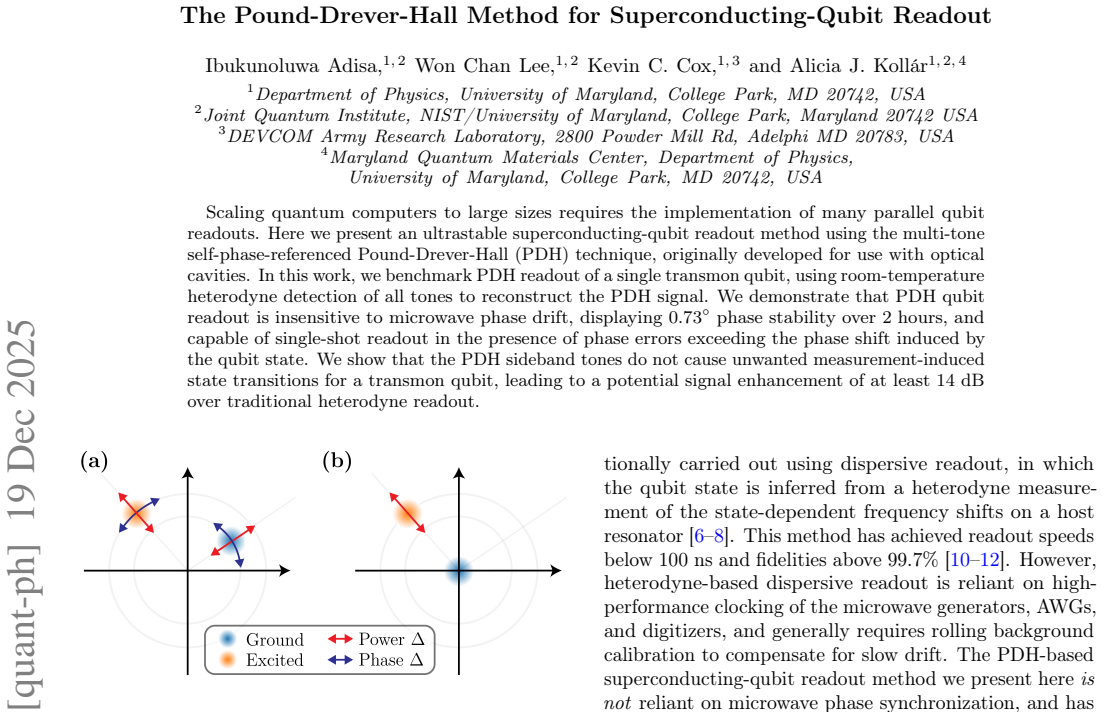
The central object is the PDH error signal, the sum of the two carrier-sideband beat notes ε(ω) = E₊E₀e^{i(φ₀−φ₊)} + E₋E₀e^{i(φ₋−φ₀)}. It converts the qubit-state-dependent cavity frequency shift into a differential phase measurement that cancels common-mode phase errors because the three tones originate from one source and traverse the same path. The paper also introduces the scissors phase Σ = 2φ₀ − (φ₋ + φ₊), a linear combination orthogonal to both common-mode and differential-mode errors, which remains stable even when timing offsets rotate the standard PDH quadratures.
What would settle it
Run full three-tone PDH readout with a cryogenic square-law detector and measure the probability p(o|g) of jumping to a non-computational state as sideband power is increased while the carrier sits near resonance and the modulation frequency is 20 MHz. If p(o|g) rises measurably before the sideband reaches +28 dBc — or if two-tone spectroscopy reveals new transition lines attributable to carrier–sideband beats — the MIST-tolerance claim fails. A simpler Floquet calculation of quasienergies under the three-tone drive would also reveal whether the single-tone threshold is the right bound.
Extended reading notes
Core claim
On its own terms, the paper establishes that PDH readout of a transmon is intrinsically phase-stable and that strong off-resonant sidebands are free of measurement-induced state transitions (MIST). The stability follows because the qubit-state-dependent resonator frequency shift appears in the differential phases between carrier and sidebands, and any phase error that shifts all three tones equally drops out; errors that shift the sidebands oppositely are suppressed by the small ratio of modulation frequency to carrier frequency. The experimental signature is 0.73° RMS fluctuation of the differential phase over two hours while the raw carrier phase drifts about 400°, plus single-shot separat
Load-bearing premise
The claim that more than 14 dB of extra sideband power is safe for readout assumes that a single off-resonant probe tone's MIST-free behavior predicts the behavior of the full three-tone PDH interrogation; if carrier–sideband beating introduces extra transitions, the tolerated sideband power could be lower.
Editorial extensions
If this is right
- PDH readout can remove the need for rolling phase calibration and reduce clocking precision requirements in superconducting-qubit experiments, lowering the per-channel cost of readout electronics.
- Because the phase reference is intrinsic, single-shot readout remains viable even when generators and local oscillators are free-running or unlocked.
- Off-resonant sidebands at detunings above 20 MHz can carry much more power than the carrier without inducing MIST, enabling faster or higher-SNR readout than conventional heterodyne at fixed resonant probe power.
- A cryogenic square-law detector that mixes carrier and sidebands before amplification would realize the predicted more-than-14 dB heterodyne gain, motivating a new class of Josephson-junction detectors optimized for PDH beatnote detection.
- The scissors phase offers a readout that survives simultaneous generator-phase and timing errors, which could be valuable in distributed or multiplexed measurement chains.
Reading between the lines
- The 14 dB gain figure is an upper-bound estimate: the MIST measurement used a single probe tone, and a full three-tone PDH interrogation could in principle produce intermodulation or two-photon transitions at lower power; a direct three-tone MIST test would settle it.
- The phase-stability advantage should extend naturally to frequency-multiplexed readout of many qubits, where a shared carrier and per-qubit sidebands could eliminate per-channel phase references — a scaling benefit the paper only gestures at.
- The scissors phase could be applied beyond qubit readout, e.g., to precision resonator characterization or any microwave measurement where both source and digitizer timing are uncontrolled.
- The synthetic-PDH reconstruction in this work demonstrates the signal but not the noise benefit; a testable extension is to compare the SNR of direct PDH readout (with a cryogenic square-law detector) against heterodyne readout at the same carrier power to verify the predicted gain.
Editorial analysis
A structured set of objections, weighed in public.
Referee Report
Summary. The manuscript proposes a Pound-Drever-Hall-style multi-tone readout for superconducting transmon qubits. Because the three tones are generated from a single source and travel the same path, the detected differential phase between carrier and sidebands is largely immune to common-mode microwave phase drift. Since a suitable cryogenic square-law detector is not available, the authors implement a 'synthetic' PDH receiver: all three tones are simultaneously downconverted and digitized, and the PDH error signal is reconstructed digitally. They report 0.73° RMS differential-phase stability over 2 h (compared with roughly 400° carrier phase drift), single-shot state discrimination with free-running generators, and a 'scissors phase' Σ = 2ϕ0 − (ϕ− + ϕ+) robust to modulation and digitizer timing errors. A separate MIST benchmark, using a single probe tone applied between two heterodyne measurements, shows no added transitions at detunings ≥20 MHz up to +28 dBc probe power; the authors interpret this as permitting 14 dB of intrinsic heterodyne gain for a future PDH implementation with a cryogenic |E|^2 detector.
Significance. If the phase-stability result holds, the work is a useful step toward self-referenced microwave readout and reduces the need for phase-locked references and rolling calibration. The 2-hour differential-phase data are direct and convincing, and the paper is transparent that the reconstruction itself provides no SNR gain (Appendix S5) and that the 14 dB figure is a projection contingent on future hardware. The MIST measurement is carefully designed with a two-measurement protocol and Gaussian state assignment. The principal weakness is that the headline gain claim extrapolates single-tone MIST results to the three-tone PDH waveform, where carrier dressing and intermodulation could alter thresholds; this specific concern is not addressed by the data. The paper is therefore scientifically sound in its demonstrated claims but overstates the certainty of the quantitative gain projection.
major comments (2)
- [Main text, Fig. 4; Appendix S7] The 'at least 28 dBc' sideband-tolerance claim is an extrapolation from a single-tone MIST measurement. In the protocol of Appendix S7, the probe is applied alone between two heterodyne measurements, with the readout carrier absent. In a real PDH interrogation the near-resonant carrier and both sidebands arrive simultaneously; the carrier ac-Stark dresses the transmon, the Josephson nonlinearity can generate intermodulation products (e.g., 2ω0−ω±, ω−+ω0−ω+), and the 20–30 MHz beat itself may parametrically modulate the resonator. None of these channels is probed by the single-tone measurement. The statement 'the PDH readout scheme can tolerate at least 28 dBc more power in the sideband at large detunings' should be restricted to the single-probe test unless a three-tone MIST measurement or a quantitative estimate of these multi-tone processes is provided. Since the 14 dB potential gain c
- [Appendix S5; main text 'Intrinsic Heterodyne Gain'] The 14 dB improvement is not realized by the reported receiver. Appendix S5 states explicitly that the reconstructed PDH signal inherits all heterodyne detection noise and shows no SNR improvement; the gain requires a cryogenic square-law detector that does not yet exist. The paper does disclose this, but the abstract and concluding paragraphs present the 14 dB figure as a property of 'the PDH readout scheme' rather than as a prediction conditional on (i) a new detector and (ii) the three-tone MIST assumption of Comment 1. Please clearly separate measured results from projections, e.g., by labeling the 14 dB number as a predicted bound for a future hardware implementation.
minor comments (5)
- [Abstract and Fig. 3] The claim 'capable of single-shot readout' is not supported by a quantitative assignment fidelity or confusion matrix. The heatmaps in Fig. 3 and Fig. S4 show separation, but a number (e.g., single-shot readout fidelity with and without induced phase errors) would make the claim precise and testable.
- [Appendix S7, Fig. S10 caption] 'pump power' appears where 'probe power' is meant. Please correct.
- [Fig. 2 caption] Typo: 'A verage' should be 'Average'.
- [Appendix S5 and S7] Typos: 'carruer' should be 'carrier' in Appendix S5; 'signitures' should be 'signatures' in Appendix S7; 'repectively' should be 'respectively' in Appendix S3.
- [Eq. (3) and Eq. (S16)] The connection between the main-text PDH signal (Eq. 3) and the complex error signal ϵ(ω) defined in Eq. (S16) should be stated explicitly. The sign convention for the lower sideband differs from standard optical notation, and the reader currently has to infer the relation.
Circularity Check
No significant circularity; the phase-stability result is a direct measurement of the differential phase, and the MIST/heterodyne-gain claims rest on measured thresholds and algebraic scaling rather than fitted inputs.
full rationale
The paper's central claims are either measured directly or follow algebraically from the definition of the PDH observable. The phase-stability result (Fig. 2 and S5) is a direct measurement of the differential phase φ0−φ−; the cancellation of common-mode drift is explicitly shown in S2D (φ0'−φ±' = φ0−φ±), so it is a consequence of the method, not a hidden fitted prediction. The 14 dB heterodyne-gain claim rests on measured MIST thresholds in Fig. 4/S10, where a single off-resonant probe at large detunings shows no transitions up to +28 dBc, and on the algebraic scaling ϵQ ∝ E0E±. No parameter is fitted to the claimed outcome. S5 explicitly concedes that the synthetic reconstruction gives no SNR improvement and that the gain projection requires a future cryogenic square-law detector; this is a validity/extrapolation caveat, not circularity. The state-assignment procedure in S6 uses the MIST reference itself to locate the |o⟩ cluster, which is self-referential but not load-bearing: the MIST threshold is determined by the power dependence of p(o|j), not by the calibration. The scissors phase Σ = 2φ0−(φ−+φ+) is defined and shown invariant under common/differential errors by direct substitution; this is again definitional rather than circular. No load-bearing self-citations or imported uniqueness theorems appear. Overall, the derivation chain is self-contained against the measured data and the explicit equations, with no circular step identified.
Assumptions & free parameters
free parameters (3)
- State-assignment Gaussian parameters =
Not stated numerically; fitted to reference probe data
- Sideband phase precompensation offsets =
Not stated numerically
- Measurement carrier frequency =
6.7717 GHz
assumptions (5)
- domain assumption The transmon is treated as a two-level system coupled to the resonator in the dispersive regime (S2A).
- standard math Phase errors decompose into a common-mode part α(1,1,1) and a differential part β(-1,0,1); PDH is sensitive only to β (S2D).
- domain assumption Measurement outcomes are dominated by Gaussian noise, so state assignment via Gaussian fits and linear decision boundaries is valid (S6).
- ad hoc to paper A single off-resonant probe tone replicates the effect of a PDH sideband in the full three-tone configuration (Fig. 4, S7).
- domain assumption S21 transmission through the hanger-coupled resonator is equivalent to reflection in an optical PDH scheme (S8).
invented entities (1)
-
Scissors phase Σ
Cite this review
Pith. "Pith review of The Pound-Drever-Hall Method for Superconducting-Qubit Readout." pith.science (2026). https://pith.science/paper/R4HD3DL4
@misc{pith2026251203138,
  author       = {Pith},
  title        = {Pith review of: The Pound-Drever-Hall Method for Superconducting-Qubit Readout},
  year         = {2026},
  howpublished = {\url{https://pith.science/paper/R4HD3DL4}},
  note         = {Machine review of arXiv:2512.03138}
}
abstract
Scaling quantum computers to large sizes requires the implementation of many parallel qubit readouts. Here we present an ultrastable superconducting-qubit readout method using the multi-tone self-phase-referenced Pound-Drever-Hall (PDH) technique, originally developed for use with optical cavities. In this work, we benchmark PDH readout of a single transmon qubit, using room-temperature heterodyne detection of all tones to reconstruct the PDH signal. We demonstrate that PDH qubit readout is insensitive to microwave phase drift, displaying $0.73^\circ$ phase stability over 2 hours, and capable of single-shot readout in the presence of phase errors exceeding the phase shift induced by the qubit state. We show that the PDH sideband tones do not cause unwanted measurement-induced state transitions for a transmon qubit, leading to a potential signal enhancement of at least $14$~dB.
Figures


Figures from the paper (1 more)

Reference graph
Works this paper leans on
-
[10]
Swiadek, R
F. Swiadek, R. Shillito, P. Magnard, A. Remm, C. Hellings, N. Lacroix, Q. Ficheux, D. C. Zanuz, G. J. Norris, A. Blais, et al. , PRX Quantum 5, 040326 (2024)
2024
-
[11]
P. A. Spring, L. Milanovic, Y. Sunada, S. Wang, A. F. Van Loo, S. Tamate, and Y. Nakamura, PRX Quantum 6, 020345 (2025)
2025
-
[12]
Walter, P
T. Walter, P. Kurpiers, S. Gasparinetti, P. Mag- nard, A. Potočnik, Y. Salathé, M. Pechal, M. Mondal, M. Oppliger, C. Eichler, and A. Wallraff, Phys. Rev. Appl. 7, 054020 (2017)
2017
-
[13]
Krantz, M
P. Krantz, M. Kjaergaard, F. Yan, T. P. Orlando, S. Gus- tavsson, and W. D. Oliver, Appl. Phys. Rev. 6, 021318 (2019)
2019
-
[16]
P. D. Kurilovich, T. Connolly, C. G. Bøttcher, D. K. Weiss, S. Hazra, V. R. Joshi, A. Z. Ding, H. Nho, S. Diamond, V. D. Kurilovich, et al. , arXiv preprint arXiv:2501.09161 (2025)
arXiv 2025
-
[18]
Khezri, A
M. Khezri, A. Opremcak, Z. Chen, K. C. Miao, M. McEwen, A. Bengtsson, T. White, O. Naaman, D. Sank, A. N. Korotkov, et al. , Physical Review Ap- plied 20, 054008 (2023)
2023
-
[20]
Y. Y. Gao, M. A. Rol, S. Touzard, and C. Wang, PRX quantum 2, 040202 (2021)
2021
-
[23]
Blais, A
A. Blais, A. L. Grimsmo, S. M. Girvin, and A. Wallraff, Rev. Mod. Phys. 93, 025005 (2021)
2021
Show all 29 references
-
[24]
Wallraff, D
A. Wallraff, D. I. Schuster, A. Blais, L. Frunzio, J. Majer, M. H. Devoret, S. M. Girvin, and R. J. Schoelkopf, Physical review letters 95, 060501 (2005)
2005
-
[25]
J. Koch, T. M. Yu, J. Gambetta, A. A. Houck, D. I. Schuster, J. Majer, A. Blais, M. H. Devoret, S. M. Girvin, and R. J. Schoelkopf, Phys. Rev. A 76, 042319 (2007)
2007
-
[26]
Blais, R.-S
A. Blais, R.-S. Huang, A. Wallraff, S. M. Girvin, and R. J. Schoelkopf, Phys. Rev. A 69, 062320 (2004)
2004
-
[27]
Krantz, M
P. Krantz, M. Kjaergaard, F. Yan, T. P. Orlando, S. Gustavsson, and W. D. Oliver, Appl. Phys. Rev. 6, 021318 (2019)
2019
-
[28]
R. V. Pound, Review of Scientific Instruments 17, 490 (1946)
1946
-
[29]
R. W. Drever, J. L. Hall, F. V. Kowalski, J. Hough, G. Ford, A. Munley, and H. Ward, Applied Physics B 31, 97 (1983)
1983
-
[30]
E. D. Black, American journal of physics 69, 79 (2001)
2001
-
[31]
Lindström, J
T. Lindström, J. Burnett, M. Oxborrow, and A. Y. Tzalenchuk, Review of Scientific Instruments 82, 104706 (2011)
2011
-
[32]
S. E. de Graaf, A. Danilov, and S. Kubatkin, IEEE Transactions on Applied Superconductivity 24, 1 (2014)
2014
-
[33]
Kedar, Z
D. Kedar, Z. Yao, I. Ryger, J. L. Hall, and J. Ye, Optica 11, 58 (2024)
2024
-
[34]
P. K. Rath, J. D. Philips, T. Yoon, K. R. Shirer, A. Fereidouni, and J. Pollanen, arXiv preprint arXiv:2512.06289 (2025)
2025
-
[35]
Haroche and J.-M
S. Haroche and J.-M. Raimond, Exploring the quantum: atoms, cavities, and photons (Oxford university press, 2006)
2006
-
[36]
M. F. Dumas, B. Groleau-Paré, A. McDonald, M. H. Muñoz Arias, C. Lledó, B. D’Anjou, and A. Blais, Phys. Rev. X 14, 041023 (2024)
2024
-
[37]
Shillito, A
R. Shillito, A. Petrescu, J. Cohen, J. Beall, M. Hauru, M. Ganahl, A. G. Lewis, G. Vidal, and A. Blais, Physical Review Applied 18, 034031 (2022)
2022
-
[38]
Connolly, P
T. Connolly, P. D. Kurilovich, V. D. Kurilovich, C. G. Bøttcher, S. Hazra, W. Dai, A. Z. Ding, V. R. Joshi, H. Nho, S. Diamond, et al. , arXiv preprint arXiv:2506.05306 (2025). 20 300 K 50 K 20 kHz LPF 20 kHz LPF 20 kHz LPF 20 kHz LPF 20 kHz LPF -1dB Magnet FBL 1 In FBL 2 In J...
2025 arXiv
-
[39]
D. Sank, Z. Chen, M. Khezri, J. Kelly, R. Barends, B. Campbell, Y. Chen, B. Chiaro, A. Dunsworth, A. Fowler, et al. , Physical review letters 117, 190503 (2016)
2016
-
[40]
Lloyd, IEEE Transactions on Information Theory 28, 129 (1982)
S. Lloyd, IEEE Transactions on Information Theory 28, 129 (1982)
1982
-
[41]
Gambetta, W
J. Gambetta, W. Braff, A. Wallraff, S. Girvin, and R. Schoelkopf, Physical Review A—Atomic, Molecular, and Optical Physics 76, 012325 (2007)
2007
-
[42]
Magesan, J
E. Magesan, J. M. Gambetta, A. D. Córcoles, and J. M. Chow, Phys. Rev. Lett. 114, 200501 (2015)
2015
-
[43]
P. J. Rousseeuw, Journal of Computational and Applied Mathematics 20, 53 (1987)
1987
-
[44]
Bista, M
A. Bista, M. Thibodeau, K. Nie, K. Chow, B. K. Clark, and A. Kou, arXiv preprint arXiv:2501.17807 (2025). [25] M. Khezri, A. Opremcak, Z. Chen, K. C. Miao, M. McEwen, A. Bengtsson, T. White, O. Naaman, D. Sank, A. N. Korotkov, et al. , Physical Review Applied 20, 054008 (2023)
2025
Reviewed August 3, 2026 · model on record in the stance chip above.
Discussion (0). Sign in to comment.