Early Telescope Throughput Results from the Collimated Beam Projector at the Vera C. Rubin Observatory
Pith reviewed 2026-07-01 03:06 UTC · model grok-4.3
The pith
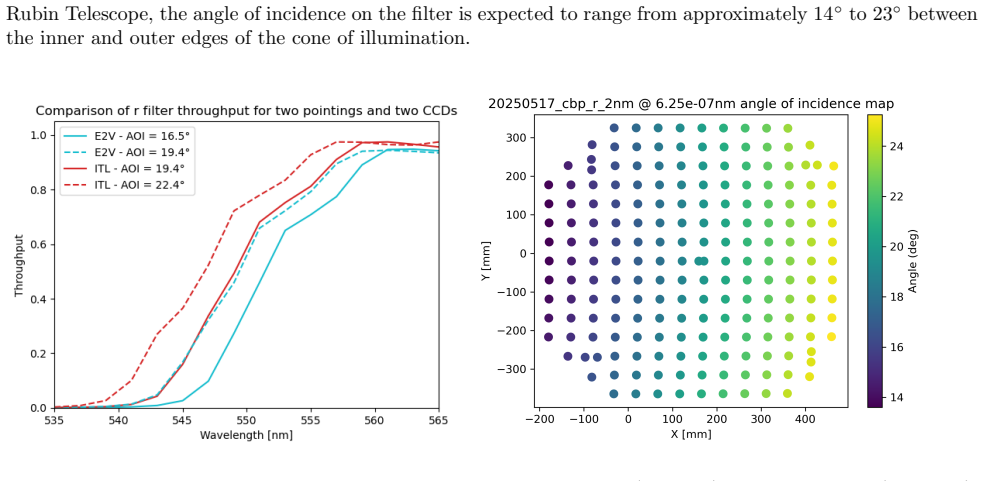
The Collimated Beam Projector maps filter bandpass edge shifts of several nanometers across the Rubin Observatory focal plane.
A machine-rendered reading of the paper's core claim, the machinery that carries it, and where it could break.
Core claim
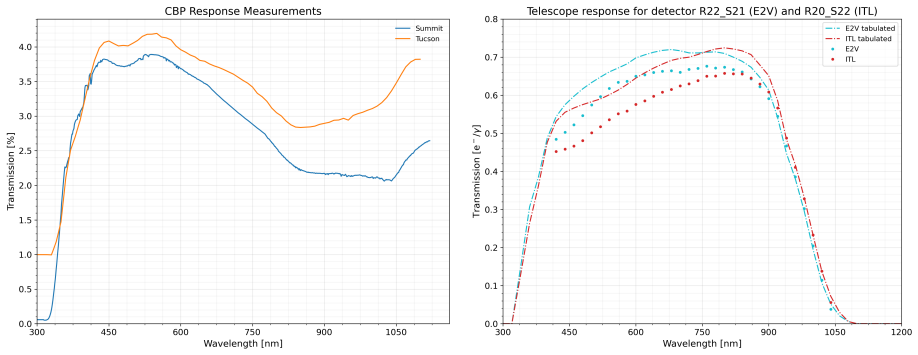
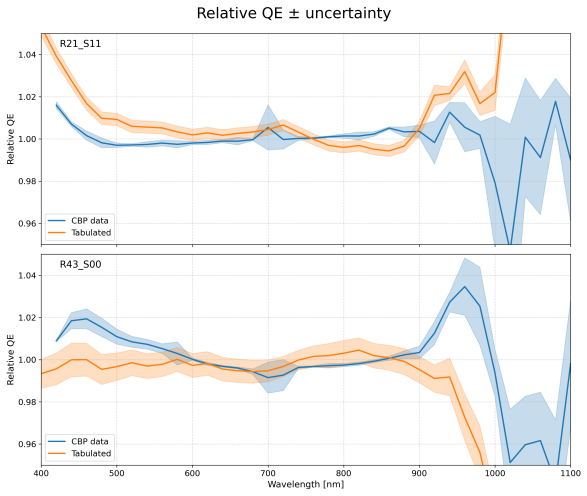
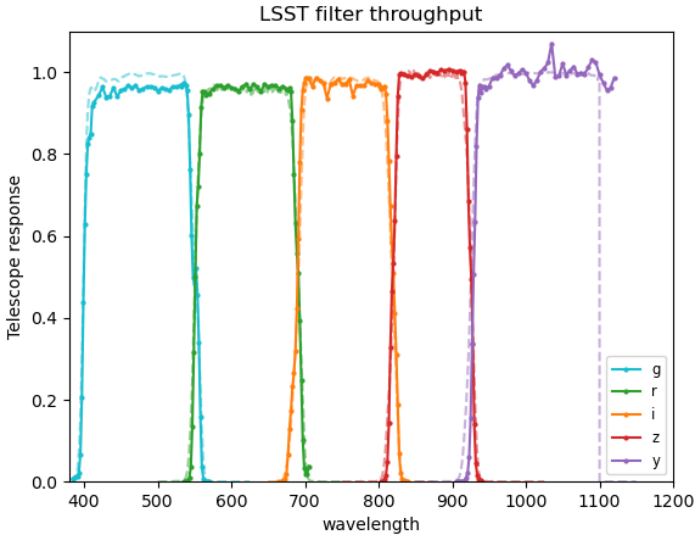
The Collimated Beam Projector enables direct in situ measurements of the Rubin Telescope instrumental response and the transmission profiles of LSSTCam broadband filters. In particular it enables spatially resolved mapping of filter bandpass edge shifts across the focal plane, which can vary by several nanometers as a function of the ray angle of incidence.
What carries the argument
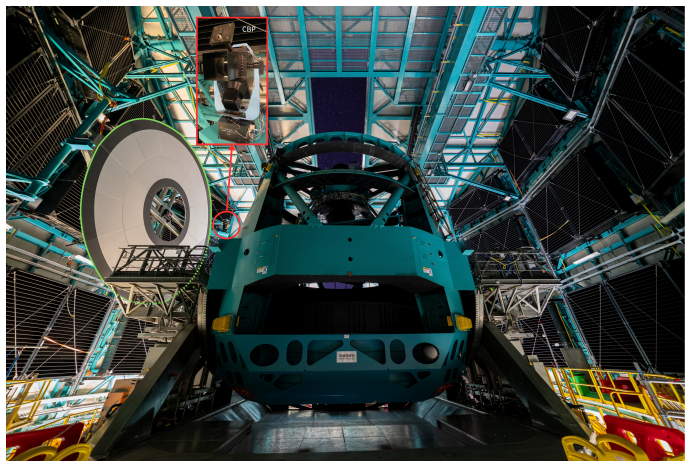
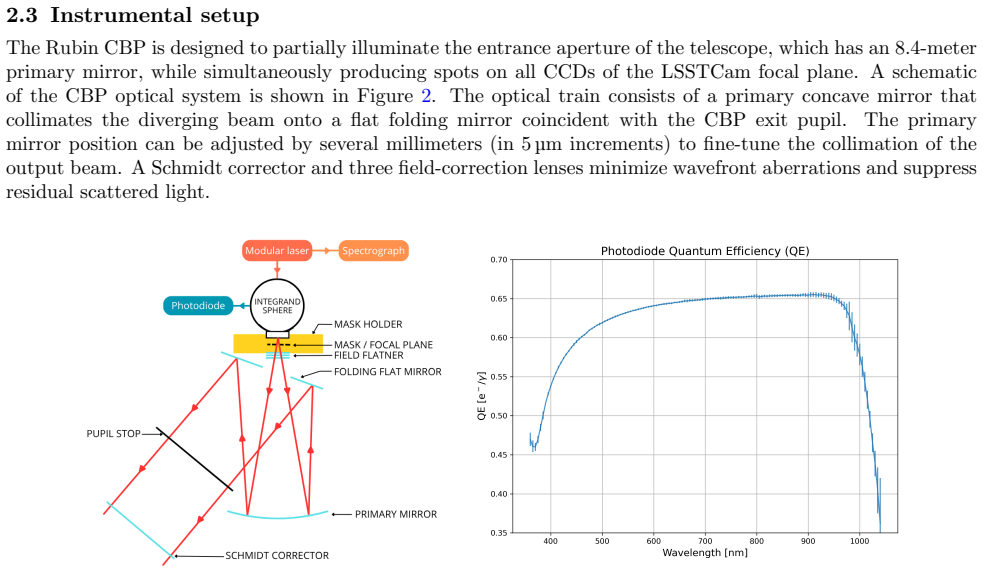
The Collimated Beam Projector, which projects monochromatic point sources of known wavelength and flux into the telescope aperture to measure full system throughput.
If this is right
- Enables continuous throughput monitoring throughout LSST operations.
- Supports the precise photometric calibration required for cosmological analyses based on Type Ia supernovae.
- Characterizes full system throughput including effects from varying ray angle of incidence across the focal plane.
- Provides spatially resolved transmission profiles of the broadband filters.
Where Pith is reading between the lines
- The same projector approach could be applied to other wide-field telescopes to quantify similar angle-dependent filter effects.
- Correcting for the mapped shifts may reduce systematic errors in derived supernova distances at the level needed for dark energy constraints.
- The spatial variation data could be used to test filter manufacturing uniformity across large substrates.
Load-bearing premise
The projected monochromatic sources have flux and wavelength known to sufficient accuracy that any measured deviations can be attributed to the telescope and camera rather than to the projector itself.
What would settle it
Independent calibration of the same filter positions using standard star observations that yields bandpass edge positions differing from the CBP map by more than the expected uncertainty.
Figures
read the original abstract
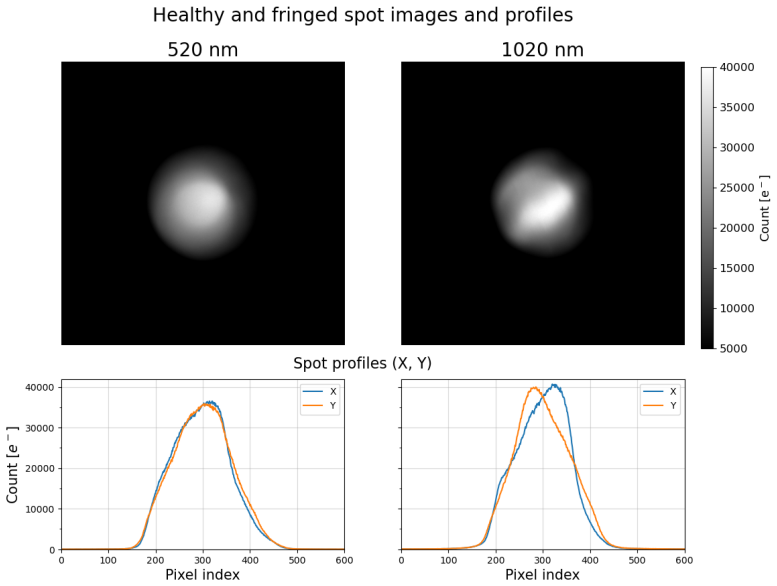
The Vera C. Rubin Observatory LSST requires precise photometric calibration to meet its science goals, particularly for cosmological analyses based on Type Ia supernovae. The Collimated Beam Projector (CBP) has been developed to support this effort by projecting monochromatic point sources of known wavelength and flux directly into the telescope aperture, enabling direct in situ measurements of the full system throughput. We present initial results demonstrating the CBP capability to characterize the instrumental response of the Rubin Telescope and to measure the transmission profiles of LSSTCam broadband filters. In particular, the CBP enables spatially resolved mapping of filter bandpass edge shifts across the focal plane, which can vary by several nanometers as a function of the ray angle of incidence. These early results establish the CBP as a powerful photometric calibration tool and lay the groundwork for continuous throughput monitoring throughout LSST operations.
Editorial analysis
A structured set of objections, weighed in public.
Referee Report
Summary. The manuscript presents early results from the Collimated Beam Projector (CBP) at the Vera C. Rubin Observatory. It claims that the CBP enables direct in situ measurements of full-system throughput by projecting monochromatic point sources of known wavelength and flux into the telescope aperture, and specifically demonstrates the capability to measure LSSTCam broadband filter transmission profiles with spatially resolved mapping of bandpass edge shifts across the focal plane that vary by several nanometers as a function of ray angle of incidence.
Significance. If the calibration accuracy and repeatability claims hold with supporting quantitative data, the CBP would represent a valuable addition to photometric calibration infrastructure for LSST, directly addressing needs for precise throughput knowledge in cosmological analyses. The in-situ projection approach offers a route to continuous monitoring that is not currently available.
major comments (1)
- [Abstract] Abstract: The claim that bandpass edge shifts of several nanometers can be mapped and attributed to angle-of-incidence effects in the LSSTCam filters is load-bearing for the central result. This attribution requires that the CBP monochromatic sources have wavelength and flux known to substantially better than ~1 nm (with corresponding flux precision). No error budget, stability measurements, repeatability tests, or cross-check against an independent wavelength reference is supplied to establish this margin, so measured deviations cannot yet be cleanly separated from projector systematics.
Simulated Author's Rebuttal
We thank the referee for their constructive review and for highlighting the importance of a quantitative error budget to support the central claims. We address the single major comment below and agree that additional material is needed.
read point-by-point responses
-
Referee: [Abstract] Abstract: The claim that bandpass edge shifts of several nanometers can be mapped and attributed to angle-of-incidence effects in the LSSTCam filters is load-bearing for the central result. This attribution requires that the CBP monochromatic sources have wavelength and flux known to substantially better than ~1 nm (with corresponding flux precision). No error budget, stability measurements, repeatability tests, or cross-check against an independent wavelength reference is supplied to establish this margin, so measured deviations cannot yet be cleanly separated from projector systematics.
Authors: We agree that the manuscript as submitted lacks a dedicated error budget, stability measurements, repeatability tests, and independent cross-checks for the CBP source wavelength and flux. This omission limits the strength of the attribution to angle-of-incidence effects. In the revised version we will add a new section (approximately 1–2 pages) that presents the wavelength calibration chain, measured source stability over multiple nights, repeatability across repeated scans, and any available cross-checks against a laboratory spectrometer or known atomic lines. These additions will quantify the achieved precision and allow readers to evaluate whether the several-nanometer shifts can be separated from projector systematics. revision: yes
Circularity Check
No circularity: purely experimental results with no derivations
full rationale
The paper reports initial experimental measurements of telescope throughput and filter transmission using the CBP instrument. No equations, derivations, fitted parameters, or self-citations are invoked to support load-bearing claims. The mapping of bandpass shifts is presented as a direct observational capability, not as a prediction derived from prior equations or ansatzes. The reader's assessment of score 1.0 aligns with this; the skeptic's concern addresses calibration accuracy (a correctness issue) rather than any reduction of results to self-defined inputs. The work is self-contained as an empirical demonstration.
Axiom & Free-Parameter Ledger
axioms (1)
- domain assumption Projected sources have accurately known wavelength and flux.
Reference graph
Works this paper leans on
-
[1]
The dark energy survey: Cosmology results with 1500 new high-redshift type ia supernovae using the full 5 yr data set,
Abbott, D. C. T. et al., “The dark energy survey: Cosmology results with 1500 new high-redshift type ia supernovae using the full 5 yr data set,”The Astrophysical Journal Letters973(2024)
2024
-
[2]
The pantheon+ analysis: Cosmological constraints,
Brout, D. et al., “The pantheon+ analysis: Cosmological constraints,”The Astrophysical Journal938 (2022)
2022
-
[3]
Measuring the growth rate of structure with type ia supernovae from lsst,
Howlett, C., Robotham, A. S. G., Lagos, C. D. P., and Kim, A. G., “Measuring the growth rate of structure with type ia supernovae from lsst,”The Astrophysical Journal847, 128 (September 2017)
2017
-
[4]
Improved cosmological constraints from a joint analysis of the sdss-ii and snls supernova samples,
Betoule, M. et al., “Improved cosmological constraints from a joint analysis of the sdss-ii and snls supernova samples,”Astronomy and Astrophysics568, A22 (2014)
2014
-
[5]
Precise astronomical flux calibration and its impact on studying the nature of the dark energy,
Stubbs, C. W. and Brown, Y. J., “Precise astronomical flux calibration and its impact on studying the nature of the dark energy,”Modern Physics Letters A30(40), 1530030 (2015)
2015
-
[6]
Decal: A spectrophotometric calibration system for decam,
Marshall, J. L. et al., “Decal: A spectrophotometric calibration system for decam,” (2013)
2013
-
[7]
Faint white dwarf flux standards: Data and models,
Bohlin, R. C. et al., “Faint white dwarf flux standards: Data and models,”Astronomical Journal169 (January 2025)
2025
-
[8]
Techniques and review of absolute flux calibration from the ultraviolet to the mid-infrared,
Bohlin, R. C., Gordon, K. D., and Tremblay, P.-E., “Techniques and review of absolute flux calibration from the ultraviolet to the mid-infrared,”Publications of the Astronomical Society of the Pacific126(942), 711–732 (2014)
2014
-
[9]
The lsst calibration hardware system design and development,
Ingraham, P. et al., “The lsst calibration hardware system design and development,” 99060O (2016)
2016
-
[10]
Toward 1% photometry: End-to-end calibration of astronomical telescopes and detectors,
Stubbs, C. W. and Tonry, J. L., “Toward 1% photometry: End-to-end calibration of astronomical telescopes and detectors,”The Astrophysical Journal646(2), 1436–1444 (2006)
2006
-
[11]
Preliminary results from detector-based throughput calibration of the ctio mosaic im- ager and blanco telescope using a tunable laser,
Stubbs, C. et al., “Preliminary results from detector-based throughput calibration of the ctio mosaic im- ager and blanco telescope using a tunable laser,” in [The Future of Photometric, Spectrophotometric and Polarimetric Standardization],364, 373 (2007)
2007
-
[12]
Precise throughput determination of the panstarrs telescope and the gigapixel im- ager using a calibrated silicon photodiode and a tunable laser: initial results,
Stubbs, C. W. et al., “Precise throughput determination of the panstarrs telescope and the gigapixel im- ager using a calibrated silicon photodiode and a tunable laser: initial results,”The Astrophysical Journal Supplement Series191(2), 376–388 (2010)
2010
-
[13]
Testing of the lsst’s photometric calibration strategy at the ctio 0.9 meter telescope,
Coughlin, M. W. et al., “Testing of the lsst’s photometric calibration strategy at the ctio 0.9 meter telescope,” (2018)
2018
-
[14]
Stardice iii: Characterization of the photometric instrument with a collimated beam projector,
Souverin, T. et al., “Stardice iii: Characterization of the photometric instrument with a collimated beam projector,” (2024)
2024
-
[15]
Mitigation of the brighter-fatter effect in the lsst camera,
Broughton, A. et al., “Mitigation of the brighter-fatter effect in the lsst camera,”Publications of the Astro- nomical Society of the Pacific136, 045003 (apr 2024)
2024
-
[16]
E., Kirkby, D., and Thomas, D., “batoid.” [Computer Software]https://doi.org/10.11578/ dc.20200708.1(oct 2019)
Meyers, J. E., Kirkby, D., and Thomas, D., “batoid.” [Computer Software]https://doi.org/10.11578/ dc.20200708.1(oct 2019). 13
2019
discussion (0)
Sign in with ORCID, Apple, or X to comment. Anyone can read and Pith papers without signing in.