Slice Monte Carlo Integration
Pith reviewed 2026-06-25 19:04 UTC · model grok-4.3
The pith
SℓMC uses a surrogate to slice the space and stratify prior samples for low-variance integration of expensive targets.
A machine-rendered reading of the paper's core claim, the machinery that carries it, and where it could break.
Core claim
Slice Monte Carlo integration (SℓMC) leverages a Nested Sampling-like procedure on the surrogate to partition the space into informative strata, or slices, while generating samples in the parameter space drawn from the prior within each slice. This enables stratified Monte Carlo integration of the expensive target function over the surrogate-induced partition, yielding an efficient estimate of the target integral. The decoupling of slice volume estimation from target function evaluation allows adaptive, variance-aware allocation of computational effort.
What carries the argument
The surrogate-induced slices created by a Nested Sampling-like procedure, which partition the domain so that prior samples can be grouped and the target integral estimated by stratified Monte Carlo.
If this is right
- Target evaluations can be allocated slice by slice according to measured variance instead of uniformly.
- Posterior samples can be generated directly from the stratified draws without additional reweighting steps.
- The total number of expensive evaluations needed for a given precision is reduced when the surrogate partition is informative.
- Volume estimation for each slice is performed once on the surrogate and reused for any number of target evaluations.
Where Pith is reading between the lines
- The same slicing idea could be tested on integration tasks outside Bayesian settings, such as expectation values in physics simulations.
- If the surrogate is a neural network or Gaussian process, one could measure how surrogate accuracy affects the final variance reduction.
- Extending the adaptive allocation rule to decide when to stop sampling a slice would be a direct next step.
Load-bearing premise
The slices produced from the surrogate must actually lower the variance of the target integral estimate compared with ordinary Monte Carlo sampling.
What would settle it
Run the method and standard Monte Carlo on the same benchmark integral with the same number of target evaluations; if the empirical variance of the SℓMC estimator is not smaller, the efficiency claim is false.
Figures
read the original abstract
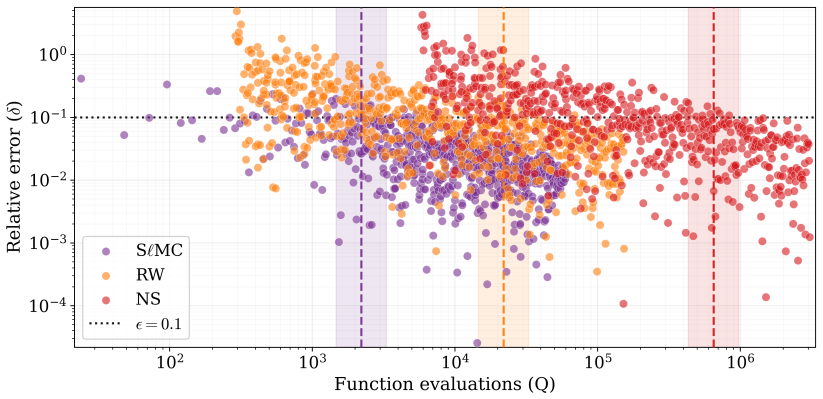
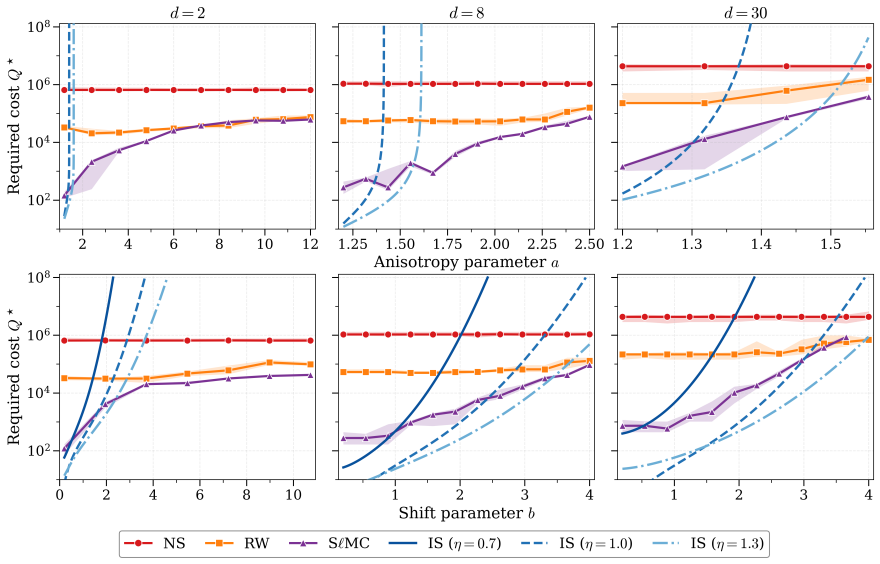
Numerical integration involving expensive target functions is a common bottleneck in Bayesian inference and simulation. When a cheap surrogate is available, standard approaches such as reweighting or importance sampling often suffer from high variance and inefficient use of function evaluations. We introduce Slice Monte Carlo integration (S$\ell$MC), a method that leverages a Nested Sampling-like procedure on the surrogate to partition the space into informative strata, or $\textit{slices}$, while generating samples in the parameter space drawn from the prior within each slice. This enables stratified Monte Carlo integration of the expensive target function over the surrogate-induced partition, yielding an efficient estimate of the target integral. A key advantage of S$\ell$MC is the decoupling of slice volume estimation from target function evaluation, which allows for adaptive, variance-aware allocation of computational effort. We investigate the properties of S$\ell$MC, demonstrate how to efficiently generate posterior samples, and validate the method on simple benchmark problems.
Editorial analysis
A structured set of objections, weighed in public.
Referee Report
Summary. The paper introduces Slice Monte Carlo Integration (SℓMC) for numerical integration of expensive target functions. It uses a Nested Sampling-like procedure on a surrogate to partition the parameter space into slices, estimates slice volumes from surrogate prior-mass shrinkage (decoupled from target evaluations), draws prior samples within slices, and applies stratified Monte Carlo to the target with adaptive, variance-aware allocation of evaluations. The manuscript investigates the method's properties, shows how to generate posterior samples, and validates it on benchmark problems.
Significance. If the variance reduction holds, SℓMC could offer a practical advantage over reweighting or importance sampling when surrogates are available, by enabling adaptive allocation without target-dependent volume estimates. The benchmark validation provides some empirical support for utility in Bayesian settings, but the lack of any derived bound on the variance reduction factor restricts the assessed generality.
major comments (2)
- [Method section on slice definition and partitioning] Method section on slice definition and partitioning: the central efficiency claim requires that surrogate-induced strata satisfy Var(target | slice) ≪ Var(target), yet no theorem, inequality, or condition is stated that relates surrogate-target discrepancy to the achieved variance reduction or to the reliability of the adaptive allocation step.
- [Properties investigation] Properties investigation: no worst-case analysis or general bound is given on the variance reduction factor when the surrogate is only moderately informative, which is load-bearing for the claim of yielding an efficient estimate relative to standard Monte Carlo.
minor comments (1)
- [Abstract] Abstract: the notation SℓMC and the phrase 'Nested Sampling-like procedure' could be defined on first use for clarity.
Simulated Author's Rebuttal
We thank the referee for the constructive comments on our manuscript. We address each major comment below, acknowledging where the manuscript can be strengthened through clarification or added discussion.
read point-by-point responses
-
Referee: Method section on slice definition and partitioning: the central efficiency claim requires that surrogate-induced strata satisfy Var(target | slice) ≪ Var(target), yet no theorem, inequality, or condition is stated that relates surrogate-target discrepancy to the achieved variance reduction or to the reliability of the adaptive allocation step.
Authors: The manuscript does not contain a formal theorem or inequality linking surrogate-target discrepancy to variance reduction, as the presentation emphasizes the algorithmic structure (Nested Sampling-like partitioning on the surrogate, decoupled volume estimation, and variance-aware allocation) together with empirical validation. The efficiency claim rests on the practical observation that informative surrogates induce strata with reduced conditional variance, which is standard in surrogate-assisted integration methods. We will revise the method section to include an explicit discussion of the conditions under which Var(target | slice) ≪ Var(target) is expected, namely when the surrogate and target exhibit positive correlation over the prior support. revision: yes
-
Referee: Properties investigation: no worst-case analysis or general bound is given on the variance reduction factor when the surrogate is only moderately informative, which is load-bearing for the claim of yielding an efficient estimate relative to standard Monte Carlo.
Authors: The properties investigation in the manuscript consists of analysis of the decoupling between volume estimation and target evaluations plus benchmark experiments; no worst-case bound on the variance reduction factor is derived. We agree that such a bound would provide additional context for moderately informative surrogates. Deriving a general, non-vacuous bound requires assumptions on surrogate error that lie outside the current scope. We will add a limitations paragraph in the properties section that qualitatively describes expected performance when the surrogate is only moderately informative and note that the method’s advantage is most pronounced for high-quality surrogates. revision: partial
Circularity Check
No significant circularity; method presented as independent procedure
full rationale
The paper defines SℓMC as a new combination of NS-like surrogate partitioning into slices followed by stratified MC on the target, with volume estimation decoupled from target evaluations. No equations, derivations, or self-citations are shown that reduce the efficiency claim or variance reduction to a quantity fitted or defined by the method itself. The central procedure is self-contained against external benchmarks and does not invoke load-bearing self-citations, uniqueness theorems from the authors, or ansatzes smuggled via prior work. Absence of a general bound on variance reduction is a potential correctness gap, not a circularity.
Axiom & Free-Parameter Ledger
axioms (1)
- domain assumption A cheap surrogate is available that can be used to partition the space into informative strata via a nested sampling-like procedure.
Reference graph
Works this paper leans on
-
[1]
and Dose, V
von der Linden, W. and Dose, V. and von Toussaint, U. , title =. 2014 , isbn =
2014
-
[2]
An introduction to
Andrieu, Christophe and de Freitas, Nando and Doucet, Arnaud and Jordan, Michael I , journal=. An introduction to. 2003 , doi=
2003
-
[3]
The Journal of the Acoustical Society of America , volume=
Nested sampling applied in Bayesian room-acoustics decay analysis , author=. The Journal of the Acoustical Society of America , volume=. 2012 , doi=
2012
-
[4]
Parameter estimation for compact binaries with ground-based gravitational-wave observations using the LALInference software library , author =. Phys. Rev. D , volume =. 2015 , month =
2015
-
[5]
Properties of the Binary Neutron Star Merger GW170817 , author =. Phys. Rev. X , volume =. 2019 , month =
2019
-
[6]
Statistics and Computing , volume=
Understanding predictive information criteria for Bayesian models , author=. Statistics and Computing , volume=. 2014 , doi=
2014
-
[7]
Goggans, Paul and Henderson, R. W. and Xiang, Ning , title =. Proceedings of Meetings on Acoustics , volume =. 2013 , month =
2013
-
[8]
Uncertainty Quantification and Polynomial Chaos Techniques in Computational Fluid Dynamics
Najm, Habib N. Uncertainty Quantification and Polynomial Chaos Techniques in Computational Fluid Dynamics. Annual Review of Fluid Mechanics. 2009. doi:10.1146/annurev.fluid.010908.165248
-
[9]
Uncertainty Quantification: Theory, Implementation, and Applications , author =. 2024 , edition =. doi:10.1137/1.9781611977844 , url =
-
[10]
Uncertainty Quantification in Climate Modeling and Projection
Qian, Yun and Jackson, Charles and Giorgi, Filippo and Booth, Ben and Duan, Qingyun and Forest, Chris and others. Uncertainty Quantification in Climate Modeling and Projection. Bulletin of the American Meteorological Society. 2016. doi:10.1175/BAMS-D-15-00297.1
-
[11]
Physical Review E , volume=
Nested sampling for materials: The case of hard spheres , author=. Physical Review E , volume=. 2014 , publisher=
2014
-
[12]
Journal of Chemical Theory and Computation , volume=
Direct computation of the quantum partition function by path-integral nested sampling , author=. Journal of Chemical Theory and Computation , volume=. 2018 , publisher=
2018
-
[13]
Binder, Christian W. and Krondorfer, Johannes K. and Hauser, Andreas W. The ridge integration method and its application to molecular sieving , demonstrated for gas purification via graphdiyne membranes. Mol. Syst. Des. Eng. 2022. doi:10.1039/D2ME00120A
-
[14]
2010 , publisher=
Quantum mechanics and path integrals , author=. 2010 , publisher=
2010
-
[15]
Reviews of modern physics , volume=
Space-time approach to non-relativistic quantum mechanics , author=. Reviews of modern physics , volume=. 1948 , publisher=
1948
-
[16]
Herman, M. F. and Bruskin, E. J. and Berne, B. J. , title =. The Journal of Chemical Physics , volume =. 1982 , month =
1982
-
[17]
The European Physical Journal B , author =
Nested sampling for materials , volume =. The European Physical Journal B , author =. 2021 , pages =. doi:10.1140/epjb/s10051-021-00172-1 , number =
-
[18]
Nested Transition Path Sampling , author =. Phys. Rev. Lett. , volume =. 2018 , month =
2018
-
[19]
and Binder, Christian W
Krondorfer, Johannes K. and Binder, Christian W. and Hauser, Andreas W. , title =. The Journal of Chemical Physics , volume =. 2023 , month =
2023
-
[20]
and Ricciuto, D
Lu, D. and Ricciuto, D. , TITLE =. Geoscientific Model Development , VOLUME =. 2019 , NUMBER =
2019
-
[21]
Journal of the American Chemical Society , volume=
MACE-OFF: Short-Range Transferable Machine Learning Force Fields for Organic Molecules , author=. Journal of the American Chemical Society , volume=. 2025 , doi=
2025
-
[22]
and Finney, Jacob M
Lu, Fenris and Cheng, Lixue and DiRisio, Ryan J. and Finney, Jacob M. and Boyer, Mark A. and Moonkaen, Pattarapon and others , title =. The Journal of Physical Chemistry A , volume =. 2022 , doi =
2022
-
[23]
and Wilkinson, Richard D
Uteva, Elena and Graham, Richard S. and Wilkinson, Richard D. and Wheatley, Richard J. , title =. The Journal of Chemical Physics , volume =. 2018 , doi =
2018
-
[24]
Edward Higson and William Handley and Michael Hobson and Anthony Lasenby , title =. Statistics and Computing , year =. doi:10.1007/s11222-018-9844-0 , publisher =
-
[25]
Monthly Notices of the Royal Astronomical Society , volume =
Speagle, Joshua S , title =. Monthly Notices of the Royal Astronomical Society , volume =. 2020 , month =
2020
-
[26]
Wills, Adrian G. and Schön, Thomas B. Sequential Monte Carlo: A Unified Review. Annual Review of Control, Robotics, and Autonomous Systems. 2023. doi:10.1146/annurev-control-042920-015119
-
[27]
Journal of the Royal Statistical Society Series B: Statistical Methodology , volume =
Salomone, Robert and South, Leah F and Drovandi, Christopher and Kroese, Dirk P and Johansen, Adam M , title =. Journal of the Royal Statistical Society Series B: Statistical Methodology , volume =. 2025 , month =
2025
-
[28]
Tokdar, Surya T. and Kass, Robert E. , title =. WIREs Computational Statistics , volume =. doi:10.1002/wics.56 , year =
-
[29]
Giles, Michael B. , year=. Multilevel Monte Carlo methods , volume=. doi:10.1017/S096249291500001X , journal=
-
[30]
SIAM Review , volume =
Peherstorfer, Benjamin and Willcox, Karen and Gunzburger, Max , title =. SIAM Review , volume =. 2018 , doi =
2018
-
[31]
SIAM Journal on Scientific Computing , volume =
Peherstorfer, Benjamin and Willcox, Karen and Gunzburger, Max , title =. SIAM Journal on Scientific Computing , volume =. 2016 , doi =
2016
-
[32]
AIP Conference Proceedings , volume =
Feroz, Farhan and Skilling, John , title =. AIP Conference Proceedings , volume =. 2013 , month =
2013
-
[33]
AIP Conference Proceedings , volume =
Skilling, John , title =. AIP Conference Proceedings , volume =. 2012 , month =
2012
-
[34]
AIP Conference Proceedings , volume =
Skilling, John , title =. AIP Conference Proceedings , volume =. 2009 , doi =
2009
-
[35]
Proceedings , VOLUME =
Skilling, John , TITLE =. Proceedings , VOLUME =. 2019 , NUMBER =
2019
-
[36]
2021 , eprint=
Nested Sampling And Likelihood Plateaus , author=. 2021 , eprint=
2021
-
[37]
MNRAS503(1), 1199–1205 (2021) https://doi.org/10.1093/mnras/stab590 arXiv:2010.13884 [stat.CO]
Fowlie, Andrew and Handley, Will and Su, Liangliang , year=. Nested sampling with plateaus , volume=. Monthly Notices of the Royal Astronomical Society , publisher=. doi:10.1093/mnras/stab590 , number=
-
[38]
, journal =
Chopin, Nicolas and Robert, Christian P. , journal =. Properties of nested sampling , volume =. 2010 , doi =
2010
-
[39]
A new algorithm for adaptive multidimensional integration , journal =. 1978 , issn =. doi:10.1016/0021-9991(78)90004-9 , url =
-
[40]
Press, William H. and Farrar, Glennys R. , title =. 1990 , issue_date =. doi:10.1063/1.4822899 , journal =
-
[41]
Caflisch, Russel E. , year=. Monte Carlo and quasi-Monte Carlo methods , volume=. doi:10.1017/S0962492900002804 , journal=
-
[42]
The Annals of Statistics , volume=
Slice Sampling , author=. The Annals of Statistics , volume=. 2003 , doi=
2003
-
[43]
Monthly Notices of the Royal Astronomical Society , volume=
MultiNest: an efficient and robust Bayesian inference tool for cosmology and particle physics , author=. Monthly Notices of the Royal Astronomical Society , volume=. 2009 , doi=
2009
-
[44]
Bayesian Analysis , number =
John Skilling , title =. Bayesian Analysis , number =. 2006 , doi =
2006
-
[45]
AIP Conference Proceedings , volume =
Skilling, John , title =. AIP Conference Proceedings , volume =. 2004 , month =
2004
-
[46]
Nature Reviews Methods Primers , author =
Nested sampling for physical scientists , volume =. Nature Reviews Methods Primers , author =. 2022 , pages =. doi:10.1038/s43586-022-00121-x , abstract =
-
[47]
, title =
Keeton, Charles R. , title =. Monthly Notices of the Royal Astronomical Society , volume =. 2011 , month =
2011
-
[48]
Statistics Surveys , number =
Johannes Buchner , title =. Statistics Surveys , number =. 2023 , doi =
2023
-
[49]
Statistics and Computing , volume=
Point process-based Monte Carlo estimation , author=. Statistics and Computing , volume=. 2017 , publisher=
2017
-
[50]
Recursive pathways to marginal likelihood estimation with prior-sensitivity analysis , author=. Statistical Science , volume=. 2014 , publisher=. doi:10.1214/13-STS465 , url=
-
[51]
Bayesian Analysis , number =
Edward Higson and Will Handley and Mike Hobson and Anthony Lasenby , title =. Bayesian Analysis , number =. 2018 , doi =
2018
-
[52]
The Open Journal of Astrophysics , volume=
Importance Nested Sampling and the MultiNest Algorithm , author=. The Open Journal of Astrophysics , volume=. 2019 , doi=
2019
-
[53]
, title =
Bishop, Christopher M. , title =. 2006 , isbn =
2006
-
[54]
Practical
Snoek, Jasper and Larochelle, Hugo and Adams, Ryan P , editor =. Practical. Advances in
-
[55]
Handley, W. J. and Hobson, M. P. and Lasenby, A. N. , title =. Monthly Notices of the Royal Astronomical Society , volume =. 2015 , doi =
2015
-
[56]
Journal of Open Source Software , volume =
Buchner, Johannes , title =. Journal of Open Source Software , volume =. 2021 , doi =
2021
-
[57]
Peter , title =
Lepage, G. Peter , title =. Journal of Computational Physics , volume =. 2021 , doi =
2021
-
[58]
and Binder, Christian W
Krondorfer, Johannes K. and Binder, Christian W. and Neumann, Matthias and von der Linden, Wolfgang , title =. 2026 , note =
2026
discussion (0)
Sign in with ORCID, Apple, or X to comment. Anyone can read and Pith papers without signing in.