REVIEW 3 major objections 7 minor 1 cited by
Confinement-induced altermangetism in RuO$_2$ thin films
T0 review · 3 major / 7 minor · reviewed 2026-08-11 · deepseek-v4-flash
Pith's one-line read Growing RuO2 as a thin film makes it altermagnetic without a Hubbard correction.
desk verdict Novel prediction, but the paper never shows the altermagnetic state is energetically stable for the films; it only shows a self-consistent solution exists under AFM initialization. read the letter →
The pith
A machine-rendered reading of the paper's core claim, the machinery that carries it, and where it could break.
The reading
What carries the argument
The load-bearing object is a generalized Stoner criterion for antiparallel spin alignment: instead of the usual ferromagnetic susceptibility, the paper uses the anti-parallel susceptibility χ_AP ≈ χ_00 − Σχ_0i, which peaks when the Fermi energy sits at a minimum in the local density of states between bonding and antibonding resonances. The companion mechanism is geometric confinement: strong interlayer relaxation in the films, especially a surface-to-subsurface contraction of about 17–24% and an expansion of the next spacing, shifts the Ru d_z2 orbital to lower energies and suppresses the local density of states at E_F, reproducing in the film what a Hubbard U does in bulk. The d-wave symmetry of the oxygen octahedral environment then guarantees that the compensated moments are accompanied by finite spin splitting, i.e., altermagnetism.
What would settle it
Compare the total energies of the nonmagnetic, ferromagnetic, and antiparallel (altermagnetic) states for the same relaxed 4L–10L films at U = 0; if the antiparallel state is not the lowest-energy solution, the claim that confinement stabilizes altermagnetism collapses. Experimentally, spin-resolved ARPES on a 6-layer (001) film should show an approximately 0.4 eV nonrelativistic spin splitting near the Fermi energy with zero net magnetization; absence of that splitting would falsify the prediction.
Extended reading notes
Core claim
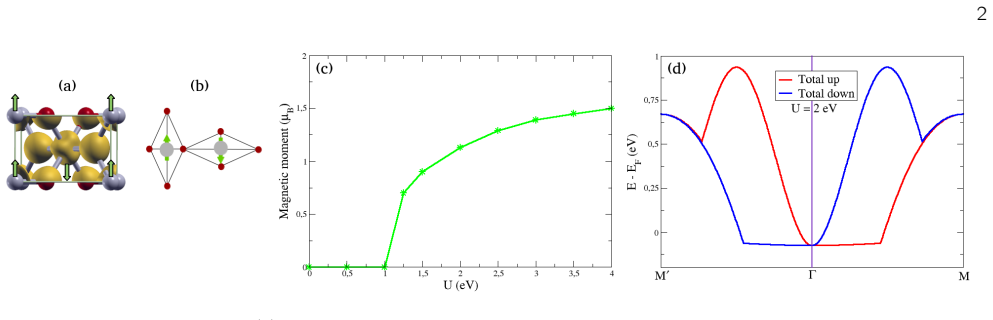
On the authors' own terms, the central discovery is that dimensionality itself can replace the Hubbard-U interaction in RuO2: although bulk RuO2 is nonmagnetic for realistic U values (below about 1 eV), (001) thin films with 4, 6, 8, and 10 layers are magnetic at U = 0 and display the d-wave-like charge-density pattern and nonrelativistic spin splitting characteristic of an altermagnet. The 2-layer film relaxes into a single monolayer and is not altermagnetic. The splitting reaches 0.4 eV at U = 0 for the 6-layer film and 0.6 eV at U = 2 eV. The paper attributes the onset of magnetism to interlayer relaxations, especially the contraction between the surface and subsurface layers and the expansion of the spacing below, which deepen the d_z2-derived states and reduce the local density of states at the Fermi level, the same electronic signature that U produces in bulk. A generalized Stoner criterion with an anti-parallel susceptibility is used to rationalize why the reduced density of states favors antiparallel rather than ferromagnetic alignment.
Load-bearing premise
The paper assumes an antiparallel spin arrangement from the start and does not compare its total energy with the nonmagnetic or ferromagnetic states, so the claim that the altermagnetic phase is the stable ground state of the films is not established.
Editorial extensions
If this is right
- Thin-film RuO2 becomes a concrete platform for altermagnetic spintronics that does not depend on defect engineering or on a disputed bulk magnetic ground state; the 6-layer film with a 0.4 eV zero-U splitting is the clearest target.
- Because the effect is driven by interlayer relaxation, film thickness and substrate choice become tuning knobs: conditions that strengthen the surface-to-subsurface contraction should raise the magnetic moment and spin splitting.
- Even when a Hubbard U of 2 eV is included, the films remain magnetic and altermagnetic, so the prediction is not tied to a specific choice of U.
- Spin-resolved photoemission on 4–10 layer RuO2 films should see an energy- and momentum-dependent spin splitting near the Fermi level without net magnetization, distinguishing the altermagnetic state from both ferromagnetism and a trivial nonmagnetic metal.
- The generalized Stoner criterion gives a simple diagnostic: films whose nonmagnetic density of states at the Fermi level is lower than the bulk value are the ones most likely to support the antiparallel, altermagnetic state.
Reading between the lines
- Beyond the paper's claims: if zero-U magnetism persists experimentally, the RuO2 debate would shift from 'is it magnetic?' to 'under what confinement is it magnetic?', potentially reconciling nonmagnetic bulk measurements with earlier magnetic signals if those samples contained strained or defective regions.
- A testable extension is thickness tuning: the model predicts the 6-layer film should show the largest splitting, so transport or spectroscopic measurements across 4L–10L films should show a clear peak at 6L rather than a monotonic trend.
- The same design logic, searching for materials whose nonmagnetic density of states has a minimum near the Fermi energy and whose structural relaxation moves E_F toward that minimum, could be screened computationally across other rutile-type oxides to find new altermagnets without Hubbard-U corrections.
Editorial analysis
A structured set of objections, weighed in public.
Referee Report
Summary. The manuscript reports DFT+U calculations of bulk RuO2 and of (001)-oriented thin films with 2-10 layers. For bulk, it reproduces the known picture: the nonmagnetic state is favorable for U below about 1 eV, while a magnetic altermagnetic solution appears for larger U, with a moment of 1.13 μB at U=2 eV. For films, starting from antiparallel spin initialization, the authors find magnetic solutions at all studied U values, altermagnetic behavior for 4L-10L, and a maximum nonrelativistic spin splitting of 0.4 eV without U for the 6L film. The proposed mechanism is that interlayer relaxation reshapes the Ru d_z2 states and reduces the LDOS at the Fermi energy, mimicking the effect of a Hubbard U, and this is rationalized with a generalized Stoner criterion for antiparallel spin alignment.
Significance. If the central claim held, it would be significant: it would provide a concrete route to altermagnetic RuO2 without invoking a Hubbard U, thereby sidestepping the current controversy over bulk magnetism. The paper has clear strengths: standard DFT+U methodology, a systematic thickness and U scan, explicit comparison to bulk, and transparent presentation of spin splittings and LDOS. However, the headline claim that confinement 'robustly stabilizes' the altermagnetic phase is not yet demonstrated, because the paper does not show that the altermagnetic state is a thermodynamic ground state rather than a metastable self-consistent solution. The current evidence supports the weaker statement that altermagnetic solutions exist for AFM-initialized film calculations.
major comments (3)
- [Results–films / Computational details] All film results are obtained 'assuming an initial antiparallel alignment of spin moments' (Table I and surrounding text), and no total-energy comparison is reported between the altermagnetic (AFM) state and nonmagnetic or ferromagnetic states. Since spin-polarized DFT with a magnetic initial guess can converge to a metastable local minimum, the statements that 'all films are magnetic independently from U' and that films 'robustly stabilize the altermagnetic phase' are not supported by the presented data. The authors need to compute total energies for nonmagnetic, ferromagnetic, and altermagnetic (antiparallel) spin configurations for each film thickness and U value, and show that the altermagnetic state is the ground state or at least lower in energy than the alternatives. This is the load-bearing evidence for the central claim.
- [Phenomenological criterion for anti-parallel spin alignment] The explanatory model is applied post hoc: the reduced LDOS at the Fermi energy in the nonmagnetic films is interpreted as enhancing the antiparallel (AP) susceptibility, which is then cited as the reason for altermagnetic stabilization. However, no quantitative link is established between the DFT LDOS and the AP susceptibility of Eqs. (1)-(2). The text does not specify how the local susceptibility χ00 is obtained from the DFT results, nor why the minimum in the LDOS corresponds to a maximum in χ_AP beyond the schematic in Fig. 4(d). To make the mechanism convincing, the authors should either compute χ_AP directly from the DFT Green's functions or explicitly limit the model to a qualitative rationalization rather than a predictive criterion.
- [Fig. 4 / Results–films] The LDOS analysis is presented as describing 'the non-magnetic phase' of the films, but the preceding section states that the films are magnetic for all U values. It is unclear whether these nonmagnetic LDOS come from a separate non-spin-polarized calculation, from a constrained-moment calculation, or from some other construction. This must be clarified, because the comparison between film and bulk LDOS at the Fermi energy is central to the proposed mechanism, and different reference states would change the interpretation of the reduction in LDOS.
minor comments (7)
- [Title] The title contains a typo: 'altermangetism' should be 'altermagnetism'.
- [Introduction] The phrase 'leading to an energy again' should read 'leading to an energy gain'.
- [Table I] The value '15,6%' uses a comma as a decimal separator; it should be '15.6%' for consistency.
- [Fig. 2(c) caption] The caption should specify exactly how 'total NRSS' is summed, for example whether it is the sum of absolute spin splittings over all bands crossing the Fermi energy or some other definition.
- [Conclusions] The conclusion describes the 2L film as 'antiferromagnetic', while the Results–films section says the 2L case is excluded and 'does not exhibit AM behavior'; these statements should be reconciled.
- [Fig. 4 caption] The notation 'd z2' should be written as d_{z^2} for clarity.
- [Abstract / Introduction] The abstract refers to 'strain relaxation', while the text mostly discusses interlayer distance relaxation; the relationship between strain and the reported interlayer changes should be clarified.
Circularity Check
No load-bearing circularity: film altermagnetism is obtained from self-consistent DFT, not from a fitted parameter or a self-citation chain.
full rationale
The central claim is that RuO2 thin films become altermagnetic at U=0 because confinement-induced interlayer relaxation shifts the dz2 states and reduces the LDOS at EF. The derivation chain is: (1) bulk DFT+U reproduces the known U-dependent moment and nonrelativistic spin splitting; (2) film relaxations are computed; (3) spin-polarized DFT with an initial antiparallel spin arrangement yields magnetic moments and NRSS for all studied thicknesses; (4) a nonmagnetic-LDOS analysis and a generalized Stoner susceptibility model rationalize the anti-parallel instability. None of these steps fits a parameter to the target output or defines the predicted quantity in terms of the input. The paper explicitly says interlayer distances are computed 'assuming an initial antiparallel alignment of spin moments' and then states 'all films are magnetic independently from the U values,' but an AFM initial guess does not force an AFM self-consistent solution; DFT can converge to a nonmagnetic state from such a start. The absence of total-energy comparisons against nonmagnetic and ferromagnetic states is a genuine evidentiary gap for the phrase 'robustly stabilize,' but it is a correctness risk rather than circularity: the reported band structures and spin splittings are not equal to the initialization by construction. The phenomenological susceptibility model is used post hoc to interpret the already-computed LDOS, but it does not enter the DFT calculation as an input, so it does not make the prediction circular. The only same-author citation, Ref. [22], is a background review of altermagnets and is not load-bearing for the film calculations. The paper is therefore best characterized as having no significant circularity, with the main weakness being an unverified ground-state comparison.
Assumptions & free parameters
free parameters (1)
- Hubbard U =
0 eV (films claim); 2 eV (bulk via Cococcioni); scanned 0-4 eV
assumptions (4)
- domain assumption DFT with PBE-GGA exchange-correlation functional accurately describes the electronic structure and magnetism of RuO2 thin films.
- standard math PAW pseudopotentials and a 600 eV plane-wave cutoff converge the relevant quantities.
- domain assumption The generalized Stoner criterion with the AP susceptibility, derived from the Heine-Samson-Nex framework, governs the onset of altermagnetic order.
- domain assumption Even-layer (001) films can host a compensated collinear magnetic state with the AM spin-group symmetry |C2||C4|.
Cite this review
Pith. "Pith review of Confinement-induced altermangetism in RuO$_2$ thin films." pith.science (2026). https://pith.science/paper/R4OQUYMW
@misc{pith2026241215377,
  author       = {Pith},
  title        = {Pith review of: Confinement-induced altermangetism in RuO$_2$ thin films},
  year         = {2026},
  howpublished = {\url{https://pith.science/paper/R4OQUYMW}},
  note         = {Machine review of arXiv:2412.15377}
}
abstract
The magnetic properties of bulk RuO$_2$ remain a subject of active debate, despite its pivotal role in the emergence of altermagnetism. The latter is a novel paradigm in magnetic phases, characterized by the absence of net magnetization due to anti-parallel alignment of magnetic moments, yet displaying finite spin-splitting in the electronic band structure. This unique behavior unlocks opportunities for advanced applications in information technology devices. Recent experimental and theoretical investigations suggest that bulk RuO$_2$, contrary to prior assumptions, is non-magnetic. In this work, we propose the fabrication of RuO$_2$ thin films to robustly stabilize the altermagnetic phase. Unlike their bulk counterparts, thin films experience substantial strain relaxation, leading to a dramatic impact on the electronic structure that triggers a transition towards an altermagnetic behavior, which mimics the impact of an artificially applied Hubbard-U correction to account for electronic correlations. Our findings promote the use and exploration of thin films for the realization of spintronic devices based on altermagnets.
Figures


Figures from the paper (1 more)

Forward citations
Cited by 1 Pith paper
-
Moir\'e-resonant surface state in ultrathin RuO$_2$
Ultrathin RuO2(110) on Ru(0001) shows a nonmagnetic moiré charge modulation enhanced by Fermi surface nesting, with no sign of surface magnetism.
Reference graph
Works this paper leans on
-
[1]
layers move closer together, while the distance between the subsurface (S-1) and the second subsurface (S-2) lay- ers increases. Furthermore, the reduction in dimension- ality substantially impacts the inner-layer distances, un- derscoring the pronounced effects of confinement on the 3 FIG. 2. (a) Supercells used for the simulation of the (001) RuO 2 surf...
work page 2022
-
[2]
L. ˇSmejkal, J. Sinova and T. Jungwirth. Beyond Con- ventional Ferromagnetism and Antiferromagnetism: A Phase with Nonrelativistic Spin and Crystal Rotation Symmetry. Phys. Rev. X 12, 031042 (2022)
work page 2022
-
[3]
L. ˇSmejkal, J. Sinova and T. Jungwirth. Emerging re- search landscape of altermagnetism. Phys. Rev. X 12, 040501 (2022)
work page 2022
-
[4]
L. ˇSmejkal, R. Gonz´alez-Hern´andez, T. Jungwirth and J. Sinova. Spontaneous anomalous Hall effect arising from an unconventional compensated magnetic phase in a semiconductor. Sci. Adv. 6, eaaz8809 (2020)
work page 2020
-
[5]
K. H. Ahn, A. Hariki, K. W. Lee, and J. Kune ˇS. Anti- ferromagnetism in RuO 2 as d-wave Pomeranchuk insta- bility. Phys. Rev. B 99, 184432 (2019)
work page 2019
-
[6]
L. ˇSmejkal, A. H. MacDonald, J. Sinova, S. Nakatsuji and T. Jungwirth. Anomalous hall antiferromagnets. Nat. Rev. Mater. 7, 482 (2022)
work page 2022
-
[7]
K. Samanta, M. Leˇzai´c, M. Merte, F. Freimuth, S. Bl¨ ugel and Y. Mokrousov. Crystal Hall and crystal magneto- optical effect in thin films of SrRuO3. J. Appl. Phys. 127, 213904 (2020)
work page 2020
-
[8]
M. Naka, S. Hayami, H. Kusunose, Y. Yanagi, Y. Mo- tome and H. Seo. Anomalous Hall effect inκ-type organic antiferromagnets. Phys. Rev. B 102, 075112 (2020)
work page 2020
Show all 56 references
-
[9]
Hayami and H
S. Hayami and H. Kusunose. Essential role of the anisotropic magnetic dipole in the anomalous Hall effect. Phys. Rev. B 103, L180407 (2021)
2021
-
[10]
I. I. Mazin, K. Koepernik, M. D. Johannes, R. Gonz´ alez- Hern´ andez and L.ˇSmejkal. Prediction of unconventional magnetism in doped FeSb2. Proc. Natl. Acad. Sci. U.S.A. 118, e2108924118 (2021)
2021
-
[11]
M. Naka, Y. Motome and H. Seo. Anomalous Hall ef- fect in antiferromagnetic perovskites. Phys. Rev. B 106, 195149 (2022)
2022
-
[12]
M. Naka, S. Hayami, H. Kusunose, Y. Yanagi, Y. Mo- 6 tome and H. Seo. Spin current generation in organic an- tiferromagnets. Nat. Commun. 10, 4305 (2019)
2019
-
[13]
Gonz´alez-Hern´andez, L
R. Gonz´alez-Hern´andez, L. ˇSmejkal, K. V´yborn´y, Y. Ya- hagi, J. Sinova, T. Jungwirth and J. ˇZelezn´y. Efficient electrical spin splitter based on nonrelativistic collinear antiferromagnetism. Phys. Rev. Lett. 126, 127701 (2021)
2021
-
[14]
M. Naka, Y. Motome and H. Seo. Perovskite as a spin current generator. Phys. Rev. B 103, 125114 (2021)
2021
-
[15]
H.-Y. Ma, M. Hu, N. Li, J. Liu, W. Yao, J.-F. Jia and J. Liu. Multifunctional antiferromagnetic materials with giant piezomagnetism and noncollinear spin current. Nat. Commun. 12, 2846 (2021)
2021
-
[16]
ˇSmejkal, A
L. ˇSmejkal, A. B. Hellenes, R. Gonz´ alez-Hern´andez, J. Sinova and T. Jungwirth. Giant and tunneling mag- netoresistance in unconventional collinear antiferromag- nets with nonrelativistic spin-momentum coupling. Phys. Rev. X 12, 011028 (2022)
2022
-
[17]
R. D. Gonzalez Betancourt, J. Zub´ aˇc, R. Gonz´ alez- Hern´andez, K. Geishendorf, Z. ˇSob´aˇn, G. Springholz, K. Olejn´ik, L. ˇSmejkal, J. Sinova, T. Jungwirth, S. T. B. Goennenwein, A. Thomas, H. Reichlov´a, J. ˇZelezn´y and D. Kriegner. Spontaneous anomalous Hall effect ari...
2023
-
[18]
L. Han, X. Fu, W. He, Y. Zhu, J. Dai, W. Yang, W. Zhu, H. Bai, C. Chen, C. Wan, X. Han, C. Song, J. Liu and F. Pan. Electrical 180 ◦ switching of N´ eel vector in spin-- splitting antiferromagnet. Sci. Adv. 10, eadn0479 (2024)
2024
-
[19]
X. Zhou, W. Feng, R. W. Zhang, L. ˇSmejkal, J. Sinova, Y. Mokrousov, and Y. Yao. Crystal thermal transport in altermagnetic RuO2. Phys. rev. lett. 132, 056701 (2024)
2024
-
[20]
H. Bai, L. Han, X. Feng, Y. Zhou, R. Su, Q. Wang, L. Liao, W. Zhu, X. Chen, F. Pan, X. L. Fan and C. Song. Observation of spin splitting torque in a collinear anti- ferromagnet RuO2. Phys. Rev. Lett. 128, 197202 (2022)
2022
-
[21]
Karube, T
S. Karube, T. Tanaka, D. Sugawara, N. Kadoguchi, M. Kohda and J. Nitta. Observation of spin-splitter torque in collinear antiferromagnetic RuO 2. Phys. Rev. Lett. 129, 137201 (2022)
2022
-
[22]
H. Y. Ma, M. Hu, N. Li, J. Liu, W. Yao, J. F. Jia and Junwei Liu. Multifunctional antiferromagnetic materials with giant piezomagnetism and noncollinear spin current. Nat Commun 12, 2846 (2021)
2021
-
[23]
Tamang, S
R. Tamang, S. Gurung, D. P. Rai, S. Brahimi and Samir Lounis. Newly discovered magnetic phase: A brief re- view on Altermagnets. arXiv preprint arXiv: 2412.05377 (2024)
2024 arXiv
-
[24]
Z. Feng, X. Zhou, L. ˇSmejkal, L. Wu, Z. Zhu, H. Guo, R. Gonz´alez-Hern´andez, X. Wang, H. Yan, P. Qin, X. Zhang, H. Wu, H. Chen, Z. Meng, L. Liu, Z. Xia, J. Sinova, T. Jungwirth and Z. Liu. An anomalous Hall ef- fect in altermagnetic ruthenium dioxide. Nat. Electron. 5, 735 (2022)
2022
-
[25]
Gopalan and D
V. Gopalan and D. B. Litvin. Rotation-reversal symme- tries in crystals and handed structures. Nat. Mater. 10, 376 (2011)
2011
-
[26]
Tschirner, P
T. Tschirner, P. Keßler, R. D. G. Betancourt, T. Kotte, D. Kriegner, B. B¨ uchner, J. Dufouleur, M. Kamp, V. Jovic, L. ˇSmejkal, J. Sinova, R. Claessen, T. Jungwirth, S. Moser, H. Reichlova and L. Veyrat. Saturation of the anomalous Hall effect at high magnetic fields in alter...
2023
-
[27]
Fedchenko, J
O. Fedchenko, J. Min´ar, A. Akashdeep, S. W. D ′Souza, D. Vasilyev, O. Tkach, L. Odenbreit, Q. Nguyen, D. Kut- nyakhov, N. Wind, L. Wenthaus, M. Scholz, K. Ross- nagel, M. Hoesch, M. Aeschlimann, B. Stadtm¨ uller, M. Kl¨ aui, G. Sch¨ onhense, T. Jungwirth, A. B. Hellenes, G. J...
2024
-
[28]
Berlijn, P
T. Berlijn, P. C. Snijders, O. Delaire, H.-D. Zhou, T. A. Maier, H.-B. Cao, S.-X. Chi, M. Matsuda, Y. Wang, M. R. Koehler, P. R. C. Kent and H. H. Weitering. Itiner- ant antiferromagnetism in RuO 2. Phys. Rev. Lett. 118, 077201 (2017)
2017
-
[29]
Ryden and A
W. Ryden and A. Lawson. Magnetic susceptibility of IrO2 and RuO 2. The Journal of Chemical Physics 52, 6058 (1970)
1970
-
[30]
Wenzel, E
M. Wenzel, E. Uykur, S. R¨ ossler, M. Schmidt, O. Jan- son, A. Tiwari, M. Dressel, A. A. Tsirlin. Fermi-liquid behavior of non-altermagnetic RuO 2. arXiv:2407.11148 (2024)
2024 arXiv
-
[31]
Kiefer, F
L. Kiefer, F. Wirth, A. Bertin, P. Becker, L. Bo- hat´ y, K. Schmalzl, A. Stunault, J. A. Rodr ´ ıguez- Velamaz´ an, O. Fabelo, M. Braden. Crystal structure and absence of magnetic order in single crystalline RuO 2. arXiv:2410.05850 (2024)
2024 arXiv
-
[32]
A. Ptok. Ruthenium dioxide RuO 2: effect of the al- termagnetism on the physical properties. arXiv preprint arXiv: 2309.02421 (2023)
2023 arXiv
-
[33]
Kresse and J
G. Kresse and J. Furthm¨ uller. Efficient iterative schemes for ab initio total-energy calculations using a plane-wave basis set. Phys. Rev. B 54 11169 (1996)
1996
-
[34]
Kresse and D
G. Kresse and D. Joubert. From ultrasoft pseudopoten- tials to the projector augmented-wave method. Phys. Rev. B 59 1758 (1999)
1999
-
[35]
J. P. Perdew, K. Burke and M. Ernzerhof. Generalized gradient approximation made simple. Phys. Rev. Lett. 77 3865 (1996)
1996
-
[36]
J. P. Perdew, J. A. Chevary, S. H. Vosko, K. A. Jackson, M. R. Pederson, D. J. Singh and C. Fiolhais. Atoms, molecules, solids, and surfaces: Applications of the gen- eralized gradient approximation for exchange and corre- lation. Phys. Rev. B 46 6671 (1992)
1992
-
[37]
Cococcioni and S
M. Cococcioni and S. de Gironcoli. Linear response ap- proach to the calculation of the effective interaction pa- rameters in the LDA+ U method. Phys. Rev. B 71 035105 (2005)
2005
-
[38]
S. L. Dudarev, G. A. Botton, S. Y. Savrasov, C. J. Humphreys and A. P. Sutton. Electron-energy-loss spec- tra and the structural stability of nickel oxide: An LSDA+ U study. Phys. Rev. B 57 1505 (1998)
1998
-
[39]
Mehtougui, D
N. Mehtougui, D. Rached, R. Khenata, H. Rached, M. Rabah and S. Bin-Omran. Structural, electronic and me- chanical properties of RuO 2 from first-principles calcu- lations. Mater. Sci. Semiconduct. Process. 15 331–339 (2012)
2012
-
[40]
J. Xu, T. Jarlborg and A.J. Freeman. Self-consistent band structure of the rutile dioxides NbO 2, RuO 2, and IrO2. Phys. Rev. B 40 7939 (1989)
1989
-
[41]
Ze-Jin, G
Y. Ze-Jin, G. Yun-Dong, L. Jin, L. Jin-Chao, D. Wei, C. Xin-Lu and Y. Xiang-Dong. Electronic structure and optical properties of rutile RuO 2 from first principles. Chin. Phys. B 19 077102 (2010)
2010
-
[42]
Mikami, S
M. Mikami, S. Nakamura, O. Kitao, H. Arakawa and X. Gonze. First-principles study of titanium dioxide: rutile and anatase. Jpn. J. Appl. Phys. 39 L847 (2000) 7
2000
-
[43]
Z. H. Zhu, J. Strempfer, R. R. Rao, C. A. Occhialini, J. Pelliciari, Y. Choi, T. Kawaguchi, H. You, J. F. Mitchell, Y. Shao-Horn and R. Comin. Anomalous antiferromag- netism in metallic RuO 2 determined by resonant X-ray scattering. Phys. Rev. Lett. 122, 017202 (2019)
2019
-
[44]
Keßler, L
P. Keßler, L. Garcia-Gassull, A. Suter, T. Prokscha, Z. Salman, D. Khalyavin, P. Manuel, F. Orlandi, I. I. Mazin, R. Valent´i and S. Moser. Absence of magnetic order in RuO2: insights from µ SR spectroscopy and neutron diffraction. npj Spintronics 2, 50 (2024)
2024
-
[45]
Hiraishi, H
M. Hiraishi, H. Okabe, A. Koda, R. Kadono, T. Muroi, D. Hirai, and Z. Hiroi. Nonmagnetic Ground State in RuO2 Revealed by Muon Spin Rotation. Phys. Rev. Lett 132, 166702 (2024)
2024
-
[46]
A. Y. Zuntu. Electronic and magnetic properties of RuO2 monolayer: DFT+ U investigation. Computational Con- densed Matter 29, e00614 (2021)
2021
-
[47]
Hariki, Y
A. Hariki, Y. Takahashi and J. Kune ˇS. X-ray magnetic circular dichroism in RuO 2. Phys. Rev. B 109 094413 (2024)
2024
-
[48]
Smolyanyuk, I
A. Smolyanyuk, I. I. Mazin, L. Garcia-Gassull and R. Valent´i. Fragility of the magnetic order in the prototypi- cal altermagnet RuO 2. Phys. Rev. B 109, 134424 (2024)
2024
-
[49]
J. T. Diulus, B. Tobler, J. Osterwalder, and Z. Novotny. Thermal oxidation of Ru (0001) to RuO 2 (110) studied with ambient pressure x-ray photoelectron spectroscopy. Journal of Physics D: Applied Physics 54, 244001 (2021)
2021
-
[50]
A. A. Bolzan, C. Fong, B. J. Kennedy, and C. J. Howard. Structural studies of rutile-type metal dioxides. Acta Crystallographica Section B: Structural Science 53, 373 (1997)
1997
-
[51]
D. B. Rogers, R. D. Shannon, A. W. Sleight, and J. L. Gillson. Crystal chemistry of metal dioxides with rutile- related structures. Inorganic Chemistry 8, 841 (1969)
1969
-
[52]
H. P. Gupta and S. K. Sinha. Wave-Number-Dependent Susceptibility Function for Paramagnetic Chromium. Phys. Rev. B 3 2401 (1971)
1971
-
[53]
C. G. Windsor. Interband contributions to the general- ized spin susceptibility of chromium. J. Phys. F : Metal Phys 2 742 (1972)
1972
-
[54]
H. L. Skriver. The electronic structure of antiferromag- netic chromium. J. Phys. F: Met. Phys. 11 97 (1981)
1981
-
[55]
Heine, J
V. Heine, J. H. Samson and C. M. M. Nex. Theory of local magnetic moments in transition metals. J. Phys. F: Met. Phys. 11 2645 (1981)
1981
-
[56]
Bl¨ ugel, Reduced Dimensions I: Magnetic Moment and Magnetic Structure, Magnetism goes nano: electron cor- relations, spin transport, molecular magnetism (2005)
S. Bl¨ ugel, Reduced Dimensions I: Magnetic Moment and Magnetic Structure, Magnetism goes nano: electron cor- relations, spin transport, molecular magnetism (2005)
2005
Reviewed August 11, 2026 · model on record in the stance chip above.
Discussion (0). Continue with ORCID to comment.