REVIEW 3 major objections 6 minor 21 references
Exponential decay in $O(n)$-invariant quantum spin systems
T0 review · 3 major / 6 minor · reviewed 2026-08-06 · deepseek-v4-flash
Pith's one-line read For O(n)-invariant quantum spin systems on the integer lattice, taking the spin dimension n large forces exponential decay of spin-spin correlations, answering Ueltschi's question about the persistence of long-range order.
desk verdict A likely-correct answer to Ueltschi's question, with a real but non-fatal gap in a combinatorial lemma and a small overstatement at the origin. read the letter →
The pith
A machine-rendered reading of the paper's core claim, the machinery that carries it, and where it could break.
The reading
What carries the argument
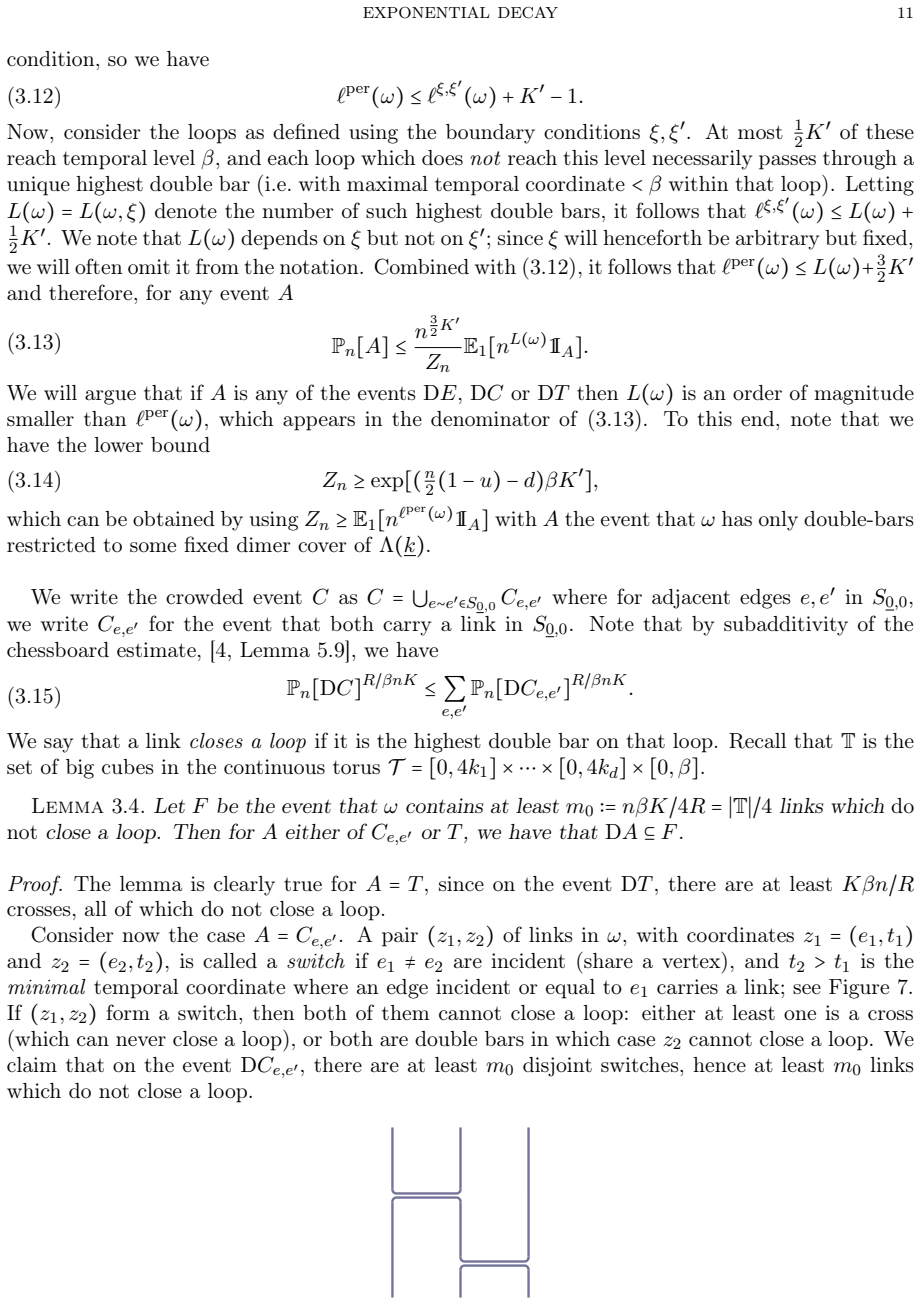
The load-bearing object is the random loop model on the space-time torus $\Lambda(k)\times[0,\beta]$: a Poisson process of crosses and double bars on edges, reweighted by $n^{\ell(\omega)}$, where $\ell(\omega)$ is the number of loops; large $n$ therefore favors many small loops. The proof runs through three linked mechanisms: reflection positivity of an auxiliary spin-colouring measure, which yields the chessboard estimate (Proposition 3.1) bounding probabilities of events in many cubes by powers of their distributed probabilities; a Peierls-type geometric lemma (Lemma 3.2) showing that a loop connection forces a path through cubes with a positive fraction of 'bad' events (crowded, empty, or transposition); and loop-counting estimates (Lemma 3.3) bounding the distributed probabilities of these bad events. The core of the counting is Lemma 3.4, which asserts that on the distributed crowded or transposition events there are at least $m_0 = n\beta K/(4R)$ links that do not close a loop; this deficit produces the $n^{-1/5}$ suppression that makes the Peierls sum converge.
What would settle it
Check the unverified 'one can check' step of Lemma 3.4 case (a) by enumerating all relative temporal orders of the four links in a reflected boundary 4-cycle within one time slab; if any order yields fewer than two disjoint switch pairs on non-incident edges, the $K/4$-per-slab bound fails and the large-$n$ suppression mechanism collapses.
Extended reading notes
Core claim
The central claim is Theorem 1.1: for $u \in [0, \tfrac12]$ and $d \ge 1$, given any decay rate $c>0$ there exist $n_d \in \mathbb{N}$ and $\alpha_d>0$ such that for all integers $n>n_d$ and all $\beta>\alpha_d/n$, the truncated spin-spin correlations on the torus $\Lambda(k)$ satisfy $|\langle S_0^{(i)}; S_x^{(i)}(t)\rangle_{\Lambda(k),\beta}| \le e^{-c(\|x\|_1+|t|)}$ for $i=1,2,3$, uniformly in the torus side lengths and in $\beta$. The probabilistic counterpart (Theorem 2.1) states the same exponential bound for loop-connection probabilities $P_n[(0,0)\leftrightarrow(x,t)]$. The mechanism is that large $n$ makes loops small: the weight $n^{\ell(\omega)}$ favors many loops, and a connection between distant points forces a long chain of 'bad' space-time cubes whose probability is shown to be exponentially small. This answers Ueltschi's question in the negative, since his long-range order for small $n$ in $d \ge 3$ cannot persist for large $n$.
Load-bearing premise
The proof hinges on a geometric counting step, checked only by inspection, that in each reflected four-edge boundary cycle two opposite edges always produce two disjoint pairs of links that cannot close loops in every time slab; if this count failed, the large-$n$ suppression of the bad events would collapse.
Editorial extensions
If this is right
- For every dimension $d \ge 1$ and every $u \in [0,\tfrac12]$, once $n$ is large enough spin-spin correlations decay exponentially, so Ueltschi's small-$n$ long-range order in $d\ge3$ cannot extend to all $n$.
- The exponential bound transfers to any correlation expressible as a loop-connection probability, including the elementary-operator correlations $\langle E^{a,b}_x(s) E^{a,b}_y(t)\rangle$ for $a\neq b$ (Remark 1.2).
- The same result applies to Ueltschi's closely related model with the projection $P_{xy}$ for odd $n$, giving exponential decay of correlations of the form $\langle(S_x^{(i)}(s))^2;(S_y^{(i)}(t))^2\rangle$.
- In two dimensions the result upgrades the previously known polynomial decay of correlations to exponential decay for large $n$ and $u\in[0,\tfrac12]$, consistent with the absence of continuous symmetry breaking.
- The temperature restriction $\beta>\alpha_d/n$ is an artifact of the proof: a separate stochastic-domination argument gives the same exponential decay for all small $\beta$, leaving only an intermediate gap that the authors expect to close.
Reading between the lines
- If the switch-counting technology of Lemma 3.4 is as robust as it appears, the same chessboard-plus-Peierls scheme could deliver exponential decay for other loop-model observables, such as probabilities of two disjoint loops connecting specified pairs of points.
- The large-$n$ exponential decay suggests viewing the loop model as a 2D loop-$O(n)$ model in which $n$ plays the role of the classical spin dimension; the paper leaves open the minimal $n$ for which decay holds for all $u\in[0,1]$, and $n=3$ (the bilinear-biquadratic Heisenberg model) is the natural test case.
- A direct Monte Carlo measurement of $P_n[(0,0)\leftrightarrow(x,t)]$ for $n$ in the range 8–16 could empirically locate the crossover from small-$n$ order to large-$n$ disorder and test whether the rate $c$ grows with $n$ as the proof suggests.
- Because the proof relies on reflection positivity, it cannot reach $u>\tfrac12$; a version avoiding reflection positivity would be needed to decide whether exponential decay persists into the ferromagnetic-anisotropy region where long-range order remains open.
Editorial analysis
A structured set of objections, weighed in public.
Referee Report
Summary. The paper proves exponential decay of spin-spin correlations in O(n)-invariant quantum spin systems on the torus Λ(k) for large n, for u in [0,1/2] and β > α_d/n, complementing Ueltschi's long-range order for small n in d ≥ 3. The proof works through a random loop representation, a Peierls-type argument with chessboard estimates, and a large-n suppression of loop-closing events. The main probabilistic result is exponential decay of loop-connection probabilities, and the spin correlation bound is derived from it via Ueltschi's identities.
Significance. If the proof is completed as indicated, this is a substantial contribution: it answers a question of Ueltschi and provides the first rigorous large-n exponential decay result for this family in all dimensions. The paper clearly identifies the external black boxes (Ueltschi's correlation identities, Biskup's chessboard framework, Georgii–Küneth domination) and organizes the argument carefully. The central mechanism is falsifiable: the bound (3.10) has explicit constants and the decay rate can be made arbitrarily large. The paper also provides a probabilistic theorem (Theorem 2.1) that is stronger than the spin statement and likely transferable to other O(n)-invariant observables.
major comments (3)
- [Theorem 1.1, Section 1.1] The statement of Theorem 1.1 is false at (x,t) = (0,0) for n ≥ 4. By Lemma 2.2, the truncated correlation ⟨S^{(i)}_0 ; S^{(i)}_0(0)⟩ equals (n²−1)/12, which exceeds 1, while the claimed bound is e^{-c·0} = 1. The 'immediate' derivation from Lemma 2.2 and Theorem 2.1 is also not immediate for other points because the prefactor (n²−1)/12 must be absorbed into the exponential rate, which requires a rate adjustment that depends on n and, for short distances, on the distance itself. Please rephrase the theorem to exclude (0,0) or to include the prefactor (e.g., bound by (n²−1)/12 e^{-c(‖x‖₁+|t|)}), and give the absorption argument.
- [Lemma 3.4, Section 3.3] The switch-counting claim in case (a) is deferred to 'one can check.' This is load-bearing because it produces the m0 = nβK/(4R) bound on links that do not close a loop, which feeds the n-suppression in Lemma 3.3 and hence the decisive Peierls factor in (3.10). I verified the claim: in each 4-edge component, the edge with the largest temporal coordinate has an opposite edge; the two edges opposite the maximum edge each have an outgoing switch, and their lower links are non-incident. The sharing bound (each link used by at most two switches) then gives at least K/4 disjoint switches per slab. The argument is short and should be included explicitly, as the present text leaves a central combinatorial step to the reader.
- [Section 2.2, Lemma 2.2 and Theorem 1.1] The factor (n²−1)/12 in Ueltschi's correlation identities is incompatible with the no-prefactor form of Theorem 1.1 without further reasoning. In particular, absorbing this factor into the exponential rate requires the rate to depend on n, so the uniformity in n asserted in Theorem 1.1 needs a careful statement. Specify the intended theorem (for example, with the prefactor included) and provide the absorption argument, or state the theorem only for (x,t) with ‖x‖₁+|t| ≥ 1 and a rate that may depend on n through the prefactor.
minor comments (6)
- [Section 3.1, equation (3.8)] In (3.8), 'θtiB' should read 'θqiB'.
- [Section 3.1, definition of Δ] The symbol T* is used in the discussion of Δ but never defined, and the phrase 'maximum distance between points in neighbouring cubes' is inaccurate if taken literally for arbitrary continuous points; the value 3d+R/n appears to be a conservative upper bound for the relevant endpoints (lattice vertices and arbitrary times). Please rephrase and define T*.
- [Section 3.3, equation (3.27)] The factor n^{3R2^{d−1}/βn} in (3.27) is easy to misread; please rewrite it with explicit parentheses or a displayed fraction, and double-check the exponent.
- [Section 4, Proposition 4.3] The proof of reflection positivity is sketched; the treatment of the i.i.d. random variables for edges not bisected by planes is terse but acceptable. A sentence explaining why conditioning on η_p does not affect these variables would improve clarity.
- [Section 1, equation (1.8)] The statement that (1.3) is equivalent to the bilinear-biquadratic Hamiltonian (1.8) is a bit abrupt; a brief indication of the parameter identification (e.g., how u and the coefficient of (S_x·S_y)² relate) would help the reader.
- [References] The companion paper [6] is cited for Lemma 2.4; please verify that the lemma numbering is correct in the final version and that the citation to [11, Theorem 1.1] for stochastic domination is the intended precise statement.
Circularity Check
No circularity: the exponential-decay bound is derived in-paper from the model via external black boxes and a direct Peierls argument.
full rationale
The paper's central claim is derived in-paper from the model definition. The loop representation and the identity (Lemma 2.2) relating spin-spin correlations to loop-connection probabilities are imported from Ueltschi [21], an external and independent source; the authors' own papers [5] and [6] appear only for context and for an optional extension in Remark 1.2, not as load-bearing support. The chessboard estimate (Proposition 3.1) is proved in Section 4 via a reflection-positive measure and a coupling to the loop measure, with the reflection-positivity argument given in detail rather than imported. The Peierls bound in Theorem 2.1 is a direct computation: the large-n suppression comes from the switch-counting Lemma 3.4 and the stochastic domination used in Lemma 3.3, neither of which assumes the target exponential decay. The only unproven step is the geometric 'one can check' claim in Lemma 3.4(a), and the translation from Theorem 2.1 to Theorem 1.1 involves a prefactor (n^2-1)/12 that is not addressed; both are potential correctness gaps, not instances of circular reasoning. No fitted parameter is renamed as a prediction, no uniqueness theorem is imported from the authors' prior work, and no ansatz is smuggled in via citation. The derivation is therefore self-contained modulo external black boxes from other authors, and the honest finding is no significant circularity.
Assumptions & free parameters
free parameters (2)
- Coarse-graining scale R (and R0) =
large, depending on d and the target rate c (no explicit value given)
- Thresholds n_d and α_d =
existentially quantified, no explicit bounds
assumptions (6)
- domain assumption Loop-representation correlation identities of Ueltschi: ⟨S^(1)S^(1)⟩ = ⟨S^(3)S^(3)⟩ = (n²-1)/12 P_n(connection), with the S^(2) version an inequality (Lemma 2.2).
- domain assumption Reflection positivity holds exactly for u ∈ [0,1/2] and fails for u > 1/2 (Ueltschi [21]); the auxiliary measure P_{ι2} in (4.5) is reflection positive across the plane set π'.
- standard math Standard chessboard-estimate framework for reflection-positive measures, including subadditivity [4, Lemma 5.9].
- standard math Stochastic domination of the link process by a Poisson process of intensity n (Georgii-Küneth [11, Theorem 1.1]).
- standard math Mecke's formula for conditioning on Poisson points (Last-Penrose [15, Theorem 4.4]).
- domain assumption Symmetry reduction ⟨S^(i)_0 ; S^(i)_x(t)⟩ = ⟨S^(i)_0 S^(i)_x(t)⟩ via [21, Lemma 3.1].
invented entities (1)
-
Auxiliary reflection-positive measure P_{ι2} with coupling Q_n
independent evidence
Cite this review
Pith. "Pith review of Exponential decay in $O(n)$-invariant quantum spin systems." pith.science (2026). https://pith.science/paper/R4QEXL7S
@misc{pith2026250622254,
  author       = {Pith},
  title        = {Pith review of: Exponential decay in $O(n)$-invariant quantum spin systems},
  year         = {2026},
  howpublished = {\url{https://pith.science/paper/R4QEXL7S}},
  note         = {Machine review of arXiv:2506.22254}
}
abstract
We consider $O(n)$-invariant and reflection-positive quantum spin systems on the integer lattice in any dimension, and prove that spin-spin correlations decay exponentially fast provided n is large enough. This answers a question of Ueltschi, who proved that for small n there is instead long-range order (for d at least 3).
Figures


Figures from the paper (7 more)




Reference graph
Works this paper leans on
-
[1]
M. Aizenman and B. Nachtergaele,Geometric aspects of quantum spin states, Comm. Math. Phys. 164 (1994), 17–63
work page 1994
-
[2]
C. Benassi, J. Fröhlich and D. Ueltschi,Decay of Correlations in 2D Quantum Systems with Continuous Symmetry, Ann. Henri Poincaré 18 (2017), 2831–2847
work page 2017
-
[3]
Improved bounds for connection probabilities in random loop models
V. Betz and A. Klippel and J. Nauth,Improved bounds for connection probabilities in random loop models, arXiv:2503.17857
-
[4]
Biskup,Reflection Positivity and Phase Transitions in Lattice Spin Models, in R
M. Biskup,Reflection Positivity and Phase Transitions in Lattice Spin Models, in R. Kotecky (ed): Methods of Contemporary Mathematical Statistical Physics. Lecture Notes in Mathematics, vol 1970. Springer, Berlin, Heidelberg (2009)
work page 2009
-
[5]
J. E. Björnberg, P. Mühlbacher, B. Nachtergaele and D. Ueltschi,Dimerization in quantum spin chains with O(n) symmetry, Comm. Math. Phys. (2021)
work page 2021
-
[6]
Dimerization in $O(n)$-invariant quantum spin chains
J. Björnberg, K. Ryan,Dimerization in O(n)-invariant quantum spin chains, arXiv:2506.06103
-
[7]
J. Björnberg, D. Ueltschi,Reflection positivity and infrared bounds for quantum spin systems, in R. Frank, A. Laptev, M. Lewin, R. Seiringer (ed): The Physics and Mathematics of Elliott Lieb, Vol 1. European Mathematical Society (2022)
work page 2022
- [8]
Show all 21 references
-
[9]
Dyson, E
F. Dyson, E. Lieb, B. Simon,Phase Transitions in Quantum Spin Systems with Isotropic and Nonisotropic Interactions, Jour. Stat. Phys. 18 (1978), 335-383
1978
-
[10]
Fröhlich, C
J. Fröhlich, C. Pfister,On the Absence of Spontaneous Symmetry Breaking and of Crystalline Ordering in Two-Dimensional Systems, Comm. Math. Phys. 81 (1981), 277–298. 20 J. E. BJÖRNBERG AND K. RYAN
1981
-
[11]
Georgii and T
H.-O. Georgii and T. Küneth.Stochastic comparison of point random fields.Journal of Applied Probability, 34(4): 868-881, 1997
1997
-
[12]
Kennedy, E
T. Kennedy, E. Lieb, B. S. Shastry,The XY Model Has Long-Range Order for All Spins and All Dimensions Greater than One, Phys. Rev. Lett. 61 (1988), 2582-2584
1988
-
[13]
Kennedy, E
T. Kennedy, E. Lieb, B. S. Shastry,Existence of Néel Order in Some Spin-l/2 Heisenberg Antiferromagnets, Jour. Stat. Phys. 53 (1988), 1019-1030
1988
-
[14]
T. Koma, H. Tasaki,Decay of superconducting and magnetic correlations in one- and two-dimensional Hub- bard models, Phys. Rev. Lett. 68 (1992)
1992
-
[15]
Last and M
G. Last and M. Penrose.Lectures on the Poisson process. Cambridge University Press, 2017
2017
-
[16]
Lees,Existence of Néel Order in the S=1 Bilinear-Biquadratic Heisenberg Model via Random LoopsComm
B. Lees,Existence of Néel Order in the S=1 Bilinear-Biquadratic Heisenberg Model via Random LoopsComm. Math. Phys. 347, (2016) 83–101
2016
-
[17]
Lees,Long-range order for the spin-1 Heisenberg model with a small antiferromagnetic interactionJ
B. Lees,Long-range order for the spin-1 Heisenberg model with a small antiferromagnetic interactionJ. Math. Phys. 55, (2014) 093303
2014
-
[18]
McBryan, T
O. McBryan, T. Spencer,On the decay of correlations in SO(n)-symmetric ferromagnets, Comm. Math. Phys. 53 (1977), 299–302
1977
-
[19]
Mermin, H
N. Mermin, H. Wagner,Absence of Ferromagnetism or Antiferromagnetism in One- or Two-Dimensional Isotropic Heisenberg Models, Phys. Rev. Lett. 17 (1966)
1966
-
[20]
Tóth,Improved lower bound on the thermodynamic pressure of the spin1/2 Heisenberg ferromagnet, Lett
B. Tóth,Improved lower bound on the thermodynamic pressure of the spin1/2 Heisenberg ferromagnet, Lett. Math. Phys. 28 (1993), 75–84
1993
-
[21]
Ueltschi,Random loop representations for quantum spin systems, J
D. Ueltschi,Random loop representations for quantum spin systems, J. Math. Phys. 54 (2013), 083301
2013
Reviewed August 6, 2026 · model on record in the stance chip above.
Discussion (0). Continue with ORCID to comment.