Polarimetry of Ultraluminous X-ray sources
Pith reviewed 2026-06-29 03:14 UTC · model grok-4.3
The pith
SKA observations can detect polarized emission from the jets and bubbles of ultraluminous X-ray sources.
A machine-rendered reading of the paper's core claim, the machinery that carries it, and where it could break.
Core claim
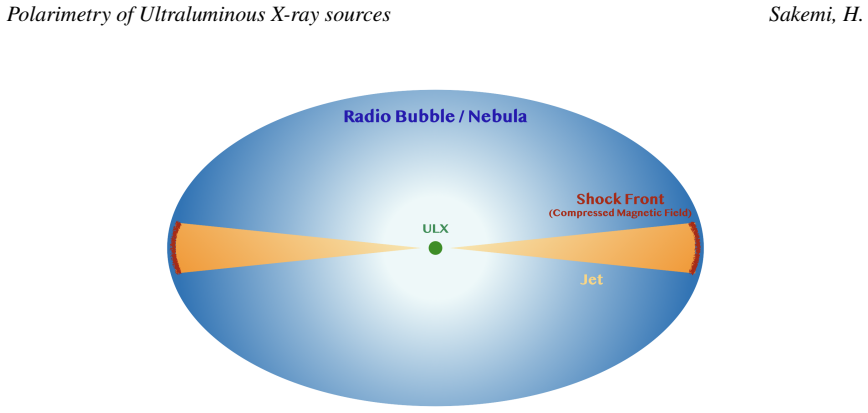
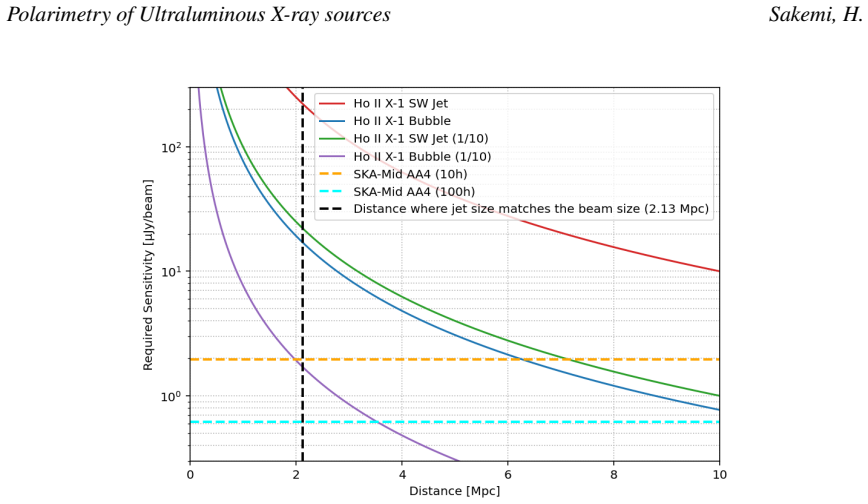
Using calculations for Holmberg II X-1 at 3.39 Mpc with the SKA-Mid AA4 configuration in Band 2 centered at 1310 MHz and assuming 20% fractional polarization, the expected polarized intensities are 260 μJy beam^{-1} for the jet and 20 μJy beam^{-1} for the bubble. A Holmberg II X-1-like jet is detectable within 10 hours even at ~10 Mpc, while bubble polarization requires ~100 hours. Future SKA-VLBI capabilities will enable detailed mapping of magnetic field morphology, marking the first polarization detections from ULXs.
What carries the argument
Detectability estimates for polarized radio intensity from ULX jets and bubbles, scaled by assumed 20% fractional polarization and SKA sensitivity parameters.
If this is right
- A jet like that in Holmberg II X-1 is detectable within 10 hours at distances around 10 Mpc.
- Bubble polarization detection requires integration times of about 100 hours.
- Resolving fine structures is possible only for nearby ULXs, but SKA-VLBI can extend this capability.
- The first polarization detections will inform on magnetic field geometry and jet-ISM interactions in super- and sub-Eddington accretors.
Where Pith is reading between the lines
- Polarization measurements could help differentiate between IMBH and stellar-mass black hole models for ULXs by revealing field structures.
- The technique might be applied to other classes of radio-loud X-ray sources to study feedback processes.
- If polarization fractions vary across sources, it could indicate different physical conditions in the outflows.
Load-bearing premise
The predictions depend on assuming a 20% fractional polarization for both jet and bubble emission; substantially lower actual polarization would make detection much harder or require longer observations.
What would settle it
Failure to detect polarized emission from the jet of Holmberg II X-1 at the predicted level after 10 hours of SKA observation would indicate that the assumed polarization fraction or intensity estimates are too high.
Figures
read the original abstract
Ultraluminous X-ray sources (ULXs) are non-nuclear X-ray emitters exceeding the Eddington luminosity, offering key insights into extreme accretion physics. Their origin is attributed to either sub-Eddington accretion onto intermediate-mass black holes (IMBHs) or supercritical accretion onto stellar-mass compact objects in binary systems. A subset of ULXs shows radio jets and surrounding bubbles, indicative of strong mechanical feedback, but no polarization detection has been reported to date because of limited sensitivity and angular resolution at multi-megaparsec distances. Next-generation facilities such as the Square Kilometre Array (SKA) will enable polarimetric studies of ULX outflows and bubbles, providing vital information on their magnetic field structure and jet-ISM interactions. Using Holmberg II X-1 (3.39 Mpc) as a representative system, we evaluated the detectability of its polarized jet and bubble with the SKA-Mid AA4 configuration. Assuming a fractional polarization of 20% and Band 2 observations centered at 1310 MHz, the expected polarized intensities are 260 $\mu$Jy beam$^{-1}$ for the jet and 20 $\mu$Jy beam$^{-1}$ for the bubble. A Holmberg II X-1-like jet is detectable within 10 hours even at $\sim$ 10 Mpc, while bubble polarization requires $\sim$ 100 hours. Although resolving fine structures is feasible only for nearby ULXs, future SKA-VLBI capabilities will help overcome this limitation and enable detailed mapping of magnetic field morphology. These results indicate that the SKA will enable the first detection of polarized emission from ULXs, advancing our understanding of magnetic field geometry, jet formation, and feedback in super- and sub-Eddington accretors.
Editorial analysis
A structured set of objections, weighed in public.
Referee Report
Summary. The manuscript evaluates the detectability of polarized radio emission from the jet and surrounding bubble of the ULX Holmberg II X-1 (at 3.39 Mpc) using the SKA-Mid AA4 configuration in Band 2 (1310 MHz). It assumes a 20% fractional polarization to predict polarized intensities of 260 μJy beam^{-1} for the jet and 20 μJy beam^{-1} for the bubble, concluding that the jet is detectable in ~10 hours even at ~10 Mpc while the bubble requires ~100 hours, thereby enabling the first polarimetric studies of ULX outflows with SKA.
Significance. If the polarization fraction and flux scaling hold, the estimates demonstrate a concrete path for SKA to provide the first polarized detections from ULXs, which would directly constrain magnetic field geometry and jet-ISM interactions in super-Eddington accretors. The work is forward-looking and uses an explicit representative source, but its impact is tempered by the single untested scalar assumption.
major comments (1)
- [Abstract] Abstract: the central detectability claims (10 h for jet, 100 h for bubble; extension to 10 Mpc) rest entirely on the assumed 20% fractional polarization with no cited observational precedent from similar synchrotron sources, no range of values, and no sensitivity analysis. If the true fraction is ≲5–10%, the polarized fluxes fall below the quoted SKA-Mid thresholds for the stated integration times.
Simulated Author's Rebuttal
We thank the referee for their constructive comments on our manuscript. The primary concern is the reliance on an assumed 20% fractional polarization without supporting citations, a range of values, or sensitivity analysis. We address this point below and will revise the manuscript to strengthen the presentation of our detectability estimates.
read point-by-point responses
-
Referee: [Abstract] Abstract: the central detectability claims (10 h for jet, 100 h for bubble; extension to 10 Mpc) rest entirely on the assumed 20% fractional polarization with no cited observational precedent from similar synchrotron sources, no range of values, and no sensitivity analysis. If the true fraction is ≲5–10%, the polarized fluxes fall below the quoted SKA-Mid thresholds for the stated integration times.
Authors: We agree that the detectability results hinge on the choice of 20% fractional polarization and that the manuscript would be improved by additional context. This value is a typical figure for ordered synchrotron emission in compact jets (commonly 10–30% in Galactic microquasars and FR I sources at GHz frequencies), but we acknowledge the absence of explicit citations and sensitivity tests in the current text. In revision we will (i) insert citations to representative polarization measurements from similar synchrotron sources in the introduction, (ii) state the adopted range explicitly, and (iii) add a short sensitivity analysis (new table or figure) showing required integration times for polarization fractions of 5%, 10%, 15%, and 20%. The abstract will be updated to note that the quoted times correspond to the fiducial 20% case while lower fractions increase the required time proportionally. These changes directly address the referee’s concern without altering the core feasibility conclusion for a Holmberg II X-1-like source. revision: yes
Circularity Check
No circularity: detectability estimates use explicit external assumption and telescope specs
full rationale
The paper states an assumed 20% fractional polarization upfront and scales total intensity to polarized flux using SKA-Mid parameters (sensitivity, frequency, integration time) for Holmberg II X-1 at known distance. No equation derives the polarization fraction from the paper's own data or prior results; the 20% value is an input, not an output. No self-citations, fitted parameters renamed as predictions, or self-definitional steps appear in the derivation chain. The central claim is a forward projection conditional on the stated assumption and external benchmarks, making the analysis self-contained against those benchmarks.
Axiom & Free-Parameter Ledger
free parameters (1)
- fractional polarization =
20%
axioms (1)
- domain assumption SKA-Mid AA4 configuration sensitivity and resolution at 1310 MHz
Reference graph
Works this paper leans on
-
[1]
Pulsating ultraluminous X-ray sources: Modeling the thermal emission and polarization properties. , keywords =. doi:10.1051/0004-6361/202449834 , archivePrefix =. 2411.13659 , primaryClass =
-
[2]
Faraday Rotation Measure Synthesis
Faraday rotation measure synthesis. , keywords =. doi:10.1051/0004-6361:20052990 , archivePrefix =. astro-ph/0507349 , primaryClass =
work page internal anchor Pith review Pith/arXiv arXiv doi:10.1051/0004-6361:20052990
-
[3]
, year = 1966, volume = 133, pages =
On the depolarization of discrete radio sources by Faraday dispersion. , year = 1966, month = jan, volume =. doi:10.1093/mnras/133.1.67 , adsurl =
-
[4]
Ultrahigh-Energy Gamma-ray Emission Associated with Black Hole-Jet Systems. arXiv e-prints , keywords =. doi:10.48550/arXiv.2410.08988 , archivePrefix =. 2410.08988 , primaryClass =
-
[5]
The evolution of a jet ejection of the ultraluminous X-ray source Holmberg II X-1
The evolution of a jet ejection of the ultraluminous X-ray source Holmberg II X-1. , keywords =. doi:10.1093/mnras/stv1308 , archivePrefix =. 1506.02988 , primaryClass =
work page internal anchor Pith review Pith/arXiv arXiv doi:10.1093/mnras/stv1308
-
[6]
Unveiling recurrent jets of the ULX Holmberg II X-1: evidence for a massive stellar-mass black hole?
Unveiling recurrent jets of the ULX Holmberg II X-1: evidence for a massive stellar-mass black hole?. , keywords =. doi:10.1093/mnrasl/slt166 , archivePrefix =. 1311.4867 , primaryClass =
work page internal anchor Pith review Pith/arXiv arXiv doi:10.1093/mnrasl/slt166
-
[7]
Exploring the case for hard-X-ray beaming in NGC 6946 X-1. , keywords =. doi:10.1093/mnras/stae1975 , archivePrefix =. 2408.07751 , primaryClass =
-
[8]
Discovery of an X-Ray Photoionized Optical Nebula and a Radio Nebula Associated with the ULX NGC 4861 X-1. , keywords =. doi:10.3847/1538-4357/acf8c3 , archivePrefix =. 2309.05718 , primaryClass =
-
[9]
The ultraluminous X-ray source bubble in NGC 5585. , keywords =. doi:10.1093/mnras/staa3784 , archivePrefix =. 2012.03970 , primaryClass =
-
[10]
Multiband counterparts of two eclipsing ultraluminous X-ray sources in M 51
Multiband counterparts of two eclipsing ultraluminous X-ray sources in M 51. , keywords =. doi:10.1093/mnras/sty014 , archivePrefix =. 1801.01889 , primaryClass =
work page internal anchor Pith review Pith/arXiv arXiv doi:10.1093/mnras/sty014
-
[11]
Detection of a Radio Bubble around the Ultraluminous X-Ray Source Holmberg IX X-1. , keywords =. doi:10.3847/1538-4357/ab9108 , archivePrefix =. 2006.05562 , primaryClass =
-
[12]
Black Hole Powered Nebulae and a Case Study of the Ultraluminous X-ray Source IC342 X-1
Black Hole Powered Nebulae and a Case Study of the Ultraluminous X-Ray Source IC 342 X-1. , keywords =. doi:10.1088/0004-637X/749/1/17 , archivePrefix =. 1201.4473 , primaryClass =
work page internal anchor Pith review Pith/arXiv arXiv doi:10.1088/0004-637x/749/1/17
-
[13]
On the radio properties of the intermediate-mass black hole candidate ESO 243-49 HLX-1
On the radio properties of the intermediate-mass black hole candidate ESO 243-49 HLX-1. , keywords =. doi:10.1093/mnras/stu2363 , archivePrefix =. 1411.1306 , primaryClass =
work page internal anchor Pith review Pith/arXiv arXiv doi:10.1093/mnras/stu2363
-
[14]
The extended radio jet of an off-nuclear low-mass AGN in NGC 5252
The extended radio jet of an off-nuclear low-mass AGN in NGC 5252. , keywords =. doi:10.1093/mnrasl/sly130 , archivePrefix =. 1807.03792 , primaryClass =
work page internal anchor Pith review Pith/arXiv arXiv doi:10.1093/mnrasl/sly130
-
[15]
The powerful jet of an off-nuclear intermediate-mass black hole in the spiral galaxy NGC 2276
The powerful jet of an off-nuclear intermediate-mass black hole in the spiral galaxy NGC 2276. , keywords =. doi:10.1093/mnras/stv143 , archivePrefix =. 1501.04897 , primaryClass =
work page internal anchor Pith review Pith/arXiv arXiv doi:10.1093/mnras/stv143
-
[16]
Radio observations of extreme ULXs: revealing the most powerful ULX radio nebula ever or the jet of an intermediate-mass black hole?. , keywords =. doi:10.1093/mnras/stt1794 , archivePrefix =. 1309.5721 , primaryClass =
work page internal anchor Pith review Pith/arXiv arXiv doi:10.1093/mnras/stt1794
-
[17]
Radio Detections During Two State Transitions of the Intermediate Mass Black Hole HLX-1
Radio Detections During Two State Transitions of the Intermediate-Mass Black Hole HLX-1. Science , keywords =. doi:10.1126/science.1222779 , archivePrefix =. 1311.6918 , primaryClass =
work page internal anchor Pith review Pith/arXiv arXiv doi:10.1126/science.1222779
-
[18]
1998, Astronomy and Astrophysics, 331,
Discovery of an optical counterpart to the hyperluminous X-ray source in ESO 243-49. , keywords =. doi:10.1111/j.1365-2966.2010.16517.x , archivePrefix =. 0910.1356 , primaryClass =
-
[19]
The innermost jet in the hidden ultra-luminous X-ray source Cygnus X-3. , keywords =. doi:10.1093/mnrasl/slad111 , archivePrefix =. 2308.01002 , primaryClass =
-
[20]
Transients from initial conditions in cosmological simulations
Radio and X-ray properties of relativistic beaming models for ultraluminous X-ray sources. , keywords =. doi:10.1111/j.1365-2966.2006.10750.x , archivePrefix =. astro-ph/0606707 , primaryClass =
-
[21]
Super-critical column accretion on to strongly magnetized neutron stars in ULX pulsars. , keywords =. doi:10.1093/pasj/psz136 , adsurl =
-
[22]
A radiation-hydrodynamic model of accretion columns for ultra-luminous X-ray pulsars
A radiation-hydrodynamics model of accretion columns for ultra-luminous X-ray pulsars. , keywords =. doi:10.1093/pasj/psw075 , archivePrefix =. 1608.04211 , primaryClass =
work page internal anchor Pith review Pith/arXiv arXiv doi:10.1093/pasj/psw075
-
[23]
Ultraluminous X-ray sources. , keywords =. doi:10.1016/j.newar.2022.101672 , archivePrefix =. 2302.10605 , primaryClass =
-
[24]
An Ultraluminous X-ray Source Powered by An Accreting Neutron Star
An ultraluminous X-ray source powered by an accreting neutron star. , keywords =. doi:10.1038/nature13791 , archivePrefix =. 1410.3590 , primaryClass =
work page internal anchor Pith review Pith/arXiv arXiv doi:10.1038/nature13791
-
[25]
2019 , eprint=
Anticipated Performance of the Square Kilometre Array -- Phase 1 (SKA1) , author=. 2019 , eprint=
2019
-
[26]
2015 , publisher=
Advancing Astrophysics with the Square Kilometre Array (AASKA14) , author=. 2015 , publisher=
2015
-
[27]
A multimission catalogue of ultraluminous X-ray source candidates. , keywords =. doi:10.1093/mnras/stab3001 , archivePrefix =. 2110.07625 , primaryClass =
-
[28]
Formation of intermediate-mass black holes in circumnuclear regions of galaxies
Formation of Intermediate-Mass Black Holes in Circumnuclear Regions of Galaxies. , keywords =. doi:10.1093/pasj/52.3.533 , archivePrefix =. astro-ph/0002389 , primaryClass =
work page internal anchor Pith review Pith/arXiv arXiv doi:10.1093/pasj/52.3.533
-
[29]
Astrophysical Bulletin , keywords =
Ultraluminous X-Ray Sources. Astrophysical Bulletin , keywords =. doi:10.1134/S1990341321010077 , archivePrefix =. 2105.10537 , primaryClass =
-
[30]
First Detection of X-Ray Polarization in Galactic Ultraluminous X-Ray Pulsar Swift J0243.6+6124 with IXPE. , keywords =. doi:10.3847/2041-8213/ad67e5 , archivePrefix =. 2402.11602 , primaryClass =
-
[31]
Magnetic fields in supernova remnants and pulsar-wind nebulae
Magnetic Fields in Supernova Remnants and Pulsar-Wind Nebulae. , keywords =. doi:10.1007/s11214-011-9775-y , archivePrefix =. 1104.4047 , primaryClass =
work page internal anchor Pith review Pith/arXiv arXiv doi:10.1007/s11214-011-9775-y
-
[32]
Microquasar interaction with the surrounding medium
Non-thermal emission from microquasar/ISM interaction. , keywords =. doi:10.1051/0004-6361/200810781 , archivePrefix =. 0903.3293 , primaryClass =
work page internal anchor Pith review Pith/arXiv arXiv doi:10.1051/0004-6361/200810781
discussion (0)
Sign in with ORCID, Apple, or X to comment. Anyone can read and Pith papers without signing in.