REVIEW 5 minor 26 references
The Amerigo Vespucci as a traveling laboratory for studying the cosmic-ray fluxes at sea level
T0 review · 0 major / 5 minor · reviewed 2026-07-11 · grok-4.5
Pith's one-line read A shipboard scintillator finds sea-level cosmic-ray rate lowest near 7°N, about 16% below the rate at Trieste.
desk verdict Clean modern muon latitude survey on a single instrument; 16% effect and ~7°N minimum are solid, Forbush ratios check out, work is incremental but usable. read the letter →
The pith
A machine-rendered reading of the paper's core claim, the machinery that carries it, and where it could break.
The reading
What carries the argument
The phenomenological rate model (Eq. 1) that multiplies a sum of Forbush-decrease templates (start times, rise and fall times fixed to the Oulu neutron-monitor fit) by either a simple latitude term L(λ)=1−α cos^γ(λ−λ0) or the Dorman cutoff function R(Rc)=1−exp(−A Rc^−k); the free amplitude parameters then isolate the geomagnetic latitude effect from solar modulation.
What would settle it
An independent continuous muon-rate measurement spanning the same 7°N–45°N corridor during a period of low solar activity that either recovers a 16% amplitude and λ0≈7.8°N or finds a statistically different minimum location or depth.
Extended reading notes
Core claim
The sea-level cosmic-ray rate measured by a two-tile plastic scintillator on the Vespucci reaches its minimum near geographic latitude 7°N and is about 16% lower there than at Trieste (~45°N); the same data set also captures seven Forbush decreases whose amplitudes are typically a factor of three smaller than those recorded by the Oulu neutron monitor.
Load-bearing premise
The assumption that fixing the Forbush start, rise and fall times to the Oulu neutron-monitor values fully removes solar modulation so that the remaining latitude dependence is purely geomagnetic.
Signed reviews
Editorial analysis
A structured set of objections, weighed in public.
Referee Report
Summary. The paper reports sea-level cosmic-ray rates measured with a two-tile plastic scintillator coincidence detector installed on the Italian Navy tall ship Amerigo Vespucci. Data were collected from Darwin (Oct 2024) to Trieste (Mar 2025) over latitudes 15°S–45°N, then continued on the Mediterranean leg to Genova (Jun 2025). After inclination and barometric corrections, the lowest azimuth-averaged rate occurs near 7°N and is ~16% below the Trieste value. Seven Forbush decreases are identified by fixing start/rise/fall times to the independent Oulu neutron monitor and floating only amplitudes on the Vespucci data; muon amplitudes are typically a factor ~3 smaller than neutron-monitor amplitudes. The same latitude and Forbush patterns are recovered on the Mediterranean leg and with the independent ALBERT muon counter at Bari. Rates are also shown versus IGRF vertical cutoff rigidity and fitted with a Dorman function.
Significance. A continuous, single-instrument sea-level muon survey spanning a wide latitude range during Solar Cycle 25 maximum is rare and valuable. The work cleanly separates geomagnetic latitude effects from solar modulation by anchoring Forbush timing to an independent neutron monitor, recovers a CR-equator location (~7°N) consistent with historical surveys, and quantifies the weaker muon response relative to neutrons both for latitude and for Forbush events. Cross-checks with the Mediterranean leg and with ALBERT strengthen the observational claim. The data set is a useful modern reference for geomagnetic cutoff and solar-modulation studies.
minor comments (5)
- Methods, barometric coefficient: β = (1.52 ± 0.48) × 10^{-3} hPa^{-1} has a large relative uncertainty. A short statement on how this uncertainty propagates into the final rates (or into the 16% amplitude) would help the reader assess residual systematics.
- Eq. (3) and surrounding text: the latitude term is correctly described as phenomenological; a one-sentence note that it is used only for description (not for physical inference of cutoff) would further clarify its role relative to the Dorman fit of Eq. (5).
- Results, Mediterranean tour: the ~3% rate drop after relocating the detector in Trieste is attributed to additional overburden. A brief estimate of the material thickness or a comparison of the two positions would make this correction more transparent.
- Fig. 11 bottom panel: the Sense HAT vertical geomagnetic field shows a constant offset relative to IGRF. Mentioning that the offset does not affect the rate analysis (which uses IGRF cutoffs) would avoid reader confusion.
- Abstract and Introduction: a few minor typographical inconsistencies (e.g., spacing around degree symbols, “Thelowestrate”) should be cleaned in production.
Circularity Check
No significant circularity: observational latitude effect and Forbush amplitudes are measured data, not forced by construction; phenomenological fits are descriptive only.
-
self citation load bearing
[Mediterranean Tour section; Fig. 8 and surrounding text]
"In Fig. 8 we also show the rate measured with the CR detector “ALBERT” [13] installed at the INFN Bari. In this case we find that the amplitude decrease coefficient associated to the Forbush event is of about 0.08, similar to the result achieved with the Vespucci data."
ALBERT is the authors’ own portable muon counter (Pillera et al., ICRC 2023). Its use as a contemporaneous cross-check for the June 2025 Forbush amplitude is a minor self-citation. It is not load-bearing for the world-tour 16% latitude claim or the location of the minimum at ~7°N, which rest on the Vespucci data alone and on comparison with the independent Oulu NM.
full rationale
The central claims (minimum rate at ~7°N, ~16% lower than Trieste; seven Forbush decreases with amplitudes ~1/3 of Oulu NM) are direct measurements of the Vespucci scintillator rates after standard inclination and barometric corrections. Forbush start/rise/fall times are taken from the independent Oulu neutron monitor and held fixed while only amplitudes are floated on Vespucci data—an ordinary multi-instrument procedure that does not force the reported 16% latitude amplitude. The latitude term L(λ)=1−α cos^γ(λ−λ0) and the Dorman cutoff function are explicitly phenomenological fits to the same rates; they organize the data but are not presented as first-principles predictions. The Mediterranean leg and the independent ALBERT Bari counter recover consistent latitude and Forbush ratios, providing external cross-checks. Minor self-reference to ALBERT is not load-bearing. Residuals are Gaussian with zero mean. Score 1 reflects only the trivial self-citation of the authors’ own ALBERT instrument, which does not underwrite the primary result.
Assumptions & free parameters
free parameters (7)
- latitude amplitude α =
0.170 ± 0.001
- latitude of minimum λ0 =
7.80 ± 0.09 deg N
- latitude plateau exponent γ =
7.95 ± 0.16
- Dorman A =
9.21 ± 0.22
- Dorman k =
0.575 ± 0.007
- barometric coefficient β =
(1.52 ± 0.48)×10^-3 hPa^-1
- Forbush amplitudes a_j (7 events) =
range ~1.1% to ~4%
assumptions (4)
- domain assumption The geomagnetic field is adequately described by the IGRF model at epoch 2024.9 for computing vertical cutoff rigidities at 20 km altitude.
- domain assumption The Oulu neutron-monitor count rate provides an independent, latitude-independent monitor of solar modulation (Forbush decreases).
- domain assumption Secondary particles reaching sea level are predominantly muons (plus a reduced electron/positron fraction) whose rate is proportional to the primary flux above the local geomagnetic cutoff.
- ad hoc to paper The phenomenological forms L(λ)=1-α cos^γ(λ-λ0) and the Dorman function adequately capture the latitude and cutoff dependence after Forbush subtraction.
Cite this review
Pith. "Pith review of The Amerigo Vespucci as a traveling laboratory for studying the cosmic-ray fluxes at sea level." pith.science (2026). https://pith.science/paper/R5BM7YO7
@misc{pith2026260704197,
  author       = {Pith},
  title        = {Pith review of: The Amerigo Vespucci as a traveling laboratory for studying the cosmic-ray fluxes at sea level},
  year         = {2026},
  howpublished = {\url{https://pith.science/paper/R5BM7YO7}},
  note         = {Machine review of arXiv:2607.04197}
}
read the original abstract
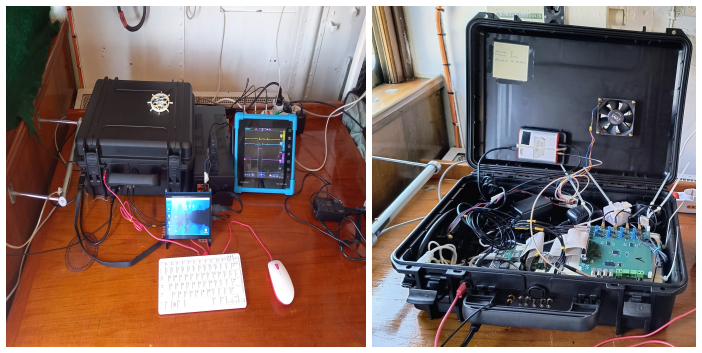
We have installed and operated a plastic scintillator detector counter to measure the flux of cosmic radiation during the 2023-2025 tour of the historical vessel Amerigo Vespucci. The Vespucci is the oldest ship of the Italian Navy and serves as a training vessel for Navy cadets. During its tour, some experiments were hosted onboard the vessel, providing unique opportunities for scientists working in different fields. We installed our detector upon the Vespucci's departure from Darwin in early October 2024. The detector collected cosmic-ray data during the journey from Darwin to Trieste, where the worldwide tour ended in March 2025. After about one month of stop in Trieste, the ship continued its tour in the Mediterranean sea, and arrived in Genova on June 10, 2025. We performed measurements of the cosmic radiation reaching the sea level across a wide latitude range, from 15{\deg} S to about 45{\deg} N. The lowest rate (averaged over all azimuth angles) was measured at a geographic latitude of about 7{\deg} N, and was about 16% less than the highest value, which was measured at Trieste, the northernmost location of the journey. Latitude effects on the cosmic radiation flux at sea level are due to the quasi-dipole geomagnetic field configuration, tilted by an angle of about 11{\deg} with respect to Earth's rotational axis.
Figures


Figures from the paper (9 more)



Reference graph
Works this paper leans on
-
[1]
Navas et al
S. Navas et al. Review of particle physics.Phys. Rev. D, 110(3):030001, 2024
2024
-
[2]
Victor F. Hess. Über Beobachtungen der durchdringenden Strahlung bei sieben Freiballonfahrten.Phys. Z., 13:1084–1091, 1912
1912
-
[3]
D. Pacini. Penetrating Radiation at the Surface of and in Water.Nuovo Cim., 8:93–100, 1912
1912
-
[4]
C. D. Anderson. The Positive Electron.Phys. Rev., 43:491–494, 1933
1933
-
[5]
Sur les trajectoires des corpuscules électrisés dans l’espace sous l’action du magnétisme terrestre, avec application aux aurores boréales.Arch
Carl Störmer. Sur les trajectoires des corpuscules électrisés dans l’espace sous l’action du magnétisme terrestre, avec application aux aurores boréales.Arch. Sci. Phys. et Nat., 24:317–364, 1907
1907
-
[6]
Sur les trajectoires des corpuscules électrisés dans l’espace
Carl Störmer. Sur les trajectoires des corpuscules électrisés dans l’espace. Applications à l’aurore boréale et aux perturbations magnétiques.Radium (Paris), 4(1):2–5, 1907
1907
-
[7]
J. Clay. Penetrating radiation ii.Proc. R. Acad. Amsterdam, 30:1115– 1127, 1927
1927
-
[8]
J. Clay. Penetrating radiation ii.Proc. R. Acad. Amsterdam, 31:1091– 1097, 1928
1928
Show all 26 references
-
[9]
Arthur H. Compton. A geographic study of cosmic rays.Phys. Rev., 43:387–403, Mar 1933
1933
-
[10]
S. E. Forbush. On the effects in cosmic-ray intensity observed during the recent magnetic storm.Phys. Rev., 51:1108–1109, Jun 1937. [11]https://www.nmdb.com/
1937
-
[11]
Mavromichalaki, A
H. Mavromichalaki, A. Papaioannou, C. Sarlanis, G. Souvatzoglou, M. Gerontidou, C. Plainaki, M. Papailiou, G. Mariatos, and Nmdb Team. Establishing and Using the Real-Time Neutron Monitor Database (NMDB). In K. Tsinganos, D. Hatzidimitriou, and T. Matsakos, editors,9th Interna...
2010
-
[12]
ALBERT: A Little Bar ExpeRimental Tracker, a portable cosmic ray telescope for outreach and teaching purposes.PoS, ICRC2023:1615, 2023
Roberta Pillera et al. ALBERT: A Little Bar ExpeRimental Tracker, a portable cosmic ray telescope for outreach and teaching purposes.PoS, ICRC2023:1615, 2023
2023
-
[13]
J. D. Hunter. Matplotlib: A 2d graphics environment.Computing in Science & Engineering, 9(3):90–95, 2007. [15]https://appel.nasa.gov/2024/10/30/solar-cycle-25-reaches-maximum/
2007
-
[14]
Bondar, W.J
P.Alken, E.Thébault, C.D.Beggan, H.Amit, J.Aubert, J.Baerenzung, T.N. Bondar, W.J. Brown, S. Califf, A. Chambodut, et al. International Geomagnetic Reference Field: the thirteenth generation.Earth, Planets and Space, 73(1):1–25, 2021
2021
-
[15]
IAGA-VMOD/ppigrf: 2.0.0, 2024
Karl M Laundal, Santiago Soler, Ashley Smith, Andreas S Skeidsvoll, Daniel Billett, and PB. IAGA-VMOD/ppigrf: 2.0.0, 2024
2024
-
[16]
Dorman.Cosmic rays in magnetospheres of the earth and other planets, volume358ofAstrophysics and Space Science Library
L. Dorman.Cosmic rays in magnetospheres of the earth and other planets, volume358ofAstrophysics and Space Science Library. Springer, 2009
2009
-
[17]
Time variation of cosmic ray intensity in the antarctic region.Journal of geomagnetism and geoelectricity, 12(4):175–180, 1961
Taiichi Kitamura and Masahiro Kodama. Time variation of cosmic ray intensity in the antarctic region.Journal of geomagnetism and geoelectricity, 12(4):175–180, 1961
1961
-
[18]
M. Kodama. Latitude effect of cosmic ray nucleon and meson components at sea level.Il Nuovo Cimento (1955-1965), 8(2):283–284, Sep 1958
1955
-
[19]
M. A. Pomerantz, A. E. Sandsteöm, and D. C. Rose. Shipboard neutron monitor determination of cosmic-ray equator.Il Nuovo Cimento (1955- 1965), 8(2):257–262, Sep 1958
1955
-
[20]
D. C. Rose and J. Katzman. The geomagnetic latitude effect on the nucleon and meson component of cosmic rays at sea level.Canadian Journal of Physics, 34(1):1–19, 1956
1956
-
[21]
Abbrescia et al
M. Abbrescia et al. Measurement of the cosmic charged particle rate at sea level in the latitude range 35◦÷82 ◦ N with the PolarquEEEst experiment.Eur. Phys. J. C, 83(4):293, 2023
2023
-
[22]
Nuntiyakul, P
W. Nuntiyakul, P. Evenson, D. Ruffolo, A. Sáiz, J. W. Bieber, J. Clem, R. Pyle, M. L. Duldig, and J. E. Humble. Latitude Survey Investigation of Galactic Cosmic Ray Solar Modulation during 1994-2007.The Astrophysical Journal, 795(1):11, November 2014. 23
1994
-
[23]
CharacterizationofSilicon Photomultipliers after proton irradiation up to 1014 neq/cm2.Nucl
Anna Rita Altamura, Fabio Acerbi, Chiara Nociforo, Veronica Regazzoni, AlbertoMazzi, andAlbertoGola. CharacterizationofSilicon Photomultipliers after proton irradiation up to 1014 neq/cm2.Nucl. Instrum. Meth. A, 1040:167284, 2022. [26]https://www.raspberrypi.com/products/ rasp...
2022
-
[24]
Abbrescia et al
M. Abbrescia et al. New high precision measurements of the cosmic charged particle rate beyond the Arctic Circle with the PolarquEEEst experiment.Eur. Phys. J. C, 80(7):665, 2020. [Erratum: Eur.Phys.J.C 80, 897 (2020)]
2020
-
[25]
Centrum voor Wiskunde en Informatica Amsterdam, 1995
Guido Van Rossum and Fred L Drake Jr.Python reference manual. Centrum voor Wiskunde en Informatica Amsterdam, 1995
1995
-
[26]
Capitano di Vascello
R. Brun and F. Rademakers. ROOT: An object oriented data analysis framework.Nucl. Instrum. Meth. A, 389:81–86, 1997. 24 Acknowledgments This work was supported by an agreement between the INFN and the Italian Navy. The authors are very grateful to the Commander “Capitano di Va...
1997
Reviewed July 11, 2026 · model on record in the stance chip above.
Discussion (0). Continue with ORCID to comment.