REVIEW 2 major objections 6 minor 54 references
Unlocking the power of global quantum gates with machine learning
T0 review · 2 major / 6 minor · reviewed 2026-08-09 · deepseek-v4-flash
Pith's one-line read Finite-depth global-gate variational circuits can prepare strongly entangled ground states with a constant number of global entangling pulses.
desk verdict Interesting variational use of global gates, but the constant-pulse count for 2D CX layers is unsupported and the best-half averaging overstates the numerics. read the letter →
The pith
A machine-rendered reading of the paper's core claim, the machinery that carries it, and where it could break.
The reading
What carries the argument
Each ansatz is an alternating circuit: a layer of single-qubit rotations $R_3=R_Z(\theta_3)R_Y(\theta_2)R_Z(\theta_1)$ followed by a layer of two-qubit entangling gates that are all of the same type (CZ or CX) and are meant to be realized simultaneously as a single global GCZ or GCX gate. GZ uses only CZ layers; GZX alternates CZ and CX layers; GZXH splits the entangling links into two complementary groups so that the total number of two-qubit gates matches GZ. The design keeps the local depth finite (at most four per layer on 2D lattices), which, by the barren-plateau results for finite-local-depth circuits, protects trainability. Expressibility is quantified by comparing the state ensemble generated by an ansatz to the Haar ensemble through moment distances $A^{(t)}$, the frame potential, and the KL divergence of the fidelity distribution. The reported numerics show GZX matching the much more general Cartan ansatz on these expressibility measures.
What would settle it
Compute the commutator of the two CX gates on links $(x,y)\text{-}(x+1,y)$ and $(x,y)\text{-}(x,y+1)$ in a single GZX layer on the square lattice; if it is nonzero, that layer cannot be one GCX pulse, and the claimed constant number of global gates for the 2D ansatze is not established.
Extended reading notes
Core claim
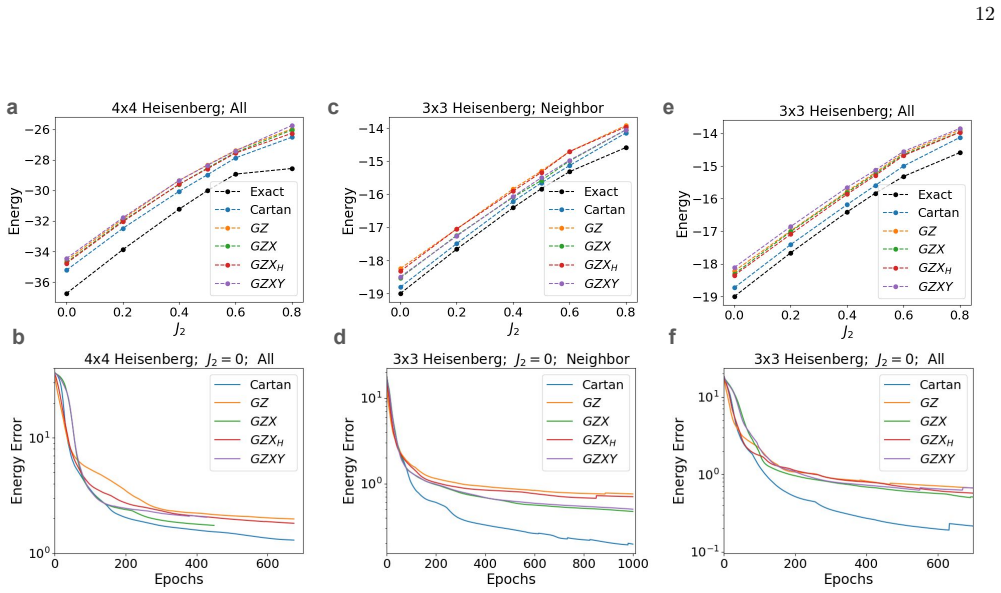
On the paper's own terms, the central discovery is that finite-depth global-gate ansatze are both barren-plateau-free and sufficiently expressive to variationally prepare strongly entangled ground states. For the 3x3 toric code model, the GZX and GZXH circuits converge close to the exact ground-state energy across the full range of the field parameter h, reproduce the topological entanglement entropy, and in the reported numerics even outperform the more general Cartan ansatz. For the 4x4 J1-J2 Heisenberg model, the same ansatze achieve energies close to exact diagonalization over the studied range of J2. The paper interprets this as evidence that a constant number of global gates, together with free single-qubit rotations, can encode long-range entanglement, so global-gate hardware can prepare these states far more cheaply than with local-gate compilations.
Load-bearing premise
The load-bearing premise is that each layer of two-qubit CZ or CX gates can be executed as a single global pulse, which requires the gates in that layer to commute; the 2D ansatz layers described in the paper include gates on links that share a vertex, and no argument is given that those layers commute.
Editorial extensions
If this is right
- Ground states of the Heisenberg and toric code models can be prepared with a constant number of global-entangling pulses, provided each layer is realizable as one commuting global gate.
- The GZX and GZXH ansatze are trainable: gradient variance stays roughly constant with system size for fixed depth, so no barren plateau appears.
- Global-gate ansatze can reproduce topological order, as measured by the topological entanglement entropy, not just local energies.
- A wider class of shallow circuits—those with logarithmic local depth but linear total depth—may be simulable with a finite or logarithmic number of global gates, which the paper suggests for further investigation.
- The approach generalizes to any global gate set beyond GCZ/GCX and to any lattice with a well-defined ordering of two-qubit gate applications.
Reading between the lines
- If the constant-global-gate depth claim survives scrutiny on realistic 2D layouts, the main practical consequence is that global-gate hardware could bypass the usual compile-to-CNOT overhead for variational algorithms entirely.
- The paper's own finite-depth circuits are classically simulable for local observables; the real payoff would come from using the trained circuits as building blocks for non-local tasks, where the paper notes shallow circuits can still have quantum advantage.
- A direct follow-up test is to measure whether the same ansatze prepare topological states under global-pulse noise, since the claimed cost advantage depends on each layer being a single physical pulse.
- Comparing GZX against the Cartan ansatz on larger lattices would clarify whether the observed advantage persists or is a finite-size effect.
Editorial analysis
A structured set of objections, weighed in public.
Referee Report
Summary. The paper proposes variational quantum circuits built from alternating layers of single-qubit rotations and global entangling gates (GCZ/GCX), with the stated aim of preparing ground states of the Heisenberg model and the toric code Hamiltonian using a constant number of global pulses. The authors introduce three ansatze (GZ, GZX, GZXH), benchmark their barren-plateau behavior via gradient variances and their expressibility via frame-potential and KL-divergence measures, and report numerical ground-state energies and topological entanglement entropies from a variational optimizer. The central assertions are that the ansatze are trainable, expressive, and that the best-performing 2D ansatze require only two global gates per layer.
Significance. If the resource-count and numerical claims were established, the paper would be significant: it would provide a concrete variational route to preparing topologically ordered states with a constant number of global entangling pulses, a claim that goes beyond existing two-qubit-gate compilation and is relevant to trapped-ion and Rydberg platforms. The authors deserve credit for a clear ansatz taxonomy, a direct comparison against the Cartan benchmark, and order-parameter diagnostics via topological entanglement entropy. However, the two main load-bearing points---the single-global-pulse implementation of 2D CX layers and the statistical reliability of the reported energies---are not currently supported, so the significance is conditional on revision.
major comments (2)
- [II B; Eq. (3); Fig. 2(e)-(f)] The assertion in Section II B that 'all CZ (or CX) gates in a layer can be implemented simultaneously as a single global gate operation' is unsupported for the CX layers of the 2D GZX and GZXH ansatze. In the construction of Fig. 2(e), a layer contains edges such as (0,0)-(1,0) and (1,0)-(2,0), so that qubit (1,0) is the target of one CX gate and the control of another. These two CX gates do not commute (on the three-qubit computational basis state |1,0,0> the two orders produce different states), so the layer cannot be represented as the commuting product in Eq. (3), and no pulse-level construction is given that realizes the noncommuting product as a single global pulse. Consequently the stated resource count of two global gates per layer for the 2D GZX/GZXH ansatze is not established. Since the GZ ansatz, whose global implementation is uncontroversial, is the one reported to fail for the toric code model, the paper's central practical-advantage claim rests on the very ansatze whose global-gate implementation is in question.
- [Figure 4 caption; III A] The numerical evidence for the central performance claim is reported as 'the average of the best-performing half among the converged results' over 100 runs. This is a post-hoc selection that can hide optimization failures and inflate averages; without the success rate and the distribution of outcomes, the statements that GZX and GZXH 'consistently reach energies very close to the ground state for most instances' are not supported. Please report the fraction of successful runs and the median or worst-case energies, or otherwise justify the selection procedure as a standard protocol.
minor comments (6)
- [Introduction, p. 1] In the sentence 'Whether global gates can offer potential advantages for practical tasks remains exclusive', the word 'exclusive' should be 'elusive'.
- [Section II B] The notation for the GZXH ansatz is inconsistent: the main text sometimes types it as 'GZX H' with a space. Please unify the name to 'GZXH' throughout.
- [Figure 7 caption] The caption contains a corrupted panel-label line ('a e d e c b fd'). Please correct the labels so that they match panels (a)-(f).
- [Section II B] The phrase 'keeps the total number of 2-qubits gates same as the GZ ansatz' is ambiguous, because GZXH uses two two-qubit-gate sublayers per k while GZ uses one. Clarify whether the count refers to the number of two-qubit gates or the number of gate layers.
- [Section II C; Eq. (5)] The norm and integration measure in Eq. (5) are not fully specified. Please state explicitly that the trace norm is taken on the difference of the t-th moments and define the parameter measure used for the ensemble average.
- [Section III A; Figure 4] The term 'converged results' in the Figure 4 caption should be defined. Please report how many of the 100 runs satisfy the early-stopping criterion and how the convergence threshold interacts with the best-half selection.
Circularity Check
No significant circularity: the variational results are benchmarked against exact diagonalization, and the only flagged issue (noncommuting 2D CX layers) is an implementation concern, not a circular derivation.
full rationale
The paper's central quantitative claims are variational ground-state energies and topological entanglement entropies obtained by optimizing finite-depth global-gate ansatze, and these are benchmarked against exact diagonalization and Haar-random ensembles rather than derived from the ansatz definitions. The trainability claim is imported from an external shallow-circuit barren-plateau theorem (Refs. 28-29, by other authors) and is also independently checked numerically; the expressibility metric is a direct comparison to Haar-random state ensembles. There is no fitted parameter that is later renamed as a prediction: the only tuned quantity is the circuit depth k, which is a standard hyperparameter choice and does not by construction force the reported energies. The paper explicitly disclaims direct quantum advantage and acknowledges that finite-depth circuits are classically simulatable for local measurements, so the Discussion does not overstate implications. The one genuine concern, the assertion in Section II B that all CX gates in a 2D layer can be implemented simultaneously as a single global gate despite CX gates on shared qubits not commuting, is an implementation-feasibility and correctness issue about the hardware-cost claim, not a circular derivation; the numerical energy results themselves would be unaffected if that assertion failed. Self-citations are non-load-bearing (e.g., Ref. 15 is only a literature-sparseness pointer). No step reduces to its own input by construction.
Assumptions & free parameters
free parameters (3)
- Circuit depth k =
k=3 for Heisenberg, k=4 for toric code
- Best-half selection fraction =
50%
- Early stopping threshold =
1e-4 energy change
assumptions (4)
- domain assumption Single-qubit rotations are free and can be implemented with high fidelity relative to entangling gates.
- domain assumption Global GCZ/GCX gates can be implemented on trapped-ion hardware with pulse synthesis time polynomial in qubit number, comparable to a two-qubit gate.
- standard math Finite local-depth circuits are free of barren plateaus for local cost functions.
- domain assumption Expressibility measured by t-design distance and KL divergence for random parameters implies ability to represent the specific target ground states.
Cite this review
Pith. "Pith review of Unlocking the power of global quantum gates with machine learning." pith.science (2026). https://pith.science/paper/R5EHDOHS
@misc{pith2026250202405,
  author       = {Pith},
  title        = {Pith review of: Unlocking the power of global quantum gates with machine learning},
  year         = {2026},
  howpublished = {\url{https://pith.science/paper/R5EHDOHS}},
  note         = {Machine review of arXiv:2502.02405}
}
read the original abstract
In conventional circuit-based quantum computing architectures, the standard gate set includes arbitrary single-qubit rotations and two-qubit entangling gates. This choice is not always aligned with the native operations available in certain hardware, where the natural entangling gates are not restricted to two qubits but can act on multiple, or even all, qubits simultaneously. However, leveraging the capabilities of global quantum operations for algorithm implementations is highly challenging, as directly compiling local gate sequences into global gates usually gives rise to a quantum circuit that is more complex than the original one. Here, we circumvent this difficulty using a variational approach. Specifically, we study parameterized circuit ansatze composed of a finite number of global gates and layers of single-qubit unitaries. We demonstrate the expressibility of these ansatze and apply them to the problem of ground state preparation for the Heisenberg model and the toric code Hamiltonian, highlighting their potential for offering practical advantages.
Figures


Figures from the paper (5 more)



Reference graph
Works this paper leans on
-
[1]
Trainability—The circuit should avoid barren plateaus, which can impede convergence and lead to optimization stagnation into sub-optimal solu- tions
-
[2]
Expressibility—The circuit must be capable of rep- resenting the desired quantum states with high fi- delity. We are going to discuss each of these criteria in detail and bolster how our proposed circuits fulfill them. A. Barren Plateau One key requirement for any successful ansatz is its ability to train well, starting from any arbitrary ini- tial state ...
-
[3]
Initialization: The parameters ⃗θ are initialized ran- domly. The choice of initialization plays a crucial role in the convergence behavior, as poor initializa- tion can lead to slow convergence or local minima
-
[4]
These updates continue until the energy stabilizes
Iterative Optimization: The optimizer updates pa- rameters in each epoch based on the computed gra- dients, progressively reducing the energy. These updates continue until the energy stabilizes. Most instances in our experiments converge to the de- sired precision within 1000 epochs
-
[5]
This prevents unnecessary computations once the optimization has converged
Early Stopping: To improve efficiency, we employ an early stopping criterion: if the change in en- ergy between consecutive epochs falls below a pre- defined threshold (10 −4), we stop further training. This prevents unnecessary computations once the optimization has converged
-
[6]
Order Parameter Monitoring: At regular intervals, we compute the order parameter to track the phys- ical characteristics of the state during training. For each experiment, we fix the circuit depth ( k) and run multiple optimization instances with different initial parameters. Since the choice of initialization significantly influences convergence, we cond...
-
[7]
C. M. Dawson and M. A. Nielsen, The solovay-kitaev algorithm, arXiv:quant-ph/0505030 (2005)
arXiv 2005
-
[8]
A. Y. Kitaev, A. Shen, and M. N. Vyalyi, Classical and quantum computation, 47 (American Mathematical Soc., 2002)
2002
Show all 54 references
-
[9]
M. B. Mansky, S. L. Castillo, V. R. Puigvert, and C. Linnhoff-Popien, Near-optimal quantum circuit con- struction via cartan decomposition, Physical Review A 108, 052607 (2023)
2023
-
[10]
D. Nigg, M. Mueller, E. A. Martinez, P. Schindler, M. Hennrich, T. Monz, M. A. M-D, and R. Blatt, Quan- tum computations on a topologically encoded qubit, Sci- ence 345, 302 (2014)
2014
-
[11]
Grzesiak, R
N. Grzesiak, R. Bl¨ umel, K. Wright, K. M. Beck, N. C. Pisenti, M. Li, V. Chaplin, J. M. Amini, S. Debnath, J.- S. Chen, et al., Efficient arbitrary simultaneously entan- gling gates on a trapped-ion quantum computer, Nature Communications 11, 2963 (2020)
2020
-
[12]
Baßler, M
P. Baßler, M. Zipper, C. Cedzich, M. Heinrich, P. H. Huber, M. Johanning, and M. Kliesch, Synthesis of and compilation with time-optimal multi-qubit gates, Quan- tum 7, 984 (2023)
2023
-
[13]
Van de Wetering, Constructing quantum circuits with global gates, New Journal of Physics 23, 043015 (2021)
J. Van de Wetering, Constructing quantum circuits with global gates, New Journal of Physics 23, 043015 (2021)
2021
-
[14]
Maslov and Y
D. Maslov and Y. Nam, Use of global interactions in efficient quantum circuit constructions, New Journal of Physics 20, 033018 (2018)
2018
-
[15]
Landsman, Y
K. . Landsman, Y. Wu, P. H. Leung, D. Zhu, N. M. Linke, K. R. Brown, L. Duan, and C. Monroe, Two-qubit entangling gates within arbitrarily long chains of trapped ions, Physical Review A 100, 022332 (2019)
2019
-
[17]
D. Nigg, M. Mueller, E. A. Martinez, P. Schindler, M. Hennrich, T. Monz, M. A. Martin-Delgado, and R. Blatt, Quantum computations on a topologically en- coded qubit, Science 345, 302 (2014)
2014
-
[18]
N. M. Debnath, S.and Linke, C. Figgatt, K. A. Lands- man, and C. Wright, K.and Monroe, Demonstration of a small programmable quantum computer with atomic qubits, Nature 536, 63 (2016)
2016
-
[19]
E. A. Martinez, T. Monz, D. Nigg, P. Schindler, and R. Blatt, Compiling quantum algorithms for architec- tures with multi-qubit gates, New Journal of Physics 18, 063029 (2016)
2016
-
[20]
Cesa and H
F. Cesa and H. Pichler, Universal quantum computation in globally driven rydberg atom arrays, Physical Review Letters 131, 170601 (2023)
2023
-
[21]
N. A. Sinitsyn and B. Yan, Topologically protected grover’s oracle for the partition problem, Physical Re- view A 108, 022412 (2023)
2023
-
[22]
Menta, F
R. Menta, F. Cioni, R. Aiudi, M. Polini, and V. Giovan- netti, A globally driven superconducting quantum com- puting architecture, arXiv:2407.01182 (2024)
2024 arXiv
-
[23]
Cioni, R
F. Cioni, R. Menta, R. Aiudi, M. Polini, and V. Gio- vannetti, Conveyor-belt superconducting quantum com- puter, arXiv:2412.11782 (2024)
2024
-
[24]
Shapira, L
Y. Shapira, L. Peleg, D. Schwerdt, J. Nemirovsky, N. Ak- erman, A. Stern, A. B. Kish, and R. Ozeri, Fast design and scaling of multi-qubit gates in large-scale trapped-ion quantum computers, arXiv:2307.09566 (2023)
2023
-
[25]
Shapira, R
Y. Shapira, R. Shaniv, T. Manovitz, N. Akerman, L. Pe- leg, L. Gazit, R. Ozeri, and A. Stern, Theory of robust multiqubit nonadiabatic gates for trapped ions, Physical Review A 101, 032330 (2020)
2020
-
[26]
Shapira, J
Y. Shapira, J. Markov, N. Akerman, A. Stern, and R. Oz- eri, Programmable quantum simulations on a trapped-ion quantum computer with a global drive, Physical Review Letters 134, 010602 (2025)
2025
-
[27]
Schwerdt, L
D. Schwerdt, L. Peleg, Y. Shapira, N. Priel, Y. Florshaim, A. Gross, A. Zalic, G. Afek, N. Akerman, A. Stern, et al., Scalable architecture for trapped-ion quantum comput- ing using rf traps and dynamic optical potentials, Phys- ical Review X 14, 041017 (2024)
2024
-
[28]
M. H. Devoret and R. J. Schoelkopf, Superconducting circuits for quantum information: an outlook, Science 339, 1169 (2013)
2013
-
[29]
Sørensen and K
A. Sørensen and K. Mølmer, Quantum computation with ions in thermal motion, Physical Review Letters 82, 1971 (1999)
1999
-
[30]
Figgatt, A
C. Figgatt, A. Ostrander, N. M. Linke, K. A. Landsman, D. Zhu, D. Maslov, and C. Monroe, Parallel entangling operations on a universal ion-trap quantum computer, Nature 572, 368 (2019)
2019
-
[31]
Bravyi, D
S. Bravyi, D. Maslov, and Y. Nam, Constant-cost imple- mentations of clifford operations and multiply-controlled gates using global interactions, Physical Review Letters 129, 230501 (2022)
2022
-
[32]
J. R. McClean, S. Boixo, V. N. Smelyanskiy, R. Bab- bush, and H. Neven, Barren plateaus in quantum neural network training landscapes, Nature Communications 9, 4812 (2018)
2018
-
[33]
Larocca, S
M. Larocca, S. Thanasilp, S. Wang, K. Sharma, J. Bia- monte, P. J. Coles, L. Cincio, J. R. McClean, Z. Holmes, 10 and M. Cerezo, A review of barren plateaus in variational quantum computing, arXiv:2405.00781 (2024)
2024 arXiv
-
[34]
Cerezo, A
M. Cerezo, A. Sone, T. Volkoff, L. Cincio, and P. J. Coles, Cost function dependent barren plateaus in shal- low parametrized quantum circuits, Nature Communica- tions 12, 1791 (2021)
2021
-
[35]
Zhang, S
H.-K. Zhang, S. Liu, and S.-X. Zhang, Absence of barren plateaus in finite local-depth circuits with long-range en- tanglement, Physical Review Letters 132, 150603 (2024)
2024
-
[36]
Watrous, The theory of quantum information(Cam- bridge university press, 2018)
J. Watrous, The theory of quantum information(Cam- bridge university press, 2018)
2018
-
[37]
Nakaji and N
K. Nakaji and N. Yamamoto, Expressibility of the alter- nating layered ansatz for quantum computation, Quan- tum 5, 434 (2021)
2021
-
[38]
D. P. Kingma, Adam: A method for stochastic optimiza- tion, arXiv:1412.6980 (2014)
2014 arXiv
-
[39]
Kitaev, Anyons in an exactly solved model and be- yond, Annals of Physics 321, 2 (2006)
A. Kitaev, Anyons in an exactly solved model and be- yond, Annals of Physics 321, 2 (2006)
2006
-
[40]
K. J. Satzinger, Y.-J. Liu, A. Smith, C. Knapp, M. Newman, C. Jones, Z. Chen, C. Quintana, X. Mi, A. Dunsworth, et al., Realizing topologically ordered states on a quantum processor, Science 374, 1237 (2021)
2021
-
[41]
X. Chen, A. Dua, M. Hermele, D. T. Stephen, N. Tan- tivasadakarn, R. Vanhove, and J.-Y. Zhao, Sequential quantum circuits as maps between gapped phases, Phys- ical Review B 109, 075116 (2024)
2024
-
[42]
Trebst, P
S. Trebst, P. Werner, M. Troyer, K. Shtengel, and C. Nayak, Breakdown of a topological phase: Quantum phase transition in a loop gas model with tension, Phys- ical Review Letters 98, 070602 (2007)
2007
-
[43]
F. Wu, Y. Deng, and N. Prokof’ev, Phase diagram of the toric code model in a parallel magnetic field, Physical Review B 85, 195104 (2012)
2012
-
[44]
Levin and X.-G
M. Levin and X.-G. Wen, Detecting topological order in a ground state wave function, Physical Review Letters 96, 110405 (2006)
2006
-
[45]
Kitaev and J
A. Kitaev and J. Preskill, Topological entanglement en- tropy, Physical Review Letters 96, 110404 (2006)
2006
-
[46]
Kochkov, T
D. Kochkov, T. Pfaff, A. Sanchez-Gonzalez, P. Battaglia, and B. K. Clark, Learning ground states of quan- tum hamiltonians with graph networks, arXiv:2110.06390 (2021)
2021 arXiv
-
[47]
Nomura and M
Y. Nomura and M. Imada, Dirac-type nodal spin liq- uid revealed by refined quantum many-body solver using neural-network wave function, correlation ratio, and level spectroscopy, Physical Review X 11, 031034 (2021)
2021
-
[48]
S.-S. Gong, W. Zhu, D. N. Sheng, O. I. Motrunich, and M. Fisher, Plaquette ordered phase and quantum phase diagram in the spin-1 2 j 1-j 2 square heisenberg model, Physical Review Letters 113, 027201 (2014)
2014
-
[49]
K. Choo, T. Neupert, and G. Carleo, Two-dimensional frustrated j 1-j 2 model studied with neural network quantum states, Physical Review B 100, 125124 (2019)
2019
-
[50]
Leone, S
L. Leone, S. F. E. Oliviero, L. Cincio, and M. Cerezo, On the practical usefulness of the hardware efficient ansatz, Quantum 8, doi.org/10.22331/q-2024-07-03-1395 (2024)
2024 doi
-
[51]
Bravyi, D
S. Bravyi, D. Gosset, and R. K¨ onig, Quantum advantage with shallow circuits, Science 362, 308 (2018)
2018
-
[52]
B. M. Terhal and D. P. DiVincenzo, Adaptive quan- tum computation, constant depth quantum circuits and arthur-merlin games, arXiv preprint quant-ph/0205133 (2002)
2002 arXiv
-
[53]
Gao, S.-T
X. Gao, S.-T. Wang, and L.-M. Duan, Quantum supremacy for simulating a translation-invariant ising spin model, Physical Review Letters 118, 040502 (2017)
2017
-
[54]
Bermejo-Vega, D
J. Bermejo-Vega, D. Hangleiter, M. Schwarz, R. Raussendorf, and J. Eisert, Architectures for quantum simulation showing a quantum speedup, Physical Review X 8, 021010 (2018)
2018
-
[55]
Haferkamp, D
J. Haferkamp, D. Hangleiter, A. Bouland, B. Fefferman, J. Eisert, and J. Bermejo-Vega, Closing gaps of a quan- tum advantage with short-time hamiltonian dynamics, Physical Review Letters 125, 250501 (2020). 11 APPENDIX A. F rame Potential In the main text, we have used the tra...
2020
Reviewed August 9, 2026 · model on record in the stance chip above.
Discussion (0). Continue with ORCID to comment.