REVIEW 4 major objections 5 minor 46 references
Discrete Minds in a Continuous World: Do Language Models Know Time Passes?
T0 review · 4 major / 5 minor · reviewed 2026-08-07 · deepseek-v4-flash
Pith's one-line read Large language models can map token counts to wall-clock time, this paper argues.
desk verdict Three clean behavioral probes, but the 'time perception' claim overreaches; still worth a serious referee. read the letter →
The pith
A machine-rendered reading of the paper's core claim, the machinery that carries it, and where it could break.
The reading
What carries the argument
The load-bearing object is the Token-Time Hypothesis formalized as $T^m_{\text{wall}} = T^m_{\text{tok}} \times V^m$, with output conversion rate $V^{\text{out}}$ assumed stable. This equation converts an observable quantity, the number of generated tokens, into the unobservable quantity the paper cares about, elapsed wall-clock time. It does the work of making duration judgment a well-posed question, making brevity under urgency interpretable as time saving rather than stylistic mimicry, and letting BombRush convert reasoning length directly into countdown seconds.
What would settle it
Re-run BombRush keeping the system prompt identical but doubling the token-to-second conversion rate $V^{\text{out}}$; if models genuinely track the mapping, their per-step token spending should shift toward brevity at the higher rate, whereas pure prompt-following without time perception would leave behavior unchanged.
Extended reading notes
Core claim
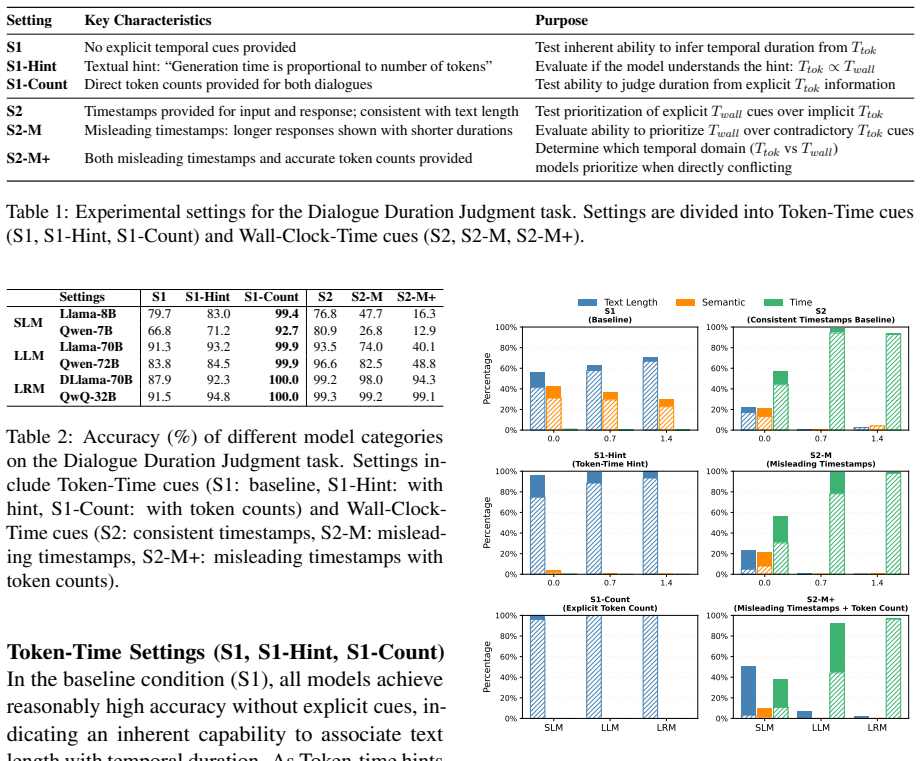
The central claim is that LLMs possess a measurable awareness of time passage that lets them bridge discrete linguistic tokens and continuous physical time. The formal device is the mapping $T^m_{\text{wall}} = T^m_{\text{tok}} \times V^m$ for input and output modes, where $V^m$ is a seconds-per-token conversion rate; the output rate $V^{\text{out}}$ is treated as stable, making generated token count a usable proxy for elapsed time. In the dialogue duration judgment task, models infer which of two responses took longer to generate, improving as token cues become explicit and, for reasoning models, staying accurate even when timestamps contradict text length. In urgency-aware question answering, models cut token usage by roughly 5 to 21 percent while preserving or improving accuracy, including gains on the hardest benchmark. In BombRush, an agent navigating a grid world toward a timed bomb, several models reduce per-step reasoning tokens as remaining time shrinks, and some explicitly articulate that shorter reasoning conserves time.
Load-bearing premise
The argument rests on treating a stable token-to-seconds conversion rate $V^{\text{out}}$ as something LLMs adopt, so that cutting tokens is experienced as saving wall-clock time; in BombRush that rate is imposed and announced by the simulator, and in the urgency task 'quick' may simply activate 'brief' as a semantic neighbor.
Editorial extensions
If this is right
- Response length becomes a controllable resource: models can trade tokens against wall-clock time while keeping accuracy, which matters for latency-sensitive deployment.
- Explicit token cues make duration judgments nearly perfect, and reasoning models keep high accuracy even when timestamps and text lengths conflict, suggesting better-integrated temporal signals in larger or reasoning-trained models.
- Urgency prompting can shorten outputs by double-digit percentages with accuracy flat, and on a hard scientific QA benchmark five of six models improved, undercutting the assumption that longer reasoning always helps.
- In dynamic time-pressured environments, models adapt behavior by shrinking reasoning verbosity as time runs out, though the adaptation pattern differs across model families.
- These results establish a foundation for enhancing temporal awareness in simultaneous translation, real-time dialogue, and time-sensitive agent systems.
Reading between the lines
- The experiments cannot fully separate genuine time perception from semantic association, since 'quick' and 'brief' are correlated in language; a control condition using a time-neutral brevity instruction would settle this.
- Because BombRush announces that reasoning consumes time and imposes the token-to-second rate, the observed token savings could partly reflect instruction-following; varying the imposed rate across runs would test whether models actually track the mapping.
- If the mapping is real and robust, prompt-level control of token budgets could give deployed systems time-sensitive behavior without retraining, and token spend per wall-clock second could serve as a monitoring signal for overthinking.
- The paper leaves open where the capability comes from, so a natural next test is whether temporal awareness emerges from pretraining on time-ordered text, from post-training, or from architectural choices such as relative position encodings.
Editorial analysis
A structured set of objections, weighed in public.
Referee Report
Summary. The paper proposes the Token-Time Hypothesis, according to which LLMs can map discrete token counts to continuous wall-clock time, and claims to validate it through three experiments: a Dialogue Duration Judgment task, an Urgency-Aware QA task, and an interactive BombRush navigation task. The authors report that models can judge which of two responses took longer to generate, that they shorten responses under urgency, and that they reduce reasoning verbosity under simulated time pressure. They conclude that LLMs possess a certain awareness of time passage that lets them bridge linguistic tokens and physical time, with capability varying by model size and reasoning ability.
Significance. The question of whether LLMs perceive the passage of time, as opposed to merely reasoning about temporal expressions, is timely and interesting, especially for time-sensitive applications such as simultaneous translation, autonomous driving, and interactive agents. If the central claim were established, the Token-Time Hypothesis would provide a useful framework for studying and possibly improving temporal adaptation in LLMs. The paper introduces three novel experimental paradigms and presents a substantial amount of behavioral data across six models. However, the current experiments do not isolate the hypothesized internal token-to-time mapping from alternative explanations such as instruction following, lexical association, and text-length heuristics. The strongest results, such as LRMs resisting misleading timestamps, are consistent with models following explicit instructions to trust timestamps rather than possessing an internal sense of wall-clock time. The paper's contribution is therefore better characterized as a set of behavioral probes and a framework, rather than a validated claim about internal time perception.
major comments (4)
- [Section 5, Fig. 13 and Appendix E.1] The BombRush system prompt explicitly instructs the agent that “every action—including your reasoning—consumes it” and that “the longer and more detailed your reasoning, the more time you lose.” The simulator also imposes a per-model Vout calibrated from each model's own treasure-hunt token budget (0.042, 0.166, 0.017, and 0.005 s/token). Under this design, the observed reduction in reasoning tokens under time pressure is a direct consequence of following the instructions and of the externally imposed conversion rate. The experiment therefore cannot discriminate between instruction following and an internal token-to-time mapping. A control condition that omits or contradicts the instruction that reasoning consumes time, or that assigns Vout values uncorrelated with each model's verbosity, is necessary to support the central claim.
- [Section 4, Fig. 11 and Section B.3.4] The urgency pool contains expressions such as “Please give me the answer quickly”, “be quick”, and “answer immediately”, which are lexically associated with brevity. The authors themselves acknowledge in Section B.3.4 that the observed shortening could arise from embedding-space proximity between “quick” and “brief” rather than from temporal awareness. Without a control condition that separates “answer quickly” from “answer briefly”, or that decouples output length from wall-clock duration, the token reductions in Table 3 are equally consistent with a semantic-association hypothesis and with the Token-Time Hypothesis. This confound is load-bearing because the urgency experiment is presented as evidence of “temporal empathy.”
- [Section 3, Tables 1 and 2] The Dialogue Duration Judgment task mainly asks the model to compare text lengths: in S1 the longer response is the correct answer, S1-Hint states that generation time is proportional to token count, and S1-Count provides explicit token counts. Near-perfect accuracy in S1-Count and high accuracy in S1 demonstrate text-length discrimination, not perception of time passage. In the misleading-timestamp settings (S2-M, S2-M+), the correct answer is defined by the provided timestamps, so high LRM accuracy shows that these models follow explicit timestamp instructions when they conflict with length. To validate the Token-Time Hypothesis, the task needs a setting in which token count and wall-clock duration are systematically decoupled without explicit instruction about which cue to trust, and where the model must rely on an internally inferred mapping rather than on externally provided rules.
- [Section 2.3, Eq. (1)] The formal mapping T^m_wall = T^m_tok × V^m assumes that the model knows its own generation speed Vout. The paper provides no argument or evidence that LLMs have access to Vout in a real-world setting; in all experiments where time matters, Vout is imposed by the simulator rather than inferred by the model. Consequently, the experiments show that LLMs can use an externally supplied token-to-time conversion rate when instructed to do so, but they do not establish that LLMs possess an internal, stable Vout. The authors should either provide a mechanism by which Vout could be learned or internalized, or explicitly restrict the central claim to environments where the mapping is provided.
minor comments (5)
- [Abstract and Introduction] The abstract states that the Token-Time Hypothesis is “validated” and that the paper “establishes” it, but the experimental evidence, as discussed above, does not rule out alternative explanations; a more cautious wording such as “provides initial evidence for” would better match the results.
- [Section C.4, Table 5] The attribution analysis relies on Llama-3.3-70B as the classifier, but no accuracy or manual validation of this classifier is reported. A misclassification rate here could affect the interpretation of which cues models actually used.
- [Table 4] The significance testing reports raw p-values from paired t-tests over 20 replications without multiple-comparison correction or effect sizes; with six models and five comparisons, some false positives are likely, and the supplementary text should note this.
- [Figure 2] The figure uses “Token Time” and “Token-Time” inconsistently; a single hyphenated form would improve readability.
- [Section A, Related Work] The paper claims to be the “first comprehensive study” of LLM time perception, but TIMEARENA (Zhang et al., 2024) already places LLM agents in time-constrained environments; the novelty claim should be qualified to distinguish the Token-Time mapping focus from that prior work.
Circularity Check
Central 'time awareness' results are partly manufactured: BombRush installs the Token-Time mapping in the system prompt and the Dialogue-Duration hint/count settings encode the mapping in the instructions, while the urgency result is explicitly acknowledged as potentially a semantic association confound.
-
fitted input called prediction
[Section 5 (BombRush); Figure 13 system prompt; Section E.1 (Vout calibration)]
"In this task, time flows continuously, and every action—including your reasoning—consumes it... Your thought process: the longer and more detailed your reasoning, the more time you lose, lengthy and detailed analysis will consume valuable time. (Figure 13) ... Cru[C]ially, we establish a direct mapping between reasoning token usage (Token-Time) and simulated elapsed time... This design compels the LLM to recognize that verbose reasoning consumes time."
The BombRush simulation sets the very Token-Time mapping (Vout and countdown) as ground truth and explicitly instructs the agent that longer reasoning consumes time. The reported adaptive shortening of reasoning under pressure is therefore a direct consequence of the system prompt and simulator mechanics, not an independent confirmation that LLMs spontaneously map token counts to wall-clock time. The predicted behavior is contained, by construction, in the experimental input.
-
self definitional
[Section 3.1 and Figure 10 (S1-Hint, S1-Count prompts); Table 2 results]
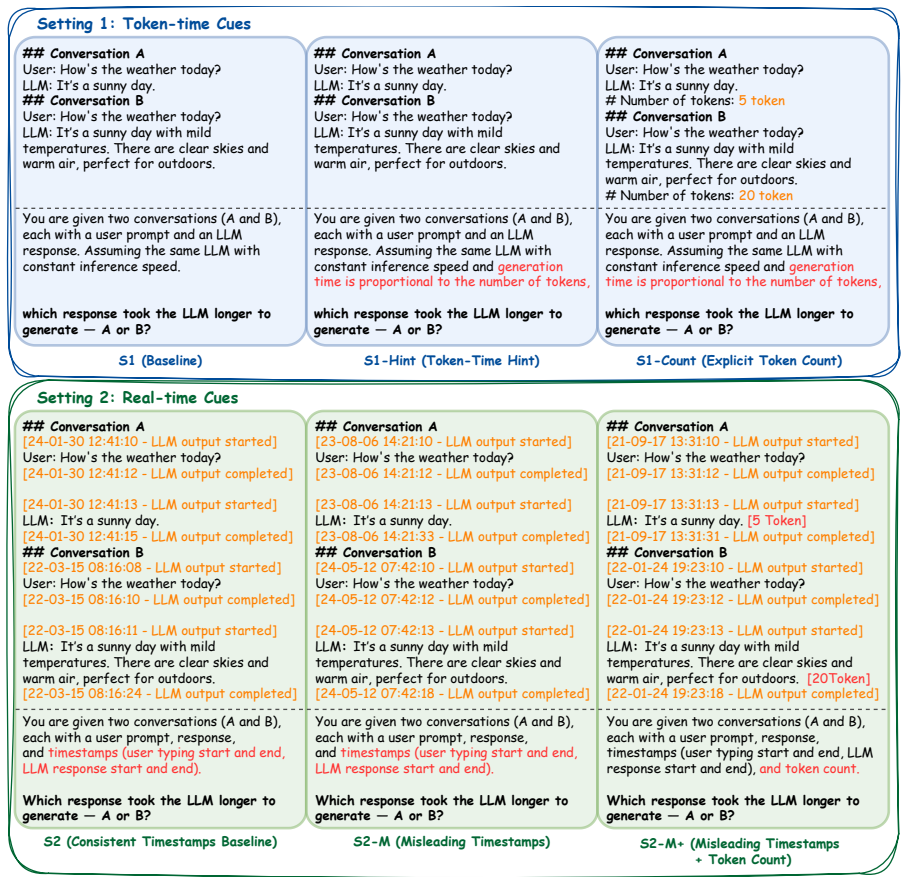
"Assuming that both responses are generated by the same LLM, the inference speed of the LLM is constant and identical for both responses, the time taken to complete a response is directly proportional to the number of tokens in the response. ... Which response took the LLM longer to generate?"
In S1-Hint and S1-Count, the prompt itself supplies the rule that time is proportional to token count, and S1-Count even provides the token counts. The correct answer is then fully determined by comparing token numbers, so near-perfect accuracy in S1-Count (99.4-100%) demonstrates token-count comparison, not an independently established mapping to passing physical time. These conditions assume the hypothesis in the instruction and then present it as validated; only the S1 baseline and the timestamp settings retain non-tautological content.
1 more flagged steps
-
other
[Section 4.2 (Urgency-Aware QA) and Section B.3.4 (Semantic Associations)]
"In urgent mode, we augmented the prompt with an additional sentence randomly sampled from a pool of urgency expressions (e.g., "I'm in a big hurry right now. Please give me the answer quickly!!!") ... this behavior might result from semantic proximity in the embedding space after training on vast corpora, where terms like "quick" and "brief" share high similarity, naturally triggering more concise responses."
The urgency stimuli are lexically tied to brevity ('quick', 'hurry', 'fast'), so the observed reduction in output tokens can be explained by semantic association or instruction following rather than by any internal sense of time passage. The paper itself flags this alternative and admits that 'determining which mechanism drives this consistent behavior would require more rigorous controlled experiments.' As a result, the claimed demonstration of 'temporal empathy' is not uniquely supported by the data; the prediction is consistent with a non-temporal confound the authors leave unresolved.
full rationale
The paper has genuine independent content: the S1 baseline in Dialogue Duration Judgment presents no explicit hint and still shows above-chance performance, and the misleading-timestamp settings (S2-M, S2-M+) produce nontrivial accuracy differences between model classes. Those results suggest LLMs can compare response lengths and, in some cases, resist contradictory temporal cues. However, the headline claim that LLMs possess 'awareness of time passage' is not established independently in the two most central demonstrations. In BombRush, the simulator imposes the Vout mapping and the system prompt directly tells the agent that reasoning length consumes time, so the observed adaptation is manufactured by the setup rather than discovered. In the Dialogue Duration Judgment task, the S1-Hint/S1-Count conditions define the token-to-time proportionality in the prompt, so high accuracy there is an arithmetic consequence of the instruction, not a test of the hypothesis. In Urgency-Aware QA, the paper explicitly acknowledges that the shortening behavior may simply be semantic proximity between 'quick' and 'brief', and it provides no controlled experiment to separate that mechanism from temporal perception. Weighing these together, the most striking positive findings are partly reducible to their inputs or to acknowledged confounds, giving the paper a moderate circularity score; the remaining baseline and timestamp results keep it from being fully circular.
Assumptions & free parameters
free parameters (1)
- Vout (BombRush token-to-time conversion rate) =
Llama-3.3-70B 0.042 s/token, Qwen-2.5-72B 0.166, DS-Llama-70B 0.017, QwQ-32B 0.005
assumptions (4)
- domain assumption Vout is stable during generation, with negligible computational overhead from longer outputs.
- domain assumption LLMs can access or infer their own generation speed Vout.
- domain assumption The Llama-3.3-70B classifier reliably labels models' justifications into text_length, semantic, time, and other categories.
- ad hoc to paper Urgency phrases such as "give me the answer quickly" are interpreted by models as time pressure rather than as a generic request for brevity.
invented entities (1)
-
Token-Time (discrete temporal metric)
Cite this review
Pith. "Pith review of Discrete Minds in a Continuous World: Do Language Models Know Time Passes?." pith.science (2026). https://pith.science/paper/R5LDAB5C
@misc{pith2026250605790,
  author       = {Pith},
  title        = {Pith review of: Discrete Minds in a Continuous World: Do Language Models Know Time Passes?},
  year         = {2026},
  howpublished = {\url{https://pith.science/paper/R5LDAB5C}},
  note         = {Machine review of arXiv:2506.05790}
}
read the original abstract
While Large Language Models (LLMs) excel at temporal reasoning tasks like event ordering and duration estimation, their ability to perceive the actual passage of time remains unexplored. We investigate whether LLMs perceive the passage of time and adapt their decision-making accordingly through three complementary experiments. First, we introduce the Token-Time Hypothesis, positing that LLMs can map discrete token counts to continuous wall-clock time, and validate this through a dialogue duration judgment task. Second, we demonstrate that LLMs could use this awareness to adapt their response length while maintaining accuracy when users express urgency in question answering tasks. Finally, we develop BombRush, an interactive navigation challenge that examines how LLMs modify behavior under progressive time pressure in dynamic environments. Our findings indicate that LLMs possess certain awareness of time passage, enabling them to bridge discrete linguistic tokens and continuous physical time, though this capability varies with model size and reasoning abilities. This work establishes a theoretical foundation for enhancing temporal awareness in LLMs for time-sensitive applications.
Figures


Figures from the paper (12 more)




Reference graph
Works this paper leans on
-
[1]
S1 (Baseline): As the baseline setting, there are no hints to encourage the LLM to build any connection between token count with du- ration; the LLM must solely rely on its in- ternal awareness and understanding of time passage
-
[2]
S1-Hint (Token-Time Hint): A textual hint is provided, explicitly stating that generation time is proportional to the number of tokens
-
[3]
Training verifiers to solve math word prob- lems.Preprint, arXiv:2110.14168. Jeremy R. Cole, Aditi Chaudhary, Bhuwan Dhingra, and Partha Talukdar. 2023. Salient span masking for tem- poral understanding.Preprint, arXiv:2303.12860. DeepSeek-AI. 2025. Deepseek-r1: Incentivizing rea- soning capability in llms via reinforcement learning. Preprint, arXiv:2501....
arXiv 2023
-
[4]
S2 (Consistent Timestamps Baseline): Timestamps are provided to indicate start and end times for both user input and LLM re- sponse, with temporal intervals consistent with text lengths. (Note that when insert- ing timestamps, we independently sample the starting time points for the two dialogues to ensure they occur independently in different temporal co...
-
[5]
Taishi Hosokawa, Adam Jatowt, and Kazunari Sugiyama
Measuring massive multitask language under- standing.Preprint, arXiv:2009.03300. Taishi Hosokawa, Adam Jatowt, and Kazunari Sugiyama. 2023. Temporal natural language infer- ence: Evidence-based evaluation of temporal text validity. InAdvances in Information Retrieval, pages 441–458, Cham. Springer Nature Switzerland. Raghav Jain, Daivik Sojitra, Arkadeep ...
arXiv 2009
-
[6]
S2-M+ (Misleading Timestamps + Token Count): Both misleading timestamps and ac- curate token counts are provided withcontra- dictoryimplications, forcing models to choose which temporal domain to prioritize. C.2 Prompts The prompt used in Dialogue Duration Judgment Task is shown in Figure 10. The first three tasks (S1, S1-Hint, S1-Count) are Token-time Cu...
-
[7]
Bowen Peng, Jeffrey Quesnelle, Honglu Fan, and En- rico Shippole
Time is encoded in the weights of finetuned language models.Preprint, arXiv:2312.13401. Bowen Peng, Jeffrey Quesnelle, Honglu Fan, and En- rico Shippole. 2023. Yarn: Efficient context win- dow extension of large language models.Preprint, arXiv:2309.00071. Lianhui Qin, Aditya Gupta, Shyam Upadhyay, Luheng He, Yejin Choi, and Manaal Faruqui. 2021. Time- dia...
arXiv 2023
-
[8]
It's critical that I get a response now! Please be quick!!!
Show all 46 references
-
[9]
Jiexin Wang, Adam Jatowt, Masatoshi Yoshikawa, and Yi Cai
Probing language models for understanding of temporal expressions.Preprint, arXiv:2110.01113. Jiexin Wang, Adam Jatowt, Masatoshi Yoshikawa, and Yi Cai. 2023. Bitimebert: Extending pre-trained lan- guage representations with bi-temporal information. Preprint, arXiv:2204.13032....
2023 arXiv
-
[10]
Yikai Zhang, Siyu Yuan, Caiyu Hu, Kyle Richardson, Yanghua Xiao, and Jiangjie Chen
Benchmarking large language models for news summarization.Preprint, arXiv:2301.13848. Yikai Zhang, Siyu Yuan, Caiyu Hu, Kyle Richardson, Yanghua Xiao, and Jiangjie Chen. 2024. Timearena: Shaping efficient multitasking language agents in a time-aware simulation.Preprint, arXiv:...
2024 arXiv
-
[14]
S1-Count (Explicit Token Count): In this setting, we directly provide the token count for each dialogue (including both user prompt and model response), making the Token-Time cue completely explicit
-
[16]
LLMsshouldpriori- tize timestamps over text length
S2-M (Misleading Timestamps): Times- tamps are manipulated so thelongerresponse appears to takelesstime, creating a conflict between temporal cues. LLMsshouldpriori- tize timestamps over text length
-
[18]
Only 32 sec- onds remaining, extremely urgent!
Time Urgency Mentions:Explicit acknowl- edgment of time pressure (e.g., "Only 32 sec- onds remaining, extremely urgent!")
-
[19]
I need to be more concise in my reasoning to save time
Token-Wall-Clock Time Mapping Aware- ness:Explicit reflection on the relationship between reasoning length and time consump- tion (e.g., "I need to be more concise in my reasoning to save time") These metrics provide valuable insight into how models perceive ongoing time passa...
-
[20]
1 minute and 45 seconds
**`time`**: The reason explicitly involves **timing information** — such as start time, end time, duration (e.g., “1 minute and 45 seconds”), timestamps, or calculations of elapsed time. If the decision is made **primarily or solely based on these time-based values**, without ...
-
[21]
Response A is longer,
**`text_length`**: The reason makes a judgment based on the **length of the text**, such as token count, number of words, number of sentences, or how long the generated response is. This includes explicitly mentioning phrases like “Response A is longer,” “has more tokens,” or ...
-
[22]
**`semantic`**: The reason does **not mention time or length difference** at all, but solely relies on **semantic or cognitive complexity** — such as the depth of explanation, difficulty of the topic, use of logic or math, or other indicators of **conceptual effort**
-
[23]
Do **not** include any explanation or justification in your response
**`other`**: Use this category if the reasoning doesn’t clearly match any of the above — for example, if the model relies on **irrelevant metadata**, contradictory logic, unclear rationale, or vague comparison that doesn’t fit well into the previous categories. Do **not** incl...
-
[24]
Please give me the answer quickly!!!
I'm in a big hurry right now. Please give me the answer quickly!!!
-
[25]
Time is running out! I need your response immediately!!!
-
[26]
Can you please answer this as fast as possible? It's really urgent!!!
-
[27]
I need your help urgently! Every second counts right now!!!
-
[28]
This can't wait! I need your answer immediately!!!
-
[29]
Please hurry! This issue is blocking my progress!!!
-
[30]
I don't have much time! Please give me the answer right away!!!
-
[32]
I'm in a rush and need a quick answer to move forward!!!
-
[33]
answer":
I'm counting on your quick reply! It’s really urgent!!! {urgent_words} Pool You are a helpful assistant. Solve the following math problem efficiently and clearly. The last line of your response should be a JSON object: {{"answer": "<NUMBER>"}} where NUMBER is the exact numeric...
-
[34]
You step onto the treasure's cell (**success**), or
-
[35]
last_action
You exceed the maximum allowed number of steps (**failure**). ## 5. State Format (input to you each turn) For each step, you will receive the environment state as a JSON object: ```json { "last_action": "start" or "moved" or "blocked_by_wall", "current_location": [x, y], "sign...
-
[37]
Use signal direction and distance to guide movement toward the treasure
-
[40]
X" represents your current position -
Keep reasoning short but clear, concise plans speed up play. Happy hunting! may your steps lead straight to the prize! Figure 12: System prompt used in the Treasure Hunt setting (S1) of the Bomb Rush task. 24 # Grid World Bomb Detection Task You are a police in a grid world. Y...
-
[41]
Always return a valid JSON with the action and reasoning fields
-
[42]
Use signal direction and distance to guide movement toward the bomb
-
[43]
**Balance movement with detection - you need updated info, but too many detections waste time.**
-
[44]
Plan paths that avoid walls and minimise detours
-
[45]
Consider the bomb's movement when planning your path
-
[46]
Track how the distance shrinks to verify you're heading the right way
-
[47]
**Pay attention to the remaining time.**
-
[48]
Track the time passing based on previous states and actions
-
[49]
last_action
Keep reasoning clear but concise, especially when time is limited. Remember, lives are at stake! Your mission is to find the moving bomb as quickly as possible. Figure 14: System prompt used in the Bomb Rush Hard (S3) setting where identical content are omitted for spacing rea...
-
[2018]
time perception as a function of interoceptive processing.Frontiers in Human Neuro- science, V olume 12 - 2018
Feel the time. time perception as a function of interoceptive processing.Frontiers in Human Neuro- science, V olume 12 - 2018. Xi Ding and Lei Wang. 2025. Do language models un- derstand time? InThe First International Workshop on Transformative Insights in Multifaceted Evalua...
2018 arXiv
-
[2019]
going on a vacation
“going on a vacation” takes longer than “go- ing for a walk”: A study of temporal commonsense understanding. InProceedings of the 2019 Confer- ence on Empirical Methods in Natural Language Pro- cessing and the 9th International Joint Conference on Natural Language Processing (...
2023 arXiv
-
[2020]
Preprint, arXiv:2004.05150
Longformer: The long-document transformer. Preprint, arXiv:2004.05150. Tom B. Brown, Benjamin Mann, Nick Ryder, Melanie Subbiah, Jared Kaplan, Prafulla Dhariwal, Arvind Neelakantan, Pranav Shyam, Girish Sastry, Amanda Askell, Sandhini Agarwal, Ariel Herbert-V oss, Gretchen Kru...
2004 arXiv
-
[2021]
A dataset for answering time-sensitive ques- tions.Preprint, arXiv:2108.06314. Karl Cobbe, Vineet Kosaraju, Mohammad Bavarian, Mark Chen, Heewoo Jun, Lukasz Kaiser, Matthias Plappert, Jerry Tworek, Jacob Hilton, Reiichiro Nakano, Christopher Hesse, and John Schulman
-
[2022]
Jianlin Su, Yu Lu, Shengfeng Pan, Ahmed Murtadha, Bo Wen, and Yunfeng Liu
Improving time sensitivity for question an- swering over temporal knowledge graphs.Preprint, arXiv:2203.00255. Jianlin Su, Yu Lu, Shengfeng Pan, Ahmed Murtadha, Bo Wen, and Yunfeng Liu. 2023a. Roformer: En- hanced transformer with rotary position embedding. Preprint, arXiv:210...
2023 arXiv
-
[2023]
InPro- ceedings of the 2023 Conference on Empirical Meth- ods in Natural Language Processing, pages 6750– 6774, Singapore
Do language models have a common sense regarding time? revisiting temporal commonsense 9 reasoning in the era of large language models. InPro- ceedings of the 2023 Conference on Empirical Meth- ods in Natural Language Processing, pages 6750– 6774, Singapore. Association for Co...
2023 arXiv
Reviewed August 7, 2026 · model on record in the stance chip above.
Discussion (0). Sign in to comment.