PolSAR Image Classification using a Hybrid Complex-Valued Network (HybridCVNet)
Pith reviewed 2026-06-28 22:50 UTC · model grok-4.3
The pith
Hybrid complex-valued network blends CNN and vision transformer for PolSAR classification
A machine-rendered reading of the paper's core claim, the machinery that carries it, and where it could break.
Core claim
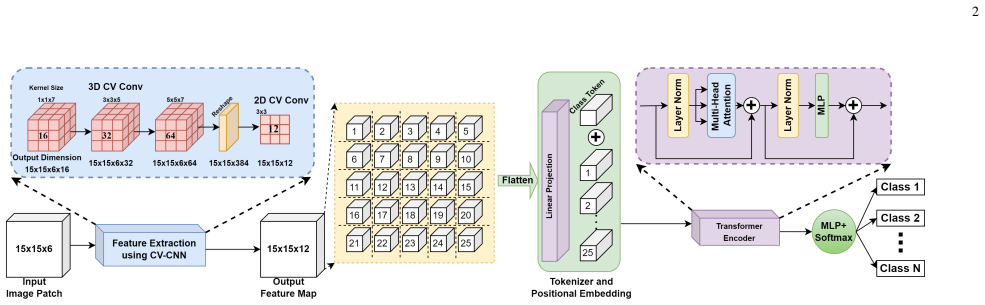
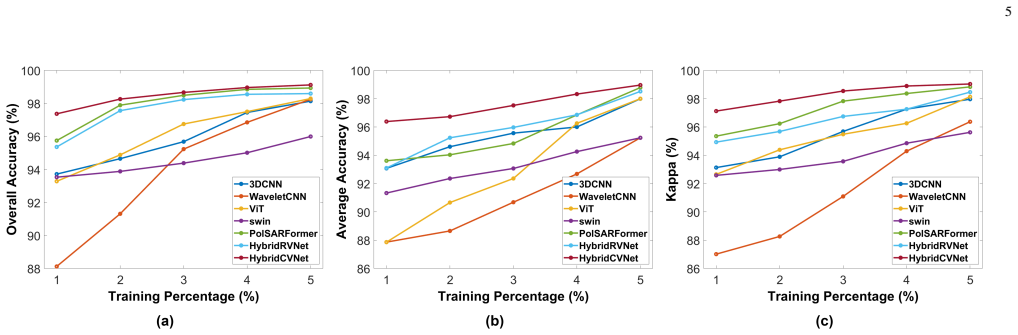
HybridCVNet efficiently combines CV 3D and 2D CNNs as feature extractors with CV-ViT to extract complementary information and leverage interdependencies within PolSAR data, resulting in superior classification performance on widely-used datasets.
What carries the argument
The hybrid architecture of complex-valued CNNs and complex-valued vision transformer that processes phase information in PolSAR data
If this is right
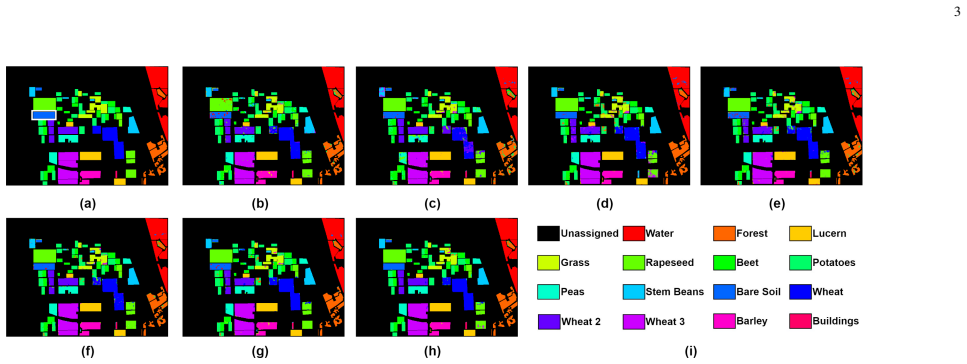
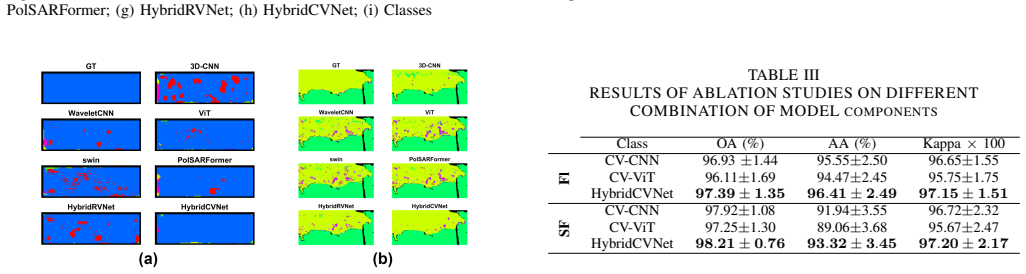
- Overall accuracy reaches 97.39 percent on the Flevoland dataset
- Classification remains reliable even at a one percent sampling ratio
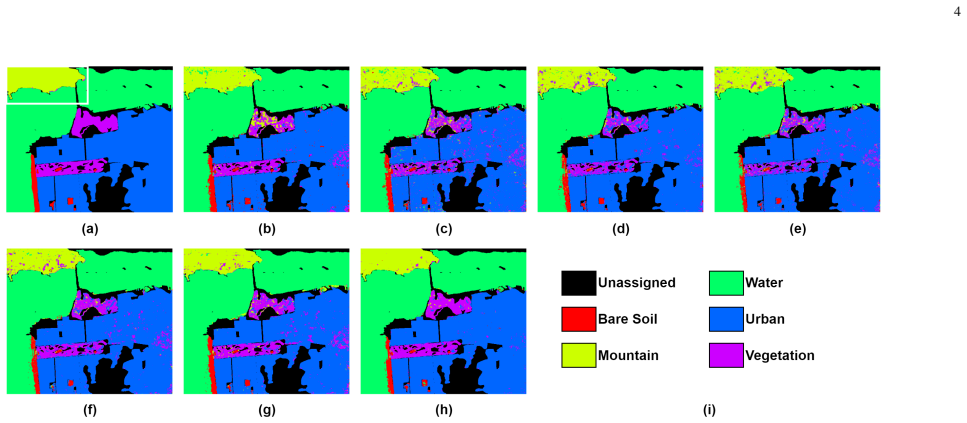
- Kappa coefficient of 0.972 is obtained on the San Francisco dataset
- The approach exceeds results from other methods on standard PolSAR test sets
Where Pith is reading between the lines
- The same hybrid pattern could be tested on other complex-valued remote-sensing inputs such as interferometric data
- Lower data requirements might support deployment where ground-truth labels are scarce
- The architecture offers a template for preserving phase in any complex imaging pipeline
Load-bearing premise
The hybrid CV-CNN plus CV-ViT design extracts complementary information and leverages interdependencies in PolSAR data without the need for extensive post-hoc tuning or dataset-specific adjustments
What would settle it
Showing that a standard real-valued network or a non-hybrid complex network reaches equal or higher accuracy on the Flevoland and San Francisco datasets at the same sampling ratios would undermine the claimed benefit of the specific hybrid design
Figures
read the original abstract
Recently, convolutional neural networks (CNNs) have become popular for image classification due to their effectiveness in computer vision tasks. Now, researchers are exploring the potential of vision transformers (ViTs) in remote sensing and Earth observation. However, traditional Real-Valued networks often overlook important phase information in Complex-Valued (CV) data like polarimetric synthetic aperture radar (PolSAR) data. To address this, new CV deep architectures have emerged. HybridCVNet, a novel hybrid network, blends CV-CNN and CV vision transformer (CV-ViT) techniques. It efficiently combines CV 3D and 2D CNNs as feature extractors, enhancing PolSAR image classification by extracting complementary information and effectively leveraging interdependencies within the data. Experimental results from widely-used PolSAR datasets show HybridCVNet outperforms other methods, achieving an overall accuracy of 97.39% on the Flevoland dataset and showing promise even with just a 1% sampling ratio, with a Kappa value of 0.972 on the San Francisco dataset. Source code is accessible through https://github.com/mqalkhatib/HybridCVNet
Editorial analysis
A structured set of objections, weighed in public.
Referee Report
Summary. The manuscript proposes HybridCVNet, a hybrid complex-valued architecture combining CV-CNN (3D and 2D) feature extractors with a CV-ViT component for PolSAR image classification. It reports empirical results showing superior performance over other methods, with 97.39% overall accuracy on the Flevoland dataset and a Kappa value of 0.972 on the San Francisco dataset, including strong results at a 1% sampling ratio. Source code is released on GitHub.
Significance. If the performance claims hold under rigorous validation, the work would contribute to PolSAR classification by demonstrating benefits of hybrid complex-valued networks that preserve phase information. The public code release is a positive factor supporting reproducibility.
major comments (1)
- [Abstract] Abstract: The performance numbers (97.39% OA on Flevoland, Kappa 0.972 on San Francisco) are stated without any description of the experimental protocol, data splitting strategy, baseline methods and their implementations, cross-validation procedure, or error analysis; this prevents evaluation of the central empirical claim.
Simulated Author's Rebuttal
We thank the referee for the constructive feedback on the abstract. We address the concern point-by-point below.
read point-by-point responses
-
Referee: [Abstract] Abstract: The performance numbers (97.39% OA on Flevoland, Kappa 0.972 on San Francisco) are stated without any description of the experimental protocol, data splitting strategy, baseline methods and their implementations, cross-validation procedure, or error analysis; this prevents evaluation of the central empirical claim.
Authors: We agree that the abstract is concise by design and omits explicit details on the experimental protocol, data splitting (e.g., the 1% sampling ratio), baseline implementations, cross-validation, and error analysis. These elements are fully described in the Experiments and Results sections of the manuscript, including dataset descriptions, sampling strategies, baseline comparisons, and quantitative metrics. To improve clarity for readers who encounter only the abstract, we will revise the abstract to include a brief sentence summarizing the evaluation protocol on standard PolSAR datasets with the reported sampling ratios and comparisons to baselines. revision: yes
Circularity Check
No significant circularity
full rationale
The paper's central claim is an empirical performance result: HybridCVNet achieves 97.39% accuracy on Flevoland and Kappa 0.972 on San Francisco using a hybrid CV-CNN + CV-ViT architecture. No derivation chain, equations, fitted parameters renamed as predictions, or self-citation load-bearing steps are present. The architecture's ability to extract complementary information is presented as an observed experimental outcome rather than a formal necessity derived from its own inputs. The work is self-contained against external benchmarks via reported dataset results and released code.
Axiom & Free-Parameter Ledger
Reference graph
Works this paper leans on
-
[1]
Potential of estimating soil moisture under vegetation cover by means of polsar,
I. Hajnsek, T. Jagdhuber, H. Schon, and K. P. Papathanassiou, “Potential of estimating soil moisture under vegetation cover by means of polsar,” IEEE Transactions on Geoscience and Remote Sensing, vol. 47, no. 2, pp. 442–454, 2009
2009
-
[2]
A robust change detection methodology for flood events using sar images,
M. Al-Saad, N. Aburaed, M. S. Zitouni, M. Q. Alkhatib, S. Almansoori, and H. Al Ahmad, “A robust change detection methodology for flood events using sar images,” inIGARSS 2023 - 2023 IEEE International Geoscience and Remote Sensing Symposium, 2023, pp. 341–344
2023
-
[3]
Polarimetric radar technology for european defence superiority-the polrad project,
A. Lupidi, C. Greiff, S. Br ¨uggenwirth, M. Brandfass, and M. Martorella, “Polarimetric radar technology for european defence superiority-the polrad project,” in2020 21st International Radar Symposium (IRS). IEEE, 2020, pp. 6–10
2020
-
[4]
Machine learning classification based on k-nearest neighbors for polsar data,
J. A. Ferreira, A. K. Rodrigues, R. Ospina, and L. Gomez, “Machine learning classification based on k-nearest neighbors for polsar data,” Anais da Academia Brasileira de Ci ˆencias, vol. 96, no. 1, p. e20230064, 2024
2024
-
[5]
Performance analysis of sar filtering techniques using svm and wishart classifier,
A. Masurkar, R. Daruwala, and A. Mohite, “Performance analysis of sar filtering techniques using svm and wishart classifier,”Remote Sensing Applications: Society and Environment, vol. 34, p. 101189, 2024
2024
-
[6]
Polarimetric sar image clas- sification using deep convolutional neural networks,
Y . Zhou, H. Wang, F. Xu, and Y .-Q. Jin, “Polarimetric sar image clas- sification using deep convolutional neural networks,”IEEE Geoscience and Remote Sensing Letters, vol. 13, no. 12, pp. 1935–1939, 2016
1935
-
[7]
Polarimetric sar terrain classification using 3d convolutional neural network,
L. Zhang, Z. Chen, B. Zou, and Y . Gao, “Polarimetric sar terrain classification using 3d convolutional neural network,” inIGARSS 2018- 2018 IEEE International Geoscience and Remote Sensing Symposium. IEEE, 2018, pp. 4551–4554
2018
-
[8]
Complex-valued convo- lutional neural network and its application in polarimetric sar image classification,
Z. Zhang, H. Wang, F. Xu, and Y .-Q. Jin, “Complex-valued convo- lutional neural network and its application in polarimetric sar image classification,”IEEE Transactions on Geoscience and Remote Sensing, vol. 55, no. 12, pp. 7177–7188, 2017
2017
-
[9]
Complex-valued 3- d convolutional neural network for polsar image classification,
X. Tan, M. Li, P. Zhang, Y . Wu, and W. Song, “Complex-valued 3- d convolutional neural network for polsar image classification,”IEEE Geoscience and Remote Sensing Letters, vol. 17, no. 6, pp. 1022–1026, 2019
2019
-
[10]
An image is worth 16x16 words: Transformers for image recognition at scale,
A. Dosovitskiy, L. Beyer, A. Kolesnikov, D. Weissenborn, X. Zhai, T. Unterthiner, M. Dehghani, M. Minderer, G. Heigold, S. Gellyet al., “An image is worth 16x16 words: Transformers for image recognition at scale,”arXiv preprint arXiv:2010.11929, 2020
Pith/arXiv arXiv 2010
-
[11]
Exploring vision transformers for polarimetric sar image classification,
H. Dong, L. Zhang, and B. Zou, “Exploring vision transformers for polarimetric sar image classification,”IEEE Transactions on Geoscience and Remote Sensing, vol. 60, pp. 1–15, 2021
2021
-
[12]
Multimodal fusion transformer for remote sensing image classification,
S. K. Roy, A. Deria, D. Hong, B. Rasti, A. Plaza, and J. Chanussot, “Multimodal fusion transformer for remote sensing image classification,” IEEE Transactions on Geoscience and Remote Sensing, vol. 61, pp. 1– 20, 2023
2023
-
[13]
Local window attention transformer for polarimetric sar image classification,
A. Jamali, S. K. Roy, A. Bhattacharya, and P. Ghamisi, “Local window attention transformer for polarimetric sar image classification,”IEEE Geoscience and Remote Sensing Letters, vol. 20, pp. 1–5, 2023
2023
-
[14]
A new architecture of a complex-valued convolutional neural network for polsar image classification,
Y . Ren, W. Jiang, and Y . Liu, “A new architecture of a complex-valued convolutional neural network for polsar image classification,”Remote Sensing, vol. 15, no. 19, p. 4801, 2023
2023
-
[15]
Polsar image classification using attention based shallow to deep convolutional neural network,
M. Q. Alkhatib, M. Al-Saad, N. Aburaed, M. S. Zitouni, and H. Al- Ahmad, “Polsar image classification using attention based shallow to deep convolutional neural network,” inIGARSS 2023-2023 IEEE International Geoscience and Remote Sensing Symposium. IEEE, 2023, pp. 8034–8037
2023
-
[16]
Hybridsn: Exploring 3-d–2-d cnn feature hierarchy for hyperspectral image classi- fication,
S. K. Roy, G. Krishna, S. R. Dubey, and B. B. Chaudhuri, “Hybridsn: Exploring 3-d–2-d cnn feature hierarchy for hyperspectral image classi- fication,”IEEE Geoscience and Remote Sensing Letters, vol. 17, no. 2, pp. 277–281, 2019
2019
-
[17]
Multimodal fusion transformer for remote sensing image classification,
S. K. Roy, A. Deria, D. Hong, B. Rasti, A. Plaza, and J. Chanussot, “Multimodal fusion transformer for remote sensing image classification,” IEEE Transactions on Geoscience and Remote Sensing, 2023
2023
-
[18]
Complex-valued vs. real-valued neural networks for classification perspectives: An example on non-circular data,
J. A. Barrachina, C. Ren, C. Morisseau, G. Vieillard, and J.-P. Ovar- lez, “Complex-valued vs. real-valued neural networks for classification perspectives: An example on non-circular data,” inICASSP 2021- 2021 IEEE International Conference on Acoustics, Speech and Signal Processing (ICASSP). IEEE, 2021, pp. 2990–2994
2021
-
[19]
Polsar image classifica- tion using a superpixel-based composite kernel and elastic net,
Y . Cao, Y . Wu, M. Li, W. Liang, and P. Zhang, “Polsar image classifica- tion using a superpixel-based composite kernel and elastic net,”Remote Sensing, vol. 13, no. 3, p. 380, 2021
2021
-
[20]
Polsf: Polsar image datasets on san francisco,
X. Liu, L. Jiao, F. Liu, D. Zhang, and X. Tang, “Polsf: Polsar image datasets on san francisco,” inInternational Conference on Intelligence Science. Springer, 2022, pp. 214–219
2022
-
[21]
Polsar image classification based on deep convolu- tional neural networks using wavelet transformation,
A. Jamali, M. Mahdianpari, F. Mohammadimanesh, A. Bhattacharya, and S. Homayouni, “Polsar image classification based on deep convolu- tional neural networks using wavelet transformation,”IEEE Geoscience and Remote Sensing Letters, vol. 19, pp. 1–5, 2022
2022
-
[22]
Swin transformer: Hierarchical vision transformer using shifted windows,
Z. Liu, Y . Lin, Y . Cao, H. Hu, Y . Wei, Z. Zhang, S. Lin, and B. Guo, “Swin transformer: Hierarchical vision transformer using shifted windows,” inProceedings of the IEEE/CVF international conference on computer vision, 2021, pp. 10 012–10 022
2021
discussion (0)
Sign in with ORCID, Apple, or X to comment. Anyone can read and Pith papers without signing in.