REVIEW 3 major objections 5 minor 68 references
Effects of magnetic anisotropy on spin and thermal transports in classical antiferromagnets on the square lattice
T0 review · 3 major / 5 minor · reviewed 2026-08-14 · deepseek-v4-flash
Pith's one-line read In a classical square-lattice antiferromagnet with XY anisotropy, the spin-current conductivity diverges at the Kosterlitz-Thouless temperature as $\exp[B/\sqrt{T/T_{KT}-1}]$, while thermal conductivity shows no anomaly.
desk verdict A solid numerical study with a compelling qualitative claim—spin transport sees the KT transition, thermal transport doesn't—but the headline exponential divergence is less nailed down than the abstract suggests. read the letter →
The pith
A machine-rendered reading of the paper's core claim, the machinery that carries it, and where it could break.
The reading
What carries the argument
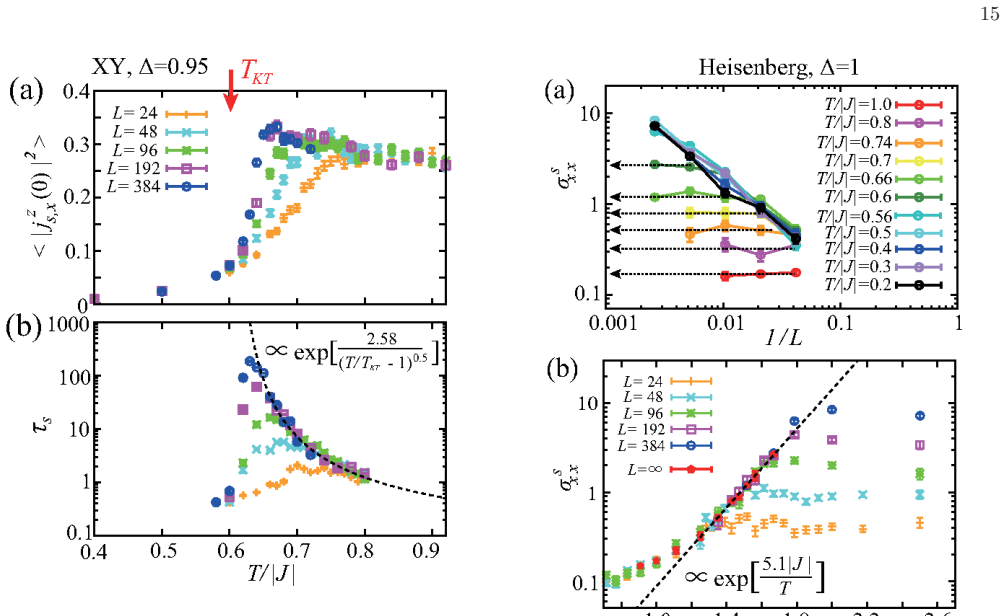
The load-bearing object is the time-dependent spin-current correlation function $\langle J^z_s(0)J^z_s(t)\rangle$, computed from the semiclassical equation of motion $d\mathbf{S}_i/dt=\mathbf{S}_i\times\mathbf{H}^{\rm eff}_i$, whose zero-frequency integral defines $\sigma^s_{xx}$ through the Green-Kubo formula. The paper factorizes the conductivity as $\sigma^s_{xx}\simeq T^{-1}\langle|j^z_{s,x}(0)|^2\rangle\tau_s$, where the equal-time fluctuation term is mild but the spin-current relaxation time $\tau_s$ diverges toward $T_{KT}$ in the XY case, fitted as $\tau_s\propto\exp[\tilde{B}/\sqrt{T/T_{KT}-1}]$ with $\tilde{B}\simeq 2.6$. This divergence is attributed to the growing lifetime of diffusing free vortices, which must travel farther to find an antivortex partner as the inter-vortex distance grows. The same machinery makes the effect specific to the XY case: in Ising and Heisenberg magnets, $\tau_s$ is controlled by ordinary magnon damping or by the spin correlation length, not by vortex unbinding.
What would settle it
A decisive numerical test would extend the spin-dynamics integration beyond $t=800\,|J|^{-1}$ on the largest lattices used here, or repeat the calculation with a small Gilbert damping added: if the time-integrated spin-current correlation saturates to a finite value as $T_{KT}$ is approached, or if the fitted exponent $B$ shifts beyond its quoted uncertainty, the claimed exponential divergence is a finite-window artifact rather than an intrinsic property of the XXZ model.
Extended reading notes
Core claim
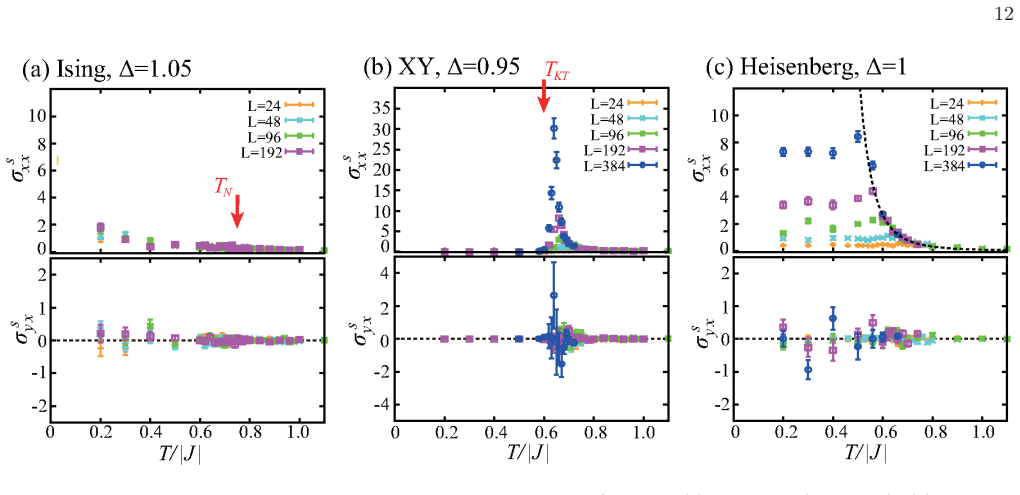
The central claim is that the conserved magnetization current in the classical antiferromagnetic XXZ model on the square lattice distinguishes the three universality classes, while the energy current does not. In the XY case ($\Delta<1$), the longitudinal spin-current conductivity $\sigma^s_{xx}=\sigma^s_{yy}$ diverges as $T$ approaches $T_{KT}$ from above, following $\sigma^s_{xx}\propto\exp[B/\sqrt{T/T_{KT}-1}]$ with fitted $B\simeq 2.3$, comparable to the KT correlation-length coefficient $b_{KT}\simeq\pi/2$. Below $T_{KT}$, $\sigma^s_{xx}$ drops to a vanishingly small value, in line with the absence of a leading-order magnon spin current when the easy-plane order is perpendicular to the conserved spin component. In the Ising case ($\Delta>1$), $\sigma^s_{xx}$ rises monotonically toward low temperature with no clear anomaly at $T_N$, and in the Heisenberg case ($\Delta=1$) it grows approximately as $\exp[b_H|J|/T]$, following the exponentially growing spin correlation length. The thermal conductivity, by contrast, shows a common power-law increase toward $T=0$ in all three cases.
Load-bearing premise
The load-bearing premise is that the undamped spin-dynamics equation, started from Monte Carlo thermalized configurations, relaxes the spin current completely within integration windows of 100–800 inverse exchange couplings, and that finite-size extrapolation then yields the thermodynamic-limit conductivity; if longer-lived current tails or lattice-induced damping are needed, the exponential divergence at $T_{KT}$ could be an artifact of the simulation protocol rather than a property of the spin Hamiltonian.
Editorial extensions
If this is right
- In the XY-anisotropic square-lattice antiferromagnet, $\sigma^s_{xx}$ should show a sharp, exponentially divergent peak just above $T_{KT}$ while the thermal conductivity remains featureless, so spin transport is the discriminating probe of the KT transition.
- Below $T_{KT}$, $\sigma^s_{xx}$ drops to a near-zero value because the leading magnon contribution to the conserved spin current vanishes when the easy-plane order is perpendicular to the spin-current polarization; the same suppression holds for antiferromagnetic and ferromagnetic XY models.
- In the Ising-anisotropy case, no transport anomaly marks $T_N$; $\sigma^s_{xx}$ grows roughly as $T^{-1}$ toward low temperature, controlled by magnon damping.
- In the Heisenberg case, $\sigma^s_{xx}$ grows as $\exp(b_H|J|/T)$ toward $T=0$, mirroring the exponential spin-correlation length and the absence of finite-temperature order.
- The contrast between spin and thermal currents is a general lesson: conserved magnetization currents can be sensitive to topological excitations that carry no obvious energy anomaly, so spin-conductivity measurements can detect vortex unbinding where heat transport cannot.
Reading between the lines
- Since the divergence lives in $\tau_s$, the frequency-dependent (ac) spin conductivity should develop a narrow low-frequency peak that sharpens as $T_{KT}$ is approached; measuring it would give a direct experimental window on vortex lifetimes.
- In real quasi-two-dimensional XY magnets with weak interlayer coupling, the true divergence at $T_{KT}$ will be rounded by three-dimensional ordering, so the paper's mechanism predicts a crossover enhancement of $\sigma^s_{xx}$ just above the ordering temperature rather than a true singularity.
- The same vortex-lifetime logic applies to frustrated Heisenberg magnets with $Z_2$ vortices, where a spin-conductivity enhancement at the vortex-unbinding temperature $T_v$ should appear even though the correlation length stays finite—an extension the paper leaves open.
- If the factorization $\sigma^s_{xx}\simeq T^{-1}\langle|j^z_s|^2\rangle\tau_s$ is exact enough, comparing the peak height with the equal-time current fluctuation would extract $\tau_s$ directly, turning a transport measurement into a measurement of topological-defect lifetime.
Signed reviews
Editorial analysis
A structured set of objections, weighed in public.
Referee Report
Summary. The manuscript studies spin and thermal transport in the classical square-lattice antiferromagnetic XXZ model using hybrid Monte Carlo and spin-dynamics simulations, supplemented by linear spin-wave theory. For Ising-type (\Delta>1), XY-type (\Delta<1), and Heisenberg-type (\Delta=1) anisotropies, the authors compute the thermal conductivity \kappa and the spin-current conductivity \sigma^s from time-dependent current correlations. They find that \kappa shows no clear anomaly at the magnetic or KT transitions and follows a roughly power-law low-temperature increase, while \sigma^s distinguishes the three universality classes. The central claim is that in the XY case \sigma^s_{xx} diverges at T_\mathrm{KT} as \exp[B/\sqrt{T/T_\mathrm{KT}-1}] with B=2.26\pm0.10, and that this divergence is caused by an exponentially growing spin-current relaxation time associated with vortex lifetimes.
Significance. If the central claim is substantiated, the result is significant: it identifies the longitudinal spin conductivity as a sharp transport signature of the Kosterlitz-Thouless transition, in contrast to thermal transport, and it connects the divergence to vortex dynamics. The paper is careful in using undamped spin dynamics without phenomenological damping, and the linear spin-wave results provide useful low-temperature cross-checks for both the equal-time correlations and the conductivity. The prediction is falsifiable by further simulation and, in principle, by experiments on quasi-two-dimensional XY magnets. The main limitation is that the exponential-divergence claim rests on finite-time integration and finite-size extrapolation in the critical region, so the numerical evidence needs additional controlled convergence tests before the claim can be accepted as quantitative.
major comments (3)
- [§V.B, Fig. 11(b)] The fit in Fig. 11(b) yields B=2.26±0.10, whereas the KT correlation-length exponent quoted in the same paragraph is b_\mathrm{KT}\simeq\pi/2\simeq1.57. The difference is about 7σ, so the statement that the obtained B is 'comparable to b_\mathrm{KT}' is not supported by the reported errors. This comparison is load-bearing because the manuscript uses it to connect the conductivity divergence to the KT universality class. The claim should either be softened or accompanied by a quantitative explanation of why the fitted B differs from b_\mathrm{KT} by this factor, supported by additional analysis.
- [§II.C and Fig. 6(b)] The conductivity in Eq. (11) is an infinite-time integral of the spin-current autocorrelation, but the numerical integration is truncated at t=800|J|^{-1}. In the XY case at T/|J|=0.66, slightly above T_\mathrm{KT}, the manuscript itself reports that the correlation 'persists for a long time' and shows 'a large system size dependence' (Fig. 6(b)). No convergence test is shown establishing that the integrated correlation has reached a plateau before the cutoff. If slow, size-dependent tails exist beyond t=800, the finite-time integral systematically underestimates the thermodynamic conductivity, and the L→∞ extrapolation of a truncated integral could produce an apparent essential singularity even if the true conductivity is regular. Please provide, for the largest sizes and temperatures used in the exponential fit, plots of the running time integral of ⟨j^z_{s,x}(0)j^z_{s,x}(t)⟩ as a function of the upper cutoff, or an equivalent demonstration that the integral has converged.
- [§V.B, Fig. 11(a)] The finite-size extrapolation in Fig. 11(a) is performed at temperatures where the KT correlation length greatly exceeds the simulated sizes. For example, at T/|J|=0.62 one has T/T_\mathrm{KT}\simeq1.03 and ξ_s/a\sim\exp[(\pi/2)/\sqrt{T/T_\mathrm{KT}-1}]\sim10^3–10^4, while the largest simulated linear size is L=384. In this regime the assumption that σ^s_{xx}(L) can be extrapolated to L→∞ without explicitly accounting for ξ_s\sim L is uncontrolled. A finite-size scaling analysis, for instance plotting σ^s_{xx} as a function of L/ξ_s or performing fits that include the ξ_s dependence, is needed to substantiate the thermodynamic-limit divergence and the fitted exponent B.
minor comments (5)
- [Fig. 7 caption / §V] The text and caption label both panel (a) and panel (b) as Δ=1.05; panel (b) should correspond to the XY-type case Δ=0.95.
- [§V.B] The sentence describing the determination of τ_s refers to 'Fig. 8 (b)', but the spin-current time-correlation function for the XY case is shown in Fig. 6(b); Fig. 8 shows a different quantity.
- [§V.B] The expression '2b_XT\simeq\pi' contains a typographical error: it should read '2b_\mathrm{KT}\simeq\pi'.
- [§V.C] The sentence 'neither a magnetic transition nor a topological one does not occur' contains a double negative; it should read 'neither a magnetic transition nor a topological one occurs'.
- [§II.B, Eq. (11)] The notation for the conductivity components would be clearer if the manuscript explicitly stated, near Eq. (11), that σ^s_{xx}=σ^s_{yy} by square-lattice symmetry and that the off-diagonal components vanish within the reported precision, as is later shown for κ and σ^s.
Circularity Check
No significant circularity: the XY spin-conductivity divergence is extracted from a direct Kubo integral, not constructed from a fitted parameter or a self-citation.
full rationale
The paper's central claim, the exponential divergence of sigma^s_xx at T_KT, is obtained by direct numerical evaluation of the Kubo formula in Eq. (11), i.e., the time integral of the spin-current autocorrelation computed from the undamped spin dynamics of Eq. (2). No fitted parameter is inserted into Eq. (11) to force the divergence; the exponential form is only used afterward to characterize the numerically extrapolated thermodynamic-limit data. The parameters T_KT and b_KT are taken from external references [34-37], not from the present authors' prior work. The separate exponential fit to the spin-current relaxation time tau_s is a decomposition of the same autocorrelation into an amplitude and a relaxation time, so the near-agreement between B and Btilde is a consistency check of the exponential-decay form rather than an independent prediction; this is a mild interpretive point, not a circular derivation. The vortex-lifetime explanation is qualitative and additional: the paper does not define sigma in terms of a fitted vortex lifetime or import a uniqueness theorem. Self-citations present in the paper are not load-bearing: [25] is a numerical integrator reference and [63-65] appear only in the outlook on Z2 vortices. Numerical caveats that the paper itself reports, such as the long-lived and size-dependent spin-current autocorrelation just above T_KT (Sec. V.B) and the admitted insufficiency of L=384 in the Heisenberg case (Sec. V.C), are convergence and correctness concerns, not circularity: they concern whether the finite-time and finite-size extrapolation is reliable, not whether the claimed result is equivalent to its inputs. The derivation chain is therefore self-contained against the Hamiltonian and standard linear-response formulas, and no circular step can be exhibited.
Assumptions & free parameters
free parameters (10)
- KT σ divergence amplitude A =
0.008 ± 0.002
- KT σ divergence exponent B =
2.26 ± 0.10
- KT τ divergence amplitude à =
0.013 ± 0.003
- KT τ divergence exponent B̃ =
2.58 ± 0.07
- Heisenberg σ amplitude A_H =
0.0017 ± 0.0003
- Heisenberg σ exponent B_H =
5.1 ± 0.1
- Heisenberg τ amplitude Ã_H =
0.0006 ± 0.0002
- Heisenberg τ exponent B̃_H =
5.8 ± 0.2
- Low-T power exponent x for τth and τs =
≈ −2.5
- Transition temperatures T_N and T_KT =
T_N/|J| ≈ 0.75 (Δ=1.05); T_KT/|J| ≈ 0.6 (Δ=0.95)
assumptions (8)
- standard math The classical limit of the Kubo linear response formula reduces to L_{a,b}(0) = (1/T) ∫ dt ⟨j_a(0) j_b(t)⟩ (Eq. 10).
- domain assumption Spin dynamics without phenomenological damping, Eq. (2), captures all intrinsic relaxation relevant to transport.
- domain assumption Magnon damping α is purely magnetic in origin and approximately α ∝ T² in all three anisotropy regimes, as in Refs. [27,32].
- standard math Heisenberg spin correlation length grows as ξs/a ∼ exp[b_H |J|/T] with b_H ≈ 2π.
- standard math KT correlation length diverges as ξs/a ∼ exp[b_KT/√(T/T_KT−1)] with b_KT ≈ π/2.
- domain assumption Free vortices above T_KT diffuse, so the vortex lifetime scales as τ_vtx ∝ ξs².
- standard math The magnon Hamiltonian can be diagonalized by Holstein-Primakoff and Bogoliubov transformations.
- domain assumption Monte Carlo snapshots form a thermal equilibrium ensemble for initial conditions of deterministic spin dynamics.
Cite this review
Pith. "Pith review of Effects of magnetic anisotropy on spin and thermal transports in classical antiferromagnets on the square lattice." pith.science (2026). https://pith.science/paper/R6TMAQJZ
@misc{pith2026190806630,
  author       = {Pith},
  title        = {Pith review of: Effects of magnetic anisotropy on spin and thermal transports in classical antiferromagnets on the square lattice},
  year         = {2026},
  howpublished = {\url{https://pith.science/paper/R6TMAQJZ}},
  note         = {Machine review of arXiv:1908.06630}
}
abstract
Transport properties of the classical antiferromagnetic XXZ model on the square lattice have been theoretically investigated, putting emphasis on how the occurrence of a phase transition is reflected in spin and thermal transports. As is well known, the anisotropy of the exchange interaction $\Delta\equiv J_z/J_x$ plays a role to control the universality class of the transition of the model, i.e., either a second-order transition at $T_N$ into a magnetically ordered state or the Kosterlitz-Thouless (KT) transition at $T_{KT}$, which respectively occur for the Ising-type ($\Delta >1$) and $XY$-type ($\Delta <1$) anisotropies, while for the isotropic Heisenberg case of $\Delta=1$, a phase transition does not occur at any finite temperature. It is found by means of the hybrid Monte-Carlo and spin-dynamics simulations that the spin current probes the difference in the ordering properties, while the thermal current does not. For the $XY$-type anisotropy, the longitudinal spin-current conductivity $\sigma^s_{xx}$ ($=\sigma^s_{yy}$) exhibits a divergence at $T_{KT}$ of the exponential form, $\sigma^s_{xx} \propto \exp\big[ B/\sqrt{T/T_{KT}-1 }\, \big]$ with $B={\cal O}(1)$, while for the Ising-type anisotropy, the temperature dependence of $\sigma^s_{xx}$ is almost monotonic without showing a clear anomaly at $T_{N}$ and such a monotonic behavior is also the case in the Heisenberg-type spin system. The significant enhancement of $\sigma^s_{xx}$ at $T_{KT}$ is found to be due to the exponential rapid growth of the spin-current-relaxation time toward $T_{KT}$, which can be understood as a manifestation of the topological nature of a vortex whose lifetime is expected to get longer toward $T_{KT}$. Possible experimental platforms for the spin-transport phenomena associated with the KT topological transition are discussed.
Figures


Figures from the paper (9 more)






Reference graph
Works this paper leans on
-
[1]
95), and (c) Heisenberg-type (∆ =
05), (b) XY -type (∆ = 0 . 95), and (c) Heisenberg-type (∆ =
-
[2]
τth and ⟨|jth,x (0)|2⟩ are measured in units of |J|− 1 and |J|4, respectively
spin systems. τth and ⟨|jth,x (0)|2⟩ are measured in units of |J|− 1 and |J|4, respectively. In the left panels, ⟨|jth,x (0)|2⟩ is multiplied by 100 such that the scale of the vertical axis be the same as that in the right panels. In the left panels, a dashed curve represents a power function of T obtained by fitting the low-temperature data in each case, ...
-
[3]
75. Correspondingly, mz AF starts growing up at TN and ξz s /L for different system sizes cross one another at TN , which is usually the case for ordinary continuous mag- netic phase transitions. In the XY case of ∆ = 0 . 95, the KT transition temper- ature is estimated to be TKT / |J| ≃ 0. 6 in Refs. [34–36]. Actually, as one can see from Fig. 15 (b), ξxy...
-
[4]
L. Frangou, S. Oyarzun, S. Auffret, L. Vila, S. Gam- barelli, and V. Baltz, Phys. Rev. Lett. 116, 077203 (2016)
work page 2016
-
[5]
Z. Qiu, J. Li, D. Hou, E. Arenholz, A. T. N’Diaye, A. Tan, K. Uchida, K. Sato, S. Okamoto, Y. Tserkovnyak, Z. Q. Qiu, and E. Saitoh, nat. commun. 7, 12670 (2016)
work page 2016
-
[6]
H. Wang, D. Hou, Z. Qiu, T. Kikkawa, E. Saitoh, and X. Jin, J. Appl. Phys. 122, 083907 (2017)
work page 2017
-
[7]
L. Frangou, G. Forestier, S. Auffret, S. Gambarelli, and V. Baltz, Phys. Rev. B 95, 054416 (2017)
work page 2017
- [8]
Show all 68 references
-
[9]
Y. Ou, D. C. Ralph, and R. A. Buhrman, Phys. Rev. Lett. 120, 097203 (2018)
2018
-
[10]
J. M. Kosterlitz and D. J. Thouless, J. Phys. C: Solid State Phys. 6, 1181 (1973)
1973
-
[11]
D. L. Huber, Phys. Rev. B 26, 3758 (1982)
1982
-
[12]
F. G. Mertens, A. R. Bishop, G. M. Wysin, and C. Kawa- bata, Phys. Rev. Lett. 59, 117 (1987);Phys. Rev. B 39, 591 (1989)
1987
-
[13]
M. E. Gouvea, G. M. Wysin, A. R. Bishop, and F. G. Mertens, Phys. Rev. B 39, 11840 (1989)
1989
-
[14]
H. G. Evertz and D. P. Landau, Phys. Rev. B 54, 12302 (1996)
1996
-
[15]
Landau and E
L. Landau and E. Lifshitz, Phys. Z. Sowietunion 8, 153 (1935)
1935
-
[16]
N. A. Lurie, D. L. Huber, and M. Blume, Phys. Rev. B 9, 2171 (1974)
1974
-
[17]
Jencic and P
B. Jencic and P. Prelovsek, Phys. Rev. B 92, 134305 (2015)
2015
-
[18]
A. Mook, J. Henk, and I. Mertig, Phys. Rev. B 94, 174444 (2016)
2016
-
[19]
A. Mook, B. Gobel, J. Henk, and I. Mertig, Phys. Rev. B 95, 020401(R) (2017)
2017
-
[20]
D. L. Huber, Prog. Theor. Phys. 39, 1170 (1968)
1968
-
[21]
A. V. Savin, G. P. Tsironis, and X. Zotos, Phys. Rev. B 72, 140402(R) (2005)
2005
-
[22]
Sentef, M
M. Sentef, M. Kollar, and A. P. Kampf, Phys. Rev. B 75, 214403 (2007)
2007
-
[23]
A. S. T. Pires and L. S. Lima, Phys. Rev. B 79, 064401 (2009)
2009
-
[24]
Z. Chen, T. Datta, and D. Yao, Eur. Phys. J. B 86, 63 (2013)
2013
-
[25]
G. D. Mahan, Many-Particle Physics , third edition (Springer Science+Business Media, New York, 2000)
2000
-
[26]
R. Kubo, J. Phys. Soc. Jpn. 12, 570 (1957)
1957
-
[27]
Krech, A
M. Krech, A. Bunker, and D.P. Landau, Comput. Phys. Commun. 111, 1-13 (1998)
1998
-
[28]
Okubo and H
T. Okubo and H. Kawamura, J. Soc. Phys. Jpn. 79, 084706 (2010)
2010
-
[29]
S. C. Furuya, M. Oshikawa, and I. Affleck, Phys. Rev. B 83, 224417 (2011)
2011
-
[30]
Tyc and B
S. Tyc and B. I. Halperin, Phys. Rev. B 42, 2096 (1990)
1990
-
[31]
A. M. Polyakov, Phys. Lett. B 59, 79 (1975)
1975
-
[32]
A. A. Abrikosov, L. P. Gorkov, and I. E. Dzyaloshinski, Methods of Quantum Field Theory in Statistical Physics , (Dover Publications, New York, 1963)
1963
-
[33]
Yamaguchi and H
T. Yamaguchi and H. Kohno, J. Phys. Soc. Jpn. 86, 063706 (2017)
2017
-
[34]
Tatara, Phys
G. Tatara, Phys. Rev. B 92, 064405 (2015)
2015
-
[35]
A. B. Harris, D. Kumar, B. I. Halperin, and P. C. Ho- henberg, Phys. Rev. B 3, 961 (1971)
1971
-
[36]
Jiang, P
W. Jiang, P. Upadhyaya, Y. Fan, J. Zhao, M. Wang, L. T. Chang, M. Lang, K. L. Wong, M. Lewis, Y. T. Lin, J. Tang, S. Cherepov, X. Zhou, Y. Tserkovnyak, R. N. Schwartz, and K. L. Wang, Phys. Rev. Lett. 110, 177202 (2013), supplementary information
2013
-
[37]
Cuccoli, V
A. Cuccoli, V. Tognetti, and R. Vaia, Phys. Rev. B 52, 10221 (1995)
1995
-
[38]
K. W. Lee, C. E. Lee, I.-M. Kim, Solid State Commun. 135, 95 (2005)
2005
-
[39]
A. S. T. Pires, Phys. Rev. B 54, 6081 (1996); Solid State Commun. 100, 791 (1996)
1996
-
[40]
J. M. Kosterlitz, J. Phys. C 7, 1046 (1974)
1974
-
[41]
Hirakawa and K
K. Hirakawa and K. Ubukoshi, J. Phys. Soc. Jpn. 50, 1909 (1981)
1981
-
[42]
Hirakawa, H
K. Hirakawa, H. Yoshizawa, and K. Ubukoshi, J. Phys. Soc. Jpn. 51, 2151 (1982)
1982
-
[43]
Hirakawa, J
K. Hirakawa, J. Appl. Phys. 53, 1893 (1983)
1983
-
[44]
Sachs, T
B. Sachs, T. O. Wehling, K. S. Novoselov, A. I. Lichten- stein, and M. I. Katsnelson, Phys. Rev. B 88, 201402(R) (2013)
2013
-
[45]
L. P. Regnault, J. Y. Henry, J. Rossat-Mignod, and A. De Combarieu, J. Mag. Mag. Mater. 15, 1021 (1980)
1980
-
[46]
L. P. Regnault, J. P. Boucher, J. Rossat-Mignod, J. Bouillot, R. Pynn, J. Y. Henry, and J. P. Renard, Physica B 136, 329 (1986)
1986
-
[47]
L. P. Regnault, C. Lartigue, J. F. Legrand, B. Farago, J. Rossat-Mignod, and J. Y. Henry, Physica B 156, 298 (1989)
1989
-
[48]
Gaveau, J
P. Gaveau, J. P. Boucher, L. P. Regnault, and Y. Henry, J. Appl. Phys. 69, 6228 (1991)
1991
-
[49]
Heinrich, H.-A
M. Heinrich, H.-A. Krug von Nidda, A. Loidl, N. Rogado, and R. J. Cava, Phys. Rev. Lett. 91, 137601 (2003)
2003
-
[50]
Waibel, G
D. Waibel, G. Fischer, Th. Wolf, H. v. Lohneysen, and B. Pilawa, Phys. Rev. B 91, 214412 (2015)
2015
-
[51]
E. S. Klyushina, B. Lake, A. T. M. N. Islam, J. T. Park, A. Schneidewind, T. Guidi, E. A. Goremychkin, B. Klemke, and M. Mansson, Phys. Rev. B 96, 214428 (2017)
2017
-
[52]
A. R. Wildes, B. Roessli, B. Lebech, and K. W. Godfrey, J. Phys.: Condens. Matter 10, 6417 (1998)
1998
-
[53]
H. M. Ronnow, A. R. Wildes, and S. T. Bramwell, Phys- ica B 276, 676 (2000)
2000
-
[54]
A. R. Wildes, H. M. Ronnow, B. Roessli, M. J. Harris, and K. W. Godfrey, Phys. Rev. B 74, 094422 (2006)
2006
-
[55]
Yu. S. Karimov and Yu. N. Novikov, JETP Lett. 19, 159 (1974)
1974
-
[56]
Yu. S. Karimov, Sov. Phys. JETP 41, 772 (1975)
1975
-
[57]
Suzuki and H
M. Suzuki and H. Ikeda, J. Phys. C: Solid State Phys. 14, L923 (1981)
1981
-
[58]
Murakami, M
Y. Murakami, M. Matsuura, M. Suzuki, and H. Ikeda, J. Mag. Mag. Mater. 31-34, 1171 (1983)
1983
-
[59]
Ikeda, Y
H. Ikeda, Y. Endoh, and S. Mitsuda, J. Phys. Soc. Jpn. 54, 3232 (1985)
1985
-
[60]
D. G. Wiesler, H. Zabel, and S. M. Shapiro, Z. Phys. B 93, 277 (1994)
1994
-
[61]
Loft and T
R. Loft and T. A. DeGrand, Phys. Rev. B 35, 8528 (1987)
1987
-
[62]
Toyoki, Phys
H. Toyoki, Phys. Rev. A 42, 911 (1990)
1990
-
[63]
Mondello and N
M. Mondello and N. Goldenfeld, Phys. Rev. A 42, 5865 20 (1990)
1990
-
[64]
Yurke, A
B. Yurke, A. N. Pargellis, T. Kovacs, and D. A. Huse, Phys. Rev. E 47, 1525 (1993)
1993
-
[65]
A. J. Bray, A. J. Briant, and D. K. Jervis, Phys. Rev. Lett. 84, 1503 (2000)
2000
-
[66]
Kawamura and S
H. Kawamura and S. Miyashita, J. Phys. Soc. Jpn. 53, 4138 (1984)
1984
-
[67]
Kawamura, A
H. Kawamura, A. Yamamoto, and T. Okubo, J. Phys. Soc. Jpn. 79, 023701 (2010)
2010
-
[68]
Kawamura, J
H. Kawamura, J. Phys. Conf. Ser. 320, 012002 (2011)
2011
Reviewed August 14, 2026 · model on record in the stance chip above.
Discussion (0). Continue with ORCID to comment.