Map-Z: Exposing the Zcash Network in Times of Transition
Pith reviewed 2026-05-24 17:47 UTC · model grok-4.3
The pith
A timing analysis of block arrivals infers direct node connections in the Zcash network at 50% precision and 82% recall.
A machine-rendered reading of the paper's core claim, the machinery that carries it, and where it could break.
Core claim
We present an inference method based on a timing analysis of block arrivals that we use to determine interconnections of nodes. We evaluate and verify our method through simulations and real-world experiments, yielding a precision of 50 % with a recall of 82 % in the real-world scenario. By adjusting the parameters, the topology inference model is adaptable to the conditions found in other cryptocurrencies.
What carries the argument
Timing analysis of block arrivals at multiple observation points to infer direct peer connections.
If this is right
- Long-term monitoring can produce time series of Zcash network size and node locations.
- Centralization metrics become measurable and trackable as the network evolves.
- The same timing-based inference can be tuned for other proof-of-work cryptocurrencies.
- Topology information can be extracted even when nodes attempt to hide their connections.
Where Pith is reading between the lines
- If timing leaks persist across privacy coins, network-layer anonymity may require changes to relay protocols rather than just transaction obfuscation.
- Operators could use the method to monitor whether their node set remains hidden from external observers.
- The approach opens the possibility of mapping how mining pools or large nodes cluster together over months.
Load-bearing premise
Observed differences in when blocks reach different nodes are caused mainly by whether those nodes are directly connected rather than by unrelated delays or forwarding rules.
What would settle it
A controlled test in which nodes apply random extra delays to block relays while keeping the same set of direct connections; if the inference method still reports the original links at similar precision, the timing signal is not driven by topology.
Figures


read the original abstract
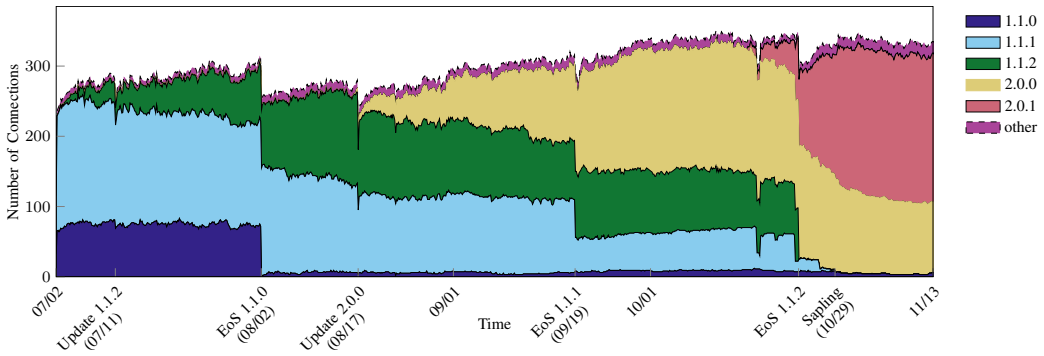
Zcash is a privacy-preserving cryptocurrency that provides anonymous monetary transactions. While Zcash's anonymity is part of a rigorous scientific discussion, information on the underlying peer-to-peer network are missing. In this paper, we provide the first long-term measurement study of the Zcash network to capture key metrics such as the network size and node distribution as well as deeper insights on the centralization of the network. Furthermore, we present an inference method based on a timing analysis of block arrivals that we use to determine interconnections of nodes. We evaluate and verify our method through simulations and real-world experiments, yielding a precision of 50 % with a recall of 82 % in the real-world scenario. By adjusting the parameters, the topology inference model is adaptable to the conditions found in other cryptocurrencies and therefore also contributes to the broader discussion of topology hiding in general.
Editorial analysis
A structured set of objections, weighed in public.
Referee Report
Summary. The manuscript reports the first long-term measurement study of the Zcash peer-to-peer network, including metrics on network size, node distribution, and centralization. It introduces an inference method that uses timing analysis of block arrivals to determine node interconnections, evaluated and verified through simulations and real-world experiments that report 50% precision and 82% recall; the method is claimed to be adaptable to other cryptocurrencies via parameter adjustment.
Significance. If the inference method is robust, the work supplies scarce empirical data on the topology and centralization of a privacy-focused cryptocurrency and offers a timing-based technique that could generalize to other P2P networks, thereby contributing to the broader literature on topology inference and hiding.
major comments (2)
- [Section 4] Section 4 (inference method): the central premise that observed block-arrival time differences serve as a direct proxy for topology edges after basic filtering is not accompanied by an explicit ablation or control that isolates the contribution of direct peer links from variable inter-node latencies, heterogeneous relay policies, or processing delays; without such isolation the mapping from timing deltas to edges remains under-constrained and directly affects the validity of the reported 50%/82% metrics.
- [Section 5] Section 5 (evaluation): the real-world validation yielding 50% precision and 82% recall does not describe how ground-truth edges were established or whether the experimental node set was chosen in a manner that could introduce selection effects; absent these details it is impossible to determine whether the metrics reflect the intended signal or are driven by the confounders noted in the method.
minor comments (1)
- [Abstract] The abstract states that parameters can be adjusted for other cryptocurrencies but provides no concrete description of the parameter set or sensitivity analysis, which would aid reproducibility.
Simulated Author's Rebuttal
We thank the referee for their constructive feedback on our manuscript. We address the major comments below and will revise the paper accordingly to improve clarity and address the concerns raised.
read point-by-point responses
-
Referee: [Section 4] Section 4 (inference method): the central premise that observed block-arrival time differences serve as a direct proxy for topology edges after basic filtering is not accompanied by an explicit ablation or control that isolates the contribution of direct peer links from variable inter-node latencies, heterogeneous relay policies, or processing delays; without such isolation the mapping from timing deltas to edges remains under-constrained and directly affects the validity of the reported 50%/82% metrics.
Authors: We agree that an explicit ablation study would strengthen the validation of the inference method. Our current evaluation relies on simulations that incorporate variable latencies and processing delays, as well as real-world experiments on the live Zcash network. However, to better isolate the contribution of direct links, we will add an ablation analysis in the revised manuscript by comparing results with and without certain filtering steps and by discussing the impact of potential confounders such as relay policies. This will help demonstrate that the timing deltas primarily reflect direct peer connections under the conditions tested. revision: yes
-
Referee: [Section 5] Section 5 (evaluation): the real-world validation yielding 50% precision and 82% recall does not describe how ground-truth edges were established or whether the experimental node set was chosen in a manner that could introduce selection effects; absent these details it is impossible to determine whether the metrics reflect the intended signal or are driven by the confounders noted in the method.
Authors: We apologize for the lack of detail in describing the ground-truth establishment and node selection process in Section 5. The ground-truth edges were determined through direct connections established in our controlled experimental setup on the Zcash testnet and mainnet, where we deployed multiple nodes with known interconnections. The node set was selected to represent a diverse range of network conditions, but we acknowledge potential selection effects. In the revision, we will provide a detailed description of the experimental methodology, including how ground truth was obtained and the criteria for node selection, to allow readers to assess the validity of the metrics. revision: yes
Circularity Check
Empirical measurement study with no circular derivations
full rationale
The paper describes a timing-based inference method for node interconnections, evaluated via simulations and real-world experiments reporting precision/recall metrics. No equations, fitted parameters presented as predictions, self-definitional constructs, or load-bearing self-citations appear in the provided text or abstract. The method is presented as an empirical technique adaptable to other networks, with no reduction of outputs to inputs by construction. This is a standard non-circular empirical study.
Axiom & Free-Parameter Ledger
axioms (1)
- domain assumption Block arrival timing differences can be used to infer direct node interconnections
Reference graph
Works this paper leans on
-
[1]
Nakamoto, Bitcoin: A peer-to-peer electronic cash system, 2008
S. Nakamoto, Bitcoin: A peer-to-peer electronic cash system, 2008
work page 2008
-
[2]
Zerocash: Decen- tralized anonymous payments from bitcoin,
E. Ben-Sasson, A. Chiesa, C. Garman, M. Green, I. Miers, E. Tromer, and M. Virza, “Zerocash: Decen- tralized anonymous payments from bitcoin,” in SP ’14: Proceedings of the 35th IEEE Symposium on Security and Privacy, San Jose, CA, USA, May 2014
work page 2014
-
[3]
Succinct non-interactive zero knowledge for a von neumann architecture,
E. Ben-Sasson, A. Chiesa, E. Tromer, and M. Virza, “Succinct non-interactive zero knowledge for a von neumann architecture,” in USENIX Security ’14: Pro- ceedings of the 23rd USENIX Security Symposium , San Diego, CA, USA, 2014, pp. 781–796
work page 2014
-
[4]
On the linkability of Zcash transactions
J. Quesnelle, “On the linkability of zcash transactions,” ArXiv preprint arXiv:1712.01210 , 2017
work page internal anchor Pith review Pith/arXiv arXiv 2017
-
[5]
An Empirical Analysis of Anonymity in Zcash
G. Kappos, H. Yousaf, M. Maller, and S. Meiklejohn, “An empirical analysis of anonymity in zcash,” ArXiv preprint arXiv:1805.03180, 2018
work page internal anchor Pith review Pith/arXiv arXiv 2018
-
[6]
On scaling decentralized blockchains - (A position paper),
K. Croman, C. Decker, I. Eyal, A. E. Gencer, A. Juels, A. E. Kosba, A. Miller, P. Saxena, E. Shi, E. G. Sirer, D. Song, and R. Wattenhofer, “On scaling decentralized blockchains - (A position paper),” in BITCOIN ’16: Proceedings of the 3rd Workshop on Bitcoin Research , Christ Church, Barbados, Feb. 2016, pp. 106–125
work page 2016
-
[7]
On the security and performance of proof of work blockchains,
A. Gervais, G. Karame, K. W ¨ust, V . Glykantzis, H. Ritz- dorf, and S. Capkun, “On the security and performance of proof of work blockchains,” in CCS ’16: Proceedings of the 23nd ACM SIGSAC Conference on Computer and Communications Security, Vienna, Austria, Oct. 2016
work page 2016
-
[8]
Deanonymisation of clients in bitcoin p2p network,
A. Biryukov, D. Khovratovich, and I. Pustogarov, “Deanonymisation of clients in bitcoin p2p network,” in CCS ’14: Proceedings of the 21st ACM Conference on Computer and Communications Security, Scottsdale, AZ, USA, Nov. 2014, pp. 15–29
work page 2014
-
[9]
Deanonymization in the bitcoin P2P network,
G. C. Fanti and P. Viswanath, “Deanonymization in the bitcoin P2P network,” in NIPS ’17: Proceedings of 30th Annual Conference on Neural Information Processing Systems, Long Beach, CA, USA, Dec. 2017
work page 2017
-
[10]
Tim- ing analysis for inferring the topology of the bitcoin peer-to-peer network,
T. Neudecker, P. Andelfinger, and H. Hartenstein, “Tim- ing analysis for inferring the topology of the bitcoin peer-to-peer network,” in UIC ’16: Proceedings of the 2016 International Conference on Ubiquitous Intelli- gence & Computing , Toulouse, France, Jul. 2016
work page 2016
-
[11]
Boost graph library , www.boost.org/doc/libs/1 66 0/ libs/graph/doc/, Accessed: 2019-04
work page 2019
-
[12]
Information propaga- tion in the bitcoin network,
C. Decker and R. Wattenhofer, “Information propaga- tion in the bitcoin network,” in P2P ’13: Proceedings of the 13th IEEE International Conference on Peer-to-Peer Computing, Trento, Italy, Sep. 2013, pp. 1–10
work page 2013
-
[13]
Blockchain inefficiency in the bitcoin peers network,
G. Pappalardo, T. Di Matteo, G. Caldarelli, and T. Aste, “Blockchain inefficiency in the bitcoin peers network,” EPJ Data Science , vol. 7, no. 1, p. 30, 2018
work page 2018
-
[14]
Measuring ethereum network peers,
S. K. Kim, Z. Ma, S. Murali, J. Mason, A. Miller, and M. Bailey, “Measuring ethereum network peers,” in IMC ’18: Proceedings of the Internet Measurement Conference, Boston, MA, USA, Oct. 2018, pp. 91–104
work page 2018
-
[15]
Decentralization in bitcoin and ethereum networks,
A. E. Gencer, S. Basu, I. Eyal, R. van Renesse, and E. G. Sirer, “Decentralization in bitcoin and ethereum networks,” in FC ’18: Proceedings of the 22nd Interna- tional Conference on Financial Cryptography and Data Security, Santa Barbara, Curac ¸ao, Feb. 2018
work page 2018
-
[16]
The Looming Threat of China: An Analysis of Chinese Influence on Bitcoin
B. Kaiser, M. Jurado, and A. Ledger, “The looming threat of china: An analysis of chinese influence on bitcoin,” CoRR, vol. abs/1810.02466, 2018
work page internal anchor Pith review Pith/arXiv arXiv 2018
-
[17]
Maximum likelihood network topology identification from edge-based unicast mea- surements,
M. Coates, R. M. Castro, R. D. Nowak, M. Gadhiok, R. King, and Y . Tsang, “Maximum likelihood network topology identification from edge-based unicast mea- surements,” in SIGMETRICS ’02: Proceedings of the International Conference on Measurements and Model- ing of Computer Systems , Marina Del Rey, California, USA, Jun. 2002, pp. 11–20
work page 2002
-
[18]
A fast topology inference: A building block for network-aware parallel processing,
T. Shirai, H. Saito, and K. Taura, “A fast topology inference: A building block for network-aware parallel processing,” in HPDC ’07: Proceedings of the 16th International Symposium on High-Performance Dis- tributed Computing , Monterey, California, USA, Jun. 2007, pp. 11–22
work page 2007
-
[19]
Multicast topology inference from measured end-to-end loss,
N. G. Duffield, J. Horowitz, F. L. Presti, and D. Towsley, “Multicast topology inference from measured end-to-end loss,” IEEE Transactions on Information Theory, vol. 48, no. 1, pp. 26–45, 2002
work page 2002
- [20]
-
[21]
Exploiting transaction accumulation and double spends for topology inference in bitcoin,
M. Grundmann, T. Neudecker, and H. Hartenstein, “Exploiting transaction accumulation and double spends for topology inference in bitcoin,” in BITCOIN ’18: Proceedings of the 5th Workshop on Bitcoin Research , Santa Barbara, Curac ¸ao, Feb. 2018
work page 2018
-
[22]
Network layer as- pects of permissionless blockchains,
T. Neudecker and H. Hartenstein, “Network layer as- pects of permissionless blockchains,” IEEE Communi- cations Surveys and Tutorials , vol. 21, no. 1, pp. 838– 857, 2019
work page 2019
-
[23]
Characterization of the bitcoin peer-to- peer network (2015-2018),
T. Neudecker, “Characterization of the bitcoin peer-to- peer network (2015-2018),” Karlsruhe, Tech. Rep. 1, 2019, 29 pp
work page 2015
-
[24]
Zcash - network , z.cash/upgrade/, Accessed: 2019-05
work page 2019
-
[25]
Maxmind, www.maxmind.com/, Accessed: 2019-03
work page 2019
-
[26]
iPlane: An information plane for distributed services , web . eecs . umich . edu /∼harshavm / iplane/, Accessed: 2019-04
work page 2019
discussion (0)
Sign in with ORCID, Apple, or X to comment. Anyone can read and Pith papers without signing in.