REVIEW 4 major objections 5 minor 22 references
Detecting Blinks in Healthy and Parkinson's EEG: A Deep Learning Perspective
T0 review · 4 major / 5 minor · reviewed 2026-08-05 · deepseek-v4-flash
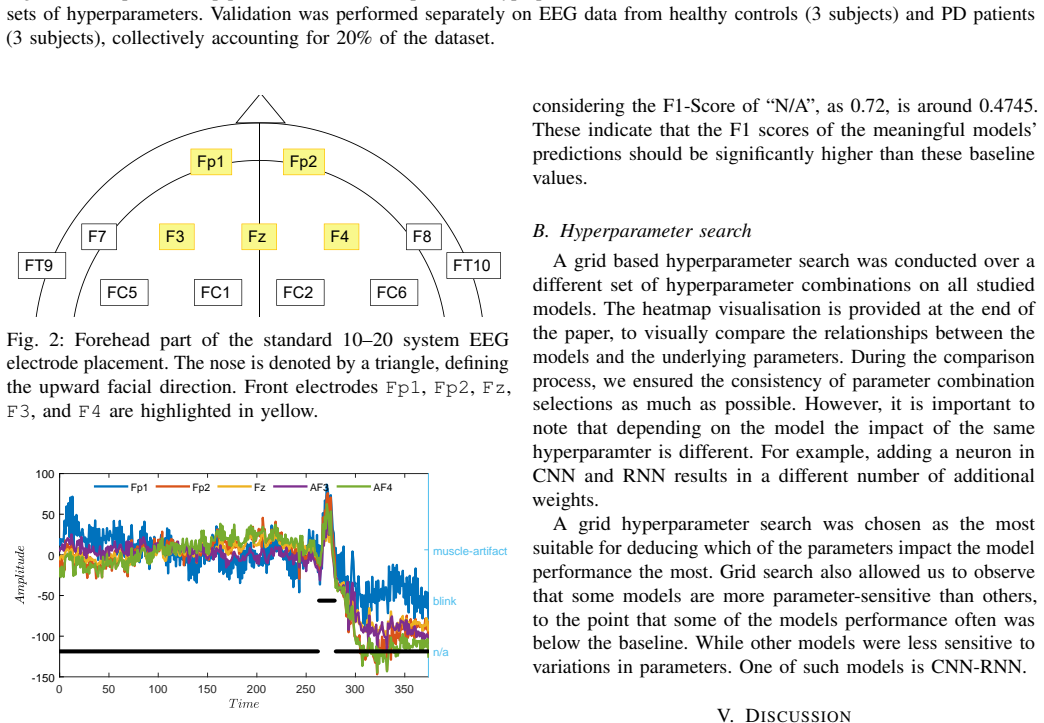
Pith's one-line read A CNN-RNN hybrid beats ten deep models at EEG blink segmentation on raw frontal signals.
desk verdict Useful comparison idea, thin evidence: the CNN-RNN result is plausible but not established. read the letter →
The pith
A machine-rendered reading of the paper's core claim, the machinery that carries it, and where it could break.
The reading
What carries the argument
The load-bearing object is the CNN-RNN sequence-to-sequence model: a 1D convolutional stack learns local high-amplitude blink-peak features from raw electrode traces, and a bidirectional LSTM then models temporal context in both directions. Because CNN blocks need fixed windows, a weighted-voting post-processor shifts the analysis window by several offsets and merges the overlapping predictions, so blinks cut off at window edges are still recovered. This combination is what the paper's architecture ranking is built around; every other tested model is a variant or ablation of one of its two stages.
What would settle it
Run the same ten architectures on the same public dataset using leave-one-subject-out cross-validation over all 31 subjects. If the CNN-RNN's F1-micro margin over TCN-RNN or BiLSTM disappears or reverses, the central ranking claim fails. A cheaper test: apply a threshold-based method like BLINKER or RT-Blink to the same held-out subjects; if it matches or beats the reported 93.8% healthy accuracy without training, the deep-learning premise of the comparison weakens.
Extended reading notes
Core claim
The central claim is that a CNN-RNN hybrid with a bidirectional LSTM is the best-performing deep architecture for EEG blink segmentation across every electrode configuration tested. On the held-out subjects the model reached 93.8%, 95.4%, and 95.8% accuracy with 1, 3, and 5 channels in healthy participants, and 73.8%, 75.4%, and 75.8% in Parkinson's patients; the Table II mean F1-micro is 0.93178. The paper attributes the margin to the hybrid's ability to combine convolutional extraction of blink waveform shapes with bidirectional temporal context. The same pipeline handles tremor-contaminated PD data with minimal preprocessing, so the authors position it as a way to obtain blink statistics
Load-bearing premise
The reported performance gaps rest on only six held-out subjects (three healthy, three Parkinson's), so the architecture ranking could change if a few different subjects had landed in the test split.
Editorial extensions
If this is right
- A single frontal electrode is enough for a useful blink-rate monitor: the one-channel CNN-RNN scored 93.8% in healthy and 73.8% in Parkinson's subjects, within two points of the five-channel version.
- Adding channels buys only a small accuracy gain, so the extra computation may not be worth it for wearable devices.
- Minimal preprocessing suffices: raw signals can be segmented directly, skipping ICA and hand-crafted blink features.
- The same model family is portable to other clinical populations or cognitive-load studies where blink statistics matter.
Reading between the lines
- The paper's own observation that five-channel inputs underperformed one- and three-channel inputs during hyperparameter search but outperformed them at test time indicates the channel ranking is not stable at six test subjects; leave-one-subject-out evaluation would resolve it.
- The closing suggestion that forehead blink features could distinguish PD from healthy subjects implies a direct next experiment: feed blink-rate and blink-shape features from the CNN-RNN output into a PD-versus-control classifier.
- The abstract mentions transformer-based models, but no transformer appears in the method descriptions or Table II; a reader should treat the comparison as covering RNN, CNN, TCN, and hybrids only.
- The equal-parameter depthwise variants trained faster with near-identical F1, so the natural engineering follow-up is deploying the depthwise CNN-RNN on low-power hardware and benchmarking real-time latency.
Signed reviews
Editorial analysis
A structured set of objections, weighed in public.
Referee Report
Summary. The paper proposes a sequence-to-sequence blink detection pipeline using 1, 3, or 5 frontal EEG electrodes and compares several deep learning architectures—RNNs, CNNs, TCNs, and hybrids—on the public UCSD dataset containing 15 healthy controls and 16 Parkinson's disease patients. The central claim is that a CNN-RNN hybrid (CNN feature extractor with bidirectional LSTM) consistently outperforms all other models, achieving the best blink detection accuracy of 93.8%/95.4%/95.8% in healthy controls and 73.8%/75.4%/75.8% in PD patients for 1/3/5 channels. The body reports mean F1-micro scores with CNN-RNN at 0.93178, followed by TCN-RNN, CNN variants, and simpler RNNs. The evaluation uses a held-out set of 3 healthy and 3 PD subjects.
Significance. If the reported ranking is robust, the paper provides a useful systematic comparison of architecture families for a practical EEG blink-segmentation task on a public dataset. The raw-signal, minimal-preprocessing pipeline and the inclusion of both healthy and PD subjects are strengths, and the paper correctly identifies class imbalance as a reason to prefer F1 over accuracy. However, the main contribution is an empirical architecture ranking supported by a single 6-subject test split with no significance testing, no per-subject breakdown, and no repeated evaluation. The paper's own observation of a channel-count anomaly during hyperparameter search indicates evaluation instability. The abstract's headline accuracy numbers are not tabulated in the body, and the body itself argues that accuracy is misleading. Thus, while the topic is relevant and the experimental setup is reasonable in principle, the statistical support for the central claim is currently insufficient.
major comments (4)
- [Table II / Fig. 1 / §V.A.1] The central architecture ranking rests on a single held-out test set of 6 subjects (3 healthy, 3 PD). No per-subject results, confidence intervals, or significance tests are reported. The paper's own §V.A.1 notes that five-channel inputs scored lower than one- and three-channel inputs during hyperparameter search but slightly better during testing, calling this 'rather anomalous.' This is a concrete indicator that the evaluation is noisy at this sample size. The claim that CNN-RNN 'consistently outperformed' other models needs either repeated splits, per-subject paired comparisons, or a nonparametric significance test; otherwise the ordering in Table II may reflect subject-specific recording conditions rather than architecture quality.
- [Abstract / §IV.A] The abstract headlines per-cohort and per-channel accuracy values (93.8/95.4/95.8 and 73.8/75.4/75.8), but these exact numbers are not tabulated anywhere in the body. Moreover, §IV.A states explicitly that accuracy is misleading for this imbalanced task and that F1 is the main performance metric. This is an internal inconsistency: the paper's own methodology argues against the metric used in the abstract's key quantitative claim. The authors should either provide a table with per-cohort and per-channel accuracy and F1 values, or replace the abstract's accuracy figures with the F1-based numbers that the body endorses.
- [Fig. 1 / §III.B / §IV.B] The evaluation protocol is not fully specified. Fig. 1's caption describes the held-out 20% as 'validation,' while the text and Fig. 1 legend also refer to 'test.' It is unclear whether the reported best hyperparameters were selected on a validation subset and then evaluated once on the test set, or whether test-set information influenced model selection. This matters because Table II reports the best F1-micro per model after hyperparameter search; if the test set was used repeatedly to pick the winning architecture, the reported ordering is optimistically biased. Please clarify the exact split sizes, the role of the validation set, and how many times the test set was consulted.
- [Fig. 4 / Fig. 5 / §V.A.3] The box plots show 'distributions' of F1-micro and F1-macro across models, but the manuscript does not explain what these distributions represent: subjects, hyperparameter configurations, random seeds, or cross-validation folds. Without this information, the visual evidence for CNN-RNN's superiority (e.g., 'highest median performance' in Fig. 4) cannot be interpreted. Please define the source of variation explicitly and report the number of observations per box.
minor comments (5)
- [Abstract / Conclusion] Typographical and grammatical errors: 'health cohort' should be 'healthy cohort'; 'involuntarily blinks' should be 'involuntary blinks'; the conclusion is missing a closing parenthesis in 'Parkinson’s syndrome.' These should be corrected.
- [Fig. 1] The split labels in Fig. 1 are ambiguous: '70% preserved train', '10% test', '20%' with the caption calling the 20% 'validation.' Please reconcile the percentages and terminology.
- [§VII / Appendix] The text states that a heatmap visualization is provided at the end of the paper, but the appendix only contains CNN-DW results and no heatmap appears. Either the heatmap is missing or the reference is incorrect.
- [§IV.B / Table I] The hyperparameter search ranges differ across model families (e.g., filter sizes 5/11/15 for CNN and TCN, but 5/15 for CNN-RNN; RNN blocks vary). This makes 'fair comparison across architectures' difficult to establish. Please discuss whether the search budgets were comparable.
- [§V,A.3] The statement that depthwise and standard versions are 'designed to have the same number of parameters' is not supported by any parameter counts in the paper. Reporting actual parameter counts would strengthen the claim.
Circularity Check
No circularity: empirical architecture comparison on public data; self-citations are background only.
full rationale
The paper makes no derivation chain that reduces to its inputs. Its central claim is an empirical comparison of deep learning models for EEG blink segmentation on the public UCSD dataset, with F1-micro reported for held-out subjects. Hyperparameters were selected on a disjoint validation subset, and the final numbers come from evaluation on held-out healthy and Parkinson's subjects; there is no fitted parameter that is then renamed as a prediction. The self-citations ([2], [5]) motivate blink-rate analysis and describe earlier blink-detection methods, but they are not load-bearing for the architecture comparison, which is evaluated against an external benchmark with manual labels. The small test set and the reported channel-count anomaly are concerns about statistical robustness, not about circularity. No equation or claim is equivalent by construction to its own input, so the paper is not circular.
Assumptions & free parameters
free parameters (5)
- CNN-RNN best hyperparameters (filter size, num blocks, num filters, RNN blocks, num units) =
15, 2, 32, 2, 32
- Window size for CNN/TCN fixed-width models =
not reported
- Weighted voting offset count and aggregation rule =
not reported
- Training details (optimizer, learning rate, batch size, epochs, loss) =
not reported
- Train/validation/test split =
70/10/20 (approx. 22/3/6 subjects), ambiguous between validation and test
assumptions (4)
- domain assumption Manual blink annotation on the UCSD recordings is accurate ground truth
- domain assumption The UCSD 31-subject dataset (15 HC, 16 PD) is blink-rich, recorded with eyes open, and comparable across subjects
- domain assumption A held-out set of 3 healthy and 3 PD subjects supports generalization claims about model ranking
- domain assumption Minimal preprocessing preserves the blink and tremor information the models exploit
Cite this review
Pith. "Pith review of Detecting Blinks in Healthy and Parkinson's EEG: A Deep Learning Perspective." pith.science (2026). https://pith.science/paper/R77HAVPF
@misc{pith2026250904951,
  author       = {Pith},
  title        = {Pith review of: Detecting Blinks in Healthy and Parkinson's EEG: A Deep Learning Perspective},
  year         = {2026},
  howpublished = {\url{https://pith.science/paper/R77HAVPF}},
  note         = {Machine review of arXiv:2509.04951}
}
read the original abstract
Blinks in electroencephalography (EEG) are often treated as unwanted artifacts. However, recent studies have demonstrated that blink rate and its variability are important physiological markers to monitor cognitive load, attention, and potential neurological disorders. This paper addresses the critical task of accurate blink detection by evaluating various deep learning models for segmenting EEG signals into involuntary blinks and non-blinks. We present a pipeline for blink detection using 1, 3, or 5 frontal EEG electrodes. The problem is formulated as a sequence-to-sequence task and tested on various deep learning architectures including standard recurrent neural networks, convolutional neural networks (both standard and depth-wise), temporal convolutional networks (TCN), transformer-based models, and hybrid architectures. The models were trained on raw EEG signals with minimal pre-processing. Training and testing was carried out on a public dataset of 31 subjects collected at UCSD. This dataset consisted of 15 healthy participants and 16 patients with Parkinson's disease allowing us to verify the model's robustness to tremor. Out of all models, CNN-RNN hybrid model consistently outperformed other models and achieved the best blink detection accuracy of 93.8%, 95.4% and 95.8% with 1, 3, and 5 channels in the healthy cohort and correspondingly 73.8%, 75.4% and 75.8% in patients with PD. The paper compares neural networks for the task of segmenting EEG recordings to involuntary blinks and no blinks allowing for computing blink rate and other statistics.
Figures


Figures from the paper (1 more)

Reference graph
Works this paper leans on
-
[1]
Development of Evaluation System of Student’s Concentration in Active Learning,
K. Yajima, S. Takahashi, Y . Takeichi, and J. Sato, “Development of Evaluation System of Student’s Concentration in Active Learning,” In Proceedings of the 2018 International Conference on Engineering, Applied Sciences, and Technology (ICEAST), Phuket, Thailand, 2018, pp. 1-4. doi: 10.1109/ICEAST.2018.8434492
-
[2]
What Does Eye-Blink Rate Variability Dynamics Tell Us About Cognitive Performance,
R. Paprocki and A. Lenskiy, “What Does Eye-Blink Rate Variability Dynamics Tell Us About Cognitive Performance,” Frontiers in Human Neuroscience, vol. 11, 2017. doi: 10.3389/fnhum.2017.00620
-
[3]
A. Delorme and S. Makeig, “EEGLAB: an Open Source Toolbox for Analysis of Single-Trial EEG Dynamics, Including Independent Component Analysis,” Journal of Neuroscience Methods, vol. 134, no. 1, pp. 9-21, 2004. doi: 10.1016/j.jneumeth.2003.10.009
-
[4]
Automatic spike detection based on adap- tive template matching for extracellular neural recordings,
S. Kim and J. McNames, “Automatic spike detection based on adap- tive template matching for extracellular neural recordings,” Journal of Neuroscience Methods, vol. 165, no. 2, pp. 165-174, 2007. doi: 10.1016/j.jneumeth.2007.05.033
-
[5]
Extracting Blink Rate Variability from EEG Signals,
R. Paprocki, T. Gebrehiwot, M. Gradinscak, and A. Lenskiy, “Extracting Blink Rate Variability from EEG Signals,” International Journal of Machine Learning and Computing, vol. 6, no. 3, 2016
work page 2016
-
[6]
BLINKER: Automated Extraction of Ocular Indices from EEG Enabling Large-Scale Analysis,
K. Kleifges, N. Bigdely-Shamlo, S. E. Kerick, and K. A. Robbins, “BLINKER: Automated Extraction of Ocular Indices from EEG Enabling Large-Scale Analysis,” Frontiers in Neuroscience, vol. 11, 2017. doi: 10.3389/fnins.2017.00012
arXiv 2017
-
[7]
Use of spontaneous blinking for application in human authentication,
A. Jalilifard, D. Chen, A. K. Mutasim, M. R. Bashar, R. S. Tipu, A. Kabir Shawon, N. Sakib, M. A. Amin, and M. K. Islam, “Use of spontaneous blinking for application in human authentication,” Engineering Science and Technology, an International Journal, vol. 23, pp. 903-910, 2020
work page 2020
-
[8]
Blink: A Fully Automated Unsuper- vised Algorithm for Eye-Blink Detection in EEG Signals,
M. Agarwal and R. Sivakumar, “Blink: A Fully Automated Unsuper- vised Algorithm for Eye-Blink Detection in EEG Signals,” In 2019 57th Annual Allerton Conference on Communication, Control, and Computing (Allerton), Monticello, IL, USA, 2019, pp. 1113-1121. doi: 10.1109/ALLERTON.2019.8919795
Show all 22 references
-
[9]
Unsupervised eye blink artifact detection from EEG with Gaussian mixture model,
J. Cao, L. Chen, D. Hu, F. Dong, T. Jiang, W. Gao, and F. Gao, “Unsupervised eye blink artifact detection from EEG with Gaussian mixture model,” IEEE Journal of Biomedical and Health Informatics, vol. 25, no. 8, pp. 2895-2905, 2021
2021
-
[10]
Multidimensional feature optimization based eye blink detection under epileptiform discharges,
M. Wang, J. Wang, X. Cui, T. Wang, T. Jiang, F. Gao, and J. Cao, “Multidimensional feature optimization based eye blink detection under epileptiform discharges,” IEEE Transactions on Neural Systems and Rehabilitation Engineering, vol. 30, pp. 905-914, 2022
2022
-
[11]
RT-Blink: A Method Toward Real-Time Blink Detection From Single Frontal EEG Signal,
Y . Zhang, X. Zheng, W. Xu, and H. Liu, “RT-Blink: A Method Toward Real-Time Blink Detection From Single Frontal EEG Signal,” IEEE Sensors Journal, vol. 23, no. 3, pp. 2794-2802, 2023. doi: 10.1109/JSEN.2022.3232176
2023
-
[12]
1D convolutional neural network approach to classify voluntary eye blinks in EEG signals for BCI applications,
M. Lo Giudice, G. Varone, C. Ieracitano, N. Mammone, A. R. Bruna, V . Tomaselli, and F. C. Morabito, “1D convolutional neural network approach to classify voluntary eye blinks in EEG signals for BCI applications,” In 2020 International Joint Conference on Neural Networks (IJCN...
2020
-
[13]
EEGANet: Removal of ocular artifacts from the EEG signal using generative adver- sarial networks,
P. Sawangjai, M. Trakulruangroj, C. Boonnag, M. Piriyajitakonkij, R. K. Tripathy, T. Sudhawiyangkul, and T. Wilaiprasitporn, “EEGANet: Removal of ocular artifacts from the EEG signal using generative adver- sarial networks,” IEEE Journal of Biomedical and Health Informatics, v...
2022
-
[14]
LSTM based brain-machine interface tool for text generation through eyes blink- ing detection,
A. F. Reyes, E. C. Camacho, M. Armando, and J. M. Calderon, “LSTM based brain-machine interface tool for text generation through eyes blink- ing detection,” In 2021 IEEE 18th Annual Consumer Communications & Networking Conference (CCNC), pp. 1-6, 2021
2021
-
[15]
CNN-based removal of eye blink artifacts from single-channel EEG,
J. Jurczak, M. Kania, and K. Domino, “CNN-based removal of eye blink artifacts from single-channel EEG,” Sensors, vol. 22, no. 17, p. 6297, 2022
2022
-
[16]
EEG multipurpose eye blink detector using convolutional neural network,
A. F. Iaquinta, A. C. S. Silva, A. F. Junior, J. M. de Toledo, and G. V . von Atzingen, “EEG multipurpose eye blink detector using convolutional neural network,” arXiv preprint arXiv:2107.14235, 2021
2021 arXiv
-
[17]
1D-ResCNN: One-dimensional residual convolutional neural network for EEG signal denoising,
J. Sun, X. Zhang, and H. Wang, “1D-ResCNN: One-dimensional residual convolutional neural network for EEG signal denoising,” IEEE Transactions on Neural Systems and Rehabilitation Engineering, vol. 28, no. 9, pp. 1976-1985, 2020
1976
-
[18]
Online V oluntary Eye Blink Detection using Electrooculogram,
M. Nakanishi, Y . Mitsukura, Y . Wang, Y .-T. Wang, and T.-P. Jung, “Online V oluntary Eye Blink Detection using Electrooculogram,” IEICE Proceeding Series, vol. 1, 2012. doi: 10.15248/proc.1.114
2012 doi
-
[19]
Extended ICA and M-CSP with BiLSTM Towards Improved Classification of EEG Signals,
A. U. Rahman, A. Tubaishat, F. Al-Obeidat, Z. Halim, M. Tahir, and F. Qayum, “Extended ICA and M-CSP with BiLSTM Towards Improved Classification of EEG Signals,” Soft Computing, pp. 1-12, 2022. 7 (a) LSTM LSTMBiLSTMBiLSTMGRU GRUCNN-STCNN-STCNN-DWCNN-DWCNN-RNNCNN-RNNTCN-DWTCN-D...
2022
-
[20]
A Temporal Convolution Network Solution for EEG Motor Imagery Classification,
N. Lu, T. Yin, and X. Jing, “A Temporal Convolution Network Solution for EEG Motor Imagery Classification,” Proceedings of the 2019 IEEE 19th International Conference on Bioinformatics and Bioengineering (BIBE), pp. 796-799, 2019. doi: 10.1109/BIBE.2019.00148
2019
-
[21]
MobileNets: Efficient Convolutional Neural Networks for Mobile Vision Applications,
A. G. Howard, M. Zhu, B. Chen, D. Kalenichenko, W. Wang, T. Weyand, M. Andreetto, and H. Adam, “MobileNets: Efficient Convolutional Neural Networks for Mobile Vision Applications,” arXiv preprint arXiv:1704.04861, 2017
2017 arXiv
-
[22]
Patches Are All You Need?,
A. Trockman and J. Z. Kolter, “Patches Are All You Need?,” In International Conference on Learning Representations, 2022. VII. APPENDIX A. CNN-DW Results 8 (a) Filter Size: 5 (b) Filter Size: 11 (c) Filter Size: 15 (d) Filter Size: 5 (e) Filter Size: 11 (f) Filter Size: 15 (g)...
2022
Reviewed August 5, 2026 · model on record in the stance chip above.
Discussion (0). Continue with ORCID to comment.