REVIEW 4 major objections 6 minor 61 references
Quantized Approximate Signal Processing (QASP): Towards Homomorphic Encryption for audio
T0 review · 4 major / 6 minor · reviewed 2026-08-15 · deepseek-v4-flash
Pith's one-line read Fully homomorphic encryption can compute standard audio time-frequency representations on encrypted raw audio.
desk verdict First FHE pipeline for raw-audio time-frequency features is real, but the abstract oversells the approximate STFT gains; the improvement tables are within statistical noise. read the letter →
The pith
A machine-rendered reading of the paper's core claim, the machinery that carries it, and where it could break.
The reading
What carries the argument
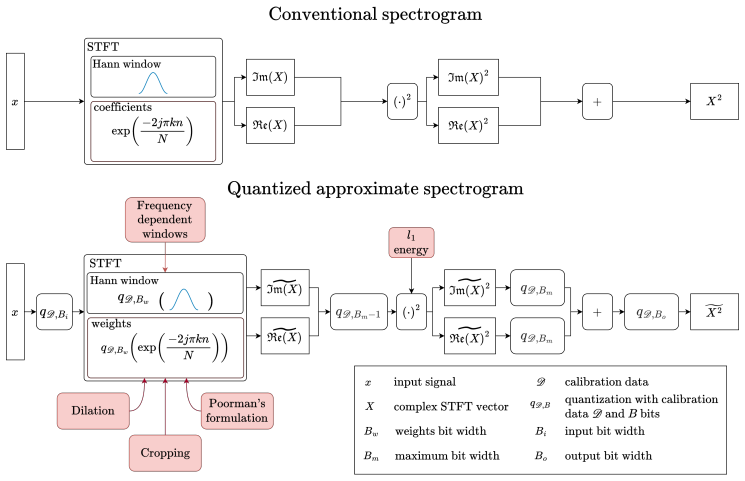
The load-bearing object is the quantized approximate STFT, treated as a fixed-weight convolutional layer whose input, kernel weights, outputs, and intermediate activations each have their own bit width, constrained so that no intermediate exceeds 16 bits. The argument runs through the bit-growth formula for a dot product, which shows that sparsifying the kernel (dilation, cropping), narrowing windows (frequency-dependent windows), or replacing complex exponentials by projections onto the $L$-th roots of unity (poorman's transform) reduces the bits needed for accumulation; the freed budget is then spent on higher input/output precision, which matters more for downstream statistical tests and classifiers. The poorman's transform comes with a provable error bound $\|X-X_L\|\le 2|\sin(\pi/(2L))|\sqrt{\sum_i (x(i)w(i-mh))^2}$, and the dilation error is expressed as leakage from other frequency bins. These approximations are not free: they add their own approximation error, and the paper's heuristic is that the quantization-error reduction outweighs it.
What would settle it
Take the exact grid-selected quantization parameters and bit widths reported for the best conventional and approximate models on VocalSet, and evaluate them on a held-out set of the same classes recorded in a different room, microphone, or signal-to-noise ratio; if the statistical-test error rate jumps well above the reported 1.9-6.5% range, or encrypted classification accuracy drops far below the clear baseline, then the calibration-to-evaluation generalization on which the results depend has failed. A sharper test of the approximation claim: measure the FHE-vs-clear distance for a signal whose energy lies mostly above 4 kHz, where the paper states quantization zeroes the spectrum; a large distance there is expected, and only matters if downstream tasks rely on that band.
Extended reading notes
Core claim
The central discovery is that the computational bottleneck of FHE audio processing is quantization error, not cryptographic noise, and that this error can be steered by choosing where bits are spent. By writing the STFT as a convolution, all four representations become quantized neural-network operations, and the accumulation width grows as $\lceil \log_2(L(2^N-1)(2^M-1))\rceil$ for a length-$L$ dot product with $N$- and $M$-bit operands. The paper shows that inserting zeros into the STFT kernel (dilation, cropping), adapting windows to frequency, or projecting complex exponentials onto a finite set of roots of unity (poorman's transform, $L=4$) lowers the bit demand and lets more bits go to inputs and activations, yielding encrypted outputs that are closer to the clear computation than the conventional STFT is in FHE. Empirically, the best approximations cut mean statistical-test error rates from 5.9% to 4.7% on VocalSet and from 6.5% to 1.9% on OxVoc, and encrypted CNNs classify gender near clear accuracy while vocal-exercise classification stays within a few points of clear. The paper also acknowledges a cost: quantization zeroes much of the energy above 4 kHz in the spectrograms.
Load-bearing premise
The pipeline rests on the assumption that quantization parameters (bit widths, and min/max calibration ranges) chosen on a stratified 10% calibration set remain good for the other 90% of the data; if the calibration audio is not representative of the evaluation distribution, the reported FHE-vs-clear errors are optimistic.
Editorial extensions
If this is right
- A server can compute STFT, Mel filterbanks, MFCCs, and gammatone features on encrypted raw audio and return them, or their statistics, to the client, enabling private speech analytics without exposing the signal.
- Approximation is not merely a lossy shortcut: in FHE, approximate STFT variants such as dilation and poorman can be more faithful to the clear computation than the conventional STFT, because they reduce quantization error.
- End-to-end encrypted classification from raw audio is feasible for at least simple CNNs: gender classification stays within about 0.05 of clear accuracy, and 4-class vocal exercise classification remains well above chance.
- A practical heuristic for FHE parameter selection follows from the bit-budget analysis: spend more bits on activations and outputs, fewer on convolution weights, which the post-hoc bit distributions support.
Reading between the lines
- The same descriptor-based pipeline could be pointed at clinical or paralinguistic biomarkers (for example, vocal jitter or shimmer-like statistics) without architectural change, since the paper already computes mean and standard-deviation statistics over Mel and gammatone energies; a direct test is whether the low error rates survive on disordered speech.
- Because the poorman and dilation error bounds are explicit functions of $L$ and $d$, one could replace the grid search for bit widths with a principled, bound-driven parameter selection, treating the allowed approximation error as a budget to be split between quantization and approximation.
- The reported runtime of about 12,970 seconds for 64 ms of audio suggests that the practical bottleneck has shifted from accuracy to speed; the approximate kernels' sparsity may cut the number of encrypted multiplications and thus latency, an effect the paper does not quantify.
- The large intrinsic distance for MFCCs hints that cepstral features need their own approximation strategy, for example handling the log and discrete cosine transform stages separately, before FHE-MFCCs are used in applications that depend on fine cepstral structure.
Signed reviews
Editorial analysis
A structured set of objections, weighed in public.
Referee Report
Summary. This paper presents Quantized Approximate Signal Processing (QASP), a framework for computing standard time-frequency representations (STFT, Mel filterbanks, MFCCs, gammatone filters) on encrypted raw audio under the TFHE scheme, using quantized neural network layers and several approximate STFT formulations (dilation, frequency-dependent windows, poorman's projection, l1 energy, cropping). The authors derive error bounds for the approximations and evaluate the pipeline on VocalSet and OxVoc through intrinsic spectrogram distances, statistical tests over audio descriptors, and CNN gender/vocal-exercise classification, comparing conventional STFT with the approximations. The paper claims that the approximations significantly improve error rates and classification performance relative to conventional FHE STFT.
Significance. If the empirical claims were fully supported, this would be a valuable proof-of-concept: it would show that a server can compute standard audio features and simple classifiers over encrypted raw audio without seeing plaintext, with error bounds guiding parameter choice. The derivation of the poorman's transform error bound (Appendix A.2) and the decomposition of quantization bit widths (Section 3.3) are clear strengths, as are the use of public datasets and the explicit statement of limitations (lost harmonics above 4 kHz, very high FHE latency). However, the headline claims about approximation gains are not established by the reported numbers, and several statements go beyond what the tables show.
major comments (4)
- [Section 5.2, Tables 2 and 3; Abstract] The claim that the approximations 'substantially reduce error rates' and yield 'significant performance improvements' is not supported by the reported error counts. The largest improvement over the conventional STFT in any cell is 3 errors (e.g., 15 vs 12 on VocalSet Mean Gammatone; 3 vs 1 on OxVoc Std RMS). For paired binary outcomes, a McNemar exact test with a total-error difference of 3 has a minimum two-sided p-value of 0.25, and differences of 1 or 2 have p-values of at least 0.5; therefore no cell in these tables can reach statistical significance no matter how the discordant pairs are arranged. The paper reports no significance test, no confidence intervals, and no raw confusion matrices. Moreover, the best variant is selected post hoc among 12 approximations, and the winner changes across markers and datasets (e.g., OxVoc Mean Mel has 0.0 errors for Poorman L=6, Poorman L=8, and Dilation d=2, while Dilation d=4 gives 3.7), so the inference that 'dilation factor 4 ... is the best approach across both datasets' is not established.
- [Sections 4.1.2 and 4.2] The quantization bit widths Bi, Bo, Bw, and Bm are selected by grid search on a 10% calibration set and then used to evaluate on the remaining 90%, but the manuscript provides no evidence that the selected widths generalize to the evaluation distribution. Because the calibration criterion is Pearson correlation with clear descriptors, the comparison of approximation methods on the evaluation set can be biased toward methods that happen to overfit the calibration split. Please report repeated calibration/evaluation splits (or a bootstrap) and the stability of the selected bit widths, or otherwise demonstrate that the ranking of approximations is robust to the calibration set choice.
- [Section 5.3, Tables 4 and 5] The statement that the approximations 'helped to get closer to the clear computation' for CNN classification is inconsistent with the tables. For binary gender classification, Poorman is worse than the conventional FHE pipeline for every representation (e.g., 0.82 vs 0.89 for STFT) and Dilation is worse for Mel (0.82 vs 0.86) and Gammatone (0.82 vs 0.89). For 4-class vocal exercises, Dilation improves only STFT and Mel, and Poorman degrades STFT (0.50 vs 0.54) and MFCC (0.50 vs 0.53) relative to the conventional STFT. No significance test is reported across the 5 runs, and the standard deviations (0.01–0.04) are large relative to the differences, so the claimed classification improvements are not established.
- [Section 1 and Highlights] The 'first' claims (first system to perform FHE on raw audio; 'First complete end-to-end demonstration of FHE applied directly to raw audio signals') are not reconciled with the authors' own description of Zhang et al. [59] as avoiding filterbanks and 'using only smaller convolutions on audio'. If prior work already applied homomorphic computations directly to raw audio, the novelty should be stated more narrowly (e.g., first to compute these four time-frequency representations under TFHE, or first with this particular CNN pipeline). Please cite and compare explicitly so that the contribution is accurately scoped.
minor comments (6)
- [Equation (7) and Appendix A.1] The dilation indicator function notation is ambiguous: '1_{n≡0[min(d,dk)]}' should be defined as n ≡ 0 mod min(d, d_k), and Appendix A.1 uses a different form '1_{n≡0[d]}'; please align the notation and define all symbols.
- [Figure 3] The caption says the figure shows the FHE-friendly transformation 'corresponding to lowest Euclidean distance' but does not specify which approximation is used; please state the configuration explicitly.
- [Section 5.1 and Section 6] The conclusion states that all four time-frequency representations were 'successfully demonstrated', but Section 5.1 reports MFCC mean normalized 2D Euclidean distances of 0.78–0.85 with maxima above 1.5, far above the other features (0.13–0.18); please qualify the MFCC claim and discuss the practical utility of the encrypted MFCCs.
- [Section 5.5] The limitation section reports an FHE latency of 12,970 seconds for a 64 ms audio clip; this practical constraint should be reflected in the abstract or conclusion to avoid a misleading impression about deployability.
- [General] The paper does not include a data/code availability statement; given the many pipeline parameters, releasing code or a detailed configuration file would improve reproducibility.
- [General] There are minor typographical inconsistencies (e.g., 'Vocalset' vs 'VocalSet' in Figure 3, a stray period in the Table 3 caption); please proofread carefully.
Circularity Check
No significant circularity: the FHE pipeline, quantization framework, and approximation error bounds are derived from external tools and stated mathematical assumptions, with self-citations only in contextual passages.
full rationale
The paper's derivation chain is self-contained. The secure audio pipeline is built on external primitives (TFHE/Concrete, Brevitas) and standard signal-processing identities; the STFT is expressed as a fixed-weight convolution, and the Mel/MFCC/gammatone transforms are likewise fixed-weight layers. Each approximate STFT variant is introduced by an explicit defining equation (e.g., Eq. 7 for dilation, Eq. 9 for poorman's transform) and accompanied by error bounds derived in the text, such as the Cauchy-Schwarz bound in Appendix A.2. No fitted parameter is relabeled as a prediction: bit-width parameters are selected by grid search on a 10% calibration split and evaluated on the held-out 90%, and the claim that dilation d=4 performs best is an empirical comparison across variants, not a quantity forced by construction. The two author self-citations, Riad et al. 2020 and 2022, appear only as background for clinical speech markers and are not used to justify any methodological step. The absence of significance testing and the post-hoc choice of the winning approximation are statistical-validity concerns rather than circularity, so the circularity score is 0.
Assumptions & free parameters
free parameters (6)
- Quantization bit widths (Bi, Bo, Bw, Bm) =
grid-searched per experiment
- Dilation factor d =
2, 3, 4, 5, or d_k, chosen per experiment
- Poorman's L =
4, 6, or 8
- N_min for frequency-adapted windows =
80
- Cropping frequency band =
f_min=0 Hz, f_max=1000 Hz
- STFT window length N and hop length h =
not stated explicitly
assumptions (5)
- ad hoc to paper The FHE compilation error is negligible compared to the quantization error.
- domain assumption The client is honest.
- domain assumption Concrete enforces a 16-bit limit over all intermediate values.
- standard math Shannon-Nyquist sampling theorem can determine the maximum safe dilation rate per frequency bin.
- standard math Cauchy-Schwarz inequality for the poorman's transform error bound.
Cite this review
Pith. "Pith review of Quantized Approximate Signal Processing (QASP): Towards Homomorphic Encryption for audio." pith.science (2026). https://pith.science/paper/R7PJJTKA
@misc{pith2026250510500,
  author       = {Pith},
  title        = {Pith review of: Quantized Approximate Signal Processing (QASP): Towards Homomorphic Encryption for audio},
  year         = {2026},
  howpublished = {\url{https://pith.science/paper/R7PJJTKA}},
  note         = {Machine review of arXiv:2505.10500}
}
read the original abstract
Audio and speech data are increasingly used in machine learning applications such as speech recognition, speaker identification, and mental health monitoring. However, the passive collection of this data by audio listening devices raises significant privacy concerns. Fully homomorphic encryption (FHE) offers a promising solution by enabling computations on encrypted data and preserving user privacy. Despite its potential, prior attempts to apply FHE to audio processing have faced challenges, particularly in securely computing time frequency representations, a critical step in many audio tasks. Here, we addressed this gap by introducing a fully secure pipeline that computes, with FHE and quantized neural network operations, four fundamental time-frequency representations: Short-Time Fourier Transform (STFT), Mel filterbanks, Mel-frequency cepstral coefficients (MFCCs), and gammatone filters. Our methods also support the private computation of audio descriptors and convolutional neural network (CNN) classifiers. Besides, we proposed approximate STFT algorithms that lighten computation and bit use for statistical and machine learning analyses. We ran experiments on the VocalSet and OxVoc datasets demonstrating the fully private computation of our approach. We showed significant performance improvements with STFT approximation in private statistical analysis of audio markers, and for vocal exercise classification with CNNs. Our results reveal that our approximations substantially reduce error rates compared to conventional STFT implementations in FHE. We also demonstrated a fully private classification based on the raw audio for gender and vocal exercise classification. Finally, we provided a practical heuristic for parameter selection, making quantized approximate signal processing accessible to researchers and practitioners aiming to protect sensitive audio data.
Figures


Figures from the paper (4 more)


Reference graph
Works this paper leans on
-
[59]
Encrypted speech recog- nition using deep polynomial networks
Shi-Xiong Zhang, Yifan Gong, and Dong Yu. Encrypted speech recog- nition using deep polynomial networks. InICASSP 2019-2019 IEEE International Conference on Acoustics, Speech and Signal Processing (ICASSP), pages 5691–5695. IEEE, 2019. 32 Appendix A. STFT approximations Appendix A.1. Calculations for dilation X (d)(m,k) = X l,ld<N x[ld]w[ld−mh]e −2iπkld N...
work page 2019
-
[1]
Heir: Homomorphic encryption intermediate representation.https: //heir.dev/
-
[2]
Zrar Kh. Abdul and Abdulbasit K. Al-Talabani. Mel frequency cepstral coefficient and its applications: A review.IEEE Access, 10:122136– 122158, 2022. doi: 10.1109/ACCESS.2022.3223444
arXiv 2022
-
[3]
Mehmet Berkehan Akçay and Kaya Oğuz. Speech emotion recognition: Emotional models, databases, features, preprocessing methods, support- ing modalities, and classifiers.Speech Communication, 116:56–76, 2020
work page 2020
-
[4]
Privacy in speech technology.arXiv preprint arXiv:2305.05227, 2023
Tom Bäckström. Privacy in speech technology.arXiv preprint arXiv:2305.05227, 2023
arXiv 2023
-
[5]
an efficient algorithm for the cal- culation of a constant q transform
Judith Brown and Miller Puckette. "an efficient algorithm for the cal- culation of a constant q transform".Journal of the Acoustical Society of America, 92:2698, 11 1992. doi: 10.1121/1.404385
-
[6]
Homomor- phic encryption for arithmetic of approximate numbers
Jung Cheon, Andrey Kim, Miran Kim, and Yongsoo Song. Homomor- phic encryption for arithmetic of approximate numbers. pages 409–437, 11 2017. ISBN 978-3-319-70693-1. doi: 10.1007/978-3-319-70694-8_15
-
[7]
Kin Wai Cheuk, Hans Anderson, Kat Agres, and Dorien Herremans. nnaudio: An on-the-fly gpu audio to spectrogram conversion toolbox using 1d convolutional neural networks.IEEE Access, 8:161981–162003,
Show all 61 references
-
[8]
Tfhe: Fast fully homomorphic encryption over the torus
Ilaria Chillotti, Nicolas Gama, Mariya Georgieva, and Malika Iz- abachène. Tfhe: Fast fully homomorphic encryption over the torus. Cryptology ePrint Archive, Paper 2018/421, 2018. URLhttps:// eprint.iacr.org/2018/421.https://eprint.iacr.org/2018/421
2018
-
[9]
Voxceleb2: Deep speaker recognition
Joon Son Chung, Arsha Nagrani, and Andrew Zisserman. Voxceleb2: Deep speaker recognition. InInterspeech, 2018. URLhttps://api. semanticscholar.org/CorpusID:49211906. 26
2018
-
[10]
A review of depression and suicide risk assessment using speech analysis.Speech communica- tion, 71:10–49, 2015
Nicholas Cummins, Stefan Scherer, Jarek Krajewski, Sebastian Schnieder, Julien Epps, and Thomas F Quatieri. A review of depression and suicide risk assessment using speech analysis.Speech communica- tion, 71:10–49, 2015
2015
-
[11]
Sine-wave speech and privacy-preserving depression detec- tion
Sri Harsha Dumpala, Rudolf Uher, Stan Matwin, Michael Kiefte, and Sageev Oore. Sine-wave speech and privacy-preserving depression detec- tion. InProc. SMM21, Workshop on Speech, Music and Mind, volume 2021, pages 11–15, 2021
2021
-
[12]
Opensmile: the munich versatile and fast open-source audio feature extractor
Florian Eyben, Martin Wöllmer, and Björn Schuller. Opensmile: the munich versatile and fast open-source audio feature extractor. InPro- ceedings of the 18th ACM international conference on Multimedia, pages 1459–1462, 2010
2010
-
[13]
Linguistic features identify alzheimer’s disease in narrative speech.Journal of Alzheimer’s Disease, 49(2):407–422, 2016
Kathleen C Fraser, Jed A Meltzer, and Frank Rudzicz. Linguistic features identify alzheimer’s disease in narrative speech.Journal of Alzheimer’s Disease, 49(2):407–422, 2016
2016
-
[14]
Privacy- preservingtree-basedinferencewithtfhe
Jordan Frery, Andrei Stoian, Roman Bredehoft, Luis Montero, Celia Kherfallah, Benoit Chevallier-Mames, and Arthur Meyre. Privacy- preservingtree-basedinferencewithtfhe. InInternational Conference on Mobile, Secure, and Programmable Networking, pages139–156.Springer, 2023
2023
-
[15]
Optimization of rnn-based speech activitydetection.IEEE/ACM Transactions on Audio, Speech, and Lan- guage Processing, PP:1–1, 11 2017
Gregory Gelly and Jean-Luc Gauvain. Optimization of rnn-based speech activitydetection.IEEE/ACM Transactions on Audio, Speech, and Lan- guage Processing, PP:1–1, 11 2017. doi: 10.1109/TASLP.2017.2769220
2017
-
[16]
Fully homomorphic encryption using ideal lattices
Craig Gentry. Fully homomorphic encryption using ideal lattices. In Proceedings of the forty-first annual ACM symposium on Theory of com- puting, pages 169–178, 2009
2009
-
[17]
Mood state prediction from speech of varying acoustic quality for individuals with bipolar disorder
John Gideon, Emily Mower Provost, and Melvin McInnis. Mood state prediction from speech of varying acoustic quality for individuals with bipolar disorder. In2016 IEEE international conference on acoustics, speech and signal processing (ICASSP), pages 2359–2363. IEEE, 2016
2016
-
[18]
Privacy preserving encrypted phonetic search of speech data
Cornelius Glackin, Gerard Chollet, Nazim Dugan, Nigel Cannings, Julie Wall, Shahzaib Tahir, Indranil Ghosh Ray, and Muttukrishnan Rajara- jan. Privacy preserving encrypted phonetic search of speech data. In 27 2017 IEEE International Conference on Acoustics, Speech and Signal ...
2017
-
[19]
AST: Audio Spectrogram Transformer
Yuan Gong, Yu-An Chung, and James Glass. AST: Audio Spectrogram Transformer. InProc. Interspeech 2021, pages 571–575, 2021. doi: 10. 21437/Interspeech.2021-698
2021
-
[20]
Birkhäuser Boston, 2001
Karlheinz Gröchenig.The Short-Time Fourier Transform, pages 37–58. Birkhäuser Boston, 2001. doi: 10.1007/978-1-4612-0003-1_4
2001 doi
-
[21]
Training speech recognition models with federated learning: A quality/cost framework
Dhruv Guliani, Françoise Beaufays, and Giovanni Motta. Training speech recognition models with federated learning: A quality/cost framework. InICASSP 2021-2021 IEEE International Conference on Acoustics, Speech and Signal Processing (ICASSP), pages 3080–3084. IEEE, 2021
2021
-
[22]
Voxceleb enrichment for age and gender recognition
Khaled Hechmi, Trung Ngo Trong, Ville Hautamäki, and Tomi Kin- nunen. Voxceleb enrichment for age and gender recognition. In 2021 IEEE Automatic Speech Recognition and Understanding Workshop (ASRU), pages 687–693. IEEE, 2021
2021
-
[23]
Measuring relative attack surfaces.Computer Security in the 21st Cen- tury, page 109, 2005
Michael Howard, WA Redmond, Jon Pincus, and Jeannette M Wing. Measuring relative attack surfaces.Computer Security in the 21st Cen- tury, page 109, 2005
2005
-
[24]
Advances and open prob- lems in federated learning.Foundations and trends®in machine learn- ing, 14(1–2):1–210, 2021
Peter Kairouz, H Brendan McMahan, Brendan Avent, Aurélien Bellet, MehdiBennis, ArjunNitinBhagoji, KallistaBonawitz, ZacharyCharles, Graham Cormode, Rachel Cummings, et al. Advances and open prob- lems in federated learning.Foundations and trends®in machine learn- ing, 14(1–2):...
2021
-
[25]
Quantizing deep convolutional networks for efficient inference: A whitepaper.ArXiv, abs/1806.08342:4–5, 2018
Raghuraman Krishnamoorthi. Quantizing deep convolutional networks for efficient inference: A whitepaper.ArXiv, abs/1806.08342:4–5, 2018. URLhttps://api.semanticscholar.org/CorpusID:49356451
2018 arXiv
-
[26]
Lamoureux
M.P. Lamoureux. The poorman’s transform: approximating the fourier transform without multiplication.IEEE Transactions on Signal Pro- cessing, 41(3):1413–1415, 1993. doi: 10.1109/78.205744
1993 doi
-
[27]
Exploring the granularity of sparsity in convolutional 28 neural networks
Huizi Mao, Song Han, Jeff Pool, Wenshuo Li, Xingyu Liu, Yu Wang, and William J Dally. Exploring the granularity of sparsity in convolutional 28 neural networks. InProceedings of the IEEE Conference on Computer Vision and Pattern Recognition Workshops, pages 13–20, 2017
2017
-
[28]
Convolution-friendly image compression in FHE
Axel Mertens, Georgio Nicolas, and Sergi Rovira. Convolution-friendly image compression in FHE. Cryptology ePrint Archive, Paper 2024/559,
2024
-
[29]
Estimation of unknown speaker’s height from speech.International Journal of Speech Technology, 12: 149–160, 2009
Iosif Mporas and Todor Ganchev. Estimation of unknown speaker’s height from speech.International Journal of Speech Technology, 12: 149–160, 2009
2009
-
[30]
Behavioral signal processing: Deriving human behavioral informatics from speech and lan- guage.Proceedings of the IEEE, 101(5):1203–1233, 2013
Shrikanth Narayanan and Panayiotis G Georgiou. Behavioral signal processing: Deriving human behavioral informatics from speech and lan- guage.Proceedings of the IEEE, 101(5):1203–1233, 2013
2013
-
[31]
Homomorphic encryption for speaker recognition: Protection of biometric templates and vendor model pa- rameters.arXiv preprint arXiv:1803.03559, 2018
Andreas Nautsch, Sergey Isadskiy, Jascha Kolberg, Marta Gomez- Barrero, and Christoph Busch. Homomorphic encryption for speaker recognition: Protection of biometric templates and vendor model pa- rameters.arXiv preprint arXiv:1803.03559, 2018
2018 arXiv
-
[32]
Preserving privacy in speaker and speech characterisation.Computer Speech & Language, 58: 441–480, 2019
Andreas Nautsch, Abelino Jiménez, Amos Treiber, Jascha Kolberg, Catherine Jasserand, Els Kindt, Héctor Delgado, Massimiliano Todisco, Mohamed Amine Hmani, Aymen Mtibaa, et al. Preserving privacy in speaker and speech characterisation.Computer Speech & Language, 58: 441–480, 2019
2019
-
[33]
Privacy-preserving speaker recognition with cohort score normalisation
Andreas Nautsch, Jose Patino, Amos Treiber, Themos Stafylakis, Petr Mizera, Massimiliano Todisco, Thomas Schneider, and Nicholas Evans. Privacy-preserving speaker recognition with cohort score normalisation. InInterspeech 2019, pages 2868–2872. ISCA, 2019
2019
-
[34]
Xilinx/brevitas, 2023
Alessandro Pappalardo. Xilinx/brevitas, 2023. URLhttps://doi.org/ 10.5281/zenodo.3333552
2023 doi
-
[35]
Parsons, Katherine S
Christine E. Parsons, Katherine S. Young, Michelle G. Craske, Alan L. Stein, and Morten L. Kringelbach. Introducing the oxford vocal (oxvoc) sounds database: a validated set of non-acted affective sounds from human infants, adults, and domestic animals.Frontiers in Psychology,...
2014
-
[36]
Privacy preserving probabilistic inference with hidden markov models
Manas Pathak, Shantanu Rane, Wei Sun, and Bhiksha Raj. Privacy preserving probabilistic inference with hidden markov models. In2011 IEEE International Conference on Acoustics, Speech and Signal Pro- cessing (ICASSP), pages 5868–5871. IEEE, 2011
2011
-
[37]
Privacy-preserving speaker verifica- tion and identification using gaussian mixture models.IEEE Transac- tions on Audio, Speech, and Language Processing, 21(2):397–406, 2012
Manas A Pathak and Bhiksha Raj. Privacy-preserving speaker verifica- tion and identification using gaussian mixture models.IEEE Transac- tions on Audio, Speech, and Language Processing, 21(2):397–406, 2012
2012
-
[38]
Anefficient auditory filterbank based on the gammatone function
R.Patterson, IanNimmo-Smith, J.Holdsworth, andP.Rice. Anefficient auditory filterbank based on the gammatone function. 01 1988
1988
-
[39]
Federated learning with differential privacy for end-to-end speech recognition.arXiv preprint arXiv:2310.00098, 2023
Martin Pelikan, Sheikh Shams Azam, Vitaly Feldman, Jan Silovsky, Kunal Talwar, Tatiana Likhomanenko, et al. Federated learning with differential privacy for end-to-end speech recognition.arXiv preprint arXiv:2310.00098, 2023
2023
-
[40]
Vocal-source biomarkers for depression: A link to psychomotor activity
Thomas F Quatieri and Nicolas Malyska. Vocal-source biomarkers for depression: A link to psychomotor activity. InInterspeech, volume 2, pages 1059–1062, 2012
2012
-
[41]
Robust speech recognition via large- scale weak supervision
Alec Radford, Jong Wook Kim, Tao Xu, Greg Brockman, Christine McLeavey, and Ilya Sutskever. Robust speech recognition via large- scale weak supervision. InInternational conference on machine learning, pages 28492–28518. PMLR, 2023
2023
-
[42]
Evaluation of the pain level from speech: Introducing a novel pain database and benchmarks
Zhao Ren, Nicholas Cummins, Jing Han, Sebastian Schnieder, Jarek Krajewski, and Bjorn Schuller. Evaluation of the pain level from speech: Introducing a novel pain database and benchmarks. InSpeech Commu- nication; 13th ITG-Symposium, pages 1–5. VDE, 2018
2018
-
[43]
Vocal markers from sustained phonation in huntington’s disease
Rachid Riad, Hadrien Titeux, Laurie Lemoine, Justine Montillot, Jen- nifer Hamet Bagnou, Xuan Nga Cao, Emmanuel Dupoux, and Anne- Catherine Bachoud-Lévi. Vocal markers from sustained phonation in huntington’s disease. InINTERSPEECH 2020-Annual Conference of the International S...
2020
-
[44]
Predicting clinical scores in huntington’s disease: a lightweight speech test.Journal of neurology, 269(9):5008–5021, 2022
Rachid Riad, Marine Lunven, Hadrien Titeux, Xuan-Nga Cao, Jennifer Hamet Bagnou, Laurie Lemoine, Justine Montillot, Agnes Sliwinski, Katia Youssov, Laurent Cleret de Langavant, et al. Predicting clinical scores in huntington’s disease: a lightweight speech test.Journal of neur...
2022
-
[45]
A survey of privacy attacks in machine learning.ACM Computing Surveys, 56(4):1–34, 2023
Maria Rigaki and Sebastian Garcia. A survey of privacy attacks in machine learning.ACM Computing Surveys, 56(4):1–34, 2023
2023
-
[46]
Speech emotion recognition: Two decades in a nut- shell, benchmarks, and ongoing trends.Communications of the ACM, 61(5):90–99, 2018
Björn W Schuller. Speech emotion recognition: Two decades in a nut- shell, benchmarks, and ongoing trends.Communications of the ACM, 61(5):90–99, 2018
2018
-
[47]
Differentially private speaker anonymiza- tion.Proceedings on Privacy Enhancing Technologies, 1:98–114, 2023
Ali Shahin Shamsabadi, Brij Mohan Lal Srivastava, Aurélien Bellet, Nathalie Vauquier, Emmanuel Vincent, Mohamed Maouche, Marc Tom- masi, and Nicolas Papernot. Differentially private speaker anonymiza- tion.Proceedings on Privacy Enhancing Technologies, 1:98–114, 2023
2023
-
[48]
X-vectors: Robust dnn embeddings for speaker recognition.2018 IEEE International Conference on Acoustics, Speech and Signal Processing (ICASSP), pages 5329–5333, 2018
David Snyder, Daniel Garcia-Romero, Gregory Sell, Daniel Povey, and Sanjeev Khudanpur. X-vectors: Robust dnn embeddings for speaker recognition.2018 IEEE International Conference on Acoustics, Speech and Signal Processing (ICASSP), pages 5329–5333, 2018. URLhttps: //api.semant...
2018
-
[49]
Privacy and utility of x-vector based speaker anonymization.IEEE/ACM Transactions on Audio, Speech, and Language Processing, 30:2383–2395, 2022
Brij Mohan Lal Srivastava, Mohamed Maouche, Md Sahidullah, Em- manuel Vincent, Aurélien Bellet, Marc Tommasi, Natalia Tomashenko, Xin Wang, and Junichi Yamagishi. Privacy and utility of x-vector based speaker anonymization.IEEE/ACM Transactions on Audio, Speech, and Language P...
2022
-
[50]
Deep neural networks for encrypted inference with tfhe
Andrei Stoian, Jordan Frery, Roman Bredehoft, Luis Montero, Celia Kherfallah, and Benoit Chevallier-Mames. Deep neural networks for encrypted inference with tfhe. InInternational Symposium on Cyber Security, Cryptology, and Machine Learning, pages 493–500. Springer, 2023
2023
-
[51]
Deep neural networks for en- crypted inference with tfhe
Andrei Stoian, Jordan Frery, Roman Bredehoft, Luis Montero, Celia Kherfallah, and Benoit Chevallier-Mames. Deep neural networks for en- crypted inference with tfhe. In Shlomi Dolev, Ehud Gudes, and Pas- cal Paillier, editors,Cyber Security, Cryptology, and Machine Learning, pa...
2023
-
[52]
Privacy-preserving automatic speaker diarization
Francisco Teixeira, Alberto Abad, Bhiksha Raj, and Isabel Trancoso. Privacy-preserving automatic speaker diarization. InICASSP 2023- 2023 IEEE International Conference on Acoustics, Speech and Signal Processing (ICASSP), pages 1–5. IEEE, 2023
2023
-
[53]
Improving membership inference in asr model auditing with perturbed loss features.arXiv preprint arXiv:2405.01207, 2024
Francisco Teixeira, Karla Pizzi, Raphael Olivier, Alberto Abad, Bhiksha Raj, and Isabel Trancoso. Improving membership inference in asr model auditing with perturbed loss features.arXiv preprint arXiv:2405.01207, 2024
2024 arXiv
-
[54]
Extracting mel-frequency and bark- frequency cepstral coefficients from encrypted signals
Patricia Thaine and Gerald Penn. Extracting mel-frequency and bark- frequency cepstral coefficients from encrypted signals. InInterspeech, pages 3715–3719, 2019
2019
-
[55]
Privacy-preserving plda speaker verification us- ing outsourced secure computation.Speech Communication, 114:60–71, 2019
Amos Treiber, Andreas Nautsch, Jascha Kolberg, Thomas Schneider, and Christoph Busch. Privacy-preserving plda speaker verification us- ing outsourced secure computation.Speech Communication, 114:60–71, 2019
2019
-
[56]
Vocalset: A singing voice dataset
Julia Wilkins, Prem Seetharaman, Alison Wahl, and Bryan Pardo. Vocalset: A singing voice dataset. InInternational Society for Mu- sic Information Retrieval Conference, 2018. URLhttps://api. semanticscholar.org/CorpusID:53875542
2018
-
[57]
Multi-scale context aggregation by di- lated convolutions, 2016
Fisher Yu and Vladlen Koltun. Multi-scale context aggregation by di- lated convolutions, 2016. URLhttps://arxiv.org/abs/1511.07122
2016 arXiv
-
[58]
Concrete: TFHE Compiler that converts python programs into FHE equivalent, 2022.https://github.com/zama-ai/concrete
Zama. Concrete: TFHE Compiler that converts python programs into FHE equivalent, 2022.https://github.com/zama-ai/concrete
2022
-
[2020]
doi: 10.1109/ACCESS.2020.3019084
2020
-
[2024]
iacr.org/2024/559
URLhttps://eprint.iacr.org/2024/559.https://eprint. iacr.org/2024/559
2024
Reviewed August 15, 2026 · model on record in the stance chip above.
Discussion (0). Continue with ORCID to comment.