Improving Heart Rate Variability Measurements from Consumer Smartwatches with Machine Learning
Pith reviewed 2026-05-24 20:21 UTC · model grok-4.3
The pith
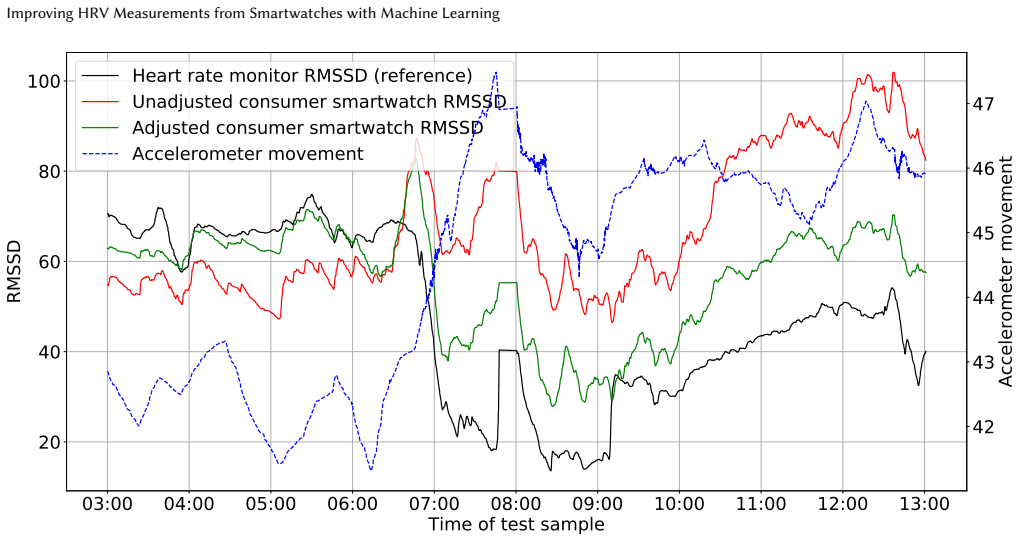
Smartwatch HRV errors correlate with wearer movement and can be reduced by machine learning on accelerometer data.
A machine-rendered reading of the paper's core claim, the machinery that carries it, and where it could break.
Core claim
The central claim is that error in smartwatch HRV readings is not random but systematically linked to wearer movement, and that this bias can be learned and subtracted by bringing accelerometer and related sensor data into a neural learning model.
What carries the argument
Neural learning applied to the combination of raw HRV signals and simultaneous accelerometer data to predict and remove movement-dependent measurement bias.
Load-bearing premise
The error observed in HRV readings is a repeatable, movement-dependent bias that additional device sensors can capture and a model can learn to subtract.
What would settle it
A controlled experiment that measures the same heart signal simultaneously with a medical-grade device and a smartwatch across varying movement levels, then checks whether the proposed model still leaves a statistically significant residual error after correction.
Figures
read the original abstract
The reactions of the human body to physical exercise, psychophysiological stress and heart diseases are reflected in heart rate variability (HRV). Thus, continuous monitoring of HRV can contribute to determining and predicting issues in well-being and mental health. HRV can be measured in everyday life by consumer wearable devices such as smartwatches which are easily accessible and affordable. However, they are arguably accurate due to the stability of the sensor. We hypothesize a systematic error which is related to the wearer movement. Our evidence builds upon explanatory and predictive modeling: we find a statistically significant correlation between error in HRV measurements and the wearer movement. We show that this error can be minimized by bringing into context additional available sensor information, such as accelerometer data. This work demonstrates our research-in-progress on how neural learning can minimize the error of such smartwatch HRV measurements.
Editorial analysis
A structured set of objections, weighed in public.
Referee Report
Summary. The manuscript claims that HRV measurements from consumer smartwatches contain a systematic, movement-related error that can be detected via statistically significant correlation with wearer movement and then reduced by incorporating additional on-device sensor data (e.g., accelerometer) into a neural model. The work is presented as research-in-progress demonstrating that explanatory and predictive modeling can minimize this error.
Significance. If the central claim were substantiated with an independent reference standard and a properly held-out evaluation, the result would be relevant to the growing literature on artifact correction in wearable PPG signals. However, the absence of any description of the ground-truth HRV reference, dataset, model architecture, or validation protocol means the reported improvement cannot be assessed for independence from physiology or from training-set fit.
major comments (2)
- [Abstract] Abstract: The manuscript asserts a 'statistically significant correlation between error in HRV measurements and the wearer movement' and that 'this error can be minimized' by ML, yet supplies no description of the reference device, protocol, or ground-truth HRV used to define the error term. Without this, any observed correlation is consistent with both motion artifact and genuine autonomic changes during movement; only the former is correctable by the proposed approach.
- [Abstract] Abstract / Methods (missing): No model specification, training procedure, baseline comparison, error bars, dataset size, or cross-validation scheme is provided. The central claim of successful error reduction therefore cannot be evaluated and the reported improvement may simply reflect training-set fit rather than an independent test.
Simulated Author's Rebuttal
We thank the referee for their review. The manuscript is explicitly a short research-in-progress report, which explains the absence of full methodological details. We agree that these omissions prevent proper evaluation of the claims and will expand the work accordingly.
read point-by-point responses
-
Referee: [Abstract] Abstract: The manuscript asserts a 'statistically significant correlation between error in HRV measurements and the wearer movement' and that 'this error can be minimized' by ML, yet supplies no description of the reference device, protocol, or ground-truth HRV used to define the error term. Without this, any observed correlation is consistent with both motion artifact and genuine autonomic changes during movement; only the former is correctable by the proposed approach.
Authors: We agree that the current abstract provides no description of the reference device, protocol, or ground-truth definition. As a brief research-in-progress note, the text focuses on the hypothesis rather than experimental details. The error term is computed as the difference between smartwatch-derived HRV and a reference measurement, but without the requested information it is impossible to exclude physiological confounds. We will revise the manuscript to specify the reference (clinical ECG), protocol (rest vs. movement tasks), and exact HRV metric used. revision: yes
-
Referee: [Abstract] Abstract / Methods (missing): No model specification, training procedure, baseline comparison, error bars, dataset size, or cross-validation scheme is provided. The central claim of successful error reduction therefore cannot be evaluated and the reported improvement may simply reflect training-set fit rather than an independent test.
Authors: We agree that the manuscript supplies none of the listed methodological elements. This omission is a direct consequence of the short research-in-progress format. The neural model uses accelerometer features as additional inputs to a regression network, but without architecture, dataset size, validation scheme, or baselines the improvement cannot be assessed. We will add these specifications, including subject-wise cross-validation and held-out performance metrics, in the next version. revision: yes
Circularity Check
No significant circularity; derivation remains self-contained.
full rationale
The abstract and description present a hypothesis of movement-related systematic error in HRV, a reported correlation, and an ML correction using accelerometer data. No equations, fitted parameters renamed as predictions, self-citations, or uniqueness claims are supplied that would reduce any result to its inputs by construction. The modeling step is described at a high level without evidence that the reported improvement collapses to a training fit on the same pairs or any other enumerated circular pattern. This is the normal case of an independent empirical claim whose validity can be assessed externally.
Axiom & Free-Parameter Ledger
axioms (1)
- domain assumption Error in optical HRV is systematically related to wearer movement and can be isolated from other sources of variability.
Reference graph
Works this paper leans on
-
[1]
Hyun Jae Baek, Chul-Ho Cho, Jaegeol Cho, and Jong-Min Woo. 2015. Reliability of Ultra-Short-Term Analysis as a Surrogate of Standard 5-Min Analysis of Heart Rate Variability. Telemedicine and e-Health 21, 5 (2015), 404–414. https://doi.org/10.1089/tmj.2014.0104
-
[2]
Hejlesen, Lise Tarnow, and Jesper Fleischer
Simon Lebech Cichosz, Jan Frystyk, Ole K. Hejlesen, Lise Tarnow, and Jesper Fleischer. 2014. A novel algorithm for prediction and detection of hypoglycemia based on continuous glucose monitoring and heart rate variability in patients with type 1 diabetes. Journal of Diabetes Science and Technology 8, 4 (2014), 731–737. https://doi.org/10.1177/ 1932296814528838
work page 2014
-
[3]
Philip E. Cryer. 2004. Diverse Causes of Hypoglycemia-Associated Autonomic Failure in Diabetes. New England Journal of Medicine 350, 22 (2004), 2272–2279. https://doi.org/10.1056/NEJMra031354
-
[4]
D.A. Dimitriev and E.V. Saperova. 2015. Heart rate variability as a measure of autonomic regulation of cardiac activity for assessing mental stress. Autonomic Neuroscience 192, 3 (2015), 80. https://doi. org/10.1016/j.autneu.2015.07.086
-
[5]
Erin E Dooley, Natalie M Golaszewski, and John B Bartholomew. 2017. Estimating Accuracy at Exercise Intensities: A Comparative Study of Self-Monitoring Heart Rate and Physical Activity Wearable Devices. JMIR mHealth and uHealth 5, 3 (2017), e34. https://doi.org/10.2196/ mhealth.7043
work page 2017
-
[6]
Fatema El-Amrawy and Mohamed Ismail Nounou. 2015. Are currently available wearable devices for activity tracking and heart rate monitor- ing accurate, precise, and medically beneficial? Healthcare Informatics Research 21, 4 (2015), 315–320. https://doi.org/10.4258/hir.2015.21.4. 315
-
[7]
Michael R. Esco and Andrew A. Flatt. 2014. Ultra-short-term heart rate variability indexes at rest and post-exercise in athletes: Evaluating the agreement with accepted recommendations. Journal of Sports Science and Medicine 13, 3 (2014), 535–541
work page 2014
-
[8]
International Diabetes Federation. 2017. IDF Diabetes Atlas (8 ed.). International Diabetes Federation. http://diabetesatlas.org
work page 2017
-
[9]
Z. Ge, P. W.C. Prasad, N. Costadopoulos, Abeer Alsadoon, A. K. Singh, and A. Elchouemi. 2016. Evaluating the accuracy of wearable heart rate monitors. In Proceedings - 2016 International Conference on Advances Improving HRV Measurements from Smartwatches with Machine Learning in Computing, Communication and Automation (Fall), ICACCA 2016 . IEEE, 1–6. http...
-
[10]
A. Marc Gillinov, Muhammad Etiwy, Stephen Gillinov, Robert Wang, Gordon Blackburn, Dermot Phelan, Penny Houghtaling, Hoda Javadikasgari, and Milind Y. Desai. 2017. Variable Accuracy of Commer- cially Available Wearable Heart Rate Monitors.Journal of the American College of Cardiology 69, 11 (2017), 336. https://doi.org/10.1016/s0735- 1097(17)33725-7
-
[11]
Goldberger, Sridevi Challapalli, Roderick Tung, Michele A
Jeffrey J. Goldberger, Sridevi Challapalli, Roderick Tung, Michele A. Parker, and Alan H. Kadish. 2001. Relationship of heart rate variability to parasympathetic effect. Circulation 103, 15 (2001), 1977–1983. https: //doi.org/10.1161/01.CIR.103.15.1977
-
[12]
André Henriksen, Martin Haugen Mikalsen, Ashenafi Zebene Woldare- gay, Miroslav Muzny, Gunnar Hartvigsen, Laila Arnesdatter Hopstock, and Sameline Grimsgaard. 2018. Using fitness trackers and smart- watches to measure physical activity in research: Analysis of consumer wrist-worn wearables. Journal of Medical Internet Research 20, 3 (2018), e110. https://...
-
[13]
Mordor Intelligence. 2018. Smart Watch Market - Growth, Trends, and Forecast (2019 - 2024). https://www.mordorintelligence.com/industry- reports/global-smart-watches-market-industry
work page 2018
-
[14]
Alex Krizhevsky, Ilya Sutskever, and Geoffrey E Hinton. 2012. Ima- geNet Classification with Deep Convolutional Neural Networks. In Advances in neural information processing systems . 1097–1105
work page 2012
-
[15]
Marek Malik. 1996. Heart rate variability. Standards of measurement, physiological interpretation, and clinical use. Task Force of the Euro- pean Society of Cardiology and the North American Society of Pacing and Electrophysiology. European Heart Journal 17, 3 (1996), 354–81. http://www.ncbi.nlm.nih.gov/pubmed/8737210
-
[16]
Loretto Munoz, Arie Van Roon, Harriëtte Riese, Chris Thio, Emma Oostenbroek, Iris Westrik, Eco J.C
M. Loretto Munoz, Arie Van Roon, Harriëtte Riese, Chris Thio, Emma Oostenbroek, Iris Westrik, Eco J.C. De Geus, Ron Gansevoort, Joop Lefrandt, Ilja M. Nolte, and Harold Snieder. 2015. Validity of (Ultra- )Short recordings for heart rate variability measurements. PLoS ONE 10, 9 (2015), e0138921. https://doi.org/10.1371/journal.pone.0138921
-
[17]
Udi Nussinovitch, Keren Politi Elishkevitz, Keren Katz, Moshe Nussi- novitch, Shlomo Segev, Benjamin Volovitz, and Naomi Nussinovitch
-
[18]
Annals of Noninvasive Electrocardiology 16, 2 (2011), 117–122
Reliability of ultra-short ECG indices for heart rate variabil- ity. Annals of Noninvasive Electrocardiology 16, 2 (2011), 117–122. https://doi.org/10.1111/j.1542-474X.2011.00417.x
-
[19]
Jakub Parak and Ilkka Korhonen. 2013. Accuracy of Firstbeat Body- guard 2 beat-to-beat heart rate monitor. (Whitepaper) (2013), 6–
work page 2013
-
[20]
https://assets.firstbeat.com/firstbeat/uploads/2015/10/white_paper_ bodyguard2_final.pdf
work page 2015
-
[21]
Pathirana, and Aruna Senevi- ratne
Dung Phan, Lee Yee Siong, Pubudu N. Pathirana, and Aruna Senevi- ratne. 2015. Smartwatch: Performance evaluation for long-term heart rate monitoring. In 4th International Symposium on Bioelectronics and Bioinformatics, ISBB 2015. 144–147. https://doi.org/10.1109/ISBB.2015. 7344944
- [22]
-
[23]
Lizawati Salahuddin, Jaegeol Cho, Myeong Gi Jeong, and Desok Kim
-
[24]
In Annual International Conference of the IEEE Engineering in Medicine and Biology - Proceedings
Ultra short term analysis of heart rate variability for monitoring mental stress in mobile settings. In Annual International Conference of the IEEE Engineering in Medicine and Biology - Proceedings . IEEE, 4656–4659. https://doi.org/10.1109/IEMBS.2007.4353378
-
[25]
Hartmut Schächinger, Johannes Port, Stuart Brody, Lilly Linder, Frank H. Wilhelm, Peter R. Huber, Daniel Cox, and Ulrich Keller. 2004. Increased high-frequency heart rate variability during insulin-induced hypoglycaemia in healthy humans. Clinical Science 106, 6 (2004), 583–
work page 2004
-
[26]
https://doi.org/10.1042/cs20030337
-
[27]
T. Thong, K. Li, J. McNames, M. Aboy, and B. Goldstein. 2004. Accuracy of ultra-short heart rate variability measures. InProceedings of the 25th Annual International Conference of the IEEE Engineering in Medicine and Biology Society (IEEE Cat. No. 03CH37439) , Vol. 3. IEEE, 2424–2427. https://doi.org/10.1109/iembs.2003.1280405
-
[28]
Martin Zihlmann, Dmytro Perekrestenko, and Michael Tschannen
-
[29]
Convolutional Recurrent Neural Networks for Electrocardiogram Classification
Convolutional Recurrent Neural Networks for Electrocardiogram Classification. (2017), 1–4. arXiv:1710.06122 http://arxiv.org/abs/1710. 06122
work page internal anchor Pith review Pith/arXiv arXiv 2017
discussion (0)
Sign in with ORCID, Apple, or X to comment. Anyone can read and Pith papers without signing in.