REVIEW 3 major objections 4 minor 54 references
ScalablePromptus: Scalable and High-Fidelity Prompt-Based Video Streaming
T0 review · 3 major / 4 minor · reviewed 2026-08-01 · deepseek-v4-flash
Pith's one-line read Rank-ordered prompts cut loss-induced quality drops by up to 95%
desk verdict The dropout-trained rank-ordered prompt idea is genuinely useful and the prefix-truncation result holds, but the headline robustness claim outruns the evidence because packet-loss simulation doesn't match the prefix-only training. read the letter →
The pith
A machine-rendered reading of the paper's core claim, the machinery that carries it, and where it could break.
The reading
What carries the argument
The mechanism is the rank-ordered prompt representation learned by prefix-preserving dropout. In each training step the method truncates the low-rank factors U,V to their first k components, reconstructs the prompt as U_{:,:k}V_{:k,:}/√k, and back-propagates only through the kept prefix, while auxiliary regularization keeps the unselected trailing dimensions small. The resulting ordering makes c=U_{:,:k}V_{:k,:}/√k a valid reconstruction for any k at inference. Secondary components—a semantic cosine loss from a frozen pretrained image encoder, per-channel mean/variance color alignment, and spherical linear interpolation between keyframes—improve fidelity and intermediate frames but do not ca
What would settle it
Run the packet-loss experiment with the first dimension (or first k dimensions) forced to be lost and all trailing dimensions present. If LPIPS degrades sharply in that case, the rank-ordered representation is only robust to clean prefix truncation, and the 82–95% degradation-reduction figure does not extend to arbitrary packet loss.
Extended reading notes
Core claim
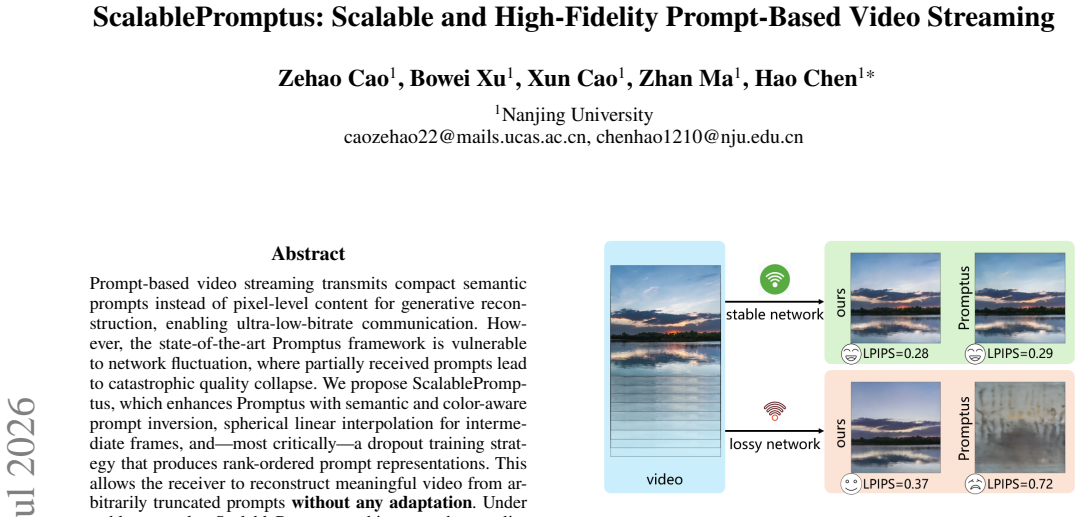
The central claim is that a single trained pair of low-rank prompt factors can serve every effective rank at once. During training, each iteration randomly keeps only a prefix of the dimensions; the reconstruction uses the kept prefix scaled by 1/√k, and gradients flow only through that prefix. This teaches dimensions to be ordered by importance: leading dimensions carry coarse, essential visual content; trailing dimensions add fine detail. At inference, if only k dimensions arrive, the receiver reconstructs the prompt from the prefix and generates normally, no adaptation needed. The paper reports that this turns truncation from catastrophic failure into graceful degradation, cutting the per
Load-bearing premise
The method's robustness rests on the assumption that the first (most important) dimensions are reliably delivered, since training only ever drops trailing suffixes and the evaluation never tests what happens when a leading dimension is lost.
Editorial extensions
If this is right
- A single dropout-trained prompt model can serve any effective rank from 4 to 16, so the sender no longer needs to store or transmit multiple rank-specific prompts.
- Mid-stream bandwidth increases become incremental: the sender transmits only additional trailing dimensions, and the receiver appends them to the already-received prefix.
- Under bursty packet loss between 5% and 20%, reconstruction quality stays near its stable-network level, while the fixed-rank baseline degrades sharply.
- The cost is a small full-rank fidelity loss at the trained rank, traded for robustness at lower ranks.
- Receiver-side decoding remains unchanged, just prefix reconstruction followed by the normal generation path.
Reading between the lines
- A decisive stress test goes beyond the paper: force the first dimension (or first few) to be lost while all later dimensions arrive; if quality collapses, the robustness claim is really about prefix truncation, not arbitrary packet loss.
- The same prefix-preserving dropout idea could be applied to other latent or token-based generative codecs, turning layered/truncatable representations into a general property of the training objective rather than a special case.
- Because prompt bitrate is independent of output resolution, the rank-ordered prompts could be combined with unequal error protection: send leading dimensions over a protected channel and trailing dimensions opportunistically, fully exploiting the graceful-degradation property.
- A practical deployment would need a rate-control policy that decides when to send the base prefix and when to append refinement dimensions; the paper does not design that policy, but its representation makes it possible.
Editorial analysis
A structured set of objections, weighed in public.
Referee Report
Summary. The paper presents ScalablePromptus, an extension of the Promptus prompt-based video streaming framework. The authors add (i) a semantic similarity loss and a color statistics alignment loss to the prompt inversion objective, (ii) spherical linear interpolation (Slerp) for intermediate frames, and (iii) a dropout training strategy intended to produce rank-ordered prompt representations so that a single trained prompt can be truncated to any lower effective rank at inference without retraining. The paper reports modest gains over Promptus under stable network conditions and claims an 82--95% reduction in truncation-induced degradation under lossy conditions, evaluated on QST and UVG at 512x512, 30 fps, with Stable Diffusion v1.5 as the generative backbone.
Significance. If the central mechanism holds, the dropout-based rank ordering is a genuinely useful idea for generative streaming: it promises incremental quality refinement and graceful degradation from a single trained model, avoiding the storage and re-download costs of pre-fitting multiple ranks. The paper ships code, presents a clear algorithm, and evaluates against standard codecs and Promptus. The semantic/color losses and Slerp are well motivated, and the ablations in Table 3 show small but consistent gains from each component. However, the evidence currently supports a narrower claim than the abstract makes: the training distribution is prefix-only, while the packet-loss experiments allow arbitrary dimension loss, and the headline 82--95% reduction is not supported by the numerical tables in the lossy-channel experiment.
major comments (3)
- [§3.3 (Algorithm 1), §4.3, §5] Algorithm 1 always selects a prefix length k and truncates to U[:,:k], V[:k,:], with gradients flowing only through that prefix. The packet-loss experiment in §4.3, however, states that lost dimensions are 'simply set to zero', which can delete leading dimensions. Because training never presents non-prefix holes, nothing in the method guarantees graceful behavior if, e.g., the first dimension is lost. The Gilbert-Elliott tables report only average LPIPS and do not condition on which dimensions were lost, so the claim that 'arbitrarily truncated prompts' are handled is not established. Section 5 implicitly concedes this by stating that leading dimensions 'must be reliably delivered' and proposing forward error correction. Please either (a) evaluate non-prefix loss conditioning on the position of lost dimensions and show bounded degradation, or (b) restrict the claims and the packet-loss p
- [§4.2 and Abstract] The headline '82%–95% reduction in degradation' is not tied to a numerical table. Section 4.2 reports only 'an absolute degradation reduction of approximately 0.35–0.37' and Figure 4 shows curves without per-rank LPIPS values for both methods. Moreover, the Gilbert-Elliott experiments in Table 1 yield reductions of roughly 55%, 63%, and 75% at 5%, 10%, and 20% loss (computed from the reported LPIPS: at 20% loss Promptus degrades by 0.1584 vs. 0.0402 for ScalablePromptus, a 74.6% reduction), not 82–95%. Since the abstract and conclusion state 'under lossy conditions' with the 82–95% figure, the reader cannot tell whether this claim refers to clean rank truncation or to packet loss, and the packet-loss table does not reproduce it. Please provide per-rank LPIPS for both methods and state explicitly which experiments support the 82–95% claim.
- [§4.2 and Table 3] The paper attributes truncation robustness to dropout training, but no experiment isolates the dropout mechanism. Table 3 ablates Lsem, Lcolor, and Slerp on top of Promptus, but not dropout; Section 4.2 compares the full method with Promptus, which differs by all proposed components. A controlled comparison between 'Ours w/o dropout' and 'Ours (full)' under rank truncation at k=4,6,...,14 is needed to show that dropout, and not the semantic/color/Slerp enhancements, is responsible for the reported degradation reduction. Similarly, Table 1 compares the full method to Promptus only, so the causal role of dropout in packet-loss resilience is not directly demonstrated.
minor comments (4)
- [§1 and Algorithm 1] The introduction says 'a random subset of prompt dimensions is dropped', but Algorithm 1 always drops a trailing suffix after a random prefix length. The wording should say 'a random suffix is dropped (i.e., a random prefix is kept)', because this distinction is central to what the training actually teaches.
- [§3.2 and Algorithm 1] Equation/algorithm cross-references are inconsistent: the text refers to 'composite loss (Equation 4)' and Algorithm 1 computes L 'using Equation 4', but the composite loss is Equation (3). Section 3.3's description of auxiliary regularization cites 'line 11' while Algorithm 1 places it on line 14.
- [Figure 4 caption] The caption contains a typo: 'Our method remains resonable results' should be 'reasonable'.
- [Tables 1, 2, 4] Only Table 3 reports mean±std; the main quantitative tables report point estimates without error bars or a statement about number of seeds. Please add error bars or state explicitly that results are single-seed, so the magnitude of the reported differences can be assessed.
Circularity Check
No significant circularity: the rank-ordered property is trained directly, and the headline comparisons are against an external baseline (Promptus).
full rationale
The central claim is that dropout training produces rank-ordered prompts. This is engineered into the objective: Algorithm 1 truncates to prefixes and back-propagates through them; inference reconstructs c = U_{:,:k} V_{:k,:}/sqrt(k), the exact operator used in training. Evaluating that property at k=4..16 is a design validation, not a prediction derived from an input by construction — the paper does not claim the ordering emerges from an unrelated first-principles theorem. The stable-network and lossy comparisons are against Promptus (Wu et al. 2026), an external baseline with no author overlap, and against H.265/H.266, so no self-citation chain carries the result. The only caveat is a coverage gap, not circularity: training only sees prefix truncation, whereas Sec 4.3 says 'The lost dimensions are simply set to zero,' which can delete leading dimensions; Sec 5 concedes 'these leading dimensions must be reliably delivered.' This limits the generality of the 'arbitrarily truncated' claim but does not make any derivation circular. The semantic/color losses and Slerp are grounded in external cited geometry findings. No fitted parameter is renamed as a prediction, and no uniqueness theorem is imported from the authors' own prior work.
Assumptions & free parameters
free parameters (3)
- Loss weights (alpha, beta, lambda_reg, w_sem, w_color) =
alpha=0.2, beta=0.8, lambda_reg=0.1, w_sem=0.5, w_color=0.3
- Dropout training hyperparameters (r_min, r_max, T_w, total iterations, eta, gamma) =
r_min=4, r_max=16, T_w=500/100, total=10000/1500, eta=1e-3, gamma=0.7
- Keyframe interval K =
10 frames (3 keyframes/s)
assumptions (5)
- domain assumption Stable Diffusion v1.5 with single-step denoising is differentiable w.r.t. prompt embeddings and can be optimized through CLIP and pixel losses.
- domain assumption Prompt embeddings live on a hyperspherical manifold where Slerp is the correct interpolation and preserves conditioning when norms are equal.
- domain assumption Nested-dropout-style suffix truncation induces a rank-ordered representation with leading dimensions carrying coarse critical content.
- domain assumption LPIPS, MSE, CLIP cosine, and color-statistics losses are adequate proxies for perceptual fidelity in the low-bitrate regime.
- domain assumption 8-bit quantization of U and V does not materially change the rank-ordered property or truncation behavior.
Cite this review
Pith. "Pith review of ScalablePromptus: Scalable and High-Fidelity Prompt-Based Video Streaming." pith.science (2026). https://pith.science/paper/RA3MZJ6U
@misc{pith2026260726106,
  author       = {Pith},
  title        = {Pith review of: ScalablePromptus: Scalable and High-Fidelity Prompt-Based Video Streaming},
  year         = {2026},
  howpublished = {\url{https://pith.science/paper/RA3MZJ6U}},
  note         = {Machine review of arXiv:2607.26106}
}
read the original abstract
Prompt-based video streaming transmits compact semantic prompts instead of pixel-level content for generative reconstruction, enabling ultra-low-bitrate communication. However, the state-of-the-art Promptus framework is vulnerable to network fluctuation, where partially received prompts lead to catastrophic quality collapse. We propose ScalablePromptus, which enhances Promptus with semantic and color-aware prompt inversion, spherical linear interpolation for intermediate frames, and--most critically--a dropout training strategy that produces rank-ordered prompt representations. This allows the receiver to reconstruct meaningful video from arbitrarily truncated prompts without any adaptation. Under stable networks, ScalablePromptus achieves modest quality gains. Under lossy conditions, it reduces the performance degradation caused by truncation by 82%-95% compared to the baseline, making prompt-based streaming robust enough for real-world deployment.
Figures


Figures from the paper (5 more)


Reference graph
Works this paper leans on
-
[1]
Proceedings of the AAAI Conference on Artificial Intelligence , volume=
Promptus: Can prompt streaming replace video streaming , author=. Proceedings of the AAAI Conference on Artificial Intelligence , volume=
-
[2]
International Conference on Machine Learning , pages=
Learning ordered representations with nested dropout , author=. International Conference on Machine Learning , pages=. 2014 , organization=
2014
-
[4]
Scandinavian Conference on Image Analysis , pages=
Addressing degeneracies in latent interpolation for diffusion models , author=. Scandinavian Conference on Image Analysis , pages=. 2025 , organization=
2025
-
[5]
IEEE Transactions on Circuits and Systems for Video Technology , volume=
Neural video coding using multiscale motion compensation and spatiotemporal context model , author=. IEEE Transactions on Circuits and Systems for Video Technology , volume=. 2020 , publisher=
2020
-
[6]
Proceedings of the IEEE/CVF Conference on Computer Vision and Pattern Recognition (CVPR) , month =
Mokady, Ron and Hertz, Amir and Aberman, Kfir and Pritch, Yael and Cohen-Or, Daniel , title =. Proceedings of the IEEE/CVF Conference on Computer Vision and Pattern Recognition (CVPR) , month =. 2023 , pages =
2023
-
[7]
2022 , eprint=
An Image is Worth One Word: Personalizing Text-to-Image Generation using Textual Inversion , author=. 2022 , eprint=
2022
-
[8]
and Cohen, Taco S
Habibian, Amirhossein and Rozendaal, Ties van and Tomczak, Jakub M. and Cohen, Taco S. , title =. Proceedings of the IEEE/CVF International Conference on Computer Vision (ICCV) , month =
-
[9]
and Liu, Xue and Kuo, Tei-Wei and Xue, Chun Jason , journal=
Cui, Yufei and Mao, Yu and Liu, Ziquan and Li, Qiao and Chan, Antoni B. and Liu, Xue and Kuo, Tei-Wei and Xue, Chun Jason , journal=. Variational Nested Dropout , year=
Show all 54 references
-
[10]
Multiuser Content-Style Adaptive Semantic Communication for Image Transmission , year=
Song, Mengshu and Ma, Nan and Liang, Haotai and Dong, Chen and Li, Weizhi and Chen, Jianqiao and Lin, Yijing and Zhang, Ping , journal=. Multiuser Content-Style Adaptive Semantic Communication for Image Transmission , year=
-
[11]
Proceedings of the IEEE/CVF Conference on Computer Vision and Pattern Recognition (CVPR) , month =
Wang, Ting-Chun and Mallya, Arun and Liu, Ming-Yu , title =. Proceedings of the IEEE/CVF Conference on Computer Vision and Pattern Recognition (CVPR) , month =. 2021 , pages =
2021
-
[12]
2024 , eprint=
Reparo: Loss-Resilient Generative Codec for Video Conferencing , author=. 2024 , eprint=
2024
-
[13]
Proceedings of the IEEE/CVF Conference on Computer Vision and Pattern Recognition (CVPR) , month =
Rombach, Robin and Blattmann, Andreas and Lorenz, Dominik and Esser, Patrick and Ommer, Bj\"orn , title =. Proceedings of the IEEE/CVF Conference on Computer Vision and Pattern Recognition (CVPR) , month =. 2022 , pages =
2022
-
[14]
and Sullivan, G.J
Wiegand, T. and Sullivan, G.J. and Bjontegaard, G. and Luthra, A. , journal=. Overview of the H.264/AVC video coding standard , year=
-
[15]
and Ohm, Jens-Rainer and Han, Woo-Jin and Wiegand, Thomas , journal=
Sullivan, Gary J. and Ohm, Jens-Rainer and Han, Woo-Jin and Wiegand, Thomas , journal=. Overview of the High Efficiency Video Coding (HEVC) Standard , year=
-
[16]
and Ohm, Jens-Rainer , journal=
Bross, Benjamin and Wang, Ye-Kui and Ye, Yan and Liu, Shan and Chen, Jianle and Sullivan, Gary J. and Ohm, Jens-Rainer , journal=. Overview of the Versatile Video Coding (VVC) Standard and its Applications , year=
-
[17]
Proceedings of the IEEE/CVF Conference on Computer Vision and Pattern Recognition (CVPR) , month =
Li, Jiahao and Li, Bin and Lu, Yan , title =. Proceedings of the IEEE/CVF Conference on Computer Vision and Pattern Recognition (CVPR) , month =. 2023 , pages =
2023
-
[18]
Proceedings of the IEEE/CVF Winter Conference on Applications of Computer Vision (WACV) , month =
Pourreza, Reza and Le, Hoang and Said, Amir and Sauti\`ere, Guillaume and Wiggers, Auke , title =. Proceedings of the IEEE/CVF Winter Conference on Applications of Computer Vision (WACV) , month =. 2023 , pages =
2023
-
[19]
Proceedings of the IEEE/CVF Winter Conference on Applications of Computer Vision (WACV) , month =
Fathima, Noor and Petersen, Jens and Sauti\`ere, Guillaume and Wiggers, Auke and Pourreza, Reza , title =. Proceedings of the IEEE/CVF Winter Conference on Applications of Computer Vision (WACV) , month =. 2023 , pages =
2023
-
[20]
Proceedings of the IEEE/CVF Conference on Computer Vision and Pattern Recognition (CVPR) , month =
Li, Jiahao and Li, Bin and Lu, Yan , title =. Proceedings of the IEEE/CVF Conference on Computer Vision and Pattern Recognition (CVPR) , month =. 2024 , pages =
2024
-
[21]
A slimmable framework for practical neural video compression , journal =
Zhaocheng Liu and Fei Yang and Defa Wang and Marc. A slimmable framework for practical neural video compression , journal =. 2024 , issn =. doi:https://doi.org/10.1016/j.neucom.2024.128525 , url =
2024
-
[22]
2023 , eprint=
CaDM: Codec-aware Diffusion Modeling for Neural-enhanced Video Streaming , author=. 2023 , eprint=
2023
-
[23]
He, Zhaoyuan and Yang, Yifan and Qiu, Lili and Park, Kyoungjun and Yang, Yuqing , title =. Proc. ACM Netw. , month = mar, articleno =. 2024 , issue_date =. doi:10.1145/3649472 , abstract =
2024 doi
-
[24]
REM: Enabling Real-Time Neural-Enhanced Video Streaming on Mobile Devices Using Macroblock-Aware Lookup Table , year=
Chai, Baili and Wu, Di and Chen, Jinyu and Yang, Mengyu and Wang, Zelong and Hu, Miao , journal=. REM: Enabling Real-Time Neural-Enhanced Video Streaming on Mobile Devices Using Macroblock-Aware Lookup Table , year=
-
[25]
DoMo: Rethinking Downscaling For Mobile Neural-Enhanced Video Streaming , year=
Zhu, Zhui and Wang, Xu and Xu, Jingao and Zhang, Weichen and Yuan, Yankun and Wang, Lin and Dang, Fan and Liu, Yunhao , booktitle=. DoMo: Rethinking Downscaling For Mobile Neural-Enhanced Video Streaming , year=
-
[26]
DTVNet: Dynamic Time-Lapse Video Generation via Single Still Image
Zhang, Jiangning and Xu, Chao and Liu, Liang and Wang, Mengmeng and Wu, Xia and Liu, Yong and Jiang, Yunliang. DTVNet: Dynamic Time-Lapse Video Generation via Single Still Image. Computer Vision -- ECCV 2020. 2020
2020
-
[27]
Proceedings of the 11th ACM Multimedia Systems Conference , pages =
Mercat, Alexandre and Viitanen, Marko and Vanne, Jarno , title =. Proceedings of the 11th ACM Multimedia Systems Conference , pages =. 2020 , isbn =. doi:10.1145/3339825.3394937 , abstract =
2020
-
[28]
Elliott, E. O. , journal=. Estimates of error rates for codes on burst-noise channels , year=
-
[29]
J.; and Ohm, J.-R
Bross, B.; Wang, Y.-K.; Ye, Y.; Liu, S.; Chen, J.; Sullivan, G. J.; and Ohm, J.-R. 2021. Overview of the Versatile Video Coding (VVC) Standard and its Applications. IEEE Transactions on Circuits and Systems for Video Technology, 31(10): 3736--3764
2021
-
[30]
Chai, B.; Wu, D.; Chen, J.; Yang, M.; Wang, Z.; and Hu, M. 2025. REM: Enabling Real-Time Neural-Enhanced Video Streaming on Mobile Devices Using Macroblock-Aware Lookup Table. IEEE Transactions on Mobile Computing, 24(3): 2085--2097
2025
-
[31]
B.; Liu, X.; Kuo, T.-W.; and Xue, C
Cui, Y.; Mao, Y.; Liu, Z.; Li, Q.; Chan, A. B.; Liu, X.; Kuo, T.-W.; and Xue, C. J. 2023. Variational Nested Dropout. IEEE Transactions on Pattern Analysis and Machine Intelligence, 45(8): 10519--10534
2023
-
[32]
Elliott, E. O. 1963. Estimates of error rates for codes on burst-noise channels. The Bell System Technical Journal, 42(5): 1977--1997
1963
-
[33]
Eslami, S.; and de Melo, G. 2024. Mitigate the gap: Investigating approaches for improving cross-modal alignment in clip. arXiv preprint arXiv:2406.17639
2024 arXiv
-
[34]
Fathima, N.; Petersen, J.; Sauti\`ere, G.; Wiggers, A.; and Pourreza, R. 2023. A Neural Video Codec With Spatial Rate-Distortion Control. In Proceedings of the IEEE/CVF Winter Conference on Applications of Computer Vision (WACV), 5365--5374
2023
-
[35]
H.; Chechik, G.; and Cohen-Or, D
Gal, R.; Alaluf, Y.; Atzmon, Y.; Patashnik, O.; Bermano, A. H.; Chechik, G.; and Cohen-Or, D. 2022. An Image is Worth One Word: Personalizing Text-to-Image Generation using Textual Inversion. arXiv:2208.01618
2022 arXiv
-
[36]
v.; Tomczak, J
Habibian, A.; Rozendaal, T. v.; Tomczak, J. M.; and Cohen, T. S. 2019. Video Compression With Rate-Distortion Autoencoders. In Proceedings of the IEEE/CVF International Conference on Computer Vision (ICCV)
2019
-
[37]
He, Z.; Yang, Y.; Qiu, L.; Park, K.; and Yang, Y. 2024. NERVE: Real-Time Neural Video Recovery and Enhancement on Mobile Devices. Proc. ACM Netw., 2(CoNEXT1)
2024
-
[38]
Landolsi, E.; and Kahl, F. 2025. Addressing degeneracies in latent interpolation for diffusion models. In Scandinavian Conference on Image Analysis, 16--29. Springer
2025
-
[39]
Li, J.; Li, B.; and Lu, Y. 2023. Neural Video Compression With Diverse Contexts. In Proceedings of the IEEE/CVF Conference on Computer Vision and Pattern Recognition (CVPR), 22616--22626
2023
-
[40]
Li, J.; Li, B.; and Lu, Y. 2024. Neural Video Compression with Feature Modulation. In Proceedings of the IEEE/CVF Conference on Computer Vision and Pattern Recognition (CVPR), 26099--26108
2024
-
[41]
Li, T.; Sivaraman, V.; Karimi, P.; Fan, L.; Alizadeh, M.; and Katabi, D. 2024. Reparo: Loss-Resilient Generative Codec for Video Conferencing. arXiv:2305.14135
2024 arXiv
-
[42]
Liu, Z.; Yang, F.; Wang, D.; G \'o rriz Blanch , M.; Murn, L.; Wan, S.; Zhang, S.; Mrak, M.; and Herranz, L. 2024. A slimmable framework for practical neural video compression. Neurocomputing, 610: 128525
2024
-
[43]
Mercat, A.; Viitanen, M.; and Vanne, J. 2020. UVG dataset: 50/120fps 4K sequences for video codec analysis and development. In Proceedings of the 11th ACM Multimedia Systems Conference, MMSys '20, 297--302. New York, NY, USA: Association for Computing Machinery. ISBN 9781450368452
2020
-
[44]
Mokady, R.; Hertz, A.; Aberman, K.; Pritch, Y.; and Cohen-Or, D. 2023. NULL-Text Inversion for Editing Real Images Using Guided Diffusion Models. In Proceedings of the IEEE/CVF Conference on Computer Vision and Pattern Recognition (CVPR), 6038--6047
2023
-
[45]
Pourreza, R.; Le, H.; Said, A.; Sauti\`ere, G.; and Wiggers, A. 2023. Boosting Neural Video Codecs by Exploiting Hierarchical Redundancy. In Proceedings of the IEEE/CVF Winter Conference on Applications of Computer Vision (WACV), 5355--5364
2023
-
[46]
Rippel, O.; Gelbart, M.; and Adams, R. 2014. Learning ordered representations with nested dropout. In International Conference on Machine Learning, 1746--1754. PMLR
2014
-
[47]
Rombach, R.; Blattmann, A.; Lorenz, D.; Esser, P.; and Ommer, B. 2022. High-Resolution Image Synthesis With Latent Diffusion Models. In Proceedings of the IEEE/CVF Conference on Computer Vision and Pattern Recognition (CVPR), 10684--10695
2022
-
[48]
Song, M.; Ma, N.; Liang, H.; Dong, C.; Li, W.; Chen, J.; Lin, Y.; and Zhang, P. 2025. Multiuser Content-Style Adaptive Semantic Communication for Image Transmission. IEEE Internet of Things Journal, 12(17): 36063--36078
2025
-
[49]
J.; Ohm, J.-R.; Han, W.-J.; and Wiegand, T
Sullivan, G. J.; Ohm, J.-R.; Han, W.-J.; and Wiegand, T. 2012. Overview of the High Efficiency Video Coding (HEVC) Standard. IEEE Transactions on Circuits and Systems for Video Technology, 22(12): 1649--1668
2012
-
[50]
Wang, T.-C.; Mallya, A.; and Liu, M.-Y. 2021. One-Shot Free-View Neural Talking-Head Synthesis for Video Conferencing. In Proceedings of the IEEE/CVF Conference on Computer Vision and Pattern Recognition (CVPR), 10039--10049
2021
-
[51]
Wiegand, T.; Sullivan, G.; Bjontegaard, G.; and Luthra, A. 2003. Overview of the H.264/AVC video coding standard. IEEE Transactions on Circuits and Systems for Video Technology, 13(7): 560--576
2003
-
[52]
Wu, J.; Liu, L.; Tan, Y.; Hao, J.; Zhang, L.; and Zhang, X. 2026. Promptus: Can prompt streaming replace video streaming. In Proceedings of the AAAI Conference on Artificial Intelligence, volume 40, 10664--10672
2026
-
[53]
Zhang, J.; Xu, C.; Liu, L.; Wang, M.; Wu, X.; Liu, Y.; and Jiang, Y. 2020. DTVNet: Dynamic Time-Lapse Video Generation via Single Still Image. In Vedaldi, A.; Bischof, H.; Brox, T.; and Frahm, J.-M., eds., Computer Vision -- ECCV 2020, 300--315. Cham: Springer International Pu...
2020
-
[54]
Zhou, Q.; Li, R.; Guo, S.; Dong, P.; Liu, Y.; Guo, J.; and Xu, Z. 2023. CaDM: Codec-aware Diffusion Modeling for Neural-enhanced Video Streaming. arXiv:2211.08428
2023 arXiv
-
[55]
Zhu, Z.; Wang, X.; Xu, J.; Zhang, W.; Yuan, Y.; Wang, L.; Dang, F.; and Liu, Y. 2025. DoMo: Rethinking Downscaling For Mobile Neural-Enhanced Video Streaming. In IEEE INFOCOM 2025 - IEEE Conference on Computer Communications, 1--10
2025
Reviewed August 1, 2026 · model on record in the stance chip above.
Discussion (0). Continue with ORCID to comment.