REVIEW 3 major objections 5 minor 63 references
Graph Coarsening via Supervised Granular-Ball for Scalable Graph Neural Network Training
T0 review · 3 major / 5 minor · reviewed 2026-08-11 · deepseek-v4-flash
Pith's one-line read SGBGC claims a label-guided granular-ball coarsening that shrinks graphs up to 20x with no test-accuracy loss, training GNNs far faster.
desk verdict The coarsening idea is real, but the headline accuracy claims are invalidated by test-label leakage in the coarsening step. read the letter →
The pith
A machine-rendered reading of the paper's core claim, the machinery that carries it, and where it could break.
The reading
What carries the argument
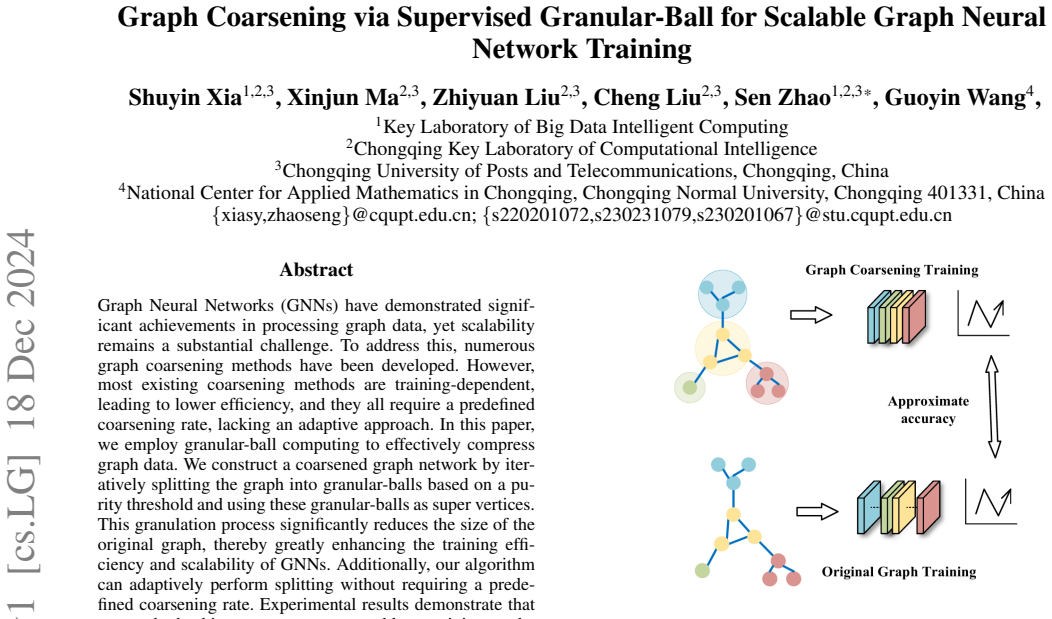
The load-bearing object is the graph granular-ball: a connected subgraph of the original graph whose center is its highest-degree node and whose purity T is the fraction of its nodes belonging to the most frequent label. The mechanism is iterative binary splitting — choose the two highest-degree nodes as new centers, assign every other node to the nearer center by shortest-path distance, and repeat until every ball has T = 1 — followed by contraction of each ball into a super-node with mean features and majority label. This replaces global distance computations with local shortest-path splits, giving O($N^{{3/2}}$ + M√N) coarsening and an adaptive coarsening rate set by the data itself rather than by a user-chosen ratio.
What would settle it
Hold out the 20% test labels when running Algorithm 3 on Cora and Citeseer — use only the 60% training labels for center selection and purity splitting — and compare the reported Table 1 accuracies; if accuracy drops by more than a few points, the central claim depends on label leakage.
Extended reading notes
Core claim
The central discovery the paper asserts is that a purely structural-plus-label-driven coarsening — no gradient training, no spectral decomposition — can pack nodes into super-nodes whose mean features and dominant labels reproduce full-graph classification accuracy. SGBGC first picks α = √N high-degree seeds, distributed evenly across label categories, assigns every node to the nearest seed by shortest path, then recursively splits each granular-ball by its two highest-degree nodes until each child ball is label-pure (purity T = 1). The coarsened graph connects any two super-nodes whose original node sets share an edge, and training happens on that graph with the learned weights transferred to the original graph. On Cora, Citeseer, Pubmed, Co-CS and Co-Phy, the paper reports accuracy within 0.2–1.1 points of the full graph at adaptive ratios of roughly 0.36–0.49, and at forced ratios of 0.05–0.1 the method beats training-dependent condensers like GCOND and CMGC on most settings.
Load-bearing premise
The algorithm is given the labels of the very nodes it is later asked to predict, so its reported accuracy includes the effect of having seen the test answers during graph construction.
Editorial extensions
If this is right
- GNN training on large graphs can be replaced by one cheap coarsening pass plus training on the compressed graph, with the learned weights transferred back to the full graph for inference.
- Users no longer need to pick a coarsening rate; the purity threshold T = 1 determines the compression level automatically for each dataset.
- Because coarsening happens before training, it composes with sampling and mini-batching strategies rather than competing with them.
- If Theorem 1 holds, the coarsened graph approximately preserves the original Rayleigh quotient, so the compressed graph can stand in for the original in other spectral pipelines, not only node classification.
- Purity-based splitting groups noisy nodes together, which acts as a label-noise filter before the GNN sees the data.
Reading between the lines
- A fair evaluation would withhold the 20% test-split labels from Algorithm 3, because the reported numbers come from a 60/20/20 split in which all labels, including the test nodes', are used to seed centers and check purity.
- The noise-injection experiments flip labels that the coarsening procedure itself consumes, so the observed robustness may reflect the graph being built from those noisy labels rather than structural denoising; a clean test would inject noise only after coarsening.
- An immediate extension is to run the structural part of the split (degree centers, shortest-path assignment) without any label input on link prediction or graph classification, where no purity signal exists, to see whether the compression benefit survives without supervision.
- The 20x compression claims are concentrated on Co-CS and Co-Phy, whose homophilic label structure makes purity-based splitting unusually easy; on label-heterogeneous graphs the adaptive ratio may remain close to 0.5, weakening the scalability claim.
Editorial analysis
A structured set of objections, weighed in public.
Referee Report
Summary. This paper proposes Supervised Granular-Ball Graph Coarsening (SGBGC), a preprocessing method that partitions a graph into granular-balls using node labels and structural connectivity, aggregates node features and labels per ball, and then trains a GNN on the coarsened graph. The method is intended to be adaptive, requiring no preset coarsening ratio, and is evaluated on Cora, Citeseer, Pubmed, Co-CS, and Co-Phy against unsupervised and learned coarsening baselines, including a noise-robustness study and runtime/memory measurements. The paper's central claims are that SGBGC achieves accuracy comparable to full-graph training at coarsening ratios as low as 0.05 and state-of-the-art results on five benchmark datasets.
Significance. If the empirical claims were valid, SGBGC would be a practically attractive preprocessing method: it is fast, adaptive, and appears to give large compression without accuracy loss. The paper includes a broad comparison across many baselines, runtime and memory measurements, a robustness study, and a public code link. However, the evaluation as presented cannot support these claims. The coarsening algorithm consumes the full label vector, including test labels, so the reported accuracy gains are confounded by label leakage; the theoretical guarantee is an assumption restatement rather than a proof; and the procedure used for the fixed-ratio experiments in Table 1 is not documented. These issues affect the central claims, so the contribution in its current form is not acceptable.
major comments (3)
- [Algorithms 1 and 3; Experimental Setup / Training details] Test-label leakage invalidates the experimental comparison. Algorithm 3 takes the full label vector Y as input and uses it in Step 3 (initial centers are chosen 'within each label category') and in Steps 8-11 (splitting continues until purity T=1), so the partition P is a function of every node's true label, including the 20% test split in the 60/20/20 'full-supervised' splits. Algorithm 1 then builds the training target \tilde{Y}=argmax(PY) from this same P. The unsupervised baselines VNGC/VEGC/JCGC/GSGC do not use test labels to construct the coarsened graph, and the learned baselines GCOND/FGC/CMGC are trained only on labeled training nodes. Consequently, the accuracies reported in Table 1 and the abstract's 'up to 20 times without compromising test accuracy' claim measure information injected by test labels rather than coarsening quality; the same concern applies to the noise-robustness tables, where the noisy labels of all nodes, including test nodes, are used during coarsening.
- [Theoretical Foundations, Theorem 1 and proof] Theorem 1 is circular and does not provide a spectral-preservation guarantee. The proof assumes P^T P \approx I and L_gb \approx L, but L_gb is defined as L_gb = P^T L P in Eq. (22), so assuming L_gb \approx L is essentially equivalent to assuming the very property the theorem claims to establish. The additional approximation PL_gb P^T \approx L in Eq. (32) is asserted without derivation, and no argument is given for why the granular-ball construction makes P approximately orthogonal or L_gb close to L. Thus the theorem does not support the method's central theoretical claim.
- [Table 1 and Algorithm 3; Training details] The fixed-ratio experiments in Table 1 are not reproducible from the algorithm as described. Algorithm 3 splits adaptively until purity T=1 and has no coarsening-ratio parameter, yet Table 1 reports SGBGC results at r=0.5, 0.3, 0.1, and 0.05. The text states that other methods 'followed the adaptive coarsening ratio r achieved by SGBGC,' but it never specifies how SGBGC itself is forced to produce a target ratio, how the ratio is computed after isolated nodes are removed, or whether the fixed-ratio results come from thresholding the adaptive process. Without this procedure, the main comparison table cannot be reproduced and the claimed distinction between adaptive and fixed-ratio operation is unclear.
minor comments (5)
- [Algorithm 3, Step 8 vs Equations (6)-(8)] The pseudocode says the two centers are chosen to 'maximize the diversity of labels,' but the surrounding text and Equations (6)-(8) specify that the centers are the two highest-degree nodes and assignment is by shortest path; these two descriptions are inconsistent and should be reconciled.
- [Training details] The sentence 'During the coarsening process, unlabelled isolated nodes were removed from the training and validation sets' is unclear, because the 60/20/20 split labels every node; if isolated nodes are indeed removed, the reported ratios r and accuracy values are computed on different node sets and need explicit explanation.
- [Abstract and Conclusion] The claim of reducing graph size 'up to 20 times' is not tied to a specific dataset or protocol; Table 1 reports r=0.05 for Pubmed, Co-CS, and Co-Phy only, while Cora and Citeseer are not evaluated at that ratio, so the scope of the headline claim should be stated precisely.
- [Appendix structure] The Related Work section appears twice, once before 'Theoretical Foundations' and once after the reference list with a truncated GNN subsection; this duplication appears to be a formatting error and should be corrected.
- [Algorithm 3] In Algorithm 3, the set GB_s is initialized as {\emptyset} and the loop over GB_init only adds a granular-ball to GB_s when splitting stops; it is not clear whether the initial granular-balls that do not satisfy the purity condition are ever added to the returned set, and the pseudocode should be made unambiguous.
Circularity Check
The reported test accuracies are inflated by construction: Algorithm 3 builds the coarsening from the full label vector Y (including the 20% test split), and Algorithm 1 derives the coarse training targets as ~Y = arg max(PY), so test labels are baked into the graph and training objective before evaluation.
-
fitted input called prediction
[Algorithm 3 (Require line and Steps 3, 10-11); Algorithm 1 Step 4; Experimental Setup "Training details"]
"Require: Graph G = (V, E, X, A), labels Y, purity threshold T ... Select initial centers c = {c1, c2, . . . , cα} based on highest degree nodes within each label category ... if purity(GB c1) < T or purity(GB c2) < T then Split GB current into GB c1 and GB c2 ... Calculate the labels of ˜G, ˜Y = arg max(PY). ... datasets split using a random split of 60%/20%/20% for training, validation, and testing. Given that our coarsening method relies heavily on label information, full-supervised node classification is essential when sufficient labeled nodes are available."
The coarsening partition P is constructed from the full label vector Y: initial centers are selected "within each label category," and splitting stops only when every granular-ball is pure (T=1). With the 60/20/20 split, Y includes the 20% test labels. Algorithm 1 then builds the coarse training targets as ˜Y = arg max(PY), so the GNN is trained on supernode labels that are a direct function of test labels. The reported test accuracy (e.g., 91.21% on Co-CS at r=0.05) therefore measures how much of the test set was injected into the coarsened graph and back out through ˜Y, rather than the quality of structure-preserving coarsening. Unsupervised baselines receive no labels, and the supervised baselines use only training labels, so the comparison is not on equal terms.
-
self definitional
[Theoretical Foundations, Theorem 1 proof, Eqs. (31)-(36)]
"Assuming Lgb ≈ L, we get: PLgbPT ≈ L ... Rgb(˜x) ≈ xT Lx + λC(y) xT x = RC(x). This shows that when the label consistency measure C(y) approaches its maximum, the Rayleigh quotient of the granular-ball graph is approximately equal to the Rayleigh quotient of the original graph, thereby preserving the spectral properties of the original graph."
The advertised spectral-preservation guarantee is not derived from the granular-ball construction; it is assumed outright as Lgb ≈ L. Since Lgb is defined as P^T L P (Eq. 22), the proof's step P Lgb P^T ≈ L is exactly the claim that the coarsened Laplacian already approximates the original. The theorem therefore restates its input assumption as its conclusion, providing no independent bound or mechanism by which SGBGC achieves spectral preservation.
full rationale
The central empirical claim—"our approach can reduce the graph size by up to 20 times without compromising test accuracy" and the SOTA numbers on Co-CS/Co-Phy at r=0.05—is not a clean measure of coarsening quality. Algorithm 3 takes the full label vector Y as input, uses labels to choose initial centers and to enforce purity T=1, and Algorithm 1 computes the coarse training target as ˜Y = arg max(PY). Because Y contains the 20% test split under the paper's 60/20/20 full-supervised setup, test labels are baked into the partition P and the training labels before any GNN is trained; the later evaluation on the test split is therefore a measure of label leakage, not generalization. This is a constructive reduction of the prediction to its input labels. The Theorem 1 guarantee is similarly circular: its proof assumes Lgb ≈ L, which is precisely the spectral preservation it claims to show. Other aspects of the paper are not circular: the complexity analysis and the wall-clock efficiency measurements are self-contained, and the many granular-ball citations to the authors' prior work are background rather than load-bearing evidence for the empirical comparison. However, because the primary empirical result and the theoretical guarantee both reduce to their own inputs, the overall circularity score is 6 rather than lower.
Assumptions & free parameters
free parameters (3)
- Initial center count alpha = sqrt(N) =
sqrt(N)
- Purity threshold T =
1 (main); lower values implied for fixed-ratio runs
- lambda in label-consistency Rayleigh quotient =
not specified or used
assumptions (4)
- domain assumption Granular-ball clusters are connected subgraphs and remain connected after shortest-path reassignment
- domain assumption All node labels are available for coarsening (full-supervised setting)
- ad hoc to paper P^T P ≈ I and L_gb ≈ L in Theorem 1
- domain assumption The purity threshold T=1 is a valid stopping criterion that yields a good coarsened graph
Cite this review
Pith. "Pith review of Graph Coarsening via Supervised Granular-Ball for Scalable Graph Neural Network Training." pith.science (2026). https://pith.science/paper/RAFM4B22
@misc{pith2026241213842,
  author       = {Pith},
  title        = {Pith review of: Graph Coarsening via Supervised Granular-Ball for Scalable Graph Neural Network Training},
  year         = {2026},
  howpublished = {\url{https://pith.science/paper/RAFM4B22}},
  note         = {Machine review of arXiv:2412.13842}
}
read the original abstract
Graph Neural Networks (GNNs) have demonstrated significant achievements in processing graph data, yet scalability remains a substantial challenge. To address this, numerous graph coarsening methods have been developed. However, most existing coarsening methods are training-dependent, leading to lower efficiency, and they all require a predefined coarsening rate, lacking an adaptive approach. In this paper, we employ granular-ball computing to effectively compress graph data. We construct a coarsened graph network by iteratively splitting the graph into granular-balls based on a purity threshold and using these granular-balls as super vertices. This granulation process significantly reduces the size of the original graph, thereby greatly enhancing the training efficiency and scalability of GNNs. Additionally, our algorithm can adaptively perform splitting without requiring a predefined coarsening rate. Experimental results demonstrate that our method achieves accuracy comparable to training on the original graph. Noise injection experiments further indicate that our method exhibits robust performance. Moreover, our approach can reduce the graph size by up to 20 times without compromising test accuracy, substantially enhancing the scalability of GNNs.
Figures


Figures from the paper (4 more)


Reference graph
Works this paper leans on
-
[1]
Bezdek, J. C.; and Pal, N. R. 1998. Some new indexes of cluster validity. IEEE Transactions on Systems, Man, and Cybernetics, Part B (Cybernetics), 28(3): 301--315
work page 1998
-
[2]
Chen, J.; Ma, T.; and Xiao, C. 2018. FastGCN: Fast Learning with Graph Convolutional Networks via Importance Sampling. In International Conference on Learning Representations
work page 2018
-
[3]
Chen, J.; Saad, Y.; and Zhang, Z. 2022. Graph coarsening: from scientific computing to machine learning. SeMA Journal, 79(1): 187--223
work page 2022
-
[4]
Chen, L. 1982. Topological structure in visual perception. Science, 218(4573): 699--700
work page 1982
-
[5]
Chen, M.; Wei, Z.; Huang, Z.; Ding, B.; and Li, Y. 2020. Simple and deep graph convolutional networks. In International conference on machine learning, 1725--1735. PMLR
work page 2020
-
[6]
Cheng, D.; Li, Y.; Xia, S.; Wang, G.; Huang, J.; and Zhang, S. 2023. A Fast Granular-Ball-Based Density Peaks Clustering Algorithm for Large-Scale Data. IEEE Transactions on Neural Networks and Learning Systems, 1--14
work page 2023
-
[7]
Dai, D.; Zhu, H.; Xia, S.; and Wang, G. 2024. Granular-ball Representation Learning for Deep CNN on Learning with Label Noise. arXiv preprint arXiv:2409.03254
work page Pith review arXiv 2024
-
[8]
Dai, E.; Aggarwal, C.; and Wang, S. 2021. NRGNN: Learning a Label Noise Resistant Graph Neural Network on Sparsely and Noisily Labeled Graphs. In Proceedings of the 27th ACM SIGKDD Conference on Knowledge Discovery & Data Mining, KDD '21, 227–236. New York, NY, USA: Association for Computing Machinery. ISBN 9781450383325
work page 2021
Show all 63 references
-
[9]
S.; Guan, Y.; and Kulis, B
Dhillon, I. S.; Guan, Y.; and Kulis, B. 2007. Weighted graph cuts without eigenvectors a multilevel approach. IEEE transactions on pattern analysis and machine intelligence, 29(11): 1944--1957
2007
-
[10]
Dickens, C.; Huang, E.; Reganti, A.; Zhu, J.; Subbian, K.; and Koutra, D. 2024. Graph coarsening via convolution matching for scalable graph neural network training. In Companion Proceedings of the ACM on Web Conference 2024, 1502--1510
2024
-
[11]
Fahrbach, M.; Goranci, G.; Peng, R.; Sachdeva, S.; and Wang, C. 2020. Faster graph embeddings via coarsening. In international conference on machine learning, 2953--2963. PMLR
2020
-
[12]
Feng, S.; Tan, Z.; Wan, H.; Wang, N.; Chen, Z.; Zhang, B.; Zheng, Q.; Zhang, W.; Lei, Z.; Yang, S.; et al. 2022. Twibot-22: Towards graph-based twitter bot detection. Advances in Neural Information Processing Systems, 35: 35254--35269
2022
-
[13]
Fey, M.; and Lenssen, J. E. 2019. Fast graph representation learning with PyTorch Geometric. arXiv preprint arXiv:1903.02428
2019 arXiv
-
[14]
Fout, A.; Byrd, J.; Shariat, B.; and Ben-Hur, A. 2017. Protein interface prediction using graph convolutional networks. Advances in neural information processing systems, 30
2017
-
[15]
Gasteiger, J.; Bojchevski, A.; and G \"u nnemann, S. 2018. Predict then propagate: Graph neural networks meet personalized pagerank. arXiv preprint arXiv:1810.05997
2018 arXiv
-
[16]
Hamilton, W.; Ying, Z.; and Leskovec, J. 2017. Inductive representation learning on large graphs. Advances in neural information processing systems, 30
2017
-
[17]
Huang, W.; Zhang, T.; Rong, Y.; and Huang, J. 2018. Adaptive sampling towards fast graph representation learning. Advances in neural information processing systems, 31
2018
-
[18]
Huang, Z.; Zhang, S.; Xi, C.; Liu, T.; and Zhou, M. 2021. Scaling up graph neural networks via graph coarsening. In Proceedings of the 27th ACM SIGKDD conference on knowledge discovery & data mining, 675--684
2021
-
[19]
Imre, M.; Tao, J.; Wang, Y.; Zhao, Z.; Feng, Z.; and Wang, C. 2020. Spectrum-preserving sparsification for visualization of big graphs. Computers & Graphics, 87: 89--102
2020
-
[20]
Jin, W.; Tang, X.; Jiang, H.; Li, Z.; Zhang, D.; Tang, J.; and Yin, B. 2022. Condensing graphs via one-step gradient matching. In Proceedings of the 28th ACM SIGKDD Conference on Knowledge Discovery and Data Mining, 720--730
2022
-
[21]
Jin, W.; Zhao, L.; Zhang, S.; Liu, Y.; Tang, J.; and Shah, N. 2021. Graph condensation for graph neural networks. arXiv preprint arXiv:2110.07580
2021 arXiv
-
[22]
Jin, Y.; Loukas, A.; and JaJa, J. 2020. Graph coarsening with preserved spectral properties. In International Conference on Artificial Intelligence and Statistics, 4452--4462. PMLR
2020
-
[23]
N.; and Welling, M
Kipf, T. N.; and Welling, M. 2016. Semi-supervised classification with graph convolutional networks. arXiv preprint arXiv:1609.02907
2016 arXiv
-
[24]
Kumar, M.; Sharma, A.; Saxena, S.; and Kumar, S. 2023. Featured graph coarsening with similarity guarantees. In International Conference on Machine Learning, 17953--17975. PMLR
2023
-
[25]
Li, C.; and Goldwasser, D. 2019. Encoding social information with graph convolutional networks forpolitical perspective detection in news media. In Proceedings of the 57th Annual Meeting of the Association for Computational Linguistics, 2594--2604
2019
-
[26]
Liu, J.; Jianye, H.; Ma, Y.; and Xia, S. 2024. Unlock the Cognitive Generalization of Deep Reinforcement Learning via Granular Ball Representation. In Forty-first International Conference on Machine Learning
2024
-
[27]
Liu, Y.; Safavi, T.; Dighe, A.; and Koutra, D. 2018. Graph summarization methods and applications: A survey. ACM computing surveys (CSUR), 51(3): 1--34
2018
-
[28]
Loukas, A. 2019. Graph reduction with spectral and cut guarantees. Journal of Machine Learning Research, 20(116): 1--42
2019
-
[29]
Loukas, A.; and Vandergheynst, P. 2018. Spectrally approximating large graphs with smaller graphs. In International conference on machine learning, 3237--3246. PMLR
2018
-
[30]
J.; and Murata, T
NT, H.; Jin, C. J.; and Murata, T. 2019. Learning graph neural networks with noisy labels. arXiv preprint arXiv:1905.01591
2019 arXiv
-
[31]
Pang, Y.; Zhao, Y.; and Li, D. 2021. Graph pooling via coarsened graph infomax. In Proceedings of the 44th International ACM SIGIR Conference on Research and Development in Information Retrieval, 2177--2181
2021
-
[32]
Quadir, A.; and Tanveer, M. 2024. Granular ball twin support vector machine with pinball loss function. IEEE Transactions on Computational Social Systems
2024
-
[33]
when to sample
Ramezani, M.; Cong, W.; Mahdavi, M.; Sivasubramaniam, A.; and Kandemir, M. 2020. Gcn meets gpu: Decoupling “when to sample” from “how to sample”. Advances in Neural Information Processing Systems, 33: 18482--18492
2020
-
[34]
Ron, D.; Safro, I.; and Brandt, A. 2011. Relaxation-based coarsening and multiscale graph organization. Multiscale Modeling & Simulation, 9(1): 407--423
2011
-
[35]
Shchur, O.; Mumme, M.; Bojchevski, A.; and G \"u nnemann, S. 2018. Pitfalls of graph neural network evaluation. arXiv preprint arXiv:1811.05868
2018 arXiv
-
[36]
I.; Faraji, M
Shuman, D. I.; Faraji, M. J.; and Vandergheynst, P. 2015. A multiscale pyramid transform for graph signals. IEEE Transactions on Signal Processing, 64(8): 2119--2134
2015
-
[37]
St \"u ben, K. 2001. A review of algebraic multigrid. Numerical Analysis: Historical Developments in the 20th Century, 331--359
2001
-
[38]
Veli c kovi \'c , P.; Cucurull, G.; Casanova, A.; Romero, A.; Lio, P.; and Bengio, Y. 2017. Graph attention networks. arXiv preprint arXiv:1710.10903
2017 arXiv
-
[39]
Wang, G. 2017. DGCC: data-driven granular cognitive computing. Granular Computing, 2(4): 343--355
2017
-
[40]
Wang, Z.; Li, J.; Xia, S.; Lin, L.; and Wang, G. 2024 a . Text Adversarial Defense via Granular-Ball Sample Enhancement. In Proceedings of the 2024 International Conference on Multimedia Retrieval, 348--356
2024
-
[41]
Wang, Z.; Zhang, T.; Xia, S.; Lin, L.; and Wang, G. 2024 b . GBRAIN: Combating Textual Label Noise by Granular-ball based Robust Training. In Proceedings of the 2024 International Conference on Multimedia Retrieval, 357--365
2024
-
[42]
C.; and Zhu, P
Wilson, R. C.; and Zhu, P. 2008. A study of graph spectra for comparing graphs and trees. Pattern Recognition, 41(9): 2833--2841
2008
-
[43]
Xia, D.; Wang, G.; Zhang, Q.; Yang, J.; and Xia, S. 2024 a . Three-way approximations fusion with granular-ball computing to guide multi-granularity fuzzy entropy for feature selection. IEEE Transactions on Fuzzy Systems
2024
-
[44]
Xia, S.; Lian, X.; Wang, G.; Gao, X.; Chen, J.; and Peng, X. 2024 b . GBSVM: An Efficient and Robust Support Vector Machine Framework via Granular-Ball Computing. IEEE Transactions on Neural Networks and Learning Systems, 1--15
2024
-
[45]
Xia, S.; Lian, X.; Wang, G.; Gao, X.; Hu, Q.; and Shao, Y. 2024 c . Granular-Ball Fuzzy Set and Its Implement in SVM. IEEE Transactions on Knowledge and Data Engineering, 36(11): 6293--6304
2024
-
[46]
Xia, S.; Liu, Y.; Ding, X.; Wang, G.; Yu, H.; and Luo, Y. 2019. Granular ball computing classifiers for efficient, scalable and robust learning. Information Sciences, 483: 136--152
2019
-
[47]
Xia, S.; Wang, C.; Wang, G.; Gao, X.; Ding, W.; Yu, J.; Zhai, Y.; and Chen, Z. 2023. GBRS: A Unified Granular-Ball Learning Model of Pawlak Rough Set and Neighborhood Rough Set. IEEE Transactions on Neural Networks and Learning Systems
2023
-
[48]
Xia, S.; Wang, G.; and Gao, X. 2023. Granular ball computing: an efficient, robust, and interpretable adaptive multi-granularity representation and computation method. arXiv preprint arXiv:2304.11171
2023 arXiv
-
[49]
Xia, S.; Zhang, H.; Li, W.; Wang, G.; Giem, E.; and Chen, Z. 2020. GBNRS: A novel rough set algorithm for fast adaptive attribute reduction in classification. IEEE Transactions on Knowledge and Data Engineering, 34(3): 1231--1242
2020
-
[50]
Xia, S.; Zheng, S.; Wang, G.; Gao, X.; and Wang, B. 2021. Granular ball sampling for noisy label classification or imbalanced classification. IEEE Transactions on Neural Networks and Learning Systems, 34(4): 2144--2155
2021
-
[51]
Xie, J.; Dai, M.; Xia, S.; Zhang, J.; Wang, G.; and Gao, X. 2024 a . An Efficient Fuzzy Stream Clustering Method Based on Granular-Ball Structure. In 2024 IEEE 40th International Conference on Data Engineering (ICDE), 901--913. IEEE
2024
-
[52]
Xie, J.; Hua, C.; Xia, S.; Cheng, Y.; Wang, G.; and Gao, X. 2024 b . W-GBC: An Adaptive Weighted Clustering Method Based on Granular-Ball Structure. In 2024 IEEE 40th International Conference on Data Engineering (ICDE), 914--925. IEEE
2024
-
[53]
Xie, J.; Xiang, X.; Xia, S.; Jiang, L.; Wang, G.; and Gao, X. 2024 c . MGNR: A Multi-Granularity Neighbor Relationship and Its Application in KNN Classification and Clustering Methods. IEEE Transactions on Pattern Analysis and Machine Intelligence, 1--17
2024
-
[54]
Xie, J.; Xiong, Z.-Y.; Dai, Q.-Z.; Wang, X.-X.; and Zhang, Y.-F. 2020 a . A new internal index based on density core for clustering validation. Information Sciences, 506: 346--365
2020
-
[55]
Xie, Y.; Yao, C.; Gong, M.; Chen, C.; and Qin, A. K. 2020 b . Graph convolutional networks with multi-level coarsening for graph classification. Knowledge-Based Systems, 194: 105578
2020
-
[56]
Yang, J.; Liu, Z.; Xia, S.; Wang, G.; Zhang, Q.; Li, S.; and Xu, T. 2024. 3WC-GBNRS++: A novel three-way classifier with granular-ball neighborhood rough sets based on uncertainty. IEEE Transactions on Fuzzy Systems
2024
-
[57]
L.; and Leskovec, J
Ying, R.; He, R.; Chen, K.; Eksombatchai, P.; Hamilton, W. L.; and Leskovec, J. 2018. Graph convolutional neural networks for web-scale recommender systems. In Proceedings of the 24th ACM SIGKDD international conference on knowledge discovery & data mining, 974--983
2018
-
[58]
Zhang, C.; Bengio, S.; Hardt, M.; Recht, B.; and Vinyals, O. 2021. Understanding deep learning (still) requires rethinking generalization. Communications of the ACM, 64(3): 107--115
2021
-
[59]
Zhang, M.; Hu, L.; Shi, C.; and Wang, X. 2020. Adversarial Label-Flipping Attack and Defense for Graph Neural Networks. In 2020 IEEE International Conference on Data Mining (ICDM), 791--800
2020
-
[60]
Zhang, Q.; Wu, C.; Xia, S.; Zhao, F.; Gao, M.; Cheng, Y.; and Wang, G. 2023. Incremental learning based on granular ball rough sets for classification in dynamic mixed-type decision system. IEEE Transactions on Knowledge and Data Engineering, 35(9): 9319--9332
2023
-
[61]
Zhang, Z.; Liu, Q.; Hu, Q.; and Lee, C.-K. 2022. Hierarchical graph transformer with adaptive node sampling. Advances in Neural Information Processing Systems, 35: 21171--21183
2022
-
[62]
Zhou, J.; Cui, G.; Hu, S.; Zhang, Z.; Yang, C.; Liu, Z.; Wang, L.; Li, C.; and Sun, M. 2018. Graph Neural Networks: A Review of Methods and Applications. arXiv e-prints, arXiv--1812
2018
-
[63]
Zou, D.; Hu, Z.; Wang, Y.; Jiang, S.; Sun, Y.; and Gu, Q. 2019. Layer-dependent importance sampling for training deep and large graph convolutional networks. Advances in neural information processing systems, 32
2019
Reviewed August 11, 2026 · model on record in the stance chip above.
Discussion (0). Continue with ORCID to comment.