Dark Photons from Red Dwarfs
Pith reviewed 2026-06-25 20:25 UTC · model grok-4.3
The pith
Dark photon cooling changes red dwarf mass-radius relation, allowing binary observations to set tighter limits than the Sun in key parameter regions.
A machine-rendered reading of the paper's core claim, the machinery that carries it, and where it could break.
Core claim
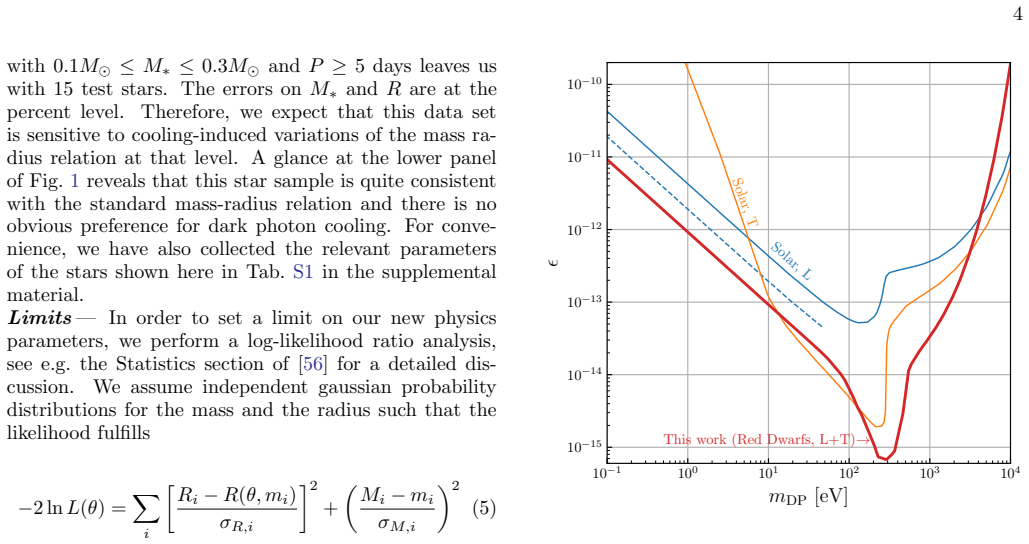
Incorporating dark photon production and the resulting additional cooling into red dwarf evolution simulations modifies the predicted mass-radius relation; confronting these modified relations with precise observational data from eclipsing binaries produces competitive limits on dark photon parameters that outperform solar constraints over a significant portion of the parameter space.
What carries the argument
Dark photon induced cooling inside red dwarfs, which increases the energy loss rate and thereby changes the thermal structure and radius at a given mass in the stellar evolution simulations.
If this is right
- Dark photon cooling would make red dwarfs at a given mass smaller or larger than standard models predict.
- Precise eclipsing-binary data can be translated directly into upper bounds on the dark photon kinetic mixing parameter.
- The resulting bounds exclude regions of dark photon parameter space that remain allowed by solar observations.
Where Pith is reading between the lines
- If future binary surveys increase the number and precision of red dwarf mass-radius pairs, the excluded dark photon region would grow.
- The same simulation-plus-observation approach could be applied to other low-mass main-sequence stars once comparable data become available.
- Any confirmed deviation in the mass-radius relation would also constrain the production rate of dark photons in hydrogen-burning cores more generally.
Load-bearing premise
Standard stellar evolution models without dark photons correctly predict the mass-radius relation of red dwarfs, so any observed deviation can be attributed solely to dark photon cooling.
What would settle it
A collection of red dwarf eclipsing binaries whose measured masses and radii match standard-model predictions without any extra cooling would falsify the derived limits by showing no room for the additional energy-loss channel.
Figures
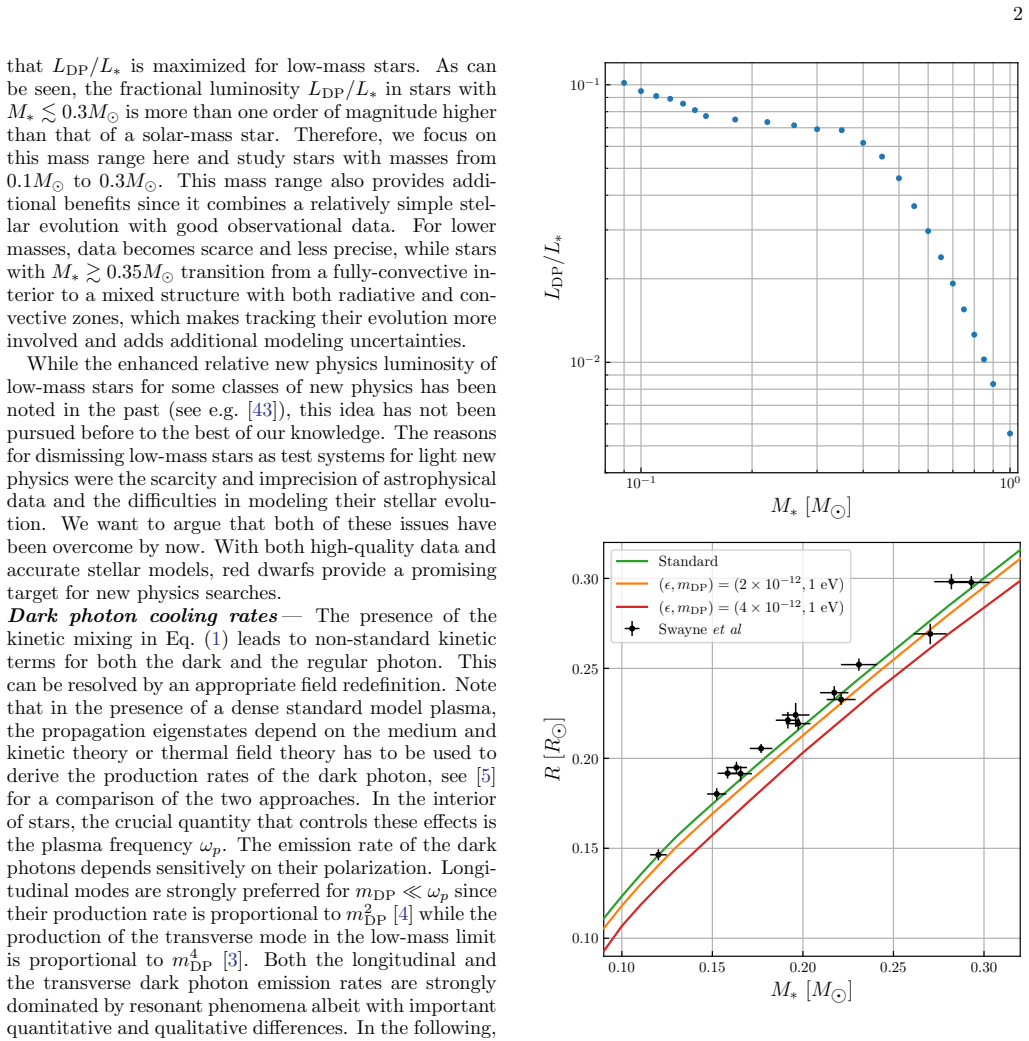
read the original abstract
Light dark photons can be produced in stellar systems and thus contribute to the stellar cooling rate. The additional cooling changes the evolution of the star and has an impact on various observable properties such as radius, photon luminosity or the emitted neutrino fluxes. This has been exploited before to derive limits based on observations of the Sun, horizontal branch stars and red giants. Given the wealth of astrophysical data collected in the last decade and the improvements in modeling stellar evolution it is interesting to investigate whether other stellar systems offer a complementary avenue towards testing dark photons. In this work, we study the effect on an alternative class of stars. We focus on the impact of dark photon induced cooling on red dwarfs, i.e. the lowest mass stars on the Hydrogen main sequence. Running simulations of the evolution of red dwarfs with dark photon cooling we determine the impact on the mass-radius relation. Combining our simulations with precise determination of mass and radius derived from observations of eclipsing binaries that have recently become available, we derive competitive limits which outperform the solar ones in a significant part of the parameter space.
Editorial analysis
A structured set of objections, weighed in public.
Referee Report
Summary. The paper simulates the evolution of red dwarfs including additional cooling from light dark photon production, examines the resulting changes to the mass-radius relation, and combines these with precise mass and radius measurements from eclipsing binary observations to derive upper limits on dark photon parameters. It claims these limits are competitive with and outperform solar bounds over a significant fraction of the parameter space.
Significance. If the central claim holds after addressing the issues below, the work would usefully extend stellar cooling constraints on dark photons to a new stellar population using recently available high-precision eclipsing-binary data. This could fill gaps in existing solar and horizontal-branch limits without requiring new observations.
major comments (3)
- [Abstract] Abstract: the claim that the derived limits 'outperform the solar ones in a significant part of the parameter space' is presented without any quantitative comparison, table, or figure showing the two sets of bounds side-by-side or indicating the relevant mass or coupling ranges.
- No section provides an error budget, uncertainty quantification, or description of how dark-photon production rates and cooling efficiencies are computed inside the stellar evolution code; without these the central claim that deviations can be attributed to dark photons cannot be verified.
- The analysis assumes that the baseline stellar-evolution code (no dark photons) reproduces the observed red-dwarf mass-radius relation to better than the few-percent level set by the dark-photon signal, yet does not demonstrate that uncertainties from convection treatment, opacity, equation of state, or binary-activity effects are sub-dominant across the relevant mass range.
Simulated Author's Rebuttal
We thank the referee for the careful reading and constructive comments. We address each major point below and have revised the manuscript accordingly to strengthen the presentation and add missing details.
read point-by-point responses
-
Referee: [Abstract] Abstract: the claim that the derived limits 'outperform the solar ones in a significant part of the parameter space' is presented without any quantitative comparison, table, or figure showing the two sets of bounds side-by-side or indicating the relevant mass or coupling ranges.
Authors: We agree that the abstract claim would be clearer with a direct visual comparison. In the revised manuscript we have added Figure 7, which overlays the red-dwarf 95% CL exclusion contour on the solar bounds from the literature across the (m_\gamma', g) plane and explicitly marks the mass-coupling region where the red-dwarf limits are stronger. The abstract has been updated to reference this figure. revision: yes
-
Referee: No section provides an error budget, uncertainty quantification, or description of how dark-photon production rates and cooling efficiencies are computed inside the stellar evolution code; without these the central claim that deviations can be attributed to dark photons cannot be verified.
Authors: We have added a new subsection 3.2 that details the implementation of dark-photon production (Primakoff and plasmon-decay channels) inside the MESA-based evolution code, including the analytic expressions used for the emissivity and the numerical integration of the cooling term. Section 4 now contains an explicit error budget table that quantifies the dominant uncertainties in the production rate (plasma frequency, degeneracy effects, and numerical resolution) at the 20-30% level, which propagates to a sub-dominant shift in the derived limits. revision: yes
-
Referee: The analysis assumes that the baseline stellar-evolution code (no dark photons) reproduces the observed red-dwarf mass-radius relation to better than the few-percent level set by the dark-photon signal, yet does not demonstrate that uncertainties from convection treatment, opacity, equation of state, or binary-activity effects are sub-dominant across the relevant mass range.
Authors: We have expanded Section 5.2 with a dedicated discussion of systematic uncertainties. Using the same MESA setup, we vary the mixing-length parameter by \pm0.2, switch between OPAL and OP opacity tables, and adopt two different EOS tables; the resulting radius shifts remain below 1.5% across the 0.1-0.6 M_\odot range, which is smaller than the dark-photon-induced deviations excluded by the data. Binary-activity effects are estimated from the selected low-activity systems and contribute <1%. A full Monte-Carlo propagation of all systematics is noted as future work but is not required to establish the present limits. revision: partial
Circularity Check
No circularity: limits derived from external observations vs. independent simulations
full rationale
The derivation runs stellar evolution simulations (with and without dark photon cooling) to predict mass-radius shifts, then compares those predictions directly to independent observational mass-radius data from eclipsing binaries. No step reduces a claimed prediction to a fitted input by construction, no self-citation is load-bearing for the central result, and the baseline model is tested against external benchmarks rather than defined in terms of the dark-photon limits. This matches the default expectation of a self-contained analysis against external data.
Axiom & Free-Parameter Ledger
axioms (1)
- domain assumption Standard stellar evolution models without dark photons accurately reproduce the observed mass-radius relation of red dwarfs in the absence of new physics.
invented entities (1)
-
Light dark photon
no independent evidence
Reference graph
Works this paper leans on
-
[1]
Two U(1)’s and Epsilon Charge Shifts,
B. Holdom, “Two U(1)’s and Epsilon Charge Shifts,” Phys. Lett. B166(1986) 196–198
1986
-
[2]
LIMITS OF ELECTRODYNAMICS: PARAPHOTONS?,
L. B. Okun, “LIMITS OF ELECTRODYNAMICS: PARAPHOTONS?,”Sov. Phys. JETP56(1982) 502
1982
-
[3]
Helioscope Bounds on Hidden Sector Photons,
J. Redondo, “Helioscope Bounds on Hidden Sector Photons,”JCAP07(2008) 008,arXiv:0801.1527 [hep-ph]
Pith/arXiv arXiv 2008
-
[4]
New stellar constraints on dark photons,
H. An, M. Pospelov, and J. Pradler, “New stellar constraints on dark photons,”Phys. Lett. B725(2013) 190–195,arXiv:1302.3884 [hep-ph]
Pith/arXiv arXiv 2013
-
[5]
Solar constraints on hidden photons re-visited,
J. Redondo and G. Raffelt, “Solar constraints on hidden photons re-visited,”JCAP08(2013) 034, arXiv:1305.2920 [hep-ph]
Pith/arXiv arXiv 2013
-
[6]
Atlas of solar hidden photon emission,
J. Redondo, “Atlas of solar hidden photon emission,” JCAP07(2015) 024,arXiv:1501.07292 [hep-ph]
Pith/arXiv arXiv 2015
-
[7]
Cool WISPs for stellar cooling excesses,
M. Giannotti, I. Irastorza, J. Redondo, and A. Ringwald, “Cool WISPs for stellar cooling excesses,” JCAP05(2016) 057,arXiv:1512.08108 [astro-ph.HE]
Pith/arXiv arXiv 2016
-
[8]
New axion and hidden photon constraints from a solar data global fit,
N. Vinyoles, A. Serenelli, F. L. Villante, S. Basu, J. Redondo, and J. Isern, “New axion and hidden photon constraints from a solar data global fit,”JCAP 10(2015) 015,arXiv:1501.01639 [astro-ph.SR]
Pith/arXiv arXiv 2015
-
[9]
Stellar cooling bounds on new light particles: plasma mixing effects,
E. Hardy and R. Lasenby, “Stellar cooling bounds on new light particles: plasma mixing effects,”JHEP02 (2017) 033,arXiv:1611.05852 [hep-ph]
Pith/arXiv arXiv 2017
-
[10]
New limits on dark photons from solar emission and keV scale dark matter,
H. An, M. Pospelov, J. Pradler, and A. Ritz, “New limits on dark photons from solar emission and keV scale dark matter,”Phys. Rev. D102(2020) 115022, arXiv:2006.13929 [hep-ph]
arXiv 2020
-
[11]
Production rates of dark photons andZ ′ in the Sun and stellar cooling bounds,
S.-P. Li and X.-J. Xu, “Production rates of dark photons andZ ′ in the Sun and stellar cooling bounds,” JCAP09(2023) 009,arXiv:2304.12907 [hep-ph]
arXiv 2023
-
[12]
Constraining dark photons with self-consistent simulations of globular cluster stars,
M. J. Dolan, F. J. Hiskens, and R. R. Volkas, “Constraining dark photons with self-consistent simulations of globular cluster stars,”JCAP05(2024) 099,arXiv:2306.13335 [hep-ph]
arXiv 2024
-
[13]
Heating the dark matter halo with dark radiation from supernovae,
S. Vogl and X.-J. Xu, “Heating the dark matter halo with dark radiation from supernovae,”JCAP07(2025) 058,arXiv:2411.18052 [hep-ph]
arXiv 2025
-
[14]
Revisiting Supernova 1987A Constraints on Dark Photons,
J. H. Chang, R. Essig, and S. D. McDermott, “Revisiting Supernova 1987A Constraints on Dark Photons,”JHEP01(2017) 107,arXiv:1611.03864 [hep-ph]
Pith/arXiv arXiv 2017
-
[15]
Nucleon-nucleon bremsstrahlung of dark gauge bosons and revised supernova constraints,
E. Rrapaj and S. Reddy, “Nucleon-nucleon bremsstrahlung of dark gauge bosons and revised supernova constraints,”Phys. Rev. C94(2016) no. 4, 045805,arXiv:1511.09136 [nucl-th]
Pith/arXiv arXiv 2016
-
[16]
Supernova Bounds on the Dark Photon Using its Electromagnetic Decay,
D. Kazanas, R. N. Mohapatra, S. Nussinov, V. L. Teplitz, and Y. Zhang, “Supernova Bounds on the Dark Photon Using its Electromagnetic Decay,”Nucl. Phys. B890(2014) 17–29,arXiv:1410.0221 [hep-ph]
Pith/arXiv arXiv 2014
-
[17]
Constraints on Light Hidden Sector Gauge Bosons from Supernova Cooling,
J. B. Dent, F. Ferrer, and L. M. Krauss, “Constraints on Light Hidden Sector Gauge Bosons from Supernova Cooling,”arXiv:1201.2683 [astro-ph.CO]
-
[18]
Massive hidden photons as lukewarm dark matter,
J. Redondo and M. Postma, “Massive hidden photons as lukewarm dark matter,”JCAP02(2009) 005, arXiv:0811.0326 [hep-ph]
Pith/arXiv arXiv 2009
-
[19]
Cosmological Constraints on Very Dark Photons,
A. Fradette, M. Pospelov, J. Pradler, and A. Ritz, “Cosmological Constraints on Very Dark Photons,” Phys. Rev. D90(2014) no. 3, 035022,arXiv:1407.0993 [hep-ph]
Pith/arXiv arXiv 2014
-
[20]
Cosmological Constraints on Decoupled Dark Photons and Dark Higgs,
J. Berger, K. Jedamzik, and D. G. E. Walker, “Cosmological Constraints on Decoupled Dark Photons and Dark Higgs,”JCAP11(2016) 032, arXiv:1605.07195 [hep-ph]
Pith/arXiv arXiv 2016
-
[21]
Room for New Physics in the Rayleigh-Jeans Tail of the Cosmic Microwave Background,
M. Pospelov, J. Pradler, J. T. Ruderman, and A. Urbano, “Room for New Physics in the Rayleigh-Jeans Tail of the Cosmic Microwave Background,”Phys. Rev. Lett.121(2018) no. 3, 031103,arXiv:1803.07048 [hep-ph]
Pith/arXiv arXiv 2018
-
[22]
Cosmological constraint on dark photon from N ef f,
M. Ibe, S. Kobayashi, Y. Nakayama, and S. Shirai, “Cosmological constraint on dark photon from N ef f,” JHEP04(2020) 009,arXiv:1912.12152 [hep-ph]
arXiv 2020
-
[23]
Cosmological evolution of light dark photon dark matter,
S. D. McDermott and S. J. Witte, “Cosmological evolution of light dark photon dark matter,”Phys. Rev. D101(2020) no. 6, 063030,arXiv:1911.05086 [hep-ph]
arXiv 2020
-
[24]
Cosmological Bounds on sub-GeV Dark Vector Bosons from Electromagnetic Energy Injection,
J. Coffey, L. Forestell, D. E. Morrissey, and G. White, “Cosmological Bounds on sub-GeV Dark Vector Bosons from Electromagnetic Energy Injection,”JHEP07 (2020) 179,arXiv:2003.02273 [hep-ph]
arXiv 2020
-
[25]
Probing dark photons in the early universe with big bang nucleosynthesis,
J.-T. Li, G. M. Fuller, and E. Grohs, “Probing dark photons in the early universe with big bang nucleosynthesis,”JCAP12(2020) 049, arXiv:2009.14325 [astro-ph.CO]
arXiv 2020
-
[26]
Radio excess from stimulated dark matter decay,
A. Caputo, H. Liu, S. Mishra-Sharma, M. Pospelov, and J. T. Ruderman, “Radio excess from stimulated dark matter decay,”Phys. Rev. D107(2023) no. 12, 123033, arXiv:2206.07713 [hep-ph]
arXiv 2023
-
[27]
Dark radiation constraints on portal interactions with hidden 6 sectors,
P. Adshead, P. Ralegankar, and J. Shelton, “Dark radiation constraints on portal interactions with hidden 6 sectors,”JCAP09(2022) 056,arXiv:2206.13530 [hep-ph]
arXiv 2022
-
[28]
Patchy screening of the CMB from dark photons,
D. Pˆ ırvu, J. Huang, and M. C. Johnson, “Patchy screening of the CMB from dark photons,”JCAP01 (2024) 019,arXiv:2307.15124 [hep-ph]
arXiv 2024
-
[29]
Cosmologically varying kinetic mixing,
X. Gan and D. Liu, “Cosmologically varying kinetic mixing,”JHEP11(2023) 031,arXiv:2302.03056 [hep-ph]
arXiv 2023
-
[30]
Detectable and Defect-Free Dark Photon Dark Matter,
D. Cyncynates and Z. J. Weiner, “Detectable and Defect-Free Dark Photon Dark Matter,”Phys. Rev. Lett.134(2025) no. 21, 211002,arXiv:2310.18397 [hep-ph]
arXiv 2025
-
[31]
Dark photon constraints from CMB temperature anisotropies,
A. Aramburo-Garcia, K. Bondarenko, A. Boyarsky, P. Kashko, J. Pradler, A. Sokolenko, R. Kugel, M. Schaller, and J. Schaye, “Dark photon constraints from CMB temperature anisotropies,”JCAP11(2024) 049,arXiv:2405.05104 [astro-ph.CO]
arXiv 2024
-
[32]
Dark Photon Limits from Patchy Dark Screening of the Cosmic Microwave Background,
F. McCarthy, D. Pirvu, J. C. Hill, J. Huang, M. C. Johnson, and K. K. Rogers, “Dark Photon Limits from Patchy Dark Screening of the Cosmic Microwave Background,”Phys. Rev. Lett.133(2024) no. 14, 141003,arXiv:2406.02546 [hep-ph]
arXiv 2024
-
[33]
A. Trost, J. S. Bolton, A. Caputo, H. Liu, S. Cristiani, and M. Viel, “Constraints on dark photon dark matter from Lyman-αforest simulations and an ultrahigh signal-to-noise quasar spectrum,”Phys. Rev. D111 (2025) no. 8, 083034,arXiv:2410.02858 [astro-ph.CO]
arXiv 2025
-
[34]
Experimental targets for dark photon dark matter,
D. Cyncynates and Z. J. Weiner, “Experimental targets for dark photon dark matter,”Phys. Rev. D111(2025) no. 10, 103535,arXiv:2410.14774 [hep-ph]
arXiv 2025
-
[35]
Dark Photons in the Early Universe: From Thermal Production to Cosmological Constraints,
X.-J. Xu and B. Zhou, “Dark Photons in the Early Universe: From Thermal Production to Cosmological Constraints,”arXiv:2512.08528 [hep-ph]
-
[36]
A. Hook, J. Huang, and M. Shalaby, “No cosmological constraints on dark photon dark matter from resonant conversion: Impact of nonlinear plasma dynamics,” arXiv:2510.13956 [hep-ph]
-
[37]
Signatures of a hidden cosmic microwave background,
J. Jaeckel, J. Redondo, and A. Ringwald, “Signatures of a hidden cosmic microwave background,”Phys. Rev. Lett.101(2008) 131801,arXiv:0804.4157 [astro-ph]
Pith/arXiv arXiv 2008
-
[38]
M. Fabbrichesi, E. Gabrielli, and G. Lanfranchi, “The Dark Photon,”arXiv:2005.01515 [hep-ph]
Pith/arXiv arXiv 2005
-
[39]
Dark photon limits: A handbook,
A. Caputo, A. J. Millar, C. A. J. O’Hare, and E. Vitagliano, “Dark photon limits: A handbook,” Phys. Rev. D104(2021) no. 9, 095029, arXiv:2105.04565 [hep-ph]
arXiv 2021
-
[40]
The Heavy Dark Photon Handbook: Cosmological and Astrophysical Bounds,
A. Caputo, J. Park, and S. Yun, “The Heavy Dark Photon Handbook: Cosmological and Astrophysical Bounds,”arXiv:2511.15785 [hep-ph]
-
[41]
The Dark Photon: a 2026 Perspective,
A. Caputo and R. Essig, “The Dark Photon: a 2026 Perspective,” 3, 2026.arXiv:2603.08430 [hep-ph]
Pith/arXiv arXiv 2026
-
[42]
Kippenhahn and A
R. Kippenhahn and A. Weigert,Stellar Structure and Evolution. Springer-Verlag Berlin Heidelberg, 1994
1994
-
[43]
Axions and Stars,
J. A. Frieman, S. Dimopoulos, and M. S. Turner, “Axions and Stars,”Phys. Rev. D36(1987) 2201
1987
-
[44]
M. I. Swayne, P. F. L. Maxted, A. H. M. J. Triaud,et al., “The EBLM Project- XI. Mass, radius, and effective temperature measurements for 23 M-dwarf companions to solar-type stars observed with CHEOPS,”MNRAS 528(2024) no. 4, 5703–5722,arXiv:2312.11339
arXiv 2024
-
[45]
Spectra of axions emitted from main sequence stars,
N. H. Nguyen, E. H. Tanin, and M. Kamionkowski, “Spectra of axions emitted from main sequence stars,” JCAP11(2023) 091,arXiv:2307.11216 [hep-ph]. [46]MESACollaboration, B. Paxton, L. Bildsten, A. Dotter, F. Herwig, P. Lesaffre, and F. Timmes, “Modules for Experiments in Stellar Astrophysics (MESA),”Astrophys. J. Suppl.192(2011) 3, arXiv:1009.1622 [astro-ph.SR]
arXiv 2023
-
[46]
MESA: Modules for Experiments in Stellar Astrophysics
The MESA Team, “MESA: Modules for Experiments in Stellar Astrophysics.”https://mesastar.org/, 2026
2026
-
[47]
Constraining the Axion-Photon Coupling with Massive Stars,
A. Friedland, M. Giannotti, and M. Wise, “Constraining the Axion-Photon Coupling with Massive Stars,”Phys. Rev. Lett.110(2013) no. 6, 061101, arXiv:1210.1271 [hep-ph]
Pith/arXiv arXiv 2013
-
[48]
Constraining axion-like particles using the white dwarf initial-final mass relation,
M. J. Dolan, F. J. Hiskens, and R. R. Volkas, “Constraining axion-like particles using the white dwarf initial-final mass relation,”JCAP09(2021) 010, arXiv:2102.00379 [hep-ph]
arXiv 2021
-
[49]
A. Friedland’s webpage
“A. Friedland’s webpage.” https://alexfriedland.com/papers/axion/
-
[50]
MESA ALPs on github
F. J. Hiskens, “MESA ALPs on github.” https://github.com/fhiskens/MESA_ALPs/, 2021
2021
-
[51]
MESA dark photons on github
F. J. Hiskens, “MESA dark photons on github.”https: //github.com/fhiskens/Dark_Photon_MESA_files/, 2024
2024
-
[52]
I. Baraffe, D. Homeier, F. Allard, and G. Chabrier, “New evolutionary models for pre-main sequence and main sequence low-mass stars down to the hydrogen-burning limit,”Astronomy&Astrophysics 577(2015) A42,arXiv:1503.04107 [astro-ph.SR]
Pith/arXiv arXiv 2015
-
[53]
Binney and M
J. Binney and M. Merrifield,Galactic Astronomy. Princeton University Press, 1998
1998
-
[54]
Weighing stars from birth to death: mass determination methods across the hrd,
A. Serenelli, A. Weiss, C. Aerts,et al., “Weighing stars from birth to death: mass determination methods across the hrd,”The Astronomy and Astrophysics Review29(2021) no. 1, . http://dx.doi.org/10.1007/s00159-021-00132-9. [56]Particle Data GroupCollaboration, S. Navaset al., “Review of particle physics,”Phys. Rev. D110(2024) no. 3, 030001
-
[55]
Asymptotic formulae for likelihood-based tests of new physics,
G. Cowan, K. Cranmer, E. Gross, and O. Vitells, “Asymptotic formulae for likelihood-based tests of new physics,”Eur. Phys. J. C71(2011) 1554, arXiv:1007.1727 [physics.data-an]. [Erratum: Eur.Phys.J.C 73, 2501 (2013)]
Pith/arXiv arXiv 2011
-
[56]
Helioseismological constraint on solar axion emission,
H. Schlattl, A. Weiss, and G. Raffelt, “Helioseismological constraint on solar axion emission,” Astropart. Phys.10(1999) 353–359, arXiv:hep-ph/9807476
Pith/arXiv arXiv 1999
-
[57]
Solar neutrino limit on axions and keV-mass bosons,
P. Gondolo and G. G. Raffelt, “Solar neutrino limit on axions and keV-mass bosons,”Phys. Rev. D79(2009) 107301,arXiv:0807.2926 [astro-ph]
Pith/arXiv arXiv 2009
-
[58]
GARSTEC—the Garching Stellar Evolution Code. The direct descendant of the legendary Kippenhahn code,
A. Weiss and H. Schlattl, “GARSTEC—the Garching Stellar Evolution Code. The direct descendant of the legendary Kippenhahn code,”Astrophysics and Space Science316(2008) no. 1-4, 99–106
2008
-
[59]
Extending MESA with run star extras.f90
B. Wolf, “Extending MESA with run star extras.f90.” https://mesa-leuven.4d-star.org/tutorials/tues day/morning-session/, 2024. 1 Supplemental Material: Dark Photons from Red Dwarfs Stefan Vogl, Xun-Jie Xu S1. MESA IMPLEMENT A TION DET AILS A. F ormulae and approximations The differential dark photon luminosity in stellar medium is given by dLDP drdk = 4πr...
2024
discussion (0)
Sign in with ORCID, Apple, or X to comment. Anyone can read and Pith papers without signing in.