REVIEW 4 major objections 4 minor 36 references
Spark-to-Paper: End-to-End Research Paper Generation as a Composable Skill
T0 review · 4 major / 4 minor · reviewed 2026-08-16 · deepseek-v4-flash
Pith's one-line read The paper claims that end-to-end research paper generation can be implemented as a lightweight, composable skill workflow inside an existing coding assistant, with experimental evidence kept central to how claims are accepted, revised, or…
desk verdict A solid, honest systems paper that gets the architecture right and is upfront about its measurements, but its central evidence-centrality claim hinges on model-assigned labels that nobody has audited. read the letter →
The pith
A machine-rendered reading of the paper's core claim, the machinery that carries it, and where it could break.
The reading
What carries the argument
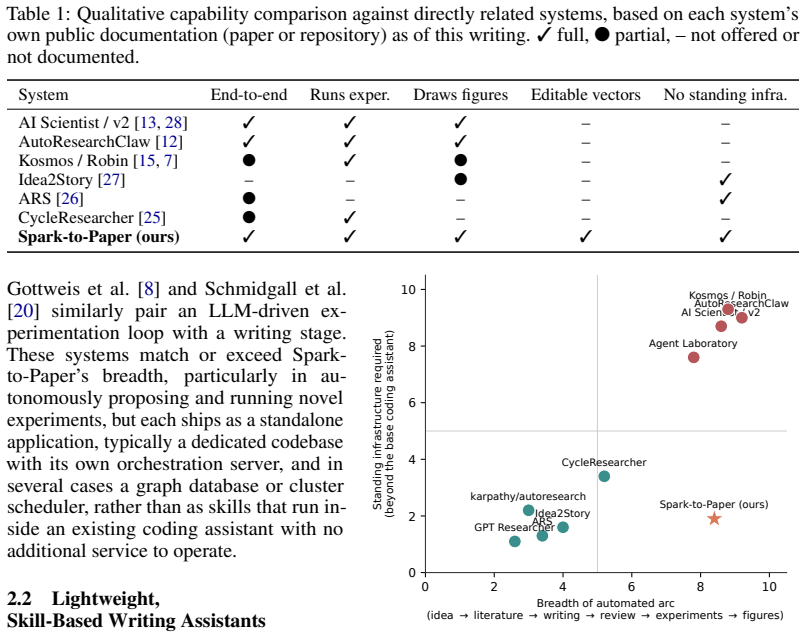
The central mechanism is the skill-pipeline architecture: thirteen skills that share a common project directory and are orchestrated only by a high-level ordering, with each skill deciding how to carry out its task from the current project state. Within each skill, the system separates model-based judgment from deterministic operations that can be executed and checked, such as citation resolution, LaTeX compilation, and plotting from measured data. Two mechanisms do the paper's heavy lifting: the evidence-grounded claim admission protocol, which labels claims as supported, partially supported, unsupported, contradicted, or needs-confirmation and maps each label to a revision action, and the bounded Self-Refutation Loop, which caps experiment–critique–revision cycles at seven and converts an unsupported trajectory into a failure report instead of forcing an apparent success. The figure pipeline also matters: quantitative plots are generated deterministically from measurements, while explanatory figures are produced by an image model as a visual target and then reconstructed in HTML as editable vector PDFs.
What would settle it
An external audit would take a random sample of claims that Spark-to-Paper labeled supported or contradicted and check each against the raw experiment logs, metrics, and source data; if a substantial fraction of supported labels turn out not to be implied by the measurements, the evidence-centrality claim fails. A cheaper check would rerun the 36-probe fabrication corpus while also measuring claim-label accuracy on probes whose evidence status is known.
Extended reading notes
Core claim
The central claim is that end-to-end research paper generation can be implemented as a lightweight, composable skill workflow inside an existing coding assistant, and that this workflow can keep experimental evidence central to how claims are accepted, revised, or abandoned. On the paper's own terms, Spark-to-Paper establishes this by using thirteen skills that communicate through persistent project artifacts, with deterministic gates for machine-checkable properties and model-based critique for semantic ones. The evaluation reports 99.5% citation validity across 384 references, 96.4% figure editability across roughly 1,900 figure elements, fabrication detection rising from 14% for a single-pass draft to 92% with the full integrity stack, and adversarial review precision of 74%. The full system is reported to use 11.9M tokens, cost $8.1, and take 3.2 hours per manuscript on average.
Load-bearing premise
The load-bearing premise is that the model-based protocol for deciding whether a measured result actually supports a claim gets that judgment right; if it misclassifies claims, the deterministic gates catch only structural violations and the system stops being evidence-based and becomes a loop counter.
Editorial extensions
If this is right
- A complete paper with verified references, executed experiments, and editable figures can be produced for roughly $8 and 3 hours inside a coding assistant, making the cost comparable to a long interactive session rather than a dedicated research platform.
- Because experiment planning is committed before results are observed, the generated paper cannot silently swap in an easier evaluation after the fact; any change to the protocol becomes a visible revision or an abandoned trajectory.
- The full integrity and review stack detects 92% of seeded unsupported claims, compared with 14% for a single-pass draft, so most fabrication that survives ordinary drafting would be caught.
- Failure is treated as a first-class outcome: when experiments keep contradicting the hypothesis, the trajectory is written up as a failure report and a new idea is tried, so the output corpus can contain negative results rather than only polished successes.
- Editable vector figures are the default for both explanatory and quantitative content, which means the generated artifacts can be modified by a human rather than only viewed as embedded bitmaps.
Reading between the lines
- If the claim-admission classifications are as reliable as the 36-probe ablation suggests, the same protocol could be applied to human-authored drafts as a pre-submission integrity audit, not just to generated papers; the paper does not test this application.
- The skill-based decomposition implies a modular upgrade path: a better citation resolver, a different plotting library, or a stronger review model could be swapped into one skill without rebuilding the orchestration; the paper does not directly demonstrate this modularity.
- The reported cost and runtime assume current model pricing and a particular coding assistant; scaling to many parallel papers or switching to a weaker model would likely change the token and dollar figures, and the paper's single-backbone evaluation does not address cross-model transfer.
- A natural extension would be to run the same pipeline on a topic with a known published answer and compare the generated claims against ground-truth literature, which would measure whether evidence-grounded revision produces scientifically sound conclusions beyond citation integrity.
Signed reviews
Editorial analysis
A structured set of objections, weighed in public.
Referee Report
Summary. The paper presents Spark-to-Paper, a system that generates complete research papers inside an existing coding assistant using thirteen composable skills, without a separate orchestration service. The system separates model-based judgment from deterministic checks, separates experiment planning from reporting so that required evidence is specified before results are observed, and uses the resulting evidence to retain, weaken, remove, or contradict manuscript claims. It also introduces a bounded recovery mechanism for a failure mode called the Self-Refutation Loop and generates editable vector figures via deterministic plotting for measured results and code-based reconstruction for method diagrams. The evaluation reports 99.5% citation validity and 96.4% figure editability over eight controlled topics, a fabrication-detection improvement from 14% to 92% when the full integrity and review stack is added, 74% review precision, and average costs of 11.9M tokens, $8.1, and 3.2 hours per manuscript.
Significance. If the empirical claims hold, the paper makes a genuinely useful architectural contribution: it shows that a lightweight skill-based pipeline inside a coding assistant can match or exceed the artifact-level reliability of standalone autonomous research systems while remaining infrastructure-free. The separation of deterministic integrity gates from model-based semantic judgment is a principled design that makes many properties independently checkable, and the paper is commendably transparent about the provenance of each number: controlled measurements, retrospective audits, and self-reported showcase counts are labeled as such. The fixed-probe ablation and blinded human review of raised issues are appropriate evaluation instruments. However, the central claim that experimental evidence governs claim acceptance, revision, or abandonment currently rests on a model-internal claim-admission protocol that has not been independently audited, and the main quantitative evaluation is small and partly retrospective. These are fixable with additional reporting and analysis, and the underlying system design appears sound.
major comments (4)
- [§7.3 and Appendix C] The central evidence-centrality claim is currently supported only by a model-internal claim-admission protocol with no independent audit. The reported 14%→92% ablation measures detection of 36 externally seeded unsupported claims, not the accuracy of the five-way labels (supported, partially-supported, unsupported, contradicted, needs-confirmation) that actually trigger the revision actions in Table 5. Since the deterministic gates in Appendix A explicitly disclaim semantic judgment, a systematic tendency of the model to label insufficiently supported claims as supported would pass every gate and terminate with an over-claimed manuscript. Please release the probe corpus, report label-level confusion across all five categories, and add an independent audit of claim-admission labels from the full runs, or narrow the evidence-centrality claim accordingly.
- [§7.2, Table 3] The main quantitative comparison rests on only eight controlled topics and on retrospective audits of prior systems' self-released artifacts. The paper states that the protocol was registered with an external timestamp and that all outcomes are reported, but no protocol identifier, topic list, or raw outputs are provided, so the pre-registration claim cannot be independently verified. In addition, the reported quality metrics are limited to citation validity and figure editability; these do not directly measure scientific soundness or the correctness of the evidence-to-claim mapping, which is the mechanism the paper identifies as its main contribution. A controlled evaluation of claim-label accuracy on the eight full runs would substantially strengthen the central claim.
- [§5.3 and §7.2] The efficiency and quality averages may exclude abandoned trajectories. Section 5.3 states that only trajectories whose evidence supports claims are consolidated into a final manuscript and that failed trajectories are preserved as failure reports, but the eight-topic evaluation reports no count of such failures or their cost. If the 11.9M-token, $8.1, and 3.2-hour averages exclude self-refutation aborts and restarts, they understate the true cost of producing a successful manuscript. Please report the trajectory-level breakdown, including the number of aborted trajectories and their resource consumption, so that the cost and reliability claims are fully measurable.
- [§6 and Table 3] Figure editability is computed over approximately 1,900 elements 'excluding figures that are intentionally rasterized by design,' but the paper does not define the criterion for 'intentionally rasterized' nor state how raster fallbacks from failed HTML reconstruction are classified. Because Section 6.1 explicitly allows fallback to raster when reconstruction is unreliable, the 96.4% editability figure could be inflated by excluding reconstruction failures. Please define the exclusion rule and report editability with fallback-to-raster counted as non-editable, or provide evidence that no reconstruction failures were excluded from the denominator.
minor comments (4)
- [Table 4] The header '∆tokens (M)∆USD' is missing a separator and should be two distinct column headers, e.g., '∆tokens (M)' and '∆USD', for readability.
- [§7.2] The human-written preprint reference point is described as 'eight sampled papers' but no sampling criteria are given; please specify how these papers were selected so that the 97.8% citation-validity interval can be interpreted as a fair reference.
- [Figure 6 caption] The phrase 'incorrect expectations are highlighted by Bold and Underline text' should read 'highlighted in bold and underlined text'; the current phrasing is ambiguous about which visual style is applied.
- [§3.1, Stage 5 and §4] Review-driven revision and experiment-driven claim admission are described separately, but their interaction is unclear when a review issue and an evidence-based claim revision target the same passage; please clarify the ordering or arbitration between these two correction loops.
Circularity Check
No circular reduction: the headline metrics are externally benchmarked or use fixed injected probes; the only flagged weakness is the model-based claim admission in Appendix C, which is a limitation on independent audit rather than a circular step.
full rationale
The claimed results are measurements against external or fixed instruments, not predictions re-derived from their own inputs. Citation validity (99.5%) is computed by resolving 384 references against external bibliographic metadata (Section 7.2); figure editability (96.4%) is measured over approximately 1,900 ground-truth elements using the same procedure applied to human preprints; review precision (74%) uses blinded human raters (Section 7.3); and fabrication detection is evaluated with a fixed corpus of 36 externally seeded probes, with the detection procedure held fixed across configurations, so the 14% to 92% ablation is a controlled benchmark rather than a restatement of the injection set. The evidence-centrality claim does lean on the Claim Admission Protocol (Appendix C), and the paper openly states that 'claim-level evidence diagnosis is currently performed by the model'; this limits independent auditability of the five-way labels, but it is not a circular reduction because the label assignments are not the ground truth for any headline metric and the deterministic gates explicitly avoid semantic judgment (Appendix A). The only self-citation, to Idea2story [27], whose author list overlaps with this paper, appears in a related-work comparison and is not load-bearing; no uniqueness theorem or ansatz is imported from prior work. No step in the derivation is equivalent to its inputs by construction.
Assumptions & free parameters
free parameters (2)
- self-refutation loop cap =
7
- fabrication probe corpus =
36 probes, 10 families, 3 sources
assumptions (3)
- domain assumption The base coding assistant (Claude Code) provides sufficient file inspection, tool use, and code execution capabilities for the thirteen skills.
- domain assumption The LLM's claim-level evidence classification (supported, partially-supported, etc.) is accurate enough for the evidence-guided revision loop.
- domain assumption Pre-committed experiment designs in the planning stage can be specified before results exist and will be feasible to execute later.
Cite this review
Pith. "Pith review of Spark-to-Paper: End-to-End Research Paper Generation as a Composable Skill." pith.science (2026). https://pith.science/paper/RBSKY24O
@misc{pith2026260811924,
  author       = {Pith},
  title        = {Pith review of: Spark-to-Paper: End-to-End Research Paper Generation as a Composable Skill},
  year         = {2026},
  howpublished = {\url{https://pith.science/paper/RBSKY24O}},
  note         = {Machine review of arXiv:2608.11924}
}
abstract
Turning a research idea into a complete paper requires more than text generation: the system must retrieve literature, design and execute experiments, revise claims according to evidence, produce publication-ready figures, and maintain consistency across a long generation process. We present Spark-to-Paper, an end-to-end research paper generation system implemented as thirteen composable skills inside an existing coding assistant, without requiring a separate agent platform or orchestration service. Spark-to-Paper separates model-based judgment from deterministic operations that can be directly executed and checked. It further separates experiment planning from reporting, so that required evidence is specified before results are observed and manuscript claims are revised according to measured outcomes. To improve reliability over long research trajectories, the system combines deterministic integrity checks with self-critique and bounds a failure mode we call the Self-Refutation Loop, in which repeated experiments continue to reject the original research objective. Spark-to-Paper also produces editable vector figures through programmatic plotting for experimental results and code-based reconstruction for generated method diagrams. Across eight controlled research topics, Spark-to-Paper achieves 99.5% citation validity and 96.4% figure editability. A controlled ablation increases fabrication detection from 14% for a single-pass draft to 92% with the full integrity and review stack, while adversarial review achieves 74% precision. The full system uses 11.9M tokens, costs $8.1 per manuscript, and requires 3.2 hours on average. These results show that end-to-end research paper generation can be implemented as a lightweight, composable workflow inside existing coding assistants while keeping experimental evidence central to how claims are accepted, revised, or abandoned.
Figures


Figures from the paper (7 more)




Reference graph
Works this paper leans on
-
[1]
The Claude 3 model family: Opus, sonnet, haiku
Anthropic. The Claude 3 model family: Opus, sonnet, haiku. https://assets. anthropic.com/m/61e7d27f8c8f5919/original/Claude-3-Model-Card.pdf ,
-
[2]
Anthropic. Claude agent SDK overview. https://code.claude.com/docs/en/ agent-sdk/overview, 2026. URL https://code.claude.com/docs/en/agent-sdk/ overview
work page 2026
-
[3]
Claude code documentation
Anthropic. Claude code documentation. https://code.claude.com/docs/en/overview,
-
[4]
From copilots to colleagues: A survey of autonomous research agents
Deli Chen. From copilots to colleagues: A survey of autonomous research agents. https:// victorchen96.github.io/auto_research/auto_research_survey.pdf, 2026. URL https://victorchen96.github.io/auto_research/auto_research_survey.pdf
work page 2026
-
[5]
Assaf Elovic. GPT researcher. https://github.com/assafelovic/gpt-researcher,
-
[6]
Yunfan Gao, Yun Xiong, Xinyu Gao, Kangxiang Jia, Jinliu Pan, Yuxi Bi, Yi Dai, Jiawei Sun, and Haofen Wang. Retrieval-augmented generation for large language models: A survey.arXiv preprint arXiv:2312.10997, 2023. URLhttps://arxiv.org/abs/2312.10997
arXiv 2023
-
[7]
Ali Essam Ghareeb, Benjamin Chang, Ludovico Mitchener, Angela Yiu, Caralyn J. Szostkiewicz, Jon M. Laurent, Muhammed T. Razzak, Andrew D. White, Michaela M. Hinks, and Samuel G. Rodriques. Robin: A multi-agent system for automating scientific discovery. arXiv preprint arXiv:2505.13400, 2025. URLhttps://arxiv.org/abs/2505.13400
arXiv 2025
-
[8]
URLhttps://github.com/assafelovic/gpt-researcher
Show all 36 references
-
[9]
Survey of hallucination in natural language generation
Ziwei Ji, Nayeon Lee, Rita Frieske, Tiezheng Yu, Dan Su, Yan Xu, Etsuko Ishii, Yejin Bang, Andrea Madotto, and Pascale Fung. Survey of hallucination in natural language generation. ACM Computing Surveys, 55(12), 2023. URLhttps://arxiv.org/abs/2202.03629
2023 arXiv
-
[10]
autoresearch: AI agents running research on single-GPU nanochat training automatically
Andrej Karpathy. autoresearch: AI agents running research on single-GPU nanochat training automatically. https://github.com/karpathy/autoresearch, 2026. URL https:// github.com/karpathy/autoresearch
2026
-
[11]
Accelerating scientific discovery with co-scientist.Nature, pages 1–3, 2026
Juraj Gottweis, Wei-Hung Weng, Alexander Daryin, Tao Tu, Petar Sirkovic, Artiom Myaskovsky, Grzegorz Glowaty, Felix Weissenberger, Alessio Orlandi, Dan Popovici, et al. Accelerating scientific discovery with co-scientist.Nature, pages 1–3, 2026
2026
-
[12]
AutoResearchClaw: Self-reinforcing autonomous research with human-AI collaboration.arXiv preprint arXiv:2605.20025, 2026
Jiaqi Liu, Shi Qiu, Mairui Li, Bingzhou Li, Haonian Ji, Siwei Han, Xinyu Ye, Peng Xia, Zihan Dong, Meng Chen, Congyu Zhang, Letian Zhang, Guiming Chen, Haoqin Tu, Xinyu Yang, Lu Feng, Xujiang Zhao, Haifeng Chen, Jiawei Zhou, Xiao Wang, Weitong Zhang, Hongtu Zhu, Yun Li, Jieru ...
2026 arXiv
-
[13]
The AI scientist: Towards fully automated open-ended scientific discovery.arXiv preprint arXiv:2408.06292, 2024
Chris Lu, Cong Lu, Robert Tjarko Lange, Jakob Foerster, Jeff Clune, and David Ha. The AI scientist: Towards fully automated open-ended scientific discovery.arXiv preprint arXiv:2408.06292, 2024. URLhttps://arxiv.org/abs/2408.06292
2024 arXiv
-
[14]
Retrieval-augmented generation for knowledge-intensive NLP tasks
Patrick Lewis, Ethan Perez, Aleksandra Piktus, Fabio Petroni, Vladimir Karpukhin, Naman Goyal, Heinrich Küttler, Mike Lewis, Wen-tau Yih, Tim Rocktäschel, Sebastian Riedel, and Douwe Kiela. Retrieval-augmented generation for knowledge-intensive NLP tasks. InAdvances in Neural ...
2020 arXiv
-
[15]
Kosmos: An ai scientist for autonomous discovery.arXiv preprint arXiv:2511.02824, 2025
Ludovico Mitchener, Angela Yiu, Benjamin Chang, Mathieu Bourdenx, Tyler Nadolski, Arvis Sulovari, Eric C Landsness, Daniel L Barabasi, Siddharth Narayanan, Nicky Evans, et al. Kosmos: An ai scientist for autonomous discovery.arXiv preprint arXiv:2511.02824, 2025
2025 arXiv
-
[16]
SciGen: A dataset for reasoning-aware text generation from scientific tables
Nafise Sadat Moosavi, Andreas Rücklé, Dan Roth, and Iryna Gurevych. SciGen: A dataset for reasoning-aware text generation from scientific tables. InAdvances in Neural Information Processing Systems (NeurIPS) Datasets and Benchmarks Track, 2021. URL https://arxiv. org/abs/2104.08296
2021 arXiv
-
[17]
Self-refine: Iterative refinement with self-feedback
Aman Madaan, Niket Tandon, Prakhar Gupta, Skyler Hallinan, Luyu Gao, Sarah Wiegreffe, Uri Alon, Nouha Dziri, Shrimai Prabhumoye, Yiming Yang, et al. Self-refine: Iterative refinement with self-feedback. InAdvances in Neural Information Processing Systems (NeurIPS), 2023. URLht...
2023 arXiv
-
[18]
O’Brien, Carrie J
Joon Sung Park, Joseph C. O’Brien, Carrie J. Cai, Meredith Ringel Morris, Percy Liang, and Michael S. Bernstein. Generative agents: Interactive simulacra of human behavior. In Proceedings of the 36th Annual ACM Symposium on User Interface Software and Technology (UIST), 2023. ...
2023 arXiv
-
[19]
Toolformer: Language models can teach themselves to use tools
Timo Schick, Jane Dwivedi-Yu, Roberto Dessì, Roberta Raileanu, Maria Lomeli, Luke Zettle- moyer, Nicola Cancedda, and Thomas Scialom. Toolformer: Language models can teach themselves to use tools. InAdvances in Neural Information Processing Systems (NeurIPS),
-
[20]
WebGPT: Browser- assisted question-answering with human feedback.arXiv preprint arXiv:2112.09332, 2021
Reiichiro Nakano, Jacob Hilton, Suchir Balaji, Jeff Wu, Long Ouyang, Christina Kim, Christo- pher Hesse, Shantanu Jain, Vineet Kosaraju, William Saunders, et al. WebGPT: Browser- assisted question-answering with human feedback.arXiv preprint arXiv:2112.09332, 2021. URLhttps://...
2021 arXiv
-
[21]
Reflexion: Language agents with verbal reinforcement learning
Noah Shinn, Federico Cassano, Edward Berman, Ashwin Gopinath, Karthik Narasimhan, and Shunyu Yao. Reflexion: Language agents with verbal reinforcement learning. InAdvances in Neural Information Processing Systems (NeurIPS), 2023. URL https://arxiv.org/abs/ 2303.11366
2023 arXiv
-
[22]
Retrieval augmenta- tion reduces hallucination in conversation
Kurt Shuster, Spencer Poff, Moya Chen, Douwe Kiela, and Jason Weston. Retrieval augmenta- tion reduces hallucination in conversation. InFindings of the Association for Computational Linguistics: EMNLP, 2021. URLhttps://arxiv.org/abs/2104.07567
2021 arXiv
-
[23]
Walters and Esther Isabelle Wilder
William H. Walters and Esther Isabelle Wilder. Fabrication and errors in the bibliographic citations generated by ChatGPT.Scientific Reports, 13:14045, 2023. doi: 10.1038/ s41598-023-41032-5
2023
-
[24]
Agent laboratory: Using LLM agents as research assistants.arXiv preprint arXiv:2501.04227, 2025
Samuel Schmidgall, Yusheng Su, Ze Wang, Ximeng Sun, Jialian Wu, Xiaodong Yu, Jiang Liu, Michael Moor, Zicheng Liu, and Emad Barsoum. Agent laboratory: Using LLM agents as research assistants.arXiv preprint arXiv:2501.04227, 2025. URL https://arxiv.org/abs/ 2501.04227
2025 arXiv
-
[25]
Cycleresearcher: Improving automated research via automated review.arXiv preprint arXiv:2411.00816, 2025
Yixuan Weng, Minjun Zhu, Guangsheng Bao, Hongbo Zhang, Jindong Wang, Yue Zhang, and Linyi Yang. Cycleresearcher: Improving automated research via automated review.arXiv preprint arXiv:2411.00816, 2025. URL https://arxiv.org/abs/2411.00816. ICLR 2025
2025 arXiv
-
[26]
academic-research-skills: A claude code skill suite for research, writing, and review
Cheng-I Wu. academic-research-skills: A claude code skill suite for research, writing, and review. https://github.com/Imbad0202/academic-research-skills , 2026. URL https://github.com/Imbad0202/academic-research-skills
2026
-
[27]
Idea2story: An automated pipeline for transforming research concepts into complete scientific narratives.arXiv preprint arXiv:2601.20833, 2026
Tengyue Xu, Zhuoyang Qian, Gaoge Liu, Li Ling, Zhentao Zhang, Biao Wu, Shuo Zhang, Ke Lu, Wei Shi, Ziqi Wang, Zheng Feng, Yan Luo, Shu Xu, Yongjin Chen, Zhibo Feng, Zhuo Chen, Bruce Yuan, Harry Wang, and Kris Chen. Idea2story: An automated pipeline for transforming research co...
2026
-
[28]
Chain-of-thought prompting elicits reasoning in large language models
Jason Wei, Xuezhi Wang, Dale Schuurmans, Maarten Bosma, Brian Ichter, Fei Xia, Ed Chi, Quoc Le, and Denny Zhou. Chain-of-thought prompting elicits reasoning in large language models. InAdvances in Neural Information Processing Systems (NeurIPS), volume 35, 2022. URLhttps://arx...
2022 arXiv
-
[29]
Griffiths, Yuan Cao, and Karthik Narasimhan
Shunyu Yao, Dian Yu, Jeffrey Zhao, Izhak Shafran, Thomas L. Griffiths, Yuan Cao, and Karthik Narasimhan. Tree of thoughts: Deliberate problem solving with large language models. InAdvances in Neural Information Processing Systems (NeurIPS), 2023. URL https://arxiv.org/abs/2305.10601
2023 arXiv
-
[30]
ReAct: Synergizing reasoning and acting in language models
Shunyu Yao, Jeffrey Zhao, Dian Yu, Nan Du, Izhak Shafran, Karthik Narasimhan, and Yuan Cao. ReAct: Synergizing reasoning and acting in language models. InProceedings of ICLR,
-
[31]
Siren’s song in the AI ocean: A survey on hallucination in large language models.arXiv preprint arXiv:2309.01219, 2023
Yue Zhang, Yafu Li, Leyang Cui, Deng Cai, Lemao Liu, Tingchen Fu, Xinting Huang, Enbo Zhao, Yu Zhang, Yulong Chen, Longyue Wang, Anh Tuan Luu, Wei Bi, Freda Shi, and Shuming Shi. Siren’s song in the AI ocean: A survey on hallucination in large language models.arXiv preprint ar...
2023 arXiv
-
[32]
The AI scientist-v2: Workshop-level automated scientific discovery via agentic tree search.arXiv preprint arXiv:2504.08066, 2025
Yutaro Yamada, Robert Tjarko Lange, Cong Lu, Shengran Hu, Chris Lu, Jakob Foerster, Jeff Clune, and David Ha. The AI scientist-v2: Workshop-level automated scientific discovery via agentic tree search.arXiv preprint arXiv:2504.08066, 2025. URL https://arxiv.org/abs/ 2504.08066
2025 arXiv
-
[35]
URLhttps://arxiv.org/abs/2210.03629
-
[2023]
URLhttps://arxiv.org/abs/2302.04761
-
[2024]
URL https://assets.anthropic.com/m/61e7d27f8c8f5919/original/ Claude-3-Model-Card.pdf
-
[2026]
URLhttps://code.claude.com/docs/en/overview
Reviewed August 16, 2026 · model on record in the stance chip above.
Discussion (0). Continue with ORCID to comment.