REVIEW 3 major objections 4 minor 72 references
A circumsphere filter on tiled Delaunay tessellations lets DisPerSE scale to gigaparsec simulations.
Reviewed by Pith at T0; open to challenge. T0 means a machine referee read the full paper against a public rubric. the ladder, T0–T4 →
T0 review · deepseek-v4-flash
2026-08-02 01:02 UTC pith:RCAWZ2UU
load-bearing objection A genuinely useful tiling method for DisPerSE with solid validation, but the abstract oversells the connectivity result and the validation reference is not the true global tessellation. the 3 major comments →
Enabling Cosmic Web Analysis at Gigaparsec Scales: A Multi Block Approach for DisPerSE
The pith
A machine-rendered reading of the paper's core claim, the machinery that carries it, and where it could break.
Core claim
The central discovery is that a tetrahedron whose circumsphere fits entirely within a padded tile is provably part of the global Delaunay tessellation, so overlapping tiles can be filtered by this circumsphere criterion and merged to reproduce the monolithic result almost exactly. On a 300 Mpc/h subvolume of MDPL2, the tiled pipeline recovers 99.6% of the total filament length, 100% of density maxima and minima, 99.7% of 2-saddles, and 94.7% of individual filaments, with zero spurious critical points. The approximately 5% unmatched filaments are predominantly short, low-significance structures. The method is applied to the full 1 Gpc MDPL2 box, and as a first science application the authors
What carries the argument
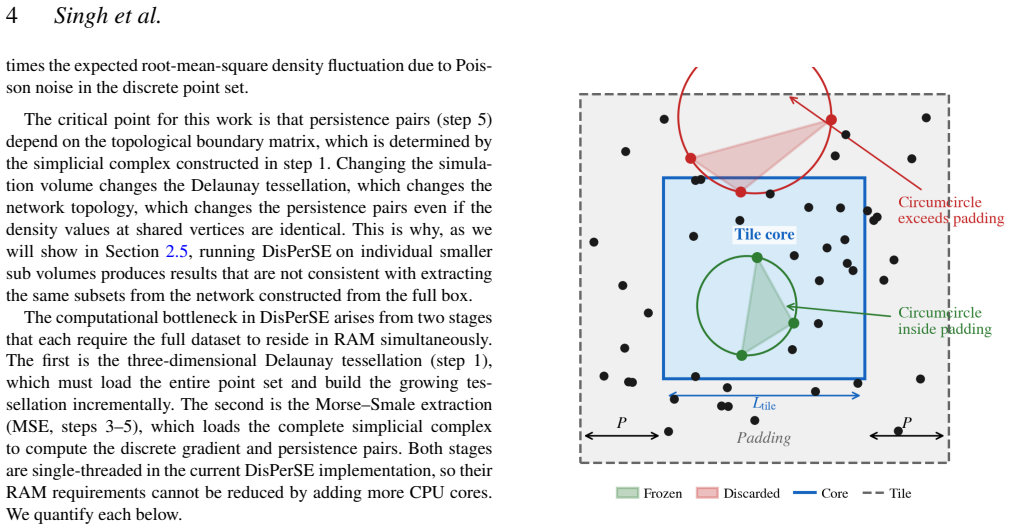
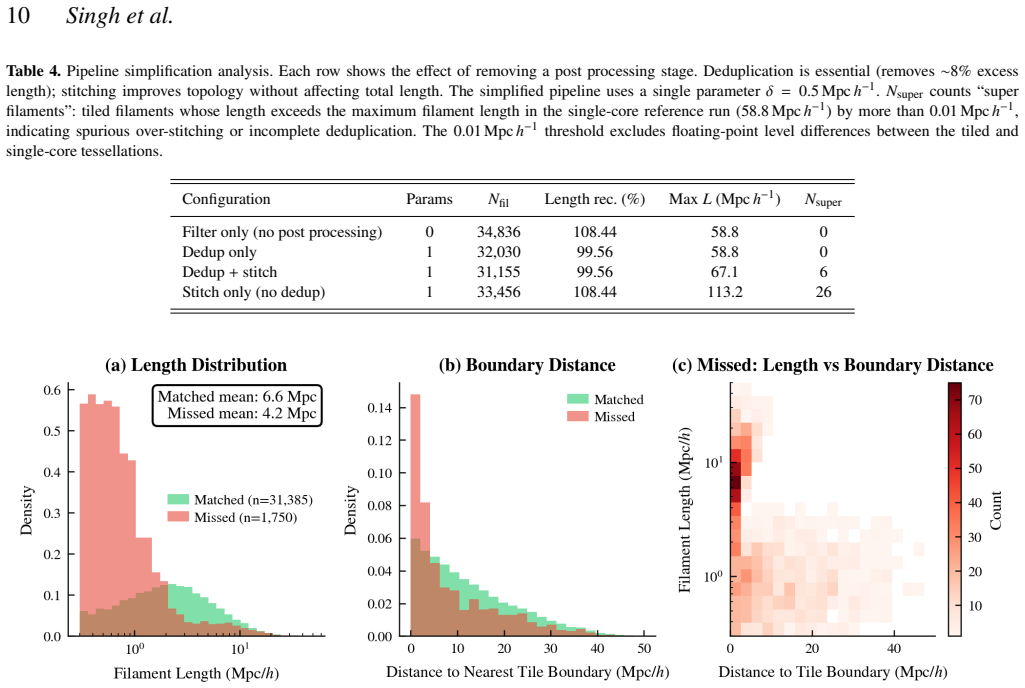
The central object is the circumsphere of a Delaunay tetrahedron. The empty-circumsphere property defines global validity: a tetrahedron belongs to the global Delaunay tessellation if no other input point lies inside its circumsphere. By padding each tile with a layer whose width is set from the circumradius distribution (60 Mpc/h for MDPL2, capturing 99.33% of tetrahedra) and discarding tetrahedra whose circumspheres cross the padded boundary, the surviving 'frozen core' tetrahedra are guaranteed identical to the monolithic tessellation. A post-processing pipeline with a single tolerance parameter δ=0.5 Mpc/h then deduplicates and stitches filaments across tile boundaries.
Load-bearing premise
The monolithic reference run with 60 Mpc/h padding is treated as the true global cosmic-web topology, even though rare void tetrahedra have circumspheres extending to 273 Mpc/h or more, so points outside that padding could alter the reference tessellation itself.
What would settle it
Run the frozen-core tiled pipeline on a larger reference volume (e.g., a 500 Mpc/h core with 200 Mpc/h padding, or a fully periodic 1 Gpc box) and compare the tiled output against that monolithic result; if the 99.6% length recovery and 94.7% filament matching degrade when the reference padding is increased, the original reference was not the true global tessellation.
If this is right
- DisPerSE can now be applied to next-generation simulations with 10^8–10^9 tracer objects, such as Euclid Flagship and FLAMINGO volumes, using bounded memory per compute node.
- Density maxima and minima are recovered at 100%, so node-based studies (cluster identification, void centres) can rely on the tiled catalogue as faithfully as on a monolithic run.
- The mass-connectivity power law is confirmed in a pure dark-matter halo catalogue across three decades in halo mass, matching gas-based and persistent-homology slopes.
- Filament catalogues at multiple persistence thresholds provide a quantitative reference for the length distribution and number density of the cosmic web in the largest volume analysed to date.
- The method is embarrassingly parallel and scales to arbitrarily large volumes by increasing the number of tiles while keeping per-node memory constant.
Where Pith is reading between the lines
- The circumsphere-filtering principle is not tied to DisPerSE; it could generalize to other Delaunay-based estimators, such as DTFE density fields or topological analyses of other point processes, wherever a global tessellation is assumed.
- The padding width is set by the tracer's circumradius distribution and may become impractically large for sparse tracers with heavy tails, suggesting that for such data a probabilistic (rather than absolute) guarantee of global validity would need to be accepted.
- The 5% unmatched short filaments, distributed throughout the volume rather than only at boundaries, indicate that the method is conservative by design; studies requiring exact per-filament fidelity around individual objects should still use monolithic runs on smaller regions.
- The stability of the connectivity slope across persistence thresholds suggests that the mass-connectivity relation is a robust feature of the cosmic web topology, not an artifact of threshold choice, which could simplify comparisons between future surveys and simulations.
Editorial analysis
A structured set of objections, weighed in public.
Referee Report
Summary. The paper presents a frozen-core, multi-block method for running DisPerSE on gigaparsec-scale halo catalogues. The volume is split into overlapping tiles; each tile is padded and tessellated independently; a circumsphere filter retains only tetrahedra whose circumspheres lie entirely inside the padded tile, which are guaranteed to belong to the global Delaunay tessellation; a post-processing pipeline merges the tiled outputs via core filtering, KDTree-based deduplication, and boundary stitching. Validation against a monolithic reference run on a 300 Mpc/h MDPL2 subvolume reports 99.6% total filament-length recovery, 94.7% individual filament matching, and 100% recovery of density maxima and minima. The method is applied to the full (1 Gpc/h)^3 MDPL2 box with 92 million haloes, producing a Gpc-scale filament catalogue at three persistence thresholds. As an application, the paper measures the mass–connectivity relation for ~22,900 haloes from 10^12 to 10^15.5 M_sun/h, reporting a power-law slope A ≈ 0.27–0.315 at 1.5R200 and claiming agreement with gas-based and theoretical results.
Significance. If the claims are accurate, this is a practically important contribution: it removes the dominant memory bottleneck of DisPerSE and enables topologically rigorous filament extraction in volumes inaccessible to monolithic runs. The validation design is a genuine strength: a direct comparison against a monolithic reference, a systematic ablation of pipeline stages, and a public simulation/data set. The connectivity analysis is a useful first Gpc-scale halo-based measurement and the reported slope is consistent with independent gas-based and persistent-homology analyses. However, several headline claims — 'preserving global topology', 'across three decades', and 'first confirmation in an N-body halo catalogue' — overstate what is actually demonstrated and need to be corrected or qualified.
major comments (3)
- [§2.4.1, Table 1, §2.5.4, §4.2] The validation reference is itself a finite-padded approximation, not the true global Delaunay/Morse-Smale complex. The circumsphere criterion is one-directional: a tetrahedron whose circumsphere lies wholly inside the padded tile is globally valid, but the converse is not established. With P=60 Mpc/h capturing only 99.33% of tetrahedra and a 99.9th-percentile circumradius of 273 Mpc/h, a tail of tetrahedra has circumspheres extending beyond the padding; points in the rest of the 1 Gpc/h box could invalidate such tetrahedra. The monolithic reference uses the same P=60 Mpc/h and is therefore itself an approximation. The quoted 99.6% length and 94.7% filament recovery rates measure agreement with this P=60-specific reference, not with the global topology that the abstract claims to preserve. The paper partially concedes this in §4.2 ('to within the 0.37 per cent of tetrahedra whose circums
- [Abstract; §3.3.4; Fig. 13] The abstract claims the mass–connectivity relation 'extends ... across three decades in halo mass', but the paper itself states in §3.3.4 that 'The power-law relation holds over nearly two decades in halo mass above the κ > 2 threshold'. The fit uses only bins with mean κ > 2, so the range 10^12–10^15.5 M_sun/h is not fully covered by the fitted power law. This is a direct inconsistency between the abstract/conclusions and the actual fitted range. Revise the abstract and conclusions to 'nearly two decades' (or fit the full range and report the resulting slope).
- [Abstract; §3.3.5] The abstract's claim of 'the first confirmation in an N-body halo catalogue that the theoretically predicted scaling holds across three decades in halo mass' appears contradicted by the paper's own literature review. Section 3.3.5 states that Galárraga-Espinosa et al. (2024) 'measured connectivity from DisPerSE applied to the MillenniumTNG halo catalogue in a (500 h−1 Mpc)^3 box ... Their slopes are consistent with our values', and earlier work such as Colberg et al. (2005) also used N-body simulations. Unless 'first' is narrowly meant as 'first at Gpc scale' or 'first across a specific mass range', the novelty claim is inaccurate. Please specify precisely what is new and avoid a blanket 'first confirmation' statement.
minor comments (4)
- [Table 1 caption; §2.4.1] The text says the 60 Mpc/h padding captures 99.33% of tetrahedra, but the Table 1 caption says 'captures 99.3 per cent'. Unify the precision.
- [§2.4.2] The statement that 'the 60 Mpc/h padding used in our pipeline therefore provides ample margin' is too strong given the long circumradius tail (99.9th percentile 273 Mpc/h) and the 0.37% of tetrahedra extending beyond the padding. Reword to reflect the residual tail.
- [§5 conclusion (i) and Table 4] The conclusion says deduplication removes '10 per cent excess length from tile overlaps', but Table 4 shows the filter-only configuration has 108.44% of the reference length, an excess of ~8.4%, not 10%. Correct the number.
- [§4.3] The phrase 'parameter free identification of DisPerSE' is inaccurate: DisPerSE has a user-specified persistence threshold nσ and smoothing parameter, as the paper itself describes in §2.2. Rephrase as e.g. 'non-stochastic' or 'deterministic with a single significance threshold'.
Circularity Check
No significant circularity: tiling validated against an independent monolithic benchmark; connectivity compared with external theory.
full rationale
The paper's derivation chain is self-contained rather than circular. The frozen-core guarantee (§2.4, Fig. 1) is the standard Delaunay empty-circumsphere property: if a tetrahedron's circumsphere lies entirely inside a padded tile, no point outside the tile can lie inside that sphere, so the tetrahedron is valid in the global tessellation. This is a mathematical implication, not a fit. The padding width P=60 Mpc/h is calibrated from the circumradius distribution of the same catalogue, but the headline validation is an independent pipeline comparison: the tiled output is matched against a monolithic DisPerSE run on a 300 Mpc/h subvolume (§2.5.4, Table 3), and the one post-processing parameter δ=0.5 Mpc/h is shown to be stable over δ<0.7 Mpc/h (Appendix A2), so the 99.6% length / 94.7% filament recovery are not forced by construction. The connectivity slope (§3.3.4) is measured from the produced catalogue and then compared with external analytic and gas-based results (Codis et al. 2018; Santoni et al. 2024); it is not derived from them. The paper explicitly flags the finite-padding caveat in §4.2 ('to within the 0.37 per cent of tetrahedra whose circumspheres extend beyond the padding'), i.e. the monolithic reference is not the exact global complex of the full 1 Gpc/h box. That is a validation-ground-truth limitation, honestly stated, but not a circular reduction: no central number is defined in terms of the quantity it is supposed to predict, and no load-bearing step rests on a self-citation chain.
Axiom & Free-Parameter Ledger
free parameters (7)
- Padding width P =
60 h^-1 Mpc
- Matching tolerance delta =
0.5 h^-1 Mpc
- Persistence threshold n_sigma =
6.5 (fiducial)
- 20-particle mass cut =
M_vir >= 3.02e10 h^-1 M_sun
- Topological cleaning thresholds (zero-length, isolated maxima, length filter) =
0.01 h^-1 Mpc, degree-1 removal, 1 h^-1 Mpc
- Filament merging angle and endpoint tolerance =
60 degrees, 0.5 h^-1 Mpc
- Smoothing iterations =
10
axioms (5)
- standard math The empty-circumsphere property characterizes Delaunay tetrahedra globally.
- domain assumption The 300 h^-1 Mpc monolithic run with 60 h^-1 Mpc padding represents the true global topology.
- domain assumption DisPerSE's Morse-Smale complex on the 20-particle-cut halo catalogue defines the physical cosmic-web filaments.
- ad hoc to paper The purity/completeness ratio calibration (R ~ 1) selects the correct persistence threshold.
- domain assumption Codis et al. (2018) provides the theoretical mass-connectivity scaling being confirmed.
read the original abstract
Cosmic filaments are the longest structures in the Universe and the dominant element of the cosmic web, channelling matter onto clusters and shaping the environments in which galaxies form and evolve. Accurate reconstructions of this network across gigaparsec volumes are increasingly important for cosmology and galaxy evolution. However, the most commonly used topological filament finder, DisPerSE (Discrete Persistent Structures Extractor), faces a memory bottleneck: it requires a Delaunay tessellation of the full input point set, preventing application to large simulations. Naively splitting the volume fails, as different sub-volumes yield inconsistent tessellations and filament networks. We present a frozen-core method that overcomes this bottleneck while preserving the global topology. The volume is decomposed into overlapping blocks whose tessellations are filtered by a circumsphere criterion retaining only globally valid tetrahedra; a post-processing pipeline merges the tiled outputs through core filtering, deduplication, and boundary stitching. Validation against a monolithic reference on a $300\,h^{-1}\,\mathrm{Mpc}$ MDPL2 subvolume shows 99.6% total length recovery, 100% recovery of density maxima and minima, and 94.7% individual filament matching (the ${\sim}$5% of unmatched filaments are predominantly short, low-significance structures). We apply the method to the full $(1\,h^{-1}\,\mathrm{Gpc})^3$ MDPL2 box (92 million haloes), producing a gigaparsec-scale filament catalogue. As a first application, we measure the connectivity ($\kappa$) for 22,900 haloes spanning $M_{200\mathrm{c}} = 10^{12}$-$10^{15.5}\,h^{-1}\,\mathrm{M}_\odot$, finding a power-law mass-connectivity relation that extends from group to cluster scales, providing the first confirmation in an $N$-body halo catalogue that the theoretically predicted scaling holds across three decades in halo mass.
Figures






Reference graph
Works this paper leans on
-
[1]
Ultraviolet and optical view of galaxies in the Coma supercluster. , keywords =. doi:10.1093/mnras/sty1370 , archivePrefix =. 1805.09029 , primaryClass =
-
[2]
The Environmental Dependence of the Stellar Mass - Gas Metallicity Relation in Horizon Run 5. , keywords =. doi:10.1093/mnras/stae1384 , archivePrefix =. 2404.10055 , primaryClass =
-
[3]
The role of large-scale environment in shaping the stellar mass-gas metallicity relation across time. , keywords =. doi:10.1093/mnras/stag199 , archivePrefix =. 2503.12928 , primaryClass =
-
[4]
3: The constructions and statistics of 3-D Voronoi tessellations
Fragmenting the Universe. 3: The constructions and statistics of 3-D Voronoi tessellations. , keywords =
-
[5]
Multiscale phenomenology of the cosmic web. , keywords =. doi:10.1111/j.1365-2966.2010.17263.x , archivePrefix =. 1007.0742 , primaryClass =
arXiv 2010
-
[7]
The persistent cosmic web and its filamentary structure - II. Illustrations. , keywords =. doi:10.1111/j.1365-2966.2011.18395.x , archivePrefix =. 1009.4014 , primaryClass =
arXiv 2011
-
[8]
Galaxy And Mass Assembly (GAMA): stellar mass growth of spiral galaxies in the cosmic web. , keywords =. doi:10.1093/mnras/stw134 , archivePrefix =. 1601.03391 , primaryClass =
-
[9]
From voids to filaments: environmental transformations of galaxies in the SDSS. , keywords =. doi:10.1051/0004-6361/201730526 , archivePrefix =. 1703.04338 , primaryClass =
-
[10]
Study of galaxies on large-scale filaments in simulations. , keywords =. doi:10.1093/mnras/staa1913 , archivePrefix =. 2007.01149 , primaryClass =
Pith/arXiv arXiv 2007
-
[11]
The Statistics of Peaks of Gaussian Random Fields. , keywords =. doi:10.1086/164143 , adsurl =
-
[12]
The ROCKSTAR Phase-Space Temporal Halo Finder and the Velocity Offsets of Cluster Cores. , keywords =. doi:10.1088/0004-637X/762/2/109 , archivePrefix =. 1110.4372 , primaryClass =
-
[13]
J Richard Bond and Lev Kofmant and Dmitry Pogosyan , title =. 1996 , url =. doi:https://doi.org/10.1038/380603a0 , journal =
doi:10.1038/380603a0 1996
-
[14]
How galaxy properties vary with filament proximity in the SIMBA simulations , url =
Teodora-Elena Bulichi and Romeel Dave and Katarina Kraljic , month =. How galaxy properties vary with filament proximity in the SIMBA simulations , url =. doi:https://doi.org/10.48550/arXiv.2309.03282 , journal =
-
[15]
NEXUS: tracing the cosmic web connection. , keywords =. doi:10.1093/mnras/sts416 , archivePrefix =. 1209.2043 , primaryClass =
Pith/arXiv arXiv 2043
-
[16]
Evolution of the cosmic web. , keywords =. doi:10.1093/mnras/stu768 , archivePrefix =. 1401.7866 , primaryClass =
-
[17]
Where Are the Baryons?. , keywords =. doi:10.1086/306949 , archivePrefix =. astro-ph/9806281 , primaryClass =
-
[18]
Detecting effects of filaments on galaxy properties in the Sloan Digital Sky Survey III. , keywords =. doi:10.1093/mnras/stw3127 , archivePrefix =. 1509.06376 , primaryClass =
-
[19]
On the connectivity of the cosmic web: theory and implications for cosmology and galaxy formation. , keywords =. doi:10.1093/mnras/sty1643 , archivePrefix =. 1803.11477 , primaryClass =
-
[20]
The localization of galaxy groups in close proximity to galaxy clusters using cosmic web nodes. , keywords =. doi:10.1093/mnras/stad3205 , archivePrefix =. 2310.11268 , primaryClass =
-
[21]
The Three Hundred project: a large catalogue of theoretically modelled galaxy clusters for cosmological and astrophysical applications. , keywords =. doi:10.1093/mnras/sty2111 , archivePrefix =. 1809.04622 , primaryClass =
-
[22]
Group connectivity in COSMOS: a tracer of mass assembly history. , keywords =. doi:10.1093/mnras/stz2490 , archivePrefix =. 1904.11859 , primaryClass =
Pith/arXiv arXiv 1904
-
[23]
Spectroscopic Study of Star-forming Galaxies in Filaments and the Field at z -0.5ex 0.5: Evidence for Environmental Dependence of Electron Density. , keywords =. doi:10.1088/0004-637X/814/2/84 , archivePrefix =. 1510.05009 , primaryClass =
-
[24]
Cold streams in early massive hot haloes as the main mode of galaxy formation. , keywords =. doi:10.1038/nature07648 , archivePrefix =. 0808.0553 , primaryClass =
-
[25]
A SLICE OF THE UNIVERSE 1 , volume =
Valérie de Lapparent and Margaret J Geller and John P Huchra , doi =. A SLICE OF THE UNIVERSE 1 , volume =. The Astrophysical Journal , keywords =
-
[26]
Callumn Donnan and Rita Tojeiro and Katarina Kraljic , journal =. The role of the cosmic web in the scatter of the galaxy stellar mass - gas metallicity relation , url =. doi:https://doi.org/10.1038/s41550-022-01619-w , month =
-
[27]
Galaxy morphology in rich clusters: implications for the formation and evolution of galaxies. , keywords =. doi:10.1086/157753 , adsurl =
-
[28]
Contemporary Mathematics , year = 2008, volume =
Persistent homology --- a survey. Contemporary Mathematics , year = 2008, volume =
2008
-
[29]
Populations of filaments from the distribution of galaxies in numerical simulations. , keywords =. doi:10.1051/0004-6361/202037986 , archivePrefix =. 2003.09697 , primaryClass =
Pith/arXiv arXiv 2003
-
[30]
Distinguish satisfactory and unsatisfactory dark matter models with the cosmic web. , keywords =. doi:10.1051/0004-6361/202452238 , archivePrefix =. 2402.04837 , primaryClass =
-
[31]
Properties of gas phases around cosmic filaments at z = 0 in the IllustrisTNG simulation. , keywords =. doi:10.1051/0004-6361/202039781 , archivePrefix =. 2010.15139 , primaryClass =
Pith/arXiv arXiv 2010
-
[32]
Relative distribution of dark matter, gas, and stars around cosmic filaments in the IllustrisTNG simulation. , keywords =. doi:10.1051/0004-6361/202141974 , archivePrefix =. 2109.06198 , primaryClass =
-
[33]
Evolution of cosmic filaments in the MTNG simulation. , keywords =. doi:10.1051/0004-6361/202347982 , archivePrefix =. 2309.08659 , primaryClass =
-
[34]
1989 , doi =
Margaret J Geller and John P Huchra , title =. 1989 , doi =
1989
-
[35]
C. Gouin and T. Bonnaire and N. Aghanim , doi =. Shape and connectivity of groups and clusters: Effect of the dynamical state and accretion history , volume =. Astronomy and Astrophysics , keywords =. 2101.04686 , archivePrefix =
-
[36]
The Evolving Effect of Cosmic Web Environment on Galaxy Quenching. , keywords =. doi:10.3847/1538-4357/acd11c , archivePrefix =. 2303.08088 , primaryClass =
-
[37]
The effect of cosmic web filaments on galaxy properties in the RESOLVE and ECO surveys. , keywords =. doi:10.1093/mnras/stae066 , archivePrefix =. 2401.09114 , primaryClass =
-
[38]
How do galaxies get their gas?. , keywords =. doi:10.1111/j.1365-2966.2005.09451.x , archivePrefix =. astro-ph/0407095 , primaryClass =
arXiv 2005
-
[39]
MultiDark simulations: the story of dark matter halo concentrations and density profiles. , keywords =. doi:10.1093/mnras/stw248 , archivePrefix =. 1411.4001 , primaryClass =
-
[40]
Galaxy evolution in the metric of the cosmic web. , keywords =. doi:10.1093/mnras/stx2638 , archivePrefix =. 1710.02676 , primaryClass =
-
[41]
COSMOS2015 photometric redshifts probe the impact of filaments on galaxy properties. , keywords =. doi:10.1093/mnras/stx3055 , archivePrefix =. 1702.08810 , primaryClass =
-
[42]
Tracing the cosmic web. , keywords =. doi:10.1093/mnras/stx1976 , archivePrefix =. 1705.03021 , primaryClass =
-
[43]
Galaxy segregation on the cosmic web from PDR-2
The VIMOS Public Extragalactic Redshift Survey. Galaxy segregation on the cosmic web from PDR-2. , keywords =. doi:10.1093/mnras/stw2864 , archivePrefix =. 1611.07045 , primaryClass =
-
[44]
Like a spider in its web: a study of the large-scale structure around the Coma cluster. , keywords =. doi:10.1051/0004-6361/201936629 , archivePrefix =. 1910.11879 , primaryClass =
Pith/arXiv arXiv 1910
-
[45]
The Effect of Filaments and Tendrils on the H I Content of Galaxies. , keywords =. doi:10.3847/1538-4357/aaa1e8 , archivePrefix =. 1712.05045 , primaryClass =
-
[46]
and Boots, B
Okabe, A. and Boots, B. and Sugihara, K. and Chiu, S. N. , title =
-
[47]
The effect of cosmic web filaments on galaxy evolution. , keywords =. doi:10.1093/mnras/stae2142 , archivePrefix =. 2409.09028 , primaryClass =
-
[48]
Mass and Environment as Drivers of Galaxy Evolution in SDSS and zCOSMOS and the Origin of the Schechter Function. , keywords =. doi:10.1088/0004-637X/721/1/193 , archivePrefix =. 1003.4747 , primaryClass =
-
[49]
Planck 2013 results. XVI. Cosmological parameters. , year = 2014, month = nov, volume =. doi:10.1051/0004-6361/201321591 , archivePrefix =. 1303.5076 , primaryClass =
Pith/arXiv arXiv 2013
-
[50]
Astronomische Nachrichten , keywords =
The MultiDark Database: Release of the Bolshoi and MultiDark cosmological simulations. Astronomische Nachrichten , keywords =. doi:10.1002/asna.201211900 , archivePrefix =. 1109.0003 , primaryClass =
-
[51]
THE THREE HUNDRED project: Estimating the dependence of gas filaments on the mass of galaxy clusters. , keywords =. doi:10.1051/0004-6361/202450895 , archivePrefix =. 2405.17239 , primaryClass =
-
[52]
Sarron and C
F. Sarron and C. Adami and F. Durret and C. Laigle , doi =. Pre-processing of galaxies in cosmic filaments around AMASCFI clusters in the CFHTLS , volume =. Astronomy and Astrophysics , keywords =
-
[53]
, keywords =
Continuous fields and discrete samples: reconstruction through Delaunay tessellations. , keywords =
-
[54]
Beyond halo mass: Quenching galaxy mass assembly at the edge of filaments , volume =
Hyunmi Song and Clotilde Laigle and Ho Seong Hwang and Julien Devriendt and Yohan Dubois and Katarina Kraljic and Christophe Pichon and Adrianne Slyz and Rory Smith , doi =. Beyond halo mass: Quenching galaxy mass assembly at the edge of filaments , volume =. Monthly Notices of the Royal Astronomical Society , keywords =
-
[55]
Detecting filamentary pattern in the cosmic web: a catalogue of filaments for the SDSS. , keywords =. doi:10.1093/mnras/stt2454 , archivePrefix =. 1308.2533 , primaryClass =
-
[56]
An unbiased study of the association of large-scale structure with AGN and galaxy evolution. , keywords =. doi:10.1093/mnras/stz1399 , archivePrefix =. 1905.08942 , primaryClass =
Pith/arXiv arXiv 1905
-
[57]
Fragmentation of a homogeneous medium under the action of gravitation
Ya B Zel'dovich , issue =. Fragmentation of a homogeneous medium under the action of gravitation. , volume =. doi:https://doi.org/10.1007/BF01007263 , journal =
-
[58]
Baryons in the Warm-Hot Intergalactic Medium. , keywords =. doi:10.1086/320548 , archivePrefix =. astro-ph/0007217 , adsurl =
-
[59]
The effects of the cosmic web on galaxy evolution. , keywords =. doi:10.1093/mnras/staa1083 , archivePrefix =. 2004.08408 , adsurl =
Pith/arXiv arXiv 2004
-
[60]
Cosmic filaments in galaxy cluster outskirts: quantifying finding filaments in redshift space. , keywords =. doi:10.1093/mnras/stab567 , archivePrefix =. 2102.12500 , adsurl =
-
[61]
Topological bias: how haloes trace structural patterns in the cosmic web. , keywords =. doi:10.1093/mnras/stae801 , archivePrefix =. 2206.14655 , adsurl =
-
[62]
The cosmic web around the Coma cluster from constrained cosmological simulations. I. Filaments connected to Coma at z = 0. , keywords =. doi:10.1051/0004-6361/202245777 , archivePrefix =. 2306.03124 , adsurl =
-
[63]
The MillenniumTNG Project: the hydrodynamical full physics simulations, their calibration and validation. , year = 2023, volume =. doi:10.1093/mnras/stad2027 , archivePrefix =. 2210.10060 , primaryClass =
Pith/arXiv arXiv 2023
-
[64]
The FLAMINGO project: cosmological hydrodynamical simulations for large-scale structure and galaxy cluster surveys. , year = 2023, volume =. doi:10.1093/mnras/stad2419 , archivePrefix =. 2306.04024 , primaryClass =
Pith/arXiv arXiv 2023
-
[65]
Euclid. V. The Flagship galaxy mock catalogue. , year = 2025, doi =
2025
-
[66]
Large Scale Structure and the Cosmic Web. arXiv e-prints , keywords =. doi:10.48550/arXiv.2503.21759 , archivePrefix =. 2503.21759 , primaryClass =
-
[67]
Statistical Properties of X-Ray Clusters: Analytic and Numerical Comparisons. , keywords =. doi:10.1086/305262 , archivePrefix =. astro-ph/9710107 , adsurl =
-
[68]
Intercluster filaments in a
Colberg, J. Intercluster filaments in a. Monthly Notices of the Royal Astronomical Society , volume =. 2005 , month = may, doi =
2005
-
[69]
Cohn, J. D. , title =. Monthly Notices of the Royal Astronomical Society , volume =. 2022 , month = jun, doi =. 2108.02292 , archivePrefix=
Pith/arXiv arXiv 2022
-
[70]
Monthly Notices of the Royal Astronomical Society , volume =
Zhang, Youcai and Guo, Hong and Yang, Xiaohu and Wang, Peng , title =. Monthly Notices of the Royal Astronomical Society , volume =. 2024 , month = sep, doi =. 2408.03083 , archivePrefix=
Pith/arXiv arXiv 2024
-
[71]
arXiv e-prints , keywords =
Evolution of submillimeter galaxies across cosmic-web environments. arXiv e-prints , keywords =
-
[72]
The role of cosmic connectivity in shaping galaxy clusters
Euclid Quick Data Release (Q1). The role of cosmic connectivity in shaping galaxy clusters. arXiv e-prints , keywords =
-
[73]
Galaxy shapes and alignments in the cosmic web
Euclid Quick Data Release (Q1). Galaxy shapes and alignments in the cosmic web. arXiv e-prints , keywords =
discussion (0)
Sign in with ORCID, Apple, or X to comment. Anyone can read and Pith papers without signing in.