REVIEW 4 major objections 5 minor 19 references
A learning layer that adjusts obstacle inflation in a visibility-graph planner makes a humanoid robot navigate more robustly under control delay and sensor noise than either a fixed-geometry MPC or a pure end-to-end RL policy.
Reviewed by Pith at T0; open to challenge. T0 means a machine referee read the full paper against a public rubric. the ladder, T0–T4 →
T0 review · deepseek-v4-flash
2026-08-01 22:31 UTC pith:RCN3KPHU
load-bearing objection A sensible hybrid-planner idea—RL adapting visibility-graph inflation radii—is let down by single-scenario, no-variance evaluation; still worth a serious referee. the 4 major comments →
RAVEN: Reinforcement-Adaptive Visibility-Graph Planning for Robust Humanoid Navigation with Collision-Free MPC
The pith
A machine-rendered reading of the paper's core claim, the machinery that carries it, and where it could break.
Core claim
The central claim is that learned adaptation of a geometric planner parameter—obstacle inflation—is an effective, interpretable middle ground between rigid classical planning and monolithic end-to-end reinforcement learning. The meta-policy observes the delayed, noisy robot state and outputs an inflation radius for each obstacle in a visibility-graph planner; larger radii push the shortest path further from obstacles, smaller radii allow it to cut closer. Since the graph always returns the shortest path under the current geometry, the RL search is constrained to a family of shortest-path solutions, which the paper argues both guides exploration and preserves global efficiency. The downstream
What carries the argument
The load-bearing object is the adaptive obstacle-inflation radius in the Dynamic Augmented Visibility Graph. A visibility graph is a graph whose vertices include obstacle vertices and the start and goal, with edges between any two mutually visible vertices; shortest paths through it are piecewise straight and tangent to inflated obstacles. RAVEN lets a reinforcement-learning meta-policy choose each obstacle's inflation radius continuously, so the learned layer effectively morphs the graph's geometry and therefore the topology of the planned path. The collision-free MPC layer tracks the planned trajectory through a quadratic program that enforces velocity and acceleration limits and linearize
Load-bearing premise
The learned inflation policy transfers from simulation to the physical robot because the simulation faithfully reproduces the robot's control delay, observation noise, and low-level tracking behavior; if the real tracking-error distribution differs from the simulated one, the claimed real-world robustness is not established.
What would settle it
Run the trained RAVEN policy on the physical humanoid for repeated trials with the same start, goal, and obstacle layout under the nominal 0.06 s delay, and measure per-trial maximum obstacle penetration and success rate; if the median penetration exceeds the 0.03 m safety bound or trials fail at a rate not observed in simulation, the central robustness claim is falsified.
If this is right
- Under 0.06 s actuation delay, RAVEN keeps maximum obstacle penetration at 0.03 m while the fixed-inflation MPC baseline reaches 0.128 m, supporting the claim that geometric adaptation suppresses delay-induced overshoot.
- RAVEN's average path length (9.33 m) and time to completion (11.58 s) are better than both the classical baseline (11.25 m, 12.32 s) and the end-to-end RL baseline (9.80 m, 12.21 s), showing that learning over shortest-path structures preserves efficiency while adding robustness.
- Because the MPC layer, not a learned network, enforces velocity and obstacle constraints, the framework retains explicit safety guarantees and runs at about 100 Hz, fast enough for real-time humanoid navigation.
- The asymmetric actor-critic design—the actor sees delayed noisy states while the critic sees privileged clean states—is intended to make the learned inflation policy transfer from simulation to the physical robot.
- The approach suggests that learning at the level of geometric planning parameters, rather than control weights or raw commands, can be a scalable way to add adaptability to classical navigation stacks.
Where Pith is reading between the lines
- An implication the paper leaves implicit is that the same mechanism of learning geometric parameters rather than control weights could be applied to other graph-based or sampling-based planners, for example adapting connection radii or sample distributions in a probabilistic roadmap, with similar interpretability.
- A natural testable extension is to train the meta-policy with moving obstacles; the learned inflation schedule could then be examined to see whether the robot pre-inflates obstacles on the side where control delay is largest.
- The paper's hardware evidence is a single qualitative trajectory comparison; a quantitative multi-trial deployment measuring per-trial penetration depth and success rate would directly substantiate the sim-to-real claim.
- Since control delay is the dominant disturbance, a fixed analytic rule that inflates obstacles as a function of current speed and heading rate might capture much of the benefit; comparing RAVEN against such a hand-designed schedule would isolate what the learned adaptation adds beyond a well-chosen static inflation policy.
Editorial analysis
A structured set of objections, weighed in public.
Referee Report
Summary. RAVEN is a hierarchical navigation framework for humanoid robots. A PPO meta-policy observes robot, goal, and obstacle states and outputs per-obstacle inflation radii used by the DA VG visibility-graph planner; the resulting shortest path is tracked by a cf-MPC layer with linearized obstacle constraints and a low-level locomotion policy. The paper compares RAVEN with a fixed-radius DA VG-cfMPC baseline and an end-to-end RL baseline under zero delay and 0.06 s delay in a single simulation scenario (Table V), and reports a qualitative hardware demonstration on the T1 robot. The central claim is that RL-adapted geometric graph construction is more robust and more efficient than both static MPC and pure RL while retaining interpretability.
Significance. The idea of using RL to modify obstacle inflation in a visibility graph is a genuinely different integration point from prior work that tunes MPC cost weights or generates subgoals; it has the potential to be interpretable and sample-efficient because the graph shortest-path structure provides a planning prior. Strengths include a JAX/GPU implementation with parallel training, a deliberate attempt to equalize total training time between RAVEN and the pure RL baseline, and a real-hardware deployment with a low-level locomotion policy. No circularity is apparent: the learned inflation behavior is not forced by the reward construction. However, the evidence base is too narrow to support the broad robustness and sim-to-real claims made in the paper.
major comments (4)
- [§V-A, Table V] The quantitative support for the main claim rests on a single scenario: one start pose, one goal pose, and three fixed obstacles. The table reports 'Average' metrics with no number of episodes, no seeds, no standard deviations, and no significance tests. The observed margins (e.g., 9.33 m vs 9.80 m path length and 11.58 s vs 12.21 s completion time under 0.06 s delay) could easily be within run-to-run variance. Since the RL meta-policy is trained on randomized episodes, a held-out, multi-seed evaluation over varied obstacle layouts and start/goal configurations is necessary before claiming superiority.
- [§III-A and §V-A, Table V(b)] The term 'collision-free MPC' is contradicted by the reported 'Ave. Max Obstacle Penetration Depth' of 0.03 m for RAVEN and 0.128 m for the baseline. The constraint in §III-A contains a slack variable δ_j ≥ 0, so it is a soft constraint that permits penetration. The paper should either rename this layer or explicitly frame the guarantee as bounded penetration under a chosen safety margin; otherwise the title, abstract, and conclusion overstate the safety property.
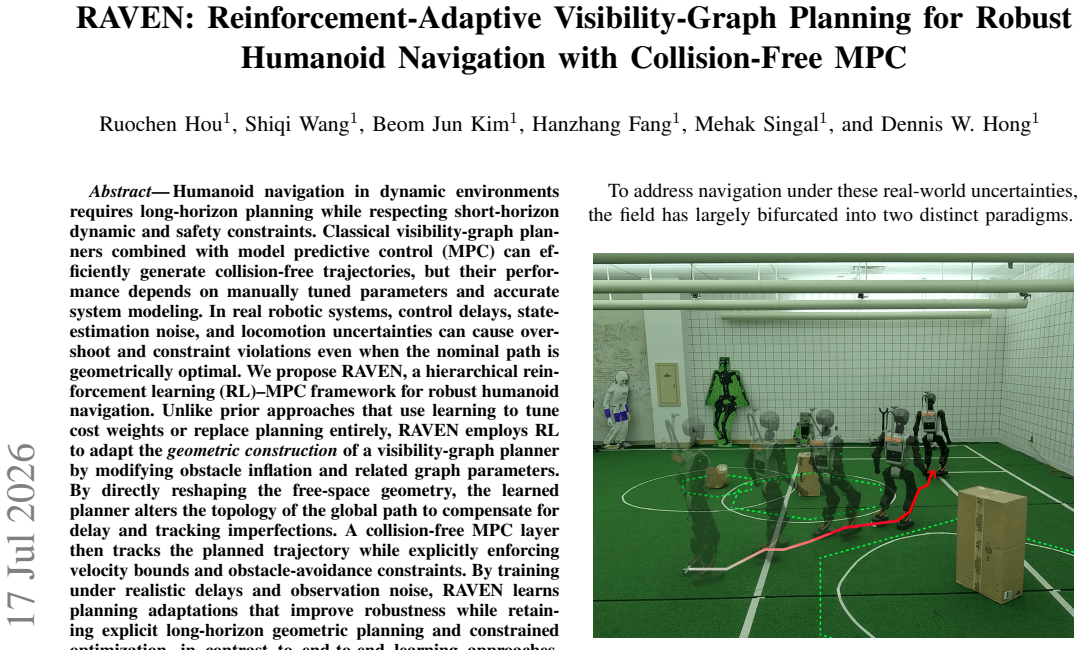
- [§V-B] The hardware demonstration is a single qualitative trajectory comparison: no success criteria, no repeated trials, and no quantitative metrics such as completion time, penetration depth, or failure count. The text concludes 'more reliable navigation' and 'consistent performance across simulation and real-world' from Fig. 5, but the figure only shows curves. Additionally, the hardware start pose (3.4, -1.0, 1.57) differs from the simulation scenario in Table V (3.0, -1.0, -1.57), making it unclear what the simulated rollout in Fig. 5 was compared against. This section does not support the sim-to-real transfer claim.
- [§IV-A, §V-A] The only classical baseline uses a fixed inflation radius of 1 m, with no sensitivity analysis or systematic tuning. A central claim is that automatic adaptation is preferable to manual tuning, but a more favorable fixed radius, or a small set of tuned radii, might close much of the gap. Reporting an ablation over fixed inflation values, and ideally a comparison against RL-tuned MPC cost weights, would make the contribution of geometric adaptation load-bearing rather than an artifact of a single baseline setting.
minor comments (5)
- [§III-A] The obstacle-avoidance inequality should be numbered, and all symbols (V_{k,j}, R_obs,j, δ_j) should be defined immediately after the equation.
- [Table V] The table should state the number of evaluation episodes and seeds for each method, and the authors should consider reporting standard deviations or confidence intervals.
- [References] Reference [13] lacks publication venue, year, and bibliographic details; please complete it.
- [Throughout] The name is written inconsistently as 'RAVEN' in the title and 'RA VEN' in the body; pick one convention.
- [§V-A] The term 'penetration depth' is used without definition; define it consistently with the soft-constraint slack variables.
Circularity Check
No circular derivation: RL-adapted inflation is an open empirical result; the self-citation to the prior DAVG-cfMPC pipeline is legitimate reuse, not load-bearing.
full rationale
The paper's derivation chain is not circular. The only learned component is the RL meta-policy, which maps observations to inflation radii through an affine transformation; its behavior is determined by PPO training against a reward that includes time, path length, collision, penetration, and action-rate penalties. Table V then reports those same quantities, but this is standard evaluation of a trained policy rather than a quantity equal to the policy output by construction. The learned inflation schedule is not derivable from the reward alone: the reward does not specify which radii to select, the visibility graph still computes shortest paths, and the MPC still enforces its own constraints, so the outcome remains an empirical result. The only self-citation is [4], the authors' prior DAVG-cfMPC pipeline, used as the base planner and as the MPC baseline; this is a peer-reviewed reusable component and is not invoked to establish the new adaptive-inflation claim, so it is not load-bearing. The manuscript's use of a single 'representative navigation scenario' in Section V-A and the qualitative hardware comparison in Section V-B are validity/statistical-support concerns, not circularity steps.
Axiom & Free-Parameter Ledger
free parameters (6)
- RAVEN reward weights =
w_time=-5.0, w_path=-20.0, w_col=-8.0, w_inside=-80.0, w_ar=-0.5, R_succ=5000, R_fall=-50000
- Inflation radius bounds r_min, r_max =
not reported
- Baseline fixed inflation radius =
1.0 m
- Success/penalty thresholds =
epsilon_p=0.2, epsilon_psi=0.2, r_pen=1.0
- Delay/noise injection parameters =
0.06 s delay; noise not specified
- MPC cost weights and horizon =
not reported
axioms (5)
- domain assumption Visibility graph shortest path yields a kinematically feasible reference trajectory.
- domain assumption Linearized soft collision constraints with slack delta_j in the QP are sufficient to keep the robot collision-free during execution.
- domain assumption Booster Gym locomotion policy tracks MPC velocity commands on the T1 robot.
- domain assumption MJX simulation with injected delay and noise faithfully replicates the T1's real-world tracking behavior for training and evaluation.
- domain assumption PPO converges to a generalizable policy under the given reward and observation space.
read the original abstract
Humanoid navigation in dynamic environments requires long-horizon planning while respecting short-horizon dynamic and safety constraints. Classical visibility-graph planners combined with model predictive control (MPC) can efficiently generate collision-free trajectories, but their performance depends on manually tuned parameters and accurate system modeling. In real robotic systems, control delays, state-estimation noise, and locomotion uncertainties can cause overshoot and constraint violations even when the nominal path is geometrically optimal. We propose RAVEN, a hierarchical reinforcement learning (RL)-MPC framework for robust humanoid navigation. Unlike prior approaches that use learning to tune cost weights or replace planning entirely, RAVEN employs RL to adapt the geometric construction of a visibility-graph planner by modifying obstacle inflation and related graph parameters. By directly reshaping the free-space geometry, the learned planner alters the topology of the global path to compensate for delay and tracking imperfections. A collision-free MPC layer then tracks the planned trajectory while explicitly enforcing velocity bounds and obstacle-avoidance constraints. By training under realistic delays and observation noise, RAVEN learns planning adaptations that improve robustness while retaining explicit long-horizon geometric planning and constrained optimization, in contrast to end-to-end learning approaches. We evaluate RAVEN against a manually tuned visibility-graph MPC baseline and a pure RL navigation policy. Results demonstrate reduced overshoot near obstacles, improved robustness in narrow passages, and more reliable navigation under delay and noise. These findings indicate that reinforcement-adaptive graph construction combined with constrained MPC provides an effective and interpretable alternative to end-to-end learning for robust humanoid navigation.
Figures


Reference graph
Works this paper leans on
-
[1]
Compass: Cross-embodiment mobility policy via residual rl and skill synthesis,
W. Liu, H. Zhao, C. Li, Y . Deng, J. Biswas, S. Pouya, and Y . Chang, “Compass: Cross-embodiment mobility policy via residual rl and skill synthesis,” 2025. [Online]. Available: https://arxiv.org/abs/2502.16372
arXiv 2025
-
[2]
Anymal parkour: Learning agile navigation for quadrupedal robots,
D. Hoeller, N. Rudin, D. Sako, and M. Hutter, “Anymal parkour: Learning agile navigation for quadrupedal robots,” 2023. [Online]. Available: https://arxiv.org/abs/2306.14874
Pith/arXiv arXiv 2023
-
[3]
Z. Zhuang, Z. Fu, J. Wang, C. Atkeson, S. Schwertfeger, C. Finn, and H. Zhao, “Robot parkour learning,” 2023. [Online]. Available: https://arxiv.org/abs/2309.05665
Pith/arXiv arXiv 2023
-
[4]
Model predictive control with visibility graphs for humanoid path planning and tracking against adversarial opponents,
R. Hou, G. I. Fernandez, M. Zhu, and D. W. Hong, “Model predictive control with visibility graphs for humanoid path planning and tracking against adversarial opponents,” in2025 IEEE International Conference on Robotics and Automation (ICRA). IEEE, 2025, pp. 14 520–14 526
2025
-
[5]
Lto: lazy trajectory opti- mization with graph-search planning for high dof robots in cluttered environments,
Y . Shirai, X. Lin, A. Mehta, and D. Hong, “Lto: lazy trajectory opti- mization with graph-search planning for high dof robots in cluttered environments,” in2021 IEEE International Conference on Robotics and Automation (ICRA). IEEE, 2021, pp. 7533–7539
2021
-
[6]
C. Peng, Z. Zhang, S. Gong, S. Agrawal, K. A. Redmill, and A. Hereid, “Reinforcement learning with data bootstrapping for dynamic subgoal pursuit in humanoid robot navigation,” 2025. [Online]. Available: https://arxiv.org/abs/2506.02206
Pith/arXiv arXiv 2025
-
[7]
Hierarchical learning-enhanced mpc for safe crowd navigation with heterogeneous constraints,
H. Liu, Y . Feng, W. Dong, K. Fan, C. Wang, and Y . Gao, “Hierarchical learning-enhanced mpc for safe crowd navigation with heterogeneous constraints,” 2025. [Online]. Available: https: //arxiv.org/abs/2506.09859
Pith/arXiv arXiv 2025
-
[8]
Robot navigation with reinforcement learned path generation and fine-tuned motion control,
L. Zhang, Z. Hou, J. Wang, Z. Liu, and W. Li, “Robot navigation with reinforcement learned path generation and fine-tuned motion control,” IEEE Robotics and Automation Letters, vol. 8, no. 8, pp. 4489–4496, 2023
2023
-
[9]
Residual reinforcement learning for robot control,
T. Johannink, S. Bahl, A. Nair, J. Luo, A. Kumar, M. Loskyll, J. A. Ojea, E. Solowjow, and S. Levine, “Residual reinforcement learning for robot control,” 2018. [Online]. Available: https: //arxiv.org/abs/1812.03201
Pith/arXiv arXiv 2018
-
[10]
Mpc-net: A first principles guided policy search,
J. Carius, F. Farshidian, and M. Hutter, “Mpc-net: A first principles guided policy search,”IEEE Robotics and Automation Letters, vol. 5, no. 2, p. 2897–2904, Apr. 2020. [Online]. Available: http://dx.doi.org/10.1109/LRA.2020.2974653
arXiv 2020
-
[11]
Learning deep control policies for autonomous aerial vehicles with mpc-guided policy search,
T. Zhang, G. Kahn, S. Levine, and P. Abbeel, “Learning deep control policies for autonomous aerial vehicles with mpc-guided policy search,” 2016. [Online]. Available: https://arxiv.org/abs/1509.06791
Pith/arXiv arXiv 2016
-
[12]
Hybrid classical/rl local planner for ground robot navigation,
V . D. Sharma, J. Lee, M. Andrews, and I. Hadži ´c, “Hybrid classical/rl local planner for ground robot navigation,” 2024. [Online]. Available: https://arxiv.org/abs/2410.03066
Pith/arXiv arXiv 2024
-
[13]
Safe reinforcement learning via statistical model predictive shielding
O. Bastani, S. Li, and A. Xu, “Safe reinforcement learning via statistical model predictive shielding.”
-
[14]
T. Salzmann, E. Kaufmann, J. Arrizabalaga, M. Pavone, D. Scaramuzza, and M. Ryll, “Real-time neural mpc: Deep learning model predictive control for quadrotors and agile robotic platforms,”IEEE Robotics and Automation Letters, vol. 8, no. 4, p. 2397–2404, Apr. 2023. [Online]. Available: http://dx.doi.org/10.1109/LRA.2023.3246839
arXiv 2023
-
[15]
W. D. Compton, N. Csomay-Shanklin, C. Johnson, and A. D. Ames, “Dynamic tube mpc: Learning tube dynamics with massively parallel simulation for robust safety in practice,” 2024. [Online]. Available: https://arxiv.org/abs/2411.15350
Pith/arXiv arXiv 2024
-
[16]
Automated tuning of nonlinear model predictive controller by reinforcement learning,
M. Mehndiratta, E. Camci, and E. Kayacan, “Automated tuning of nonlinear model predictive controller by reinforcement learning,” in 2018 IEEE/RSJ International Conference on Intelligent Robots and Systems (IROS), 2018, pp. 3016–3021
2018
-
[17]
B. Zarrouki, M. Spanakakis, and J. Betz, “A safe reinforcement learning driven weights-varying model predictive control for autonomous vehicle motion control,” 2024. [Online]. Available: https://arxiv.org/abs/2402.02624
Pith/arXiv arXiv 2024
-
[18]
A. Romero, E. Aljalbout, Y . Song, and D. Scaramuzza, “Actor- critic model predictive control: Differentiable optimization meets reinforcement learning for agile flight,” 2025. [Online]. Available: https://arxiv.org/abs/2306.09852
arXiv 2025
-
[19]
Booster gym: An end-to-end reinforcement learning framework for humanoid robot locomotion,
Y . Wang, P. Chen, X. Han, F. Wu, and M. Zhao, “Booster gym: An end-to-end reinforcement learning framework for humanoid robot locomotion,”arXiv preprint arXiv:2506.15132, 2025
Pith/arXiv arXiv 2025
discussion (0)
Sign in with ORCID, Apple, or X to comment. Anyone can read and Pith papers without signing in.