REVIEW 4 major objections 6 minor 28 references
Aquarius: A Family of Industry-Level Video Generation Models for Marketing Scenarios
T0 review · 4 major / 6 minor · reviewed 2026-08-15 · deepseek-v4-flash
Pith's one-line read This paper argues that a five-part engineering recipe yields industrial-scale marketing-video generation at 2B and 13.4B scales, with 36% training efficiency and a 2.35x inference speedup.
desk verdict An honest engineering disclosure with useful training-infra details, whose headline efficiency numbers are too under-specified to check. read the letter →
The pith
A machine-rendered reading of the paper's core claim, the machinery that carries it, and where it could break.
The reading
What carries the argument
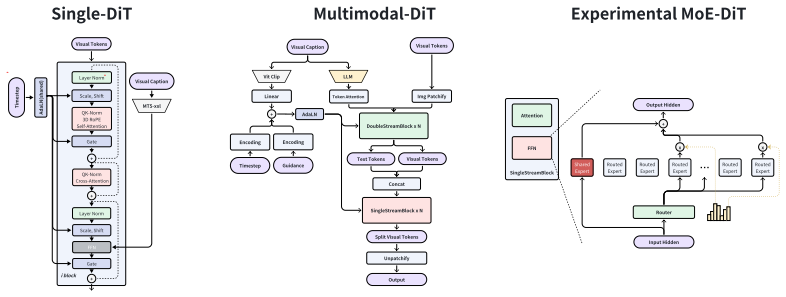
The load-bearing machinery is the integration of five named mechanisms. The 3D VAE with CausalConv3D and spatial-temporal tiling compresses video $4\times8\times8$ and supports extrapolation to arbitrary lengths while enabling tile-wise parallel encoding and decoding. The DiT pair—Single-DiT at 2B with cross-attention text conditioning, Multimodal-DiT at 13.4B with dual-stream self-attention and a multimodal large language model text encoder—is the generative backbone, and 3D RoPE (rotary position embedding applied separately to time, height, and width) lets a single model handle mixed aspect ratios and frame counts. Flow matching defines the training objective, with the model predicting the velocity $V_t = X_1 - X_0$ of the linear interpolation between noise and video. The training scaffold is bucket-based multi-stage curriculum plus hybrid parallelism—tensor and sequence parallelism inside a node, optional context parallelism for ultra-long sequences, and ZeRO-style data parallelism outside—with recomputation and offloading chosen by measured memory-latency ratios. Inference acceleration uses training-free caching of DiT-layer offsets and attention outputs, withholding cache for the first ten denoising steps, combined with parallel VAE decoding.
What would settle it
An independent evaluation would settle it: run the released Aquarius checkpoints on a fixed, diverse prompt set with automatic video-quality metrics and side-by-side human preference against the open models it positions itself alongside, and recompute the 36% MFU from a standard training stage's logs. If the quality gap is large or the MFU and caching numbers do not reproduce, the central claims fail.
Extended reading notes
Core claim
On its own terms, Aquarius claims that the hard part of industrial video generation is not a single algorithmic breakthrough but the integration of five components, each with a concrete design choice. The 3D variational autoencoder (3D VAE) compresses video by $4\times8\times8$ using causal 3D convolutions and spatial-temporal tiling, which allows arbitrary-length videos to be encoded and decoded in parallel. The architecture split is resolved by scale: a 2B Single-DiT (text conditioning through cross-attention, using a multilingual text encoder) for instruction-following use, and a 13.4B Multimodal-DiT (separate visual and text streams that concatenate and self-attend in later layers, with an in-house multimodal large language model text encoder and CLIP-based timestep guidance) for larger reasoning budgets. Training is flow matching on token-equivalent buckets, staged from 320px text-to-image through 61-frame 320px video to joint image-video pretraining at 960px and a 500k-sample supervised fine-tuning stage for human-centric marketing content. On inference, the paper reports DiT caching (reusing output-feature offsets of rear layers across sampling steps) and attention caching, with no caching in the first ten denoising steps, for a total 2.35x speedup. The report further claims the same backbone serves video inpainting through a from-scratch small DiT with temporal MultiDiffusion and video personalization by concatenating reference-image tokens along the sequence axis.
Load-bearing premise
The load-bearing premise is that the paper's qualitative video samples and a single video-inpainting benchmark suffice to establish the claimed commercial-grade quality of the 2B and 13.4B models, since the report offers no human evaluation, preference study, or systematic metric for its main text-to-video and image-to-video claims.
Editorial extensions
If this is right
- A 2B single-stream DiT with a strong multilingual text encoder can carry instruction-following marketing-video tasks, so teams without 13B-scale budgets have a viable smaller entry point.
- If reproduced, the 36% MFU figure and the communication-computation overlap, explicit patchify gradient synchronization, and recomputation/offloading balance give other industrial trainers concrete efficiency targets.
- The paper's caching recipe—reuse rear-DiT layer offsets and attention outputs, skip caching for the first ten denoising steps—is claimed to deliver a 2.35x inference speedup with stable generation quality.
- The bucket strategy makes multi-resolution, multi-aspect-ratio, and multi-duration training a matter of editing a configuration file, because configurations like $\{1,29,640,640\}$ and $\{1,125,320,320\}$ are token-equivalent.
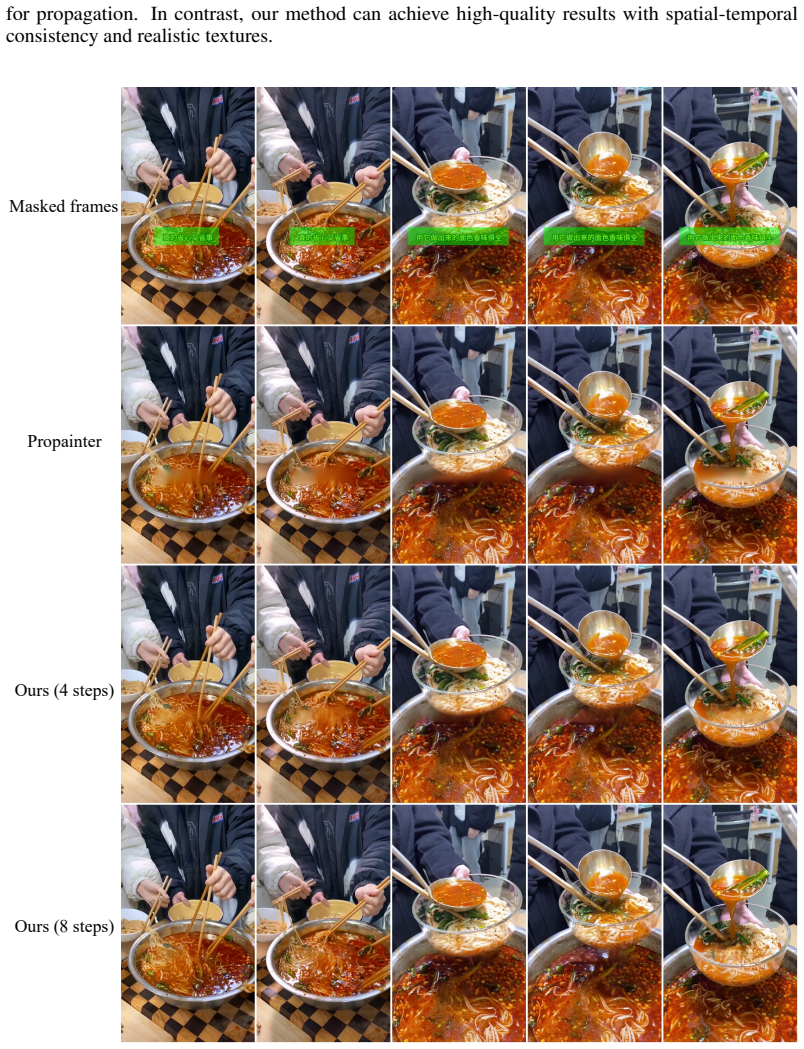
- For video completion, the paper claims a from-scratch flow-matching DiT with temporal MultiDiffusion surpasses ProPainter on PSNR, SSIM, and VFID in as few as four inference steps.
Reading between the lines
- This is an inference: the paper compares 2B single-stream against 13.4B multimodal, so the architecture choice is not isolated; a same-parameter-count ablation would be the natural way to see which scaling decision actually drives quality.
- This is an inference: the proprietary data layer—aesthetic scorers, human-quality scoring, structured captioning with 7B and 34B captioners, and human-reviewed SFT sets—is likely the hardest part to reproduce, even with the architecture and training code disclosed.
- This is an inference: applying the same caching and tile-parallel VAE ideas to open DiT video codebases would test whether the 2.35x speedup is framework-general or specific to Aquarius's architecture and training.
- This is an inference: if Aquarius-Datapipe is truly open-sourced, a community benchmark could determine how much of downstream video quality comes from the filtering and annotation cascade itself rather than from model size.
Signed reviews
Editorial analysis
A structured set of objections, weighed in public.
Referee Report
Summary. The paper describes Aquarius, a family of video generation models (2B Single-DiT and 13.4B Multimodal-DiT) aimed at marketing applications. It presents a distributed data curation pipeline, architectural choices, multi-stage flow-matching training, hybrid-parallel infrastructure with a reported 36% MFU, training-free inference acceleration claimed at 2.35x, and downstream applications including digital humans, video inpainting, and video personalization. The only quantitative comparison against an external method is an inpainting evaluation against ProPainter on a 50-video test set (Table 3); the main text-to-video and image-to-video claims rest on qualitative examples and internally developed scoring models.
Significance. If the engineering and performance claims were substantiated, Aquarius would be a useful industrial case study, particularly the explicit tensor-parallel gradient synchronization, fine-grained recomputation selection, and decoupled encoder/DiT training. The data-pipeline and inpainting design descriptions contain reusable recipes. However, as submitted, the key performance claims are not backed by systematic, independently checkable evidence; the paper reads more as an engineering blog post than a verifiable research report.
major comments (4)
- [Section 5] The claim that the 13.4B model achieves 36% MFU is not verifiable as stated because the FLOPs definition is missing. The paper does not specify which operations are counted in the numerator (e.g., whether the decoupled VAE and text encoders are included, whether the adaLN conditioning MLPs that add over 3B parameters are counted, or which attention variant is used), nor does it state the hardware peak-FLOPs assumption in the denominator. Without this information the number cannot be reproduced or compared with other systems.
- [Section 6] The 2.35x inference speedup is reported without a measurement protocol: no hardware, batch size, resolution, number of sampling steps, caching step interval, or latency breakdown is given. The claim that quality is preserved is supported only by an unspecified validation-set check. As written, the acceleration result is not reproducible.
- [Table 3 / Section 7.2] The inpainting comparison against ProPainter is based on 50 short 720p videos resized to 432x240, with a single baseline, no error bars, no statistical significance test, and VFID is not defined. This evidence is too thin to support the sentence that the method 'surpasses ProPainter, the state-of-the-art video inpainting algorithm,' especially because the differences in PSNR/SSIM are small.
- [Sections 1 and 7.1] The central claims of 'exceptional performance', strong instruction following, and realistic commercial-grade digital humans are supported only by qualitative figures and by internally trained scoring models used in the data-filtering pipeline (Section 2.2.2). There is no independent human evaluation protocol, preference study, external benchmark, or comparison with commercial video-generation models for the main text-to-video and image-to-video capabilities. Internal filters cannot validate the headline performance claims.
minor comments (6)
- [Section 5 heading] The section heading 'Training Efficieny' contains a typo and should read 'Training Efficiency'.
- [Equation (2)] The loss is described as mean squared error, but the displayed expression lacks a square on the norm; it should read \|u(X_t,y,t;\theta)-V_t\|^2.
- [Table 1] The step counts are given as order-of-magnitude values such as 'O(100K)'; exact or more precise step counts would improve reproducibility.
- [Abstract and Section 8] The open-source framework is called 'Aquarius-Datapipe' in the Abstract and Section 2 but 'Aquarius-Raydata' in Section 8; the naming should be made consistent.
- [Section 3.2.3] It is unclear whether the 10B MoE model is part of the Aquarius family or a separate exploratory experiment; its status and relation to the 2B and 13.4B models should be clarified.
- [Abstract and Section 8] The paper repeatedly states that the framework is designed for models with hundreds of billions of parameters, but all reported results are at 2B and 13.4B scale; this claim should be tempered or supported with concrete design/experiment evidence.
Circularity Check
No significant circularity: the paper is an engineering report whose main claims are either architectural descriptions, infrastructure measurements (MFU, speedup), or applications evaluated on one external benchmark; internal-model quality filtering is self-referential but is not a derivation of a predicted result from its own input.
full rationale
I walked the claimed derivation chain and found no step in which a predicted quantity is equivalent, by construction, to a fitted input or to a self-citation. The paper's main text-to-video and image-to-video quality claims rest on qualitative figures and on data curated by in-house models (internal human quality model, internal VideoCLIP, internal captioners), but that is a lack of external validation, not circularity: the report does not define a quantity such as 'quality' in terms of those filters and then claim to predict it. The one quantitative comparison, video completion against ProPainter (Table 3), uses an external baseline and a 50-video test set; it is self-contained even if narrow. The MFU 36% and 2.35x inference speedup numbers are under-specified (no FLOPs formula, no hardware/latency breakdown), which makes them hard to verify but does not make them circular. The only self-citation I found, Xie et al. (2024) on unified understanding-and-generation models, appears in the Future Works section as an external direction and is not load-bearing for any present claim. No ansatz is smuggled in via citation, and no known result is renamed as a new derivation. Per the hard rules, an unsupported performance claim is a correctness or evidence concern, not a circularity concern; I therefore return a score of 0 with no circular steps.
Assumptions & free parameters
free parameters (4)
- Thresholds of filtering models =
not disclosed
- Diffusion cache schedule and layer selection =
not disclosed
- Image-to-video ratio in joint pretraining =
30% decreasing to 10%
- Similarity threshold 0.7 for cross-video pairs =
0.7
assumptions (4)
- domain assumption The internal quality models (aesthetic, human quality, VideoCLIP) used for filtering and validation are reliable indicators of generation quality.
- standard math Flow matching with logit-normal timestep sampling and the stated multi-stage curriculum is a sound training framework for video generation.
- domain assumption The VAE tiling strategy preserves reconstruction quality well enough that tiled training and inference do not degrade downstream video quality.
- domain assumption Ray-based distributed data processing scales to tens of thousands of CPUs and thousands of xPUs as stated.
Cite this review
Pith. "Pith review of Aquarius: A Family of Industry-Level Video Generation Models for Marketing Scenarios." pith.science (2026). https://pith.science/paper/RCW5BV4F
@misc{pith2026250510584,
  author       = {Pith},
  title        = {Pith review of: Aquarius: A Family of Industry-Level Video Generation Models for Marketing Scenarios},
  year         = {2026},
  howpublished = {\url{https://pith.science/paper/RCW5BV4F}},
  note         = {Machine review of arXiv:2505.10584}
}
read the original abstract
This report introduces Aquarius, a family of industry-level video generation models for marketing scenarios designed for thousands-xPU clusters and models with hundreds of billions of parameters. Leveraging efficient engineering architecture and algorithmic innovation, Aquarius demonstrates exceptional performance in high-fidelity, multi-aspect-ratio, and long-duration video synthesis. By disclosing the framework's design details, we aim to demystify industrial-scale video generation systems and catalyze advancements in the generative video community. The Aquarius framework consists of five components: Distributed Graph and Video Data Processing Pipeline: Manages tens of thousands of CPUs and thousands of xPUs via automated task distribution, enabling efficient video data processing. Additionally, we are about to open-source the entire data processing framework named "Aquarius-Datapipe". Model Architectures for Different Scales: Include a Single-DiT architecture for 2B models and a Multimodal-DiT architecture for 13.4B models, supporting multi-aspect ratios, multi-resolution, and multi-duration video generation. High-Performance infrastructure designed for video generation model training: Incorporating hybrid parallelism and fine-grained memory optimization strategies, this infrastructure achieves 36% MFU at large scale. Multi-xPU Parallel Inference Acceleration: Utilizes diffusion cache and attention optimization to achieve a 2.35x inference speedup. Multiple marketing-scenarios applications: Including image-to-video, text-to-video (avatar), video inpainting and video personalization, among others. More downstream applications and multi-dimensional evaluation metrics will be added in the upcoming version updates.
Figures


Figures from the paper (11 more)




Reference graph
Works this paper leans on
-
[2]
URLhttps://arxiv.org/abs/2310.00426. Pengtao Chen, Mingzhu Shen, Peng Ye, Jianjian Cao, Chongjun Tu, Christos-Savvas Bouganis, Yiren Zhao, and Tao Chen.δ-dit: A training-free acceleration method tailored for diffusion transformers,
-
[4]
Fast and memory-efficient exact attention with io-awareness, 2022.URL https://arxiv
T Dao, DY Fu, S Ermon, A Rudra, and C Flashattention Ré. Fast and memory-efficient exact attention with io-awareness, 2022.URL https://arxiv. org/abs/2205.14135. Patrick Esser, Sumith Kulal, Andreas Blattmann, Rahim Entezari, Jonas Müller, Harry Saini, Yam Levi, Dominik Lorenz, Axel Sauer, Frederic Boesel, Dustin Podell, Tim Dockhorn, Zion English, Kyle L...
arXiv 2022
-
[5]
URLhttps://arxiv.org/abs/2403.03206. FFmpeg. Ffmpeg. URLhttps://ffmpeg.org/. Ian J. Goodfellow, Jean Pouget-Abadie, Mehdi Mirza, Bing Xu, David Warde-Farley, Sherjil Ozair, Aaron Courville, and Yoshua Bengio. Generative adversarial networks,
-
[10]
URL https://arxiv.org/abs/2412.03603. Vijay Anand Korthikanti, Jared Casper, Sangkug Lym, Lawrence McAfee, Michael Andersch, Mohammad Shoeybi, and Bryan Catanzaro. Reducing activation recomputation in large transformer models.Proceedings of Machine Learning and Systems, 5:341–353,
-
[11]
URLhttps://arxiv.org/abs/2412.00131. Yaron Lipman, Ricky T. Q. Chen, Heli Ben-Hamu, Maximilian Nickel, and Matt Le. Flow matching for generative modeling,
-
[12]
URLhttps://arxiv.org/abs/2210.02747. Luma. Dream machine
-
[14]
URL https: //arxiv.org/abs/2212.09748. Xiangyu Peng, Zangwei Zheng, Chenhui Shen, Tom Young, Xinying Guo, Binluo Wang, Hang Xu, Hongxin Liu, Mingyan Jiang, Wenjun Li, Yuhui Wang, Anbang Ye, Gang Ren, Qianran Ma, Wanying Liang, Xiang Lian, Xiwen Wu, Yuting Zhong, Zhuangyan Li, Chaoyu Gong, Guojun Lei, Leijun Cheng, Limin Zhang, Minghao Li, Ruijie Zhang, Si...
- [16]
Show all 28 references
-
[18]
Minsoo Rhu, Natalia Gimelshein, Jason Clemons, Arslan Zulfiqar, and Stephen W Keckler
URL https://arxiv.org/abs/2404.13686. Minsoo Rhu, Natalia Gimelshein, Jason Clemons, Arslan Zulfiqar, and Stephen W Keckler. vdnn: Virtualized deep neural networks for scalable, memory-efficient neural network design. In2016 49th Annual IEEE/ACM International Symposium on Micr...
-
[19]
URL https://arxiv.org/abs/ 2112.10752. Runway. Runway-gen-3-alpha
-
[20]
Mohammad Shoeybi, Mostofa Patwary, Raul Puri, Patrick LeGresley, Jared Casper, and Bryan Catan- zaro
URL https://runwayml.com/research/ introducing-gen-3-alpha. Mohammad Shoeybi, Mostofa Patwary, Raul Puri, Patrick LeGresley, Jared Casper, and Bryan Catan- zaro. Megatron-lm: Training multi-billion parameter language models using model parallelism. arXiv preprint arXiv:1909.08053,
1909 arXiv
-
[22]
URL https://arxiv.org/abs/ 2104.09864. WanTeam, Ang Wang, Baole Ai, Bin Wen, Chaojie Mao, Chen-Wei Xie, Di Chen, Feiwu Yu, Haiming Zhao, Jianxiao Yang, Jianyuan Zeng, Jiayu Wang, Jingfeng Zhang, Jingren Zhou, Jinkai Wang, Jixuan Chen, Kai Zhu, Kang Zhao, Keyu Yan, Lianghua Hua...
-
[23]
Rongchang Xie, Chen Du, Ping Song, and Chang Liu
URLhttps://arxiv.org/abs/2503.20314. Rongchang Xie, Chen Du, Ping Song, and Chang Liu. Muse-vl: Modeling unified vlm through semantic discrete encoding.arXiv preprint arXiv:2411.17762,
-
[24]
Linting Xue, Noah Constant, Adam Roberts, Mihir Kale, Rami Al-Rfou, Aditya Siddhant, Aditya Barua, and Colin Raffel
URLhttps://arxiv.org/abs/2405.18991. Linting Xue, Noah Constant, Adam Roberts, Mihir Kale, Rami Al-Rfou, Aditya Siddhant, Aditya Barua, and Colin Raffel. mt5: A massively multilingual pre-trained text-to-text transformer,
-
[25]
URLhttps://arxiv.org/abs/2010.11934. Zhuoyi Yang, Jiayan Teng, Wendi Zheng, Ming Ding, Shiyu Huang, Jiazheng Xu, Yuanming Yang, Wenyi Hong, Xiaohan Zhang, Guanyu Feng, Da Yin, Yuxuan Zhang, Weihan Wang, Yean Cheng, Bin Xu, Xiaotao Gu, Yuxiao Dong, and Jie Tang. Cogvideox: Text...
2010 arXiv
-
[26]
26 Lijun Yu, José Lezama, Nitesh B
URLhttps://arxiv.org/abs/2408.06072. 26 Lijun Yu, José Lezama, Nitesh B. Gundavarapu, Luca Versari, Kihyuk Sohn, David Minnen, Yong Cheng, Vighnesh Birodkar, Agrim Gupta, Xiuye Gu, Alexander G. Hauptmann, Boqing Gong, Ming-Hsuan Yang, Irfan Essa, David A. Ross, and Lu Jiang. L...
-
[27]
Xuanlei Zhao, Xiaolong Jin, Kai Wang, and Yang You
URLhttps://arxiv.org/abs/2310.05737. Xuanlei Zhao, Xiaolong Jin, Kai Wang, and Yang You. Real-time video generation with pyramid attention broadcast,
-
[28]
Shangchen Zhou, Chongyi Li, Kelvin C.K Chan, and Chen Change Loy
URLhttps://arxiv.org/abs/2408.12588. Shangchen Zhou, Chongyi Li, Kelvin C.K Chan, and Chen Change Loy. ProPainter: Improving propagation and transformer for video inpainting. InProceedings of IEEE International Conference on Computer Vision (ICCV),
-
[1991]
Sam Ade Jacobs, Masahiro Tanaka, Chengming Zhang, Minjia Zhang, Shuaiwen Leon Song, Samyam Rajbhandari, and Yuxiong He
doi: 10.1162/neco.1991.3.1.79. Sam Ade Jacobs, Masahiro Tanaka, Chengming Zhang, Minjia Zhang, Shuaiwen Leon Song, Samyam Rajbhandari, and Yuxiong He. Deepspeed ulysses: System optimizations for enabling training of extreme long sequence transformer models.arXiv preprint arXiv...
1991 arXiv
-
[2014]
Aaron Grattafiori, Abhimanyu Dubey, Abhinav Jauhri, Abhinav Pandey, Abhishek Kadian, Ahmad Al-Dahle, Aiesha Letman, Akhil Mathur, Alan Schelten, Alex Vaughan, et al
URL https: //arxiv.org/abs/1406.2661. Aaron Grattafiori, Abhimanyu Dubey, Abhinav Jauhri, Abhinav Pandey, Abhishek Kadian, Ahmad Al-Dahle, Aiesha Letman, Akhil Mathur, Alan Schelten, Alex Vaughan, et al. The llama 3 herd of models.arXiv preprint arXiv:2407.21783,
-
[2018]
URLhttps://arxiv.org/abs/1712.05889. Deepak Narayanan, Mohammad Shoeybi, Jared Casper, Patrick LeGresley, Mostofa Patwary, Vijay Korthikanti, Dmitri Vainbrand, Prethvi Kashinkunti, Julie Bernauer, Bryan Catanzaro, et al. Efficient large-scale language model training on gpu clu...
-
[2019]
Transnet v2: An effective deep network architecture for fast shot transition detection.arXiv preprint arXiv:2008.04838,
Tomáš Souˇcek and Jakub Lokoˇc. Transnet v2: An effective deep network architecture for fast shot transition detection.arXiv preprint arXiv:2008.04838,
2008 arXiv
-
[2020]
Robert A
URL https://arxiv.org/abs/2006.11239. Robert A. Jacobs, Michael I. Jordan, Steven J. Nowlan, and Geoffrey E. Hinton. Adaptive mixtures of local experts.Neural Computation, 3(1):79–87,
2006 arXiv
-
[2021]
Samyam Rajbhandari, Jeff Rasley, Olatunji Ruwase, and Yuxiong He
URL https: //arxiv.org/abs/2103.00020. Samyam Rajbhandari, Jeff Rasley, Olatunji Ruwase, and Yuxiong He. Zero: Memory optimizations toward training trillion parameter models. InSC20: International Conference for High Performance Computing, Networking, Storage and Analysis, pag...
-
[2022]
org/abs/2207.12598
URL https://arxiv. org/abs/2207.12598. 24 Jonathan Ho, Ajay Jain, and Pieter Abbeel. Denoising diffusion probabilistic models,
-
[2023]
BlackForestLabs
URLhttps://arxiv.org/abs/2302.08113. BlackForestLabs. Flux.https://github.com/black-forest-labs/flux,
-
[2024]
Damai Dai, Chengqi Deng, Chenggang Zhao, RX Xu, Huazuo Gao, Deli Chen, Jiashi Li, Wangding Zeng, Xingkai Yu, Yu Wu, et al
URLhttps://arxiv.org/abs/2406.01125. Damai Dai, Chengqi Deng, Chenggang Zhao, RX Xu, Huazuo Gao, Deli Chen, Jiashi Li, Wangding Zeng, Xingkai Yu, Yu Wu, et al. Deepseekmoe: Towards ultimate expert specialization in mixture- of-experts language models.arXiv preprint arXiv:2401.06066,
-
[2025]
Dustin Podell, Zion English, Kyle Lacey, Andreas Blattmann, Tim Dockhorn, Jonas Müller, Joe Penna, and Robin Rombach
URLhttps://arxiv.org/abs/2503.09642. Dustin Podell, Zion English, Kyle Lacey, Andreas Blattmann, Tim Dockhorn, Jonas Müller, Joe Penna, and Robin Rombach. Sdxl: Improving latent diffusion models for high-resolution image synthesis,
Reviewed August 15, 2026 · model on record in the stance chip above.
Discussion (0). Continue with ORCID to comment.