Evolution of Realistic Neutron star in the framework of f (Q) gravity
Pith reviewed 2026-06-28 00:03 UTC · model grok-4.3
The pith
Four pulsars fit as neutron stars in f(Q) gravity when f is linear in nonmetricity and the Krori-Barua metric is used for the interior.
A machine-rendered reading of the paper's core claim, the machinery that carries it, and where it could break.
Core claim
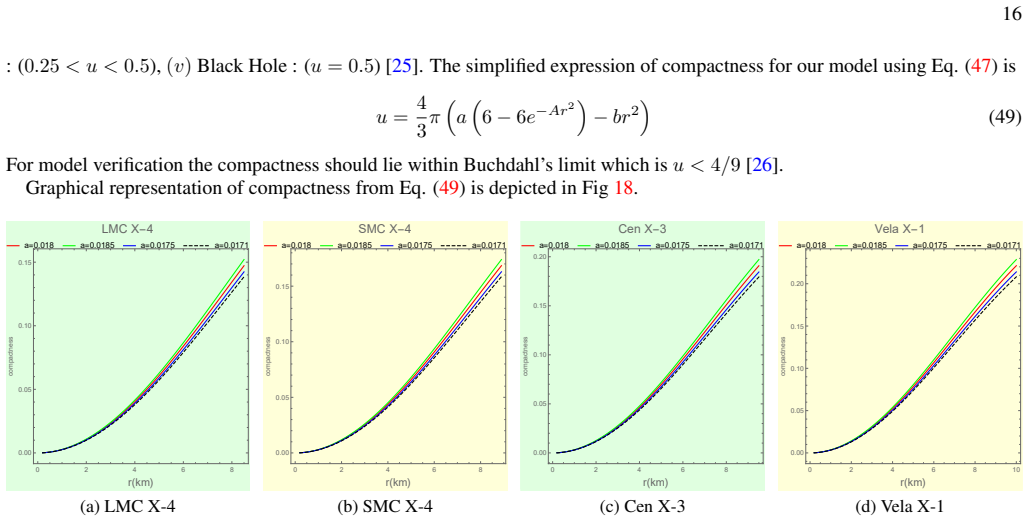
With f(Q) taken as a linear function of Q and the Krori-Barua line element adopted as the interior metric, the anisotropic solutions for the four named pulsars yield compactness values that remain below the Buchdahl limit for a range of the parameter a, permitting the interpretation that these objects are neutron stars whose structure is consistent with modified gravity sourced by nonmetricity.
What carries the argument
Linear f(Q) = a + bQ together with the Krori-Barua metric ansatz that supplies the interior geometry for an anisotropic fluid in f(Q) gravity.
If this is right
- Positive, monotonically increasing anisotropy implies that nuclear forces can counteract gravitational collapse inside these objects.
- The derived mass-radius curves for varying a produce families of stable neutron-star configurations.
- Chi-square tests indicate that the model masses match observed values for many parameter choices without requiring fine tuning.
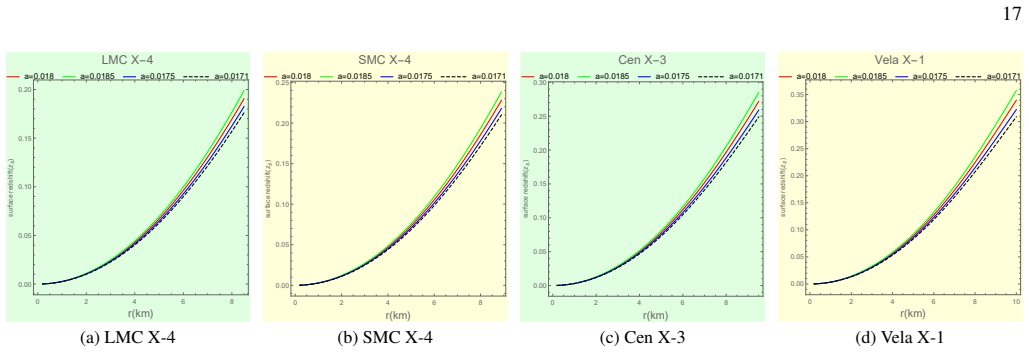
- Surface redshifts computed from the solutions stay within the range observed for known compact stars.
Where Pith is reading between the lines
- The same linear f(Q) plus Krori-Barua construction could be applied to additional pulsars or to merging neutron-star events to obtain further parameter constraints.
- If the model holds, the parameter a might be bounded by combining compactness limits with independent equation-of-state information from nuclear physics.
- The framework predicts that deviations from general relativity would appear first in the anisotropy profile rather than in the total mass.
Load-bearing premise
The Krori-Barua metric remains an acceptable interior solution and f(Q) is adequately described by a strictly linear function of the nonmetricity scalar.
What would settle it
A precise mass and radius measurement for any of the four pulsars that places its compactness above the Buchdahl limit would rule out the linear-f(Q) Krori-Barua description for that object.
Figures
read the original abstract
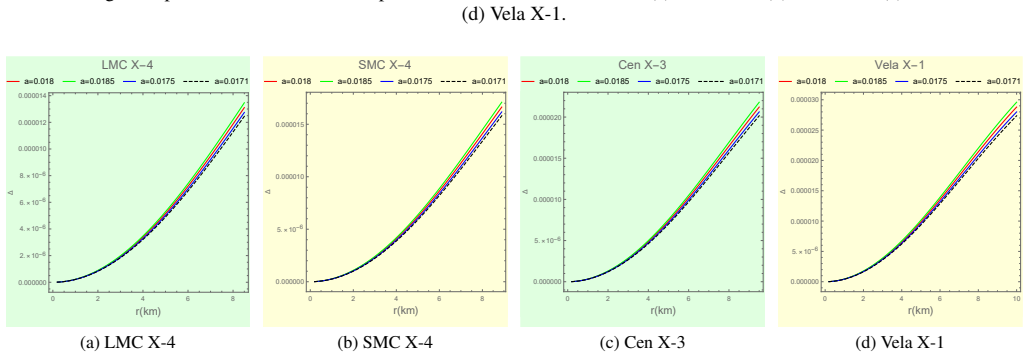
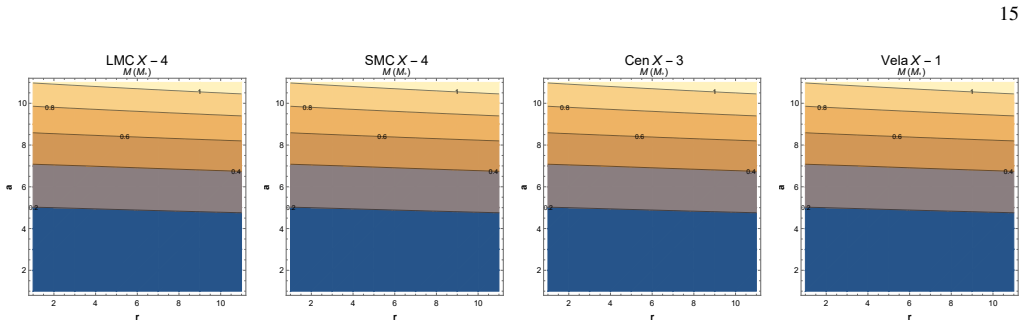
This work analyses and evaluates a few realistic compact objects in the presence of a gravitational interaction between two particles with a nonmetricity $Q$. In the $f(Q)$ gravity framework, we have selected the anisotropic equation of motion and have determined $f(Q)$ to be a linear function of nonmetricity $Q$. To evaluate the field equations in our work, we have opted to employ the Krori-Barua metric. We calculated the anisotropic factor for each of the four compact objects and found that the anisotropic component is positive and increases monotonically and interpreted that the nuclear force can oppose the gravitational attraction. At last, the relationship between mass and radius has been determined and illustrated visually. We have noted that the compactness of the pulsars LMC X-4, SMC X-4, Cen X-3, and Vela X-1 is inside the Buchdahl's limit for varying values of $a$. This has led to the interpretation that these pulsars are neutron stars in a modified gravity background of $f(Q)$. In addition, we calculated the model mass and, using thirty distinct choices of $a$, ran the Chi-Square test to see if there was a noticeable difference between the observed and model-generated masses. We have also looked at how the surface redshift has changed over time and whether the compact objects in our model that were previously described are compact.
Editorial analysis
A structured set of objections, weighed in public.
Referee Report
Summary. The manuscript analyzes four pulsars (LMC X-4, SMC X-4, Cen X-3, Vela X-1) as anisotropic compact objects in f(Q) gravity. It adopts the Krori-Barua metric, assumes f(Q) is linear in the nonmetricity scalar Q, solves the field equations to obtain a positive monotonically increasing anisotropy factor, verifies that the compactness 2M/R lies inside the Buchdahl limit 8/9 for varying parameter a, performs a chi-square comparison of model versus observed masses over thirty discrete choices of a, and concludes that these objects can be interpreted as neutron stars in the f(Q) framework. Surface redshift is also examined.
Significance. If the central claims hold, the work would supply explicit interior solutions for anisotropic stars in f(Q) gravity that match observed pulsar data while satisfying a standard stability criterion, offering a concrete modified-gravity model for neutron-star structure. The explicit use of an ansatz and direct comparison to four named objects provides a falsifiable test, though the overall significance is reduced by the absence of a modified compactness bound.
major comments (2)
- [Abstract and compactness analysis] Abstract and compactness discussion: the central interpretation that the four pulsars are neutron stars in f(Q) gravity because their compactness satisfies 2M/R < 8/9 applies the GR-derived Buchdahl bound directly. The f(Q) field equations differ from Einstein's equations (depending on Q and its derivatives), so the bound must be re-derived from the modified Tolman-Oppenheimer-Volkoff equation or junction conditions; no such derivation or justification is supplied. This assumption is load-bearing for the main claim.
- [Abstract] Abstract: the manuscript states that f(Q) is taken to be a linear function of Q 'to evaluate the field equations' with the Krori-Barua ansatz. This choice closes the system but is not shown to be the unique or physically preferred form; the resulting solutions and the subsequent compactness check are therefore tied to this specific assumption rather than to the general f(Q) theory.
minor comments (1)
- [Abstract] Abstract: the statement that 'the relationship between mass and radius has been determined and illustrated visually' does not reference a specific equation or figure number, making it difficult to locate the explicit M(R) relation.
Simulated Author's Rebuttal
We thank the referee for the careful and constructive comments. Both major points identify limitations in the current manuscript that we will address through revision.
read point-by-point responses
-
Referee: [Abstract and compactness analysis] Abstract and compactness discussion: the central interpretation that the four pulsars are neutron stars in f(Q) gravity because their compactness satisfies 2M/R < 8/9 applies the GR-derived Buchdahl bound directly. The f(Q) field equations differ from Einstein's equations (depending on Q and its derivatives), so the bound must be re-derived from the modified Tolman-Oppenheimer-Volkoff equation or junction conditions; no such derivation or justification is supplied. This assumption is load-bearing for the main claim.
Authors: We agree that the GR-derived Buchdahl bound cannot be applied directly. In the revised manuscript we will derive the relevant compactness limit from the modified field equations and TOV equation in f(Q) gravity, or provide a clear justification based on existing results for symmetric teleparallel theories. This change will be made to support the central interpretation. revision: yes
-
Referee: [Abstract] Abstract: the manuscript states that f(Q) is taken to be a linear function of Q 'to evaluate the field equations' with the Krori-Barua ansatz. This choice closes the system but is not shown to be the unique or physically preferred form; the resulting solutions and the subsequent compactness check are therefore tied to this specific assumption rather than to the general f(Q) theory.
Authors: We agree that the linear f(Q) is a specific ansatz chosen for analytic tractability with the Krori-Barua metric. The revised version will explicitly clarify that the results apply to this particular model within f(Q) gravity rather than the general theory, and will discuss the motivation for the choice along with possible extensions to nonlinear forms. revision: yes
Circularity Check
No significant circularity; standard ansatz + fitting + external bound application
full rationale
The paper selects the Krori-Barua metric and linear f(Q) ansatz, solves the resulting field equations for the anisotropic factor and mass-radius relation, then compares compactness to the known GR Buchdahl bound (2M/R < 8/9) and runs chi-square on model vs observed masses for discrete a values. No quoted step reduces a claimed prediction or central result to its own inputs by construction. The chi-square comparison is ordinary parameter scanning against data, not a forced 'prediction'. The Buchdahl limit is imported from GR without re-derivation, but this is an assumption about applicability rather than a definitional loop or self-citation chain. The derivation chain remains self-contained against external benchmarks.
Axiom & Free-Parameter Ledger
free parameters (1)
- a
axioms (2)
- ad hoc to paper f(Q) is a linear function of nonmetricity Q
- domain assumption Krori-Barua metric describes the interior spacetime of the compact objects
Reference graph
Works this paper leans on
-
[1]
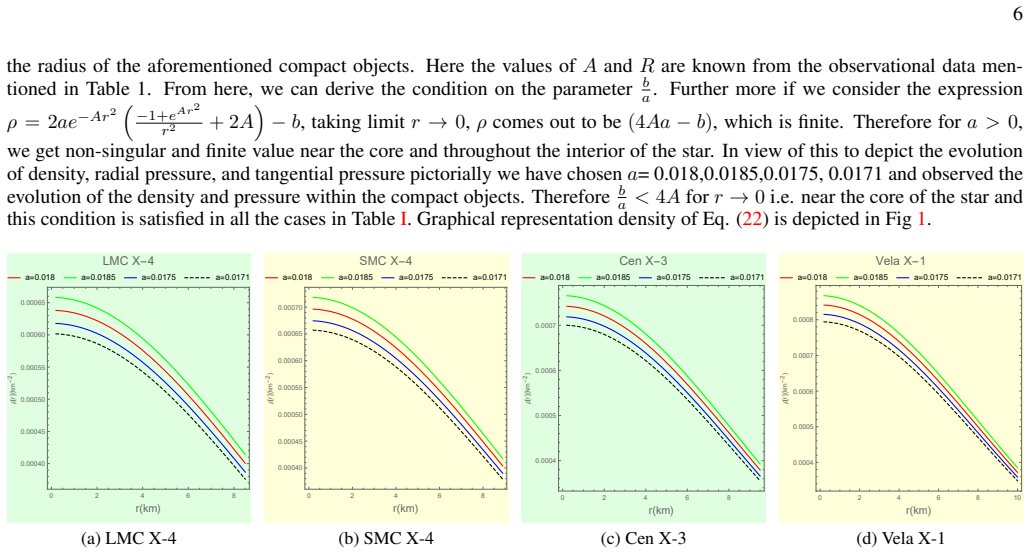
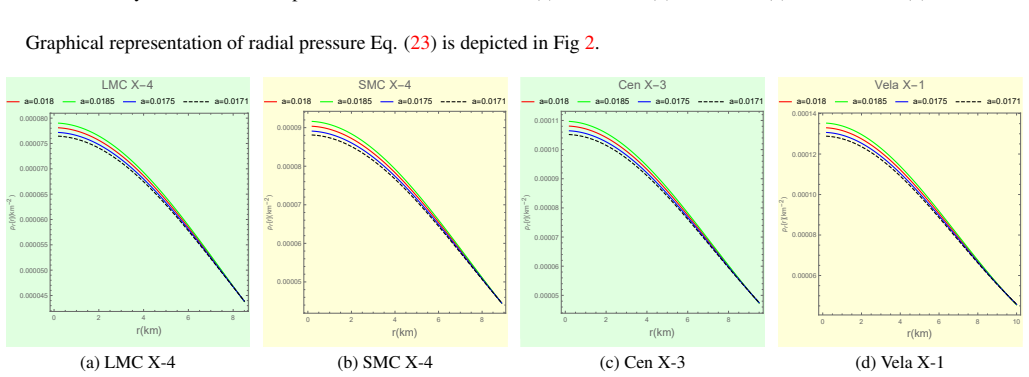
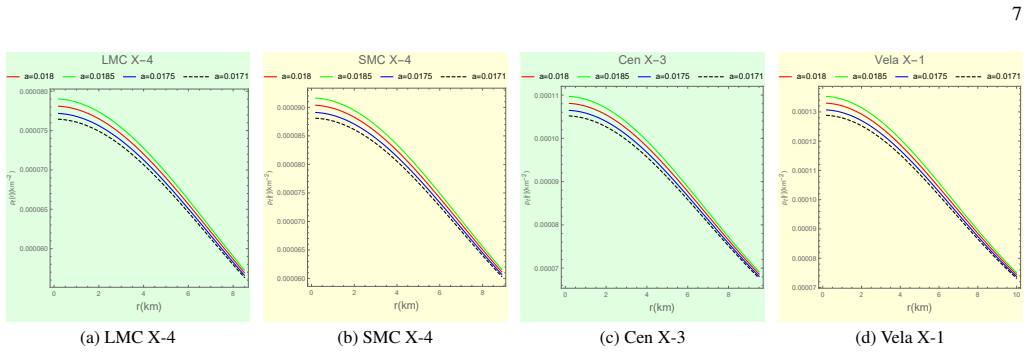
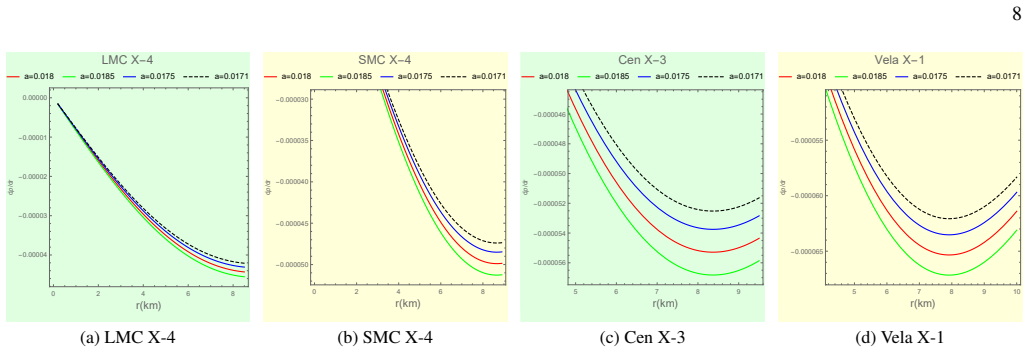
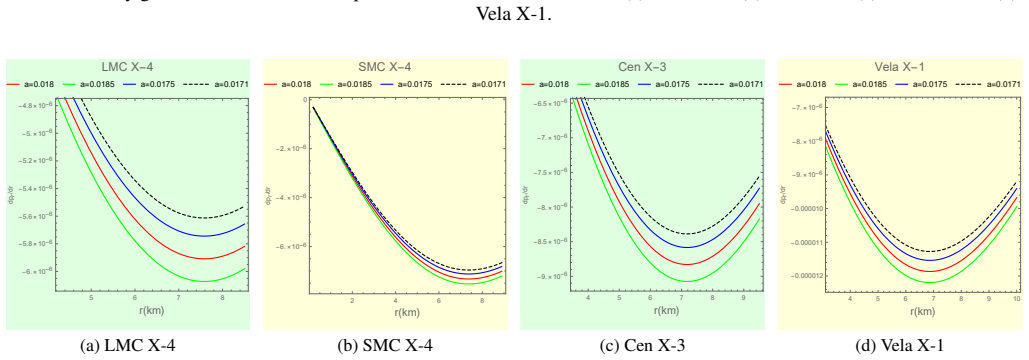
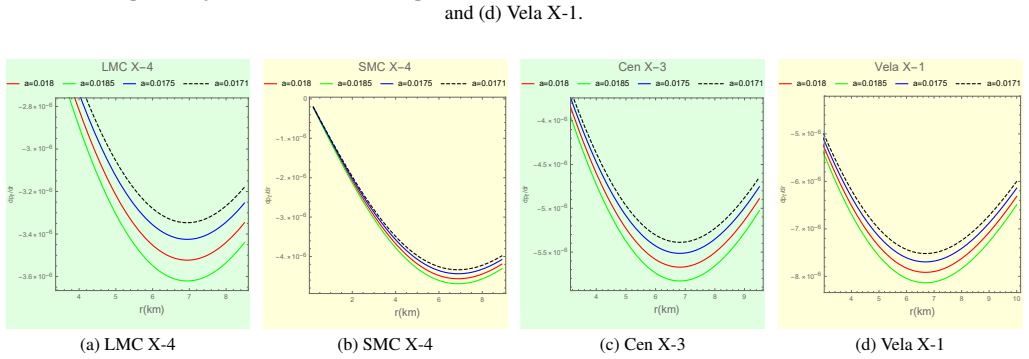
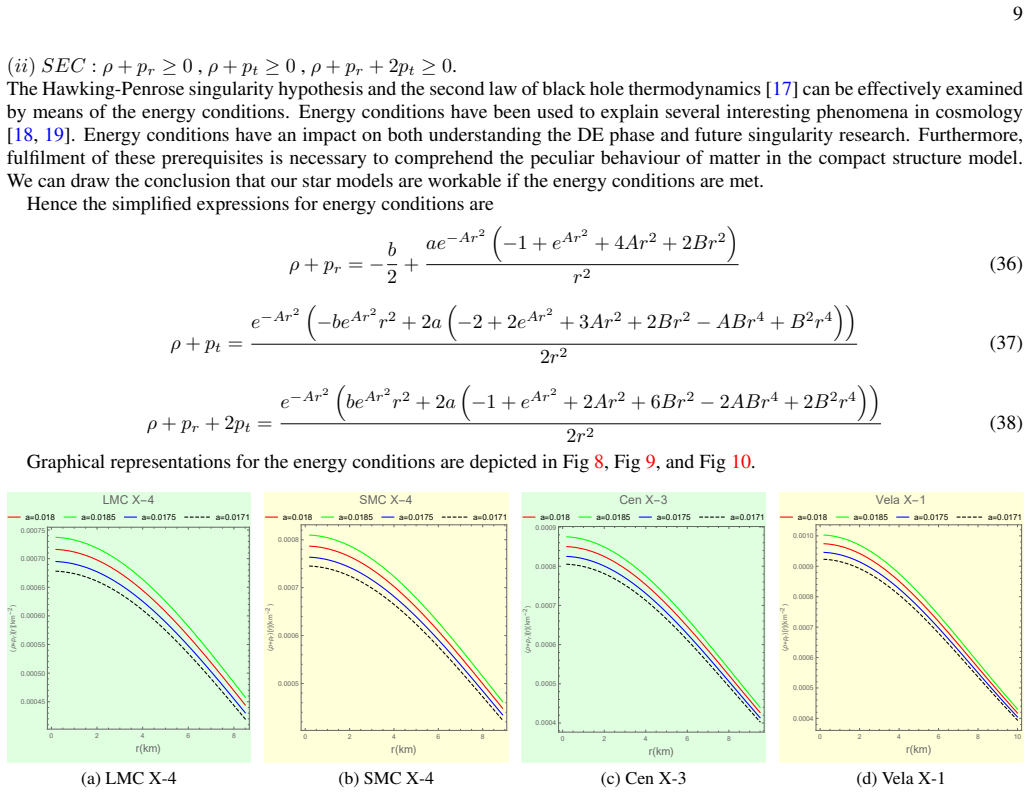
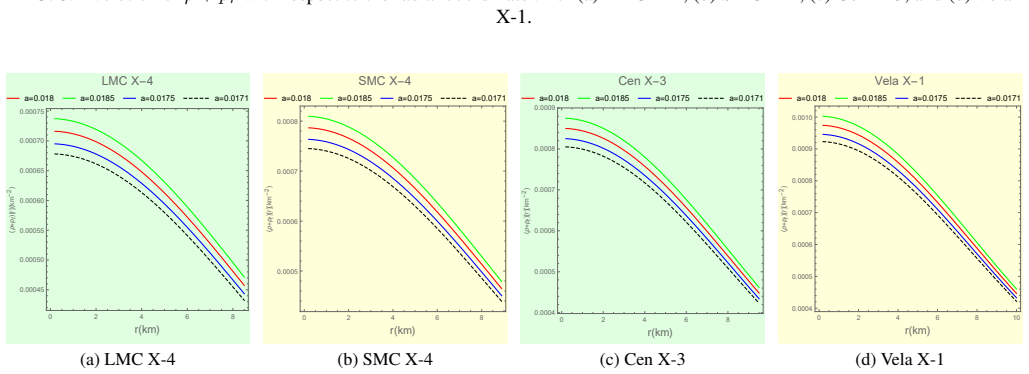
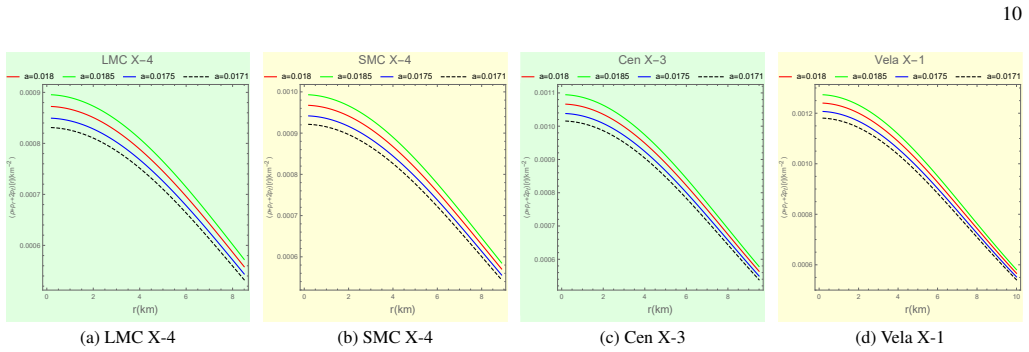
Density, Pressure and Anisotropic factor In this section we have analyzed physical attributes such as density, radial pressure, and tangential pressure within the compact stars in the background off(Q)gravity theory. By carrying out some analytical calculations and creating profiles of the various model parameters of the obtained solutions, we hope to lea...
-
[2]
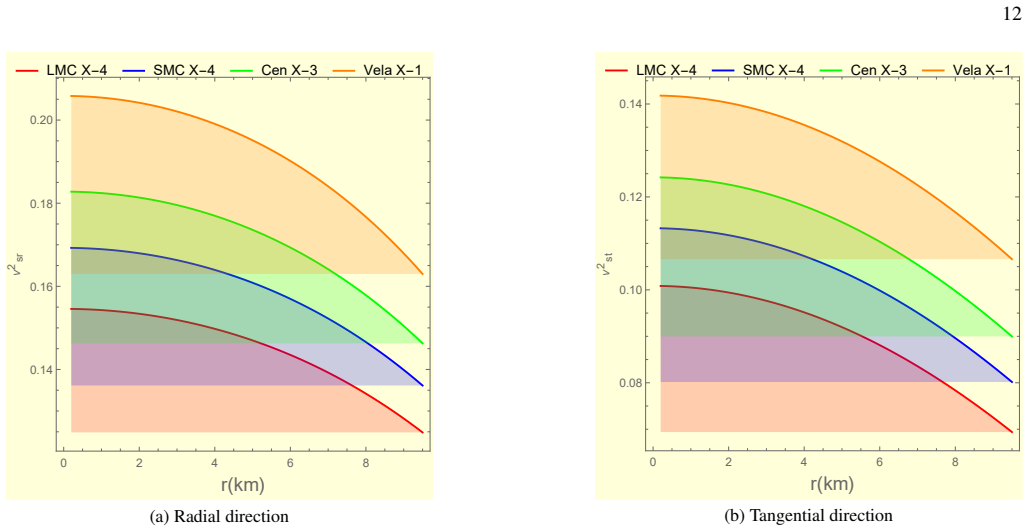
The Causality Condition Utilizing the ”cracking” technique, which has to do with how stable anisotropic stars are under tiny radial perturbations The regions of an anisotropic star that are possibly stable are those where the radial speed of sound crosses the transverse speed of sound, as demonstrated by Herrera [21] and Abreu et al. [22]. They discovered...
-
[3]
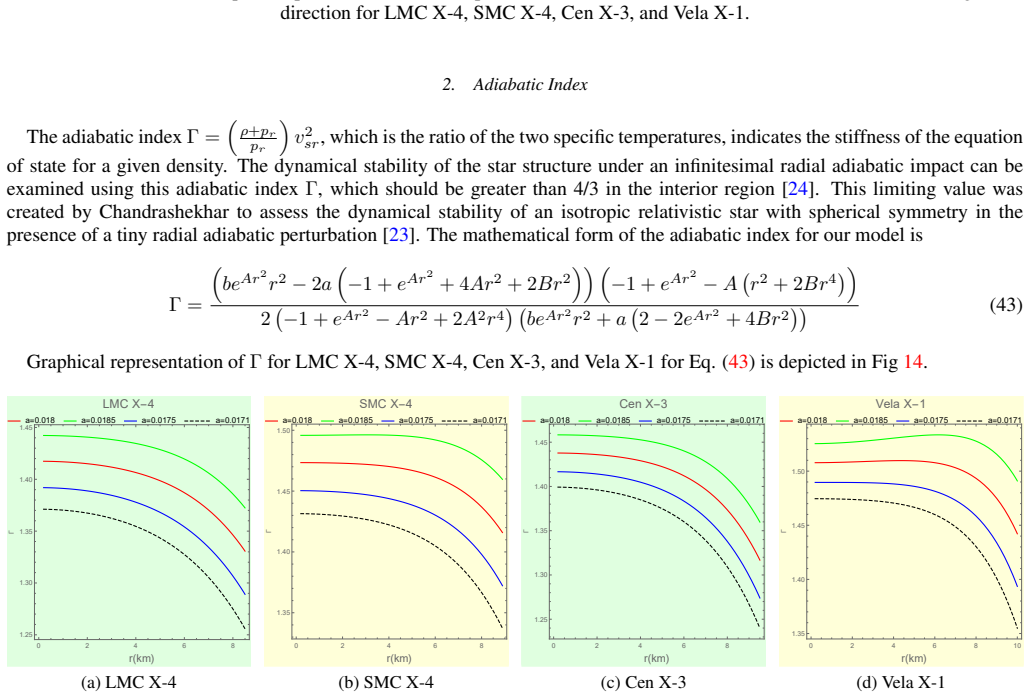
Adiabatic Index The adiabatic indexΓ = ρ+pr pr v2 sr, which is the ratio of the two specific temperatures, indicates the stiffness of the equation of state for a given density. The dynamical stability of the star structure under an infinitesimal radial adiabatic impact can be examined using this adiabatic indexΓ, which should be greater than 4/3 in the in...
-
[4]
We have determined the model mass using thirty distinct measurements ofato test the hypothesis
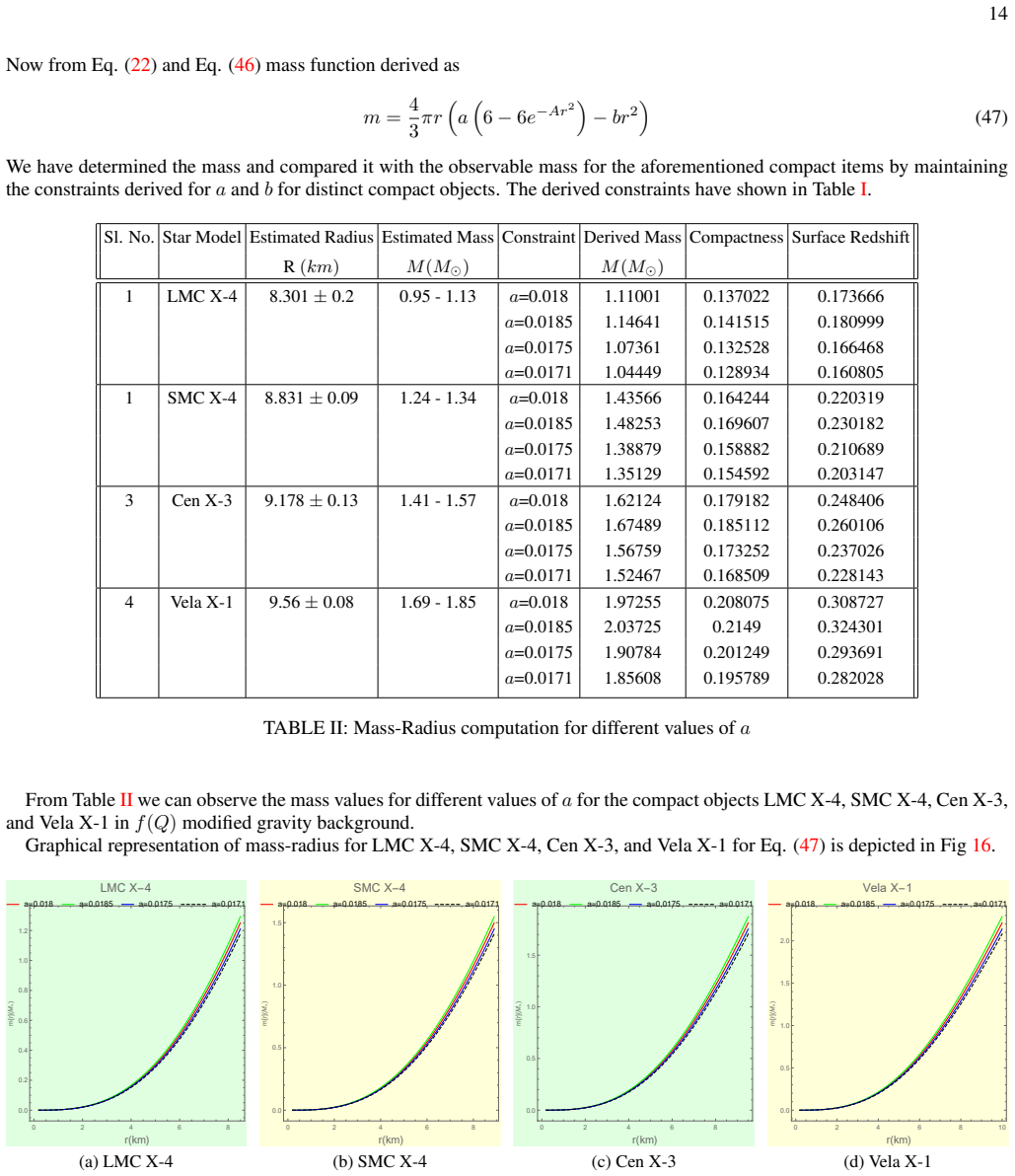
Hypothesis Testing In Table II we have represented four chosen values ofaand derived the model mass, compactness and the surface redshift for the said values. We have determined the model mass using thirty distinct measurements ofato test the hypothesis. We opt for the Chi-Square test in this model. The chi-square test is a statistical method for comparin...
2023
-
[5]
and Odintsov, S.D., 2014
Nojiri, S.I. and Odintsov, S.D., 2014. Accelerating cosmology in modified gravity: from convenient F (R) or string-inspired theory to bimetric F (R) gravity. International Journal of Geometric Methods in Modern Physics, 11(02), p.1460006
2014
-
[6]
and Oikonomou, V .K., 2017
Odintsov, S.D. and Oikonomou, V .K., 2017. Autonomous dynamical system approach for f (R) gravity. Physical Review D, 96(10), p.104049
2017
-
[7]
and Abdel-Aty, A.H., 2023
Maurya, S.K., Errehymy, A., Jasim, M.K., Daoud, M., Al-Harbi, N. and Abdel-Aty, A.H., 2023. Complexity-free solution generated by gravitational decoupling for anisotropic self-gravitating star in symmetric teleparallel f (Q)-gravity theory. The European Physical Journal C, 83(4), p.317
2023
-
[8]
and Katsuragawa, T., 2022
Wang, W., Chen, H. and Katsuragawa, T., 2022. Static and spherically symmetric solutions in f (Q) gravity. Physical Review D, 105(2), p.024060
2022
-
[9]
and Saridakis, E.N., 2015
Odintsov, S.D., Oikonomou, V .K. and Saridakis, E.N., 2015. Superbounce and loop quantum ekpyrotic cosmologies from modified gravity: F (R), F (G) and F (T) theories. Annals of Physics, 363, pp.141-163
2015
-
[10]
and Nashed, G.G., 2020
Roupas, Z. and Nashed, G.G., 2020. Anisotropic neutron stars modelling: constraints in Krori–Barua spacetime. The European Physical Journal C, 80, pp.1-11
2020
-
[11]
and Malik, A., 2022
Shamir, M.F., Asghar, Z. and Malik, A., 2022. Relativistic Krori-Barua Compact Stars in f (R, T) f(R,T) Gravity. Fortschritte der Physik, 70(12), p.2200134
2022
-
[13]
and Barua, J., 1975
Krori, K.D. and Barua, J., 1975. A singularity-free solution for a charged fluid sphere in general relativity. Journal of Physics A: Mathe- matical and General, 8(4), p.508
1975
-
[14]
On the gravitational field of a sphere of incompressible fluid according to Einstein’s theory
Schwarzschild, K., 1999. On the gravitational field of a sphere of incompressible fluid according to Einstein’s theory. arXiv preprint physics/9912033
Pith/arXiv arXiv 1999
-
[17]
and Rebouc ¸as, M.J., 2008
Lima, M.P., Vitenti, S.D.P. and Rebouc ¸as, M.J., 2008. Energy conditions bounds and supernovae data. Physics Letters B, 668(2), pp.83- 86
2008
-
[18]
and Waseem, A., 2019
Sharif, M. and Waseem, A., 2019. Charged compact objects in f (R, T) gravity. International Journal of Modern Physics D, 28(02), p.1950033
2019
-
[19]
Cracking of self-gravitating compact objects
Herrera, L., 1992. Cracking of self-gravitating compact objects. Physics Letters A, 165(3), pp.206-210
1992
-
[20]
and Santos, N.O., 1994
Chan, R., Herrera, L. and Santos, N.O., 1994. Dynamical instability for shearing viscous collapse. Monthly Notices of the Royal Astro- nomical Society, 267(3), pp.637-646
1994
-
[21]
Particle creation by black holes
Hawking, S.W., 1975. Particle creation by black holes. Communications in mathematical physics, 43(3), pp.199-220
1975
-
[22]
and Carvalho, F.C., 2007
Santos, J., Alcaniz, J.S., Reboucas, M.J. and Carvalho, F.C., 2007. Energy conditions in f (R) gravity. Physical Review D, 76(8), p.083513
2007
-
[23]
and Vagenas, E.C., 2014
Balart, L. and Vagenas, E.C., 2014. Regular black hole metrics and the weak energy condition. Physics Letters B, 730, pp.14-17
2014
-
[24]
and Chakraborty, K., 2010
Rahaman, F., Ray, S., Jafry, A.K. and Chakraborty, K., 2010. Singularity-free solutions for anisotropic charged fluids with Chaplygin equation of state. Physical Review D, 82(10), p.104055
2010
-
[25]
Cracking of self-gravitating compact objects
Herrera, L., 1992. Cracking of self-gravitating compact objects. Physics Letters A, 165(3), pp.206-210. 19
1992
-
[26]
and N´unez, L.A., 2007
Abreu, H., Hern ´andez, H. and N´unez, L.A., 2007. Sound speeds, cracking and the stability of self-gravitating anisotropic compact objects. Classical and Quantum Gravity, 24(18), p.4631
2007
-
[27]
Dynamical instability of gaseous masses approaching the Schwarzschild limit in general relativity
Chandrasekhar, S., 1964. Dynamical instability of gaseous masses approaching the Schwarzschild limit in general relativity. Physical Review Letters, 12(4), p.114
1964
-
[28]
and Hillebrandt, W., 1975
Heintzmann, H. and Hillebrandt, W., 1975. Neutron stars with an anisotropic equation of state-mass, redshift and stability. Astronomy and Astrophysics, 38, pp.51-55
1975
-
[29]
and Sahoo, P.K., 2023
Bhar, P., Pradhan, S., Malik, A. and Sahoo, P.K., 2023. Physical characteristics and maximum allowable mass of hybrid star in the context of f (Q) gravity. The European Physical Journal C, 83(7), p.646
2023
-
[30]
General relativistic fluid spheres
Buchdahl, H.A., 1959. General relativistic fluid spheres. Physical Review, 116(4), p.1027
1959
-
[31]
Maximum bounds on the surface redshift of anisotropic stars
Ivanov, B.V ., 2002. Maximum bounds on the surface redshift of anisotropic stars. Physical Review D, 65(10), p.104011
2002
-
[32]
Einstein Shift and Doppler Shift
Eddington, A.S., 1926. Einstein Shift and Doppler Shift. Nature, 117(2933), pp.86-86
1926
-
[33]
and Murray, R.B., 1987
Tallarida, R.J., Murray, R.B., Tallarida, R.J. and Murray, R.B., 1987. Chi-square test. Manual of pharmacologic calculations: With computer programs, pp.140-142
1987
-
[34]
The chi-square test of independence
McHugh, M.L., 2013. The chi-square test of independence. Biochemia medica, 23(2), pp.143-149
2013
-
[35]
and Malik, A., 2023
Asghar, Z., Shamir, M.F., Usman, A. and Malik, A., 2023. Study of embedded class-I fluid spheres in f (R, T) gravity with Karmarkar condition. Chinese Journal of Physics, 83, pp.427-437
2023
-
[36]
and Barrow, J.D., 2011
Li, B., Sotiriou, T.P. and Barrow, J.D., 2011. f (T) gravity and local Lorentz invariance. Physical Review D, 83(6), p.064035
2011
-
[37]
and Odintsov, S.D., 2011
Harko, T., Lobo, F.S., Nojiri, S.I. and Odintsov, S.D., 2011. f (R, T) gravity. Physical Review D, 84(2), p.024020
2011
-
[38]
and Chattopadhyay, S., 2023
Das, S., Radinschi, I. and Chattopadhyay, S., 2023. Modified Gravity Description of Neutron Star in the f (R) Framework. Axioms, 12(3), p.234
2023
-
[39]
and Chattopadhyay, S., 2023
Das, S., Beesham, A. and Chattopadhyay, S., 2023. Study of Neutron Star in f (T) and f (G) gravity framework with Polytropic Gas Background. Annals of Physics, 458, p.169460
2023
-
[40]
and Odintsov, S.D., 2006
Nojiri, S.I. and Odintsov, S.D., 2006. Modified f (R) gravity consistent with realistic cosmology: From a matter dominated epoch to a dark energy universe. Physical Review D, 74(8), p.086005
2006
-
[42]
and De, A., 2023
Koussour, M. and De, A., 2023. Observational constraints on two cosmological models of f (Q) theory. The European Physical Journal C, 83(5), p.400
2023
-
[43]
and Koivisto, T., 2018
Jim ´enez, J.B., Heisenberg, L. and Koivisto, T., 2018. Coincident general relativity. Physical Review D, 98(4), p.044048
2018
-
[44]
Nester, J.M. and Yo, H.J., 1998. Symmetric teleparallel general relativity. arXiv preprint gr-qc/9809049
Pith/arXiv arXiv 1998
-
[45]
and Salzano, V ., 2019
Lazkoz, R., Lobo, F.S., Ortiz-Ba ˜nos, M. and Salzano, V ., 2019. Observational constraints of f (Q) gravity. Physical Review D, 100(10), p.104027
2019
-
[47]
and Pekar, S., 2020
Jim ´enez, J.B., Heisenberg, L., Koivisto, T. and Pekar, S., 2020. Cosmology in f (Q) geometry. Physical Review D, 101(10), p.103507
2020
-
[48]
The teleparallel equivalent of general relativity
Maluf, J.W., 2013. The teleparallel equivalent of general relativity. Annalen der Physik, 525(5), pp.339-357
2013
-
[49]
and Shirafuji, T., 1979
Hayashi, K. and Shirafuji, T., 1979. New general relativity. Physical Review D, 19(12), p.3524
1979
-
[50]
and Sari, M., 2013
Adak, M., Sert, ¨O., Kalay, M. and Sari, M., 2013. Symmetric teleparallel gravity: some exact solutions and spinor couplings. International Journal of Modern Physics A, 28(32), p.1350167
2013
-
[51]
and Sert, ¨O., 2006
Adak, M., Kalay, M. and Sert, ¨O., 2006. Lagrange formulation of the symmetric teleparallel gravity. International Journal of Modern Physics D, 15(05), pp.619-634
2006
-
[52]
and Di Valentino, E., 2023
Bahamonde, S., Dialektopoulos, K.F., Escamilla-Rivera, C., Farrugia, G., Gakis, V ., Hendry, M., Hohmann, M., Said, J.L., Mifsud, J. and Di Valentino, E., 2023. Teleparallel gravity: from theory to cosmology. Reports on Progress in Physics, 86(2), p.026901
2023
-
[53]
and Pereira, J.G., 2012
Aldrovandi, R. and Pereira, J.G., 2012. Teleparallel gravity: an introduction (V ol. 173). Springer Science and Business Media
2012
-
[54]
and Capozziello, S., 2020
Bajardi, F., Vernieri, D. and Capozziello, S., 2020. Bouncing cosmology in f (Q) symmetric teleparallel gravity. The European Physical Journal Plus, 135, pp.1-14
2020
-
[55]
and Sahoo, P.K., 2021
Hassan, Z., Mandal, S. and Sahoo, P.K., 2021. Traversable wormhole geometries in gravity. Fortschritte der Physik, 69(6), p.2100023
2021
-
[56]
and Sahoo, P.K., 2022
Parsaei, F., Rastgoo, S. and Sahoo, P.K., 2022. Wormhole in f (Q) gravity. The European Physical Journal Plus, 137(9), pp.1-16
2022
-
[57]
Traversable wormhole solutions with non-exotic fluid in framework of f (Q) gravity
Sharma, U.K., Shweta and Mishra, A.K., 2022. Traversable wormhole solutions with non-exotic fluid in framework of f (Q) gravity. International Journal of Geometric Methods in Modern Physics, 19(02), p.2250019
2022
-
[58]
and Santos, J.R., 2020
Mandal, S., Sahoo, P.K. and Santos, J.R., 2020. Energy conditions in f (Q) gravity. Physical Review D, 102(2), p.024057
2020
-
[59]
and Hohmann, M., 2021
Flathmann, K. and Hohmann, M., 2021. Post-Newtonian limit of generalized symmetric teleparallel gravity. Physical Review D, 103(4), p.044030
2021
-
[60]
and Kuhn, S., 2022
D’Ambrosio, F., Fell, S.D., Heisenberg, L. and Kuhn, S., 2022. Black holes in f (Q) gravity. Physical Review D, 105(2), p.024042
2022
-
[61]
and Zhai, X.H., 2021
Lin, R.H. and Zhai, X.H., 2021. Spherically symmetric configuration in f (Q) gravity. Physical Review D, 103(12), p.124001
2021
-
[62]
and Weber, F., 2023
Sedrakian, A., Li, J.J. and Weber, F., 2023. Heavy baryons in compact stars. Progress in Particle and Nuclear Physics, p.104041
2023
-
[63]
and Stars, N., 1983
Shapiro, S.L., Teukolsky, S.A., Holes, B., Dwarfs, W. and Stars, N., 1983. The physics of compact objects. Wiley, New York, 19832, pp.119-123
1983
-
[64]
Pulsars as astrophysical laboratories for nuclear and particle physics
Weber, F., 2017. Pulsars as astrophysical laboratories for nuclear and particle physics. Routledge
2017
-
[65]
and Y AKOVLEV , D.G., 1
POTEKHIN, A.Y . and Y AKOVLEV , D.G., 1. Equation of State and Structure
-
[66]
and Logoteta, D., 2017
Bombaci, I. and Logoteta, D., 2017. Quark deconfinement in neutron stars and astrophysical implications. International Journal of Modern Physics D, 26(02), p.1730004
2017
-
[67]
Cosmic separation of phases
Witten, E., 1984. Cosmic separation of phases. Physical Review D, 30(2), p.272
1984
-
[68]
and Patruno, A., 2016
Watts, A.L., Andersson, N., Chakrabarty, D., Feroci, M., Hebeler, K., Israel, G., Lamb, F.K., Miller, M.C., Morsink, S., ¨Ozel, F. and Patruno, A., 2016. Colloquium: Measuring the neutron star equation of state using x-ray timing. Reviews of Modern Physics, 88(2), 20 p.021001
2016
-
[69]
and Odintsov, S.D., 2013
Astashenok, A.V ., Capozziello, S. and Odintsov, S.D., 2013. Further stable neutron star models from f (R) gravity. Journal of Cosmology and Astroparticle Physics, 2013(12), p.040
2013
-
[70]
and Odintsov, S.D., 2015
Astashenok, A.V ., Capozziello, S. and Odintsov, S.D., 2015. Extreme neutron stars from Extended Theories of Gravity. Journal of Cosmology and Astroparticle Physics, 2015(01), p.001
2015
-
[71]
and Odintsov, S.D., 2015
Astashenok, A.V ., Capozziello, S. and Odintsov, S.D., 2015. Magnetic neutron stars in f (R) gravity. Astrophysics and Space Science, 355, pp.333-341
2015
-
[72]
and Odintsov, S.D., 2016
Capozziello, S., De Laurentis, M., Farinelli, R. and Odintsov, S.D., 2016. Mass-radius relation for neutron stars in f (R) gravity. Physical Review D, 93(2), p.023501
2016
-
[73]
and Zhai, X.H., 2022
Lin, R.H., Chen, X.N. and Zhai, X.H., 2022. Realistic neutron star models in f (T) gravity. The European Physical Journal C, 82(4), p.308
2022
-
[74]
and Oikonomou, V .K., 2020
Astashenok, A.V ., Capozziello, S., Odintsov, S.D. and Oikonomou, V .K., 2020. Extended gravity description for the GW190814 super- massive neutron star. Physics Letters B, 811, p.135910
2020
-
[75]
and Oikonomou, V ., 2021
Astashenok, A.V ., Capozziello, S., Odintsov, S.D. and Oikonomou, V ., 2021. Causal limit of neutron star maximum mass in f (R) gravity in view of GW190814. Physics Letters B, 816, p.136222
2021
-
[76]
and Odintsov, S.D., 2012
Bamba, K., Myrzakulov, R., Nojiri, S.I. and Odintsov, S.D., 2012. Reconstruction of f (T) gravity: Rip cosmology, finite-time future singularities, and thermodynamics. Physical Review D, 85(10), p.104036
2012
-
[77]
and Odintsov, S.D., 2014
Astashenok, A.V ., Capozziello, S. and Odintsov, S.D., 2014. Maximal neutron star mass and the resolution of the hyperon puzzle in modified gravity. Physical Review D, 89(10), p.103509
2014
-
[78]
Static solutions of Einstein’s field equations for spheres of fluid
Tolman, R.C., 1939. Static solutions of Einstein’s field equations for spheres of fluid. Physical Review, 55(4), p.364
1939
-
[79]
and V olkoff, G.M., 1939
Oppenheimer, J.R. and V olkoff, G.M., 1939. On massive neutron cores. Physical Review, 55(4), p.374
1939
-
[80]
and Maurya, S.K., 2023
Ditta, A., Tiecheng, X., Errehymy, A., Mustafa, G. and Maurya, S.K., 2023. Anisotropic charged stellar models with modified Van der Waals EoS in f (Q) gravity. The European Physical Journal C, 83(3), p.254
2023
-
[81]
and Oikonomou, V .K., 2021
Nashed, G.G.L., Odintsov, S.D. and Oikonomou, V .K., 2021. Anisotropic compact stars in higher-order curvature theory. The European Physical Journal C, 81(6), p.528
2021
-
[82]
and Noureen, I., 2016
Zubair, M., Abbas, G. and Noureen, I., 2016. Possible formation of compact stars in f (R, T) gravity. Astrophysics and Space Science, 361(1), p.8
2016
-
[83]
Dark energy stars in Tolman–Kuchowicz spacetime in the context of Einstein gravity
Bhar, P., 2021. Dark energy stars in Tolman–Kuchowicz spacetime in the context of Einstein gravity. Physics of the Dark Universe, 34, p.100879
2021
-
[84]
Extended gravitational decoupling (GD) solution for charged compact star model
Maurya, S.K., 2020. Extended gravitational decoupling (GD) solution for charged compact star model. The European Physical Journal C, 80(5), p.429
2020
-
[85]
The contraction of gravitating spheres
Bondi, H., 1964. The contraction of gravitating spheres. Proceedings of the Royal Society of London. Series A. Mathematical and Physical Sciences, 281(1384), pp.39-48
1964
discussion (0)
Sign in with ORCID, Apple, or X to comment. Anyone can read and Pith papers without signing in.