REVIEW 4 major objections 5 minor 59 references
SNI-GNN: SmartNIC-Assisted Full-Graph GNN Training with In-Network Embedding Prediction
T0 review · 4 major / 5 minor · reviewed 2026-08-10 · deepseek-v4-flash
Pith's one-line read SNI-GNN: SmartNIC-side prediction cuts GNN communication by 21–45%
desk verdict Genuinely new SmartNIC-based embedding prediction for GNN training, well-evaluated on real hardware, but the theoretical section overclaims and needs a major fix or downgrade. read the letter →
The pith
A machine-rendered reading of the paper's core claim, the machinery that carries it, and where it could break.
The reading
What carries the argument
The load-bearing object is the in-network linear-trend predictor, $\hat{h}_v(t)=\bar{h}_v+\Delta t\,\Phi_v e^{-\lambda\Delta t}$, run on the SmartNIC between synchronization epochs. It estimates a baseline via exponential moving average and a trend vector from recent slopes, then extrapolates the embedding forward and exponentially decays the trend so predicted values do not run away as staleness grows. The companion machinery is the bounded-second-order-dynamics assumption, $\|H(t)-2H(t-1)+H(t-2)\|_\infty\le\epsilon$, which turns the extrapolation error into the quadratic bound $\epsilon_H=\frac{1}{2}(\Delta t)^2\epsilon$; importance-based boundary-node sampling keeps the DPU's compute and memory footprint small, while the asynchronous pipeline hides prediction latency behind GPU computation. Together these pieces convert the old trick of reusing stale historical embeddings into an active, hardware-isolated compensation mechanism.
What would settle it
Run SNI-GNN's exact setup on a graph where, during steady training, the measured maximum second-order difference of embeddings exceeds the assumed epsilon, for instance under a high learning rate without warm-up, and check whether the predictor error follows the claimed $\frac{1}{2}(\Delta t)^2\epsilon$ bound; if the error grows faster than quadratic in the sync interval, or if final accuracy at sync interval 5 drops more than 0.01 below synchronous training, the paper's central accuracy-and-convergence claim would be falsified.
Extended reading notes
Core claim
On the paper's own terms, the central discovery is that remote GNN embeddings are smooth enough in time that a single lightweight linear-trend model, executed on the SmartNIC rather than on the host or GPU, can predict them accurately enough to replace most inter-node traffic during training. The predictor extrapolates from a ring-buffer history using a baseline plus a decayed trend, and the paper proves that as long as embeddings have bounded second-order dynamics, the prediction error stays below $\frac{1}{2}(\Delta t)^2\epsilon$, which in turn keeps the gradient error bounded and preserves the $O(1/\sqrt{N})$ non-convex SGD convergence rate. The system pairs the predictor with boundary-node importance sampling, meaning only the most-connected remote neighbors get predicted, plus an asynchronous DPU–GPU pipeline and self-feeding reuse of intermediate trend results. Evaluated by integrating into SANCUS and NeutronTP on BlueField-3 hardware, SNI-GNN claims communication reductions of 21–45%, end-to-end speedups of 1.3–3.6× over BNS-GCN and up to 1.29× over SANCUS, with peak accuracy loss no greater than 0.01 on the tested datasets.
Load-bearing premise
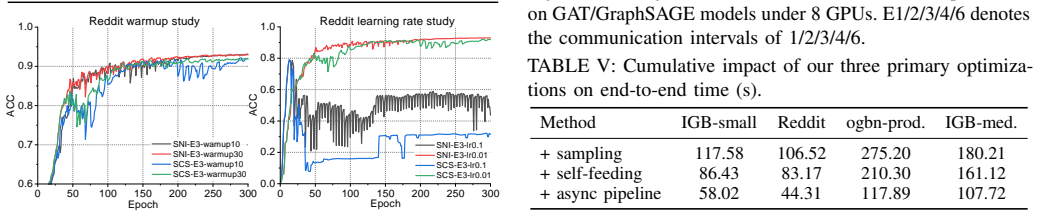
The entire argument leans on the premise that node embeddings change smoothly enough between synchronization rounds that a straight-line extrapolation from recent history stays close to the true value, formally that the second-order difference of embeddings is bounded by a small epsilon; the paper's own robustness experiments show this smoothness fails during early epochs and high learning rates, so the formal guarantee is conditional even though the system degrades gracefully.
Editorial extensions
If this is right
- Full-graph GNN training can safely skip inter-node embedding broadcasts for several epochs at a time, because in-network prediction recovers most of the freshness that full synchronization would provide.
- Existing full-graph training systems, both partition-parallel and tensor-parallel, can absorb the SmartNIC predictor as a drop-in enhancement, so communication savings compound with the system's own overlapping and compression strategies.
- The safe synchronization interval grows with the smoothness of embedding dynamics: when second-order differences are small, the same accuracy can be kept at reduced communication frequency.
- Because the predictor is hardware-isolated on the DPU, it adds no PCIe traffic or host CPU contention, so the speedup is not bought at the price of congesting the host I/O path.
- Accuracy loss stays bounded, at most 0.01 on the evaluated datasets, and standard non-convex convergence with inexact gradients still holds, so users do not face a stark accuracy-versus-speed trade-off.
Reading between the lines
- Editorial inference: the same in-network prediction pattern could apply to other communication-heavy distributed training loops, such as attention over large key-value caches or coordinate-descent-style updates, wherever the exchanged state is smooth in time and the network card has idle compute.
- Editorial inference: the theory's dependence on bounded second-order dynamics suggests a practical adaptive controller, one that measures empirical curvature online and lengthens or shortens the synchronization interval, which the paper does not itself develop.
- Editorial inference: if embedding smoothness degrades as model depth or learning rate grows, the claimed 0.01 accuracy bound may require re-tuning the sampling rate and sync interval; the paper's robustness study indicates graceful degradation, but the formal guarantee remains conditional.
Editorial analysis
A structured set of objections, weighed in public.
Referee Report
Summary. The paper presents SNI-GNN, a distributed full-graph GNN training system that offloads embedding prediction to BlueField-3 SmartNICs (DPUs). A lightweight linear-trend predictor refines cached historical embeddings for remote boundary nodes, reducing inter-node communication frequency while mitigating staleness. The system combines importance-based boundary-node sampling, an asynchronous DPU–GPU pipeline, and intermediate-result reuse. The authors claim theoretical guarantees: a prediction error bound under bounded second-order embedding dynamics, a gradient error bound, and standard non-convex SGD convergence with inexact gradients. On four datasets and up to 16 GPUs, they report 21–45% communication reduction, 1.3–3.6× end-to-end speedups over BNS-GCN, up to 1.29× over a SANCUS baseline, and accuracy within 0.01 of synchronous training.
Significance. The empirical contribution is substantial and well executed: a real BlueField-3 prototype, integration with two state-of-the-art full-graph systems (SANCUS and NeutronTP), evaluation across four datasets and multiple GNN architectures, and ablation and microbenchmark studies. If the results hold, SNI-GNN is a practical complement to existing communication-reduction techniques, and the idea of using SmartNICs for active staleness mitigation is novel and timely. The theoretical section, however, is the weakest part of the paper. The convergence and error bounds as stated are not rigorously derived from the actual predictor, and Theorem IV.3 does not have the form of a standard non-convex convergence guarantee. These issues are load-bearing for the paper's claimed 'theoretical rigor' contribution, though they do not undermine the empirical findings by themselves.
major comments (4)
- [Section IV-D, Theorem IV.1] The proof sketch asserts that the EMA baseline and the weighted trend satisfy h_bar ≈ H(τ) and Φ ≈ H'(τ), but these are exactly the approximations that need to be justified. Algorithm 1 computes h_bar as an exponential moving average and Φ as a decay-weighted average of past slopes, while Theorem IV.1 assumes a linear predictor that exactly captures the first-order Taylor term. The second-order difference bound alone does not imply that the specific EMA/weighted-trend quantities approximate the true value and derivative. The theorem's bound ||Ĥ(t) − H(t)||∞ ≤ (1/2)(Δt)²ε is therefore not established for the predictor actually used in the system.
- [Section IV-D, Lemma IV.2 and Theorem IV.3] The gradient error bound K applies only to the subset of nodes selected for prediction. With the sampling ratios used in Section V (0.3, 0.1, 0.05 for Reddit, IGB-small, ogbn-products), the remaining 70–95% of remote embeddings are raw stale caches. A bound on the second-order difference of embeddings does not control the staleness error h(t) − h(t−s) for those unsampled nodes: a constant first difference has zero second difference but an O(s) staleness error. Consequently, K in Lemma IV.2 does not bound the true gradient error of the evaluated system, and Theorem IV.3's convergence conclusion does not follow for the system as actually configured.
- [Section IV-D, Theorem IV.3] The displayed bound min_t E[||∇L(W_t)||²_F] ≤ [2(L0 − L*) + ρK]/√N is not a standard non-convex SGD convergence rate. The numerator contains the constant term 2(L0 − L*) and there is no dependence on the number of iterations T (or on the learning rate in the usual 1/(ηT) form). As stated, the bound does not imply convergence to a stationary point as training progresses. The proof sketch's reference to 'standard SGD analysis with inexact gradients' is not sufficient; a correct derivation with the appropriate T dependence and a proper treatment of the bias term is needed.
- [Section V-D4 and Theorem IV.1] The paper's own robustness experiments show that the smoothness premise of Theorem IV.1 is violated in early epochs and at high learning rates. Since the formal error and convergence guarantees rely on bounded second-order dynamics, the theoretical claims do not hold unconditionally for the evaluated training regimes. The authors should either extend the analysis to cover non-smooth dynamics with a weaker but still useful bound, or explicitly delimit the scope of the theoretical contributions and explain how the empirical fail-safe behavior (periodic synchronization) relates to the formal analysis.
minor comments (5)
- [Table II] The IGB-medium edge count is given as '120,077, 694' with an extra space; this should be corrected to a single number.
- [Figure 2] The x-axis labels appear garbled (e.g., '8 N_1G4 N_2G2 N_4G8'); please fix the label formatting so the node configurations are legible.
- [Section V-D1, Table III] The baseline row labeled '0' is clear in context, but it would be more readable to label it 'SR=0 (no prediction)' to match the other rows.
- [Section V-B] The text states 'SNI-GNN maintains accuracy loss within 0.01 across all datasets,' but Table III shows accuracy improvements over the SANCUS baseline. Please clarify that the 0.01 loss is relative to the ideal synchronous (E=1) training, not to the stale baseline.
- [Section V-G, Table VI] The PCIe bandwidth comparison appears to be based on a theoretical Dell XE9680 topology rather than the actual testbed. Please clarify in the text whether these numbers are analytical or measured, and note the implication for the CPU-vs-DPU comparison on the testbed hardware.
Circularity Check
No significant circularity: SNI-GNN's predictor is evaluated against external baselines and its theoretical bounds are assumption-based rather than reductions to fitted outputs.
full rationale
The derivation chain is not circular. The core prediction mechanism (Algorithm 1) extrapolates from cached historical embeddings, and its empirical evaluation is against external full-graph systems (SANCUS, NeutronTP, BNS-GCN), not against its own fitted outputs. Theorem IV.1 is a conditional mathematical statement: if the second-order embedding difference is bounded by ε, then the linear-trend predictor error is bounded by (1/2)(Δt)^2 ε. Even though the proof sketch relies on approximations such as ¯h≈H(τ) and Φ≈H′(τ), this is an assumption-based bound, not a definitional equivalence or a fitted parameter renamed as a prediction. Theorem IV.3 invokes standard inexact-gradient SGD analysis from an external reference [24] and does not derive its conclusion from the system's own fitted values. The boundary-node sampling scheme does not create circularity: it selects which nodes receive prediction, while unsampled nodes use stale caches; this is a coverage limitation of the formal bound, not a circular step. Likewise, Algorithm 2's self-feeding of predicted values into the history is a system optimization that may weaken the bounded-dynamics premise, but it is not an equation-level reduction of the claimed result to its inputs. The paper's own robustness section (Section V-D4) concedes that the smoothness assumption can be violated in early epochs or with large learning rates; this is a limitation of the guarantee, not circularity. The citations that may share authors (e.g., NeutronTP [36] and OS2G [29]) are used only as integration targets or related work and are not load-bearing for the paper's central claim or its convergence proof. The notable mathematical issues — the displayed O(1/√N) bound in Theorem IV.3 lacks the usual 1/(ηT) term, and the gradient-error bound does not account for unsampled stale nodes — are correctness and proof-completeness concerns, not evidence that the derivation is equivalent to its own inputs.
Assumptions & free parameters
free parameters (6)
- sampling_ratio (per dataset) =
Reddit 0.3, IGB-small 0.1, ogbn-products 0.05
- EMA weight alpha =
0.3
- trend decay lambda =
0.2
- ring buffer capacity K / window W =
unspecified
- sync interval E =
5 for main results; 1/3/5 in study
- warm-up epochs =
20
assumptions (4)
- domain assumption Bounded second-order embedding dynamics: ||H(t)-2H(t-1)+H(t-2)||_inf <= epsilon
- standard math rho-smooth loss and activations, weight matrices bounded by C, adjacency blocks bounded by B
- domain assumption Embeddings evolve smoothly and gradually over time
- standard math Standard non-convex SGD convergence with inexact gradients (following SANCUS [24])
Cite this review
Pith. "Pith review of SNI-GNN: SmartNIC-Assisted Full-Graph GNN Training with In-Network Embedding Prediction." pith.science (2026). https://pith.science/paper/RDJCSCTB
@misc{pith2026260806441,
  author       = {Pith},
  title        = {Pith review of: SNI-GNN: SmartNIC-Assisted Full-Graph GNN Training with In-Network Embedding Prediction},
  year         = {2026},
  howpublished = {\url{https://pith.science/paper/RDJCSCTB}},
  note         = {Machine review of arXiv:2608.06441}
}
abstract
Full-graph GNN training delivers high accuracy but scales poorly on multi-server clusters due to heavy, irregular inter-node embedding exchanges. We present SNI-GNN, a SmartNIC-assisted full-graph training system that reduces communication while preserving accuracy by predicting remote embeddings in-network. SNI-GNN deploys a lightweight linear-trend predictor on SmartNICs to refine cached historical embeddings, coupled with an importance-based boundary-node sampling policy and an asynchronous DPU--GPU data pipeline with intermediate-result reuse. We provide error and convergence bounds showing that predictor bias remains controlled under bounded second-order dynamics and yields standard non-convex convergence with inexact gradients. Implemented on NVIDIA BlueField-3, SNI-GNN integrates with state-of-the-art full-graph systems, cuts communication by 21--45\%, achieves 1.3--3.6$\times$ end-to-end speedups over BNS-GCN and up to 1.29$\times$ over baseline SANCUS, with accuracy loss $\leq 0.01$, and scales efficiently to 16 GPUs on graphs with up to tens of millions of edges. These results indicate SmartNIC-based in-network prediction is a practical complement to partitioning and compression techniques for communication-efficient full-graph GNN training at scale.
Figures


Figures from the paper (11 more)



Reference graph
Works this paper leans on
-
[1]
Early: Efficient and reliable graph neural network for dynamic graphs,
H. Li and L. Chen, “Early: Efficient and reliable graph neural network for dynamic graphs,”Proceedings of the ACM on Management of Data, vol. 1, no. 2, pp. 1–28, 2023
work page 2023
-
[2]
Towards deeper graph neural networks,
M. Liu, H. Gao, and S. Ji, “Towards deeper graph neural networks,” inProceedings of the 26th ACM SIGKDD international conference on knowledge discovery & data mining, pp. 338–348, 2020
work page 2020
-
[3]
Link prediction based on graph neural networks,
M. Zhang and Y . Chen, “Link prediction based on graph neural networks,” Advances in neural information processing systems, vol. 31, 2018
2018
-
[4]
A multi-scale approach for graph link prediction,
L. Cai and S. Ji, “A multi-scale approach for graph link prediction,” in Proceedings of the AAAI conference on artificial intelligence, vol. 34, pp. 3308–3315, 2020
work page 2020
-
[5]
How powerful are graph neural networks?,
K. Xu, W. Hu, J. Leskovec, and S. Jegelka, “How powerful are graph neural networks?,”arXiv preprint arXiv:1810.00826, 2018
arXiv 2018
-
[6]
Topology-aware graph pooling networks,
H. Gao, Y . Liu, and S. Ji, “Topology-aware graph pooling networks,” IEEE Transactions on Pattern Analysis and Machine Intelligence, vol. 43, no. 12, pp. 4512–4518, 2021
work page 2021
-
[7]
Y . Liu, K. Zeng, H. Wang, X. Song, and B. Zhou, “Content matters: A gnn-based model combined with text semantics for social network cascade prediction,” inPacific-Asia Conference on Knowledge Discovery and Data Mining, pp. 728–740, Springer, 2021
work page 2021
-
[8]
Deepinf: Social influence prediction with deep learning,
J. Qiu, J. Tang, H. Ma, Y . Dong, K. Wang, and J. Tang, “Deepinf: Social influence prediction with deep learning,” inProceedings of the 24th ACM SIGKDD international conference on knowledge discovery & data mining, pp. 2110–2119, 2018
work page 2018
Show all 59 references
-
[9]
A survey of graph neural network based recommendation in social networks,
X. Li, L. Sun, M. Ling, and Y . Peng, “A survey of graph neural network based recommendation in social networks,”Neurocomputing, vol. 549, p. 126441, 2023
2023
-
[10]
Neural graph collaborative filtering,
X. Wang, X. He, M. Wang, F. Feng, and T.-S. Chua, “Neural graph collaborative filtering,” inProceedings of the 42nd international ACM SIGIR conference on Research and development in Information Retrieval, pp. 165–174, 2019
2019
-
[11]
Enhancing graph neural network-based fraud detectors against camouflaged fraudsters,
Y . Dou, Z. Liu, L. Sun, Y . Deng, H. Peng, and P. S. Yu, “Enhancing graph neural network-based fraud detectors against camouflaged fraudsters,” in Proceedings of the 29th ACM international conference on information & knowledge management, pp. 315–324, 2020
2020
-
[12]
Fp-gnn: a versatile deep learning architecture for enhanced molecular property prediction,
H. Cai, H. Zhang, D. Zhao, J. Wu, and L. Wang, “Fp-gnn: a versatile deep learning architecture for enhanced molecular property prediction,” Briefings in bioinformatics, vol. 23, no. 6, p. bbac408, 2022
2022
-
[13]
A comprehensive survey on distributed training of graph neural networks,
H. Lin, M. Yan, X. Ye, D. Fan, S. Pan, W. Chen, and Y . Xie, “A comprehensive survey on distributed training of graph neural networks,” Proceedings of the IEEE, vol. 111, no. 12, pp. 1572–1606, 2023
2023
-
[14]
Graph neural network training systems: A performance comparison of full-graph and mini-batch,
S. Bajaj, H. Guan, and M. Serafini, “Graph neural network training systems: A performance comparison of full-graph and mini-batch,”arXiv preprint arXiv:2406.00552, 2024
2024 arXiv
-
[15]
Cogkr: Cognitive graph for multi-hop knowledge reasoning,
Z. Du, C. Zhou, J. Yao, T. Tu, L. Cheng, H. Yang, J. Zhou, and J. Tang, “Cogkr: Cognitive graph for multi-hop knowledge reasoning,” IEEE Transactions on Knowledge and Data Engineering, vol. 35, no. 2, pp. 1283–1295, 2021
2021
-
[16]
Fragnet: A graph neural network for molecular property prediction with four layers of interpretability,
G. Panapitiya, P. Gao, C. M. Maupin, and E. G. Saldanha, “Fragnet: A graph neural network for molecular property prediction with four layers of interpretability,”arXiv preprint arXiv:2410.12156, 2024
2024 arXiv
-
[17]
Distdgl: Distributed graph neural network training for billion-scale graphs,
D. Zheng, C. Ma, M. Wang, J. Zhou, Q. Su, X. Song, Q. Gan, Z. Zhang, and G. Karypis, “Distdgl: Distributed graph neural network training for billion-scale graphs,” in2020 IEEE/ACM 10th Workshop on Irregular Applications: Architectures and Algorithms (IA3), pp. 36–44, IEEE, 2020
2020
-
[18]
Ginex: Ssd-enabled billion-scale graph neural network training on a single machine via provably optimal in- memory caching,
Y . Park, S. Min, and J. W. Lee, “Ginex: Ssd-enabled billion-scale graph neural network training on a single machine via provably optimal in- memory caching,”Proceedings of the VLDB Endowment, vol. 15, no. 11, pp. 2626–2639, 2022
2022
-
[19]
Sequential aggregation and rematerialization: Distributed full-batch training of graph neural networks on large graphs,
H. Mostafa, “Sequential aggregation and rematerialization: Distributed full-batch training of graph neural networks on large graphs,”Proceedings of Machine Learning and Systems, vol. 4, pp. 265–275, 2022
2022
-
[20]
Flexgraph: a flexible and efficient distributed framework for gnn training,
L. Wang, Q. Yin, C. Tian, J. Yang, R. Chen, W. Yu, Z. Yao, and J. Zhou, “Flexgraph: a flexible and efficient distributed framework for gnn training,” inProceedings of the Sixteenth European Conference on Computer Systems, pp. 67–82, 2021
2021
-
[21]
Scalable and efficient full-graph gnn training for large graphs,
X. Wan, K. Xu, X. Liao, Y . Jin, K. Chen, and X. Jin, “Scalable and efficient full-graph gnn training for large graphs,”Proceedings of the ACM on Management of Data, vol. 1, no. 2, pp. 1–23, 2023
2023
-
[22]
Distributed hybrid cpu and gpu training for graph neural networks on billion- scale heterogeneous graphs,
D. Zheng, X. Song, C. Yang, D. LaSalle, and G. Karypis, “Distributed hybrid cpu and gpu training for graph neural networks on billion- scale heterogeneous graphs,” inProceedings of the 28th ACM SIGKDD Conference on Knowledge Discovery and Data Mining, pp. 4582–4591, 2022
2022
-
[23]
Pipegcn: Efficient full-graph training of graph convolutional networks with pipelined feature communication,
C. Wan, Y . Li, C. R. Wolfe, A. Kyrillidis, N. S. Kim, and Y . Lin, “Pipegcn: Efficient full-graph training of graph convolutional networks with pipelined feature communication,”arXiv preprint arXiv:2203.10428, 2022
2022 arXiv
-
[24]
Sancus: staleness-aware communication-avoiding full-graph decentralized train- ing in large-scale graph neural networks,
J. Peng, Z. Chen, Y . Shao, Y . Shen, L. Chen, and J. Cao, “Sancus: staleness-aware communication-avoiding full-graph decentralized train- ing in large-scale graph neural networks,”Proceedings of the VLDB Endowment, vol. 15, no. 9, pp. 1937–1950, 2022
1937
-
[25]
Adaptive message quantization and parallelization for distributed full-graph gnn training,
B. Wan, J. Zhao, and C. Wu, “Adaptive message quantization and parallelization for distributed full-graph gnn training,”Proceedings of Machine Learning and Systems, vol. 5, 2023
2023
-
[26]
Sylvie: 3d-adaptive and universal system for large-scale graph neural network training,
M. Zhang, Q. Hu, C. Wan, H. Wang, P. Sun, Y . Wen, and T. Zhang, “Sylvie: 3d-adaptive and universal system for large-scale graph neural network training,” in2024 IEEE 40th International Conference on Data Engineering (ICDE), pp. 3823–3836, IEEE, 2024
2024
-
[27]
Granndis: Fast distributed graph neural network training framework for multi-server clusters,
J. Song, H. Jang, H. Lim, J. Jung, Y . Kim, and J. Lee, “Granndis: Fast distributed graph neural network training framework for multi-server clusters,” inProceedings of the 2024 International Conference on Parallel Architectures and Compilation Techniques, pp. 91–107, 2024
2024
-
[28]
Guo,Software and hardware codesign of SmartNIC-based heteroge- neous HPC clusters with machine learning case studies
A. Guo,Software and hardware codesign of SmartNIC-based heteroge- neous HPC clusters with machine learning case studies. PhD thesis, Boston University, 2024
2024
-
[29]
Os2g: A high-performance dpu offloading architecture for gpu-based deep learning with object storage,
Z. Jin, Y . Chen, M. Liang, Y . Wang, G. Fang, A. Zhou, K. Zhang, J. Xu, W. Lin, Y . Lin,et al., “Os2g: A high-performance dpu offloading architecture for gpu-based deep learning with object storage,” in Proceedings of the 30th ACM International Conference on Architectural Sup...
2025
-
[30]
Bns-gcn: Efficient full-graph training of graph convolutional networks with partition-parallelism and random boundary node sampling,
C. Wan, Y . Li, A. Li, N. Kim, and Y . Lin, “Bns-gcn: Efficient full-graph training of graph convolutional networks with partition-parallelism and random boundary node sampling,”ArXiv, vol. abs/2203.10983, 2022
2022 arXiv
-
[31]
Neural message passing for quantum chemistry,
J. Gilmer, S. S. Schoenholz, P. F. Riley, O. Vinyals, and G. E. Dahl, “Neural message passing for quantum chemistry,” inInternational conference on machine learning, pp. 1263–1272, PMLR, 2017
2017
-
[32]
Dgcl: An efficient communication library for distributed gnn training,
Z. Cai, X. Yan, Y . Wu, K. Ma, J. Cheng, and F. Yu, “Dgcl: An efficient communication library for distributed gnn training,” inProceedings of the Sixteenth European Conference on Computer Systems, pp. 130–144, 2021
2021
-
[33]
P3: Distributed deep graph learning at scale,
S. Gandhi and A. P. Iyer, “P3: Distributed deep graph learning at scale,” in15th {USENIX} Symposium on Operating Systems Design and Implementation ({OSDI}21), pp. 551–568, 2021
2021
-
[34]
Gnnautoscale: Scalable and expressive graph neural networks via historical embeddings,
M. Fey, J. E. Lenssen, F. Weichert, and J. Leskovec, “Gnnautoscale: Scalable and expressive graph neural networks via historical embeddings,” inInternational conference on machine learning, pp. 3294–3304, PMLR, 2021
2021
-
[35]
Gnnlab: a factored system for sample-based gnn training over gpus,
J. Yang, D. Tang, X. Song, L. Wang, Q. Yin, R. Chen, W. Yu, and J. Zhou, “Gnnlab: a factored system for sample-based gnn training over gpus,” inProceedings of the Seventeenth European Conference on Computer Systems, pp. 417–434, 2022
2022
-
[36]
Neutrontp: Load-balanced distributed full-graph gnn training with tensor parallelism,
X. Ai, H. Yuan, Z. Ling, Q. Wang, Y . Zhang, Z. Fu, C. Chen, Y . Gu, and G. Yu, “Neutrontp: Load-balanced distributed full-graph gnn training with tensor parallelism,”Proc. VLDB Endow., vol. 18, p. 173–186, Oct. 2024
2024
-
[37]
A fast and high quality multilevel scheme for partitioning irregular graphs,
G. Karypis and V . Kumar, “A fast and high quality multilevel scheme for partitioning irregular graphs,”SIAM Journal on scientific Computing, vol. 20, no. 1, pp. 359–392, 1998
1998
-
[38]
Streaming graph partitioning for large distributed graphs,
I. Stanton and G. Kliot, “Streaming graph partitioning for large distributed graphs,” inProceedings of the 18th ACM SIGKDD international conference on Knowledge discovery and data mining, pp. 1222–1230, 2012
2012
-
[39]
Scalable Edge Partitioning,
S. Schlag, C. Schulz, D. Seemaier, and D. Strash, “Scalable Edge Partitioning,” inProceedings of the 21th Workshop on Algorithm Engineering and Experimentation (ALENEX), pp. 211–225, SIAM, 2019
2019
-
[40]
Open Graph Benchmark: Datasets for Machine Learning on Graphs,
W. Hu, M. Fey, M. Zitnik, Y . Dong, H. Ren, B. Liu, M. Catasta, and J. Leskovec, “Open Graph Benchmark: Datasets for Machine Learning on Graphs,”arXiv e-prints, p. arXiv:2005.00687, May 2020
2005 arXiv
-
[41]
Inductive representation learning on large graphs,
W. Hamilton, Z. Ying, and J. Leskovec, “Inductive representation learning on large graphs,”Advances in neural information processing systems, vol. 30, 2017
2017
-
[42]
Graphfm: Im- proving large-scale gnn training via feature momentum,
H. Yu, L. Wang, B. Wang, M. Liu, T. Yang, and S. Ji, “Graphfm: Im- proving large-scale gnn training via feature momentum,” inInternational conference on machine learning, pp. 25684–25701, PMLR, 2022
2022
-
[43]
Freshgnn: reducing memory access via stable historical embeddings for graph neural network training,
K. Huang, H. Jiang, M. Wang, G. Xiao, D. Wipf, X. Song, Q. Gan, Z. Huang, J. Zhai, and Z. Zhang, “Freshgnn: reducing memory access via stable historical embeddings for graph neural network training,”arXiv preprint arXiv:2301.07482, 2023
2023 arXiv
-
[44]
Gpus, cpus, and... nics: Rethinking the network’s role in serving complex ai pipelines,
M. Wong, U. Butler, E. Farkash, P. Tammana, A. Sivaraman, and R. Netravali, “Gpus, cpus, and... nics: Rethinking the network’s role in serving complex ai pipelines,”arXiv preprint arXiv:2502.15712, 2025
2025 arXiv
-
[45]
Large-message nonblocking mpi_iallgather and mpi ibcast offload via bluefield-2 dpu,
N. Sarkauskas, M. Bayatpour, T. Tran, B. Ramesh, H. Subramoni, and D. K. Panda, “Large-message nonblocking mpi_iallgather and mpi ibcast offload via bluefield-2 dpu,” in2021 IEEE 28th International Conference on High Performance Computing, Data, and Analytics (HiPC), pp. 388– ...
2021
-
[46]
Network-offloaded bandwidth-optimal broadcast and allgather for distributed ai,
M. Khalilov, S. Di Girolamo, M. Chrapek, R. Nudelman, G. Bloch, and T. Hoefler, “Network-offloaded bandwidth-optimal broadcast and allgather for distributed ai,” inSC24: International Conference for High Performance Computing, Networking, Storage and Analysis, pp. 1–17, IEEE, 2024
2024
-
[47]
Squeezenic: Low-latency in-nic compression for distributed deep learn- ing,
A. Rebai, M. A. Ojewale, A. Ullah, M. Canini, and S. A. Fahmy, “Squeezenic: Low-latency in-nic compression for distributed deep learn- ing,” inProceedings of the 2024 SIGCOMM Workshop on Networks for AI Computing, pp. 61–68, 2024
2024
-
[48]
Omniccl: Zero-cost sparse allreduce with direct cache access and smartnics,
T. Gu, J. Fei, and M. Canini, “Omniccl: Zero-cost sparse allreduce with direct cache access and smartnics,” inProceedings of the 2024 SIGCOMM Workshop on Networks for AI Computing, pp. 75–83, 2024
2024
-
[49]
Luwu: An end-to-end in-network out-of-core optimizer for 100b-scale model- in-network data-parallel training on distributed gpus,
M. Sun, Z. Yang, C. Liao, Y . Li, F. Wu, and Z. Wang, “Luwu: An end-to-end in-network out-of-core optimizer for 100b-scale model- in-network data-parallel training on distributed gpus,”arXiv preprint arXiv:2409.00918, 2024
2024 arXiv
-
[50]
Analysis: Forecasting and control,
G. Box and G. Jenkins, “Analysis: Forecasting and control,”San francisco, 1976
1976
-
[51]
Forecasting seasonals and trends by exponentially weighted moving averages,
C. C. Holt, “Forecasting seasonals and trends by exponentially weighted moving averages,”International journal of forecasting, vol. 20, no. 1, pp. 5–10, 2004
2004
-
[52]
Long short-term memory,
S. Hochreiter and J. Schmidhuber, “Long short-term memory,”Neural computation, vol. 9, no. 8, pp. 1735–1780, 1997
1997
-
[53]
Igb: Addressing the gaps in labeling, features, heterogeneity, and size of public graph datasets for deep learning research,
A. Khatua, V . S. Mailthody, B. Taleka, T. Ma, X. Song, and W. mei W. Hwu, “Igb: Addressing the gaps in labeling, features, heterogeneity, and size of public graph datasets for deep learning research,”Proceedings of the 29th ACM SIGKDD Conference on Knowledge Discovery and Dat...
2023
-
[54]
Semi-supervised classification with graph convolutional networks,
T. N. Kipf and M. Welling, “Semi-supervised classification with graph convolutional networks,”arXiv preprint arXiv:1609.02907, 2016
2016 arXiv
-
[55]
Graph attention networks,
P. Veli ˇckovi´c, G. Cucurull, A. Casanova, A. Romero, P. Lio, and Y . Bengio, “Graph attention networks,”arXiv preprint arXiv:1710.10903, 2017
2017 arXiv
-
[56]
Staleness-alleviated distributed gnn training via online dynamic-embedding prediction,
G. Bai, Z. Yu, Z. Chai, Y . Cheng, and L. Zhao, “Staleness-alleviated distributed gnn training via online dynamic-embedding prediction,” in Proceedings of the 2025 SIAM International Conference on Data Mining (SDM), pp. 578–587, SIAM, 2025
2025
-
[57]
Conspirator:{SmartNIC-Aided} control plane for distributed {ML} workloads,
Y . Xiao, D. Z. Tootaghaj, A. Dhakal, L. Cao, P. Sharma, and A. Kuz- manovic, “Conspirator:{SmartNIC-Aided} control plane for distributed {ML} workloads,” in2024 USENIX Annual Technical Conference (USENIX ATC 24), pp. 767–784, 2024
2024
-
[58]
Optimusnic: Offloading optimizer state to smartnics for efficient large-scale ai training,
A. Rebai and M. Canini, “Optimusnic: Offloading optimizer state to smartnics for efficient large-scale ai training,” inProceedings of the 5th Workshop on Machine Learning and Systems, pp. 176–182, 2025
2025
-
[59]
Accelerating cpu-based distributed dnn training on modern hpc clusters using bluefield-2 dpus,
A. Jain, N. Alnaasan, A. Shafi, H. Subramoni, and D. K. Panda, “Accelerating cpu-based distributed dnn training on modern hpc clusters using bluefield-2 dpus,” in2021 IEEE Symposium on High-Performance Interconnects (HOTI), pp. 17–24, IEEE, 2021
2021
Reviewed August 10, 2026 · model on record in the stance chip above.
Discussion (0). Continue with ORCID to comment.