REVIEW 3 major objections 6 minor 26 references
On Hypergraph Representation of Multipartite Quantum Systems
T0 review · 3 major / 6 minor · reviewed 2026-08-16 · deepseek-v4-flash
Pith's one-line read The paper claims that every k-qubit hyperedge in a hypergraph state can be generated by a projector Hamiltonian whose effective coupling falls as $J/2^k$, and that decoherence therefore caps realizable hyperedge order at $\log_2(J…
desk verdict A known hypergraph-state formalism wrapped in toric-geometry language, undercut by a wrong Pauli expansion that invalidates the paper's main decoherence bound. read the letter →
The pith
A machine-rendered reading of the paper's core claim, the machinery that carries it, and where it could break.
The reading
What carries the argument
The load-bearing object is the projector Hamiltonian $\hat{H}^{(k)}=-J P^{(k)}$ for a single k-hyperedge, with $P^{(k)}=|1\ldots1\rangle\langle1\ldots1|$. Its Pauli expansion is what turns a discrete controlled-Z operation into a continuous evolution and produces the factor $1/2^k$ in front of the joint spin operator $Z_1\cdots Z_k$. That factor is the entire mechanism behind the exponential gate-time growth and the logarithmic size bound.
What would settle it
Measure the duration needed to acquire the $\pi$ phase of a controlled-Z gate generated by $H=-J P$ on $k$ qubits, with $J$ fixed, for $k=2,3,4$. If the duration is $\pi/J$ in all cases, the $2^k$ slowdown and the bound $k_{\max}=\log_2(JT_c/\pi)$ do not hold.
Extended reading notes
Core claim
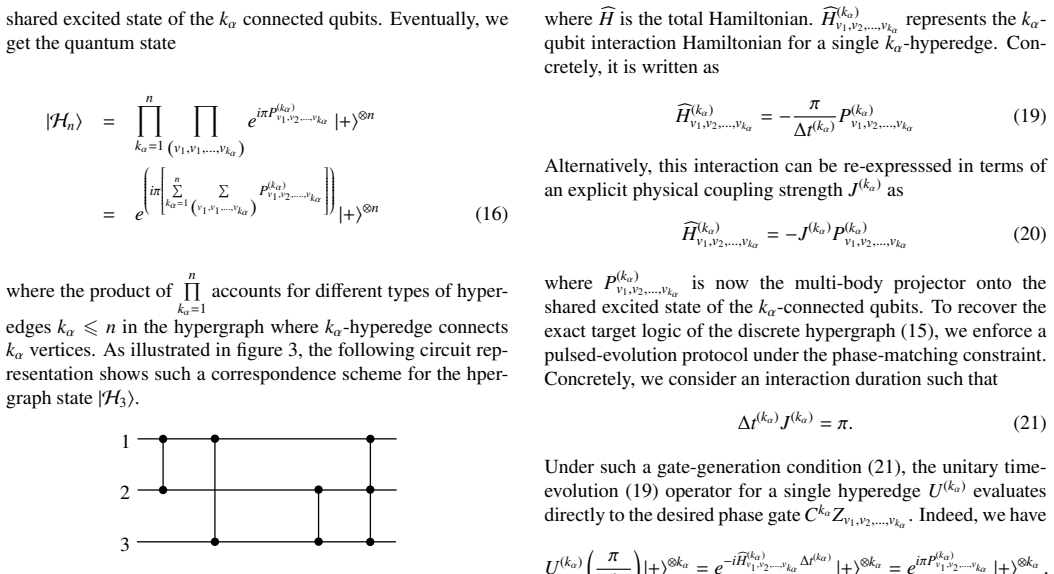
Starting from the discrete construction in which each hyperedge $e^{(k)}$ of a hypergraph $H_n$ is assigned a generalized controlled-Z gate $C^k Z$ acting on the $k$ connected qubits, the paper shows that the resulting hypergraph state $|H_n\rangle$ equals the time-evolved state $e^{-iHt}|+\rangle^{\otimes n}$ under a many-body projector Hamiltonian $H=-\sum_\alpha J^{(k_\alpha)} P^{(k_\alpha)}$, where $P^{(k)}=|1\ldots1\rangle\langle1\ldots1|$. Expanding the projector in the Pauli-Z basis gives an effective coupling $J/2^k$ for each k-body term, so the gate duration needed to implement a k-hyperedge is $\Delta t = 2^k \pi/J$. Imposing $\Delta t < T_c$ yields the bound $k_{\max}=\log_2(J T_c/\pi)$, which the paper reads as a fundamental scalability limit: hypergraph states with large hyperedges require either long coherence times or exponentially strong many-body couplings.
Load-bearing premise
The exponential limit assumes that the physically relevant coupling for a k-hyperedge is the coefficient $J/2^k$ that appears after expanding the projector in Pauli operators, so that the gate time is $2^k\pi/J$ rather than $\pi/J$.
Editorial extensions
If this is right
- Any quantum platform that realizes hypergraph states through this Hamiltonian must have a coherence time of at least $2^k\pi/J$ for a k-hyperedge, so hypergraphs with many high-order edges become exponentially harder to generate.
- The Hamiltonian-hypergraph correspondence turns the combinatorial structure into an interaction hierarchy: a k-hyperedge contributes one k-body term $Z_1\cdots Z_k$ plus lower-order terms, so target k-body interactions can be designed by choosing hyperedge orders.
- The bound $k_{\max}=\log_2(J T_c/\pi)$ gives a concrete resource estimate: improving the coherence time by a factor of 2 adds only one unit to the maximal hyperedge order unless the coupling also grows.
- With strong many-body couplings, hypergraph states of moderate size remain within reach; the paper thereby identifies long coherence and strong coupling, rather than state-preparation complexity alone, as the key scalability constraints.
Reading between the lines
- Because the exponential slowdown comes from the Pauli expansion of the projector, a direct implementation of $H=-J P$ without expanding would give a k-independent gate time; measuring the gate time as a function of $k$ would discriminate the paper's effective-coupling picture from the raw-projector picture.
- The same counting that yields $m=2^n-n-1$ hyperedges implies $2^{2^n-n-1}$ hypergraph states; this super-exponential count could serve as a resource measure for multipartite entanglement, though the paper does not develop it.
- The toric-geometry analogy suggests associating each k-hyperedge with a simplex in a dual polytope; extending the construction to qudit hypergraph states could produce a hierarchy of q-level couplings analogous to the $Z_1\cdots Z_k$ terms.
Signed reviews
Editorial analysis
A structured set of objections, weighed in public.
Referee Report
Summary. The paper proposes a hypergraph representation of n-qubit systems, motivated by the use of toric-geometry diagrams in string compactifications. It constructs hypergraph states with generalized controlled-Z gates and then maps each k_alpha-hyperedge to a projector Hamiltonian H = -J P. The central quantitative claims are that the Pauli expansion of this Hamiltonian reveals a hierarchy of multipartite couplings with effective strength J/2^k, that the required gate time grows as 2^k pi / J, and that decoherence therefore imposes the scalability bound k_max = log_2(J T_c / pi). These claims appear in Secs. 4.2, 4.3 and in the concluding remarks.
Significance. The standard identity e^{i pi P} = C^kZ and the exact unitary evolution generated by a projector Hamiltonian are correctly stated, and these ingredients give a valid construction of hypergraph states by continuous evolution. If the exponential slowdown and the derived bound were correct, they would constitute a practically relevant scalability limitation for hypergraph-state generation. However, the paper's main quantitative result is invalidated by an incorrect Pauli expansion, and the exponential gate time contradicts the paper's own phase-matching condition. The toric-geometry vocabulary is not used in any derivation and remains decorative. The paper is useful as a reminder of the elementary projector-to-C^kZ mapping, but the central scalability claim does not follow from the presented model.
major comments (3)
- [Sec. 4.2, Eq. (23)] The expansion of the projector is incorrect. For P_{v_1...v_k}=|1...1><1...1|, the exact identity is P = 2^{-k} prod_{i=1}^k (I - Z_{v_i}) = 2^{-k} sum_{S subset of [k]} (-1)^{|S|} prod_{i in S} Z_{v_i}. Eq. (23) keeps only the identity and the full k-fold product, omitting all 2^k - 2 intermediate Pauli strings. This contradicts the surrounding text in Sec. 4.2, which claims that Eq. (23) 'contains all possible interaction orders'; the displayed formula actually contains only two terms.
- [Sec. 4.3, Eq. (24)] The gate time in Eq. (24) contradicts Eq. (21) and the exact evolution. For H = -J P, the unitary is U(t) = e^{-iHt} = I + (e^{iJt} - 1)P, so the C^kZ gate is obtained at t = pi/J for every k, exactly as required by the phase-matching condition Delta t J = pi in Eq. (21). The expression Delta t = 2^k pi / J would describe a different Hamiltonian, namely a bare k-body term -J/2^k Z_1 ... Z_k, not the projector Hamiltonian in Eq. (20). Therefore the exponential slowdown does not follow from the model under consideration.
- [Sec. 4.3, Eq. (26)] The bound k_max = log_2(J T_c / pi) follows from Eq. (24), and since Eq. (24) is not the gate time of the projector Hamiltonian, the bound is unsupported. With the correct gate time pi/J, the condition Delta t < T_c is independent of k, so the paper's central conclusion about an exponential reduction of achievable hyperedge order with decoherence is not established.
minor comments (6)
- [Sec. 3.1] In the n=3 example the text says 'one has k_3 = 4' for the single 3-edge e_4^{(3)}; this should presumably be k_4 = 3, since k_alpha is the order of hyperedge alpha and k_alpha <= n.
- [Sec. 2.2, Eq. (10)] The identity 2n - 1 = n + m is used to motivate m 'communication spheres', but this counting relation does not imply that CP^{2n-1} can be decomposed into n plus m independent 2-spheres; the geometric representation is asserted rather than derived.
- [Eq. (15)] The middle equality in Eq. (15) writes the action on |1...1> with a redundant product of 1s and a sign factor (-1)^{k_alpha}; this notation is confusing and should be simplified or removed.
- [Sec. 2.1 and Eq. (5)] The qubit basis is written |1>, |2> in Sec. 2.1 but |0>, |1> in Sec. 3.2; the notation should be made consistent throughout.
- [Throughout] There are numerous typographical errors, including 'Hypegraphs', 'secanrios', 'rouphly', 'oders', and inconsistent reference formatting; a careful proofreading pass is needed.
- [Sec. 2 and Sec. 4] The toric-geometry and Calabi-Yau material in Sec. 2 is not used in the Hamiltonian derivation of Sec. 4; if the analogy is kept, the paper should either make it operational or explicitly label it as motivational.
Circularity Check
No load-bearing circularity: the Hamiltonian is explicitly defined to generate the hypergraph states, and the self-citations are motivational background, not evidence for the central claim.
full rationale
The core construction is not circular. The hypergraph state is defined in Eqs. (15)-(16) via products of projectors e^{iπP}, and the Hamiltonian is introduced in Eq. (20) explicitly as H = -J P, followed by the phase-matching condition Δt J = π in Eq. (21). Under that condition, the propagator reproduces the desired controlled-Z gate by direct construction; this is a legitimate constructive definition, not a hidden input renamed as a prediction. No data are fitted, and no external uniqueness theorem or prior result is invoked to force the central claim. The exponential gate time in Eq. (24) and the bound k_max = log2(J T_c/π) in Eq. (26) are derived from the Pauli expansion claimed in Eq. (23), not assumed in the defining Hamiltonian; whether that expansion is mathematically correct is a separate correctness issue, not a circularity, because the bound does not appear among the inputs. References [23], [25], and [26] are self-citations used only for toric-geometry vocabulary in Sections 1 and 2.1; they are not load-bearing for the Hamiltonian formulation, the hypergraph-state construction, or the scalability discussion. The central derivation is therefore self-contained in the circularity sense. The score of 2 reflects only the presence of minor, non-load-bearing self-citations; no specific circular step meets the evidentiary bar of exhibiting a reduction of the target result to its own inputs.
Assumptions & free parameters
free parameters (1)
- J^(kα) (per-hyperedge coupling strength)
assumptions (4)
- standard math C^kZ = e^{i π P} for projector P = |1><1|^⊗k
- ad hoc to paper The projector expands as H = -J/2^k [I + (-1)^k Π Z_i]
- ad hoc to paper n-qubit state space can be represented by an n-polygon with n Bloch spheres and m 'communication spheres'
- domain assumption Decoherence suppresses off-diagonal coherences over timescale T_c
invented entities (1)
-
'Communication spheres' (extra 2-spheres encoding the quantum entanglement space)
Cite this review
Pith. "Pith review of On Hypergraph Representation of Multipartite Quantum Systems." pith.science (2026). https://pith.science/paper/RDZXOY2P
@misc{pith2026260812067,
  author       = {Pith},
  title        = {Pith review of: On Hypergraph Representation of Multipartite Quantum Systems},
  year         = {2026},
  howpublished = {\url{https://pith.science/paper/RDZXOY2P}},
  note         = {Machine review of arXiv:2608.12067}
}
read the original abstract
Borrowing ideas from the link between Calabi-Yau singularities and toric geometry in string theory compactifications, a hypergraph framework for multipartite quantum systems, extending graph representations to higher-order quantum correlations, is investigated. By implementing hyperedges in many-body Hamiltonian interactions, an interplay between hypergraph states and quantum state dynamics is established. The corresponding Hamiltonian hypergraph reveals the hierarchy of all possible multipartite interactions. However, the decoherence effects impose constraints on the realization of large hypergraph states. The findings show the importance of long coherence times and strong many-body couplings for the realization of large hypergraph states.
Figures


Reference graph
Works this paper leans on
-
[1]
Born,On the Quantum Mechanics of Collision Pro- cesses
M. Born,On the Quantum Mechanics of Collision Pro- cesses. Zeitschrift für Physik. 37 (12): 863–867 (1926)
work page 1926
-
[2]
R. Feynman, R. Leighton, M. Sands,The Feynman Lec- tures on Physics. V ol. 3. California Institute of Technol- ogy. ISBN 978-0201500646 (1964)
work page 1964
-
[3]
Jaeger,What in the (quantum) world is macroscopic?, American Journal of Physics
G. Jaeger,What in the (quantum) world is macroscopic?, American Journal of Physics. 82 (9): 896–905 (2014)
work page 2014
-
[4]
D. P. DiVincenzo,The physical implementation of quan- tum computation. Fortschritte der Physik, 48(9-11), 771- 783 (2000)
work page 2000
-
[5]
C. H. Bennett, et al,Teleportating an unknown quan- tum state via dual classical and Einstein-Podolsky-Rosen channels, Physical Review Letters, 70(13), 1895 (1993)
work page 1993
-
[6]
Brunner et al,Bell nonlocality, Reviews of Modern Physics, 86(2), 419
N. Brunner et al,Bell nonlocality, Reviews of Modern Physics, 86(2), 419 . (2014)
work page 2014
-
[7]
Berge.Graphs and hypergraphs, North-Holland Pub
C. Berge.Graphs and hypergraphs, North-Holland Pub. Co.American Elsevier Pub. Co. (1973)
work page 1973
-
[8]
R. J. Wang, Z-S. Li, Y-r. Bao,Encoding hypergraphs into quantum states, Phys. Rev. A 87, 022311 (2013)
work page 2013
Show all 26 references
-
[9]
Berge,The theory of graphs, Courier Corporation
C. Berge,The theory of graphs, Courier Corporation. (2001)
2001
-
[10]
M. Hein, J. Eisert, and H. J. Briegel,Multiparty en- tanglement in graph states, Physical Review A—Atomic, Molecular, and Optical Physics, 69 (6):062311, (2004)
2004
-
[11]
Rossi, M
M. Rossi, M. Huber, D. Bruss , and C. Macchiavello, Quantum hypergraph states, New Journal of Physics, 15:113022, 11 (2013)
2013
-
[12]
Rossi, D
M. Rossi, D. Bruß, and C. Macchiavello,Hypergraph states in grover’s quantum search algorithm, Physica Scripta, T160:014036, 4 (2014)
2014
-
[13]
Y . Xie, S. Zhao,Qudit hypergraph states and their prop- erties, Quantum Information Processing (2017)
2017
-
[14]
et al.Qudit hypergraph states and their properties, Phys
F-L. et al.Qudit hypergraph states and their properties, Phys. Rev. A 97, 012323 (2018)
2018
-
[15]
J. Chen, Y . Yan, Y . Zhou,Magic of quantum hypergraph states, Quantum 8, 1351 (2024). 5
2024
-
[16]
Raussendorf, D.E
R. Raussendorf, D.E. Browne, H.J. Briegel, Measurement-based quantum computation on clus- ter states. Physical Review A, 68(2), 022312. (2003)
2003
-
[17]
Huang et al.Demonstration of hypergraph-state quan- tum information processing
H. Huang et al.Demonstration of hypergraph-state quan- tum information processing. Nature Communications, 15, 2468 (2024)
2024
-
[18]
M. A. Nielsen, I. L. Chuang,Quantum Computation and Quantum Information, Cam- bridge University Press, New York, NY , USA, 2000
2000
-
[19]
D. R. Terno,Introduction to relativistic quantum infor- mation, quant-ph/0508049
-
[20]
Kargarian,Entanglement properties of topolog- ical color codes, Phys
M. Kargarian,Entanglement properties of topolog- ical color codes, Phys. Rev. A78, 062312, (2008) arXiv:0809.4276
2008 arXiv
-
[21]
Fulton,Introduction to Toric varieties, Annals of Math
W. Fulton,Introduction to Toric varieties, Annals of Math. Studies, No.131, Princeton University Press, 1993
1993
- [22]
-
[23]
Belhaj, H
A. Belhaj, H. Ez-Zahraouy, M. B. Sedra,Toric geome- try and string theory descriptions of qudit systems, Jour. Geom. Phys, 95, 21 ( 2015)
2015
-
[24]
Katz, P.Mayr, C
S. Katz, P.Mayr, C. Vafa,Mirror Exact Solution of 4D N=2 Gauge Theories I, Adv. Theor. Math. Phys. 1, 53 (1998),hep-th/9706110
1998 arXiv
-
[25]
EL Fallah and E.H
A.Belhaj, A. EL Fallah and E.H. Saidi,On the affine D4 mirror geometry, Class. Quantum. Grav. 16, 3297(1999)
1999
-
[26]
EL Fallah and E.H
A.Belhaj, A. EL Fallah and E.H. Saidi,On non simply laced mirror geometries in type II strings, Class. Quan- tum. Grav. 17, 1 (1999). 6
1999
Reviewed August 16, 2026 · model on record in the stance chip above.
Discussion (0). Continue with ORCID to comment.