Deep Image Prototype Learning with Geometric Heat-Kernel Priors
Pith reviewed 2026-06-26 21:47 UTC · model grok-4.3
The pith
A geometry-aware EM algorithm selects on-manifold prototypes via heat-kernel diffusion centrality in variational medical image models.
A machine-rendered reading of the paper's core claim, the machinery that carries it, and where it could break.
Core claim
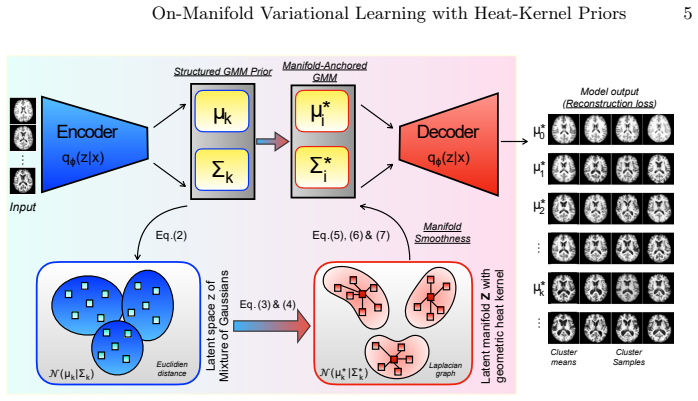
The manifold-anchored variational framework built on a geometry-aware Expectation-Maximization algorithm selects each sub-population prototype as the graph medoid with the highest diffusion centrality on a heat-kernel-weighted latent graph, ensuring that every prototype remains on-manifold; the same manifold-anchored EM extends standard EM and applies to other latent-variable models.
What carries the argument
Manifold-anchored EM algorithm that selects prototypes as highest-diffusion-centrality medoids on a heat-kernel-weighted latent graph.
If this is right
- Prototypes remain on-manifold even at large sub-population counts where Euclidean mixture models collapse.
- The same manifold-anchored EM step can be dropped into other latent-variable models without changing their encoders or decoders.
- Per-sub-population uncertainty scores derived from the heat-kernel graph give a label-free ranking of prototype quality.
- The Dirichlet energy regularizer enforces geometric smoothness of the latent space as a direct consequence of the heat-kernel construction.
Where Pith is reading between the lines
- The same heat-kernel medoid selection could replace Euclidean averaging inside non-variational clustering pipelines on any manifold-structured data.
- Because the method needs no expert labels, it could be applied to large unlabeled cohorts in domains outside MRI where manifold drift is also observed.
- Extending the heat-kernel prior to time-series or graph-valued medical data would test whether the on-manifold guarantee generalizes beyond static images.
Load-bearing premise
Choosing the graph medoid of highest diffusion centrality on a heat-kernel-weighted latent graph keeps every prototype on the data manifold.
What would settle it
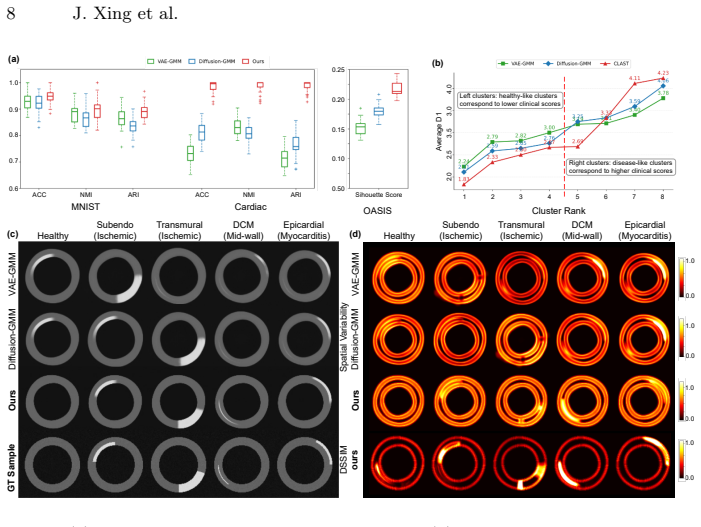
On the cardiac scar or brain MRI benchmarks, any run in which the method fails to reach the highest accuracy or degenerates once the sub-population count exceeds the baselines would falsify the central claim.
Figures
read the original abstract
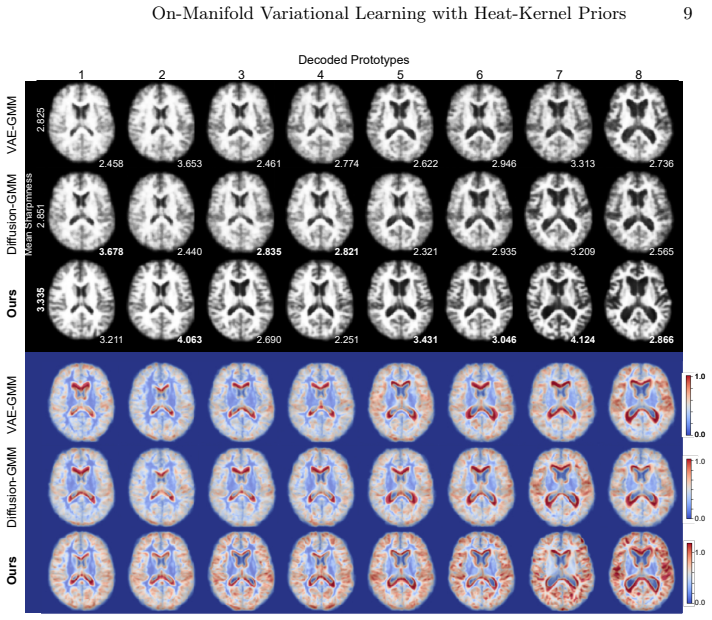
Learning unsupervised representations of medical imaging cohorts can reveal anatomically meaningful prototypes without expert labels, which are often noisy and fail to capture true pathological heterogeneity. However, existing deep latent-variable models estimate Gaussian mixture priors via Euclidean averaging, producing prototypes that drift off the curved data manifold and degenerate as the number of sub-populations grows. We propose a manifold-anchored variational framework built on a geometry-aware Expectation-Maximization (EM) algorithm, whose M-step selects each sub-population prototype as the graph medoid with the highest diffusion centrality on a heat-kernel-weighted latent graph, ensuring that every prototype remains on-manifold. A Dirichlet energy regularizer enforces geometric smoothness of the latent space, and a per-sub-population uncertainty score enables label-free quality assessment. The manifold-anchored EM is a general-purpose geometric tool that extends standard EM and applies readily to other latent-variable models beyond this setting. On cardiac scar and brain MRI benchmarks, our framework attains the highest accuracy among all compared methods, produces the sharpest prototypes reported to date, and remains stable at large sub-population counts where all baselines degenerate. Code and implementation details are available at https://github.com/jr-xing/On-Manifold-Variational-Learning-with-Heat-Kernel-Priors.
Editorial analysis
A structured set of objections, weighed in public.
Referee Report
Summary. The paper proposes a manifold-anchored variational framework for unsupervised representation learning on medical imaging cohorts. It replaces Euclidean averaging in standard EM with a geometry-aware M-step that selects each sub-population prototype as the graph medoid of highest diffusion centrality on a heat-kernel-weighted latent graph, augmented by a Dirichlet energy regularizer and per-sub-population uncertainty scores. The central claims are that prototypes remain on-manifold, the method is stable at large sub-population counts where baselines degenerate, and it attains highest accuracy plus sharpest prototypes on cardiac scar and brain MRI benchmarks. The manifold-anchored EM is presented as a general-purpose extension applicable to other latent-variable models. Code is released at the cited GitHub repository.
Significance. If the geometric construction and empirical results hold, the work supplies a concrete, internally consistent mechanism for avoiding off-manifold drift in mixture-based latent models, a recurring issue in unsupervised medical imaging analysis. The open release of code and implementation details is a clear strength that supports reproducibility and potential adoption as a modular tool beyond the reported setting.
minor comments (2)
- [Abstract] Abstract, final paragraph: the statement that the framework 'attains the highest accuracy among all compared methods' and 'produces the sharpest prototypes reported to date' should be accompanied by the precise quantitative metrics (e.g., Dice, Hausdorff, or prototype sharpness measure) and the exact list of baselines in the results section so readers can verify the ranking without ambiguity.
- [Methods] The description of the M-step (graph medoid selection on the heat-kernel-weighted latent graph) is clear at a high level but would benefit from an explicit algorithmic listing or pseudocode in the methods section to facilitate direct implementation by readers.
Simulated Author's Rebuttal
We thank the referee for the detailed summary of our manuscript and for the positive assessment of its significance and reproducibility. The recommendation of minor revision is noted. No major comments were raised in the report, so we have no specific points requiring point-by-point rebuttal or revision at this stage.
Circularity Check
No significant circularity; derivation is self-contained
full rationale
The paper defines its core M-step as an explicit construction that selects existing latent points (graph medoids with highest diffusion centrality on a heat-kernel-weighted graph) to enforce on-manifold prototypes by design, avoiding Euclidean averaging. This is presented as an algorithmic choice rather than a derived prediction that reduces to fitted inputs. No self-citations, uniqueness theorems, or ansatzes are invoked in the abstract or described framework to justify load-bearing claims; the Dirichlet regularizer and uncertainty score are additional components without reduction to the target result. Empirical claims on benchmarks are external to the derivation chain. The method is self-contained against the stated assumptions.
discussion (0)
Sign in with ORCID, Apple, or X to comment. Anyone can read and Pith papers without signing in.