REVIEW 3 major objections 6 minor 72 references
Time Series Generation Under Data Scarcity: A Unified Generative Modeling Approach
T0 review · 3 major / 6 minor · reviewed 2026-08-07 · deepseek-v4-flash
Pith's one-line read The paper argues that a single diffusion model pre-trained across many time-series domains can generate high-fidelity samples from just a few examples, and that the same model also outperforms dedicated per-dataset baselines when…
desk verdict Solid few-shot time series generation paper with real engineering and a useful benchmark, but the 'cross-domain' claim is partly inflated by family overlap between pre-training and evaluation sets. read the letter →
The pith
A machine-rendered reading of the paper's core claim, the machinery that carries it, and where it could break.
The reading
What carries the argument
Three mechanisms carry the argument. Delay embedding converts each channel of a time series into a trajectory matrix and stacks channels into an image, allowing image diffusion backbones to be reused. DyConv keeps a single canonical convolution kernel and resizes it over channel dimensions by bicubic interpolation at runtime, so one parameter set serves datasets with different variable counts instead of padding every input to the largest channel size. A dataset token, a learnable embedding injected through adaptive group normalization, tells the denoising network which domain it is generating for; during fine-tuning, a new token is allocated for each target dataset. A dynamic mask marks padded time steps so variable-length generation works without architectural changes. Pre-training uses the EDM denoising objective with preconditioning and a log-normal noise schedule.
What would settle it
Remove every evaluation-family sibling from the pre-training corpus (for example, drop ETTh1, all remaining ETT subsets, ECG5000, and SelfRegulationSCP2) and repeat the 5% and #10 fine-tuning evaluations; if the discriminative score and contextFID gains over the from-scratch baselines disappear, the cross-domain generalization claim is false.
Extended reading notes
Core claim
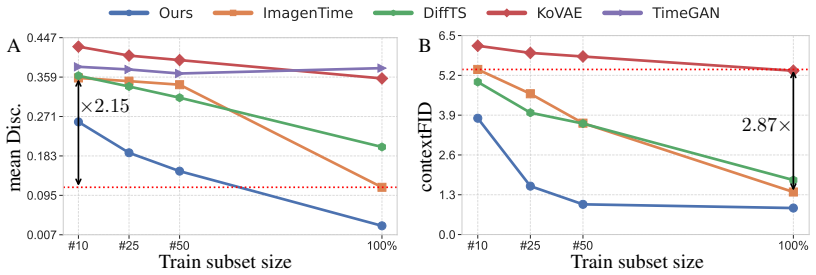
The central claim is that a unified, pre-trained generative model can close most of the gap between full-data and few-shot time series generation. The model maps each multivariate series into an image via delay embedding, denoises it with an EDM-style diffusion objective, and handles variable channel counts with a dynamically interpolated convolution; a per-dataset token conditions generation on domain identity. After pre-training on 19 datasets, the model is fine-tuned with a fresh token on a small subset of each target dataset, and the paper reports that it outperforms ImagenTime, DiffusionTS, KoVAE, and TimeGAN across all subset sizes, including the full-data case. The paper attributes this to learning domain-agnostic temporal representations during pre-training.
Load-bearing premise
The few-shot gains are attributed to cross-domain transfer, but some evaluation datasets share near-identical source families with pre-training datasets (the ETT family, ECG200 vs. ECG5000, SelfRegulationSCP1 vs. SelfRegulationSCP2); the claim collapses if this overlap, rather than general temporal structure, drives the reported improvements.
Editorial extensions
If this is right
- A single model can replace per-dataset training for time series generation, since it transfers across domains, channel counts, and sequence lengths.
- Domains with only tens of recorded examples, such as rare medical signals or seismic events, become practical targets for generative modeling.
- Pre-training improves full-data performance too, so adopting the approach does not trade few-shot ability for data-rich quality.
- Smaller models recover much of the gap to larger ones when pre-trained, which lowers the compute budget for high-quality generation.
- The reported constant compute cost of DyConv means the unified model's cost no longer grows with the maximum channel count used in pre-training.
Reading between the lines
- The paper leaves implicit that its benchmark cannot yet separate true cross-domain transfer from near-domain transfer: three evaluation families have close siblings in the pre-training corpus, so a decisive test would require holding out entire families rather than individual datasets.
- The dataset-token ablation suggests generation without a token samples a mixture of all learned distributions; this points to a testable extension where a small set of learned prototypes or cluster tokens replaces one-token-per-dataset, reducing storage for large model families.
- The fixed-count results indicate a floor near ten examples; an editorially useful next question is where the sample-count threshold lies below which pre-training no longer helps, by sweeping 5, 10, 20, 40, and 80 examples.
- The constant-cost property of DyConv could make the model attractive for deployment across many multi-channel sensors, because adding a new dataset with more channels does not inflate memory or FLOPs as it would with channel padding.
Editorial analysis
A structured set of objections, weighed in public.
Referee Report
Summary. This paper proposes a unified diffusion-based time series generation model that is pre-trained on a large, heterogeneous corpus of time series datasets and then fine-tuned on small target datasets. The architecture introduces dynamic convolutional layers (DyConv) to handle variable channel counts and dataset-token conditioning for multi-domain generation. The authors benchmark four existing generative models and their own model under percentage-based (5%, 10%, 15%) and fixed-count (10, 25, 50) subsampling, reporting consistent improvements in Discriminative Score, Predictive Score, and contextFID. They also provide ablations on sequence length, model scale, DyConv, and dataset tokens, along with runtime and memory comparisons.
Significance. If the results hold, the paper makes a notable contribution by demonstrating that a single pre-trained generative model can transfer across time series domains under extreme data scarcity, with architectural components that address variable channel counts and domain identity. The release of code and the construction of a few-shot benchmark are useful assets. However, the central cross-domain generalization claim is weakened by the overlap between pre-training and evaluation dataset families; the evidence that the gains are due to general temporal representations rather than near-duplicate family recall is not established. The paper is therefore significant but requires further validation before the strong claims in the abstract can be accepted.
major comments (3)
- [Sec. 5 (Table 5) vs. Sec. 6.1 (Table 6) and App. C.3] The pre-training corpus includes ETTh1, ECG5000, and SelfRegulationSCP2, while the few-shot evaluation suite includes ETTm1, ETTm2, ETTh2, ECG200, and SelfRegulationSCP1. These are not independent domain pairs: they are close siblings from the same benchmark families with similar sensors, sampling rates, and temporal morphology. The reported Discriminative Scores for ETTm1, ETTm2, and ETTh2 at 5-15% subset sizes (0.011-0.034) are orders of magnitude better than baselines, and Appendix C.3 explicitly lists ETTh2, ETTm1, and SelfRegulationSCP1 among datasets where 'our model demonstrates marginal improvements.' This pattern is consistent with the model having memorized or closely learned the family distribution during pre-training rather than learning domain-agnostic temporal representations. Because the headline claim is cross-domain generalization, the load-bearing assumption is that family overlap does not materially drive the measured gains. I request a leave-family-out re-run (pre-train without ETT, ECG, and SelfRegulation families, then fine-tune on all targets) or, at minimum, a per-family breakdown separating overlapping from non-overlapping evaluation datasets.
- [Table 1 and App. C.3] The aggregated contextFID scores in Table 1 are reported as point estimates without error bars or significance tests, although Discriminative Scores in the appendix include standard deviations. contextFID is known to be high-variance, especially with 10-50 training samples, and the claimed 54.25% average improvement rests on single numbers. The paper should report contextFID across multiple seeds with confidence intervals and test whether the differences are statistically significant, particularly for the marginal improvements on datasets like StarLightCurves.
- [Sec. 4 and Table 1] The comparison set omits recent generative models that have reported strong results on standard time series benchmarks, such as GT-GAN (Jeon et al., 2022) and more recent diffusion-based generators. The abstract's claim of 'state-of-the-art performance' and 'outperforming domain-specific baselines' is relative to only four baselines (TimeGAN, KoVAE, DiffusionTS, ImagenTime). Adding at least one recent competitive baseline would make the SOTA claim more robust.
minor comments (6)
- [Sec. 5, Eq. (3)] The notation Interp(W, Cin, Cout) is not formally defined; specify whether bicubic interpolation is applied over both the input and output channel dimensions and how gradients flow through the interpolation.
- [App. B.3] The Predictive Score description says 'We then subtract this error from 0.5' but that sentence belongs to the Discriminative Score paragraph; check for a copy-paste error.
- [Tables 12-17] Standard deviations are reported for Discriminative Score but not for Predictive Score or contextFID; consider providing error bars or at least a note on the number of seeds used.
- [App. C.1, Table 10] The DyConv ablation varies C0 and C1 but the parameter counts also differ; the conclusion that [128,128] is best among adequate configurations is not clearly supported by a significance test.
- [Sec. 6.1] The statement that 'some datasets, such as Weather and ECG200, remain challenging under limited data conditions' is vague; it would be helpful to quantify what 'challenging' means given the metric ranges.
- [Sec. 2] The related work discusses several time series foundation models; consider citing TimeDiT and other recent generative pre-training approaches more explicitly to position the contribution.
Circularity Check
No circular derivation: the paper is an empirical benchmark study; self-citations are benign and the family-overlap issue is a validity concern, not a circular step.
full rationale
This paper is empirical and has no analytical derivation chain whose output could be equivalent to its inputs by construction. The training objective (Eq. 1) is the standard EDM/ImagenTime denoising loss, and the few-shot results are obtained by fine-tuning on held-out subsets and measuring quality with external classifiers and embedding distances, so no fitted parameter is presented as a prediction. The authors' self-citations to ImagenTime [44] and KoVAE [45] are used as the architectural backbone and as a baseline, not as load-bearing support for the cross-domain generalization claim; those prior works are published and independently reproducible. The main threat to the headline claim is benchmark-family overlap (pre-training includes ETTh1, ECG5000, and SelfRegulationSCP2, while evaluation includes ETTm1/ETTm2/ETTh2, ECG200, and SelfRegulationSCP1), which is a benchmark-validity and contamination concern rather than a logical circularity. No specific equation or fitted quantity reduces to its own input, so no circular step can be exhibited; the score reflects only the presence of minor, non-load-bearing self-citation.
Assumptions & free parameters
free parameters (5)
- Pre-training sequence length =
24
- Fine-tuning epochs =
1000 (100 sufficient empirically)
- DyConv canonical channel dimensions =
[128, 128]
- Diffusion sampling steps =
36
- Learning rate =
1e-4
assumptions (4)
- domain assumption Delay embedding from time series to images preserves enough distributional information for diffusion-based generation to be meaningful after inverse mapping.
- domain assumption The evaluation metrics (Discriminative Score, Predictive Score, Context-FID) accurately capture the quality and utility of generated time series.
- domain assumption Pre-training on the listed 19 datasets imparts transferable temporal structure that transfers to the 12 evaluation datasets.
- domain assumption Treating classification, forecasting, and anomaly detection datasets as unconditional generation tasks is valid.
invented entities (2)
-
Dataset token
-
DyConv (Dynamic Convolution layer)
Cite this review
Pith. "Pith review of Time Series Generation Under Data Scarcity: A Unified Generative Modeling Approach." pith.science (2026). https://pith.science/paper/REEOKO4J
@misc{pith2026250520446,
  author       = {Pith},
  title        = {Pith review of: Time Series Generation Under Data Scarcity: A Unified Generative Modeling Approach},
  year         = {2026},
  howpublished = {\url{https://pith.science/paper/REEOKO4J}},
  note         = {Machine review of arXiv:2505.20446}
}
read the original abstract
Generative modeling of time series is a central challenge in time series analysis, particularly under data-scarce conditions. Despite recent advances in generative modeling, a comprehensive understanding of how state-of-the-art generative models perform under limited supervision remains lacking. In this work, we conduct the first large-scale study evaluating leading generative models in data-scarce settings, revealing a substantial performance gap between full-data and data-scarce regimes. To close this gap, we propose a unified diffusion-based generative framework that can synthesize high-fidelity time series across diverse domains using just a few examples. Our model is pre-trained on a large, heterogeneous collection of time series datasets, enabling it to learn generalizable temporal representations. It further incorporates architectural innovations such as dynamic convolutional layers for flexible channel adaptation and dataset token conditioning for domain-aware generation. Without requiring abundant supervision, our unified model achieves state-of-the-art performance in few-shot settings-outperforming domain-specific baselines across a wide range of subset sizes. Remarkably, it also surpasses all baselines even when tested on full datasets benchmarks, highlighting the strength of pre-training and cross-domain generalization. We hope this work encourages the community to revisit few-shot generative modeling as a key problem in time series research and pursue unified solutions that scale efficiently across domains. Code is available at https://github.com/azencot-group/ImagenFew.
Figures


Reference graph
Works this paper leans on
-
[1]
A. Abdulaal, Z. Liu, and T. Lancewicki. Practical approach to asynchronous multivariate time series anomaly detection and localization. In Proceedings of the 27th ACM SIGKDD Conference on Knowledge Discovery & Data Mining , KDD ’21, page 2485–2494, New York, NY , USA, 2021. Association for Computing Machinery
work page 2021
-
[2]
A. Bagnall, H. A. Dau, J. Lines, M. Flynn, J. Large, A. Bostrom, P. Southam, and E. Keogh. The UEA multivariate time series classification archive, 2018. arXiv preprint arXiv:1811.00075, 2018
arXiv 2018
-
[3]
E. Ben Zaken, Y . Goldberg, and S. Ravfogel. BitFit: Simple parameter-efficient fine-tuning for transformer- based masked language-models. In S. Muresan, P. Nakov, and A. Villavicencio, editors,Proceedings of the 60th Annual Meeting of the Association for Computational Linguistics (Volume 2: Short Papers), pages 1–9, Dublin, Ireland, May 2022. Association...
work page 2022
-
[4]
R. Bommasani, D. A. Hudson, E. Adeli, R. Altman, S. Arora, S. von Arx, M. S. Bernstein, J. Bohg, A. Bosselut, E. Brunskill, et al. On the opportunities and risks of foundation models. arXiv preprint arXiv:2108.07258, 2021
arXiv 2021
-
[5]
Brown, B
T. Brown, B. Mann, N. Ryder, M. Subbiah, J. D. Kaplan, P. Dhariwal, A. Neelakantan, P. Shyam, G. Sastry, A. Askell, et al. Language models are few-shot learners. Advances in neural information processing systems, 33:1877–1901, 2020
1901
-
[6]
L. M. Candanedo, V . Feldheim, and D. Deramaix. Data driven prediction models of energy use of appliances in a low-energy house. Energy and Buildings, 140:81–97, 2017
work page 2017
-
[7]
D. Cao, F. Jia, S. O. Arik, T. Pfister, Y . Zheng, W. Ye, and Y . Liu. TEMPO: Prompt-based generative pre-trained transformer for time series forecasting. In The Twelfth International Conference on Learning Representations, 2024
work page 2024
-
[8]
D. Cao, W. Ye, Y . Zhang, and Y . Liu. TimeDiT: General-purpose diffusion transformers for time series foundation model. arXiv preprint arXiv:2409.02322, 2024
arXiv 2024
Show all 72 references
-
[9]
CDC. Illness. https://gis.cdc.gov/grasp/fluview/fluportaldashboard.html. Accessed: 2025-05-06
2025
-
[10]
Chang, W.-Y
C. Chang, W.-Y . Wang, W.-C. Peng, and T.-F. Chen. LLM4TS: Aligning pre-trained llms as data-efficient time-series forecasters. ACM Transactions on Intelligent Systems and Technology, 16(3):1–20, 2025
2025
-
[11]
Chicaiza and M
K. Chicaiza and M. Benalcázar. A brain-computer interface for controlling iot devices using eeg signals. In 2021 IEEE ETCM, pages 1–6, 2021
2021
-
[12]
C. T. Chung, S. Lee, E. King, T. Liu, A. A. Armoundas, G. Bazoukis, and G. Tse. Clinical signifi- cance, challenges and limitations in using artificial intelligence for electrocardiography-based diagnosis. International journal of arrhythmia, 23(1):24, 2022
2022
-
[13]
Coletta, S
A. Coletta, S. Gopalakrishnan, D. Borrajo, and S. Vyetrenko. On the constrained time-series generation problem. Advances in Neural Information Processing Systems, 36:61048–61059, 2023
2023
-
[14]
A. Das, W. Kong, R. Sen, and Y . Zhou. A decoder-only foundation model for time-series forecasting. In Forty-first International Conference on Machine Learning, 2024
2024
-
[15]
H. A. Dau, A. Bagnall, K. Kamgar, C.-C. M. Yeh, Y . Zhu, S. Gharghabi, C. A. Ratanamahatana, and E. Keogh. The UCR time series archive. IEEE/CAA Journal of Automatica Sinica, 6(6):1293–1305, 2019
2019
-
[16]
Desai, C
A. Desai, C. Freeman, Z. Wang, and I. Beaver. Timevae: A variational auto-encoder for multivariate time series generation. arXiv preprint arXiv:2111.08095, 2021
2021 arXiv
-
[17]
Dhariwal and A
P. Dhariwal and A. Q. Nichol. Diffusion models beat GANs on image synthesis. In A. Beygelzimer, Y . Dauphin, P. Liang, and J. W. Vaughan, editors,Advances in Neural Information Processing Systems, 2021
2021
-
[18]
J. O. Egede, S. Song, T. A. Olugbade, C. Wang, A. Williams, H. Meng, M. Aung, N. D. Lane, M. Valstar, and N. Bianchi-Berthouze. Emopain challenge 2020: Multimodal pain evaluation from facial and bodily expressions, 2020
2020
-
[19]
Franceschi, A
J.-Y . Franceschi, A. Dieuleveut, and M. Jaggi. Unsupervised scalable representation learning for multivari- ate time series. Advances in neural information processing systems, 32, 2019. 10
2019
-
[20]
S. Gao, T. Koker, O. Queen, T. Hartvigsen, T. Tsiligkaridis, and M. Zitnik. UniTS: A unified multi-task time series model. In The Thirty-eighth Annual Conference on Neural Information Processing Systems, 2024
2024
-
[21]
A. L. Goldberger, L. A. Amaral, L. Glass, J. M. Hausdorff, P. C. Ivanov, R. G. Mark, J. E. Mietus, G. B. Moody, C.-K. Peng, and H. E. Stanley. Physiobank, physiotoolkit, and physionet: components of a new research resource for complex physiologic signals. circulation, 101(23):...
2000
-
[22]
I. J. Goodfellow, J. Pouget-Abadie, M. Mirza, B. Xu, D. Warde-Farley, S. Ozair, A. Courville, and Y . Bengio. Generative adversarial nets.Advances in neural information processing systems, 27, 2014
2014
-
[23]
Gruver, M
N. Gruver, M. Finzi, S. Qiu, and A. G. Wilson. Large language models are zero-shot time series forecasters. Advances in Neural Information Processing Systems, 36:19622–19635, 2023
2023
-
[24]
J. Ho, A. Jain, and P. Abbeel. Denoising diffusion probabilistic models. In Advances in Neural Information Processing Systems, volume 33, pages 6840–6851, 2020
2020
-
[25]
A. Hsu, W. Khoo, N. Goyal, and M. Wainstein. Next-generation digital ecosystem for climate data mining and knowledge discovery: a review of digital data collection technologies. Frontiers in big Data, 3:29, 2020
2020
-
[26]
E. J. Hu, yelong shen, P. Wallis, Z. Allen-Zhu, Y . Li, S. Wang, L. Wang, and W. Chen. LoRA: Low-rank adaptation of large language models. In International Conference on Learning Representations, 2022
2022
-
[27]
Hundman, V
K. Hundman, V . Constantinou, C. Laporte, I. Colwell, and T. Soderstrom. Detecting spacecraft anomalies using lstms and nonparametric dynamic thresholding. In Proceedings of the 24th ACM SIGKDD Inter- national Conference on Knowledge Discovery &; Data Mining , KDD ’18, page 38...
2018
-
[28]
P. Jeha, M. Bohlke-Schneider, P. Mercado, S. Kapoor, R. S. Nirwan, V . Flunkert, J. Gasthaus, and T. Januschowski. Psa-gan: Progressive self attention gans for synthetic time series. In The Tenth International Conference on Learning Representations, 2022
2022
-
[29]
J. Jeon, J. Kim, H. Song, S. Cho, and N. Park. GT-GAN: General purpose time series synthesis with generative adversarial networks. Advances in Neural Information Processing Systems, 35:36999–37010, 2022
2022
-
[30]
M. Jin, S. Wang, L. Ma, Z. Chu, J. Y . Zhang, X. Shi, P.-Y . Chen, Y . Liang, Y .-F. Li, S. Pan, and Q. Wen. Time-LLM: Time series forecasting by reprogramming large language models. InThe Twelfth International Conference on Learning Representations, 2024
2024
-
[31]
Karras, M
T. Karras, M. Aittala, T. Aila, and S. Laine. Elucidating the design space of diffusion-based generative models. Advances in neural information processing systems, 35:26565–26577, 2022
2022
-
[32]
D. P. Kingma and M. Welling. Auto-encoding variational bayes. In International Conference on Learning Representations (ICLR), 2014
2014
-
[33]
Kirillov, E
A. Kirillov, E. Mintun, N. Ravi, H. Mao, C. Rolland, L. Gustafson, T. Xiao, S. Whitehead, A. C. Berg, W.-Y . Lo, et al. Segment anything. InProceedings of the IEEE/CVF international conference on computer vision, pages 4015–4026, 2023
2023
-
[34]
Z. Kong, W. Ping, J. Huang, K. Zhao, and B. Catanzaro. Diffwave: A versatile diffusion model for audio synthesis. In International Conference on Learning Representations, 2021
2021
-
[35]
Lai, W.-C
G. Lai, W.-C. Chang, Y . Yang, and H. Liu. Modeling long- and short-term temporal patterns with deep neural networks. The 41st International ACM SIGIR Conference on Research & Development in Information Retrieval, 2017
2017
-
[36]
H. Li, S. Yu, and J. Principe. Causal recurrent variational autoencoder for medical time series generation. In Proceedings of the AAAI conference on artificial intelligence, volume 37, pages 8562–8570, 2023
2023
-
[37]
Lines, A
J. Lines, A. Bagnall, P. Caiger-Smith, and S. Anderson. Classification of household devices by electricity usage profiles. In Advances in Intelligent Data Analysis XI (IDA), volume 6936, pages 403–412, 2011
2011
-
[38]
H. Liu, Z. Chen, Y . Yuan, X. Mei, X. Liu, D. Mandic, W. Wang, and M. D. Plumbley. AudioLDM: Text-to-audio generation with latent diffusion models. In A. Krause, E. Brunskill, K. Cho, B. Engelhardt, S. Sabato, and J. Scarlett, editors, Proceedings of the 40th International Con...
2023
-
[39]
H. Liu, C. Li, Q. Wu, and Y . J. Lee. Visual instruction tuning.Advances in neural information processing systems, 36:34892–34916, 2023
2023
-
[40]
J. Liu, L. Zhong, J. Wickramasuriya, and V . Vasudevan. uWave: Accelerometer-based personalized gesture recognition and its applications. Pervasive and Mobile Computing, 5:657–675, 2009
2009
-
[41]
McLeod and H
A. McLeod and H. Gweon. Optimal deseasonalization for monthly and daily geophysical time series. Journal of Environmental statistics, 4(11):1–11, 2013. 11
2013
-
[42]
Middlehurst, P
M. Middlehurst, P. Schäfer, and A. Bagnall. Bake off redux: a review and experimental evaluation of recent time series classification algorithms. Data Mining and Knowledge Discovery, 38(4):1958–2031, Apr. 2024
1958
-
[43]
Missel, P
R. Missel, P. K. Gyawali, J. V . Murkute, Z. Li, S. Zhou, A. AbdelWahab, J. Davis, J. Warren, J. L. Sapp, and L. Wang. A hybrid machine learning approach to localizing the origin of ventricular tachycardia using 12-lead electrocardiograms. Computers in biology and medicine, 12...
2020
-
[44]
Naiman, N
I. Naiman, N. Berman, I. Pemper, I. Arbiv, G. Fadlon, and O. Azencot. Utilizing image transforms and diffusion models for generative modeling of short and long time series. Advances in Neural Information Processing Systems, 37:121699–121730, 2024
2024
-
[45]
Naiman, N
I. Naiman, N. B. Erichson, P. Ren, M. W. Mahoney, and O. Azencot. Generative modeling of regular and irregular time series data via Koopman V AEs. InThe Twelfth International Conference on Learning Representations, 2024
2024
-
[46]
Nochumsohn and O
L. Nochumsohn and O. Azencot. Data augmentation policy search for long-term forecasting. Transactions on Machine Learning Research, 2025
2025
-
[47]
R. T. Olszewski. Generalized feature extraction for structural pattern recognition in time-series data . Carnegie Mellon University, 2001
2001
-
[48]
Oquab, T
M. Oquab, T. Darcet, T. Moutakanni, H. V . V o, M. Szafraniec, V . Khalidov, P. Fernandez, D. Haziza, F. Massa, A. El-Nouby, M. Assran, N. Ballas, W. Galuba, R. Howes, P. Huang, S. Li, I. Misra, M. Rabbat, V . Sharma, G. Synnaeve, H. Xu, H. Jégou, J. Mairal, P. Labatut, A. Jou...
2024
-
[49]
Radford, J
A. Radford, J. W. Kim, C. Hallacy, A. Ramesh, G. Goh, S. Agarwal, G. Sastry, A. Askell, P. Mishkin, J. Clark, et al. Learning transferable visual models from natural language supervision. In International conference on machine learning, pages 8748–8763. PmLR, 2021
2021
-
[50]
Rebbapragada, P
U. Rebbapragada, P. Protopapas, C. E. Brodley, and C. Alcock. Finding anomalous periodic time series: An application to catalogs of periodic variable stars. Machine Learning, 74(3):281–313, Dec. 2008
2008
-
[51]
P. Ren, R. Nakata, M. Lacour, I. Naiman, N. Nakata, J. Song, Z. Bi, O. A. Malik, D. Morozov, O. Azencot, et al. Learning physics for unveiling hidden earthquake ground motions via conditional generative modeling. arXiv preprint arXiv:2407.15089, 2024
2024 arXiv
-
[52]
D. Roverso. Plant diagnostics by transient classification: The aladdin approach. International Journal of Intelligent Systems, 17, 2002
2002
-
[53]
Silva, J
I. Silva, J. Behar, R. Sameni, T. Zhu, J. Oster, G. D. Clifford, and G. B. Moody. Noninvasive fetal ecg: The physionet/computing in cardiology challenge 2013. In Computing in Cardiology, pages 149–152, 2013
2013
-
[54]
J. Song, C. Meng, and S. Ermon. Denoising diffusion implicit models. In International Conference on Learning Representations, 2021
2021
-
[55]
Song and S
Y . Song and S. Ermon. Generative modeling by estimating gradients of the data distribution.Advances in neural information processing systems, 32, 2019
2019
-
[56]
Y . Song, J. Sohl-Dickstein, D. P. Kingma, A. Kumar, S. Ermon, and B. Poole. Score-based generative mod- eling through stochastic differential equations. In International Conference on Learning Representations (ICLR), 2021
2021
-
[57]
Y . Su, Y . Zhao, C. Niu, R. Liu, W. Sun, and D. Pei. Robust anomaly detection for multivariate time series through stochastic recurrent neural network. In Proceedings of the 25th ACM SIGKDD International Conference on Knowledge Discovery & Data Mining, KDD ’19, pages 2828–283...
2019
-
[58]
G. Team, R. Anil, S. Borgeaud, J.-B. Alayrac, J. Yu, R. Soricut, J. Schalkwyk, A. M. Dai, A. Hauth, K. Millican, et al. Gemini: a family of highly capable multimodal models.arXiv preprint arXiv:2312.11805, 2023
2023 arXiv
-
[59]
Todorov, T
E. Todorov, T. Erez, and Y . Tassa. Mujoco: A physics engine for model-based control. In2012 IEEE/RSJ International Conference on Intelligent Robots and Systems, pages 5026–5033, 2012
2012
-
[60]
Touvron, T
H. Touvron, T. Lavril, G. Izacard, X. Martinet, M.-A. Lachaux, T. Lacroix, B. Rozière, N. Goyal, E. Hambro, F. Azhar, et al. Llama: Open and efficient foundation language models. arXiv preprint arXiv:2302.13971, 2023
2023 arXiv
-
[61]
Q. Wen, L. Sun, F. Yang, X. Song, J. Gao, X. Wang, and H. Xu. Time series data augmentation for deep learning: A survey. In Proceedings of the Thirtieth International Joint Conference on Artificial Intelligence, IJCAI, pages 4653–4660. ijcai.org, 2021
2021
-
[62]
Wetterstation. Weather. https://www.bgc-jena.mpg.de/wetter/
-
[63]
G. Woo, C. Liu, A. Kumar, C. Xiong, S. Savarese, and D. Sahoo. Unified training of universal time series forecasting transformers. In Proceedings of the 41st International Conference on Machine Learning, ICML’24. JMLR.org, 2024. 12
2024
-
[64]
H. Wu, T. Hu, Y . Liu, H. Zhou, J. Wang, and M. Long. Timesnet: Temporal 2d-variation modeling for general time series analysis. In The Eleventh International Conference on Learning Representations, 2023
2023
-
[65]
X. Yi, Y . Zheng, J. Zhang, and T. Li. ST-MVL: Filling missing values in geo-sensory time series data. In Proceedings of the Twenty-Fifth International Joint Conference on Artificial Intelligence (IJCAI), IJCAI’16, pages 2704–2710, New York, NY , USA, 2016. AAAI Press
2016
-
[66]
J. Yoon, D. Jarrett, and M. Van der Schaar. Time-series generative adversarial networks. Advances in neural information processing systems, 32, 2019
2019
-
[67]
Yuan and Y
X. Yuan and Y . Qiao. Diffusion-TS: Interpretable diffusion for general time series generation. In The Twelfth International Conference on Learning Representations, 2024
2024
-
[68]
H. Zhou, S. Zhang, J. Peng, S. Zhang, J. Li, H. Xiong, and W. Zhang. Informer: Beyond efficient transformer for long sequence time-series forecasting. In Proceedings of the AAAI conference on artificial intelligence, volume 35, pages 11106–11115, 2021
2021
-
[69]
T. Zhou, P. Niu, L. Sun, R. Jin, et al. One fits all: Power general time series analysis by pretrained lm. Advances in neural information processing systems, 36:43322–43355, 2023. 13 A Additional Dataset Details We provide detailed descriptions of the datasets used in our fram...
2008
-
[70]
To quantitatively evaluate the similarity between real and generated time series data, we adopt the framework proposed by [66]
Discriminative Score. To quantitatively evaluate the similarity between real and generated time series data, we adopt the framework proposed by [66]. Specifically, we train a post-hoc LSTM-based time series classifier to distinguish between sequences originating from the origi...
-
[71]
To assess the predictive utility of the generated data, we again follow an evaluation protocol proposed by [ 66], which tests whether synthetic data can support forecasting tasks
Predictive Score. To assess the predictive utility of the generated data, we again follow an evaluation protocol proposed by [ 66], which tests whether synthetic data can support forecasting tasks. Specifically, we train an LSTM model on the synthetic dataset to perform next-s...
-
[72]
To measure global and contextual realism, we use the Context-Fréchet Inception Distance (Context-FID) [28]
Context-FID. To measure global and contextual realism, we use the Context-Fréchet Inception Distance (Context-FID) [28]. This is an adaptation of the FID score used in image generation, but tailored for time series. Rather than using image-based features, Context-FID uses embe...
Reviewed August 7, 2026 · model on record in the stance chip above.
Discussion (0). Continue with ORCID to comment.