REVIEW 1 major objections 4 minor 85 references
Axion searches at colliders
T0 review · 1 major / 4 minor · reviewed 2026-08-16 · deepseek-v4-flash
Pith's one-line read A photophilic axion, from Lagrangian to Belle II exclusion plot.
desk verdict Useful lecture notes for students, but the tutorial contains a genuine factor-of-two error in the a->γγ width that should be corrected before publication. read the letter →
The pith
A machine-rendered reading of the paper's core claim, the machinery that carries it, and where it could break.
The reading
What carries the argument
The load-bearing object is the simplified Belle II detector model combined with the analytic ALP kinematics. The vertex resolution $L_{\min}=0.14$ m and detector outer radius $L_{\max}=1.55$ m are compared with the boosted decay length $\ell_a = (|\vec p_a|/m_a)\,128\pi/(g_{a\gamma\gamma}^2 m_a^3)$; the electromagnetic calorimeter's $0.8^\circ$ angular resolution is compared with the opening angle $\Delta\theta \sim 4m_a/\sqrt{s}$. This comparison alone assigns each point in the mass-coupling plane to one of four signal classes. The statistical treatment is a $\chi^2$ test where resolved-signal limits use a 90% CL with $\Delta\chi^2 = 2.71$, and invisible-signal limits use the $N_{\rm signal}=3$ rule.
What would settle it
Compare the tutorial's Fig. 19 curves with the full Belle II exclusion contours from Ref. [82] at the same luminosity: if the resolved-channel contour disagrees by more than the expected reconstruction-efficiency factor in any mass bin, or if the invisible-channel contour excludes points the experiment does not, the simplified background treatment is the reason.
Extended reading notes
Core claim
The central claim is that the expected signals of a photophilic ALP at an e+e- collider are completely determined, in their parametric behavior, by two formulas and one geometric comparison. The cross section for $e^+e^- \to \gamma a$ scales as $\frac{\alpha g_{a\gamma\gamma}^2}{32}(1+\cos^2\theta)(1 - m_a^2/s)^3$, and the decay width is $\Gamma(a\to\gamma\gamma)=g_{a\gamma\gamma}^2 m_a^3/(128\pi)$, so the boosted decay length is $\ell_a \sim (|\vec p_a|/m_a)\,128\pi/(g_{a\gamma\gamma}^2 m_a^3)$. Comparing $\ell_a$ to the detector's inner and outer radii, and comparing the typical photon opening angle, $\sim 4m_a/\sqrt{s}$, to the angular resolution, partitions the $(m_a, g_{a\gamma\gamma})$ plane into invisible, merged, displaced-resolved, and prompt-resolved regions. Using the Belle II geometry ($L_{\min}=0.14$ m, $L_{\max}=1.55$ m, angular resolution $0.8^\circ$, $0.25$ GeV energy threshold), an idealized background treatment, and a three-event discovery threshold, the paper produces approximate 90% CL exclusion curves for 445 inverse picobarns and for the full 50 inverse attobarns, mirroring the published Belle II analysis.
Load-bearing premise
The reach curves stand or fall on the assumption that a simplified detector model—inner radius 0.14 m, outer radius 1.55 m, 0.8 degree angular resolution, 0.25 GeV photon threshold—together with an idealized background treatment (zero background for the invisible channel, perfect background subtraction for the resolved channel, and a three-event discovery rule) reproduces the actual Belle II sensitivity.
Editorial extensions
If this is right
- The resolved diphoton signature is the relevant probe for ALP masses from a few hundred MeV up to near $\sqrt{s}$, where the production cross section vanishes as $(1 - m_a^2/s)^3$.
- The invisible single-photon signature covers low ALP masses and small couplings, where the decay length exceeds the detector size; its reach improves only with integrated luminosity, roughly as an order of magnitude when going from 445 inverse picobarns to 50 inverse attobarns.
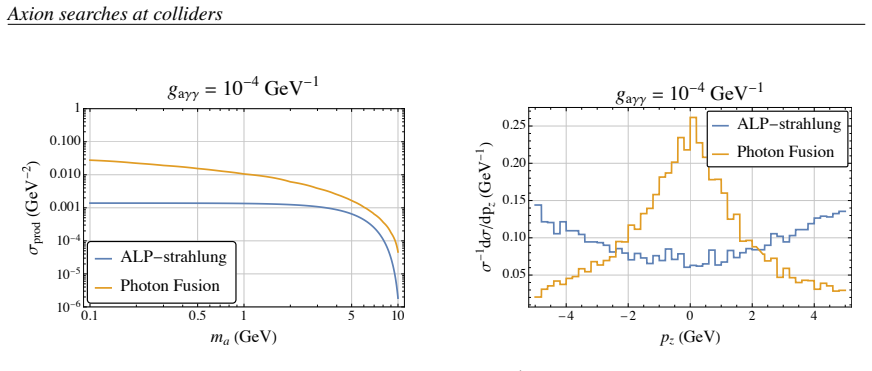
- Photon-fusion production has a larger cross section than associated production at Belle II, but it is discarded because the outgoing electrons remain in the uninstrumented forward region and the resulting signature suffers large beam-induced backgrounds.
- Whether a given ALP is visible, displaced, merged, or invisible is fixed by the ratios $\ell_a/L_{\rm det}$ and $\Delta\theta/\Delta\theta_{\rm res}$, so the same classification applies to any e+e- detector with different radii and angular resolution.
- For two benchmark flavor structures, rare kaon decays probe axion scales that differ by orders of magnitude: flavor-anarchic couplings reach $f_a \sim 10^{12}$ GeV, while loop-generated minimal-flavor-violation couplings reach only $f_a \sim 10^6$-$10^7$ GeV, or about 10 TeV for a gluon-only UV coupling.
Reading between the lines
- The same closed-form chain can be rerun for any other electron-positron machine by changing $\sqrt{s}$, $L_{\min}$, $L_{\max}$, and angular resolution, so the tutorial effectively gives a parametric calculator for photophilic-ALP reach rather than a single experiment-specific result.
- The merged-photon region is classified but not quantified in the tutorial; a dedicated search using electromagnetic-shower shapes in that corner of parameter space would be a natural complement to the resolved and invisible analyses.
- For a hadrophilic or leptophilic ALP, the same steps apply with the lifetime formulas of Section 4.3 replacing the two-photon width; the reach curves would be shaped by whichever decay channel dominates.
- The idealized background treatment makes a concrete prediction: the full Belle II limits, which use a complete simulation, should lie close enough to the tutorial's curves to confirm that the simplified model captures the main sensitivity.
Signed reviews
Editorial analysis
A structured set of objections, weighed in public.
Referee Report
Summary. These lecture notes provide an introduction to axion and ALP searches at colliders. After reviewing basic collider physics and the landscape of dark-sector portals, the authors focus on the QCD axion and ALP phenomenology, including production and decay, and give a broad overview of search strategies. The final part is a worked tutorial that starts from the Lagrangian in Eq. (44), derives the associated-production cross section, the ALP decay width, and the expected detector signatures, and ends with Fig. 19, which shows approximate Belle II exclusion bounds for both the invisible and resolved γγ signatures. The tutorial is explicitly based on the published Belle II analysis of Ref. [82].
Significance. The paper fills a useful pedagogical niche: it takes the reader from first principles to a concrete, reproducible estimate of the Belle II sensitivity to photophilic ALPs, benchmarking each step against a real analysis. The main strengths are the clear step-by-step derivations (including the 2→2 phase-space counting, the χ2 statistics detour, and the explicit detector-geometry description), the explicit statement of the simplifications, and the transparent comparison with published data points in Fig. 21. If the numerical error identified below is corrected, the tutorial will be a valuable resource for students entering the field. The paper does not claim to derive new bounds; its value is didactic, and the declared approximations (zero background for the invisible channel, perfect background subtraction for the resolved channel, 3-event discovery rule) are acceptable for that purpose provided the underlying widths are correct.
major comments (1)
- [§5.3, Eq. (54)] Eq. (54) gives Γ(a→γγ) = g²_{aγγ} m³_a/(128π), but the standard result with the convention in Eq. (44) is Γ(a→γγ) = g²_{aγγ} m³_a/(64π). The inconsistency is internal: under the mapping g_{aγγ} = α C^{eff}_{γγ}/(2π f_a) in §4.3, Eq. (25) reproduces exactly the 64π result, while Eq. (54) is a factor of 2 smaller. The missing factor is the identical-particle phase-space factor 1/2!, which is not fully captured by the heuristic prefactor (4π/32π²) in Eq. (54). This error propagates directly into Eq. (56) for the proper lifetime, Eq. (57) for the boosted decay length, the numerical example in Eq. (58), and—through the survival probability P(L) in Eq. (72)—into the reach curves in Fig. 19. Since the tutorial’s stated purpose is to reproduce the quantitative sensitivity of Belle II, this factor must be corrected throughout §5.3 and §5.7–§5.8, and the affected numerical results and Fig. 19 should be updated.
minor comments (4)
- [§5.2, after Eq. (52)] The word “desribed” in the phase-space paragraph is a typo and should be “described”.
- [§5.3, Eq. (54)] The explanation of the prefactor in Eq. (54) would be clearer if the identical-particle factor 1/2! were mentioned explicitly; this is directly related to the factor-of-2 error and should be part of the corrected derivation.
- [§5.4, Eq. (60)] The sentence “the direction of the other photon in the rest frame is −(π−θ′)” is confusing; a photon back-to-back with a photon at polar angle θ′ has polar angle π−θ′ and an azimuthal angle shifted by π, so the notation with a minus sign should be revised.
- [§5.6] “The ECL barell” is a typo; it should be “the ECL barrel”.
Circularity Check
No significant circularity: the tutorial is benchmarked against external Belle II data, and the self-citations are background references rather than load-bearing inputs.
full rationale
This paper is a review with a pedagogical tutorial. The tutorial's derivation chain—Lagrangian Eq. (44), production cross-section Eq. (52), decay width Eq. (54), lifetime Eq. (56), survival probability Eq. (72), event rates Eqs. (73)-(74), and reach curves in Fig. 19—is self-contained in the sense that each quantity is computed from previous equations rather than fitted to the target reach. The reach is benchmarked against the published Belle II analysis Ref. [82] and against Belle II data points shown in Fig. 21, which is external evidence, not an input fitted into the prediction. The detector simplifications (L_min, L_max, angular resolution, energy threshold, zero or perfectly subtracted backgrounds, and the 3-event discovery rule) are explicitly declared approximations, and none of them is a parameter adjusted to force agreement with the Belle II limits; they are chosen before computing the reach. The self-citations (e.g., Refs. [1], [51], [56], [80]) appear as background references to prior work by one of the authors and do not carry the tutorial's derivation or the review's main claims. The internal factor-of-2 discrepancy between Eq. (25) and Eq. (54) is a correctness issue that propagates into lifetimes and reach, but it is not circularity: Eq. (54) is not defined in terms of the reach curves, nor is any fitted parameter renamed as a prediction. Overall, no load-bearing circular step was found.
Assumptions & free parameters
assumptions (4)
- domain assumption The ALP is a pNGB, so the most general dimension-5 Lagrangian contains only derivative couplings to fermions and anomalous couplings to gauge bosons, Eqs. (12)-(15).
- domain assumption The QCD axion mass is generated by the QCD anomaly and given by m_a = m_pi f_pi / f_a, Eq. (2).
- domain assumption The effective ALP-photon coupling C_γγ^eff in Eq. (26) includes NLO ChPT contributions from the gluon coupling and pi0-a mixing.
- domain assumption For the resolved-signal background, the dominant SM process is e+ e- -> gamma gamma gamma, as stated in Sec. 5.8; Belle II detector parameters are as listed in Sec. 5.6.
Cite this review
Pith. "Pith review of Axion searches at colliders." pith.science (2026). https://pith.science/paper/REPKUF3P
@misc{pith2026250500124,
  author       = {Pith},
  title        = {Pith review of: Axion searches at colliders},
  year         = {2026},
  howpublished = {\url{https://pith.science/paper/REPKUF3P}},
  note         = {Machine review of arXiv:2505.00124}
}
abstract
We provide an introduction to searches for axions and Axion-Like Particles (ALPs) at colliders. After covering the basics of collider physics, with a focus on production and detection of new particles, we give a rather broad introduction into searches for dark sectors at colliders. While our focus is on searches for light dark sectors, with the special emphasis on ALPs, we also contrast these with searches for heavy dark matter. In the final part of the notes we provide a ``tutorial'', a worked out example of a search for a photo-philic ALP in $e^+e^-$ collisions, reflecting the actual analysis that was performed at Belle-II with early data.
Figures


Figures from the paper (18 more)






Reference graph
Works this paper leans on
-
[82]
Abudinén et al.,Search for Axion-Like Particles produced in𝑒+𝑒− collisions at Belle II, Phys
Belle-IICollaboration, F. Abudinén et al.,Search for Axion-Like Particles produced in𝑒+𝑒− collisions at Belle II, Phys. Rev. Lett.125 (2020), no. 16 161806, [arXiv:2007.13071]. 42 Axion searches at colliders
arXiv 2020
- [1]
-
[2]
Silk et al.,Particle Dark Matter: Observations, Models and Searches
J. Silk et al.,Particle Dark Matter: Observations, Models and Searches. Cambridge Univ. Press, Cambridge, 2010
2010
-
[3]
G. Bertone, D. Hooper, and J. Silk,Particle dark matter: Evidence, candidates and constraints, Phys. Rept.405 (2005) 279–390, [hep-ph/0404175]
arXiv 2005
-
[4]
C. A. J. O’Hare,Cosmology of axion dark matter,PoSCOSMICWISPers(2024) 040, [arXiv:2403.17697]
arXiv 2024
-
[5]
L. Di Luzio, M. Giannotti, E. Nardi, and L. Visinelli,The landscape of QCD axion models, Phys. Rept.870 (2020) 1–117, [arXiv:2003.01100]
arXiv 2020
-
[6]
G. Grilli di Cortona, E. Hardy, J. Pardo Vega, and G. Villadoro,The QCD axion, precisely, JHEP01 (2016) 034, [arXiv:1511.02867]
arXiv 2016
-
[7]
A. Blondel and P. Janot,FCC-ee overview: new opportunities create new challenges, Eur. Phys. J. Plus137(2022), no. 1 92, [arXiv:2106.13885]
arXiv 2022
Show all 85 references
-
[8]
Abada et al.,FCC-ee: The Lepton Collider: Future Circular Collider Conceptual Design Report Volume 2,Eur
FCC Collaboration, A. Abada et al.,FCC-ee: The Lepton Collider: Future Circular Collider Conceptual Design Report Volume 2,Eur. Phys. J. ST228 (2019), no. 2 261–623
2019
-
[9]
Dong et al.,CEPC Conceptual Design Report: Volume 2 - Physics & Detector, arXiv:1811.10545
CEPC Study GroupCollaboration, M. Dong et al.,CEPC Conceptual Design Report: Volume 2 - Physics & Detector, arXiv:1811.10545
-
[10]
Accettura et al.,Towards a muon collider,Eur
C. Accettura et al.,Towards a muon collider,Eur. Phys. J. C83(2023), no. 9 864, [arXiv:2303.08533]. [Erratum: Eur.Phys.J.C 84, 36 (2024)]
2023 arXiv
-
[11]
Aad et al.,The ATLAS Experiment at the CERN Large Hadron Collider, JINST3(2008) S08003
ATLASCollaboration, G. Aad et al.,The ATLAS Experiment at the CERN Large Hadron Collider, JINST3(2008) S08003
2008
-
[12]
Chatrchyan et al.,The CMS Experiment at the CERN LHC, JINST3 (2008) S08004
CMSCollaboration, S. Chatrchyan et al.,The CMS Experiment at the CERN LHC, JINST3 (2008) S08004
2008
-
[13]
Abe et al.,Belle II Technical Design Report, arXiv:1011.0352
Belle-II Collaboration, T. Abe et al.,Belle II Technical Design Report, arXiv:1011.0352
-
[14]
Aielli et al.,Expression of interest for the CODEX-b detector, Eur
CODEX-bCollaboration, G. Aielli et al.,Expression of interest for the CODEX-b detector, Eur. Phys. J. C80(2020), no. 12 1177, [arXiv:1911.00481]
2020 arXiv
-
[15]
Aielli et al.,Technical design report for the CODEX-𝛽 demonstrator, arXiv:2406.12880
CODEX-bCollaboration, G. Aielli et al.,Technical design report for the CODEX-𝛽 demonstrator, arXiv:2406.12880
-
[16]
V. V. Gligorov, S. Knapen, M. Papucci, and D. J. Robinson,Searching for Long-lived Particles: A Compact Detector for Exotics at LHCb,Phys. Rev. D97(2018), no. 1 015023, [arXiv:1708.09395]. 38 Axion searches at colliders
2018 arXiv
-
[17]
J. L. Feng, I. Galon, F. Kling, and S. Trojanowski,ForwArd Search ExpeRiment at the LHC, Phys. Rev. D97(2018), no. 3 035001, [arXiv:1708.09389]
2018 arXiv
-
[18]
S. P. Martin,A Supersymmetry primer,Adv. Ser. Direct. High Energy Phys.18(1998) 1–98, [hep-ph/9709356]
1998 arXiv
-
[19]
Baer, K.-m
H. Baer, K.-m. Cheung, and J. F. Gunion,A Heavy gluino as the lightest supersymmetric particle, Phys. Rev. D59 (1999) 075002, [hep-ph/9806361]
1999 arXiv
-
[20]
R. D. Peccei and H. R. Quinn,CP Conservation in the Presence of Instantons,Phys. Rev. Lett.38(1977) 1440–1443
1977
-
[21]
Wilczek,Problem of Strong𝑃 and𝑇 Invariance in the Presence of Instantons,Phys
F. Wilczek,Problem of Strong𝑃 and𝑇 Invariance in the Presence of Instantons,Phys. Rev. Lett.40(1978) 279–282
1978
-
[22]
Weinberg,A New Light Boson?, Phys
S. Weinberg,A New Light Boson?, Phys. Rev. Lett.40(1978) 223–226
1978
-
[23]
Preskill, M
J. Preskill, M. B. Wise, and F. Wilczek,Cosmology of the Invisible Axion, Phys. Lett. B120 (1983) 127–132
1983
-
[24]
L. F. Abbott and M. B. Wise,The Effective Hamiltonian for Nucleon Decay,Phys. Rev. D22 (1980) 2208
1980
-
[25]
Dine and W
M. Dine and W. Fischler,The Not So Harmless Axion, Phys. Lett. B120 (1983) 137–141
1983
-
[26]
Dimopoulos,A Solution of the Strong CP Problem in Models With Scalars,Phys
S. Dimopoulos,A Solution of the Strong CP Problem in Models With Scalars,Phys. Lett. B 84 (1979) 435–439
1979
-
[27]
Holdom and M
B. Holdom and M. E. Peskin,Raising the Axion Mass,Nucl. Phys. B208(1982) 397–412
1982
-
[28]
Holdom,Strong QCD at High-energies and a Heavy Axion, Phys
B. Holdom,Strong QCD at High-energies and a Heavy Axion, Phys. Lett. B154 (1985) 316. [Erratum: Phys.Lett.B 156, 452 (1985)]
1985
-
[29]
Dine and N
M. Dine and N. Seiberg,String Theory and the Strong CP Problem,Nucl. Phys. B273 (1986) 109–124
1986
-
[30]
J. M. Flynn and L. Randall,A Computation of the Small Instanton Contribution to the Axion Potential,Nucl. Phys. B293(1987) 731–739
1987
-
[31]
K. Choi, C. W. Kim, and W. K. Sze,Mass Renormalization by Instantons and the Strong {CP} Problem,Phys. Rev. Lett.61(1988) 794
1988
-
[32]
V. A. Rubakov,Grand unification and heavy axion, JETP Lett.65(1997) 621–624, [hep-ph/9703409]
1997 arXiv
-
[33]
Choi and H
K. Choi and H. D. Kim,Small instanton contribution to the axion potential in supersymmetric models,Phys. Rev. D59(1999) 072001, [hep-ph/9809286]
1999 arXiv
-
[34]
Berezhiani, L
Z. Berezhiani, L. Gianfagna, and M. Giannotti,Strong CP problem and mirror world: The Weinberg-Wilczek axion revisited, Phys. Lett. B500 (2001) 286–296, [hep-ph/0009290]. 39 Axion searches at colliders
2001 arXiv
-
[35]
Choi,A QCD axion from higher dimensional gauge field, Phys
K.-w. Choi,A QCD axion from higher dimensional gauge field, Phys. Rev. Lett.92(2004) 101602, [hep-ph/0308024]
2004 arXiv
-
[36]
Hook,Anomalous solutions to the strong CP problem, Phys
A. Hook,Anomalous solutions to the strong CP problem, Phys. Rev. Lett.114 (2015), no. 14 141801, [arXiv:1411.3325]
2015 arXiv
-
[37]
Fukuda, K
H. Fukuda, K. Harigaya, M. Ibe, and T. T. Yanagida,Model of visible QCD axion, Phys. Rev. D 92(2015), no. 1 015021, [arXiv:1504.06084]
2015 arXiv
-
[38]
Dimopoulos, A
S. Dimopoulos, A. Hook, J. Huang, and G. Marques-Tavares,A collider observable QCD axion, JHEP11(2016) 052, [arXiv:1606.03097]
2016 arXiv
-
[39]
Agrawal and K
P. Agrawal and K. Howe,Factoring the Strong CP Problem, JHEP12(2018) 029, [arXiv:1710.04213]
2018 arXiv
-
[40]
Agrawal, G
P. Agrawal, G. Marques-Tavares, and W. Xue,Opening up the QCD axion window,JHEP03 (2018) 049, [arXiv:1708.05008]
2018 arXiv
-
[41]
M. K. Gaillard, M. B. Gavela, R. Houtz, P. Quilez, and R. Del Rey,Color unified dynamical axion, Eur. Phys. J. C78 (2018), no. 11 972, [arXiv:1805.06465]
2018 arXiv
-
[42]
A. Hook, S. Kumar, Z. Liu, and R. Sundrum,High Quality QCD Axion and the LHC,Phys. Rev. Lett.124 (2020), no. 22 221801, [arXiv:1911.12364]
2020 arXiv
-
[43]
Gherghetta, V
T. Gherghetta, V. V. Khoze, A. Pomarol, and Y. Shirman,The Axion Mass from 5D Small Instantons, JHEP03(2020) 063, [arXiv:2001.05610]
2020 arXiv
-
[44]
Kitano and W
R. Kitano and W. Yin,Strong CP problem and axion dark matter with small instantons, JHEP07 (2021) 078, [arXiv:2103.08598]
2021 arXiv
-
[45]
R. S. Gupta, V. V. Khoze, and M. Spannowsky,Small instantons and the strong CP problem in composite Higgs models,Phys. Rev. D104 (2021), no. 7 075011, [arXiv:2012.00017]
2021 arXiv
-
[46]
C.Kilic, T.Okui, andR.Sundrum, VectorlikeConfinementattheLHC ,JHEP02(2010)018, [arXiv:0906.0577]
2010 arXiv
-
[47]
Bellazzini, C
B. Bellazzini, C. Csaki, J. Hubisz, J. Serra, and J. Terning,A Higgslike Dilaton,Eur. Phys. J. C 73(2013), no. 2 2333, [arXiv:1209.3299]
2013 arXiv
-
[48]
Ferretti and D
G. Ferretti and D. Karateev,Fermionic UV completions of Composite Higgs models, JHEP 03(2014) 077, [arXiv:1312.5330]
2014 arXiv
-
[49]
Cid Vidal, A
X. Cid Vidal, A. Mariotti, D. Redigolo, F. Sala, and K. Tobioka,New Axion Searches at Flavor Factories, JHEP01(2019) 113, [arXiv:1810.09452]. [Erratum: JHEP 06, 141 (2020)]
2019 arXiv
-
[50]
K. S. Jeong, T. H. Jung, and C. S. Shin,Axionic Electroweak Baryogenesis,Phys. Lett. B790 (2019) 326–331, [arXiv:1806.02591]. 40 Axion searches at colliders
2019 arXiv
-
[51]
C.Delaunay,T.Kitahara,Y.Soreq,andJ.Zupan, LightscalarbeyondtheHiggsmixinglimit , arXiv:2501.16477
-
[52]
Batell, A
B. Batell, A. Freitas, A. Ismail, and D. Mckeen,Flavor-specific scalar mediators,Phys. Rev. D 98(2018), no. 5 055026, [arXiv:1712.10022]
2018 arXiv
-
[53]
Batell, A
B. Batell, A. Freitas, A. Ismail, and D. Mckeen,Probing Light Dark Matter with a Hadrophilic Scalar Mediator, Phys. Rev. D100 (2019), no. 9 095020, [arXiv:1812.05103]
2019 arXiv
-
[54]
Balkin, N
R. Balkin, N. Burger, J. L. Feng, and Y. Shadmi,Flavor at FASER: discovering light scalars beyond minimal flavor violation, JHEP04(2025) 071, [arXiv:2412.15197]
2025 arXiv
-
[55]
Wilczek,Axions and Family Symmetry Breaking, Phys
F. Wilczek,Axions and Family Symmetry Breaking, Phys. Rev. Lett.49(1982) 1549–1552
1982
-
[56]
Calibbi, F
L. Calibbi, F. Goertz, D. Redigolo, R. Ziegler, and J. Zupan,Minimal axion model from flavor, Phys. Rev. D95(2017), no. 9 095009, [arXiv:1612.08040]
2017 arXiv
-
[57]
Y. Ema, K. Hamaguchi, T. Moroi, and K. Nakayama,Flaxion: a minimal extension to solve puzzles in the standard model, JHEP01(2017) 096, [arXiv:1612.05492]
2017 arXiv
-
[58]
W. A. Bardeen and S. H. H. Tye,Current Algebra Applied to Properties of the Light Higgs Boson,Phys. Lett.74B (1978) 229–232
1978
-
[59]
Davidson and K
A. Davidson and K. C. Wali,MINIMAL FLAVOR UNIFICATION VIA MULTIGENERATIONAL PECCEI-QUINN SYMMETRY, Phys. Rev. Lett.48(1982) 11
1982
-
[60]
D. B. Reiss,Can the Family Group Be a Global Symmetry?, Phys. Lett. B115 (1982) 217–220
1982
-
[61]
Davidson, V
A. Davidson, V. P. Nair, and K. C. Wali,Peccei-Quinn Symmetry as Flavor Symmetry and Grand Unification,Phys. Rev. D29(1984) 1504
1984
-
[62]
Davidson and M
A. Davidson and M. A. H. Vozmediano,The Horizontal Axion Alternative: The Interplay of Vacuum Structure and Flavor Interactions, Nucl. Phys. B248 (1984) 647–670
1984
-
[63]
Z. G. Berezhiani and M. Y. Khlopov,The Theory of broken gauge symmetry of families. (In Russian),Sov. J. Nucl. Phys.51(1990) 739–746
1990
-
[64]
(In Russian),Sov
Z.G.BerezhianiandM.Y.Khlopov, Physicalandastrophysicalconsequencesofbreakingof the symmetry of families. (In Russian),Sov. J. Nucl. Phys.51(1990) 935–942
1990
-
[65]
K. S. Babu and S. M. Barr,Family symmetry, gravity, and the strong CP problem,Phys. Lett. B 300 (1993) 367–372, [hep-ph/9212219]
1993 arXiv
-
[66]
J. L. Feng, T. Moroi, H. Murayama, and E. Schnapka,Third generation familons,𝐵 factories, and neutrino cosmology, Phys. Rev. D57(1998) 5875–5892, [hep-ph/9709411]
1998 arXiv
-
[67]
M. E. Albrecht, T. Feldmann, and T. Mannel,Goldstone Bosons in Effective Theories with Spontaneously Broken Flavour Symmetry, JHEP10(2010) 089, [arXiv:1002.4798]. 41 Axion searches at colliders
2010 arXiv
-
[68]
Y. H. Ahn,Flavored Peccei-Quinn symmetry, Phys. Rev. D91(2015) 056005, [arXiv:1410.1634]
2015 arXiv
-
[69]
A.Celis,J.Fuentes-Martin,andH.Serodio, AninvisibleaxionmodelwithcontrolledFCNCs at tree level, Phys. Lett. B741(2015) 117–123, [arXiv:1410.6217]
2015 arXiv
-
[70]
L. J. Hall and M. B. Wise,FLAVOR CHANGING HIGGS - BOSON COUPLINGS,Nucl. Phys. B187(1981) 397–408
1981
-
[71]
Freytsis, Z
M. Freytsis, Z. Ligeti, and J. Thaler,Constraining the Axion Portal with𝐵→𝐾𝑙+𝑙−, Phys. Rev. D81(2010) 034001, [arXiv:0911.5355]
2010 arXiv
-
[72]
Bauer, M
M. Bauer, M. Neubert, S. Renner, M. Schnubel, and A. Thamm,The Low-Energy Effective Theory of Axions and ALPs, JHEP04(2021) 063, [arXiv:2012.12272]
2021 arXiv
-
[73]
Izaguirre, T
E. Izaguirre, T. Lin, and B. Shuve,Searching for Axionlike Particles in Flavor-Changing Neutral Current Processes, Phys. Rev. Lett.118 (2017), no. 11 111802, [arXiv:1611.09355]
2017 arXiv
-
[74]
Goudzovski et al.,New physics searches at kaon and hyperon factories,Rept
E. Goudzovski et al.,New physics searches at kaon and hyperon factories,Rept. Prog. Phys. 86 (2023), no. 1 016201, [arXiv:2201.07805]
2023 arXiv
-
[75]
Bauer, M
M. Bauer, M. Neubert, and A. Thamm,Collider Probes of Axion-Like Particles, JHEP12 (2017) 044, [arXiv:1708.00443]
2017 arXiv
-
[76]
Cortina Gil et al.,Measurement of the very rare K+→𝜋+𝜈𝜈 decay, JHEP06 (2021) 093, [arXiv:2103.15389]
NA62Collaboration, E. Cortina Gil et al.,Measurement of the very rare K+→𝜋+𝜈𝜈 decay, JHEP06 (2021) 093, [arXiv:2103.15389]
2021 arXiv
-
[77]
BNL-E949 Collaboration, A. V. Artamonov et al.,Study of the decay𝐾+→𝜋+𝜈 ¯𝜈 in the momentum region140< 𝑃𝜋 < 199 MeV/c, Phys. Rev. D79 (2009) 092004, [arXiv:0903.0030]
2009 arXiv
-
[78]
Cortina Gil et al.,Search for𝜋0 decays to invisible particles, JHEP 02 (2021) 201, [arXiv:2010.07644]
NA62Collaboration, E. Cortina Gil et al.,Search for𝜋0 decays to invisible particles, JHEP 02 (2021) 201, [arXiv:2010.07644]
2021 arXiv
-
[79]
J. S. Lee,Revisiting Supernova 1987A Limits on Axion-Like-Particles, arXiv:1808.10136
-
[80]
Martin Camalich, M
J. Martin Camalich, M. Pospelov, P. N. H. Vuong, R. Ziegler, and J. Zupan,Quark Flavor Phenomenology of the QCD Axion, Phys. Rev. D102 (2020), no. 1 015023, [arXiv:2002.04623]
2020 arXiv
-
[81]
Knapen, T
S. Knapen, T. Lin, H. K. Lou, and T. Melia,Searching for Axionlike Particles with Ultraperipheral Heavy-Ion Collisions,Phys. Rev. Lett.118 (2017), no. 17 171801, [arXiv:1607.06083]
2017 arXiv
-
[83]
Alwall, R
J. Alwall, R. Frederix, S. Frixione, V. Hirschi, F. Maltoni, O. Mattelaer, H. S. Shao, T. Stelzer, P. Torrielli, and M. Zaro,The automated computation of tree-level and next-to-leading order differential cross sections, and their matching to parton shower simulations,JHEP 07(2...
2014 arXiv
-
[84]
ParticleDataGroup Collaboration,R.L.Workmanetal., ReviewofParticlePhysics ,PTEP 2022 (2022) 083C01
2022
-
[85]
M. J. Dolan, T. Ferber, C. Hearty, F. Kahlhoefer, and K. Schmidt-Hoberg,Revised constraints and Belle II sensitivity for visible and invisible axion-like particles, JHEP12 (2017) 094, [arXiv:1709.00009]. [Erratum: JHEP 03, 190 (2021)]. 43
2017 arXiv
Reviewed August 16, 2026 · model on record in the stance chip above.
Discussion (0). Continue with ORCID to comment.