VLBI with SKAMPI, the SKA-Mid MPIfR dish demonstrator
Pith reviewed 2026-06-26 03:08 UTC · model grok-4.3
The pith
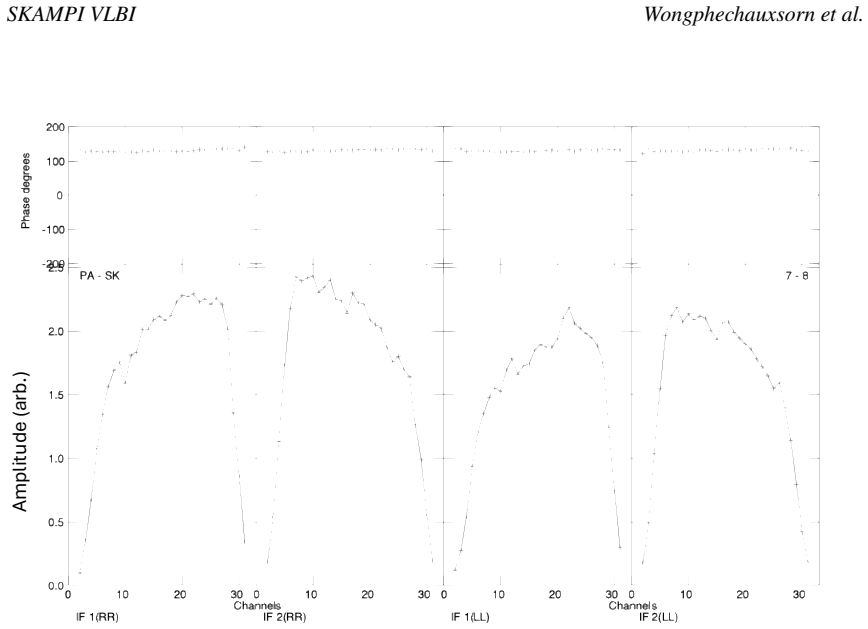
SKAMPI detects VLBI fringes in S-band with the EVN, LBA, and VLBA.
A machine-rendered reading of the paper's core claim, the machinery that carries it, and where it could break.
Core claim
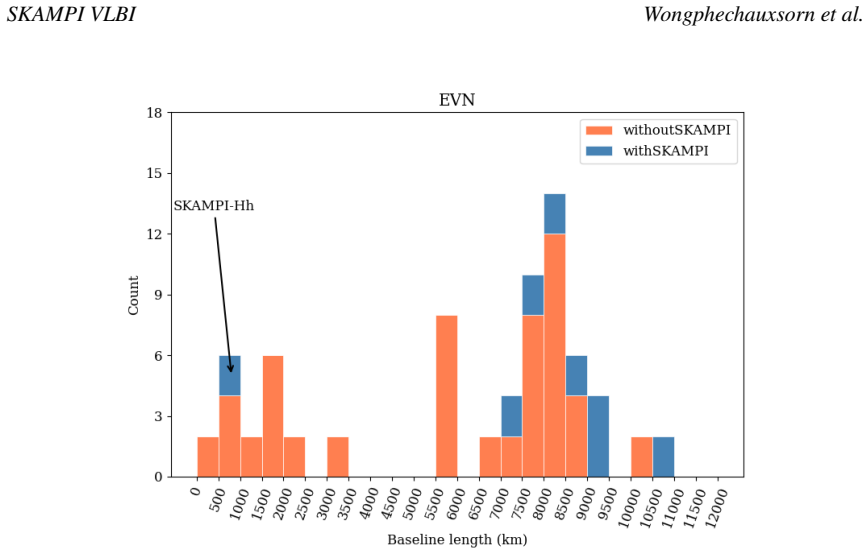
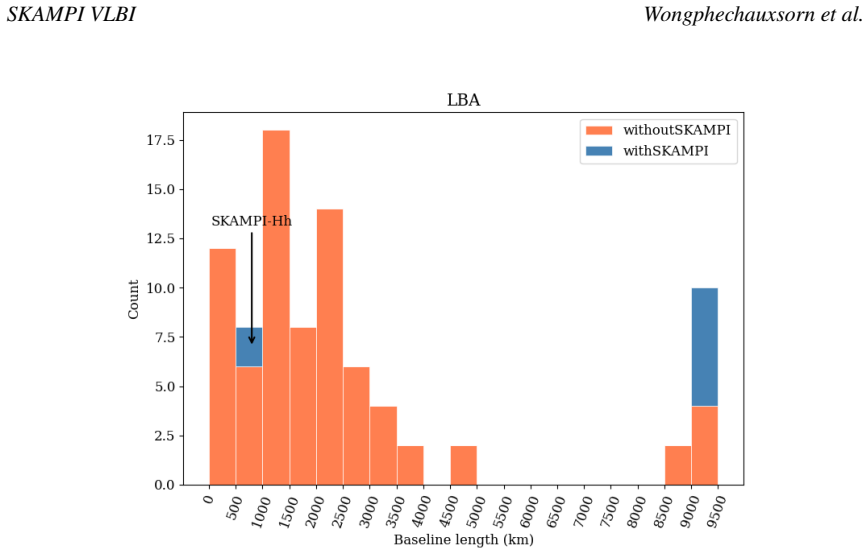
The authors present the first fringe-finding experiments with SKAMPI in S-band, including successful fringe detections and an evaluation of integration and imaging performances when the telescope participates in observations with the European VLBI Network, the Long Baseline Array, and the Very Long Baseline Array.
What carries the argument
The SKAMPI telescope in VLBI mode, which records and correlates signals across intercontinental baselines to produce detectable fringes.
If this is right
- SKAMPI can participate in routine VLBI campaigns that require extended signal integration.
- The achieved imaging performance supports use in global arrays for source structure studies.
- The S-band results provide a baseline for testing the dish at additional frequency bands.
- Prototype dishes of this class can be added to existing VLBI networks with current correlation systems.
Where Pith is reading between the lines
- Successful operation at the SKA site suggests the full SKA-Mid array could supply dense southern baselines for VLBI.
- Calibration techniques validated here may reduce setup time for future SKA VLBI sessions.
- Extension to higher frequencies would test whether the same integration performance scales with wavelength.
Load-bearing premise
The reported fringe detections represent genuine signals from astronomical sources rather than noise or calibration artifacts.
What would settle it
Re-reduction of the visibility data with independent software showing no fringes above the expected noise level for the integration times used.
Figures
read the original abstract
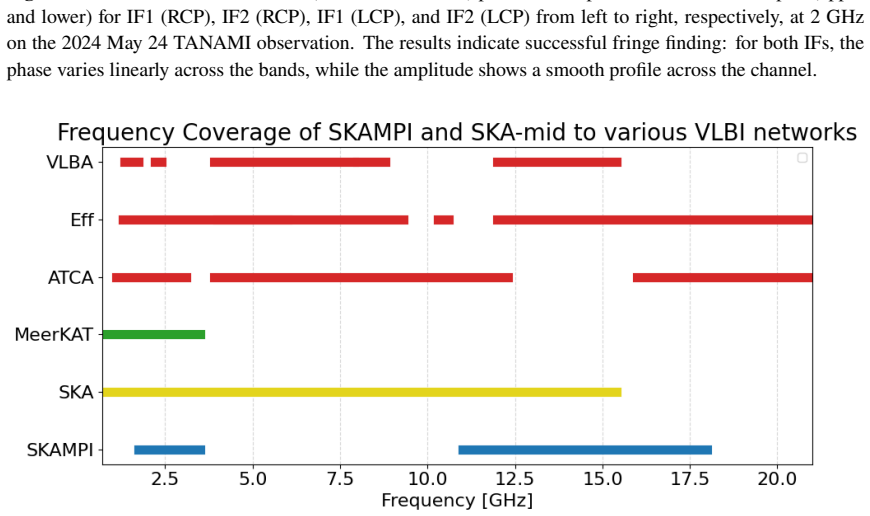
The SKA-MPIfR telescope (SKAMPI) is a prototype SKA-Mid antenna located at the SKA site in the Karoo Desert, South Africa. It is funded by the Max Planck Society, through the Max Planck Institute for Radio Astronomy (MPIfR), and operated in collaboration with the South African Radio Astronomy Observatory (SARAO). The first fringe-finding experiments have been conducted with the European VLBI Network and the southern hemisphere Long Baseline Array, connecting SKAMPI with Europe and Australia. Here we present early SKAMPI VLBI mode results in S-Band, including successful fringe detections and evaluating the integration and imaging performances of SKAMPI in observations with the EVN, LBA, and VLBA.
Editorial analysis
A structured set of objections, weighed in public.
Referee Report
Summary. The manuscript introduces the SKA-MPIfR telescope (SKAMPI) as a prototype SKA-Mid antenna and reports the first S-band fringe-finding experiments conducted with the EVN, LBA, and VLBA. It claims successful fringe detections and evaluates the integration and imaging performances of SKAMPI in these VLBI observations.
Significance. Demonstrating VLBI functionality with an SKA-Mid prototype would be significant for validating antenna performance and enabling future SKA participation in global VLBI networks, provided the detections are quantitatively substantiated.
major comments (1)
- Abstract: the central claim of 'successful fringe detections' is load-bearing for all downstream statements on integration time and imaging performance, yet no quantitative metrics (peak SNR, phase closure, delay-rate solutions, or comparison to expected thermal noise) are provided to distinguish genuine VLBI signals from noise or calibration artifacts.
Simulated Author's Rebuttal
We thank the referee for the detailed review and the emphasis on quantitative substantiation of the fringe detections. We address the single major comment below and will incorporate the requested metrics into a revised manuscript.
read point-by-point responses
-
Referee: [—] Abstract: the central claim of 'successful fringe detections' is load-bearing for all downstream statements on integration time and imaging performance, yet no quantitative metrics (peak SNR, phase closure, delay-rate solutions, or comparison to expected thermal noise) are provided to distinguish genuine VLBI signals from noise or calibration artifacts.
Authors: We agree that explicit quantitative metrics are required to support the central claim of successful fringe detections. The revised manuscript will include measured peak SNR values for the detected fringes, verification of phase closure on the triangles involving SKAMPI, the derived delay-rate solutions, and direct comparisons of the observed SNR against the expected thermal noise based on system equivalent flux density, integration time, and bandwidth. These additions will be placed in the results section and referenced from the abstract to underpin the statements on integration performance and imaging. revision: yes
Circularity Check
No circularity: purely observational report with no derivations or fitted predictions
full rationale
The paper reports observational results from VLBI fringe detections with SKAMPI in S-band using EVN, LBA, and VLBA, including integration and imaging performance evaluations. No equations, derivations, parameter fits, predictions, or ansatzes are present in the abstract or described structure. The central claims rest on empirical detections rather than any mathematical chain that could reduce to self-definition or self-citation. No load-bearing steps match the enumerated circularity patterns; the work is self-contained as a technical report of telescope performance.
Axiom & Free-Parameter Ledger
Reference graph
Works this paper leans on
-
[1]
2019 , eprint=
Anticipated Performance of the Square Kilometre Array -- Phase 1 (SKA1) , author=. 2019 , eprint=
2019
-
[2]
2015 , publisher=
Advancing Astrophysics with the Square Kilometre Array (AASKA14) , author=. 2015 , publisher=
2015
-
[3]
2025 , organization =
SKA Telescope Specifications , howpublished =. 2025 , organization =
2025
-
[4]
2025 , month =
A Year in the Life of the SKA Telescopes: Overview and Main Operating Parameters , institution =. 2025 , month =
2025
-
[5]
Sokolovsky, K. V. and Kovalev, Y. Y. and Kovalev, Y. A. and others , title =. Astronomy & Astrophysics , year =
-
[6]
Plavin, A. V. and Pushkarev, A. B. and Kovalev, Y. Y. and Lobanov, A. P. , title =. Monthly Notices of the Royal Astronomical Society , year =
-
[7]
, title =
Malkin, Z. , title =. Frontiers in Astronomy and Space Sciences , year =
-
[8]
and others , title =
Lunz, S. and others , title =. Astronomy & Astrophysics , year =
-
[9]
High frequency VLBI observations of the scatter broadened quasar B2005+403 , journal =
Gab. High frequency VLBI observations of the scatter broadened quasar B2005+403 , journal =. 2006 , volume =
2006
-
[10]
2025 , organization =
European VLBI Network --- Call for Proposals , howpublished =. 2025 , organization =
2025
-
[11]
2025 , organization =
Hartebeesthoek Radio Astronomy Observatory (HartRAO) Programme Pages , howpublished =. 2025 , organization =
2025
-
[12]
and de Witt, A
Nickola, M. and de Witt, A. and Quick, J. and Botha, R. and Mey, P. , title =. IVS 2017+2018 Biennial Report , year =
2017
-
[13]
2025 , organization =
The African Very Long Baseline Interferometry Network (AVN) , howpublished =. 2025 , organization =
2025
-
[14]
Gaylard, M. J. and Bietenholz, M. F. and Combrinck, L. and Booth, R. S. and Buchner, S. J. and Fanaroff, B. L. and MacLeod, G. C. and Nicolson, G. D. and Quick, J. F. H. and Stronkhorst, P. and Venkatasubramani, T. L. , title =
-
[15]
2019 , organization =
Delta-DOR --- Technical Characteristics and Performance (CCSDS 500.1-G-2) , howpublished =. 2019 , organization =
2019
-
[16]
Curkendall, D. W. and Border, J. S. , title =. 2013 , url =
2013
-
[17]
DiFX-2: A More Flexible, Efficient, Robust, and Powerful Software Correlator. , keywords =. doi:10.1086/658907 , archivePrefix =. 1101.0885 , primaryClass =
-
[18]
Calibration of mixed-polarization interferometric observations - Tools for the reduction of interferometric data from elements with linear and circular polarization receivers , DOI= "10.1051/0004-6361/201526063", url= "https://doi.org/10.1051/0004-6361/201526063", journal =
-
[19]
2019 , organization =
Insights into the SKA-Max Planck Dish Demonstrator , howpublished =. 2019 , organization =
2019
-
[20]
and Kl\"ockner, H.-R
Kramer, M. and Kl\"ockner, H.-R. , title =. 2020 , url =
2020
-
[21]
CMB foreground measurements through broad-band radio spectro-polarimetry: prospects of the SKA-MPG telescope. , keywords =. doi:10.1093/mnras/stz1637 , archivePrefix =. 1906.04788 , primaryClass =
work page internal anchor Pith review Pith/arXiv arXiv doi:10.1093/mnras/stz1637 1906
-
[22]
ehtim: Imaging, analysis, and simulation software for radio interferometry
-
[23]
2019 , month = jan, archivePrefix =
Paragi, Zsolt and Chrysostomou, Antonio and Garcia-Miro, Cristina , title =. 2019 , month = jan, archivePrefix =. 1901.10361 , primaryClass =
Pith/arXiv arXiv 2019
-
[24]
Anticipated Performance of the Square Kilometre Array -- Phase 1 (SKA1). arXiv e-prints , keywords =. doi:10.48550/arXiv.1912.12699 , archivePrefix =. 1912.12699 , primaryClass =
-
[25]
MOJAVE: Monitoring of Jets in Active Galactic Nuclei with VLBA Experiments. I. First-Epoch 15 GHz Linear Polarization Images. , keywords =. doi:10.1086/432969 , archivePrefix =. astro-ph/0503152 , primaryClass =
work page internal anchor Pith review Pith/arXiv arXiv doi:10.1086/432969
-
[27]
First M87 Event Horizon Telescope Results. III. Data Processing and Calibration. , keywords =. doi:10.3847/2041-8213/ab0c57 , archivePrefix =. 1906.11240 , primaryClass =
work page internal anchor Pith review Pith/arXiv arXiv doi:10.3847/2041-8213/ab0c57 2041
-
[28]
European VLBI Network Mini-Symposium and Users' Meeting 2021 , year = 2022, volume =
PRECISE localizations of repeating Fast Radio Bursts. European VLBI Network Mini-Symposium and Users' Meeting 2021 , year = 2022, volume =. doi:10.22323/1.399.0035 , archivePrefix =. 2202.11644 , primaryClass =
-
[29]
2026 ,publisher =
Emmanuel Bempong-Manful and author2 and author3 and author4 and author5 ,title =. 2026 ,publisher =
2026
-
[30]
TANAMI: tracking active galactic nuclei with austral milliarcsecond interferometry. I. First-epoch 8.4 GHz images. Astronomy and Astrophysics , keywords =. doi:10.1051/0004-6361/200912724 , archivePrefix =. 1005.4432 , primaryClass =
work page internal anchor Pith review Pith/arXiv arXiv doi:10.1051/0004-6361/200912724
-
[31]
TANAMI: Tracking active galactic nuclei with austral milliarcsecond interferometry. III. First-epoch S band images. , keywords =. doi:10.1051/0004-6361/202347823 , archivePrefix =. 2310.10206 , primaryClass =
discussion (0)
Sign in with ORCID, Apple, or X to comment. Anyone can read and Pith papers without signing in.