REVIEW 4 major objections 5 minor 1 cited by
Lorentzian Residual Neural Networks
T0 review · 4 major / 5 minor · reviewed 2026-08-11 · deepseek-v4-flash
Pith's one-line read LResNet replaces tangent-space round trips with one normalized sum, giving hyperbolic networks a commutative, stable residual connection.
desk verdict Simple, useful residual block for Lorentz hyperbolic nets, but the 'derives previous methods' claim needs a repaired proof and a softer statement. read the letter →
The pith
A machine-rendered reading of the paper's core claim, the machinery that carries it, and where it could break.
The reading
What carries the argument
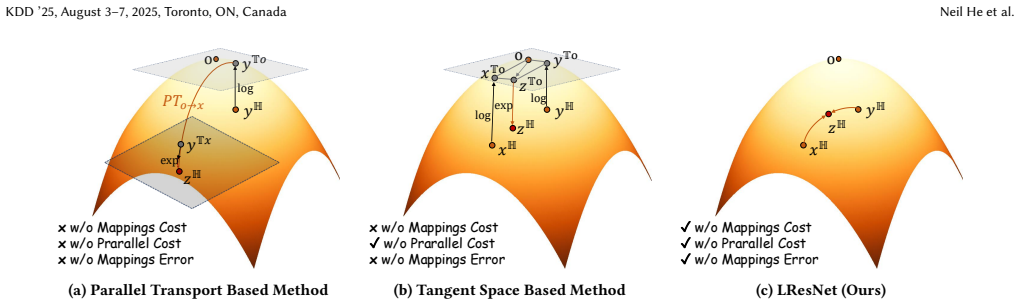
The central object is the weighted Lorentzian centroid, written as a normalized weighted sum in Eq. (8). For two hyperboloid points $x$ and $f(x)$ and positive scalar weights $w_x$, $w_y$, the Euclidean combination $w_x x + w_y f(x)$ is renormalized by its Lorentzian magnitude, which projects it back onto the hyperboloid; this generalizes the Lorentzian centroid used for aggregation, with weights and a curvature-dependent denominator. The operation does the work of a residual connection entirely on the manifold in $O(n)$ time, and because only the ratio $w_x/w_y$ matters, one weight can be fixed to a positive constant while the other is trained. An optional scaling step slides the output along a Klein-model geodesic to control its Euclidean norm, preserving the ray-alignment property used in the expressiveness argument.
What would settle it
Take any pair of hyperboloid points and each previous residual method's output, and solve Eq. (8) for the weights that make LResNet's output exactly equal to that output; if no positive weights achieve this, the strong 'derives previous methods' reading is ruled out, consistent with the proof's weaker ray-alignment promise. In addition, if trained LResNet weights in the published experiments converge to negative values, the positivity premise behind the stability and derivation arguments would be violated.
Extended reading notes
Core claim
The authors' central claim is that the operation in Eq. (8), $x\oplus_L f(x) = (w_x x + w_y f(x))/\sqrt{-K|\|w_x x + w_y f(x)\|_L|}$, is a valid residual connection on the Lorentz hyperboloid: the normalizing denominator forces the output back onto the manifold, so no tangent-space or exponential-map round trip is required. They prove (Lemma 4.1) that the denominator is bounded below by $\sqrt{w_x^2 + w_y^2}$, ruling out division-by-zero blowups, and they show the operation is commutative because it is a normalized weighted sum. On representational power, they argue in Proposition 4.2 that for each earlier residual construction — parallel transport, tangent-space addition, and space-like addition — there are nonnegative weights making the LResNet output lie on the same geodesic ray (in the Klein model, the same straight line through the origin) as that construction's output, so LResNet can match the expressive power of all of them. Empirically, LResNet used as a drop-in residual block outperforms the previous residual methods on node classification, link prediction, and image classification, and it avoids the NaN failures that parallel transport suffers in deep networks. The authors position LResNet as a generally applicable residual module for any Lorentz-model hyperbolic network.
Load-bearing premise
The argument's load-bearing premise is that sharing a ray from the origin is enough for one residual output to count as reproducing another; the proof only establishes that ray-sharing, not equality of outputs, and it does not verify that the required weights are positive.
Editorial extensions
If this is right
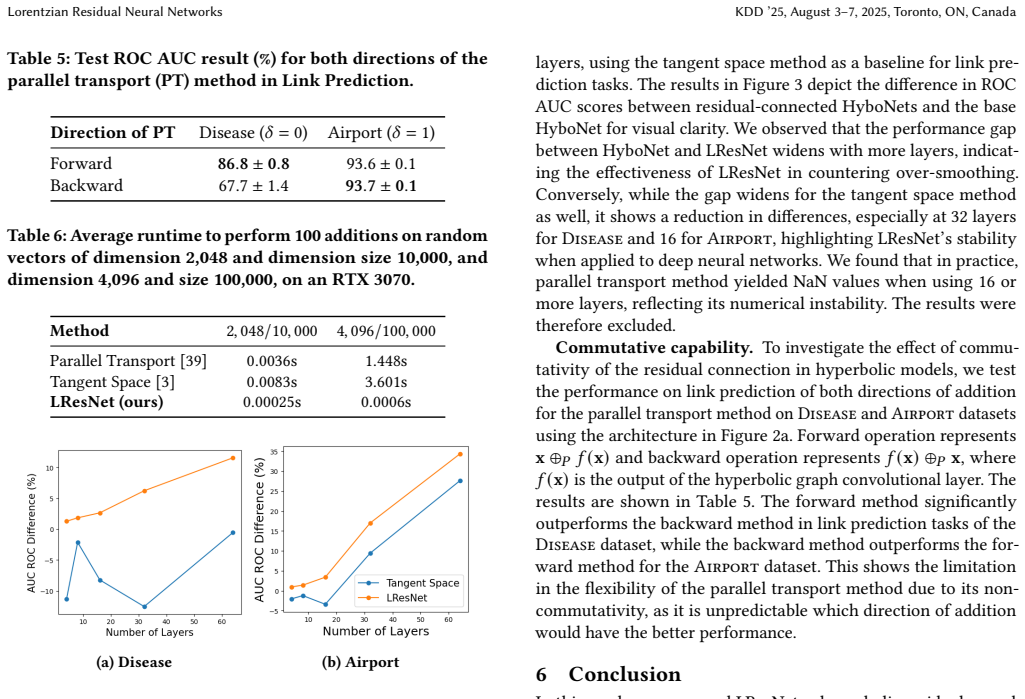
- Any Lorentz-model hyperbolic network can add residual connections by normalization alone, avoiding tangent-space and parallel-transport computations that the paper reports are over 2,000 times slower at scale.
- Since LResNet reproduces the spatial ray of previous residual outputs, it can be substituted into existing GNNs, CNNs, and graph Transformers with at least the expressive power of the prior residual methods.
- Deep GNNs using LResNet continue to gain from extra layers rather than degrading, while the parallel-transport baseline fails with NaN values at 16 layers or more.
- The optional norm-scaling step allows control of embedding magnitude, which matters in vision models where norm is tied to classification confidence.
- The same construction applies to any hyperbolic layer type on the Lorentz model, not only the convolution, GNN, and Transformer layers tested.
Reading between the lines
- Editorial inference: The ray-alignment proof does not imply pointwise equality, so if downstream layers depend on exact position or off-ray details, LResNet's outputs may differ from the methods it is said to derive; a layer-by-layer output comparison would clarify this.
- Editorial inference: Because the normalized weighted sum is commutative and $O(n)$, it is a natural candidate for a general hyperbolic aggregation or attention operator, not only a residual connection.
- Editorial inference: The speed advantage suggests the dominant cost of prior methods is the log/exp/parallel-transport round trip; at higher dimensions this makes LResNet the practical route to large-scale hyperbolic embeddings, a regime not directly benchmarked here.
- Editorial inference: The stability lemma depends on positive weights, and the implementation takes absolute values in practice; monitoring the sign of trained weights in the reported Transformer and vision experiments would test whether the theoretical positivity condition is actually met in trained models.
Signed reviews
Editorial analysis
A structured set of objections, weighed in public.
Referee Report
Summary. The paper proposes LResNet, a residual connection defined directly on the Lorentz hyperboloid by normalizing a weighted Euclidean combination of two hyperbolic vectors: x⊕_L f(x) = (w_x x + w_y f(x))/sqrt(-K|...|). It argues that this operation is commutative, numerically stable, and avoids tangent-space mappings, and that by suitable weights it can reproduce (or at least match along geodesics from the origin) the parallel-transport, tangent-space, and space-addition residual methods used in prior hyperbolic networks. Experiments apply LResNet to GNNs, graph transformers, and CNNs on graph and vision benchmarks, reporting accuracy gains over baselines and large speedups. The central theoretical claim is Proposition 4.2, which asserts that the LResNet output lies on the geodesic from the origin to the output of each prior method.
Significance. If the theoretical claim can be made rigorous, LResNet is a valuable unification: it is an O(n), commutative residual operation on the hyperboloid that subsumes several existing residual-connection designs, and the paper provides broad empirical validation across architectures and datasets plus a public code release. The experimental evidence is extensive and the speed advantage is concrete. However, the theoretical-universality claim is load-bearing for the paper's framing, and the current appendix proof contains algebraic inconsistencies, an incorrect logarithmic-map expression, and an unverified positivity condition. The core formula may still be useful empirically, but the 'derives previous methods' assertion is not established as written.
major comments (4)
- [§4.1, Prop. 4.2(a), Appendix A] The proof of Proposition 4.2(a) is algebraically inconsistent. From z = cosh(α)x + (sinh(α)/α)(c_u y' + c_v x'), the space component is [cosh(α) + (sinh(α)/α)c_v] x_s + (sinh(α)/α)c_u y_s, so the stated choice w_x = cosh(α) + c_v and w_y = (sinh(α)/α)c_u yields collinearity only if sinh(α)/α = 1 or c_v = 0. The correct candidate would be w_x = cosh(α) + (sinh(α)/α)c_v; as printed, the conclusion that z_s is proportional to w_x x_s + w_y y_s does not follow.
- [Eq. (4), Prop. 4.2(a), Thm. 4.3 proof] The appendix writes log_o(y) as c_u(y + y_t sqrt(-K)o), but Eq. (4) with u = o gives log_o(y) = c_u(y - y_t sqrt(-K)o) = c_u[0, y_s]^T. With the plus sign the 'tangent' vector is not in T_o L, so the parallel-transport step P_{o→x} is applied to a vector outside the tangent space. This also makes the proof of Theorem 4.3 inconsistent with its own worked example: following the proof's definitions for x = [3,2,-2]^T and y = [3,2,2]^T does not produce z = [9,8,-4]^T.
- [Prop. 4.2, §4.1, Eq. (10)] Even after repairing the algebra, Proposition 4.2 asserts only that m lies on the geodesic from o to z, not that m = z. The text then concludes that LResNet 'can theoretically derive previous methods' and has at least their representative power; this requires either exact equality, which might be obtained through the optional scaling of Eq. (10), or a formal argument that ray-collinearity with the origin preserves expressive power across subsequent layers. Neither is provided. The proof also never verifies w_x, w_y ∈ R+: since c_v is generically negative, positivity is a substantive condition rather than a formality.
- [Prop. 4.2(b), Appendix A] The tangent-space case is not actually proved: the text says 'one can check' and then writes c_1 = cosh^{-1}(-x_t sqrt(-K)) / sqrt(x_t^2 K - 1), which is not real for K < 0 and mismatches the c_u used in part (a). A complete proof with correct coefficients and positivity verification is needed for this case as well.
minor comments (5)
- [§3, Appendix A] The Klein-model isometry is written as φ_K(x) = x_t/x_s; it should be φ_K(x) = x_s/x_t, since collinearity is expressed through equality of space-over-time ratios.
- [Lemma 4.1, Appendix A] The proof uses ||·||_L ambiguously: the first equality treats -K||w_x x + w_y y||_L^2 as the signed Lorentzian inner product, while the lemma statement uses the absolute value. The proof should explicitly note that w_x x + w_y y is future timelike, so the absolute value is redundant; with that clarification the inequality appears correct.
- [Eq. (8)] The denominator sqrt(-K | ||w_x x + w_y f(x)||_L |) contains a redundant absolute value because the norm already includes one; define the denominator unambiguously.
- [Related Works and throughout] There are several typos and one incomplete citation: '[53?]' should be a proper reference, 'Sqirrel' should be 'Squirrel', and 'detials', 'Riemmanian', and 'ODD-detection' should be corrected.
- [Table 6, §5.4] The claim of 'over 2000 times speedup' holds only for the right-hand column (4096/100,000); the left column shows roughly a 14x speedup. Please state this qualification explicitly.
Circularity Check
No significant circularity: LResNet is defined independently and its claimed derivation of prior residual methods is a mathematical comparison, not a fit, self-definition, or self-citation chain.
full rationale
The core residual operation in Eq. (8) is defined directly as a normalized Lorentzian weighted sum and does not take the outputs of prior methods as fitting targets. Proposition 4.2 attempts to prove, from the existing formulas for parallel transport (Eq. 5), tangent-space addition (Eq. 6), and space addition (Eq. 7), that for each previous method there exist weights w_x, w_y in R+ such that the LResNet output lies on the geodesic from the origin to the previous method's output. The constructed weights are algebraic expressions in the previous methods themselves, not data-fitted parameters, and the claim is one of representational containment rather than equality of outputs. Even if the proof's algebra is internally inconsistent or the R+ constraint is left unverified, those are correctness gaps, not circularity. The empirical evaluation compares LResNet against independent baselines on standard benchmarks, and LResNet is not trained to reproduce the prior residual outputs. Self-citations such as Hypformer [45], HICF [44], and Hyperbolic Representation Learning [50] appear in related-work context and are not load-bearing for Proposition 4.2 or Eq. (8). No step reduces the paper's central claim to its own inputs, to a fitted quantity renamed as a prediction, or to an unverified self-citation chain.
Assumptions & free parameters
free parameters (3)
- Residual weight w_y per layer =
varies; fixed to 1 in some graph experiments, trainable in heterophilic and vision experiments
- Scaling coefficient gamma =
searched over {0.5, 1.0, 2.0, trainable}
- Curvature K =
searched over {-0.1, -0.5, -1.0, -1.5, -2.0, trainable}
assumptions (3)
- standard math The Lorentz model with the given metric is a valid model of hyperbolic geometry, and the exponential, logarithmic, and parallel transport formulas in Equations (3)-(5) are correct.
- domain assumption Hyperbolic negative curvature is an appropriate prior for the benchmark datasets used in the experiments.
- ad hoc to paper Collinearity in the Klein projection implies equivalent representational power for a residual connection.
Cite this review
Pith. "Pith review of Lorentzian Residual Neural Networks." pith.science (2026). https://pith.science/paper/RHPS5K6Q
@misc{pith2026241214695,
  author       = {Pith},
  title        = {Pith review of: Lorentzian Residual Neural Networks},
  year         = {2026},
  howpublished = {\url{https://pith.science/paper/RHPS5K6Q}},
  note         = {Machine review of arXiv:2412.14695}
}
read the original abstract
Hyperbolic neural networks have emerged as a powerful tool for modeling hierarchical data structures prevalent in real-world datasets. Notably, residual connections, which facilitate the direct flow of information across layers, have been instrumental in the success of deep neural networks. However, current methods for constructing hyperbolic residual networks suffer from limitations such as increased model complexity, numerical instability, and errors due to multiple mappings to and from the tangent space. To address these limitations, we introduce LResNet, a novel Lorentzian residual neural network based on the weighted Lorentzian centroid in the Lorentz model of hyperbolic geometry. Our method enables the efficient integration of residual connections in Lorentz hyperbolic neural networks while preserving their hierarchical representation capabilities. We demonstrate that our method can theoretically derive previous methods while offering improved stability, efficiency, and effectiveness. Extensive experiments on both graph and vision tasks showcase the superior performance and robustness of our method compared to state-of-the-art Euclidean and hyperbolic alternatives. Our findings highlight the potential of LResNet for building more expressive neural networks in hyperbolic embedding space as a generally applicable method to multiple architectures, including CNNs, GNNs, and graph Transformers.
Figures

Forward citations
Cited by 1 Pith paper
-
HLFormer: Enhancing Partially Relevant Video Retrieval with Hyperbolic Learning
HLFormer adds hybrid Euclidean and Lorentz attention plus a partial-order cone loss to partially relevant video retrieval and reports the best total recall on ActivityNet Captions, Charades-STA, and TVR.
Reference graph
Works this paper leans on
-
[1]
Mina Ghadimi Atigh, Julian Schoep, Erman Acar, Nanne van Noord, and Pascal Mettes. 2022. Hyperbolic Image Segmentation. In CVPR. 4453–4462
work page 2022
-
[2]
Ahmad Bdeir, Kristian Schwethelm, and Niels Landwehr. 2024. Fully Hyperbolic Convolutional Neural Networks for Computer Vision. In ICLR
work page 2024
-
[3]
Ines Chami, Zhitao Ying, Christopher Ré, and Jure Leskovec. 2019. Hyperbolic graph convolutional neural networks. In NeurIPS. 4868–4879
work page 2019
-
[4]
Bike Chen, Wei Peng, Xiaofeng Cao, and Juha Röning. 2023. Hyperbolic uncer- tainty aware semantic segmentation. TITS (2023)
work page 2023
-
[5]
Weize Chen, Xu Han, Yankai Lin, Hexu Zhao, Zhiyuan Liu, Peng Li, Maosong Sun, and Jie Zhou. 2021. Fully Hyperbolic Neural Networks. arXiv preprint arXiv:2105.14686 (2021)
arXiv 2021
-
[6]
Yankai Chen, Menglin Yang, Yingxue Zhang, Mengchen Zhao, Ziqiao Meng, Jianye Hao, and Irwin King. 2022. Modeling Scale-free Graphs for Knowledge- aware Recommendation. WSDM (2022)
work page 2022
-
[7]
Mircea Cimpoi, Subhransu Maji, Iasonas Kokkinos, Sammy Mohamed, and An- drea Vedaldi. 2014. Describing textures in the wild. CVPR (2014)
work page 2014
-
[8]
Terrance DeVries and Graham W. Taylor. 2017. Improved regularization of convolutional neural networks with cutout. (2017)
work page 2017
Show all 61 references
-
[9]
Dooley and N
A. Dooley and N. Wildberger. 1993. Harmonic analysis and the global expo- nential map for compact Lie groups. In Functional Analysis and Its Applications, 27(1):21–27
1993
-
[10]
Aleksandr Ermolov, Leyla Mirvakhabova, Valentin Khrulkov, Nicu Sebe, and Ivan Oseledets. 2022. Hyperbolic vision transformers: Combining improvements in metric learning. In CVPR. 7409–7419
2022
-
[11]
Ali Faqeeh, Saeed Osat, and Filippo Radicchi. 2018. Characterizing the analogy between hyperbolic embedding and community structure of complex networks. Physical review letters 121, 9 (2018), 098301
2018
-
[12]
Octavian Ganea, Gary Bécigneul, and Thomas Hofmann. 2018. Hyperbolic neural networks. In NeurIPS. 5345–5355
2018
-
[13]
Mina Ghadimi Atigh, Martin Keller-Ressel, and Pascal Mettes. 2021. Hyperbolic Busemann Learning with Ideal Prototypes. NeurIPS 34 (2021)
2021
-
[14]
Caglar Gulcehre, Misha Denil, Mateusz Malinowski, Ali Razavi, Razvan Pascanu, Karl Moritz Hermann, Peter Battaglia, Victor Bapst, David Raposo, Adam Santoro, et al. 2019. Hyperbolic attention networks. In ICLR
2019
-
[15]
Yunhui Guo, Xudong Wang, Yubei Chen, and Stella X Yu. 2022. Clipped hyperbolic classifiers are super-hyperbolic classifiers. In CVPR. 11–20
2022
-
[16]
Kaiming He, Xiangyu Zhang, Shaoqing Ren, and Jian Sun. 2016. Deep residual learning for image recognition. In CVPR. 770–778
2016
-
[17]
Isay Katsman, Eric Chen, Sidhanth Holalkere, Anna Asch, Aaron Lou, Ser Nam Lim, and Christopher M De Sa. 2023. Riemannian residual neural networks. NeurIPS 36 (2023)
2023
-
[18]
Valentin Khrulkov, Leyla Mirvakhabova, Evgeniya Ustinova, Ivan Oseledets, and Victor Lempitsky. 2020. Hyperbolic image embeddings. In CVPR. 6418–6428
2020
-
[19]
Dmitri Krioukov, Fragkiskos Papadopoulos, Maksim Kitsak, Amin Vahdat, and Marián Boguná. 2010. Hyperbolic geometry of complex networks. Physical Review E 82, 3 (2010), 036106
2010
-
[20]
Dmitri Krioukov, Fragkiskos Papadopoulos, Amin Vahdat, and Marián Boguná
-
[21]
Krizhevsky
A. Krizhevsky. 2009. Learning multiple layers of features from tiny images
2009
-
[22]
Marc Law, Renjie Liao, Jake Snell, and Richard Zemel. 2019. Lorentzian distance learning for hyperbolic representations. In ICML. PMLR, 3672–3681
2019
-
[23]
Derek Lim, Xiuyu Li, Felix Hohne, and Ser-Nam Lim. 2021. New Benchmarks for Learning on Non-Homophilous Graphs. arXiv preprint arXiv:2104.01404 (2021)
2021 arXiv
-
[24]
Qi Liu, Maximilian Nickel, and Douwe Kiela. 2019. Hyperbolic graph neural networks. In NeurIPS. 8230–8241
2019
-
[25]
Weitang Liu, Xiaoyun Wang, John Owens, and Yixuan Li. 2020. Energy-based out-of-distribution detection. NeurIPS (2020)
2020
-
[26]
Pascal Mettes, Mina Ghadimi Atigh, Martin Keller-Ressel, Jeffrey Gu, and Serena Yeung. 2023. Hyperbolic Deep Learning in Computer Vision: A Survey. arXiv preprint arXiv:2305.06611 (2023)
2023 arXiv
-
[27]
Yuval Netzer, Tao Wang, Adam Coates, Alessandro Bissacco, Bo Wu, and An- drew Y Ng. 2011. Reading digits in natural images with unsupervised feature learning. NeurIPS Workshop on Deep Learning and Unsupervised Feature Learning (2011)
2011
-
[28]
Maximillian Nickel and Douwe Kiela. 2017. Poincaré embeddings for learning hierarchical representations. In NeurIPS. 6338–6347
2017
-
[29]
Maximillian Nickel and Douwe Kiela. 2018. Learning Continuous Hierarchies in the Lorentz Model of Hyperbolic Geometry. In ICML. 3779–3788
2018
-
[30]
Wei Peng, Tuomas Varanka, Abdelrahman Mostafa, Henglin Shi, and Guoying Zhao. 2021. Hyperbolic deep neural networks: A survey. TPAMI (2021)
2021
-
[31]
Oleg Platonov, Denis Kuznedelev, Michael Diskin, Artem Babenko, and Liudmila Prokhorenkova. 2023. A critical look at evaluation of GNNs under heterophily: Are we really making progress?. In ICLR
2023
-
[32]
Arlan Ramsay and Robert D Richtmyer. 2013. Introduction to hyperbolic geometry . Springer Science & Business Media
2013
-
[33]
Rik Sarkar. 2011. Low distortion delaunay embedding of trees in hyperbolic plane. In International Symposium on Graph Drawing . Springer, 355–366
2011
-
[34]
Prithviraj Sen, Galileo Namata, Mustafa Bilgic, Lise Getoor, Brian Galligher, and Tina Eliassi-Rad. 2008. Collective classification in network data. AI magazine 29, 3 (2008), 93–93
2008
-
[35]
Ryohei Shimizu, Yusuke Mukuta, and Tatsuya Harada. 2020. Hyperbolic Neural Networks++. In ICLR
2020
-
[36]
Yang Song, Jascha Sohl-Dickstein, Diederik P Kingma, Abhishek Kumar, Ste- fano Ermon, and Ben Poole. 2021. Score-Based Generative Modeling through Stochastic Differential Equations. In ICLR
2021
-
[37]
Jianing Sun, Zhaoyue Cheng, Saba Zuberi, Felipe Pérez, and Maksims Volkovs
-
[38]
Abraham Albert Ungar. 2008. A gyrovector space approach to hyperbolic geome- try. Synthesis Lectures on Mathematics and Statistics 1, 1 (2008), 1–194
2008
-
[39]
Max van Spengler, Erwin Berkhout, and Pascal Mettes. 2023. Poincaré ResNet. CVPR (2023)
2023
-
[40]
Ashish Vaswani, Noam Shazeer, Niki Parmar, Jakob Uszkoreit, Llion Jones, Aidan N Gomez, Łukasz Kaiser, and Illia Polosukhin. 2017. Attention is all you need. In NeurIPS. 5998–6008
2017
-
[41]
Petar Veličković, Guillem Cucurull, Arantxa Casanova, Adriana Romero, Pietro Liò, and Yoshua Bengio. 2018. Graph Attention Networks. In ICLR
2018
-
[42]
Zhenzhen Weng, Mehmet Giray Ogut, Shai Limonchik, and Serena Yeung. 2021. Unsupervised discovery of the long-tail in instance segmentation using hierar- chical self-supervision. In CVPR. 2603–2612
2021
-
[43]
Qitian Wu, Wentao Zhao, Chenxiao Yang, Hengrui Zhang, Fan Nie, Haitian Jiang, Yatao Bian, and Junchi Yan. 2023. SGFormer: Simplifying and Empowering Transformers for Large-Graph Representations. In NeurIPS
2023
-
[44]
Menglin Yang, Zhihao Li, Min Zhou, Jiahong Liu, and Irwin King. 2022. Hicf: Hyperbolic informative collaborative filtering. In KDD. 2212–2221
2022
-
[45]
Menglin Yang, Harshit Verma, Delvin Ce Zhang, Jiahong Liu, Irwin King, and Rex Ying. 2024. Hypformer: Exploring efficient transformer fully in hyperbolic space. In KDD. 3770–3781
2024
-
[46]
Menglin Yang, Min Zhou, Marcus Kalander, Zengfeng Huang, and Irwin King
-
[47]
Menglin Yang, Min Zhou, Zhihao Li, Jiahong Liu, Lujia Pan, Hui Xiong, and Irwin King. 2022. Hyperbolic graph neural networks: a review of methods and applications. arXiv preprint arXiv:2202.13852 (2022)
2022 arXiv
-
[48]
Menglin Yang, Min Zhou, Jiahong Liu, Defu Lian, and Irwin King. 2022. HRCF: Enhancing Collaborative Filtering via Hyperbolic Geometric Regularization. In WebConf
2022
-
[49]
Discrete-time Temporal Network Embedding via Implicit Hierarchical Learning in Hyperbolic Space. In KDD. 1975–1985
1975
-
[50]
Menglin Yang, Min Zhou, Rex Ying, Yankai Chen, and Irwin King. 2023. Hyper- bolic Representation Learning: Revisiting and Advancing. ICML (2023)
2023
-
[51]
Tao Yu and Christopher M De Sa. 2019. Numerically Accurate Hyperbolic Em- beddings Using Tiling-Based Models. In NeurIPS 2019
2019
-
[52]
Menglin Yang, Min Zhou, Hui Xiong, and Irwin King. 2022. Hyperbolic Temporal Network Embedding. TKDE (2022)
2022
-
[53]
Yiding Zhang, Xiao Wang, Chuan Shi, Xunqiang Jiang, and Yanfang Fanny Ye
-
[54]
Yiding Zhang, Xiao Wang, Chuan Shi, Nian Liu, and Guojie Song. 2021. Lorentzian Graph Convolutional Networks. In WebConf. 1249–1261
2021
-
[55]
Renyu Zhang, Aly A Khan, and Robert L Grossman. 2020. Evaluation of Hyper- bolic Attention in Histopathology Images. In2020 IEEE 20th BIBE. IEEE, 773–776
2020
-
[56]
Bolei Zhou, Agata Lapedriza, Khosla Aditya, Aude Oliva, and Antonio Torralba
-
[57]
TBD (2021)
Hyperbolic graph attention network. TBD (2021)
2021
-
[59]
Lingxiao Zhao and Leman Akoglu. 2019. PairNorm: Tackling oversmoothing in GNNs. ICLR (2019)
2019
-
[2009]
Physical Review E 80, 3 (2009), 035101
Curvature and temperature of complex networks. Physical Review E 80, 3 (2009), 035101
2009
-
[2017]
−2𝛽𝑎2 1−𝛽𝑎2 𝑛+1+ 𝑛∑︁ 𝑖=2 𝛽𝑎2 𝑖 #𝑇 ⟨y, u′⟩L =
Places: A 10 million image database for scene recognition. TPAMI (2017). A Proof of Theoretical Results Proof of Lemma 4.1 Proof. Note that −𝐾||𝑤𝑥 x+𝑤𝑦y|| 2 L =−𝐾 −(𝑤𝑥𝑥𝑡+𝑤𝑦𝑦𝑡)2+|| 𝑤𝑥 x𝑠+𝑤𝑦y𝑠|| 2 =𝐾||𝑤𝑥 x|| 2 L+𝐾||𝑤𝑦y|| 2 L− 2𝐾⟨𝑤𝑥 x,𝑤𝑦y⟩L =𝑤 2 𝑥+𝑤 2 𝑦− 2𝐾 Γ >𝑤 2 𝑥+𝑤 2 𝑦− 2𝐾(𝑤𝑥𝑤...
2017
-
[2021]
In WebConf
HGCF: Hyperbolic Graph Convolution Networks for Collaborative Filtering. In WebConf. 593–601
Reviewed August 11, 2026 · model on record in the stance chip above.
Discussion (0). Continue with ORCID to comment.