REVIEW 3 major objections 4 minor 97 references
Orbital Motion in Spacetimes Influenced by the Presence of Scalar and Electromagnetic Fields
T0 review · 3 major / 4 minor · reviewed 2026-08-10 · deepseek-v4-flash
Pith's one-line read A sufficiently strong scalar field can turn the neighborhood of a naked singularity into a stable-orbit zone, and with added electric charge create two photon orbits—one stable, one unstable.
desk verdict A useful frequency catalogue for exotic spacetimes, but the JNWM stability boundary rests on a wrong derivative identity. read the letter →
The pith
A machine-rendered reading of the paper's core claim, the machinery that carries it, and where it could break.
The reading
What carries the argument
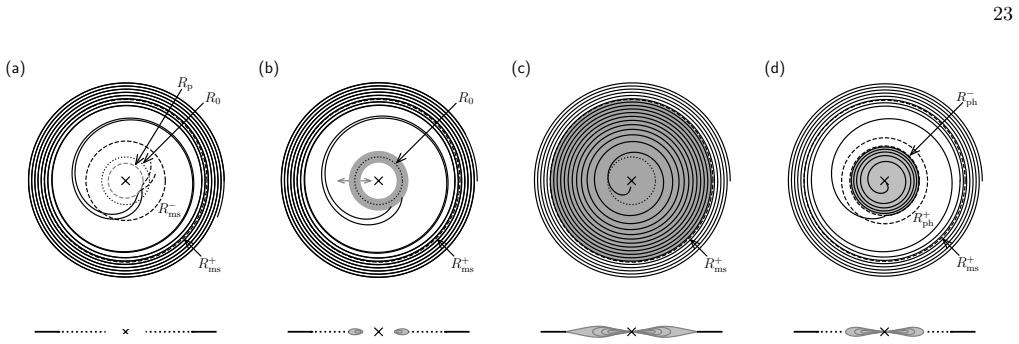
The argument is carried by the profile of the Keplerian specific angular momentum $\ell_K(r)$ and its radial derivative. Stability is governed by the Rayleigh-type criterion $\Omega_r^2=g^{rr}\,(-g_{tt})'\,(\ln\ell_K)'$: circular geodesics are stable where $\ell_K$ increases outward, and the marginally stable orbits sit at $\ell_K'=0$. Photon orbits are located by the extrema of the circumferential radius $\tilde r=\sqrt{-g_{\phi\phi}/g_{tt}}=R/\sqrt{f}$, with a minimum giving an unstable photon orbit and a maximum a stable one; in the JNWM spacetime these extrema are encoded in the auxiliary function $y(r)$, whose crossings of $y=2$ mark the photon orbits. The same quantities are reinterpreted in optical geometry through the geodesic radius $\hat r$ and curvature radius $\mathcal R$, giving the geometric relation $\Omega_r^2=(\tilde r^2/\mathcal R^2)(d\mathcal R/d\hat r)\,\Omega_K^2$ used to draw the embedding diagrams.
What would settle it
For $C_0=1.25M$ and $q=0.9M$ in the JNWM metric, the paper predicts photon orbits at $R=0.900m$ and $1.539m$ and a marginally stable orbit at $4.036m$; numerically integrating the null and timelike geodesic equations to locate the actual photon spheres and the stability boundary would confirm or refute those radii directly.
Extended reading notes
Core claim
For the JNWM spacetime, the paper claims that the scalar-field strength $C_0$ and electric charge $q$ together determine the number of photon orbits and marginally stable orbits. When $C_0>\sqrt{3/2}\,M$ and $q>q^*_{\rm ph}$, the metric contains two circular photon orbits—the inner one stable, the outer one unstable—with a band between them in which no circular time-like geodesics exist. In the same family, when $C_0>\sqrt{8/5}\,M$ and $q<q^*_{\rm ms}$, the Keplerian angular momentum increases monotonically everywhere outside the singularity, so every time-like circular geodesic is stable and an accretion disk can in principle reach the singularity. The uncharged JNW limit shows the same phenomenon without the photon pair: for $C_0>\sqrt{8/5}\,M$, $\ell_K(r)$ has no extrema and all circular geodesics are stable, while for $\sqrt{3/2}\,M<C_0<\sqrt{8/5}\,M$ two marginally stable orbits enclose a narrow band of unstable orbits. The paper also claims that the electromagnetic field alone does not cause these reversals but shifts and enlarges the intermediate unstable region, and that the optical-geometry embedding diagrams make the stable and unstable bands visually transparent.
Load-bearing premise
The orbit classification stands on the adopted JNWM exact solution and its parameter constraints $C_1=4q^2/C_2$ and $(C_1-C_2)^2=4M^2\nu^2$; if that solution is not the correct physical geometry, the two-photon and fully-stable regions do not follow.
Editorial extensions
If this is right
- A naked-singularity compact object with $C_0>\sqrt{8/5}\,M$ (and in the JNWM case also $q<q^*_{\rm ms}$) would let a thin disk extend to the singularity, raising the accretion efficiency toward 100 percent instead of the Schwarzschild value of about 5.7 percent.
- In the two-photon-orbit regime of JNWM ($C_0>\sqrt{3/2}\,M$, $q>q^*_{\rm ph}$), matter cannot maintain circular motion between the photon orbits, so accretion across that gap must be supersonic and requires angular-momentum removal by large-scale magnetic fields, radiation, or outflows.
- Because the radial epicyclic frequency is non-monotonic outside the outer marginally stable orbit, these spacetimes support trapped axisymmetric g-mode oscillations in thin disks, so QPO frequency correlations could probe scalar-field strength.
- Along a contour of fixed marginally stable orbit radius, scalar charge and electric charge give almost indistinguishable frequency profiles; only the strong-scalar regime ($C_0>\sqrt{3/2}\,M$) breaks the degeneracy and gives an unambiguous observational signature.
Reading between the lines
- Beyond the paper, the same sign-reversal mechanism should appear in any spherically symmetric naked-singularity solution whose effective potential makes $\ell_K(r)$ turn over near the center; checking this against other scalar-hair solutions would show whether the JNWM behavior is generic.
- Beyond the paper, the stable inner photon orbit in JNWM can trap gravitational radiation, so a sufficiently dense accumulation of waves could drive nonlinear collapse; this gives a dynamical instability channel not discussed in the paper.
- Beyond the paper, the predicted divergence of disk temperature near the singularity for $C_0>\sqrt{8/5}\,M$ could be tested with spectral hardening calculations: the high-energy tail of the emission would depart strongly from the Newtonian $(R/m)^{-3/4}$ profile before the flux integral converges.
Editorial analysis
A structured set of objections, weighed in public.
Referee Report
Summary. The paper studies circular and epicyclic motion of uncharged test particles in four families of static spacetimes: the Janis-Newman-Winicour (JNW) naked-singularity solution, its Einstein-Maxwell generalization (JNWM), a nonlinear-electrodynamics 'square-root' solution, and the Schwarzschild-Melvin magnetic universe. The authors derive explicit formulas for the Keplerian orbital frequency, the radial epicyclic frequency, photon orbits, and marginally stable orbits, and they use these to classify the existence and stability regions of time-like circular geodesics. The central qualitative claims are that a strong scalar field suppresses the ordinary photon orbit in JNW spacetimes and that in JNWM spacetimes with sufficiently strong scalar field and suitable charge the geometry can host two photon orbits, or two marginally stable orbits, or a region where all circular geodesics outside the singularity are stable. The paper also discusses accretion-disk implications and visualizes the orbital structure with optical-geometry embedding diagrams.
Significance. If the results were fully correct, the paper would be a useful reference for epicyclic frequencies and orbital stability in scalar-field and nonlinear-electrodynamics spacetimes, with direct relevance to QPO models, accretion-disk theory, and observational discrimination between black holes and naked singularities. The derivations are analytic and parameter-free in the sense that no fitted constants enter the geodesic-frequency formulas; the Schwarzschild and Reissner-Nordstrom limits are recovered correctly, and the paper provides several explicit formulas and classification diagrams. The use of optical geometry gives an elegant, quantitative way to connect photon orbits, marginally stable orbits, and regions of stable/unstable geodesic motion. However, the manuscript contains a concrete algebraic error in the JNWM radial epicyclic frequency that undermines the quantitative boundary curves and the 'all-stable region' claim; the qualitative two-photon-orbit result is not affected, but the stability classification and the associated figures and discussion require reworking.
major comments (3)
- [Sec. IV.B, Eq. (4.17)] The identity stated immediately after Eq. (4.17), d ln y/d ln r = 1 - (q/R)^2, is incorrect. Direct differentiation of y(r) defined in Eq. (4.14), using x' = ν M x/(r^2 - M^2) and R^2 = (r^2 - M^2)/f, gives d ln y/d ln r = 1 - q^2 y/R^2, not 1 - (q/R)^2; the two expressions agree only where y = 1, which is not satisfied on the orbits of interest. For the paper's own example q = 0.9M, C0 = 1.25M, r = 3M, the correct value is approximately 0.80, whereas 1 - (q/R)^2 is approximately 0.95. Because this derivative appears inside the argument of Omega_r^2 in Eq. (4.17), and because the curve q*_ms(nu) in Fig. 4 is defined by numerically locating the zeros of this Omega_r^2, the boundary of the dashed 'all stable' region and the statement in Sec. IV.B and the abstract that for q < q*_ms and C0 > sqrt(8/5)M all time-like circular geodesics outside the singularity are stable are not supported by the published equations. The photon-orbit classification in Sec. IV.A, which uses y = 2 and y' = 0 directly, is not affected by this error.
- [Sec. IV.C and Figs. 5-6] The incorrect derivative in Eq. (4.17) propagates into the radial profiles of Omega_r shown in the right panel of Fig. 5 and into the bottom panel of Fig. 6, where the near-degeneracy of the orbital frequencies along the contour R_ms = 4.5m is used to conclude that scalar and electromagnetic field effects are 'seemingly interchangeable' at lower intensities. These conclusions should be re-derived with the correct expression for d ln y/d ln r. Until this is done, the quantitative content of Sec. IV.C and the associated figures cannot be considered reliable, even though the qualitative picture of two photon orbits may remain intact.
- [Sec. II.B and Sec. VI] Equation (2.14) is introduced in Section II for spherically symmetric spacetimes, but it is applied in Section VI to the axisymmetric Schwarzschild-Melvin metric. The formula itself is standard for stationary axisymmetric spacetimes, so this is not a fatal issue, but the manuscript should state explicitly that the derivation via the effective potential in Eq. (2.12) applies to that broader class; as written, the reader is left with a gap between the stated assumptions of Section II and the usage in Section VI.
minor comments (4)
- [Sec. VII] In the second paragraph of the Discussion, the threshold 'C0 = sqrt(8/4)M' appears to be a typo for 'C0 = sqrt(8/5)M'; as printed it is inconsistent with the thresholds used in Secs. III and IV.
- [Abstract and Introduction] There are several misspellings of proper names: 'Schwarzschild-Melvine' in the abstract should be 'Schwarzschild-Melvin', 'Rezolla' in the introduction should be 'Rezzolla', and 'Newmann' should be 'Newman'. The figure labels 'Reisner-Nordstrom' should also be 'Reissner-Nordstrom'.
- [Sec. IV, Eqs. (4.7)-(4.8)] The constraints C1 = 4q^2/C2, (C1-C2)^2 = 4 M^2 nu^2, and C1,2 = 2m ∓ nu M are adopted from Ref. [44] without re-derivation. While this is legitimate input, the paper should state more explicitly that all orbital results in Sec. IV inherit the validity of that exact solution; a one-sentence note would make the dependence clear.
- [Sec. II, Eqs. (2.5) and (2.14)] The notation in Eq. (2.5) is compressed: the derivative with respect to r inside the parentheses is not written in full, and the sign/convention for E_K^2 and L_K^2 is only implied. Expanding these definitions would improve readability without changing the results.
Circularity Check
No significant circularity: epicyclic frequencies and orbit classifications are algebraic consequences of stated metrics; the self-cited JNWM solution is input, not a fitted prediction.
full rationale
The derivation chain is self-contained from Sec. II onward: Eqs. (2.7)-(2.20) follow from the geodesic equation for the general spherically symmetric metric (2.1), and Secs. III and IV are algebraic substitutions of the JNW and JNWM metric functions into those general formulas. Photon orbits are located by the condition that E_K^2 and L_K^2 diverge (y = 2 in Eq. (4.14)), and marginally stable orbits are located by Omega_r^2 = 0 through Eq. (4.17); both are roots of derived equations, not fitted parameters renamed as predictions. The JNWM solution and its parameter constraints (Eqs. (4.7)-(4.8)) are taken from prior work, including the authors' own Ref. [44], but this is stated input: an exact solution with stated assumptions, not a result whose derivation is claimed in this paper. The self-citations are not used as a uniqueness theorem, do not forbid alternative solutions, and do not enter the algebra that produces the orbit classification. The skeptic's concern about Eq. (4.17), namely the identity d ln y / d ln r = 1 - (q/R)^2, is a mathematical-correctness issue if correct; it is not a circularity issue, because the identity is not obtained by fitting data or by assuming the conclusion. The same holds for applying the epicyclic formalism to non-asymptotically flat spacetimes: that is a validity assumption, not a circular step. Therefore no circularity steps are identified; the minor self-citations present are not load-bearing.
Assumptions & free parameters
assumptions (6)
- standard math The metric ansatz (2.1) with positive f and circumferential radius R describes a general spherically symmetric spacetime; geodesic and normalization equations (2.2)-(2.8) govern circular orbits.
- standard math Small perturbations of circular geodesics obey the linearized geodesic equation (2.10), giving epicyclic frequencies (2.14) and the Rayleigh criterion (2.20).
- domain assumption The JNW solution (3.1)-(3.2) is an exact solution of Einstein's equations with a massless scalar field (Fisher 1948; Janis-Newman-Winicour 1968).
- domain assumption The JNWM solution (4.1)-(4.4) with constraints C1=4q^2/C2 and (C1-C2)^2=4M^2nu^2 is an exact solution of the Einstein-Maxwell-scalar system (Tahamtan 2020).
- domain assumption The square-root nonlinear electrodynamics solution (5.2)-(5.3) with alpha=1-q_m/sqrt(2) is an exact solution (Tahamtan 2020).
- domain assumption The Schwarzschild-Melvin metric (6.1) generated by an Ernst transformation is an exact solution of the Einstein-Maxwell equations (Ernst 1976; Ortaggio 2004).
Cite this review
Pith. "Pith review of Orbital Motion in Spacetimes Influenced by the Presence of Scalar and Electromagnetic Fields." pith.science (2026). https://pith.science/paper/RIJXQLRF
@misc{pith2026250113538,
  author       = {Pith},
  title        = {Pith review of: Orbital Motion in Spacetimes Influenced by the Presence of Scalar and Electromagnetic Fields},
  year         = {2026},
  howpublished = {\url{https://pith.science/paper/RIJXQLRF}},
  note         = {Machine review of arXiv:2501.13538}
}
read the original abstract
The study investigates orbital motion of test particles near compact objects described by solutions involving massless scalar fields, electromagnetic fields, and nonlinear electrodynamics. Specifically, we analyze orbital dynamics in the Janis-Newman-Winicour, Janis-Newman-Winicour-Maxwell, Schwarzschild-Melvin, and Bonnor-Melvin spacetimes, comparing the results with those obtained for the Schwarzschild and Reissner-Nordstr\"{o}m solutions. We examine the stability of circular orbits and the behavior of epicyclic frequencies under varying physical parameters. Our analysis shows that in certain cases the central object transitions into a naked singularity. Deviations from classical Schwarzschild and Reissner-Nordstr\"{o}m solutions reveal conditions for the existence of multiple photon orbits or marginally stable orbits. In some instances, the geometry allows the presence of two photon orbits -- one stable and one unstable -- with an interesting connection to the region of stable orbits. We find that at lower intensities, the effects of the scalar field and electromagnetic fields are comparable and seemingly interchangeable. However, for a sufficiently strong scalar field, its influence becomes dominant, leading to the emergence of a distinct region of stable orbits near the naked singularity. These effects are illustrated within the framework of optical geometry using embedding diagrams.
Figures


Figures from the paper (11 more)



Reference graph
Works this paper leans on
-
[44]
Rayimbaev, A
J. Rayimbaev, A. H. Bokhari, and B. Ahmedov, Classical and Quantum Gravity39, 075021 (2022)
2022
-
[1]
In this case, y(r) reaches the valuey = 2 at a single point
y(M) < 2: This situation arises when ν > 1, or equivalentlyC0 < √ 3/2M. In this case, y(r) reaches the valuey = 2 at a single point. Con- sequently, the spacetime contains a single photon orbit outside the singularity. Circular orbits of un- accelerated test particles exist only above this or- bit. Inside, particles necessarily have nonzero ra- dial compo...
-
[2]
Consequently, there are two photon orbits outside the singularity
y(M) > 2 but y(rmin) < 2: In this case, y(r) in- tersects the y = 2 line at two points, on either side of the minimumr =rmin. Consequently, there are two photon orbits outside the singularity. Test particles may orbit the central singularity circu- larly only inside the inner photon orbit or outside the outer one. In between, no circular time-like geodesi...
-
[3]
Time-like circu- lar geodesics exist in the whole domain outside the singularity (except for this particular radius)
y(M) > 2 and y(rmin) = 2: In this case,y(r) just touches the y = 2 line at a single pointr∗ ph that coincides with the minimumrmin. Time-like circu- lar geodesics exist in the whole domain outside the singularity (except for this particular radius). 0 0.2 0.4 0.6 0.8 1 √ 3/2 √ 2 C0 [M ] 1 2 3 4 5 6 7 8 9r [M ] q = 0 q = 0 q = 1.0M q = 1 .0M q = 1.4M q = 1...
-
[4]
Consequently, no photon orbits exist in the spacetime, and time-like circular geodesics are possible throughout the entire domainr>M
y(rmin)> 2: In this case,y(r) is always above the y = 2 line. Consequently, no photon orbits exist in the spacetime, and time-like circular geodesics are possible throughout the entire domainr>M . Thecases2-4occurforratherstrongscalarfields, when ν <1, corresponding to √ 3/2M < C0 < √ 2M. In the following, we elaborate the limit case 3 in more detail. The...
-
[5]
square-root
In the opposite limitν→ 0 (or C0→ √ 2M), q∗ ms approaches q∗ ms,max = 1.085M. Consequently, entirely stable orbits may exist only in the JNWM spacetimes with charges lower than this value. C. Geodesic orbital motion In this section, we analyze the behavior of specific an- gular momentum, as well as the Keplerian and radial epicyclic frequencies, for the f...
-
[6]
Bonnor–Melvin Universe
The Schwarzschild solution is re- covered in the limit ofqm = 0, corresponding toα = 1, as should be expected in the absence of a source of the electromagnetic field. Obviously, for positive values ofα, f(r) has one root,r0, which can be considered an event horizon. The α parameter should be positive and is re- lated to the solid angle deficit/excess (it ...
-
[7]
van der Klis, ARAA 38, 717 (2000), astro- ph/0001167
M. van der Klis, ARAA 38, 717 (2000), astro- ph/0001167
Show all 97 references
-
[8]
R. A. Remillard and J. E. McClintock, ARAA44, 49 (2006), astro-ph/0606352
2006 arXiv
-
[9]
A. R. Ingram and S. E. Motta, NAR85, 101524 (2019), 2001.08758. 25
2019 arXiv
-
[10]
Gilfanov, E
M. Gilfanov, E. Churazov, and M. Revnivtsev, MNRAS 316, 923 (2000), astro-ph/0001450
2000 arXiv
-
[11]
M. A. Abramowicz, W. Kluźniak, J. E. McClintock, and R. A. Remillard, ApJL 609, L63 (2004), astro- ph/0402012
2004
-
[12]
Goluchová, G
K. Goluchová, G. Török, E. Šrámková, M. A. Abramow- icz, Z. Stuchlík, and J. Horák, A&A 622, L8 (2019), 1901.05419
2019 arXiv
- [13]
-
[14]
M. A. Abramowicz, T. Bulik, M. Bursa, and W. Kluź- niak, A&A404, L21 (2003), astro-ph/0206490
2003 arXiv
-
[15]
Török, M
G. Török, M. A. Abramowicz, P. Bakala, M. Bursa, J. Horák, W. Kluzniak, P. Rebusco, and Z. Stuchlik, AC- TAA58, 15 (2008), 0802.4070
2008 arXiv
-
[16]
Torok, P
G. Torok, P. Bakala, Z. Stuchlik, and P. Cech, ACTAA 58, 1 (2008)
2008
-
[17]
Boutelier, D
M. Boutelier, D. Barret, Y. Lin, and G. Török, MNRAS 401, 1290 (2010), 0909.2990
2010 arXiv
-
[18]
T. M. Belloni, A. Sanna, and M. Méndez, MNRAS426, 1701 (2012), 1207.2311
2012 arXiv
-
[19]
S. E. Motta, T. Munoz-Darias, A. Sanna, R. Fender, T. Belloni, and L. Stella, MNRAS 439, L65 (2014), 1312.3114
2014 arXiv
- [20]
- [21]
-
[22]
Rezzolla, S
L. Rezzolla, S. Yoshida, T. J. Maccarone, and O. Zanotti, MNRAS 344, L37 (2003), astro-ph/0307487
2003 arXiv
-
[23]
O. M. Blaes, P. Arras, and P. C. Fragile, MNRAS369, 1235 (2006), astro-ph/0601379
2006 arXiv
-
[24]
M. A. Abramowicz, O. M. Blaes, J. Horák, W. Kluzniak, andP.Rebusco, ClassicalandQuantumGravity 23, 1689 (2006), astro-ph/0511375
2006 arXiv
-
[25]
M. A. Abramowicz and W. Kluźniak, A&A 374, L19 (2001), astro-ph/0105077
2001 arXiv
-
[26]
M. A. Abramowicz, V. Karas, W. Kluzniak, W. H. Lee, and P. Rebusco, PASJ55, 467 (2003), astro-ph/0302183
2003 arXiv
-
[27]
Kluzniak and M
W. Kluzniak and M. A. Abramowicz, arXiv e-prints astro-ph/0203314 (2002), astro-ph/0203314
2002 arXiv
- [28]
-
[29]
Kato, PASJ53, 1 (2001)
S. Kato, PASJ53, 1 (2001)
2001
- [30]
- [31]
- [32]
-
[33]
B. T. Ferreira and G. I. Ogilvie, MNRAS 386, 2297 (2008), 0803.1671
2008 arXiv
-
[34]
A. T. Okazaki, S. Kato, and J. Fukue, PASJ39, 457 (1987)
1987
-
[35]
M. A. Nowak and R. V. Wagoner, Astrophys. J.393, 697 (1992)
1992
-
[36]
R. V. Wagoner, A. S. Silbergleit, and M. Ortega- Rodríguez, ApJL559, L25 (2001), astro-ph/0107168
2001 arXiv
-
[37]
Török and Z
G. Török and Z. Stuchlík, A&A437, 775 (2005), astro- ph/0502127
2005
-
[38]
Kotrlová, Z
A. Kotrlová, Z. Stuchlík, and G. Török, Classical and Quantum Gravity25, 225016 (2008), 0812.0720
2008 arXiv
-
[39]
Rayimbaev, A
J. Rayimbaev, A. Abdujabbarov, and H. Wen-Biao, Phys. Rev. D 103, 104070 (2021)
2021
-
[40]
Deligianni, J
E. Deligianni, J. Kunz, P. Nedkova, S. Yazadjiev, and R. Zheleva, Phys. Rev. D 104, 024048 (2021), 2103.13504
2021 arXiv
-
[41]
Deligianni, B
E. Deligianni, B. Kleihaus, J. Kunz, P. Nedkova, and S. Yazadjiev, Phys. Rev. D 104, 064043 (2021), 2107.01421
2021 arXiv
- [42]
-
[43]
Stuchlík and J
Z. Stuchlík and J. Vrba, European Physical Journal Plus 136, 1127 (2021), 2110.10569
2021 arXiv
-
[45]
De Falco, F
V. De Falco, F. Bajardi, R. D’Agostino, M. Benetti, and S. Capozziello, European Physical Journal C 83, 456 (2023), 2305.04695
2023 arXiv
-
[46]
Rayimbaev, K
J. Rayimbaev, K. F. Dialektopoulos, F. Sarikulov, and A. Abdujabbarov, European Physical Journal C83, 572 (2023), 2307.03019
2023 arXiv
-
[47]
Shahzadi, M
M. Shahzadi, M. Kološ, R. Saleem, and Z. Stuchlík, Class. Quant. Grav.41, 075014 (2024), 2309.09712
2024 arXiv
-
[48]
Semerák and M
O. Semerák and M. Zácek, Classical and Quantum Grav- ity 17, 1613 (2000)
2000
-
[49]
Semerák and M
O. Semerák and M. Žáček, Publ. Astron. Soc. Japan52, 1067 (2000)
2000
- [50]
-
[51]
Tahamtan, inProceedings of RAGtime 20–22:Work- shops on black holes and neutron stars , edited by G
T. Tahamtan, inProceedings of RAGtime 20–22:Work- shops on black holes and neutron stars , edited by G. T. Z. Stuchlík and V. Karas (Institute of Physics in Opava No. 9, 2018-2019-2020), ISBN 978-80- 7510-433-5, URL https://proceedings.physics.cz/ wp-content/uploads/2021/04/tah.pdf
2018
-
[52]
M. F. Shirokov, General Relativity and Gravitation4, 131 (1973)
1973
-
[53]
A. N. Aliev and D. V. Galtsov, General Relativity and Gravitation 13, 899 (1981)
1981
-
[54]
Kato, PASJ42, 99 (1990)
S. Kato, PASJ42, 99 (1990)
1990
-
[55]
M. A. Abramowicz and W. Kluźniak, APSS300, 127 (2005), astro-ph/0411709
2005 arXiv
-
[56]
Kerner, J
R. Kerner, J. W. van Holten, and J. Colistete, R., Classical and Quantum Gravity 18, 4725 (2001), gr- qc/0102099
2001
-
[57]
M. A. Abramowicz, J. C. Miller, and Z. Stuchlík, Phys. Rev. D 47, 1440 (1993)
1993
-
[58]
M. A. Abramowicz, ACTAA21, 81 (1971)
1971
-
[59]
M. A. Abramowicz and W. Kluźniak, General Relativity and Gravitation35, 69 (2003), gr-qc/0206063
2003 arXiv
-
[60]
M. A. Abramowicz, B. Carter, and J. P. Lasota, General Relativity and Gravitation20, 1173 (1988)
1988
-
[61]
Keir, Classical and Quantum Gravity 33, 135009 (2016), 1404.7036
J. Keir, Classical and Quantum Gravity 33, 135009 (2016), 1404.7036
2016 arXiv
-
[62]
A. I. Janis, E. T. Newman, and J. Winicour, Phys. Rev. Lett. 20, 878 (1968)
1968
-
[63]
I. Z. Fisher, Zh. Eksp. Teor. Fiz. 18, 636 (1948), gr- qc/9911008
1948
-
[64]
Svítek, T
O. Svítek, T. Tahamtan, and A. Zampeli, Annals Phys. 418, 168195 (2020), 1606.05635
2020 arXiv
-
[65]
K. S. Virbhadra and G. F. R. Ellis, Phys. Rev. D 65, 103004 (2002), URL https://link.aps.org/doi/ 10.1103/PhysRevD.65.103004
2002 doi
-
[66]
K. S. Virbhadra, D. Narasimha, and S. M. Chitre, Astronomy and Astrophysics 337, 1 (1998), astro- ph/9801174
1998
-
[67]
A. N. Chowdhury, M. Patil, D. Malafarina, and P. S. Joshi, Phys. Rev. D85, 104031 (2012), URL https:// link.aps.org/doi/10.1103/PhysRevD.85.104031. 26
2012 doi
-
[68]
Ghosh, T
S. Ghosh, T. Sarkar, and A. Bhadra, Phys. Rev. D 92, 083010 (2015), URL https://link.aps.org/doi/ 10.1103/PhysRevD.92.083010
2015 doi
-
[69]
Gyulchev, P
G. Gyulchev, P. Nedkova, T. Vetsov, and S. Yazadjiev, Phys. Rev. D100, 024055 (2019), URLhttps://link. aps.org/doi/10.1103/PhysRevD.100.024055
2019 doi
-
[70]
S. Sau, I. Banerjee, and S. SenGupta, Phys. Rev. D 102, 064027 (2020), URL https://link.aps.org/doi/ 10.1103/PhysRevD.102.064027
2020 doi
-
[71]
Mirza, P
B. Mirza, P. K. Kangazi, and F. Sadeghi, Eur. Phys. J. C 83, 1161 (2023), 2307.13588
2023 arXiv
-
[72]
A.Azizallahi, B.Mirza, A.Hajibarat, andH.Anjomshoa, Nuclear Physics B 998, 116414 (2024), ISSN 0550- 3213, URL https://www.sciencedirect.com/science/ article/pii/S0550321323003413
2024
-
[73]
A. I. Janis, D. C. Robinson, and J. Winicour, Phys. Rev. 186, 1729 (1969)
1969
-
[74]
Penney, Phys
R. Penney, Phys. Rev.182, 1383 (1969), URL https: //link.aps.org/doi/10.1103/PhysRev.182.1383
1969 doi
-
[75]
A. F. F. Teixeira, I. Wolk, and M. M. Som, Journal of Physics A: Mathematical and General9, 53 (1976)
1976
-
[76]
Banerjee and S
A. Banerjee and S. B. D. Choudhury, Phys. Rev. D 15, 3062 (1977), URL https://link.aps.org/doi/10. 1103/PhysRevD.15.3062
1977
-
[77]
D. P. Sorokin, Fortsch. Phys. 70, 2200092 (2022), 2112.12118
2022 arXiv
-
[78]
Boillat, J
G. Boillat, J. Math. Phys.11, 941 (1970)
1970
-
[79]
Born and L
M. Born and L. Infeld, Proceedings of the Royal Society of London. Series A, Containing Papers of a Mathemat- ical and Physical Character144, 425 (1934)
1934
-
[80]
P. S. Letelier, Phys. Rev. D20, 1294 (1979), URLhttps: //link.aps.org/doi/10.1103/PhysRevD.20.1294
1979 doi
-
[81]
Barriola and A
M. Barriola and A. Vilenkin, Phys. Rev. Lett. 63, 341 (1989), URLhttps://link.aps.org/doi/10.1103/ PhysRevLett.63.341
1989
- [83]
- [84]
-
[85]
Novello, V
M. Novello, V. A. De Lorenci, J. M. Salim, and R. Klip- pert, Phys. Rev. D61, 045001 (2000), gr-qc/9911085
2000 arXiv
-
[86]
F. J. Ernst, Journal of Mathematical Physics 17, 54 (1976), https://doi.org/10.1063/1.522781, URL https: //doi.org/10.1063/1.522781
1976 doi
-
[87]
Stephani, D
H. Stephani, D. Kramer, M. MacCallum, C. Hoenselaers, and E. Herlt,Exact Solutions of Einstein’s Field Equa- tions, Cambridge Monographs on Mathematical Physics (Cambridge University Press, 2003), 2nd ed
2003
-
[88]
Ortaggio, Phys
M. Ortaggio, Phys. Rev. D 69, 064034 (2004), URL https://link.aps.org/doi/10.1103/PhysRevD. 69.064034
2004 doi
-
[89]
W. B. Bonnor, Proc. Phys. Soc. A67, 225 (1954)
1954
-
[90]
Melvin, Physics Letters 8, 65 (1964), ISSN 0031- 9163, URL https://www.sciencedirect.com/science/ article/pii/0031916364908017
M. Melvin, Physics Letters 8, 65 (1964), ISSN 0031- 9163, URL https://www.sciencedirect.com/science/ article/pii/0031916364908017
1964
-
[91]
M. A. Melvin and J. S. Wallingford, Journal of Mathe- matical Physics7, 333 (1966)
1966
- [92]
-
[93]
N. I. Shakura and R. A. Sunyaev, A&A24, 337 (1973)
1973
-
[94]
I. D. Novikov and K. S. Thorne, in Black Holes (Les Astres Occlus), edited by C. Dewitt and B. S. Dewitt (1973), pp. 343–450
1973
-
[95]
Różańska, and A
M.A.Abramowicz, M.Jaroszyński, S.Kato, J.P.Lasota, A. Różańska, and A. Sądowski, A&A521, A15 (2010), 1003.3887
2010 arXiv
-
[96]
Lasota and M
J.-P. Lasota and M. Abramowicz, arXiv e-prints arXiv:2410.06200 (2024), 2410.06200
2024 arXiv
-
[97]
C.F.Gammie, ApJL 522, L57(1999), astro-ph/9906223
1999 arXiv
-
[98]
C. W. Misner and D. H. Sharp, Phys. Rev. 136, B571 (1964), URL https://link.aps.org/doi/10. 1103/PhysRev.136.B571
1964
Reviewed August 10, 2026 · model on record in the stance chip above.
Discussion (0). Continue with ORCID to comment.