REVIEW 2 major objections 5 minor 44 references
Applying machine learning optimization methods to the production of a quantum gas
T0 review · 2 major / 5 minor · reviewed 2026-08-14 · deepseek-v4-flash
Pith's one-line read Machine learning can optimize every cooling stage of a BEC apparatus at once, and starting from randomized settings it finds configurations with about four times more condensate atoms than manual tuning.
desk verdict A worthwhile, clearly written demonstration of simultaneous ML optimization of a BEC machine, with the headline gain resting on a cost proxy that deserves more careful validation. read the letter →
The pith
A machine-rendered reading of the paper's core claim, the machinery that carries it, and where it could break.
The reading
What carries the argument
The load-bearing object is the closed-loop cost function: after 23 ms of time-of-flight, the optimizer counts atoms inside a fixed 50 µm-radius circular region centered on the cloud and minimizes $-\log(\tilde N)$, where $\tilde N$ is that count. Slow, condensed atoms stay inside the region while the thermal pedestal expands beyond it, so the scalar tracks the approach to BEC without requiring fragile bimodal fits. Around this cost, the central inference engine is Gaussian-process regression with squared-exponential kernel $K(X_i,X_j)=\exp\left(-\frac12\sum_k \eta_k(X_i[k]-X_j[k])^2\right)$; the inverse length scales $\eta_k$ rank the sensitivity of each experimental setting and the GP's mean and uncertainty choose each next setting to test. Differential Evolution generates the initial training set, and a fully-connected artificial neural network trained by Adam with GELU activations is the third strategy compared. This machinery converts a high-dimensional, noisy, non-convex experimental landscape into a few dozen well-chosen experiments.
What would settle it
Fit the cloud's bimodal distribution for the settings the optimizer finds and check whether the fitted condensate fraction or phase-space density improves in step with the region-of-interest count; if some settings raise the count without raising the condensate fraction, by packing thermal atoms into the patch, the proxy that every reported improvement depends on is false.
Extended reading notes
Core claim
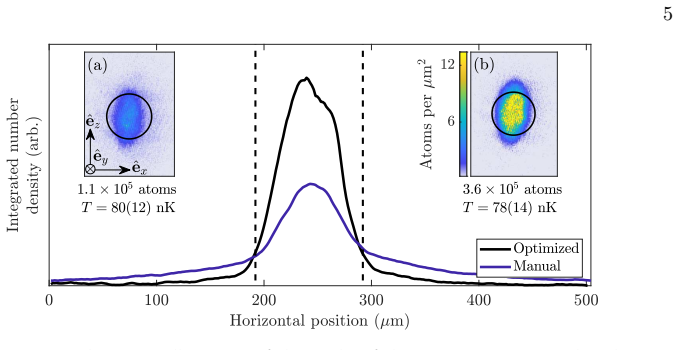
The paper's central claim is that the whole cooling chain of a quantum-gas apparatus can be optimized simultaneously in a single online loop, and that doing so beats optimizing stages one at a time. The evidence is a series of runs on one 87Rb apparatus: Gaussian-process regression alone optimized evaporative cooling from random settings to 3.8e5 atoms in 47 sequences; the full simultaneous optimization, restricted to the 18 settings the GP flagged as sensitive, reached 4.5e5 atoms after 12 GP-guided sequences following a 36-run training set, a factor of about four over the manually optimized BEC of 1.1e5 atoms. The paper also reports that the GP's inverse length scales identify the most performance-limiting settings, including a nonzero ellipticity in the rotating TOP-trap field that manual optimization had fixed at zero, and that the same optimizer, with different cost functions, shortened the sequence from 58 s to 46 s and produced a 37(12) nK cloud.
Load-bearing premise
The whole result rests on the assumption that counting atoms inside one fixed 50 µm circular patch of the time-of-flight image is a faithful measure of BEC quality, even as the cloud's size, shape, and temperature change during optimization.
Editorial extensions
If this is right
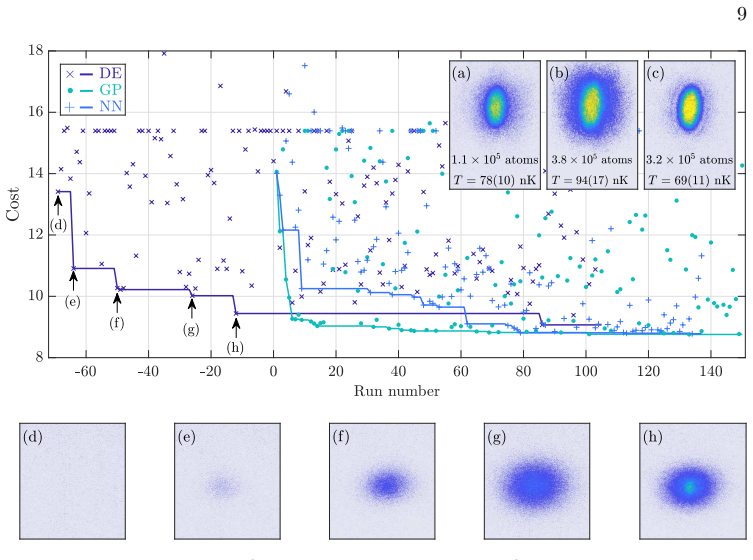
- A BEC can be produced from completely randomized settings with no model and no prior knowledge; the Gaussian-process version reached 3.8e5 atoms after 47 sequences for the evaporative stages.
- Joint optimization of laser cooling and evaporative cooling outperforms optimizing stages separately, reaching 4.5e5 atoms, about four times the manual 1.1e5 baseline.
- The GP's inverse length scales identify the experimental knobs that most limit performance, including a nonzero TOP-field ellipticity that manual optimization had left at zero.
- The same learner can be re-targeted by changing the cost: it cut the sequence time from 58 s to 46 s for a threshold-size BEC and produced a 37(12) nK cloud when minimizing temperature.
- With only the sensitive settings optimized, re-optimization fits within about an hour, making scheduled daily or weekly retuning a practical way to counter long-term drift.
Reading between the lines
- The authors leave implicit that the two-stage recipe — use a cheap global search to estimate the GP length scales, then optimize only sensitive settings — could be rerun periodically, with each cycle updating the sensitivity ranking and thereby tracking slow apparatus drift without human intervention.
- Because the cost is just a count inside a region of interest, the procedure should transfer to other ultracold-atom platforms (different species, optical dipole traps) if the region radius is scaled to the expected condensate size; that transfer is an extrapolation, not a claim the paper makes.
- A testable extension is to monitor the GP sensitivity values themselves as a fault diagnostic: a setting whose $\eta_k$ jumps between optimization runs would flag a developing misalignment or field error before the atom number visibly degrades.
Signed reviews
Editorial analysis
A structured set of objections, weighed in public.
Referee Report
Summary. The manuscript reports online machine-learning optimization of the cooling stages in a 87Rb Bose-Einstein condensate apparatus. Three algorithms are tested: Differential Evolution, Gaussian Process regression, and an Artificial Neural Network. Starting from randomized settings that initially produce no visible cloud, the GP method reaches a BEC with 3.8e5 atoms after 47 optimization sequences (plus 70 DE training sequences), the ANN reaches 3.2e5 atoms after 117 sequences, and DE does not converge within the time limit; the manually optimized settings produce 1.1e5 atoms. The paper then uses GP to optimize the cMOT laser-cooling stage, identifies 'sensitive' settings via GP length-scale hyperparameters, and performs a joint optimization of the sensitive laser-cooling and evaporative-cooling parameters, producing a BEC of 4.5e5 atoms. It also demonstrates customized cost functions for minimizing sequence duration and cloud temperature. The central claim is that this is the first simultaneous optimization of all atomic cooling stages and that the procedure yields a factor-of-four increase in BEC atom number compared to manual optimization.
Significance. If the results hold, the paper is a valuable practical demonstration that online machine learning can replace manual retuning of a complex quantum-gas apparatus and can uncover counterintuitive but useful settings, such as nonzero TOP-trap ellipticity. The use of a robust atom-count cost, the open-source M-LOOP toolkit, and GP length-scale sensitivity analysis are useful contributions for experimental practitioners. However, the quantitative claims - the factor-of-four improvement and the convergence-rate ordering - are based on single optimization trials and on a cost proxy validated along only one direction in parameter space. The qualitative demonstration is therefore stronger than the specific numerical comparisons.
major comments (2)
- [Section 2.3 / Appendix A / Section 4.3] The central quantitative claim - the factor-of-four increase in BEC atom number - rests on the fixed 50-micron-radius ROI cost function of Section 2.3. Appendix A validates this proxy only along a single evaporative-cooling ramp in which the completion percentage is varied while other settings are fixed. Section 4.1 (Table 1) and Section 4.3, however, vary quadrupole current IQ, TOP amplitudes Bx and ellipticity, RF-knife ramps, and cMOT laser settings, all of which can alter the post-TOF cloud size. Because the ROI radius was chosen from the Thomas-Fermi radius of a 1e5-atom BEC and was never re-adapted, the fraction of the condensate captured in the ROI is not constant over the searched landscape; a setting that produces a smaller cloud, or that places low-momentum thermal atoms inside the region, can raise N_tilde without a corresponding increase in total condensed atom number. Since the optimizations select settings by maximizing this cost, the separately fitted total atom numbers (3.8e5 and 4.5e5) do not by themselves close the loop. Please add a direct validation, for example correlating ROI counts with fitted BEC atom number or phase-space density on settings sampled along the actual optimization trajectories, or re-adapt the ROI to the changing cloud size.
- [Section 4.1] The comparison of the three algorithms is based on one optimization run per method ('We perform one optimization routine for each method'). With stochastic costs and randomly generated DE training sets, the reported convergence-rate ordering (GP fastest, ANN intermediate, DE slowest) is a single draw and carries no statistical uncertainty. The 47-sequence GP result and the 117-sequence ANN result are particular realizations; different initial populations could easily change the ordering. Please either run multiple independent optimizations for at least one more instance of GP and ANN, or explicitly rephrase the claim as a single-trial demonstration rather than a general comparison of the methods.
minor comments (5)
- [Section 4.2] There is a typo: 'unneccesarily' should be 'unnecessarily'.
- [References] Reference [34] has incomplete author information ('Wagner P J and R M 2018'); please correct.
- [Abstract / Section 1] The paper states that all atomic cooling stages are optimized, but the initial MOT loading stage is not varied in the optimizations; only the cMOT and evaporative stages are. Please clarify the scope in the abstract and introduction.
- [Section 4.4.1] In the cost function f = -(1+arctan(N_tilde-N0))/(1+t), the sequence duration t is in seconds, making the cost dimensionful, and the cost can become positive when N_tilde is sufficiently below N0. Please specify the normalization of t and the intended behavior for small N_tilde.
- [Section 5] The statement 'We have observed that the optima found are no less stable than the previous, manually optimized values' is not accompanied by any stability or repeatability data; either include a measurement or remove the sentence.
Circularity Check
No circularity: the reported gains are measured experimental outcomes from online optimization, not quantities reconstructed from the fitted or chosen inputs.
full rationale
This paper is an experimental online-optimization study, not a derivation from first principles. The cost function -log(N_tilde) is an explicitly chosen heuristic for ranking settings, and the reported BEC atom numbers are independent absorption-imaging measurements of the resulting clouds, so the factor-of-four claim is an empirical outcome rather than a quantity forced by the cost function or by a fitted model. Appendix A validates the ROI count against fitted phase-space density along one evaporation ramp; that is an empirical correlation supporting a proxy, not a circular reduction where the target is defined by the proxy. The sensitivity analysis infers settings' importance from GP length scales and is explicitly labeled a heuristic indicator, so it does not present a fitted parameter as an independent prediction. The authors' self-citations to their previous apparatus descriptions provide background context, and the only load-bearing external tools (M-LOOP, GP regression, DE, ANN) are standard and independently documented. No uniqueness theorem, ansatz, or prior result is imported from the authors' own work to force the optimization choices. Consequently, there is no step in which a claimed prediction or result is equivalent by construction to its own inputs.
Assumptions & free parameters
free parameters (4)
- GP inverse length-scale hyperparameters eta_k =
Not reported in full; Figure 4 shows values for five most sensitive settings only
- Region-of-interest radius for cost function =
50 um
- Sensitivity threshold for eta_k =
exp(-2)
- Stopping criteria for optimization =
No improvement for 35 sequences; maximum 180 sequences
assumptions (4)
- domain assumption The cost landscape is sufficiently smooth and stationary that a Gaussian process trained on fewer than 100 settings/cost pairs generalizes to untested settings.
- domain assumption The fixed region of interest of radius 50 um after 23 ms of time-of-flight is a faithful proxy for condensate quality throughout the optimization.
- domain assumption Experimental conditions are stable within each optimization window, so settings/cost pairs collected over up to three hours are comparable.
- domain assumption Settings fixed to separately optimized values in Section 4.3 do not interact strongly with the optimized sensitive settings.
Cite this review
Pith. "Pith review of Applying machine learning optimization methods to the production of a quantum gas." pith.science (2026). https://pith.science/paper/RIOMAGTU
@misc{pith2026190808495,
  author       = {Pith},
  title        = {Pith review of: Applying machine learning optimization methods to the production of a quantum gas},
  year         = {2026},
  howpublished = {\url{https://pith.science/paper/RIOMAGTU}},
  note         = {Machine review of arXiv:1908.08495}
}
read the original abstract
We apply three machine learning strategies to optimize the atomic cooling processes utilized in the production of a Bose-Einstein condensate (BEC). For the first time, we optimize both laser cooling and evaporative cooling mechanisms simultaneously. We present the results of an evolutionary optimization method (Differential Evolution), a method based on non-parametric inference (Gaussian Process regression) and a gradient-based function approximator (Artificial Neural Network). Online optimization is performed using no prior knowledge of the apparatus, and the learner succeeds in creating a BEC from completely randomized initial parameters. Optimizing these cooling processes results in a factor of four increase in BEC atom number compared to our manually-optimized parameters. This automated approach can maintain close-to-optimal performance in long-term operation. Furthermore, we show that machine learning techniques can be used to identify the main sources of instability within the apparatus.
Figures

Figures from the paper (3 more)


Reference graph
Works this paper leans on
-
[1]
Patterson J and Gibson A 2015 Deep learning : a practitioner’s approach 1st ed (O’Reilly) ISBN 1491914211 18
work page 2015
-
[2]
Min H 2010 International Journal of Logistics Research and Applications 13 13–39 ISSN 1367- 5567 URL https://www.tandfonline.com/doi/full/10.1080/13675560902736537
-
[3]
com/retrieve/pii/S0092867418301545
Kermany D S 2018 Cell 172 1122–1131.e9 ISSN 00928674 URL https://linkinghub.elsevier. com/retrieve/pii/S0092867418301545
work page 2018
-
[4]
Wigley P B, Everitt P J, van den Hengel A, Bastian J W, Sooriyabandara M A, McDonald G D, Hardman K S, Quinlivan C D, Manju P, Kuhn C C N, Petersen I R, Luiten A N, Hope J J, Robins N P and Hush M R 2016 Scientific Reports 6 25890 ISSN 2045-2322 URL http://www.nature.com/articles/srep25890
work page 2016
-
[5]
Tranter A D, Slatyer H J, Hush M R, Leung A C, Everett J L, Paul K V, Vernaz-Gris P, Lam P K, Buchler B C and Campbell G T 2018 Nature Communications 9 4360 ISSN 2041-1723 URL http://www.nature.com/articles/s41467-018-06847-1
work page 2018
-
[6]
Seif A, Landsman K A, Linke N M, Figgatt C, Monroe C and Hafezi M 2018 Journal of Physics B: Atomic, Molecular and Optical Physics 51 174006 ISSN 0953-4075 URL https://iopscience.iop.org/article/10.1088/1361-6455/aad62b
-
[7]
Einstein A 1925 Verlag der K¨ oniglich-Preussischen Akademie3–14
work page 1925
-
[8]
Davis K B, Mewes M O, Andrews M R, van Druten N J, Durfee D S, Kurn D M and Ketterle W 1995 Physical Review Letters 75 3969–3973 ISSN 0031-9007 URL https://link.aps.org/ doi/10.1103/PhysRevLett.75.3969
Show all 44 references
-
[9]
5221.198
Anderson M H, Ensher J R, Matthews M R, Wieman C E and Cornell E A 1995 Science 269 198–201 ISSN 0036-8075 URL http://www.sciencemag.org/cgi/doi/10.1126/science.269. 5221.198
1995 doi
-
[10]
Bloch I, Dalibard J and Nascimb` ene S 2012 Nature Physics 8 267–276 ISSN 1745-2473 URL http://www.nature.com/articles/nphys2259
2012
-
[11]
Hadzibabic Z, Kr¨ uger P, Cheneau M, Battelier B and Dalibard J 2006 Nature 441 1118– 1121 ISSN 0028-0836 (Preprint 0605291) URL http://www.nature.com/doifinder/10.1038/ nature04851
2006
-
[12]
Greiner M, Mandel O, Esslinger T, Haensch T W and Bloch I 2002 Nature 415 39–44 ISSN 00280836 URL http://www.nature.com/doifinder/10.1038/415039a
2002 doi
-
[13]
Navon N, Gaunt A L, Smith R P and Hadzibabic Z 2016 Nature 539 72–75 ISSN 0028-0836 URL http://www.nature.com/articles/nature20114
2016
-
[14]
Bradley C C, Sackett C A, Tollett J J and Hulet R G 1995 Physical Review Letters 75 1687–1690 ISSN 0031-9007 URL https://link.aps.org/doi/10.1103/PhysRevLett.75.1687
1995 doi
-
[15]
Anderson M H, Ensher J R, Matthews M R, Wieman C E and Cornell E A 1995 Science 269 198–201 ISSN 0036-8075 URL https://science.sciencemag.org/content/269/5221/198
1995
-
[16]
1002/9783527617197
Cohen-Tannoudji C, Dupont-Roc J and Grynberg G 1998 Atom-Photon Interactions (Weinheim, Germany: Wiley-VCH Verlag GmbH) ISBN 9783527617197 URL http://doi.wiley.com/10. 1002/9783527617197
1998
-
[17]
Ketterle W and Druten N V 1996 Advances In Atomic, Molecular, and Optical Physics 37 181–236 ISSN 1049-250X URL https://www.sciencedirect.com/science/article/pii/ S1049250X08601019?via{%}3Dihub
1996
-
[18]
a 123 5388 URL https://www.ncbi.nlm.nih.gov/pmc/articles/PMC6601004/
Toscano J, Wu L Y, Hejduk M and Heazlewood B R 2019 The Journal of Physical Chemistry. a 123 5388 URL https://www.ncbi.nlm.nih.gov/pmc/articles/PMC6601004/
2019
-
[19]
Geisel I, Cordes K, Mahnke J, J¨ ollenbeck S, Ostermann J, Arlt J, Ertmer W and Klempt C 2013 Applied Physics Letters 102 214105 ISSN 0003-6951 URL http://aip.scitation.org/doi/ 10.1063/1.4808213
2013 doi
-
[20]
Lausch T, Hohmann M, Kindermann F, Mayer D, Schmidt F and Widera A 2016Applied Physics B 122 112 ISSN 0946-2171 URL http://link.springer.com/10.1007/s00340-016-6391-2
-
[21]
Rohringer W, B¨ ucker R, Manz S, Betz T, Koller C, G¨ obel M, Perrin A, Schmiedmayer J and Schumm T 2008 Applied Physics Letters 93 264101 ISSN 0003-6951 URL http: //aip.scitation.org/doi/10.1063/1.3058756
2008 doi
-
[22]
Harte T L, Bentine E, Luksch K, Barker A J, Trypogeorgos D, Yuen B and Foot C J 2018 Physical Review A 97 013616 ISSN 2469-9926 URL https://link.aps.org/doi/10.1103/ PhysRevA.97.013616
2018
-
[23]
Hush M R 2019 M-LOOP URL https://m-loop.readthedocs.io/en/latest/index.html
2019
-
[24]
Foot C J 2005 Atomic Physics (Oxford University Press) ISBN 0 19 850695 3
2005
-
[25]
81.031402
Gildemeister M, Nugent E, Sherlock B E, Kubasik M, Sheard B T and Foot C J 2010 Physical Review A 81 031402 ISSN 1050-2947 URL https://link.aps.org/doi/10.1103/PhysRevA. 81.031402
2010 doi
-
[26]
Raab E L, Prentiss M, Cable A, Chu S and Pritchard D E 1987 Physical Review Letters 59 2631–2634 ISSN 0031-9007 URL https://link.aps.org/doi/10.1103/PhysRevLett.59.2631
1987 doi
-
[27]
Steck D A 2001 URL http://steck.us/alkalidata/rubidium87numbers.1.6.pdf 19
2001
-
[28]
Sherlock B E, Gildemeister M, Owen E, Nugent E and Foot C J 2011 Physical Review A 83 043408 ISSN 1050-2947 URL https://link.aps.org/doi/10.1103/PhysRevA.83.043408
2011 doi
-
[29]
Sheard B T 2011 Magnetic Transport and Bose-Einstein Condensation of Rubidium Atoms URL https://ora.ox.ac.uk/objects/uuid:dedece2b-c33a-415b-9d6b-570263042797
2011
-
[30]
Blundell S and Blundell K M 2010 Concepts in thermal physics (Oxford University Press) ISBN 0199562105
2010
-
[31]
Pethick C J and Smith H 2008 Bose-Einstein Condensation in Dilute Gases 2nd ed (Cambridge University Press)
2008
-
[32]
ac.uk/objects/uuid:b3a77b79-230b-4b61-92f5-1ebf0794f490
Bentine E 2018 Atomic Mixtures in Radiofrequency-Dressed Potentials URL https://ora.ox. ac.uk/objects/uuid:b3a77b79-230b-4b61-92f5-1ebf0794f490
2018
-
[33]
Glover F and Kochenberger G A 2003 Handbook of Metaheuristics (Springer US) URL https: //www.springer.com/gp/book/9780387717739
2003
-
[34]
Wagner P J and R M 2018 Online Optimisation (Springer) ISBN 978-0-387-71773-9
2018
-
[35]
Storn R and Price K 1997 Journal of Global Optimization 11 341–359 ISSN 09255001 URL http://link.springer.com/10.1023/A:1008202821328
1997 doi
-
[36]
Seeger M 2004 International Journal of Neural Systems 14 69–106 ISSN 0129-0657 URL http://www.worldscientific.com/doi/abs/10.1142/S0129065704001899
2004 doi
-
[37]
org/document/7955308/
Vikhar P A 2016 Evolutionary algorithms: A critical review and its future prospects 2016 ICGTSPICC (IEEE) pp 261–265 ISBN 978-1-5090-0467-6 URL http://ieeexplore.ieee. org/document/7955308/
2016
-
[38]
Rasmussen C E and Williams C K I 2006 Gaussian processes for machine learning (MIT Press) ISBN 026218253X URL http://www.gaussianprocess.org/gpml/
2006
-
[39]
sciencedirect.com/science/article/pii/S0893608014002135?via{%}3Dihub
Schmidhuber J 2015 Neural Networks 61 85–117 ISSN 0893-6080 URL https://www. sciencedirect.com/science/article/pii/S0893608014002135?via{%}3Dihub
2015
-
[40]
Hendrycks D and Gimpel K 2016 ( Preprint 1606.08415) URL http://arxiv.org/abs/1606. 08415
2016 arXiv
-
[41]
Kalantre S S, Zwolak J P, Ragole S, Wu X, Zimmerman N M, Stewart M D and Taylor J M 2019 npj Quantum Information 5 6 ISSN 2056-6387 URL http://www.nature.com/articles/ s41534-018-0118-7
2019
-
[42]
Sheela K G and Deepa S N 2013 Mathematical Problems in Engineering 2013 1–11 ISSN 1024- 123X URL http://www.hindawi.com/journals/mpe/2013/425740/
2013
-
[43]
Kingma D P and Ba J 2014 ( Preprint 1412.6980) URL http://arxiv.org/abs/1412.6980
2014 arXiv
-
[44]
Ruder S 2016 ( Preprint 1609.04747) URL http://arxiv.org/abs/1609.04747
2016 arXiv
Reviewed August 14, 2026 · model on record in the stance chip above.
Discussion (0). Continue with ORCID to comment.