REVIEW 3 major objections 5 minor 2 cited by
Optimizing quantum heuristics with meta-learning
T0 review · 3 major / 5 minor · reviewed 2026-08-14 · deepseek-v4-flash
Pith's one-line read A trained LSTM meta-learner tunes QAOA and VQE parameters more reliably than standard optimizers under parameter-setting noise.
desk verdict A useful first benchmark for gradient-based meta-learning in VQAs, but the headline noise-resistance claim rests on an un-de-noised evaluation metric that needs fixing. read the letter →
The pith
A machine-rendered reading of the paper's core claim, the machinery that carries it, and where it could break.
The reading
What carries the argument
The central object is the meta-learner: a long short-term memory (LSTM) recurrent network that ingests preprocessed gradients of the cost expectation value and outputs parameter updates $\Delta\vec{\phi}_t$, applied coordinatewise so one model serves any number of circuit parameters. Gradient preprocessing (Equation 1) compresses large gradient magnitudes while preserving sign, and the training loss (Equation 2) is the summed cost over an unrolled time horizon, with a curriculum that extends the horizon from 3 to 10 steps. The parameter-shift rule supplies analytic gradients for both training and evaluation. This machinery is what lets the optimizer carry knowledge across problem instances and absorb the noise model during training.
What would settle it
A concrete test is to run the same five optimizers on a real noisy quantum processor (or a simulator with drift, crosstalk, and measurement error) and count near-optimal solutions; if the meta-learner no longer reaches within 2% of the global optimum more often than L-BFGS-B or evolutionary strategies, the paper's noise-robustness claim is falsified.
Extended reading notes
Core claim
The paper claims that a gradient-based LSTM meta-learner, used as a standalone local optimizer rather than an initializer, outperforms the tested alternatives for parameter setting in variational quantum heuristics. On MAX-2-SAT and Graph Bisection via QAOA and on a three-site Fermi-Hubbard model via VQE, the meta-learner matches or beats the closest gradient-based competitor L-BFGS-B on the average gain metric $G$ in most cases, and in the Noisy environment it lands within 2% of the global minimum 80 times across all runs, versus 17 for the next best optimizer. The paper attributes this to the meta-learner having learned from noisy systems during training, so it continues to find generally good parameters when the cost evaluations are corrupted. The authors state the result as evidence that meta-learning will be useful for noisy near-term quantum heuristics.
Load-bearing premise
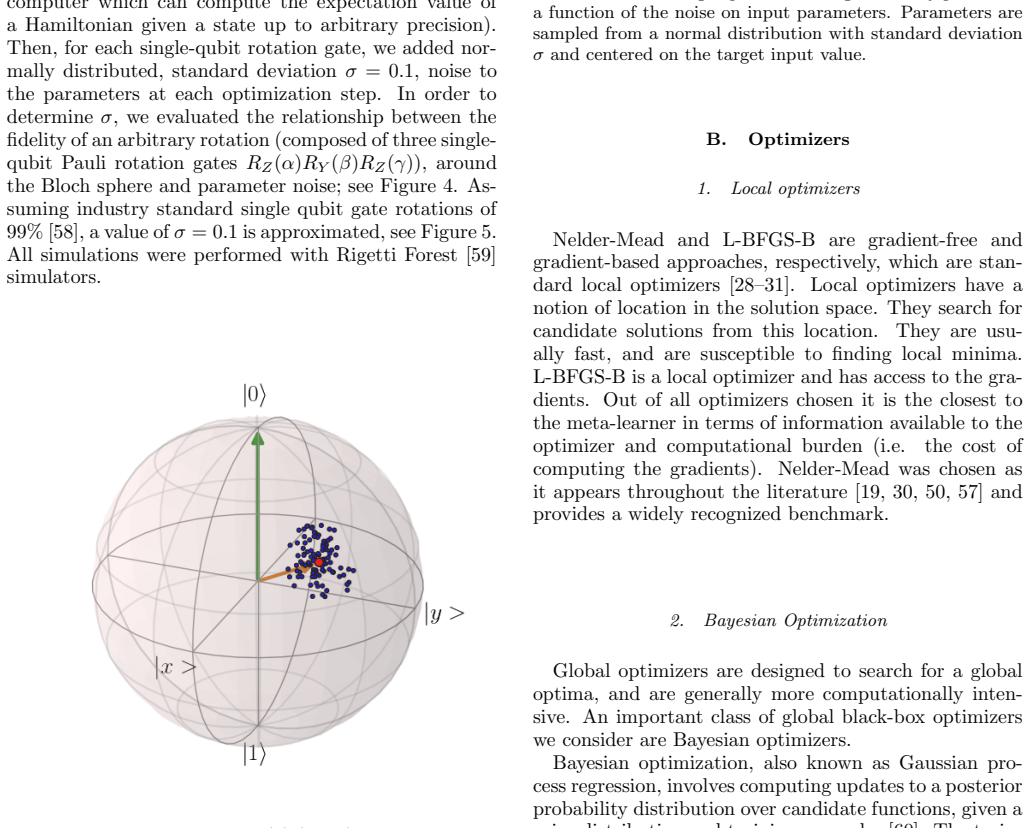
The load-bearing premise is that Gaussian parameter-setting noise with standard deviation $\sigma = 0.1$, calibrated to an assumed 99% single-qubit gate fidelity, captures the structure of real device noise closely enough that the meta-learner's measured robustness will transfer; if actual noise involves drift, crosstalk, or state-preparation and measurement errors, the comparison could change.
Editorial extensions
If this is right
- In the Noisy environment, the meta-learner's frequency of near-optimal solutions (80) is more than four times that of the next best optimizer (17), so if the simulations transfer, it is the most reliable tested method for finding good parameters on noisy devices.
- Across Noisy and Sampling environments, the meta-learner shows smaller performance reductions than L-BFGS-B from the Wave Function baseline, implying noise robustness is a learned property rather than an accident.
- The meta-learner outperforms L-BFGS-B on average gain in most problem-environment combinations while using the same gradient information, suggesting learned optimizers can beat hand-designed local optimizers at equal information.
- Because training requires only 100-200 problem instances per class, the overhead of meta-learning is modest relative to the optimization gains.
- The authors expect these methods to be integral to the useful application of noisy near-term quantum computers.
Reading between the lines
- If the noise robustness transfers to hardware, the meta-learner could be retrained on device-specific noise, not just generic Gaussian parameter noise, potentially absorbing crosstalk, drift, and calibration errors into the update rule.
- A natural test is to compare the meta-learner against SPSA and other stochastic optimizers tailored for noisy hardware, which the paper did not include.
- The coordinatewise LSTM architecture suggests a scaling route: since model size is only indirectly tied to parameter count, the same approach may extend to larger circuits, though the paper explicitly leaves scaling open.
- The gain metric and near-optimal counts reward different behaviors; a meta-learner that is good at both suggests it balances exploitation and exploration, but direct hardware comparisons are needed before claiming practical advantage.
Editorial analysis
A structured set of objections, weighed in public.
Referee Report
Summary. This paper benchmarks a gradient-based LSTM meta-learner as a standalone classical optimizer for variational quantum algorithms. The authors compare it with L-BFGS-B, Nelder-Mead, Bayesian optimization, and evolutionary strategies on QAOA for MAX-2-SAT and Graph Bisection and VQE for a three-site Fermi-Hubbard model, in three simulation environments: exact wave function, finite-shot sampling (1024 shots), and exact wave function with Gaussian parameter-setting noise (sigma = 0.1). Performance is measured by the gain metric G (Eq. 9) and by the frequency of near-optimal final costs D within 2% of the global minimum (Eq. 10). The central claimed result is that in the Noisy environment the meta-learner lands near the global optimum far more often than the other tested optimizers (80 vs 17 counts in Fig. 8), and that it is generally more noise-resistant than L-BFGS-B.
Significance. If the claim were established, this would be a useful contribution to the active discussion on classical optimization strategies for variational quantum algorithms, strengthening the case that learned optimizers can be competitive and robust to parameter noise. The study has a reasonable design in terms of breadth: multiple problems, heuristics, environments, and a sensible closest-competitor baseline. The authors also explicitly acknowledge important limitations such as the extra gradient-circuit calls made by the meta-learner and the small problem sizes. However, the central noisy-environment claim currently rests on a metric that may measure favorable noise realizations rather than actual solution quality, the training/test split is not documented, and the headline comparison is not supported by significance testing. These are fixable experimentally, so the manuscript is not beyond repair.
major comments (3)
- [III.A, IV.A, Eq. (10), Fig. 8] In the Noisy environment, every cost evaluation includes Gaussian parameter-setting noise applied to each single-qubit rotation gate at each optimization step. The near-optimal metric D in Eq. (10) is evaluated with f_F, the converged cost of the optimizer, and the paper does not state that f_F is re-evaluated noise-free or averaged over noise realizations after optimization. A run can therefore be counted as within 2% of the noiseless f_min solely because the final noise realization lowered the measured cost. This is not neutral: the meta-learner is trained on this same noisy cost (Eq. 2) and may learn to exploit the noisy evaluation rather than to find parameters with low noiseless cost. To support the headline claim, the authors should re-evaluate the final parameters of every optimizer without noise, or average over many noise realizations, and recompute D and G.
- [IV.B and IV.C] The evaluation protocol uses 20 problems with 5 initializations (Section IV.B), while the meta-learner is trained on 100-200 problem instances per class (Section IV.C). The text never states whether the 20 evaluated problems are held out from the training set. If the same instances are included in training, the Noisy and Wave Function results measure memorization rather than generalization. The authors should explicitly describe the random-instance generation and the train/test split, and ideally publish the instance or seed lists.
- [V.B and Fig. 8] The claim that the meta-learner 'finds significantly more near-optimal solutions (80)' in the Noisy environment is based on raw counts with no confidence intervals, error bars, or statistical tests. Because the counts are pooled across three problem classes and five initializations, they could be dominated by one class, and the paper's statement that 'each bubble is not divided into each problem class' prevents the reader from checking this. The authors should report per-class counts and run a significance test (e.g., a permutation or binomial test) for the 80-vs-17 comparison, and similarly for the gain-metric comparisons in Figure 7.
minor comments (5)
- [Fig. 9 caption] The caption says the graph contains the same data as 'the subplot Graph Bisection, Noisy, in Figure 9'; this should refer to Figure 7.
- [IV.B] There is a typo in the optimizer name: 'L-BFGF-B' should be 'L-BFGS-B'.
- [III.C.1 and IV.C] The meta-learner is described under a subsection nested in 'Evolutionary Strategies' (III.C.1), and the LSTM architecture hyperparameters (hidden size, number of layers, initialization, and learning-rate schedule) are not reported. Adding these details would improve reproducibility.
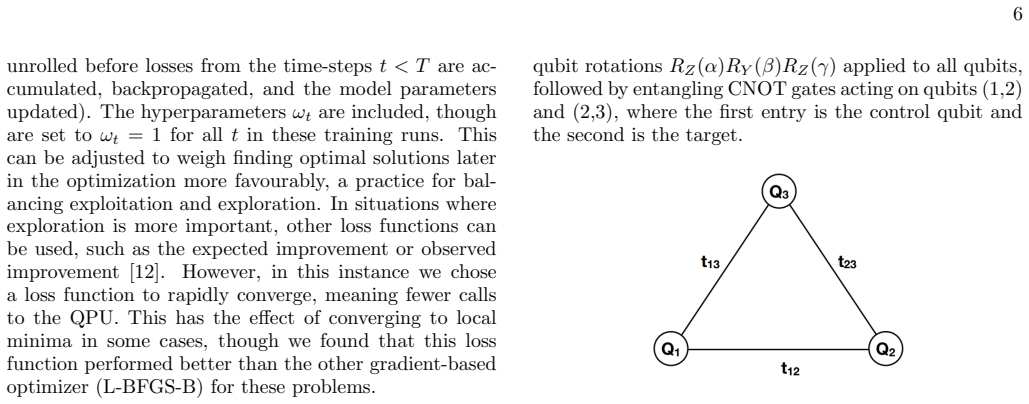
- [V.D] The sentence 'The Fermi-Hubbard models were the simplest to solve (they are small problems confined to parameter values [-2,2])' should clarify that the [-2,2] bounds refer to the Hamiltonian coefficients t_ij, not to the variational parameters being optimized.
- [Fig. 7 caption] The caveat that the x-axis counts only expectation-value evaluations and excludes the auxiliary gradient circuits is important; it should appear in the main text or at least in the first sentence of the figure caption, since the comparison of per-iteration cost otherwise appears misleading.
Circularity Check
No circularity: the central claim is an empirical benchmark against external optimizers, with no fitted constant, self-citation, or definition that forces the result by construction.
full rationale
The paper's strongest claim is an empirical comparison: the meta-learner "comes near to the global optima more frequently than all other optimizers we tested in a noisy parameter setting environment." The supporting metrics are the gain G = E_f[(f_F - f_I)/(f_min - f_I)] (Eq. 9) and the distance D = |f_min - f_F|/|f_min - f_max| * 100 (Eq. 10). Both are defined in terms of externally computed quantities: f_min is obtained by exhausting all possible solutions for MAX-2-SAT and Graph Bisection and by exact diagonalization for Fermi-Hubbard, and f_max is the maximum possible energy. No term in these metrics is fitted to the meta-learner's output, and the benchmark is conducted against independent optimizers (L-BFGS-B, Nelder-Mead, Bayesian optimization, evolutionary strategies). The meta-learner is trained to minimize the summed loss L(omega) = E_f[sum_t omega_t f(phi_t)] on a set of training instances and then evaluated on separate test instances (20 problems from 5 initializations, with training on 100-200 problems). This is ordinary machine-learning generalization rather than a circular reduction: the evaluation is not equal to the training loss by construction, and the meta-learner must produce low-cost parameters at test time. The noise parameter sigma = 0.1 is an input assumption derived from an assumed 99% single-qubit gate fidelity (citing an external reference), not a parameter fitted to the headlined result. The self-citations that appear, such as the QAOA/XY-mixer constructions from Ref. [21] and the VQE circuit based on Refs. [70,71], supply algorithm choices but do not function as a self-cited uniqueness theorem that forces the optimizer-comparison conclusion. The skeptic's concern about the Noisy environment potentially evaluating f_F on the same noise realization is a measurement-validity question, not circularity: all optimizers are evaluated under the same protocol, and the claim is not derived from its own input by definition. The paper also explicitly acknowledges the comparison is not apples-to-apples due to gradient access and draws conservative conclusions. No circular step can be exhibited, so the appropriate finding is no significant circularity.
Assumptions & free parameters
free parameters (5)
- Gradient preprocessing scale r =
10
- Noise standard deviation sigma =
0.1
- Number of shots in Sampling environment =
1024
- Evolutionary strategy parameters =
population 20, Pc = 0.9, Pm = 0.01
- Meta-learner loss time weights omega_t =
1 for all t
assumptions (5)
- domain assumption Parameter-shift gradients are reliable in all three simulation environments.
- domain assumption The simulation environments represent noisy near-term hardware sufficiently for the conclusions.
- domain assumption Small QAOA and VQE instances are representative of practical parameter optimization tasks.
- domain assumption The LSTM meta-learner, trained with Adam and uniform time weights, generalizes across problem instances.
- standard math Global optima fmin and fmax are computed exactly.
Cite this review
Pith. "Pith review of Optimizing quantum heuristics with meta-learning." pith.science (2026). https://pith.science/paper/RIPXK2C4
@misc{pith2026190803185,
  author       = {Pith},
  title        = {Pith review of: Optimizing quantum heuristics with meta-learning},
  year         = {2026},
  howpublished = {\url{https://pith.science/paper/RIPXK2C4}},
  note         = {Machine review of arXiv:1908.03185}
}
read the original abstract
Variational quantum algorithms, a class of quantum heuristics, are promising candidates for the demonstration of useful quantum computation. Finding the best way to amplify the performance of these methods on hardware is an important task. Here, we evaluate the optimization of quantum heuristics with an existing class of techniques called `meta-learners'. We compare the performance of a meta-learner to Bayesian optimization, evolutionary strategies, L-BFGS-B and Nelder-Mead approaches, for two quantum heuristics (quantum alternating operator ansatz and variational quantum eigensolver), on three problems, in three simulation environments. We show that the meta-learner comes near to the global optima more frequently than all other optimizers we tested in a noisy parameter setting environment. We also find that the meta-learner is generally more resistant to noise, for example seeing a smaller reduction in performance in Noisy and Sampling environments and performs better on average by a `gain' metric than its closest comparable competitor L-BFGS-B. These results are an important indication that meta-learning and associated machine learning methods will be integral to the useful application of noisy near-term quantum computers.
Figures


Figures from the paper (4 more)


Forward citations
Cited by 2 Pith papers
-
A unifying account of warm start guarantees for patches of quantum landscapes
A new theorem shows that a patch of parameter space around any point with non-exponentially small curvature retains polynomially large loss variance, unifying and extending prior warm-start results for variational qua...
-
Training the Quantum Approximate Optimization Algorithm without access to a Quantum Processing Unit
The paper derives QAOA parameters from the infinite regular tree limit using tensor networks, so quantum hardware is only needed to sample the final state.
Reference graph
Works this paper leans on
-
[1]
Local optimizers have a notion of location in the solution space
Local optimizers Nelder-Mead and L-BFGS-B are gradient-free and gradient-based approaches, respectively, which are stan- dard local optimizers [28–31]. Local optimizers have a notion of location in the solution space. They search for candidate solutions from this location. They are usu- ally fast, and are susceptible to finding local minima. L-BFGS-B is a ...
-
[2]
An important class of global black-box optimizers we consider are Bayesian optimizers
Bayesian Optimization Global optimizers are designed to search for a global optima, and are generally more computationally inten- sive. An important class of global black-box optimizers we consider are Bayesian optimizers. Bayesian optimization, also known as Gaussian pro- cess regression, involves computing updates to a posterior probability distribution...
-
[3]
Graph Bisection Given a graph with an even number of nodes, the Graph Bisection problem is to partition the nodes into two sets of equal size such that the number of edges across the two sets is minimized. The best classical efficient al- gorithm known for this problem provably yields only a log-factor worst-case approximation ratio [73]. Both this problem ...
-
[4]
Unrolling is the process of iteratively updating the inputs, x, cell state and hidden state, referred to together as s, of the LSTM
Meta-learning on quantum circuits The meta-learner used in this work is an LSTM, shown unrolled in time in Figure 1. Unrolling is the process of iteratively updating the inputs, x, cell state and hidden state, referred to together as s, of the LSTM. Inputs to the model were the gradients of the cost function w.r.t. the parameters, preprocessed by methods ...
-
[5]
Fermi-Hubbard Model Hubbard Hamiltonians have a simple form, as follows: H =−t ∑ ⟨i,j⟩ ∑ σ={↑,↓} (a† i,σaj,σ +a† j,σai,σ) (3) +U ∑ i a† i,↑ai,↑a† i,↓ai,↓−µ ∑ i ∑ σ={↑,↓} a† i,σai,σ, wherea† i,σ,ai,σ are creation and annihilation operators, respectively, of a particle at site i with spin σ. In this model there is a hopping termt, a many body interaction te...
-
[6]
MAX-2-SAT Given a Boolean formula on n variables in conjunc- tive normal form (i.e. the AND of a number of disjunc- tive two-variable OR clauses), MAX-SAT is the NP-hard problem of determining the maximum number of clauses which may be simultaneously satisfied. The best classical efficient algorithm known achieves only a constant factor approximation in the ...
-
[7]
A perspective view and survey of meta-learning,
R. Vilalta and Y. Drissi, “A perspective view and survey of meta-learning,” Artificial intelligence review , vol. 18, no. 2, pp. 77–95, 2002
work page 2002
-
[8]
Metalearning: a survey of trends and technologies,
C. Lemke, M. Budka, and B. Gabrys, “Metalearning: a survey of trends and technologies,” Artificial intelligence 12 review, vol. 44, no. 1, pp. 117–130, 2015
work page 2015
Show all 84 references
-
[9]
Deepsd: Generating high res- olution climate change projections through single image super-resolution,
T. Vandal, E. Kodra, S. Ganguly, A. Michaelis, R. Ne- mani, and A. R. Ganguly, “Deepsd: Generating high res- olution climate change projections through single image super-resolution,” in Proceedings of the 23rd acm sigkdd international conference on knowledge discovery and dat...
2017
-
[10]
Machine learning applications in genetics and genomics,
M. W. Libbrecht and W. S. Noble, “Machine learning applications in genetics and genomics,” Nature Reviews Genetics, vol. 16, no. 6, p. 321, 2015
2015
-
[11]
Towards energy-aware scheduling in data centers using machine learning,
J. L. Berral, I. Goiri, R. Nou, F. Julia, J. Guitart, R. Gavalda, and J. Torres, “Towards energy-aware scheduling in data centers using machine learning,” Pro- ceedings of the 1st International Conference on energy- Efficient Computing and Networking , pp. 215–224, 2010
2010
-
[12]
Machine learning: Trends, perspectives, and prospects,
M. I. Jordan and T. M. Mitchell, “Machine learning: Trends, perspectives, and prospects,” Science, vol. 349, no. 6245, pp. 255–260, 2015
2015
-
[13]
A high-bias, low- variance introduction to machine learning for physicists,
P. Mehta, M. Bukov, C.-H. Wang, A. G. Day, C. Richard- son, C. K. Fisher, and D. J. Schwab, “A high-bias, low- variance introduction to machine learning for physicists,” Physics Reports, 2019
2019
-
[14]
Deep learning,
Y. LeCun, Y. Bengio, and G. Hinton, “Deep learning,” nature, vol. 521, no. 7553, p. 436, 2015
2015
-
[15]
Meta-learning with memory-augmented neural networks,
A. Santoro, S. Bartunov, M. Botvinick, D. Wierstra, and T. Lillicrap, “Meta-learning with memory-augmented neural networks,” inInternational conference on machine learning, pp. 1842–1850, 2016
2016
-
[16]
On first-order meta-learning algorithms,
A. Nichol, J. Achiam, and J. Schulman, “On first-order meta-learning algorithms,” arXiv:1803.02999, 2018
2018 arXiv
-
[17]
Learning to learn by gradient descent by gradient de- scent,
M. Andrychowicz, M. Denil, S. Gomez, M. W. Hoffman, D. Pfau, T. Schaul, B. Shillingford, and N. De Freitas, “Learning to learn by gradient descent by gradient de- scent,” in Advances in Neural Information Processing Systems, pp. 3981–3989, 2016
2016
- [18]
-
[19]
Optimization as a model for few-shot learning,
S. Ravi and H. Larochelle, “Optimization as a model for few-shot learning,” 2016
2016
-
[20]
Learning to learn without gradient descent by gradient descent,
Y. Chen, M. W. Hoffman, S. G. Colmenarejo, M. De- nil, T. P. Lillicrap, M. Botvinick, and N. de Freitas, “Learning to learn without gradient descent by gradient descent,” in Proceedings of the 34th International Con- ference on Machine Learning-Volume 70 , pp. 748–756, JMLR. org, 2017
2017
-
[21]
Efficient and robust automated machine learning,
M. Feurer, A. Klein, K. Eggensperger, J. Springenberg, M. Blum, and F. Hutter, “Efficient and robust automated machine learning,” in Advances in neural information processing systems, pp. 2962–2970, 2015
2015
-
[22]
Meta networks,
T. Munkhdalai and H. Yu, “Meta networks,” in Proceed- ings of the 34th International Conference on Machine Learning-Volume 70, pp. 2554–2563, JMLR. org, 2017
2017
-
[23]
From ans¨ atze to Z-gates: A NASA view of quantum computing,
E. G. Rieffel, S. Hadfield, T. Hogg, S. Mandr` a, J. Marshall, G. Mossi, B. O’Gorman, E. Plamadeala, N. M. Tubman, D. Venturelli, et al. , “From ans¨ atze to Z-gates: A NASA view of quantum computing,” arXiv:1905.02860, 2019
1905 arXiv
-
[24]
Optimizing QAOA: Success probability and runtime dependence on circuit depth,
M. Y. Niu, S. Lu, and I. L. Chuang, “Optimizing QAOA: Success probability and runtime dependence on circuit depth,” arXiv:1905.12134, 2019
1905 arXiv
-
[25]
Commercialize quantum technologies in five years,
M. Mohseni, P. Read, H. Neven, S. Boixo, V. Denchev, R. Babbush, A. Fowler, V. Smelyanskiy, and J. Marti- nis, “Commercialize quantum technologies in five years,” Nature News, vol. 543, no. 7644, p. 171, 2017
2017
-
[26]
Quantum computing in the nisq era and be- yond,
J. Preskill, “Quantum computing in the nisq era and be- yond,” Quantum, vol. 2, p. 79, 2018
2018
-
[27]
A variational eigenvalue solver on a photonic quantum processor,
A. Peruzzo, J. McClean, P. Shadbolt, M.-H. Yung, X.-Q. Zhou, P. J. Love, A. Aspuru-Guzik, and J. L. O’brien, “A variational eigenvalue solver on a photonic quantum processor,” Nature communications, vol. 5, p. 4213, 2014
2014
-
[28]
A quantum approximate optimization algorithm,
E. Farhi, J. Goldstone, and S. Gutmann, “A quantum approximate optimization algorithm,” arXiv:1411.4028, 2014
2014 arXiv
-
[29]
From the quantum ap- proximate optimization algorithm to a quantum alter- nating operator ansatz,
S. Hadfield, Z. Wang, B. O’Gorman, E. G. Rieffel, D. Venturelli, and R. Biswas, “From the quantum ap- proximate optimization algorithm to a quantum alter- nating operator ansatz,” Algorithms, vol. 12, no. 2, p. 34, 2019
2019
-
[30]
QAOA for Max- Cut requires hundreds of qubits for quantum speed-up,
G. G. Guerreschi and A. Matsuura, “QAOA for Max- Cut requires hundreds of qubits for quantum speed-up,” Scientific reports, vol. 9, no. 1, p. 6903, 2019
2019
-
[31]
Performance of hybrid quantum-classical variational heuristics for combinatorial optimization,
G. Nannicini, “Performance of hybrid quantum-classical variational heuristics for combinatorial optimization,” Physical Review E, vol. 99, no. 1, p. 013304, 2019
2019
-
[32]
Optimal quan- tum measurements of expectation values of observables,
E. Knill, G. Ortiz, and R. D. Somma, “Optimal quan- tum measurements of expectation values of observables,” Physical Review A, vol. 75, no. 1, p. 012328, 2007
2007
-
[33]
Quantum chemistry calculations on a trapped-ion quantum simulator,
C. Hempel, C. Maier, J. Romero, J. McClean, T. Monz, H. Shen, P. Jurcevic, B. P. Lanyon, P. Love, R. Babbush, et al., “Quantum chemistry calculations on a trapped-ion quantum simulator,” Physical Review X , vol. 8, no. 3, p. 031022, 2018
2018
-
[34]
Scalable quantum simula- tion of molecular energies,
P. J. O’Malley, R. Babbush, I. D. Kivlichan, J. Romero, J. R. McClean, R. Barends, J. Kelly, P. Roushan, A. Tranter, N. Ding, et al. , “Scalable quantum simula- tion of molecular energies,” Physical Review X , vol. 6, no. 3, p. 031007, 2016
2016
-
[35]
A hybrid classical/quantum approach for large-scale studies of quantum systems with density ma- trix embedding theory,
N. C. Rubin, “A hybrid classical/quantum approach for large-scale studies of quantum systems with density ma- trix embedding theory,” arXiv:1610.06910, 2016
2016 arXiv
-
[36]
Training a quantum optimizer,
D. Wecker, M. B. Hastings, and M. Troyer, “Training a quantum optimizer,” Physical Review A , vol. 94, no. 2, p. 022309, 2016
2016
-
[37]
Progress to- wards practical quantum variational algorithms,
D. Wecker, M. B. Hastings, and M. Troyer, “Progress to- wards practical quantum variational algorithms,” Physi- cal Review A, vol. 92, no. 4, p. 042303, 2015
2015
-
[38]
Whilst in the production of this FIG
- the meta-learner. Whilst in the production of this FIG. 3. General parameterized quantum circuit, with arbi- trary unitaries Uj(φj), input state |0⟩ and classical register c, where ⃗φ = [φ1,φ 2,...,φ n] are the parameters of the circuit. Though the unitaries do not necessari...
-
[39]
In that preprint, the authors consider only gradient-free implementations of meta- learners
was posted online. In that preprint, the authors consider only gradient-free implementations of meta- learners. Their training set is orders of magnitude larger, as the meta-learner is learning to optimize from more limited information. They make similar conclusions re- gardin...
-
[40]
Practical op- timization for hybrid quantum-classical algorithms,
G. G. Guerreschi and M. Smelyanskiy, “Practical op- timization for hybrid quantum-classical algorithms,” arXiv:1701.01450, 2017
2017 arXiv
-
[41]
Barren plateaus in quantum neural network training landscapes,
J. R. McClean, S. Boixo, V. N. Smelyanskiy, R. Bab- bush, and H. Neven, “Barren plateaus in quantum neural network training landscapes,” Nature communications, vol. 9, no. 1, p. 4812, 2018
2018
-
[42]
A limited memory algorithm for bound constrained optimization,
R. H. Byrd, P. Lu, J. Nocedal, and C. Zhu, “A limited memory algorithm for bound constrained optimization,” SIAM Journal on Scientific Computing , vol. 16, no. 5, pp. 1190–1208, 1995
1995
-
[43]
A simplex method for func- tion minimization,
J. A. Nelder and R. Mead, “A simplex method for func- tion minimization,” The computer journal , vol. 7, no. 4, pp. 308–313, 1965
1965
-
[44]
A new method of locating the maximum point of an arbitrary multipeak curve in the presence of noise,
H. J. Kushner, “A new method of locating the maximum point of an arbitrary multipeak curve in the presence of noise,” Journal of Basic Engineering , vol. 86, no. 1, pp. 97–106, 1964
1964
-
[45]
Evolution strategies as a scalable alternative to rein- forcement learning,
T. Salimans, J. Ho, X. Chen, S. Sidor, and I. Sutskever, “Evolution strategies as a scalable alternative to rein- forcement learning,” 2017
2017
-
[46]
Long short-term memory,
S. Hochreiter and J. Schmidhuber, “Long short-term memory,” Neural computation, vol. 9, no. 8, pp. 1735– 1780, 1997
1997
-
[47]
Learning to learn with quantum neural networks via classical neural networks,
G. Verdon, M. Broughton, J. R. McClean, K. J. Sung, R. Babbush, Z. Jiang, H. Neven, and M. Mohseni, “Learning to learn with quantum neural networks via classical neural networks,” arXiv:1907.05415, 2019
1907 arXiv
-
[48]
Multivariate stochastic approximation using a simultaneous perturbation gradient approxima- tion,
J. C. Spall et al., “Multivariate stochastic approximation using a simultaneous perturbation gradient approxima- tion,” IEEE transactions on automatic control , vol. 37, no. 3, pp. 332–341, 1992
1992
-
[49]
Theoreti- cal framework for comparing several stochastic optimiza- tion approaches,
J. C. Spall, S. D. Hill, and D. R. Stark, “Theoreti- cal framework for comparing several stochastic optimiza- tion approaches,” in Probabilistic and Randomized Meth- ods for Design under Uncertainty , pp. 99–117, Springer, 2006
2006
-
[50]
Quantum optimization using variational algorithms on near-term quantum devices,
N. Moll, P. Barkoutsos, L. S. Bishop, J. M. Chow, A. Cross, D. J. Egger, S. Filipp, A. Fuhrer, J. M. Gam- betta, M. Ganzhorn, et al., “Quantum optimization using variational algorithms on near-term quantum devices,” Quantum Science and Technology, vol. 3, no. 3, p. 030503, 2018. 13
2018
-
[51]
Hardware- efficient variational quantum eigensolver for small molecules and quantum magnets,
A. Kandala, A. Mezzacapo, K. Temme, M. Takita, M. Brink, J. M. Chow, and J. M. Gambetta, “Hardware- efficient variational quantum eigensolver for small molecules and quantum magnets,” Nature, vol. 549, no. 7671, p. 242, 2017
2017
-
[52]
Papadimitriou, Computational complexity
C. Papadimitriou, Computational complexity. Addison- Wesley, 1994
1994
-
[53]
Electron correlations in narrow energy bands,
J. Hubbard, “Electron correlations in narrow energy bands,” Proceedings of the Royal Society of London. Se- ries A. Mathematical and Physical Sciences , vol. 276, no. 1365, pp. 238–257, 1963
1963
-
[54]
Quantum approximate op- timization with hard and soft constraints,
S. Hadfield, Z. Wang, E. G. Rieffel, B. O’Gorman, D. Venturelli, and R. Biswas, “Quantum approximate op- timization with hard and soft constraints,” inProceedings of the Second International Workshop on Post Moores Era Supercomputing, pp. 15–21, ACM, 2017
2017
-
[55]
Quan- tum approximate optimization algorithm for MaxCut: A fermionic view,
Z. Wang, S. Hadfield, Z. Jiang, and E. G. Rieffel, “Quan- tum approximate optimization algorithm for MaxCut: A fermionic view,” Physical Review A , vol. 97, no. 2, p. 022304, 2018
2018
-
[56]
Ausiello, P
G. Ausiello, P. Crescenzi, G. Gambosi, V. Kann, A. Marchetti-Spaccamela, and M. Protasi, Complexity and approximation: Combinatorial optimization prob- lems and their approximability properties . Springer Sci- ence & Business Media, 2012
2012
-
[57]
XY-mixers: Analytical and numerical results for QAOA,
Z. Wang, N. C. Rubin, J. M. Dominy, and E. G. Ri- effel, “XY-mixers: Analytical and numerical results for QAOA,” arXiv:1904.09314, 2019
1904 arXiv
-
[58]
Strategies for quantum computing molecular energies using the unitary coupled cluster ansatz,
J. Romero, R. Babbush, J. R. McClean, C. Hempel, P. J. Love, and A. Aspuru-Guzik, “Strategies for quantum computing molecular energies using the unitary coupled cluster ansatz,” Quantum Science and Technology, vol. 4, no. 1, p. 014008, 2018
2018
-
[59]
Bayesian optimisation for variational quantum eigensolvers,
B. Moseley, M. Osborne, and S. Benjamin, “Bayesian optimisation for variational quantum eigensolvers,”
-
[60]
Bengio, S
Y. Bengio, S. Bengio, and J. Cloutier, Learning a synap- tic learning rule . Universit´ e de Montr´ eal, D´ epartement d’informatique et de recherche op´ erationnelle, 1990
1990
-
[61]
Neural optimizer search with reinforcement learning,
I. Bello, B. Zoph, V. Vasudevan, and Q. V. Le, “Neural optimizer search with reinforcement learning,” in Pro- ceedings of the 34th International Conference on Machine Learning-Volume 70, pp. 459–468, JMLR. org, 2017
2017
-
[62]
Learned optimizers that scale and general- ize,
O. Wichrowska, N. Maheswaranathan, M. W. Hoffman, S. G. Colmenarejo, M. Denil, N. de Freitas, and J. Sohl- Dickstein, “Learned optimizers that scale and general- ize,” in Proceedings of the 34th International Conference on Machine Learning-Volume 70, pp. 3751–3760, JMLR. org, 2017
2017
-
[63]
Learning long- term dependencies with gradient descent is difficult,
Y. Bengio, P. Simard, P. Frasconi, et al., “Learning long- term dependencies with gradient descent is difficult,” IEEE transactions on neural networks , vol. 5, no. 2, pp. 157–166, 1994
1994
-
[64]
The vanishing gradient problem dur- ing learning recurrent neural nets and problem solu- tions,
S. Hochreiter, “The vanishing gradient problem dur- ing learning recurrent neural nets and problem solu- tions,” International Journal of Uncertainty, Fuzziness and Knowledge-Based Systems , vol. 6, no. 02, pp. 107– 116, 1998
1998
-
[65]
A quan- tum algorithm to train neural networks using low-depth circuits,
G. Verdon, M. Broughton, and J. Biamonte, “A quan- tum algorithm to train neural networks using low-depth circuits,” arXiv:1712.05304, 2017
2017 arXiv
-
[66]
A quantum engineer’s guide to superconducting qubits,
P. Krantz, M. Kjaergaard, F. Yan, T. P. Orlando, S. Gus- tavsson, and W. D. Oliver, “A quantum engineer’s guide to superconducting qubits,” Applied Physics Reviews , vol. 6, no. 2, p. 021318, 2019
2019
-
[67]
Forest SDK
“Forest SDK.” https://github.com/rigetti
-
[68]
Taking the human out of the loop: A re- view of bayesian optimization,
B. Shahriari, K. Swersky, Z. Wang, R. P. Adams, and N. De Freitas, “Taking the human out of the loop: A re- view of bayesian optimization,” Proceedings of the IEEE, vol. 104, no. 1, pp. 148–175, 2015
2015
-
[69]
Evolution strategies for deep neural network models design,
P. Vidnerov´ a and R. Neruda, “Evolution strategies for deep neural network models design,” CEUR Workshop Proceedings, vol. 1885, pp. 159–166, 2017
2017
-
[70]
An overview of genetic algorithms: Part 1, fundamentals,
D. Beasley, D. R. Bull, and R. R. Martin, “An overview of genetic algorithms: Part 1, fundamentals,” University computing, vol. 15, no. 2, pp. 56–69, 1993
1993
-
[71]
An introduction to genetic algorithms for numerical optimization,
P. Charbonneau, “An introduction to genetic algorithms for numerical optimization,” report, National Center for Atmospheric Research, 2002
2002
-
[72]
An initialization strategy for addressing barren plateaus in parametrized quantum circuits,
E. Grant, L. Wossnig, M. Ostaszewski, and M. Benedetti, “An initialization strategy for addressing barren plateaus in parametrized quantum circuits,” arXiv:1903.05076, 2019
1903 arXiv
-
[73]
Evaluating analytic gradients on quantum hard- ware,
M. Schuld, V. Bergholm, C. Gogolin, J. Izaac, and N. Kil- loran, “Evaluating analytic gradients on quantum hard- ware,” Physical Review A, vol. 99, no. 3, p. 032331, 2019
2019
-
[74]
Solutions of the two-dimensional hubbard model: benchmarks and results from a wide range of numerical algorithms,
J. LeBlanc, A. E. Antipov, F. Becca, I. W. Bulik, G. K.- L. Chan, C.-M. Chung, Y. Deng, M. Ferrero, T. M. Henderson, and C. A. Jim´ enez-Hoyos, “Solutions of the two-dimensional hubbard model: benchmarks and results from a wide range of numerical algorithms,” Phys. Rev. X, vol...
2015
-
[75]
Interacting fermions in one dimen- sion: from weak to strong correlation,
H. J. Schulz, “Interacting fermions in one dimen- sion: from weak to strong correlation,” arXiv e-prints , pp. cond–mat/9302006, Feb 1993
1993
-
[76]
Numerical evi- dence of fluctuating stripes in the normal state of high-tc cuprate superconductors,
E. W. Huang, C. B. Mendl, S. Liu, S. Johnston, H.-C. Jiang, B. Moritz, and T. P. Devereaux, “Numerical evi- dence of fluctuating stripes in the normal state of high-tc cuprate superconductors,” Science, vol. 358, no. 6367, pp. 1161–1164, 2017
2017
-
[77]
¨ uber das Paulische ¨ aquivalenzverbot,
P. Jordan and E. Wigner, “¨ uber das Paulische ¨ aquivalenzverbot,”Z. Phys., vol. 47, p. 631, 1928
1928
-
[78]
Entanglement in quantum-classical vari- ational algorithms,
A. Woitzik, “Entanglement in quantum-classical vari- ational algorithms,” Master’s thesis, Albert-Ludwigs- Universit ¨ at Freiburgm Germany, 2018
2018
-
[79]
Entanglement re- quirements for hybrid quantum-classical algorithms,
A. Woitzik, P. K. Barkoutsos, F. Wudarski, C. Fuchs, A. Buchleitner, and I. Tavernelli, “Entanglement re- quirements for hybrid quantum-classical algorithms,” In preparation, 2019
2019
-
[80]
On the representation of Boolean and real functions as Hamiltonians for quantum computing,
S. Hadfield, “On the representation of Boolean and real functions as Hamiltonians for quantum computing,” arXiv:1804.09130, 2018
2018 arXiv
-
[81]
A polylogarithmic ap- proximation of the minimum bisection,
R. Krauthgamer and U. Feige, “A polylogarithmic ap- proximation of the minimum bisection,” SIAM review , vol. 48, no. 1, pp. 99–130, 2006
2006
-
[82]
SciPy: Open source scientific tools for Python,
E. Jones, T. Oliphant, P. Peterson, et al., “SciPy: Open source scientific tools for Python,” 2001-
2001
-
[83]
GPyOpt: A bayesian optimiza- tion framework in python
T. G. authors, “GPyOpt: A bayesian optimiza- tion framework in python.” http://github.com/ SheffieldML/GPyOpt, 2016
2016
-
[84]
Adam: A method for stochas- tic optimization,
D. P. Kingma and J. Ba, “Adam: A method for stochas- tic optimization,” arXiv:1412.6980, 2014
2014 arXiv
Reviewed August 14, 2026 · model on record in the stance chip above.
Discussion (0). Continue with ORCID to comment.