REVIEW 3 major objections 4 minor 50 references
Memory effects in repeated uses of quantum channels
T0 review · 3 major / 4 minor · reviewed 2026-08-03 · deepseek-v4-flash
Pith's one-line read This paper derives an exact formula for the average fidelity of the n-th use of a quantum state transfer channel when the channel is not reset between uses, and shows that small readout timing errors turn memory effects into severe degradat
desk verdict Useful exact formula for repeated-use QST memory, but the central derivation is omitted and the 'memory always hurts' claim rests on an unproven inequality. read the letter →
The pith
A machine-rendered reading of the paper's core claim, the machinery that carries it, and where it could break.
The reading
What carries the argument
The memory factor A_{n-1}, computed by summing over Motzkin paths in a rooted tree graph. The graph's nodes are labelled by the number of excitations remaining in the channel (0 at the root, then {0,1} or {n-1,n,n+1} per the generation rule), and edges carry the single-particle transition amplitudes between these excitation-number sectors at each readout time. For quadratic (free-fermion) Hamiltonians, Slater-determinant expansions and the completeness relation eliminate sums over channel sites, so all amplitudes reduce to transitions between the sender site 1 and receiver site N. This reduction is the paper's second main result: the n-th-use fidelity for free-fermion channels depends only o
What would settle it
Take the PST chain of length N=6, choose a non-uniform timing sequence such as t1=0.7τ, t2=1.3τ, t3=0.9τ, and compute the exact n=3 fidelity by full state-vector simulation; compare to eq. (10). Then compute A_2 and A_1 numerically to test whether A_2 ≤ A_1 always holds. A single parameter set where A_2 > A_1, or where eq. (10) disagrees with the exact simulation, would falsify the paper's central claims.
Extended reading notes
Core claim
The paper's central claim is Eq. (4): for U(1)-symmetric quantum channels whose Hamiltonian maps to a quadratic fermionic model, the average fidelity of the n-th use is ⟨Fn⟩ = 1/2 + |f^N_1(t_n)| A_{n-1}(t_{n-1};...;t_1)/3 + |f^N_1(t_n)|^2/6, where f^N_1(t) is the single-particle transition amplitude between sender and receiver after time t, and A_{n-1} is a memory factor that sums, over all Motzkin paths (sequences of excitation numbers inside the channel after each readout), products of single-particle transition amplitudes. For free-fermion models, the memory factor collapses to combinations of sender–receiver amplitudes, for example B^N_1(t2,t1)=f^N_1(t1+t2)-f^1_1(t1)f^N_1(t2)-f^N_1(t1)f^
Load-bearing premise
The unproven monotonicity inequality 0 ≤ A_{n-1} ≤ A_{n-2} ≤ ... ≤ A_1 ≤ 1 for equal readout timings is the load-bearing premise; if it fails for some parameters, the conclusion that memory effects always degrade fidelity under uniform timing would break down.
Editorial extensions
If this is right
- For equal readout timings, the memory factor satisfies 0 ≤ A_{n-1} ≤ ... ≤ A_1 ≤ 1, so each additional use lowers the average fidelity unless all previous excitations were fully extracted; this quantifies when resetting is necessary.
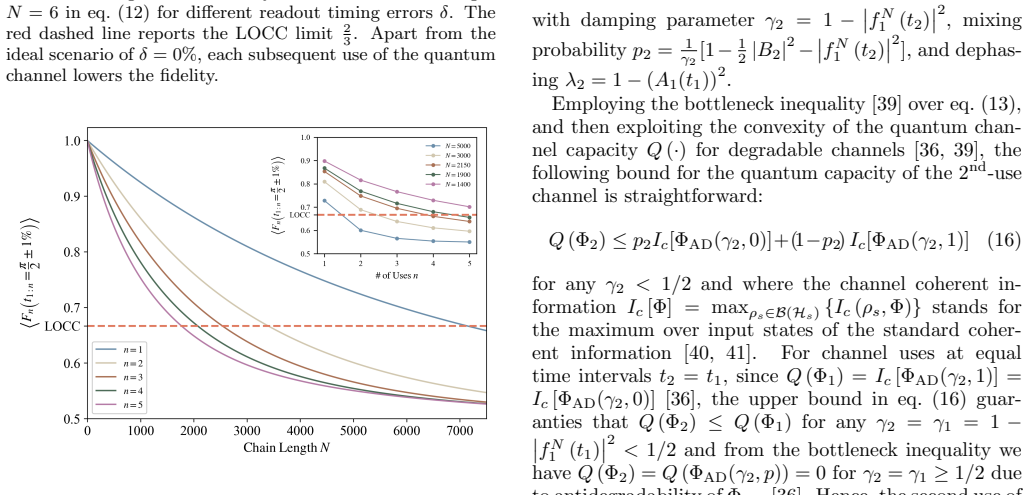
- On a perfect-state-transfer chain, a 5% timing error drops the 10th-use fidelity to about 0.91; with 1% error, chains of ~2000 sites fall below the LOCC limit by the 4th use, showing timing sensitivity grows rapidly with length.
- For the second use, the channel decomposes into a generalized amplitude-damping channel followed by a dephasing channel, yielding the bound Q(Φ2) ≤ Q(Φ1) under uniform timing; for sufficiently strong damping the capacity vanishes, so entanglement distribution through repeated uses fails in broad time windows.
- Because the formula applies to any U(1)-symmetric channel mappable to quadratic fermions, it gives a general tool to compare candidate state-transfer protocols for robustness under multiple uses.
Reading between the lines
- The monotonicity of A_{n-1} is asserted as 'evident' without proof; if it fails for some parameters, memory could in principle enhance fidelity for non-uniform timing sequences, so the uniform-timing degradation conclusion is the paper's load-bearing practical claim.
- The reduction to sender–receiver amplitudes for free fermions suggests that interacting U(1)-symmetric channels, which require the general appendix expression tracking many-particle density elements, might still inherit a Motzkin-path combinatorial structure that could be exploited numerically.
- The formula's recursive structure hints that A_n might satisfy a closed recurrence in n, which would make predictions for long reuse sequences straightforward without enumerating all Motzkin paths.
- A natural testable extension is to verify the capacity bound Q(Φ2) numerically for specific chains, and to ask whether the same degradation mechanism bounds higher uses (n>2).
Editorial analysis
A structured set of objections, weighed in public.
Referee Report
Summary. The paper studies repeated uses of a U(1)-symmetric quantum channel for quantum state transfer without resetting the channel between uses. The central result is a claimed exact formula, Eq. (4), for the nth-use Haar-averaged QST fidelity in terms of a single-particle transition amplitude |f_1^N(t_n)| and a memory factor A_{n-1} built from Motzkin-path sums of transition amplitudes. For Hamiltonians that map to quadratic fermionic models, the paper claims the memory factor reduces to amplitudes involving only the sender and receiver sites. The formalism is applied to the Christandl perfect-state-transfer chain with readout timing errors, leading to the qualitative conclusion that memory effects are always detrimental under equal readout intervals. A separate result bounds the quantum capacity of the second-use channel via a decomposition into generalized amplitude damping and dephasing.
Significance. If the central formula is correct, this is a genuinely useful tool: it extends single-use QST fidelity results to arbitrary reuse counts without a reset assumption, and it does so with no fitted parameters. The n=1 limit correctly reduces to the known Bose expression, and the free-fermion reduction to sender-receiver amplitudes is elegant and likely to be widely applicable. The numerical predictions for readout-timing errors, especially the strong sensitivity to chain length, are falsifiable. However, the paper does not actually derive the key equations: Eq. (17) is stated without proof, the reduction to Eq. (4) is not shown, and the monotonicity of the memory factor—on which the 'always detrimental' conclusion rests—is asserted but not proved. These gaps currently prevent verification of the central claims. The capacity bound in Eq. (16) also needs a more careful derivation.
major comments (3)
- [Sec. III and Appendix, Eq. (17)] Equation (17) is presented as the general expression from which Eq. (4) is derived, but no derivation is provided. The appendix merely states the formula; the paper does not show the Haar averaging over previous sender states, the U(1) sector decomposition, or how the channel density matrix elements ρ^(n-1) enter. Since Eq. (4) is the central result, the reader cannot check the validity of the averaging or the reduction to A_{n-1}. This is a load-bearing omission and should be fixed by giving the full derivation (or a clear, complete reference if it already exists elsewhere).
- [Sec. III, after Eq. (11)] The monotonicity claim '0≤A_{n-1}≤A_{n-2}···≤A_1≤1' for equal readout timings is asserted as 'evident' but is not proved. This is not immediate from the Motzkin-path sum: each path contributes a squared modulus of a sum of complex transition amplitudes, so quantum interference could in principle make A_n non-monotone. The claim is load-bearing because it underpins the paper's main practical conclusion that memory effects are always detrimental under uniform timing. Please provide a proof or, failing that, restrict the conclusion to the cases actually computed and add numerical checks for a range of parameters and chain lengths.
- [Sec. IV, Eqs. (13)–(16)] The derivation of the second-use dynamical map Φ2 = ΦGAD ΦPD and the bound Q(Φ2) ≤ p_2 I_c[ΦAD(γ2,0)] + (1−p_2) I_c[ΦAD(γ2,1)] is sketched in one sentence. The bottleneck inequality alone does not directly give this expression, and convexity of the quantum capacity for convex combinations of channels is not generally valid; the argument needs to be written out. In addition, the matrices in Eqs. (14)–(15) are stated without derivation. This part is secondary to the fidelity result, but it is used to support the claim that the second use reduces quantum information transmission, so it should be made rigorous.
minor comments (4)
- [Sec. II, Eq. (3)] The notation (t_{n−1}; t_1) is introduced, but the time arguments in Eqs. (2)–(3) are sometimes written with a missing subscript (e.g., 't n−1'); please normalize the typography.
- [Sec. III, Eq. (4)] The statement that 'the structure of the nth-use average fidelity is independent of n' would be clearer if qualified: it is independent of n only in the sense that the same functional form with f_1^N(t_n) and A_{n−1} appears; the memory factor itself depends on all previous times.
- [Sec. IV, Fig. 4] The figure caption could state whether A_{n−1} was evaluated exactly or by truncating the Motzkin-path sum; for N up to 7500 this is a nontrivial computational point.
- [Sec. V and acknowledgements] Several minor typos: 'ACKOWLEDGEMENTS' should be 'ACKNOWLEDGEMENTS', and 'Ackowledgements' in the section heading. Also, the conclusions repeat 'may be inefficient already after the first use', which seems to contradict the title emphasis on repeated uses; consider softening.
Circularity Check
No significant circularity; the derivation is self-contained and anchored to externally known limits.
full rationale
The central result, Eq. (4), is derived within the paper from unitary evolution, the protocol definitions in Eqs. (1)-(3), Haar averaging over sender states, and the U(1)/quadratic-fermion structure of the channel. No free parameter is fitted to the fidelity predictions: the transition amplitudes f_i^j(t) are computed analytically from the PST Hamiltonian, and the memory factor A_{n-1} is defined as a sum over Motzkin paths rather than being tuned to reproduce the plotted fidelities. The n=1 limit is checked against the externally known Bose result (Ref. [8]), providing an independent anchor. The use of Ref. [23] for Slater-determinant reduction of many-particle transition amplitudes is a standard mathematical tool, not a self-citation that imports the paper's conclusion. The complaint in the skeptic summary concerns the unproven monotonicity assertion 0 <= A_{n-1} <= A_{n-2} ... <= A_1 <= 1 for equal readout timings; this is a gap in proof or a correctness risk, but it is not circularity, because the inequality is not assumed in deriving Eq. (4) nor is Eq. (4) equivalent to it. The derivation therefore does not reduce to its inputs by construction, and no identified step involves fitting data and renaming it a prediction or importing a uniqueness result from the authors' own prior work.
Assumptions & free parameters
assumptions (4)
- domain assumption Haar averaging over sender states represents unknown previous inputs; the channel state after each use is the reduced density operator obtained by tracing out sender and receiver.
- domain assumption The Hamiltonian is U(1)-symmetric and maps to a quadratic fermionic model for Eq. (4); the example uses the PST Hamiltonian of Ref. [25].
- ad hoc to paper Monotonicity of the memory term: 0 ≤ A_{n-1} ≤ A_{n-2} ≤ ... ≤ A_1 ≤ 1 for equal readout timings.
- standard math Use of the completeness relation and unitary commutation to reduce sums over channel sites to amplitudes involving sender and receiver.
Cite this review
Pith. "Pith review of Memory effects in repeated uses of quantum channels." pith.science (2026). https://pith.science/paper/RIS4DO7R
@misc{pith2026251105661,
  author       = {Pith},
  title        = {Pith review of: Memory effects in repeated uses of quantum channels},
  year         = {2026},
  howpublished = {\url{https://pith.science/paper/RIS4DO7R}},
  note         = {Machine review of arXiv:2511.05661}
}
abstract
Quantum Information Processing (QIP) tasks can be efficiently formulated in terms of quantum dynamical maps, whose formalism is able to provide the appropriate mathematical representation of the evolution of open quantum systems. A key QIP task is quantum state transfer (QST) aimed at sharing quantum information between distant nodes of a quantum network, enabling, e.g. quantum key distribution and distributed quantum computing. QST has primarily been addressed insofar by resetting the quantum channel after each use, thus giving rise to memoryless channels. Here we consider the case where the quantum channel is continuously used, without implementing time- and resource- consuming resetting operations. We derive a general, analytical expression for the $n^{\mathrm{th}}$-use average QST fidelity for $U(1)$-symmetric channels and apply our formalism to a perfect QST channel in the presence of imperfect readout timing. We show that even relatively small readout timing errors give rise to memory effects which have a highly detrimental impact on subsequent QST tasks.
Figures


Figures from the paper (1 more)

Reference graph
Works this paper leans on
-
[1]
The channel is initialized in|Ψ⟩ C1 =|000. . .000⟩. At timet 0 = 0, the 1 st qubit of the sender reg- ister, in an arbitrary state|Ψ⟩ S1 = cos θ1 2 |0⟩+ sin θ1 2 eiϕ1 |1⟩, and of the receiver register, in the state|0⟩ R1 , are attached to the channel
-
[2]
The whole system is then let to evolve for a timet 2
The systemS+C+Revolves for a timet 1, when the 1 st sender and receiver qubits are sub- stituted with the 2 nd set, respectively in the states |Ψ⟩S2 = cos θ2 2 |0⟩+ sin θ2 2 eiϕ2 |1⟩and|0⟩ R2 . The whole system is then let to evolve for a timet 2
-
[3]
arXiv:2511.05661v1 [quant-ph] 7 Nov 2025 2 FIG
This procedure is repeated until the whole sender register is transferred to the receiver register. arXiv:2511.05661v1 [quant-ph] 7 Nov 2025 2 FIG. 1. A quantum channel (green spheres) for the trans- fer of quantum information between two quantum registers: a sender register (red spheres) and a receiver register (blue spheres). Our figure of merit is the ...
arXiv 2025
-
[4]
C. P. Koch, U. Boscain, T. Calarco, G. Dirr, S. Filipp, S. J. Glaser, R. Kosloff, S. Montangero, T. Schulte-Herbr¨ uggen, D. Sugny, and F. K. Wil- helm, Quantum optimal control in quantum tech- nologies. Strategic report on current status, visions and goals for research in Europe, EPJ Quantum Technology9, 10.1140/epjqt/s40507-022-00138-x (2022), arXiv:2205.12110
arXiv 2022
-
[5]
Robledo, L
L. Robledo, L. Childress, H. Bernien, B. Hensen, P. F. A. Alkemade, and R. Hanson, High-fidelity projective read- out of a solid-state spin quantum register, Nature477, 574 (2011)
2011
- [6]
-
[7]
Xuereb, P
J. Xuereb, P. Erker, F. Meier, M. T. Mitchison, and M. Huber, Impact of Imperfect Timekeeping on Quantum 6 Control, Physical Review Letters131, 160204 (2023)
2023
-
[8]
Meier, Y
F. Meier, Y. Minoguchi, S. Sundelin, T. J. G. Apollaro, P. Erker, S. Gasparinetti, and M. Huber, Precision is not limited by the second law of thermodynamics, Nature Physics21, 1147 (2025)
2025
Show all 50 references
-
[9]
Navascu´ es, Resetting Uncontrolled Quantum Sys- tems, Physical Review X8, 031008 (2018)
M. Navascu´ es, Resetting Uncontrolled Quantum Sys- tems, Physical Review X8, 031008 (2018)
2018
-
[10]
Bassman Oftelie, A
L. Bassman Oftelie, A. De Pasquale, and M. Campisi, Dynamic Cooling on Contemporary Quantum Comput- ers, PRX Quantum5, 030309 (2024)
2024
-
[11]
Bose, Quantum communication through an unmodu- lated spin chain, Phys
S. Bose, Quantum communication through an unmodu- lated spin chain, Phys. Rev. Lett.91, 207901 (2003)
2003
-
[12]
G. M. Nikolopoulos and I. Jex,Quantum State Transfer and Network Engineering, edited by G. M. Nikolopoulos and I. Jex (Springer Berlin Heidelberg, Berlin, Heidel- berg, 2014)
2014
-
[13]
Banchi, G
L. Banchi, G. Coutinho, C. Godsil, and S. Severini, Pretty good state transfer in qubit chains—the heisen- berg hamiltonian, Journal of Mathematical Physics58, 032202 (2017)
2017
-
[14]
T. J. G. Apollaro, S. Lorenzo, F. Plastina, M. Con- siglio, and K. ˙Zyczkowski, Entangled States Are Harder to Transfer than Product States, Entropy25, 46 (2022), arXiv:2301.04443
2022 arXiv
-
[15]
Caruso, Quantum channels and memory effects, Re- views of Modern Physics86, 1203 (2014)
F. Caruso, Quantum channels and memory effects, Re- views of Modern Physics86, 1203 (2014)
2014
-
[16]
F. A. Mele, G. D. Palma, M. Fanizza, V. Giovannetti, and L. Lami, Optical fibers with memory effects and their quantum communication capacities, IEEE Transactions on Information Theory70, 8844 (2024)
2024
-
[17]
Sarovar, T
M. Sarovar, T. Proctor, K. Rudinger, K. Young, E. Nielsen, and R. Blume-Kohout, Detecting crosstalk errors in quantum information processors, Quantum4, 321 (2020)
2020
-
[18]
Benenti, A
G. Benenti, A. D’Arrigo, and G. Falci, Enhancement of Transmission Rates in Quantum Memory Channels with Damping, Physical Review Letters103, 020502 (2009)
2009
-
[19]
Caruso, V
F. Caruso, V. Giovannetti, and G. M. Palma, Teleportation-Induced Correlated Quantum Channels, Physical Review Letters104, 020503 (2010)
2010
-
[20]
F. A. Mele, L. Lami, and V. Giovannetti, Restoring Quantum Communication Efficiency over High Loss Op- tical Fibers, Physical Review Letters129, 180501 (2022)
2022
-
[21]
Bayat, D
A. Bayat, D. Burgarth, S. Mancini, and S. Bose, Memory effects in spin-chain channels for information transmis- sion, Physical Review A77, 050306 (2008)
2008
-
[22]
Giovannetti, D
V. Giovannetti, D. Burgarth, and S. Mancini, Communi- cation through a quantum link, Phys. Rev. A79, 012311 (2009)
2009
-
[23]
Bowen and S
G. Bowen and S. Mancini, Quantum channels with a fi- nite memory, Phys. Rev. A69, 012306 (2004)
2004
-
[24]
Giovannetti, A dynamical model for quantum mem- ory channels, Journal of Physics A: Mathematical and General38, 10989 (2005)
V. Giovannetti, A dynamical model for quantum mem- ory channels, Journal of Physics A: Mathematical and General38, 10989 (2005)
2005
-
[25]
Donaghey and L
R. Donaghey and L. W. Shapiro, Motzkin numbers, Jour- nal of Combinatorial Theory, Series A23, 291 (1977)
1977
-
[26]
T. J. G. Apollaro, S. Lorenzo, F. Plastina, M. Con- siglio, and K. ˙Zyczkowski, Quantum transfer of interact- ing qubits, New Journal of Physics24, 083025 (2022), arXiv:2205.01579
2022 arXiv
-
[27]
E. Lieb, T. Schultz, and D. Mattis, Two soluble models of an antiferromagnetic chain, Annals of Physics16, 407 (1961)
1961
-
[28]
Christandl, N
M. Christandl, N. Datta, A. Ekert, and A. J. Landahl, Perfect State Transfer in Quantum Spin Networks, Phys- ical Review Letters92, 187902 (2004)
2004
-
[29]
Vinet and A
L. Vinet and A. Zhedanov, How to construct spin chains with perfect state transfer, Physical Review A85, 012323 (2012)
2012
-
[30]
Christandl, L
M. Christandl, L. Vinet, and A. Zhedanov, Analytic next- to-nearest-neighbor X X models with perfect state trans- fer and fractional revival, Physical Review A96, 032335 (2017)
2017
-
[31]
X. Li, Y. Ma, J. Han, T. Chen, Y. Xu, W. Cai, H. Wang, Y. P. Song, Z. Y. Xue, Z. Q. Yin, and L. Sun, Per- fect Quantum State Transfer in a Superconducting Qubit Chain with Parametrically Tunable Couplings, Physical Review Applied10, 1 (2018), arXiv:1806.03886
2018 arXiv
-
[32]
R. J. Chapman, M. Santandrea, Z. Huang, G. Corrielli, A. Crespi, M.-H. Yung, R. Osellame, and A. Peruzzo, Experimental perfect state transfer of an entangled pho- tonic qubit, Nature Communications7, 11339 (2016)
2016
-
[33]
Christandl, N
M. Christandl, N. Datta, T. C. Dorlas, A. Ekert, A. Kay, and A. J. Landahl, Perfect transfer of arbitrary states in quantum spin networks, Physical Review A71, 032312 (2005)
2005
-
[34]
Horodecki, P
R. Horodecki, P. Horodecki, M. Horodecki, and K. Horodecki, Quantum entanglement, Reviews of Mod- ern Physics81, 865 (2009)
2009
-
[35]
Chitambar, D
E. Chitambar, D. Leung, L. Manˇ cinska, M. Ozols, and A. Winter, Everything you always wanted to know about locc (but were afraid to ask), Communications in Math- ematical Physics328, 891 (2014)
2014
-
[36]
Bengtsson and K
I. Bengtsson and K. Zyczkowski,Geometry of Quantum States(Cambridge University Press, Cambridge, 2017)
2017
-
[37]
Lorenzo, F
S. Lorenzo, F. Plastina, M. Consiglio, and T. J. G. Apol- laro, Quantum Map Approach to Entanglement Trans- fer and Generation in Spin Chains (2022) pp. 321–340, arXiv:2112.02348
2022 arXiv
-
[38]
Bose, Quantum communication through spin chain dynamics: an introductory overview, Contemporary Physics48, 13 (2007), https://doi.org/10.1080/00107510701342313
S. Bose, Quantum communication through spin chain dynamics: an introductory overview, Contemporary Physics48, 13 (2007), https://doi.org/10.1080/00107510701342313
2007 doi
-
[39]
Khatri, K
S. Khatri, K. Sharma, and M. M. Wilde, Information- theoretic aspects of the generalized amplitude-damping channel, Phys. Rev. A102, 012401 (2020)
2020
-
[40]
Devetak and P
I. Devetak and P. W. Shor, The capacity of a quantum channel for simultaneous transmission of classical and quantum information, Communications in Mathematical Physics256, 287 (2005)
2005
-
[41]
Pucha la, K
Z. Pucha la, K. Korzekwa, R. Salazar, P. Horodecki, and K. ˙Zyczkowski, Dephasing superchannels, Phys. Rev. A 104, 052611 (2021)
2021
-
[42]
M. M. Wolf and D. P´ erez-Garc ´ ıa, Quantum capacities of channels with small environment, Phys. Rev. A75, 012303 (2007)
2007
-
[43]
Barnum, M
H. Barnum, M. A. Nielsen, and B. Schumacher, Infor- mation transmission through a noisy quantum channel, Phys. Rev. A57, 4153 (1998)
1998
-
[44]
M. A. Nielsen and I. L. Chuang,Quantum Computation and Quantum Information, 10th ed. (Cambridge Univer- sity Press, Cambridge, 2010)
2010
-
[45]
W. K. Wootters, Entanglement of formation of an arbi- trary state of two qubits, Physical Review Letters80, 2245 (1998), arXiv:quant-ph/9709029
1998 arXiv
-
[46]
Kay, Perfect state transfer: Beyond nearest-neighbor 7 couplings, Physical Review A - Atomic, Molecular, and Optical Physics73, 1 (2006)
A. Kay, Perfect state transfer: Beyond nearest-neighbor 7 couplings, Physical Review A - Atomic, Molecular, and Optical Physics73, 1 (2006)
2006
-
[47]
T. J. G. Apollaro, L. Banchi, A. Cuccoli, R. Vaia, and P. Verrucchi, 99 % -fidelity ballistic quantum-state trans- fer through long uniform channels, Physical Review A85, 052319 (2012)
2012
-
[48]
Ronke, M
R. Ronke, M. P. Estarellas, I. D’Amico, T. P. Spiller, and T. Miyadera, Anderson localisation in spin chains for perfect state transfer, The European Physical Journal D 70, 189 (2016)
2016
-
[49]
J. Zhou, M. Li, W. Wang, W. Cai, Z. Hua, Y. Xu, X. Pan, G. Xue, H. Zhang, Y. Song, H. Yu, C.-L. Zou, and L. Sun, Quantum State Transfer between Superconducting Cavi- ties via Exchange-Free Interactions, Physical Review Let- ters133, 220801 (2024)
2024
-
[50]
Junior, G
M. Junior, G. Almeida, and F. De Moura, Quantum state transfer in ladder systems with cross-correlated disorder, Physica E: Low-dimensional Systems and Nanostructures 171, 116249 (2025)
2025
Reviewed August 3, 2026 · model on record in the stance chip above.
Discussion (0). Continue with ORCID to comment.