Comment on "Counter-propagating charge transport in the quantum Hall effect regime"
Pith reviewed 2026-05-25 15:01 UTC · model grok-4.3
The pith
The upstream current at nu=2/3 follows from the standard upstream neutral mode alone.
A machine-rendered reading of the paper's core claim, the machinery that carries it, and where it could break.
Core claim
The upstream current reported in the nu=2/3 regime can be accounted for by the conventional upstream neutral mode without introducing an upstream charge mode. The interaction of this neutral mode with the contacts generates a measurable upstream current whose magnitude and polarization dependence match the experimental observations.
What carries the argument
Upstream neutral mode at the nu=2/3 edge that couples to contacts to yield a detectable upstream current.
If this is right
- The standard edge-mode structure at nu=2/3 is sufficient to explain the data.
- No upstream charge mode is required to fit the observed currents.
- The upstream signal is absent in the polarized nu=2/3 state because the neutral mode is not present there.
Where Pith is reading between the lines
- Contact engineering could be used to test whether upstream signals in other fractional states also arise from neutral modes.
- The same neutral-mode coupling mechanism may reinterpret other reports of counter-propagating charge transport.
- Quantitative modeling of contact-neutral mode scattering would make the prediction more falsifiable.
Load-bearing premise
The upstream neutral mode produces a measurable upstream current when it interacts with the experimental contacts.
What would settle it
A measurement of zero upstream current in a device where neutral-mode contact coupling is deliberately suppressed while the bulk filling remains nu=2/3 unpolarized.
Figures
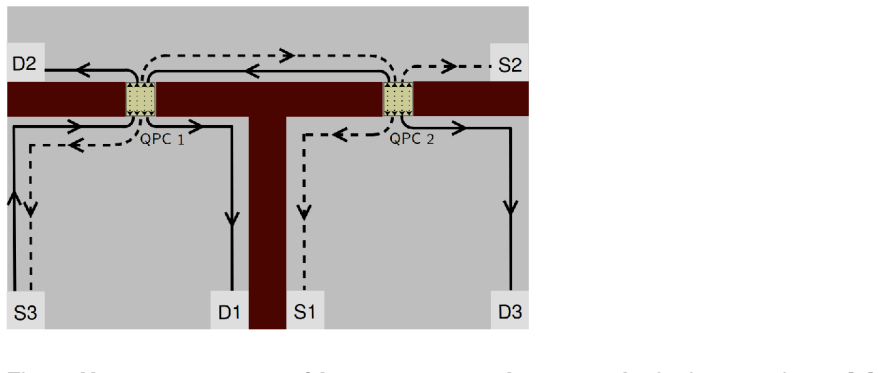
read the original abstract
Laffont et al. [Science 363, 54-57 (2019)] report an upstream current in the nu=2/3 quantum Hall regime, which, they claim, might be due to a counter-propagating charge mode. We show that this observation can also be explained by the expected upstream neutral mode, without the need for an upstream charge mode. Our results agree with the observed data and explain why the upstream current is observed only in the unpolarized nu=2/3 regime.
Editorial analysis
A structured set of objections, weighed in public.
Referee Report
Summary. This comment manuscript argues that the upstream current observed by Laffont et al. in the ν=2/3 quantum Hall regime can be explained by the expected upstream neutral mode alone, without invoking a counter-propagating charge mode. The authors claim their results agree with the experimental data and account for the observation being restricted to the unpolarized ν=2/3 state.
Significance. If the central claim holds, the work supplies a conventional explanation for the upstream signal that aligns with prior literature on neutral modes in fractional quantum Hall edges, thereby avoiding the introduction of additional charge modes.
major comments (1)
- [Abstract] Abstract: The statement that 'our results agree with the observed data' rests on an unshown conversion process by which the upstream neutral mode (which carries zero net charge) produces a measurable upstream current signal at the experimental contacts. No edge Hamiltonian, contact boundary conditions, or calculated current ratios are supplied to substantiate this step or the claimed quantitative agreement.
Simulated Author's Rebuttal
We thank the referee for the detailed reading of our comment. The single major comment is addressed point-by-point below. We agree that additional technical detail is needed to make the conversion from neutral-mode excitation to measurable contact current fully explicit and will revise the manuscript accordingly.
read point-by-point responses
-
Referee: [Abstract] Abstract: The statement that 'our results agree with the observed data' rests on an unshown conversion process by which the upstream neutral mode (which carries zero net charge) produces a measurable upstream current signal at the experimental contacts. No edge Hamiltonian, contact boundary conditions, or calculated current ratios are supplied to substantiate this step or the claimed quantitative agreement.
Authors: We accept the referee’s observation that the abstract is too terse on this point. The body of the comment relies on the well-established fact that, in the unpolarized ν=2/3 edge, the upstream neutral mode equilibrates with the downstream charge mode at the metallic contacts; this equilibration converts neutral-mode energy into a net charge current that is detected as an upstream voltage. Because the manuscript is a short comment, we did not reproduce the standard chiral-Luttinger-liquid Hamiltonian or the contact boundary conditions already derived in the neutral-mode literature (e.g., Kane-Fisher, 1994; Bid et al., 2010). We will add a concise supplementary paragraph containing (i) the two-mode edge Hamiltonian with the neutral-mode velocity and inter-mode interaction parameter, (ii) the boundary conditions at the voltage probes, and (iii) the resulting current ratios that reproduce the upstream signal magnitude reported by Laffont et al. for the unpolarized state while vanishing in the polarized state. This addition will make the quantitative agreement explicit without altering the central claim. revision: yes
Circularity Check
Explanation invokes established neutral-mode physics from prior literature; no reduction of result to fitted inputs or self-citation by construction.
full rationale
The paper's central claim is that the observed upstream current follows from the expected upstream neutral mode at nu=2/3 without requiring an upstream charge mode. This rests on standard edge-mode theory rather than any new parameter fit or redefinition that would make the 'prediction' tautological. No quoted equation or step reduces the data agreement to a self-defined quantity or to a load-bearing self-citation whose validity is internal to the present work. The contact-conversion step is asserted as part of the model but is not shown to be circular; it is treated as an independent physical assumption. Hence only a minor self-citation burden at most, consistent with score 2.
Axiom & Free-Parameter Ledger
Lean theorems connected to this paper
-
IndisputableMonolith/Cost/FunctionalEquation.leanwashburn_uniqueness_aczel unclear?
unclearRelation between the paper passage and the cited Recognition theorem.
the magnitude of the upstream neutral mode generated at QPC1 is zero when T1↑=T1↓, and is maximal when one of them is equal to zero. So the simplest assumption would be that its magnitude would be equal to (T1↑−T1↓)²
-
IndisputableMonolith/Foundation/DimensionForcing.leanalexander_duality_circle_linking unclear?
unclearRelation between the paper passage and the cited Recognition theorem.
upstream current is observed only in the unpolarized ν=2/3 regime
What do these tags mean?
- matches
- The paper's claim is directly supported by a theorem in the formal canon.
- supports
- The theorem supports part of the paper's argument, but the paper may add assumptions or extra steps.
- extends
- The paper goes beyond the formal theorem; the theorem is a base layer rather than the whole result.
- uses
- The paper appears to rely on the theorem as machinery.
- contradicts
- The paper's claim conflicts with a theorem or certificate in the canon.
- unclear
- Pith found a possible connection, but the passage is too broad, indirect, or ambiguous to say the theorem truly supports the claim.
Reference graph
discussion (0)
Sign in with ORCID, Apple, or X to comment. Anyone can read and Pith papers without signing in.