REVIEW 2 major objections 4 minor 33 references
Almost Linear Convergence under Minimal Score Assumptions: Quantized Transition Diffusion
T0 review · 2 major / 4 minor · reviewed 2026-08-07 · deepseek-v4-flash
Pith's one-line read Quantizing continuous data into a binary hypercube lets a diffusion model generate samples with near-linear score-evaluation cost.
desk verdict Smart, repairable central theorem, but the proof as written doesn't deliver the claimed 5eps guarantee—worth refereeing after the T fix and a candid look at A4. read the letter →
The pith
A machine-rendered reading of the paper's core claim, the machinery that carries it, and where it could break.
The reading
What carries the argument
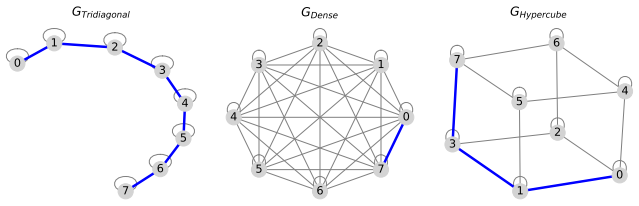
The central object is a Hamming-distance CTMC on binary-encoded quantization cells, combined with truncated uniformization. The hypercube balances long-range jumps against sparse connectivity, giving both diameter and out-degree $O(\log|\mathcal{Y}|)$, and truncated uniformization caps the total outgoing estimated rate from each state at $\beta_t = 2d\log_2 K \cdot \max\{1,(T-t)^{-1}\}$ so that Poisson event counts can be simulated without a bounded-score assumption. The analysis uses an infinitesimal chain rule for KL divergence, which turns the discrepancy between ideal and estimated reverse rates into a Bregman-divergence term controlled by the score entropy loss.
What would settle it
Train the discrete score estimator on a target satisfying [A1]\u2013[A3] and measure the achieved score entropy loss at the model budget implied by Theorem 4.1; if the minimum loss stays above $\epsilon^2/(\ln(d/\epsilon)+\ln\log_2 K)^2$ for small $\epsilon$, the theorem's premise fails and the $\mathrm{TV} \le 5\epsilon$ guarantee does not follow. A complementary check is to run Algorithm 2 on a known target such as a Gaussian and compare the empirical TV to $5\epsilon$, because an unbounded gap growing with dimension would indicate the KL drift bound is too optimistic.
Extended reading notes
Core claim
The paper establishes that continuous diffusion inference can be made almost linear in dimension and logarithmic in tolerance by changing the geometry: quantize $p_*$ onto a binary hypercube with $d\log_2 K$ bits, evolve $q_*$ under a symmetric flip CTMC, and simulate the exact reverse CTMC by truncated uniformization. Theorem 4.1 asserts that, with the histogram scale $L$ and bin width $l$ from Lemma 3.1, horizon $T = \ln(d/\epsilon) + \ln\log_2 K$, and a discrete score satisfying $\mathrm{LSE}(\hat v) \le \epsilon_{\text{score}}^2$ with $\epsilon_{\text{score}} = \epsilon/(\ln(d/\epsilon)+\ln\log_2 K)$, Algorithm 2 achieves $\mathrm{TV}(p_*, \hat p) \le 5\epsilon$ with $O(d\ln^2(d/\epsilon))$ expected score evaluations. The proof replaces the usual Girsanov-based analysis with a chain rule for KL divergence over infinitesimal time intervals, which converts score error into a per-segment drift term that telescopes.
Load-bearing premise
The load-bearing premise is Assumption [A4]: the discrete score trained on quantized data must reach error at most $\epsilon/(\ln(d/\epsilon)+\ln\log_2 K)$, and the paper does not prove or demonstrate that discrete score training achieves such accuracy.
Editorial extensions
If this is right
- Total variation convergence to within $5\epsilon$ is achieved with $O(d\ln^2(d/\epsilon))$ expected score evaluations, removing polynomial factors in $1/\epsilon$.
- A single binary flip can move a particle across an entire quantization edge in the original space, so inference is not forced to take tiny local steps.
- Truncated uniformization removes the bounded estimated score assumption, Eq. (15), that prior discrete diffusion analyses required.
- The unbiased reverse simulation means the only error sources beyond quantization are the discrete score error and the early-stopping gap, both controlled explicitly in the theorem.
- The framework applies to any light-tailed target with bounded Hessian under the stated moment and score-error assumptions, without requiring log-concavity or unimodality.
Reading between the lines
- The practical bottleneck is Assumption [A4]: the paper does not prove that a neural discrete score estimator can reach the required error $\epsilon_{\text{score}}$ at the stated budget, so the theoretical speed-up depends on an empirical question that remains open.
- Because the reverse CTMC simulation is unbiased, QTD offers a clean separation between approximation error and simulation error, making it possible to test the theory directly by measuring empirical TV against $5\epsilon$ on known targets.
- Truncated uniformization is transportable beyond QTD: any discrete diffusion with a computable bound on total reverse rate can use it, likely improving other discrete samplers that currently rely on biased Euler or $\tau$-leaping steps.
- The hypercube design suggests a general principle for latent diffusion spaces: choose an adjacency graph that minimizes the sum of diameter and out-degree, so other low-diameter sparse graphs could substitute for the hypercube in different data geometries.
Editorial analysis
A structured set of objections, weighed in public.
Referee Report
Summary. The paper introduces Quantized Transition Diffusion (QTD), a discrete diffusion algorithm for sampling from a continuous target distribution. The method first quantizes the target onto a bounded cube through a histogram approximation, binary-encodes the resulting grid into {0,1}^{d log2 K}, and defines a forward continuous-time Markov chain with unit-rate Hamming-distance flips. For reverse-time sampling, the paper proposes a truncated uniformization procedure that caps the estimated reverse rates at a time-dependent bound, and it analyzes the resulting KL error using an infinitesimal chain-rule argument. The main result, Theorem 4.1, claims that under Assumptions A1--A4, Algorithm 2 produces samples with TV(p*, \hat p) <= 5 epsilon using O(d ln^2(d/epsilon)) expected score evaluations.
Significance. If the main theorem held as stated, the paper would be a substantial advance: it would give an inference complexity that is linear in dimension and polylogarithmic in 1/epsilon, improving on prior results with inverse-polynomial epsilon dependence. The hypercube quantization is an elegant way to obtain long-range transitions with only logarithmic out-degree, and the truncated uniformization technique is a useful contribution that removes a bounded-score assumption used in earlier discrete diffusion analyses. The paper is also explicit about its assumptions and algorithm, and it honestly notes in Section 5 that the accelerated rate requires discrete score error comparable to continuous score error. However, the proof of the central theorem currently contains a numerical error in Eq. (53), so the stated TV guarantee does not follow as written.
major comments (2)
- [Theorem 4.1 / Appendix F.2, Eq. (53)] The numerical evaluation of the initial-KL term in Eq. (53) is incorrect. With the theorem's choice T = ln(d/epsilon) + ln log2 K, we have exp(-T) d log2 K = epsilon, not epsilon^2. With epsilon_score = epsilon / (ln(d/epsilon) + ln log2 K), the second term is at most epsilon^2 / (ln(d/epsilon) + ln log2 K - delta), not epsilon^2. Hence Eq. (53) only gives KL <= O(epsilon), and Pinsker's inequality yields TV <= O(sqrt(epsilon)), which does not imply the stated 5 epsilon bound for small epsilon. This is repairable within the paper's scope, for example by taking T = 2 ln(d/epsilon) + ln log2 K (or by strengthening the required epsilon_score), and the complexity remains O(d ln^2(d/epsilon)) up to constants, but as written the central convergence claim does not follow from Assumptions A1--A4.
- [Assumption A4 / Section 4] The theorem's advertised complexity is conditional on the discrete score estimator satisfying LSE(\hat v) <= epsilon^2 / (ln(d/epsilon) + ln log2 K)^2 for the quantized histogram target. The paper provides no training-side analysis, transfer bound, or experiments showing that this accuracy is achievable, and Section 5 explicitly concedes that no comparison between discrete and continuous score training is available. I accept A4 as an explicit hypothesis, but the abstract and introduction claim 'minimal score assumptions', which is stronger than what is demonstrated. The paper should either provide a justification or calibration result for A4, or state clearly in the main theorem that A4 is an unverified condition whose failure invalidates the stated complexity.
minor comments (4)
- [Appendix F.2, Lemma F.4] The stated accumulated KL bound of (T-delta) epsilon_score^2 is inconsistent with Eq. (5), where LSE is a full time integral. The derivation shows that the integrated increment is the portion of LSE on [delta, T], so the correct factor should be 1 rather than (T-delta). This error is conservative and does not by itself invalidate the argument, but the lemma statement should be corrected.
- [Proof of Theorem 4.1] The proof writes TV(pbar, \hat p) = integral |pbar - \hat p| dx, while Lemma D.1 defines TV with the conventional 1/2 factor. The normalization should be made consistent throughout the proof.
- [Appendix F.2, proof of Lemma F.4] The paper refers to 'Lemma??' for the chain rule of KL divergence; the missing reference should be supplied.
- [Proof of Theorem 4.1] The line 'delta d log2 K <= epsilon <= ln(1/(1-epsilon))' is confusing; the implication 1 - exp(-delta d log2 K) <= epsilon follows more directly from 1 - exp(-x) <= x for x >= 0.
Circularity Check
No circular derivation: QTD's bound is conditional on explicit score-error assumption A4 and is not driven by self-citation.
full rationale
We find no circular step in QTD's derivation chain. Theorem 4.1 is proved from an explicitly fixed forward CTMC (Eq. 13), a histogram approximation whose TV error is controlled by Lemma 3.1, and a reverse-process KL analysis (Lemma F.4) that invokes the stated score-error assumption A4. Assumption A4 is an oracle/training-accuracy condition stated before the theorem; it is not a fitted parameter relabeled as a prediction, and the paper's own limitation section honestly concedes that attaining discrete score error on par with continuous score error is unverified. The paper's self-citation to Huang et al. (2024) appears only in the literature survey and complexity comparison, not as a load-bearing premise, and the paper explicitly adapts its key uniformization and rate-bound arguments from external works (Chen and Ying 2024; Zhang et al. 2024; Campbell et al. 2022) rather than importing an unexamined self-cited ansatz. The reverse-transition bound, truncation lemma, and KL chain-rule argument are proved in the appendix, so the central claim does not reduce by definition to its inputs. Separately, Eq. (53) appears to contain an arithmetic slip: with T = ln(d/epsilon) + ln log2 K, one has e^{-T} d log2 K = epsilon, not epsilon^2, and (T - delta) epsilon_score^2 = epsilon^2/(T - delta), not epsilon^2. That is a proof-correctness issue, not a circularity, since the intended statement is repairable by taking T = 2 ln(d/epsilon) + ln log2 K while preserving the claimed O(d ln^2(d/epsilon)) complexity. For circularity proper, the derivation is self-contained and not equivalent to its assumptions by construction.
Assumptions & free parameters
assumptions (5)
- domain assumption A1: Bounded second moment of p*: E_{x~p*}[||x||^2] <= m0.
- domain assumption A2: H-smooth log-density: ||grad^2 ln p*(x)|| <= H for all x.
- domain assumption A3: Sub-Gaussian tail: p* is sigma-sub-Gaussian.
- domain assumption A4: Small discrete score estimation error: LSE(hat v) <= eps_score^2 with eps_score = eps / (ln(d/eps) + ln log2 K).
- standard math Modified log-Sobolev inequality for the hypercube forward CTMC (Lemma E.1)
Cite this review
Pith. "Pith review of Almost Linear Convergence under Minimal Score Assumptions: Quantized Transition Diffusion." pith.science (2026). https://pith.science/paper/RJBNF36D
@misc{pith2026250521892,
  author       = {Pith},
  title        = {Pith review of: Almost Linear Convergence under Minimal Score Assumptions: Quantized Transition Diffusion},
  year         = {2026},
  howpublished = {\url{https://pith.science/paper/RJBNF36D}},
  note         = {Machine review of arXiv:2505.21892}
}
abstract
Continuous diffusion models have demonstrated remarkable performance in data generation across various domains, yet their efficiency remains constrained by two critical limitations: (1) the local adjacency structure of the forward Markov process, which restricts long-range transitions in the data space, and (2) inherent biases introduced during the simulation of time-inhomogeneous reverse denoising processes. To address these challenges, we propose Quantized Transition Diffusion (QTD), a novel approach that integrates data quantization with discrete diffusion dynamics. Our method first transforms the continuous data distribution $p_*$ into a discrete one $q_*$ via histogram approximation and binary encoding, enabling efficient representation in a structured discrete latent space. We then design a continuous-time Markov chain (CTMC) with Hamming distance-based transitions as the forward process, which inherently supports long-range movements in the original data space. For reverse-time sampling, we introduce a \textit{truncated uniformization} technique to simulate the reverse CTMC, which can provably provide unbiased generation from $q_*$ under minimal score assumptions. Through a novel KL dynamic analysis of the reverse CTMC, we prove that QTD can generate samples with $O(d\ln^2(d/\epsilon))$ score evaluations in expectation to approximate the $d$--dimensional target distribution $p_*$ within an $\epsilon$ error tolerance. Our method not only establishes state-of-the-art inference efficiency but also advances the theoretical foundations of diffusion-based generative modeling by unifying discrete and continuous diffusion paradigms.
Figures


Reference graph
Works this paper leans on
-
[1]
Benton, J., De Bortoli, V., Doucet, A., and Deligiannidis, G. (2024a). Nearly d -linear convergence bounds for diffusion models via stochastic localization. In The Twelfth International Conference on Learning Representations
work page 2024
-
[2]
Benton, J., Shi, Y., De Bortoli, V., Deligiannidis, G., and Doucet, A. (2024b). From denoising diffusions to denoising markov models. Journal of the Royal Statistical Society Series B: Statistical Methodology , 86(2):286--301
work page 2024
-
[3]
Boffi, N. M. and Vanden-Eijnden, E. (2023). Probability flow solution of the Fokker-Planck equation
work page 2023
-
[4]
Boucheron, S., Lugosi, G., and Bousquet, O. (2003). Concentration inequalities. In Summer school on machine learning , pages 208--240. Springer
work page 2003
-
[5]
Campbell, A., Benton, J., De Bortoli, V., Rainforth, T., Deligiannidis, G., and Doucet, A. (2022). A continuous time framework for discrete denoising models. Advances in Neural Information Processing Systems , 35:28266--28279
work page 2022
-
[6]
Chen, H., Lee, H., and Lu, J. (2023a). Improved analysis of score-based generative modeling: User-friendly bounds under minimal smoothness assumptions. In International Conference on Machine Learning , pages 4735--4763. PMLR
2023
-
[7]
Chen, H. and Ying, L. (2024). Convergence analysis of discrete diffusion model: Exact implementation through uniformization. arXiv preprint arXiv:2402.08095
arXiv 2024
-
[8]
Chen, S., Chewi, S., Li, J., Li, Y., Salim, A., and Zhang, A. (2023b). Sampling is as easy as learning the score: theory for diffusion models with minimal data assumptions. In The Eleventh International Conference on Learning Representations
work page 2023
Show all 33 references
-
[9]
Guo, Z., Liu, J., Wang, Y., Chen, M., Wang, D., Xu, D., and Cheng, J. (2023). Diffusion models in bioinformatics: A new wave of deep learning revolution in action. arXiv preprint arXiv:2302.10907
2023 arXiv
-
[10]
Ho, J., Jain, A., and Abbeel, P. (2020). Denoising diffusion probabilistic models. Advances in neural information processing systems , 33:6840--6851
2020
-
[11]
J., Norouzi, M., and Salimans, T
Ho, J., Saharia, C., Chan, W., Fleet, D. J., Norouzi, M., and Salimans, T. (2022a). Cascaded diffusion models for high fidelity image generation. Journal of Machine Learning Research , 23(47):1--33
2022
-
[12]
Ho, J., Salimans, T., Gritsenko, A., Chan, W., Norouzi, M., and Fleet, D. J. (2022b). Video diffusion models. Advances in Neural Information Processing Systems , 35:8633--8646
2022
-
[13]
Huang, X., Zou, D., Dong, H., Zhang, Z., Ma, Y., and Zhang, T. (2024). Reverse transition kernel: A flexible framework to accelerate diffusion inference. Advances in Neural Information Processing Systems , 37:95515--95578
2024
-
[14]
Kong, Z., Ping, W., Huang, J., Zhao, K., and Catanzaro, B. (2020). Diffwave: A versatile diffusion model for audio synthesis. arXiv preprint arXiv:2009.09761
2020 arXiv
-
[15]
and Cai, C
Li, G. and Cai, C. (2024). Provable acceleration for diffusion models under minimal assumptions. arXiv preprint arXiv:2410.23285
2024 arXiv
-
[16]
and Yan, Y
Li, G. and Yan, Y. (2024). O (d/t) convergence theory for diffusion probabilistic models under minimal assumptions. arXiv preprint arXiv:2409.18959
2024 arXiv
-
[17]
Lou, A., Meng, C., and Ermon, S. (2024). Discrete diffusion modeling by estimating the ratios of the data distribution. In Proceedings of the 41st International Conference on Machine Learning , pages 32819--32848
2024
-
[18]
Meng, C., Choi, K., Song, J., and Ermon, S. (2022). Concrete score matching: Generalized score matching for discrete data. Advances in Neural Information Processing Systems , 35:34532--34545
2022
-
[19]
Nichol, A. Q. and Dhariwal, P. (2021). Improved denoising diffusion probabilistic models. In International conference on machine learning , pages 8162--8171. PMLR
2021
-
[20]
Popov, V., Vovk, I., Gogoryan, V., Sadekova, T., and Kudinov, M. (2021). Grad-tts: A diffusion probabilistic model for text-to-speech. In International Conference on Machine Learning , pages 8599--8608. PMLR
2021
-
[21]
M., Tao, M., and Ying, L
Ren, Y., Chen, H., Zhu, Y., Guo, W., Chen, Y., Rotskoff, G. M., Tao, M., and Ying, L. (2025). Fast solvers for discrete diffusion models: Theory and applications of high-order algorithms. arXiv preprint arXiv:2502.00234
2025
-
[22]
Rombach, R., Blattmann, A., Lorenz, D., Esser, P., and Ommer, B. (2022). High-resolution image synthesis with latent diffusion models. In Proceedings of the IEEE/CVF conference on computer vision and pattern recognition , pages 10684--10695
2022
-
[23]
Schneider, F. (2023). Archisound: Audio generation with diffusion. arXiv preprint arXiv:2301.13267
2023 arXiv
-
[24]
Sohl-Dickstein, J., Weiss, E., Maheswaranathan, N., and Ganguli, S. (2015). Deep unsupervised learning using nonequilibrium thermodynamics. In International conference on machine learning , pages 2256--2265. pmlr
2015
-
[25]
and Ermon, S
Song, Y. and Ermon, S. (2019). Generative modeling by estimating gradients of the data distribution. Advances in neural information processing systems , 32
2019
-
[26]
L., Yim, J., Tischer, D., Baker, D., Broderick, T., Barzilay, R., and Jaakkola, T
Trippe, B. L., Yim, J., Tischer, D., Baker, D., Broderick, T., Barzilay, R., and Jaakkola, T. S. (2023). Diffusion probabilistic modeling of protein backbones in 3d for the motif-scaffolding problem. In The Eleventh International Conference on Learning Representations
2023
-
[27]
van Dijk, N. M. (1992). Approximate uniformization for continuous-time markov chains with an application to performability analysis. Stochastic processes and their applications , 40(2):339--357
1992
-
[28]
M., van Brummelen, S
van Dijk, N. M., van Brummelen, S. P., and Boucherie, R. J. (2018). Uniformization: Basics, extensions and applications. Performance evaluation , 118:8--32
2018
-
[29]
and Wibisono, A
Vempala, S. and Wibisono, A. (2019). Rapid convergence of the unadjusted langevin algorithm: Isoperimetry suffices. Advances in neural information processing systems , 32
2019
-
[30]
Vincent, P. (2011). A connection between score matching and denoising autoencoders. Neural computation , 23(7):1661--1674
2011
-
[31]
L., Juergens, D., Bennett, N
Watson, J. L., Juergens, D., Bennett, N. R., Trippe, B. L., Yim, J., Eisenach, H. E., Ahern, W., Borst, A. J., Ragotte, R. J., Milles, L. F., et al. (2023). De novo design of protein structure and function with rfdiffusion. Nature , 620(7976):1089--1100
2023
-
[32]
Yang, R., Srivastava, P., and Mandt, S. (2023). Diffusion probabilistic modeling for video generation. Entropy , 25(10):1469
2023
-
[33]
Zhang, Z., Chen, Z., and Gu, Q. (2024). Convergence of score-based discrete diffusion models: A discrete-time analysis. arXiv preprint arXiv:2410.02321
2024 arXiv
Reviewed August 7, 2026 · model on record in the stance chip above.
Discussion (0). Sign in to comment.