REVIEW 4 major objections 8 minor 43 references
Early Detection of Hardware Trojans Using Neural Controlled Differential Equations and Analysis of Power Traces
T0 review · 4 major / 8 minor · reviewed 2026-07-30 · grok-4.5
Pith's one-line read An NCDE trained only on clean power traces can flag dormant hardware Trojans once their power footprint exceeds about 3% of peak amplitude.
desk verdict Solid NCDE-on-power application with real active-Trojan results, but the headline dormant/three-state claim was never measured on the real dormant traces the authors already had. read the letter →
The pith
A machine-rendered reading of the paper's core claim, the machinery that carries it, and where it could break.
The reading
What carries the argument
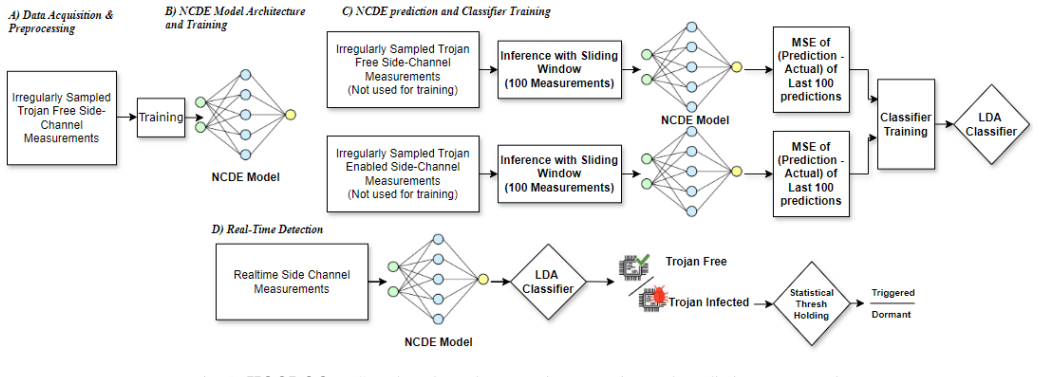
Neural Controlled Differential Equation (NCDE) next-sample predictor: a continuous-time model of nominal power dynamics whose sliding-window mean-squared prediction error becomes the sole feature for an LDA three-way threshold.
What would settle it
Measure real dormant-Trojan power traces (with known trigger timestamps) on the same Sakura-G setup; if the NCDE-plus-LDA pipeline cannot separate them from clean traces at the claimed 3% threshold, or if structured non-Gaussian residuals collapse the three-state accuracy, the central claim fails.
Extended reading notes
Core claim
An NCDE trained exclusively on Trojan-free power traces, combined with LDA on sliding-window next-sample MSE, can perform three-state classification (no Trojan / dormant Trojan / active Trojan) and detect dormant Trojans once their power deviation exceeds roughly 3% of peak amplitude, with active-Trojan accuracy at or above prior ML methods on the TrustHub/Sakura-G benchmarks.
Load-bearing premise
That the power signature of a real dormant Trojan looks enough like simple random noise added at a few percent of peak amplitude for the reported sensitivity curve to transfer to actual chips.
Editorial extensions
If this is right
- Security monitors can raise an early warning while a Trojan is still dormant, shrinking the window between insertion and first activation.
- Three-state labels give operators a graded risk signal instead of a binary clean/infected decision.
- The same NCDE residual pipeline can be reused for other continuous side-channel tasks such as aging or fault detection without retraining the dynamics model on malicious data.
- Once multi-modal side-channels are fused, the 3% sensitivity floor may drop, extending coverage to stealthier Trojans.
Reading between the lines
- Because the NCDE never sees Trojan examples during training, the approach is closer to one-class anomaly detection than to supervised malware classifiers, which may ease deployment when golden Trojan-infected chips are scarce.
- If richer latent-state features replace scalar MSE, the same continuous-time backbone could separate process variation from Trojan footprints more cleanly than noise-injection tests allow.
- The sliding-window formulation suggests a natural online monitor that could run on edge hardware with modest buffer memory.
Editorial analysis
A structured set of objections, weighed in public.
Referee Report
Summary. The manuscript proposes HOODOO, a hardware-Trojan detection pipeline in which a Neural Controlled Differential Equation (NCDE) model is trained one-class on Trojan-free power traces to predict the next sample within a sliding window; the resulting next-sample MSE is thresholded by an LDA-calibrated boundary b_LDA (clean vs. infected) and a second threshold T_triggered (dormant vs. active), yielding a three-state classifier. Experiments use the Sakura-G/TrustHub power side-channel dataset [42] (AES and RS232 bases, six Trojan variants, 10,000 traces per category). The active-Trojan detection results are plausible: prediction error elevates markedly under triggered Trojans (Fig. 2c) and the reported active accuracies (92–100%, Table III) are competitive with prior ML detectors. The paper's novelty claim, however, is dormant-Trojan detection and three-state classification, and this is where the evidence thins: the dormant-detection numbers in Table III and the ~3% sensitivity floor in Fig. 3 come entirely from injecting i.i.d. Gaussian noise into Trojan-free traces, and T_triggered is never calibrated (authors state trigger timestamps are unavailable). The NCDE application to side-channel traces is genuinely novel as far as I know, the one-class training protocol is clean and non-circular, and §V.F is unusually candid about limitations.
Significance. If the dormant-detection claim were validated on real dormant traces, this would be a notable advance: most ML-based HT detectors operate post-activation, and a golden-model-free, one-class NCDE pipeline with a three-state output would address a genuine gap. The strengths that survive scrutiny are the sound active-Trojan results on physical hardware measurements, the honest sensitivity floor analysis in Fig. 3, and the explicit limitation discussion in §V.F. However, because the central dormant/three-state claims currently rest on a synthetic noise proxy despite real dormant data being in hand, the significance of the work as written is considerably lower than the abstract suggests. The gap is closable within the manuscript's existing scope and dataset, which is why I do not recommend rejection.
major comments (4)
- [§V.D, Table III] The headline contribution — three-state classification with dormant-Trojan detection — is never evaluated on actual dormant-Trojan traces, even though §V.A states the dataset [42] contains 10,000 'HT inactive (dormant)' traces per benchmark alongside the active and Trojan-free categories. Instead, §V.D and the dormant-accuracy column of Table III are built entirely on i.i.d. Gaussian noise injected into Trojan-free traces at 1–5% of peak amplitude. Real dormant TrustHub Trojans contribute only static/leakage current and routing overhead (AES-T500 is 0.29% of base area), a footprint plausibly below the 3% floor the paper itself identifies in §V.F, and almost certainly not white Gaussian. The authors already possess the data needed to close this gap: report per-benchmark detection rates on the real HT-inactive traces. Until then, the claim of 'handling dormant Trojans above a sensitivity t
- [§IV.C, Eq. (5), Algorithm 3] The paper presents a three-state classifier (Algorithm 3, Eq. (5)) but states that T_triggered 'requires labeled traces with known trigger timestamps, which are unavailable in the current benchmark' and is therefore never calibrated. What is actually evaluated is (a) binary clean-vs-infected detection via b_LDA and (b) a synthetic noise sensitivity curve. No three-state confusion matrix, no dormant-vs-active error rate, and no evidence that a single monotone MSE axis can support two thresholds simultaneously (a dormant trace with large leakage could exceed a small active Trojan's MSE). Either the three-state claim should be demonstrated on the benchmark's active/dormant split (e.g., calibrating T_triggered on active-trace MSE distributions even without timestamps), or the contribution should be reframed as binary detection plus sensitivity analysis.
- [Table III, §V.E] Table III reports single dormant/active accuracy numbers aggregated across six benchmarks whose Trojans span 0.29%–4.46% of base area — an order-of-magnitude spread that almost certainly produces large per-benchmark variance in detectability. No per-benchmark breakdown, no window-level vs trace-level accuracy definition, and no variance over splits or seeds are given. Additionally, the 'Active Acc.' column is indexed by noise-injection level ('1% Thr: 92.4 ... 5% Thr: 100.0'), which is ambiguous: active-Trojan accuracy should be measured on the real HT-activated traces, not as a function of injected noise. As tabulated, it is unclear what quantity each cell reports. This needs a precise metric definition and a per-benchmark table before the comparison to prior work can be interpreted.
- [§V.B.3, §IV.C] The calibration protocol for b_LDA is underspecified in a load-bearing way. §V.B.3 says LDA is trained 'on MSE values from both Trojan-free and Trojan-infected traces,' but does not state whether 'infected' means active traces, dormant traces, or both. If b_LDA is calibrated on active traces (the natural reading), dormant traces with subtler deviations would systematically fall below the boundary, and the dormant column of Table III would then reflect only the synthetic experiment. This interacts with major comment 1 and must be clarified. Relatedly, the pipeline is described as 'trained exclusively on Trojan-free data,' but the LDA stage requires labeled infected traces; the framing in the Abstract and §IV should state this dependence on labeled Trojan hardware explicitly, since it is a meaningful deployment assumption.
minor comments (8)
- [Fig. 2, §V.C] Fig. 2 presents qualitative predicted-vs-actual traces for the three conditions but no quantitative baseline (MSE values, R², or residual distributions) for the Trojan-free model. A histogram of MSE for the three classes on real data would substantially strengthen the paper and is cheap to add.
- [Table I, §IV.A] Table I lists RK4 step size 0.2 while windows are mapped to t ∈ [0,1] (§IV.A.2), implying only ~5 solver steps per 50-sample window. Please clarify whether this is intentional, and whether accuracy is sensitive to step size, W, hidden channels, and stride — an ablation over W and step size is warranted given the sensitivity claims.
- [Table III, §V.E] Table III compares against MLNN [32] (gate-level netlists) and GPT-4 [35] (RTL/netlist) — different input modalities and threat assumptions. A note that these are not like-for-like comparisons, and ideally a comparison against power-trace baselines (LSTM [33], HTM [34]) re-run on the same dataset splits, would make the 'superior accuracy' claim defensible.
- [§V.E, ref [33]] Reference [33] is titled 'A Siamese deep learning framework...' but is described in §V.E as 'LSTM'. Please reconcile the label with the cited method.
- [Algorithm 1] Algorithm 1 concatenates a vector of ones of dimension 'input dim' with h; the role and naming of x here is confusing since x elsewhere denotes the power trace. Rename (e.g., bias term) and explain.
- [§V.A] No runtime/latency measurements are reported despite the run-time detection motivation (§I). With W=50, stride 1, and RK4 integration per window, per-window inference cost on the A16 and on CPU should be reported to support deployability claims.
- [Abstract, §VI] The abstract and §VI claim 'superior performance relative to conventional machine learning techniques,' but Table III shows HTM [34] at 92.2% active accuracy, which overlaps the paper's own 92.4–100% range depending on the row interpretation. Please temper or precisely support the superiority wording.
- [§V.A] Process variation is mentioned only as having been 'addressed in the original dataset by collecting traces from two separate Sakura-G boards' (§V.A). It is unclear whether training and testing traces come from the same or different boards; cross-board evaluation would speak directly to the masking concern raised in §III.B.
Circularity Check
Standard one-class NCDE+LDA pipeline; only mild circularity is presenting noise-injection sensitivity curves as dormant-Trojan accuracy.
-
fitted input called prediction
[§V.D, Fig. 3, Table III (dormant Acc. column)]
"To evaluate detection sensitivity, we injected normally distributed noise at varying levels (1–5% of peak power trace amplitude) into Trojan-free traces, simulating the subtle power deviations that stealthy hardware Trojans introduce... As shown in Fig. 3, our NCDE-based method successfully detected Trojans at noise levels ≥3% of peak power value. ... NCDE (Ours) ... 1% Thr: 55.7 ... 3% Thr: 80.2 ... 5% Thr: 92.2"
The reported “dormant Acc. (%)” figures are detection rates on synthetic traces the authors constructed by adding exactly k% peak-amplitude Gaussian noise to clean data, then tabulated under the same k% labels. The quantity is therefore the classifier’s sensitivity to a known injected perturbation, not an independent prediction about real dormant HTs. Presenting that sensitivity curve as dormant-Trojan accuracy renames a fitted/controlled experimental condition as the claimed three-state capability. (Active-Trojan and clean evaluations on real traces are not affected.)
full rationale
The core derivation is not circular. The NCDE is trained solely on Trojan-free traces to minimize next-sample MSE (Eq. 2), a conventional one-class residual model; higher MSE on held-out traces is an independent empirical signal, not forced by definition. LDA’s boundary b_LDA is ordinary supervised calibration on labeled clean vs. infected MSE values and does not make the detection claim tautological. Active-Trojan numbers in Table III are evaluated against real TrustHub/Sakura-G activated traces and are therefore externally falsifiable. Self-citations ([11],[14],[15],[19]) appear only as related-work context and do not underwrite the NCDE construction or the decision rule. The sole mild circularity is presentational: §V.D and Table III’s “dormant Acc.” column report detection rates on Trojan-free traces into which the authors themselves injected Gaussian noise at 1–5% of peak amplitude, then index those rates by the same injection levels. That quantity is by construction a noise-sensitivity curve, not a measurement on the benchmark’s actual HT-inactive traces (which the dataset description says exist). This is a renaming of a controlled sensitivity experiment as “dormant Trojan accuracy,” not a load-bearing self-definitional collapse of the method. Score 2 reflects that single minor step; the central NCDE residual + LDA claim remains independently contentful.
Assumptions & free parameters
free parameters (7)
- sliding_window_W =
50
- NCDE_hidden_channels =
64
- b_LDA =
fitted on calibration set (value not reported)
- T_triggered =
not calibrated; proxied by 1–5% noise levels
- noise_amplitude_percent_of_peak =
1%, 2%, 3%, 4%, 5%
- RK4_step_size =
0.2
- AdamW_LR_and_WD =
LR 1e-3, WD 1e-4
assumptions (5)
- domain assumption Neural Controlled Differential Equations (Kidger et al.) correctly model continuous-time dynamics of irregular or noisy power side-channel traces for next-sample prediction.
- domain assumption A dormant (untriggered) hardware Trojan still produces a measurable deviation in power consumption relative to a golden Trojan-free trace.
- ad hoc to paper Mean squared next-sample prediction error aggregated over sliding windows is a sufficient statistic for LDA separation of clean vs infected traces.
- ad hoc to paper Additive white Gaussian noise at a few percent of peak amplitude is a valid experimental proxy for stealthy dormant-Trojan power leakage.
- standard math Cubic spline / Hermite interpolation of discrete power samples yields a control path X(t) adequate for CDE integration in this application.
invented entities (1)
-
HOODOO framework
Cite this review
Pith. "Pith review of Early Detection of Hardware Trojans Using Neural Controlled Differential Equations and Analysis of Power Traces." pith.science (2026). https://pith.science/paper/RJFIGPOQ
@misc{pith2026260723417,
  author       = {Pith},
  title        = {Pith review of: Early Detection of Hardware Trojans Using Neural Controlled Differential Equations and Analysis of Power Traces},
  year         = {2026},
  howpublished = {\url{https://pith.science/paper/RJFIGPOQ}},
  note         = {Machine review of arXiv:2607.23417}
}
read the original abstract
Evolving Hardware Trojans pose a serious threat to modern digital systems by evading traditional detection through stealthy, adaptive behavior. Even recent methods that leverage advances in machine learning can only detect them after activation, leaving a critical window for potential security breaches. To address this gap, we propose a novel approach for hardware Trojan detection and prediction using Neural Controlled Differential Equations (NCDEs) and analysis of power traces. Our method leverages an NCDE model trained exclusively on Trojan-free data to learn nominal power behavior, combined with a Linear Discriminant Analysis (LDA) classifier calibrated on labeled data, to distinguish between three scenarios: no Trojan, dormant Trojan, and active Trojan. Our method uses a sliding window to process side-channel measurements, enabling detection of subtle power consumption deviations that indicate Trojan presence, even when dormant. Experimental results demonstrate that the proposed NCDE-based method achieves superior accuracy compared to traditional machine learning approaches, with the additional advantage of handling dormant Trojans above a sensitivity threshold. We validate our approach on standard hardware Trojan benchmarks, showing robust detection and prediction performance.
Figures


Reference graph
Works this paper leans on
-
[42]
Hardware Tro- jan power & EM side-channel dataset,
R. Yasaei, S. Faezi, and M. A. A. Faruque, “Hardware Tro- jan power & EM side-channel dataset,” InIEEE Dataport, https://dx.doi.org/10.21227/9fwb-8978
-
[1]
Ten years of hardware Trojans: A survey from the attacker’s perspective,
M. Xue, C. Gu, W. Liu, S. Yu, and M. O’Neill, “Ten years of hardware Trojans: A survey from the attacker’s perspective,” InIET Computers & Digital Techniques, vol. 14, pp. 231–246, 2020
2020
-
[2]
Introduction to hardware Trojan detection methods,
J. Francq and F. Frick, “Introduction to hardware Trojan detection methods,” InDesign, Automation & Test in Europe Conference & Exhibition (DATE), pp. 770–775, 2015
2015
-
[3]
Static probability analysis guided RTL hardware Trojan test generation,
H. Wang, Q. Zhou, and Y . Cai, “Static probability analysis guided RTL hardware Trojan test generation,” InAsia and South Pacific Design Automation Conference, pp. 510–515, 2023
2023
-
[4]
Automated test generation for hardware Trojan detection using reinforcement learning,
Z. Pan and P. Mishra, “Automated test generation for hardware Trojan detection using reinforcement learning,” InAsia and South Pacific Design Automation Conference (ASP-DAC), pp. 408–413, 2021
2021
-
[5]
Hardware Trojan design on neural networks,
J. Clements and Y . Lao, “Hardware Trojan design on neural networks,” InIEEE International Symposium on Circuits and Systems (ISCAS), pp. 1-5, 2019
2019
-
[6]
GramsDet: Hardware Trojan detection based on recurrent neural network,
R. Lu, H. Shen, Y . Su, H. Li, and X. Li, “GramsDet: Hardware Trojan detection based on recurrent neural network,” InIEEE Asian Test Symposium (ATS), pp. 111–115, 2019
2019
-
[7]
Trustwor- thy hardware: Identifying and classifying hardware Trojans,
R. Karri, J. Rajendran, K. Rosenfeld, and M. Tehranipoor, “Trustwor- thy hardware: Identifying and classifying hardware Trojans,” InIEEE Computer, vol. 43, no. 10, pp. 39–46, 2010
2010
Show all 43 references
-
[8]
Side-channel analysis for hard- ware Trojan detection using machine learning,
S. Yang, P. Chakraborty, and S. Bhunia, “Side-channel analysis for hard- ware Trojan detection using machine learning,” inIEEE International Test Conference India (ITC India), pp. 1–6, 2021
2021
-
[9]
Golden model-free hardware Trojan detection by classification of netlist module graphs,
A. Hepp, J. Baehr, and G. Sigl, “Golden model-free hardware Trojan detection by classification of netlist module graphs,” InDesign, Automa- tion & Test in Europe Conference & Exhibition (DATE), pp. 1317–1322, 2022
2022
-
[10]
A side-channel hardware Trojan in 65nm CMOS with 2µW precision and multi-bit leakage capability,
T. Perez and S. Pagliarini, “A side-channel hardware Trojan in 65nm CMOS with 2µW precision and multi-bit leakage capability,” InAsia and South Pacific Design Automation Conference (ASP-DAC), pp. 9–10, 2022
2022
-
[11]
Risk-aware and explainable frame- work for ensuring guaranteed coverage in evolving hardware Trojan detection,
R. Vishwakarma and A. Rezaei, “Risk-aware and explainable frame- work for ensuring guaranteed coverage in evolving hardware Trojan detection,” InIEEE/ACM International Conference on Computer Aided Design (ICCAD), pp. 1–9, 2023
2023
-
[12]
Secure run-time hardware Trojan detection using lightweight analytical models,
Z. Wang, Y . Xue, and H. Wang, “Secure run-time hardware Trojan detection using lightweight analytical models,” InIEEE International Symposium on Hardware Oriented Security and Trust (HOST), pp. 1–9, 2023
2023
-
[13]
Simulation-based approach to generating golden data for PCB-level hardware Trojan detection using capacitive sensor,
S. Kaji, D. Fujimoto, and Y . Hayashi, “Simulation-based approach to generating golden data for PCB-level hardware Trojan detection using capacitive sensor,” InIEEE Physical Assurance and Inspection of Electronics (PAINE), pp. 1–7, 2023
2023
-
[14]
Uncertainty-aware hardware Trojan detection using multimodal deep learning,
R. Vishwakarma and A. Rezaei, “Uncertainty-aware hardware Trojan detection using multimodal deep learning,” InDesign, Automation & Test in Europe Conference & Exhibition (DATE), pp. 1–6, 2024
2024
-
[15]
Uncertainty-aware unimodal and multimodal learning for evolving hardware Trojan detection,
R. Vishwakarma and A. Rezaei, “Uncertainty-aware unimodal and multimodal learning for evolving hardware Trojan detection,” InJournal of Hardware and Systems Security, V ol. 9, pp. 1–23, 2025
2025
-
[16]
Fundamental study on detecting hardware Trojans in printed circuit boards using ring oscillators,
K. Abe, D. Fujimoto and Y . Hayashi, “Fundamental study on detecting hardware Trojans in printed circuit boards using ring oscillators,” InIn- ternational Workshop on the Electromagnetic Compatibility of Integrated Circuits (EMC Compo), pp. 1–4, 2024
2024
-
[17]
Hardware Trojan detection using graph neural networks,
R. Yasaei, L. Chen, S. -Y . Yu, and M. Abdullah Al Faruque, “Hardware Trojan detection using graph neural networks,” InIEEE Transactions on Computer-Aided Design of Integrated Circuits and Systems, vol. 44, no. 1, pp. 25–38, 2025
2025
-
[18]
Hardware Trojan detection by fine-grained power domain partitioning,
T. Ishikawa, K. Yokooji, Y . Midoh, N. Miura, M. Shintani, and J. Shiomi, “Hardware Trojan detection by fine-grained power domain partitioning,” InAsia and South Pacific Design Automation Conference (ASP-DAC), pp. 1257–1263, 2025
2025
-
[19]
Reconfigurable run-time hardware Trojan mitigation for logic-locked circuits,
J. Maynard and A. Rezaei, “Reconfigurable run-time hardware Trojan mitigation for logic-locked circuits,” InIEEE 17th Dallas Circuits and Systems Conference (DCAS), pp. 1–6, 2024
2024
-
[20]
DART: Distribution-aware hardware Trojan detection,
L. Chen, Y . Gamal, Y . Li, S. -Y . Yu, I. Alouani, and M. A. A. Faruque, “DART: Distribution-aware hardware Trojan detection,” In IEEE Transactions on Information Forensics and Security, vol. 20, pp. 9600–9609, 2025
2025
-
[21]
PEARL: An adaptive and explainable hardware Trojan detection using open source and enterprise large language models,
R. Kumar Kundu, K. Khalil, E. Garcia, E. Grassia, P. Calyam, and K. A. Hoque, “PEARL: An adaptive and explainable hardware Trojan detection using open source and enterprise large language models,” In IEEE Access, vol. 13, pp. 133755–133772, 2025
2025
-
[22]
Defense in the reverse fragment: RL-based partial netlist hardware Trojan detection,
B. Li, C. Dong, D. Qiu, M. Chen, and Y . Yang, “Defense in the reverse fragment: RL-based partial netlist hardware Trojan detection,” InIEEE/ACM International Conference On Computer Aided Design (ICCAD), pp. 1–7, 2025
2025
-
[23]
SAGE: Shapley attention graph network for gate-level Trojan detection and localization,
Z. Pan, Z. Shu and X. Yu, “SAGE: Shapley attention graph network for gate-level Trojan detection and localization,” InIEEE Computer Society Annual Symposium on VLSI (ISVLSI), pp. 1–6, 2025
2025
-
[24]
Design for assurance: Employing functional verification tools for thwarting hardware Trojan threat in 3PIPs,
W. Hu, B. Li, L. Wu, Y . Li, X. Li, and L. Hong, “Design for assurance: Employing functional verification tools for thwarting hardware Trojan threat in 3PIPs,” InIEEE Transactions on Dependable and Secure Computing, vol. 23, no. 1, pp. 132–148, 2026
2026
-
[25]
Neural controlled differen- tial equations for irregular time series,
P. Kidger, J. Morrill, J. Foster, and T. Lyons, “Neural controlled differen- tial equations for irregular time series,” InInternational Conference on Neural Information Processing Systems (NIPS), pp. 6696–6707, 2020
2020
-
[26]
A pre-silicon detection based on deep learning model for hardware Trojans,
P. Ma, Z. Wang, and Y . Wang, “A pre-silicon detection based on deep learning model for hardware Trojans,” InJournal of Circuits Systems and Computers, vol. 33, no. 8, 2024
2024
-
[27]
Red team vs. blue team: A real-world hardware Trojan detection case study across four modern CMOS technology generations,
E. Puschner, T. Moos, S. Becker, C. Kison, A. Moradi, and C. Paar, “Red team vs. blue team: A real-world hardware Trojan detection case study across four modern CMOS technology generations,” InIEEE Symposium on Security and Privacy (SP), pp. 56–74, 2023
2023
-
[28]
Silicon echoes: Non-invasive Trojan and tamper detection using frequency-selective impedance analysis,
T. Mosavirik, S. K. Monfared, M. S. Safa, and S. Tajik, “Silicon echoes: Non-invasive Trojan and tamper detection using frequency-selective impedance analysis,” InCryptology ePrint Archive, Paper 2023/075, 2023
2023
-
[29]
A survey of hardware Trojan taxonomy and detection,
M. Tehranipoor and F. Koushanfar, “A survey of hardware Trojan taxonomy and detection,” InIEEE Design & Test of Computers, vol. 27, no. 1, pp. 10–25, 2010
2010
-
[30]
Hardware Trojan detection using path delay fingerprint,
Y . Jin and Y . Makris, “Hardware Trojan detection using path delay fingerprint,” InIEEE International Workshop on Hardware-Oriented Security and Trust (HOST), pp. 51–57, 2008
2008
-
[31]
Trojan detection using IC fingerprinting,
D. Agrawal, S. Baktir, D. Karakoyunlu, P. Rohatgi, and B. Sunar, “Trojan detection using IC fingerprinting,” InIEEE Symposium on Security and Privacy (SP), pp. 296–310, 2007
2007
-
[32]
Hardware Trojans classification for gate-level netlists using multi-layer neural networks,
K. Hasegawa, M. Oya, M. Yanagisawa, and N. Togawa, “Hardware Trojans classification for gate-level netlists using multi-layer neural networks,” InIEEE International Symposium on On-Line Testing and Robust System Design (IOLTS), pp. 227–232, 2017
2017
-
[33]
A Siamese deep learning framework for efficient hardware Trojan detection using power side-channel data,
A. Nasr, K. Mohamed, A. Elshenawy, and M. Zaki, “A Siamese deep learning framework for efficient hardware Trojan detection using power side-channel data,” InScientific Reports, vol. 14, no. 13013, pp. 1–13, 2024
2024
-
[34]
Brain-inspired golden chip free hardware Trojan detection,
S. Faezi, R. Yasaei, A. Barua, and M. A. A. Faruque, “Brain-inspired golden chip free hardware Trojan detection,” InIEEE Transactions on Information Forensics and Security, vol. 16, pp. 2697–2708, 2021
2021
-
[35]
LLM for SoC security: A paradigm shift,
D. Saha, S. Tarek, K. Yahyaei, S. K. Saha, J. Zhou, M. Tehranipoor, and F. Farahmandi, “LLM for SoC security: A paradigm shift,” InIEEE Access, vol. 12, pp. 155498–155521, 2024
2024
-
[36]
Neu- ral ordinary differential equations,
R. T. Q. Chen, Y . Rubanova, J. Bettencourt, and D. K. Duvenaud, “Neu- ral ordinary differential equations,” InAdvances in Neural Information Processing Systems, pp. 6571–6583, 2018
2018
-
[37]
Neural rough differential equations for long time series,
J. Morrill, P. Kidger, C. Salvi, J. Foster, and T. Lyons, “Neural rough differential equations for long time series,” InInternational Conference on Machine Learning (PMLR), pp. 7829–7838, 2021
2021
-
[38]
GRU-ODE-Bayes: Continuous modeling of sporadically-observed time series,
E. De Brouwer, J. Simm, A. Arany, and Y . Moreau, “GRU-ODE-Bayes: Continuous modeling of sporadically-observed time series,” InAdvances in Neural Information Processing Systems (NIPS), pp. 7379–7390, 2019
2019
-
[39]
Hardware Trojans: Lessons learned after one decade of research,
K. Xiao, D. Forte, Y . Jin, R. Karri, S. Bhunia, and M. Tehranipoor, “Hardware Trojans: Lessons learned after one decade of research,” InACM Transactions on Design Automation of Electronic Systems (TODAES), vol. 22, no. 1, pp. 1–23, 2016
2016
-
[40]
Differential power analysis,
P. Kocher, J. Jaffe, and B. Jun, “Differential power analysis,” InAnnual International Cryptology Conference, pp. 388–397, 1999
1999
-
[41]
Neural controlled differential equations for online prediction tasks,
J. Morrill, P. Kidger, L. Yang, and T. Lyons, “Neural controlled differential equations for online prediction tasks,” InarXiv preprint arXiv:2106.11028, 2021
2021 arXiv
-
[43]
Evasive hardware Trojan through adversarial power trace,
B. Omidi, K. N. Khasawneh, and I. Alouani, “Evasive hardware Trojan through adversarial power trace,” arXiv preprint arXiv:2401.02342, 2024
2024 arXiv
Reviewed July 30, 2026 · model on record in the stance chip above.
Discussion (0). Continue with ORCID to comment.