REVIEW 3 major objections 4 minor 3 cited by
Dark Matter Constraints on Low Mass and Weakly Coupled B-L Gauge Boson
T0 review · 3 major / 4 minor · reviewed 2026-08-14 · deepseek-v4-flash
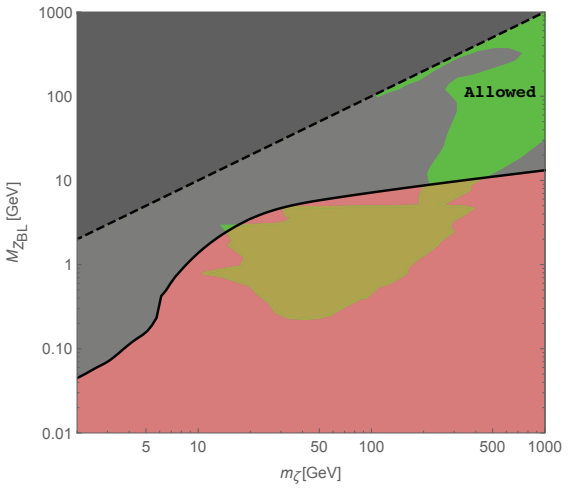
Pith's one-line read Thermal $B-L$ dark matter survives only above $m_\zeta \gtrsim 200$ GeV and $M_{Z_{BL}} \gtrsim 10$ GeV.
desk verdict Competent, useful B-L DM constraints paper with a defensible central relic-density argument, but it needs a consistency pass on headline bounds and a quantitative statement on kinetic mixing before the freeze-in reach is fully trusted. read the letter →
The pith
A machine-rendered reading of the paper's core claim, the machinery that carries it, and where it could break.
The reading
What carries the argument
The load-bearing object is the $Z_{BL}$ gauge boson with two distinct couplings: $g_{BL}$, common to all Standard Model fermions through their $B-L$ charges, and $g_\zeta = Qg_{BL}$, the dark fermion's coupling. The analysis runs on the Boltzmann equation for the DM yield, Eq. (8), with thermally averaged annihilation cross sections for $\zeta\bar\zeta \to f\bar f$ (s-channel $Z_{BL}$ exchange) and for $\zeta\bar\zeta \to Z_{BL}Z_{BL}$ (t/u-channel exchange), listed in the appendix. The observed relic density $\Omega_{DM}h^2 = 0.12$ converts the Boltzmann solution into the compact coupling relations quoted above, while the equilibrium conditions in Eqs. (5) and (7) decide whether the freeze-out or freeze-in regime applies. In the freeze-in case the same machinery is used with a vanishing initial DM abundance, and Eq. (23) implements the sequential freeze-in of $\zeta$ from an intermediate $Z_{BL}$ population.
What would settle it
A future direct detection experiment could falsify the thermal window by observing a spin-independent $\zeta$-nucleon cross section larger than the value implied by $g_{BL}g_\zeta$ from the allowed parameter curves at a claimed $m_\zeta$; equivalently, a displaced-vertex search like FASER finding a $Z_{BL}$ with parameters in the region Fig. 8 excludes, or a confirmed thermal relic with $m_\zeta<200$ GeV in this exact model, would disprove the paper's central bounds.
Extended reading notes
Core claim
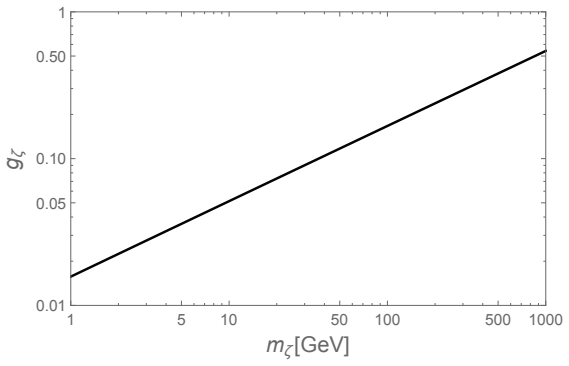
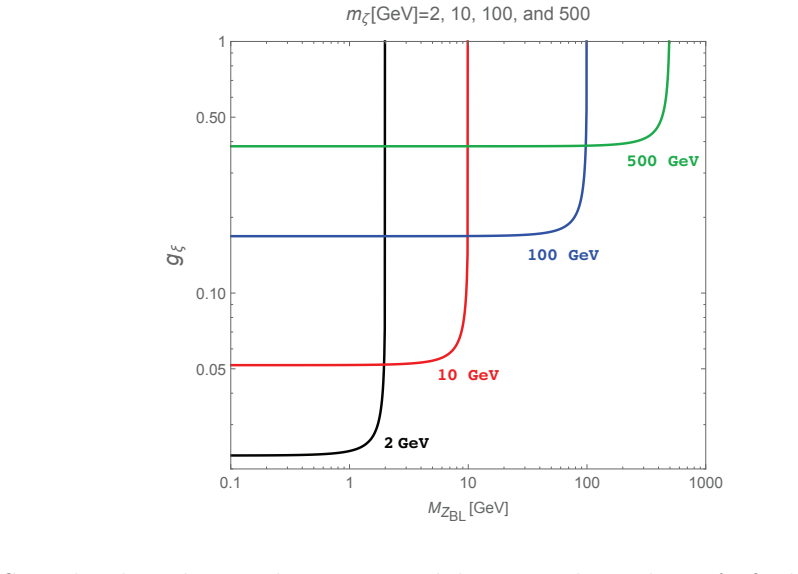
The paper's central claim is that the four-parameter $B-L$ model with masses $m_\zeta$, $M_{Z_{BL}}$ and couplings $g_{BL}$, $g_\zeta$ collapses onto narrow, calculable curves when the dark matter is required to match the observed relic abundance. In the thermal freeze-out case the relic condition fixes $g_\zeta \simeq 0.016\sqrt{m_\zeta[{\rm GeV}]}$ for $M_{Z_{BL}}^2 \ll m_\zeta^2$, and equilibrium with the Standard Model plasma requires $g_{BL} \gtrsim 2.7\times10^{-8}\sqrt{m_\zeta[{\rm GeV}]}$. Direct detection then imposes a floor on $M_{Z_{BL}}$, while CMB and AMS-02 constraints rule out $\zeta$ masses below roughly 200 GeV. In the freeze-in regime the DM starts with zero abundance and is produced either from the thermal plasma or through an intermediate $Z_{BL}$ population, yielding three distinct conditions: case (A) with $g_\zeta^2 g_{BL}^2 + (0.82/1.2)g_\zeta^4 \simeq 8.2\times10^{-24}$; case (B1) with $g_\zeta^2 g_{BL}^2 \simeq 8.2\times10^{-24}(m_\zeta/2.5\,{\rm TeV})$ for $m_\zeta \lesssim 2.5$ TeV through sequential freeze-in; and case (B2) with the same mass-independent product for heavier dark matter.
Load-bearing premise
The analysis assumes the new $Z_{BL}$ boson does not mix with the photon or the $Z$ boson of the Standard Model; if that mixing is sizable, the relic-density, direct-detection, and collider constraints all change.
Editorial extensions
If this is right
- Thermal $B-L$ dark matter cannot be light: the combined constraints force $m_\zeta \gtrsim 200$ GeV and $M_{Z_{BL}} \gtrsim 10$ GeV, so any low-mass signal in this model must come from the freeze-in regime.
- In freeze-in case A the relic condition fixes a definite combination of couplings, $g_\zeta^2 g_{BL}^2 + (0.82/1.2)g_\zeta^4 \simeq 8.2\times10^{-24}$, making the model predictive rather than merely constrained.
- Sequential freeze-in dominates for $m_\zeta \lesssim 2.5$ TeV in case B, so the coupling product scales with $m_\zeta$; this is a distinctive signature that separates the two freeze-in production routes.
- Lifetime-frontier experiments (FASER, FASER2, Belle II, SHiP, LDMX) are projected to reach part of the surviving parameter space, so the model's freeze-in window can be experimentally tested rather than remaining purely theoretical.
- For $M_{Z_{BL}} \lesssim 50$ MeV, the direct detection bound is satisfied only for $g_{BL}g_\zeta \lesssim 1.5\times10^{-12}$, which effectively closes the low-mass region to thermal production.
Reading between the lines
- Beyond the paper: if kinetic mixing between $Z_{BL}$ and the SM photon or $Z$ boson is added, the DM annihilation and scattering cross sections acquire mixing-angle-dependent terms, which would reopen parts of the low-mass parameter space the paper closes; measuring the mixing would require a dedicated two-mediator analysis.
- Beyond the paper: because the DM charge $Q$ is arbitrary and enters only through $g_\zeta = Qg_{BL}$, the derived relic-density constraints apply to any $U(1)'$ portal with a vector-like dark fermion, so the quantitative results here are a template for a broader class of models.
- Beyond the paper: the sharp transition between direct freeze-in (case B2) and sequential freeze-in (case B1) at $m_\zeta \simeq 2.5$ TeV could be probed by searching for a turn in the coupling-mass relation; a future measurement of the DM mass and its annihilation cross section would indicate which production mechanism operated.
- Beyond the paper: improved CMB bounds on energy injection from DM annihilation would strengthen the indirect constraints used here and could push the thermal freeze-out mass floor above 200 GeV, narrowing the window further.
Editorial analysis
A structured set of objections, weighed in public.
Referee Report
Summary. The paper studies a U(1)_{B-L} extension of the Standard Model with a Dirac fermion dark matter candidate ζ carrying an arbitrary B-L charge Q. It derives relic-density constraints for two regimes: thermal freeze-out and freeze-in. For freeze-out, it finds an approximate relation g_ζ ≈ 0.016 sqrt(m_ζ[GeV]) and a thermal-equilibrium lower bound g_BL ≥ 2.7×10^{-8} sqrt(m_ζ[GeV]); combined with direct and indirect detection constraints, this restricts the allowed masses. For freeze-in, it derives coupling relations depending on whether Z_BL is in equilibrium with the SM (case A) or not (cases B1/B2), and displays the parameter space that can be probed by FASER, SHiP, Belle II, LHCb and LDMX.
Significance. The paper provides a useful and mostly standard mapping of the parameter space of a well-motivated B-L portal dark matter model. The Boltzmann treatment and the cross-section formulas in the appendix are explicit, and the use of external constraints (XENON1T, CMB, AMS-02, LEP) is appropriate. The freeze-in analysis, including the sequential freeze-in discussion, is a valuable addition, and the comparison of the resulting parameter space with the reach of lifetime-frontier experiments is timely. The main results are reproducible in structure, though the paper would be strengthened by resolving internal inconsistencies and by clarifying the kinetic-mixing assumption.
major comments (3)
- [Abstract vs Sec. III C and Fig. 4] The abstract states that the allowed mass regions are limited to m_ζ ≳ 200 GeV and M_ZBL ≳ 10 GeV, while Sec. III C and the caption of Fig. 4 both state that the allowed green region corresponds to m_ζ ≳ 100 GeV and M_ZBL ≳ 10 GeV. This is a direct inconsistency in the headline result of the paper; the threshold for the dark matter mass must be corrected and made uniform across the abstract, the body, and the figure.
- [Sec. I and Eq. (3)] The paper ignores kinetic mixing between Z_BL and the SM photon/Z, stating that 'these mixing effects are loop suppressed and therefore smaller.' This statement applies only to the radiative contribution, which is of order g_Y g_BL/(16π²) ≈ 2×10^{-3} g_BL. A tree-level kinetic mixing coefficient ε is a free parameter in U(1)_{B-L} and is not loop suppressed. If ε is comparable to g_BL, the DM-nucleon scattering cross section gains a photon-mediated contribution ∝ (ε e g_ζ)²/M_ZBL^4, and Z_BL production in beam dumps and colliders gains a photon-mixing channel. Both would shift the XENON1T bound (g_BL ≲ 8.9×10^{-7} in Sec. IV B) and the sensitivity curves in Fig. 8. The freeze-in constraints in Eqs. (18)–(23) and the plotted experimental reach are therefore conditional on ε = 0; the manuscript should either justify an approximate upper bound on ε from other constraints or explicitly present the results as the ε = 0 slice of the parameter space.
- [Sec. IV A, after Eq. (23)] The summary bullet for Case (B2) in Sec. IV A states 'for m_ζ >~ 1.5 TeV, we find g_ζ² g_BL² ≃ 8.2×10^{-24}', whereas the abstract and the introduction state that the mass-independent relation applies for m_ζ ≳ 2.5 TeV. This is an internal inconsistency in the definition of the freeze-in cases; the threshold should be stated consistently as 2.5 TeV (or, if 1.5 TeV is intended, the abstract and introduction should be revised accordingly).
minor comments (4)
- [Eq. (18)] The coefficient 0.82/1.2 appearing in the freeze-in relic condition is unexplained. It would be helpful to state that it arises from the numerical integration of the Boltzmann equation and to use a more transparent notation.
- [Sec. IV C] The sentence 'unless the gauge coupling is below 10^{-10} GeV' appears to have a dimensional error; the quantity should probably be the dimensionless coupling g_BL < 10^{-10}.
- [Eq. (6) and surrounding text] The thermal-equilibrium condition for f fbar → Z_BL γ uses n_ZBL(T) times the cross section, whereas the production rate is more properly n_f n_γ / n_ZBL times ⟨σv⟩. The estimate is acceptable because all number densities are comparable in radiation domination, but this step could be clarified.
- [Throughout] The notation for the Z_BL mass is inconsistent: M_ZBL in the text and equations, m_ZBL in Fig. 4 and in Sec. III C. Please unify the notation.
Circularity Check
No significant circularity: relic-density constraints are derived by solving the Boltzmann equation with the externally measured Planck value Omega h^2 = 0.12, and experimental bounds are imported from external analyses.
full rationale
The central derivations are self-contained rather than circular. The thermal freeze-out relation g_zeta ~ 0.016 sqrt(m_zeta/GeV) and the freeze-in constraints in Eqs. (18), (19), and (23) are obtained by numerically solving the Boltzmann equation (Eq. (8)) with the observed dark matter relic density Omega h^2 = 0.12 taken as an external input from Planck (Ref. [39]); the paper does not claim to predict the relic density from the model parameters, but instead solves for the coupling combinations required to match it. Direct detection constraints enter through the externally measured spin-independent cross-section limits shown in Fig. 3, applied to the model cross section of Eq. (14). Indirect constraints are imported from Refs. [29] and [30], which are independent external analyses, not results of the present authors. The only self-citations appear in background statements, e.g., Ref. [16] for a perturbativity bound in a different class of B-L models and Ref. [32] for a speculative decaying-DM role of the B-L Higgs; neither is needed to derive the paper's constraints. The sequential freeze-in treatment follows the independent result of Ref. [49]. The simplifying assumption of zero kinetic mixing between Z_BL and the SM gauge bosons is explicitly stated in Sec. I as a modeling choice, not justified by a circular citation, so its plausibility is a robustness concern rather than a circularity. No fitted parameter is renamed as a prediction, and no load-bearing result reduces by construction to an input of the model.
Assumptions & free parameters
free parameters (5)
- Q, the B-L charge of the dark matter fermion =
scanned over 2e-4 to 50 in Fig. 8
- g_BL =
scanned roughly from 1e-10 to 1e-3
- m_zeta, dark matter mass =
1 GeV to a few TeV, with benchmarks 2, 10, 30, 100, and 500 GeV
- M_ZBL, mediator mass =
50 MeV to TeV scale, with focus below m_zeta and above 200 MeV
- Reheat temperature and initial dark matter abundance =
not specified numerically; assumed Y(x_RH) = 0 for freeze-in
assumptions (6)
- domain assumption Anomaly cancellation is satisfied by three right-handed neutrinos plus a vector-like dark fermion.
- domain assumption There is no kinetic mixing between Z_BL and the SM photon or Z boson.
- domain assumption The early universe is radiation dominated with g* = 106.75 and standard Maxwell-Boltzmann thermal averages.
- ad hoc to paper For freeze-in, the dark matter abundance starts at zero after reheating.
- ad hoc to paper The dark matter is stable because its B-L charge Q is chosen to forbid decay operators.
- domain assumption Right-handed neutrinos are heavy enough, at least 100 GeV, that only Z_BL affects BBN.
invented entities (2)
-
Z_BL gauge boson
independent evidence
-
Dirac fermion dark matter zeta
independent evidence
Cite this review
Pith. "Pith review of Dark Matter Constraints on Low Mass and Weakly Coupled B-L Gauge Boson." pith.science (2026). https://pith.science/paper/RJJSPRZR
@misc{pith2026190811325,
  author       = {Pith},
  title        = {Pith review of: Dark Matter Constraints on Low Mass and Weakly Coupled B-L Gauge Boson},
  year         = {2026},
  howpublished = {\url{https://pith.science/paper/RJJSPRZR}},
  note         = {Machine review of arXiv:1908.11325}
}
abstract
We investigate constraints on the new $B-L$ gauge boson ($Z_{BL}$) mass and coupling ($g_{BL}$) in a $U(1)_{B-L}$ extension of the standard model (SM) with an SM singlet Dirac fermion ($\zeta$) as dark matter (DM). The DM particle $\zeta$ has an arbitrary $B-L$ charge $Q$ chosen to guarantee its stability. We focus on the small $Z_{BL}$ mass and small $g_{BL}$ regions of the model, and find new constraints for the cases where the DM relic abundance arises from thermal freeze-out as well as freeze-in mechanisms. In the thermal freeze-out case, the DM coupling is given by $g_{\zeta}\equiv g_{BL}Q\simeq0.016\sqrt{m_\zeta[{\rm GeV}]}$ to reproduce the observed DM relic density and $g_{BL}\geq 2.7 \times 10^{-8} \sqrt{m_\zeta[{\rm GeV}]}$ for the DM particle to be in thermal equilibrium prior to freeze-out. Combined with the direct and indirect DM detection constraints, we find that the allowed mass regions are limited to be $m_\zeta \gtrsim 200$ GeV and $M_{Z_{BL}} \gtrsim 10$ GeV. We then discuss the lower $g_{BL}$ values where the freeze-in scenario operates and find the following relic density constraints on parameters depending on the $g_{BL}$ range and dark matter mass: Case (A): for $g_{BL}\geq 2.7\times10^{-8}\sqrt{m_\zeta[{\rm GeV}]}$, one has $g^2_\zeta\,g^2_{BL}+\frac{0.82}{1.2}\,g^4_\zeta\simeq 8.2\times10^{-24}$ and Case (B): for $g_{BL} < 2.7 \times 10^{-8} \sqrt{m_\zeta[{\rm GeV}]}$, there are two separate constraints depending on $m_\zeta$. Case (B1): for $m_\zeta\lesssim 2.5{\rm TeV}$, we find $g_\zeta^2\,g_{BL}^2\simeq 8.2\times10^{-24}\,\left( \frac{m_\zeta}{2.5\,{\rm TeV}} \right)$ and case (B2): for $m_\zeta \gtrsim 2.5$ TeV, we have $g_\zeta^2 \, g_{BL}^2 \simeq 8.2 \times 10^{-24}$. For this case, we display the various parameter regions of the model that can be probed by a variety of ``Lifetime Frontier" experiments such as FASER, FASER2, Belle II, SHiP and LDMX.
Figures

Figures from the paper (6 more)




Forward citations
Cited by 3 Pith papers
-
$Z^\prime$ Portal Dark Matter with Observable $\Delta N_{\rm eff}$
Dirac right-handed neutrinos in a U(1)_{B-L} Z' portal model produce observable ΔN_eff that, together with direct/indirect detection and collider bounds, carves out testable WIMP and FIMP dark-matter regions.
-
Searching for a light $Z'$ through Higgs production at the LHC
Existing LHC dilepton and four-lepton searches, reinterpreted for the minimal U(1)_{B-L} model, exclude gauge couplings down to about 5x10^-6 for a 0.25 GeV Z-prime at maximal Higgs mixing.
-
Reviving $Z^\prime$ Portal Dark Matter with Conversion Mechanism
In a U(1)_{B-L} Z' portal model with two nearly degenerate dark fermions, the conversion mechanism can produce the observed dark matter relic density while evading current collider and direct-detection constraints.
Reference graph
Works this paper leans on
-
[1]
2 × 10⁻²⁴ and Case (B): for gBL < 2
2 g4 ζ ≃ 8. 2 × 10⁻²⁴ and Case (B): for gBL < 2. 7 × 10⁻⁸ √ mζ[GeV], there are two separate constraints depending on mζ. Case (B1): for mζ < ∼ 2. 5 TeV, we find g2 ζ g2 BL ≃ 8. 2 × 10⁻²⁴ ( mζ
-
[2]
5 TeV ) and case (B2): for mζ > ∼ 2. 5 TeV, we have g2 ζ g2 BL ≃ 8. 2 × 10⁻²⁴. For this case, we display the various parameter regions of t he model that can be probed by a variety of “Lifetime Frontier” experi ments such as F ASER, F ASER2, Belle II, SHiP and LDMX. 1 I. INTRODUCTION Extensions of the standard model (SM) with U(1)B−L as a possible new sym...
-
[3]
7 × 10⁻⁸ √ mζ[GeV]. For the freeze-in case, we find that the product gBL gζ ≈ 2. 9 × 10⁻¹² to satisfy the constraint of the DM relic density. This result is indepe ndent of the dark matter mass as long as mζ >∼ 2. 5 TeV ≫ MZBL . When the dark matter mass is less than 2.5 TeV, the so-called sequential freeze-in mechanism dominates and t he condition on coup...
-
[4]
19 √ gDM /g ∗MP mζ ⟨σv ⟩. Since the annihilation process occurs via s-wave, we can approx- imate ⟨σv ⟩ as σv in the non-relativistic limit. Here in our analysis, we employ Eqs. (32) an d (29) given in Appendix for the annihilation processes ζ¯ζ → ZBLZBL and ζ¯ζ → f ¯f , respec- tively. As we will discuss in the following subsection, the direct DM dete cti...
-
[5]
2 g4 ζ ≃ 8. 2 × 10⁻²⁴ for gBL ≥ 2. 7 × 10⁻⁸ √ mζ[GeV]. (18) In case (B), on the other hand, there is no ZBL initially, the condition is given by only the first term in the above equation, i.e. g2 ζ g2 BL ≃ 8. 2 × 10⁻²⁴ for gBL < 2. 7 × 10⁻⁸ √ mζ[GeV]. (19) For example, for mζ = 1 GeV, the first equation implies that gζ ∼ 10−6 or lower whereas the second cas...
-
[6]
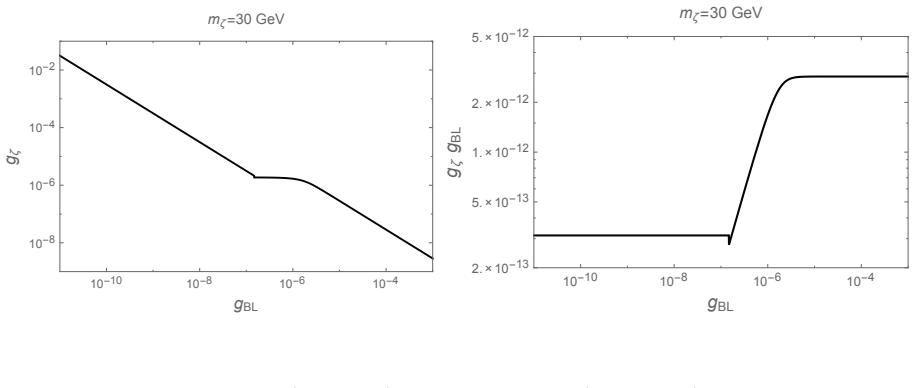
× 10 -12 gBL g gBL m =30 GeV FIG. 7. The plot of gζ vs gBL (left panel) and gζgBL vs gBL (right panel) for mζ = 30 GeV. The observed DM relic density is reproduced along the solid line s. Note that since we have analyzed case (A) and case (B) separately, the discontinuity appears at gBL ≃ 1. 5 × 10⁻⁷ for mζ = 30 GeV, where ZBL goes out of/in thermal equil...
-
[7]
(23) Comparing this result with Eq
5 TeV ) . (23) Comparing this result with Eq. (19), we conclude that the sequentia l freeze-in dominantly produces the DM particles for mζ < 2. 5 TeV, in case (B). For mζ = 30 GeV, our result is displayed in Fig. 7. The plots show cusps at gBL ≃ 1. 5 × 10⁻⁷, which is the boundary value to separate case (A) and case (B). To simplify our analysis, we have c...
-
[8]
2 × 10⁻²⁴ to reproduce Ω DM h2 = 0
2 g4 ζ ≃ 8. 2 × 10⁻²⁴ to reproduce Ω DM h2 = 0 . 12. Case (B): for gBL < 2. 7 × 10⁻⁸ √ mζ[GeV], there are two separate constraints depending on mζ. Case (B1): for mζ <∼ 2. 5 TeV, we find g2 ζ g2 BL ≃
Show all 65 references
-
[10]
R. E. Marshak and R. N. Mohapatra, Phys. Lett. 91B, 222 (1980)
1980
-
[11]
R. N. Mohapatra and R. E. Marshak, Phys. Rev. letters 44, 1316 (1980)
1980
-
[12]
Davidson, Phys
A. Davidson, Phys. Rev. D 20, 776 (1979)
1979
-
[13]
Buchmuller, C
W. Buchmuller, C. Greub and P. Minkowski, Phys. Lett. B 267, 395 (1991)
1991
-
[14]
Khalil, J
S. Khalil, J. Phys. G 35, 055001 (2008)
2008
- [15]
-
[16]
Basso, A
L. Basso, A. Belyaev, S. Moretti and C. H. Shepherd-Themi stocleous, Phys. Rev. D 80, 055030 (2009)
2009
-
[17]
S. Iso, N. Okada and Y. Orikasa, Phys. Lett. B 676, 81 (2009); Phys. Rev. D 80, 115007 (2009)
2009
-
[18]
A. A. Abdelalim, A. Hammad and S. Khalil, Phys. Rev. D 90, no. 11, 115015 (2014)
2014
-
[19]
Biswas, S
A. Biswas, S. Choubey and S. Khan, JHEP 1808, 062 (2018)
2018
-
[20]
Minkowski, Phys
P. Minkowski, Phys. Lett. B 67, 421 (1977)
1977
-
[21]
R. N. Mohapatra and G. Senjanovi´ c, Phys. Rev. Lett. 44, 912 (1980)
1980
-
[22]
Yanagida, Conf
T. Yanagida, Conf. Proc. C 7902131, 95 (1979)
1979
-
[23]
Gell-Mann, P
M. Gell-Mann, P. Ramond and R. Slansky, Conf. Proc. C 790927, 315 (1979) [arXiv:1306.4669 [hep-th]]
1979 arXiv
-
[24]
S. L. Glashow, NATO Sci. Ser. B 61, 687 (1980)
1980
-
[25]
Chauhan, P
G. Chauhan, P. S. B. Dev, R. N. Mohapatra and Y. Zhang, JHE P 1901, 208 (2019)
2019
-
[26]
Fileviez Perez, C
P. Fileviez Perez, C. Murgui and A. D. Plascencia, Phys. Rev. D 100, 035041 (2019)
2019
-
[27]
P. H. Gu, arXiv:1907.10018 [hep-ph]
1907 arXiv
-
[28]
C. P. Burgess, J. P. Conlon, L. Y. Hung, C. H. Kom, A. Mahar ana and F. Quevedo, JHEP0807, 073 (2008). 25
2008
-
[29]
L. J. Hall, K. Jedamzik, J. March-Russell and S. M. West, JHEP 1003, 080 (2010)
2010
-
[30]
Bernal, M
N. Bernal, M. Heikinheimo, T. Tenkanen, K. Tuominen and V. Vaskonen, Int. J. Mod. Phys. A 32, no. 27, 1730023 (2017)
2017
-
[31]
Hambye, M
T. Hambye, M. H. G. Tytgat, J. Vandecasteele and L. Vande rheyden, Phys. Rev. D 98, no. 7, 075017 (2018)
2018
-
[32]
X. Chu, T. Hambye and M. H. G. Tytgat, JCAP 1205, 034 (2012)
2012
-
[33]
Kaneta, Z
K. Kaneta, Z. Kang and H. S. Lee, JHEP 1702, 031 (2017)
2017
- [34]
-
[35]
Bauer, P
M. Bauer, P. Foldenauer and J. Jaeckel, JHEP 1807, 094 (2018)
2018
-
[36]
Biswas and A
A. Biswas and A. Gupta, JCAP 1609, 044 (2016)
2016
-
[37]
Heeck, Phys
J. Heeck, Phys. Lett. B 739, 256 (2014)
2014
-
[38]
Dutra, M
M. Dutra, M. Lindner, S. Profumo, F. S. Queiroz, W. Rodej ohann and C. Siqueira, JCAP 1803, 037 (2018)
2018
-
[39]
Cirelli, P
M. Cirelli, P. Panci, K. Petraki, F. Sala and M. Taoso, JC AP 1705, 036 (2017)
2017
-
[40]
J. L. Feng, I. Galon, F. Kling and S. Trojanowski, Phys. R ev. D 97, no. 3, 035001 (2018) [arXiv:1708.09389 [hep-ph]]
2018 arXiv
-
[41]
R. N. Mohapatra and N. Okada, Phys. Rev. D 101, 115022 (2020)
2020
-
[42]
Electroweak [LEP and ALEPH and DELPHI and L3 and OPAL Col laborations and LEP Electroweak Working Group and SLD Electroweak Group and SLD Heavy Flavor Group], hep-ex/0312023
-
[43]
Aaboud et al
M. Aaboud et al. [ATLAS Collaboration], JHEP 1710, 182 (2017)
2017
-
[44]
Paul Langacker, Rev. Mod. Phys. 81, 1199 (2009)
2009
-
[45]
Alves, A
A. Alves, A. Berlin, S. Profumo and F. S. Queiroz, JHEP 1510, 076 (2015); Phys. Rev. D 92, no. 8, 083004 (2015)
2015
-
[46]
E. W. Kolb and M. S. Turner, Front. Phys. 69, 1 (1990)
1990
-
[47]
Bertone, D
G. Bertone, D. Hooper and J. Silk, Phys. Rept. 405, 279 (2005)
2005
- [48]
-
[49]
Aprile et al
E. Aprile et al. [XENON Collaboration], Phys. Rev. Lett. 121, no. 11, 111302 (2018)
2018
-
[50]
Agnes et al
P. Agnes et al. [DarkSide Collaboration], Phys. Rev. Lett. 121, no. 8, 081307 (2018)
2018
-
[51]
D. S. Akerib et al. [LUX Collaboration], arXiv:1907.06272 [astro-ph.CO]
1907 arXiv
-
[52]
Cui et al
X. Cui et al. [PandaX-II Collaboration], Phys. Rev. Lett. 119, no. 18, 181302 (2017). 26
2017
-
[53]
Del Nobile, M
E. Del Nobile, M. Kaplinghat and H. B. Yu, JCAP 1510, 055 (2015) doi:10.1088/1475- 7516/2015/10/055 [arXiv:1507.04007 [hep-ph]]
2015 arXiv
-
[54]
Del Nobile, M
E. Del Nobile, M. Nardecchia and P. Panci, JCAP 1604, 048 (2016)
2016
-
[55]
Panci, Adv
P. Panci, Adv. High Energy Phys. 2014, 681312 (2014)
2014
-
[56]
T. Li, S. Miao and Y. F. Zhou, JCAP 1503, 032 (2015)
2015
-
[57]
Bringmann, F
T. Bringmann, F. Kahlhoefer, K. Schmidt-Hoberg and P. W alia, Phys. Rev. Lett. 118, no. 14, 141802 (2017)
2017
-
[58]
Hambye, M
T. Hambye, M. H. G. Tytgat, J. Vandecasteele and L. Vande rheyden, Phys. Rev. D 100, no. 9, 095018 (2019) [arXiv:1908.09864 [hep-ph]]
2019 arXiv
-
[59]
Ariga et al
A. Ariga et al. [F ASER Collaboration], Phys. Rev. D 99, no. 9, 095011 (2019)
2019
-
[60]
Alekhin et al
S. Alekhin et al. , Rept. Prog. Phys. 79, no. 12, 124201 (2016)
2016
- [61]
-
[62]
M. J. Dolan, T. Ferber, C. Hearty, F. Kahlhoefer, and K. S chmidt-Hoberg, JHEP 12, 094 (2017)
2017
-
[63]
Ilten, J
P. Ilten, J. Thaler, M. Williams, and W. Xue, Phys. Rev. D 92, no. 11, 115017 (2015)
2015
-
[64]
Ilten, Y
P. Ilten, Y. Soreq, J. Thaler, M. Williams, and W. Xue, Ph ys. Rev. Lett. 116 no. 25, 251803 (2016)
2016
-
[65]
Bauer, P
M. Bauer, P. Foldenauer and J. Jaeckel, JHEP 1807, 094 (2018) [JHEP 2018, 094 (2020)]
2018
- [66]
Reviewed August 14, 2026 · model on record in the stance chip above.
Discussion (0). Continue with ORCID to comment.