REVIEW 5 major objections 5 minor 5 cited by
Learning to Reason via Mixture-of-Thought for Logical Reasoning
T0 review · 5 major / 5 minor · reviewed 2026-08-07 · deepseek-v4-flash
Pith's one-line read The paper claims that training a single LLM to reason in natural language, code, and truth tables, then majority-voting across the three at inference, beats single-modality chain-of-thought by up to 11.7 percentage points on FOLIO and…
desk verdict Solid multi-modality training results, but the truth-table mechanism is undercut by the paper's own faulty example; worth reviewing with revisions. read the letter →
The pith
A machine-rendered reading of the paper's core claim, the machinery that carries it, and where it could break.
The reading
What carries the argument
The load-bearing object is the truth-table thought paradigm, a symbolic reasoning format the model builds itself: it grounds first-order premises into a finite set of propositional predicates, enumerates truth assignments, prunes assignments that violate any premise, and labels the conclusion true if every surviving assignment satisfies it, false if none do, and uncertain otherwise. The surrounding machinery is the self-evolving MoT training loop, which filters self-generated traces by answer correctness and format validity and finetunes on-policy each round, plus inference-time majority voting across the three modalities. The mechanism that carries the argument is complementarity: the truth table explicitly covers the branches and directions that natural-language reasoning tends to skip or reverse.
What would settle it
Run the trained MoT model on a random sample of FOLIO and ProofWriter problems, independently ground each problem with an off-the-shelf logical proof checker, and compare the model's truth-table rows and final labels with the checker's; the central claim fails if the accuracy gain over natural-language CoT does not concentrate in cases where the model's table is faithful, or if faithful tables do not disproportionately rescue missing-branch and invalid-converse errors.
Extended reading notes
Core claim
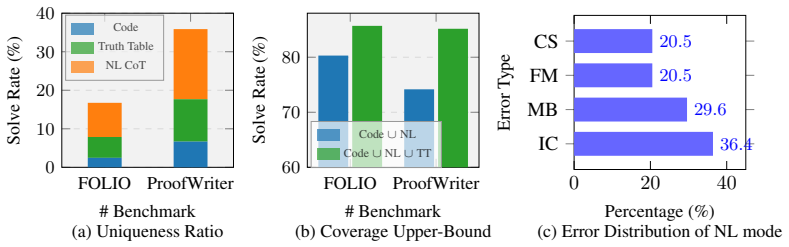
The paper's central claim is that reasoning modalities are complementary in a specific, error-targeted way: natural-language CoT is flexible but systematically misses disjunction branches and commits invalid-converse errors; code forces structured object-state tracking but can commit prematurely; truth-table reasoning enumerates possible assignments and therefore repairs exactly those natural-language failures. Self-evolving MoT training finetunes the model on filtered self-generated traces from all three modalities, and MoT inference aggregates the three outputs by majority vote. The paper reports that this recipe consistently beats single-modality CoT across three base models and two benchmarks, that the gain grows with reasoning depth, and that each modality solves some instances no other modality solves, with the truth-table modality uniquely rescuing cases involving transposition and disjunction.
Load-bearing premise
The method assumes the model's self-generated truth tables faithfully capture the original logical premises, since nothing outside the model checks whether the grounding and pruning are correct.
Editorial extensions
If this is right
- Single-model training on all three modalities outperforms training separate single-modality models, so complementarity is captured without tripling parameters.
- The gains concentrate on deep, multi-step problems, so Mixture-of-Thought is most valuable exactly where chain-of-thought is known to fail.
- Adding truth-table reasoning to code-plus-natural-language raises the oracle upper bound on both benchmarks, so the new modality is the source of coverage, not just another vote.
- A 9-billion-parameter open model reaches the FOLIO accuracy of a GPT-4-based neuro-symbolic baseline, suggesting an external solver is not required for that level of performance.
Reading between the lines
- Because the truth table is generated by the model itself with no independent verification, a version that checks or repairs tables against a lightweight logical checker is the natural next test; it would both improve accuracy and directly confirm that table faithfulness, not prompt diversity, drives the gain.
- The same three-way design should transfer to other settings with a natural enumeration modality, such as math word problems with case splits or planning problems with state spaces, though the paper only evaluates logical reasoning.
- The paper's error taxonomy implies a sharp diagnostic: if MoT's gain over natural-language reasoning disappears on instances where no missing-branch or invalid-converse error occurs, then the complementarity mechanism is confirmed; if not, the gain may be mostly ensemble averaging.
Signed reviews
Editorial analysis
A structured set of objections, weighed in public.
Referee Report
Summary. The paper proposes Mixture-of-Thought (MoT), a framework that trains a single LLM to reason in three modalities—natural-language chain-of-thought, code-based reasoning, and a newly introduced truth-table modality—via a self-evolving loop that filters self-generated rationales by final-answer correctness and format validity, and then combines the modalities by majority vote at inference. Experiments on FOLIO and ProofWriter (and ProverQA in further analyses) report consistent gains over untrained base models, over single-thought training, and in test-time scaling, with a 9B open model reaching 78.9% on FOLIO, matching the paper's reported GPT-4 + Logic-LM number. The paper also includes ablations on policy strategy, mixing strategy, data-volume controls, and an error analysis of natural-language reasoning failures.
Significance. The central idea—that jointly training on multiple reasoning modalities can be more effective than selecting or augmenting a single modality—is timely and potentially valuable for improving logical reasoning in smaller open models. The paper ships code and includes several useful controlled experiments: Appendix E.5 compares MoT data against an equal volume of diverse NL-only data, Table 6 ablates on-policy versus off-policy training, and the uniqueness/complementarity analysis in Section 4.2 quantifies cross-modal synergy. If the mechanism claims were fully supported, the work would be a meaningful step toward modality-diverse self-training. However, the paper's own illustrative truth table is logically unfaithful and yields an incorrect answer to the stated problem, which directly undermines the claim that the truth-table modality 'systematically enumerates logical cases.' That issue, together with missing statistical rigor and some uncontrolled comparisons, means the current evidence supports a more modest claim: that training and voting over three model-generated reasoning formats improves accuracy, not that the symbolic enumeration mechanism is the cause.
major comments (5)
- [Section 2.1, Table 1] The illustrative truth-table reasoning is logically unfaithful and produces the wrong answer. The premises imply T→H, H→A, and A→B (the Hulk breaks a bridge), and the premise 'If a destroyer breaks a bridge, Peter is not a civilian' cannot be applied because neither Thor (explicitly a god, hence not a destroyer) nor the Hulk is asserted to be a destroyer. Therefore B→¬C is not entailed, and the derived chain ¬C, S, U does not follow; the correct answer to the question is (C) Uncertain, not (A) True. This is not a minor presentational slip: the reward function in Eq. (2) checks only final-answer equality and tag/format validity, so exactly this kind of unfaithful grounding can be retained in the training set whenever the predicted label matches. The paper's claim that truth-table reasoning 'systematically enumerates logical cases' is therefore not supported by its own central example, and the mechanism attributed to the truth-table modality is not established.
- [Section 3.3, Table 3] The headline comparison 'MoT training outperforms single-thought training' is confounded by training-data volume. Each Single-Thought row in Table 3 is trained on roughly one modality's worth of data (N traces), whereas Mixture-of-Thought (Default, All) is trained on approximately 3N traces, one set per modality. The 'Three Models Combined' row uses three separate models, which is a different resource trade-off. Appendix E.5 does provide an equal-volume control for NL-only data (3N NL_CoT versus 3N MoT data), but this control is not in the main table. Please make the equal-volume comparison the primary evidence in Table 3, or add an equal-volume single-thought row, so the reader can separate modality-mixture effects from data-quantity effects.
- [Section 3.2, Table 2] The abstract and Section 3.2 claim that MoT 'consistently and significantly outperforms' strong baselines, but Table 2 reports a single run per condition with a fixed seed and no error bars, confidence intervals, or significance tests. The phrase 'significantly' is thus not substantiated; please report variance across multiple seeds or bootstrap CIs, and ideally a paired test on the FOLIO and ProofWriter instances. In addition, the +11.7pp average gain is computed against untrained 3-shot base models (Table 2, rows B-D), so it conflates the effect of MoT with the effect of any supervised fine-tuning on 1000 examples. The controlled comparisons in Table 3 and Appendix E.5 are more informative for isolating MoT's contribution and should be foregrounded.
- [Section 3.2 and Table 5] The statement that 'our 9B model achieves 78.9% accuracy on FOLIO, matching the performance of Logic-LM' is selectively framed. Table 5 reports GPT-4 with Symbolic CoT at 83.3% and GPT-4 with Logic-of-Thoughts at 88.2% on FOLIO, both well above 78.9%. Matching Logic-LM specifically is true, but the broader wording in the abstract and introduction ('matches the results of GPT-4 + Logic-LM on FOLIO') risks implying parity with state-of-the-art GPT-4 methods. Please either restrict the claim to the Logic-LM baseline or acknowledge the stronger GPT-4 numbers in the same sentence.
- [Section 4.2 and Appendix D] The paper's central motivation—that nearly two thirds of natural-language CoT errors are missing-branch or invalid-converse errors—rests on an automatic error-detection pipeline whose accuracy is not validated. Figure 1(c) and Section 4.2 report these percentages, and Section 4.2 mentions a human evaluation, but no agreement statistics, sample sizes, or precision/recall of the detector are given. Because the truth-table modality is introduced specifically to address these two error types, the authors should report the error detector's agreement with human annotations on a labeled sample, or provide the human-evaluation details, before using these percentages as the primary design rationale.
minor comments (5)
- [Section 3.2] The sentence 'outperforms the corresponding base models by an average of 11.7pp (from 41.1% to 61.9% ...)' lists only the Gemma-2-2B numbers in parentheses; the 11.7pp is an average across all three models, so the parenthetical should be clarified to avoid implying that 41.1% to 61.9% is the average.
- [Figure 3] The text states that there are 10 runs for each setting, but Figure 3 shows no error bars or confidence bands; adding them would make the test-time scaling comparison considerably more convincing.
- [Table 2] The rows labeled 'MoT(0-Shot) Single-Thought Best' should define how the 'Best' modality is selected for each model and dataset, and the 'Mixture-of-Thought All' row should state how ties are broken in the three-way majority vote.
- [Appendix G.2] The code-reasoning example contains inline annotations such as '⇒Correct' and '⇒Incorrect' inside the Python code, which make the displayed code non-executable; these annotations should be moved to a separate column or footnote so the code example is clearly distinct from the human commentary.
- [Section 4.1] ProverQA appears in Figure 4 and the associated analysis but is not introduced until Appendix C.1; a one-sentence definition of ProverQA in the main text would help readers interpret the depth-based results.
Circularity Check
No significant circularity: MoT's gains are measured on held-out benchmarks; the truth-table mechanism is an empirical design choice rather than a fitted prediction.
full rationale
The paper's central claims are supported by held-out evaluation, not by construction. MoT training optimizes Eq. (1) with reward Eq. (2), which accepts a generated trace only when its predicted answer equals the ground-truth label; this is standard self-training/STaR-style bootstrapping on the training split, and the reported FOLIO and ProofWriter accuracies are measured on validation/test sets that do not enter the filter. The truth-table modality is not defined in terms of the conclusion it is asked to predict: the paper specifies a decision rule ('True if every surviving assignment satisfies the conclusion, False if none do, and Uncertain otherwise') and assumes, rather than derives, that LLM-generated groundings are faithful. That assumption is an empirical risk and a correctness concern, not a circular reduction. The error analysis in Sec. 4.2 uses an LLM-based classifier with predefined error categories, which is self-referential evidence about the model's own outputs, but it does not make the headline accuracy gains reduce to their inputs. Self-citations, including FOLIO [20] and HybridMind [11], involve co-authors but are external benchmarks or prior design inspiration, and they are not load-bearing in the derivation of the main empirical results. The mis-grounding in the Table 1 illustration is a faithfulness flaw in an illustrative example, not a circular step: the later experiments could in principle have refuted the complementarity claim, and the paper's own limitations section notes that truth-table reasoning still relies on LLM generation. Overall, the derivation chain is self-contained against held-out benchmarks, and no prediction is equivalent by construction to a fitted parameter or to a self-citation.
Assumptions & free parameters
free parameters (2)
- Number of training samples per dataset =
1000
- Sampling temperature and sample count during trajectory collection =
1.0 and 10
assumptions (3)
- domain assumption Filtering generated traces by final-answer correctness and format consistency yields high-quality training examples for each modality.
- domain assumption The three reasoning modalities can be elicited from a single LLM via tagging and few-shot prompts, and the model will follow the requested mode.
- ad hoc to paper LLM-generated truth tables, after grounding and pruning, faithfully represent the logical content of first-order premises.
Cite this review
Pith. "Pith review of Learning to Reason via Mixture-of-Thought for Logical Reasoning." pith.science (2026). https://pith.science/paper/RJVQASIT
@misc{pith2026250515817,
  author       = {Pith},
  title        = {Pith review of: Learning to Reason via Mixture-of-Thought for Logical Reasoning},
  year         = {2026},
  howpublished = {\url{https://pith.science/paper/RJVQASIT}},
  note         = {Machine review of arXiv:2505.15817}
}
read the original abstract
Human beings naturally utilize multiple reasoning modalities to learn and solve logical problems, i.e., different representational formats such as natural language, code, and symbolic logic. In contrast, most existing LLM-based approaches operate with a single reasoning modality during training, typically natural language. Although some methods explored modality selection or augmentation at inference time, the training process remains modality-blind, limiting synergy among modalities. To fill in this gap, we propose Mixture-of-Thought (MoT), a framework that enables LLMs to reason across three complementary modalities: natural language, code, and a newly introduced symbolic modality, truth-table, which systematically enumerates logical cases and partially mitigates key failure modes in natural language reasoning. MoT adopts a two-phase design: (1) self-evolving MoT training, which jointly learns from filtered, self-generated rationales across modalities; and (2) MoT inference, which fully leverages the synergy of three modalities to produce better predictions. Experiments on logical reasoning benchmarks including FOLIO and ProofWriter demonstrate that our MoT framework consistently and significantly outperforms strong LLM baselines with single-modality chain-of-thought approaches, achieving up to +11.7pp average accuracy gain. Further analyses show that our MoT framework benefits both training and inference stages; that it is particularly effective on harder logical reasoning problems; and that different modalities contribute complementary strengths, with truth-table reasoning helping to overcome key bottlenecks in natural language inference.
Figures


Figures from the paper (3 more)


Forward citations
Cited by 5 Pith papers
-
Large Lemma Miners: Can LLMs do Induction Proofs for Hardware?
LLMs, verified by a symbolic model checker, produced correct inductive strengthenings for 82 of 94 curated RTL safety properties.
-
Parallel-R1: Towards Parallel Thinking via Reinforcement Learning
Parallel-R1 uses SFT cold-start on easy math plus GRPO on hard math to instill parallel thinking in Qwen3-4B, reporting 8.4% average accuracy gains and a 42.9% AIME25 gain from a parallel-exploration scaffold.
-
CDE: Curiosity-Driven Exploration for Efficient Reinforcement Learning in Large Language Models
Adding actor perplexity and multi-head critic variance as intrinsic exploration bonuses improves RLVR math reasoning accuracy by roughly +2 to +3 points on AIME benchmarks.
-
ProtoReasoning: Prototypes as the Foundation for Generalizable Reasoning in LLMs
Training on Prolog and PDDL representations improved several LLM reasoning benchmarks, but the controlled comparison does not show prototype training beats natural language training, and the abstract overstates the result.
-
Step-level Verifier-guided Hybrid Test-Time Scaling for Large Language Models
A step-level verifier-guided hybrid of Best-of-N sampling, Monte Carlo tree search, and conditional self-refinement improves reasoning in small instruction-tuned LLMs, claiming up to 28.6-point gains.
Reference graph
Works this paper leans on
-
[1]
Chain-of-thought prompting elicits reasoning in large language models
Jason Wei, Xuezhi Wang, Dale Schuurmans, Maarten Bosma, Fei Xia, Ed Chi, Quoc V Le, Denny Zhou, et al. Chain-of-thought prompting elicits reasoning in large language models. Advances in neural information processing systems, 35:24824–24837, 2022
2022
-
[2]
Xin-Ye Li, Jiang-Tian Xue, Zheng Xie, and Ming Li. Think outside the code: Brainstorming boosts large language models in code generation.arXiv preprint arXiv:2305.10679, 2023
arXiv 2023
-
[3]
Typedthinker: Diversify large language model reasoning with typed thinking
Danqing Wang, Jianxin Ma, Fei Fang, and Lei Li. Typedthinker: Diversify large language model reasoning with typed thinking. InThe Thirteenth International Conference on Learning Representations, 2025. URLhttps://openreview.net/forum?id=VIUisLx8lQ
work page 2025
-
[4]
Xuezhi Wang, Jason Wei, Dale Schuurmans, Quoc Le, Ed Chi, Sharan Narang, Aakanksha Chowdhery, and Denny Zhou. Self-consistency improves chain of thought reasoning in language models.arXiv preprint arXiv:2203.11171, 2022
arXiv 2022
-
[5]
Bradley Brown, Jordan Juravsky, Ryan Ehrlich, Ronald Clark, Quoc V Le, Christopher Ré, and Azalia Mirhoseini. Large language monkeys: Scaling inference compute with repeated sampling.arXiv preprint arXiv:2407.21787, 2024
arXiv 2024
-
[6]
Scaling LLM test- time compute optimally can be more effective than scaling parameters for reasoning
Charlie Victor Snell, Jaehoon Lee, Kelvin Xu, and Aviral Kumar. Scaling LLM test- time compute optimally can be more effective than scaling parameters for reasoning. In The Thirteenth International Conference on Learning Representations, 2025. URL https: //openreview.net/forum?id=4FWAwZtd2n
2025
-
[7]
Tian Liang, Zhiwei He, Wenxiang Jiao, Xing Wang, Yan Wang, Rui Wang, Yujiu Yang, Shuming Shi, and Zhaopeng Tu. Encouraging divergent thinking in large language models through multi- agent debate.arXiv preprint arXiv:2305.19118, 2023
arXiv 2023
-
[8]
Liangming Pan, Alon Albalak, Xinyi Wang, and William Yang Wang. Logic-lm: Empowering large language models with symbolic solvers for faithful logical reasoning.arXiv preprint arXiv:2305.12295, 2023
arXiv 2023
Show all 66 references
-
[9]
Olausson, Alex Gu, Ben Lipkin, Cedegao E
Theo X. Olausson, Alex Gu, Ben Lipkin, Cedegao E. Zhang, Armando Solar-Lezama, Joshua B. Tenenbaum, and Roger P. Levy. LINC: A neurosymbolic approach for logical reasoning by combining language models with first-order logic provers. InThe 2023 Conference on Empirical Methods i...
2023
-
[10]
Lee, and Eunho Yang
Hyun Ryu, Gyeongman Kim, Hyemin S. Lee, and Eunho Yang. Divide and translate: Compositional first-order logic translation and verification for complex logical reasoning. InThe Thirteenth International Conference on Learning Representations, 2025. URL https://openreview.net/for...
2025
-
[11]
Hybridmind: Meta selection of natural language and symbolic language for enhanced llm reasoning
Xuyuan Xiong, Simeng Han, Ziyue Zhou, and Arman Cohan. Hybridmind: Meta selection of natural language and symbolic language for enhanced llm reasoning. 2024. URL https: //api.semanticscholar.org/CorpusID:273501516. 10
2024
-
[12]
Faithful logical reasoning via symbolic chain-of-thought
Jundong Xu, Hao Fei, Liangming Pan, Qian Liu, Mong-Li Lee, and Wynne Hsu. Faithful logical reasoning via symbolic chain-of-thought. In Lun-Wei Ku, Andre Martins, and Vivek Srikumar, editors,Proceedings of the 62nd Annual Meeting of the Association for Computational Linguistics...
2024 doi
-
[13]
Logic-of-thought: Injecting logic into contexts for full reasoning in large language models.arXiv preprint arXiv:2409.17539, 2024
Tongxuan Liu, Wenjiang Xu, Weizhe Huang, Yuting Zeng, Jiaxing Wang, Xingyu Wang, Hailong Yang, and Jing Li. Logic-of-thought: Injecting logic into contexts for full reasoning in large language models.arXiv preprint arXiv:2409.17539, 2024
2024 arXiv
-
[14]
Prentice- hall Englewood Cliffs, NJ, 1972
Allen Newell, Herbert Alexander Simon, et al.Human problem solving, volume 104. Prentice- hall Englewood Cliffs, NJ, 1972
1972
-
[15]
Structure-mapping: A theoretical framework for analogy.Cognitive science, 7 (2):155–170, 1983
Dedre Gentner. Structure-mapping: A theoretical framework for analogy.Cognitive science, 7 (2):155–170, 1983
1983
-
[16]
Why a diagram is (sometimes) worth ten thousand words
Jill H Larkin and Herbert A Simon. Why a diagram is (sometimes) worth ten thousand words. Cognitive science, 11(1):65–100, 1987
1987
-
[17]
Gerald A. Goldin. Representational systems, learning, and problem solving in mathematics. The Journal of Mathematical Behavior, 17(2):137–165, 1998. ISSN 0732-3123. doi: https://doi. org/10.1016/S0364-0213(99)80056-1. URL https://www.sciencedirect.com/science/ article/pii/S036...
1998 doi
-
[18]
Large language model cascades with mixture of thought representations for cost-efficient reasoning
Murong Yue, Jie Zhao, Min Zhang, Liang Du, and Ziyu Yao. Large language model cascades with mixture of thought representations for cost-efficient reasoning. InThe Twelfth International Conference on Learning Representations, 2024. URL https://openreview.net/forum? id=6okaSfANzh
2024
-
[19]
ProofWriter: Generating implications, proofs, and abductive statements over natural language
Oyvind Tafjord, Bhavana Dalvi, and Peter Clark. ProofWriter: Generating implications, proofs, and abductive statements over natural language. In Chengqing Zong, Fei Xia, Wenjie Li, and Roberto Navigli, editors,Findings of the Association for Computational Linguistics: ACL-IJCN...
2021 doi
-
[20]
FOLIO: Natural language reasoning with first-order logic
Simeng Han, Hailey Schoelkopf, Yilun Zhao, Zhenting Qi, Martin Riddell, Wenfei Zhou, James Coady, David Peng, Yujie Qiao, Luke Benson, Lucy Sun, Alexander Wardle-Solano, Hannah Szabó, Ekaterina Zubova, Matthew Burtell, Jonathan Fan, Yixin Liu, Brian Wong, Malcolm Sailor, Anson...
2024
-
[21]
Bounded model checking using satisfiability solving.Formal methods in system design, 19:7–34, 2001
Edmund Clarke, Armin Biere, Richard Raimi, and Yunshan Zhu. Bounded model checking using satisfiability solving.Formal methods in system design, 19:7–34, 2001
2001
-
[22]
Grounding fo and fo (id) with bounds
Johan Wittocx, Maarten Mariën, and Marc Denecker. Grounding fo and fo (id) with bounds. Journal of Artificial Intelligence Research, 38:223–269, 2010
2010
-
[23]
Star: Bootstrapping reasoning with reasoning.Advances in Neural Information Processing Systems, 35:15476–15488, 2022
Eric Zelikman, Yuhuai Wu, Jesse Mu, and Noah Goodman. Star: Bootstrapping reasoning with reasoning.Advances in Neural Information Processing Systems, 35:15476–15488, 2022
2022
-
[24]
Policy gradi- ent methods for reinforcement learning with function approximation
Richard S Sutton, David McAllester, Satinder Singh, and Yishay Mansour. Policy gradi- ent methods for reinforcement learning with function approximation. In S. Solla, T. Leen, and K. Müller, editors,Advances in Neural Information Processing Systems, volume 12. MIT Press, 1999....
1999
-
[25]
An Yang, Baosong Yang, Beichen Zhang, Binyuan Hui, Bo Zheng, Bowen Yu, Chengyuan Li, Dayiheng Liu, Fei Huang, Haoran Wei, et al. Qwen2. 5 technical report.arXiv preprint arXiv:2412.15115, 2024
2024 arXiv
-
[26]
Gemma 2: Improving open language models at a practical size.arXiv preprint arXiv:2408.00118, 2024
Gemma Team, Morgane Riviere, Shreya Pathak, Pier Giuseppe Sessa, Cassidy Hardin, Surya Bhupatiraju, Léonard Hussenot, Thomas Mesnard, Bobak Shahriari, Alexandre Ramé, et al. Gemma 2: Improving open language models at a practical size.arXiv preprint arXiv:2408.00118, 2024
2024 arXiv
-
[27]
Gonzalez, Hao Zhang, and Ion Stoica
Woosuk Kwon, Zhuohan Li, Siyuan Zhuang, Ying Sheng, Lianmin Zheng, Cody Hao Yu, Joseph E. Gonzalez, Hao Zhang, and Ion Stoica. Efficient memory management for large lan- guage model serving with pagedattention. InProceedings of the ACM SIGOPS 29th Symposium on Operating System...
2023
-
[28]
Large language models meet symbolic provers for logical reasoning evaluation
Chengwen Qi, Ren Ma, Bowen Li, He Du, Binyuan Hui, Jinwang Wu, Yuanjun Laili, and Conghui He. Large language models meet symbolic provers for logical reasoning evaluation. InThe Thirteenth International Conference on Learning Representations, 2025. URL https: //openreview.net/...
2025
-
[29]
Verus-lm: a versatile framework for combining llms with symbolic reasoning.arXiv preprint arXiv:2501.14540, 2025
Benjamin Callewaert, Simon Vandevelde, and Joost Vennekens. Verus-lm: a versatile framework for combining llms with symbolic reasoning.arXiv preprint arXiv:2501.14540, 2025
2025
-
[30]
Competition-level code generation with alphacode.Science, 378(6624):1092–1097, 2022
Yujia Li, David Choi, Junyoung Chung, Nate Kushman, Julian Schrittwieser, Rémi Leblond, Tom Eccles, James Keeling, Felix Gimeno, Agustin Dal Lago, et al. Competition-level code generation with alphacode.Science, 378(6624):1092–1097, 2022
2022
-
[31]
Exploring human-like translation strategy with large language models.Transactions of the Association for Computational Linguistics, 12:229–246, 2024
Zhiwei He, Tian Liang, Wenxiang Jiao, Zhuosheng Zhang, Yujiu Yang, Rui Wang, Zhaopeng Tu, Shuming Shi, and Xing Wang. Exploring human-like translation strategy with large language models.Transactions of the Association for Computational Linguistics, 12:229–246, 2024
2024
-
[32]
Diversity of thought elicits stronger reasoning capabilities in multi-agent debate frameworks.ArXiv, abs/2410.12853, 2024
Mahmood Hegazy. Diversity of thought elicits stronger reasoning capabilities in multi-agent debate frameworks.ArXiv, abs/2410.12853, 2024. URL https://api.semanticscholar. org/CorpusID:273403906
2024
-
[33]
Self-contrast: Better reflection through inconsistent solving perspectives
Wenqi Zhang, Yongliang Shen, Linjuan Wu, Qiuying Peng, Jun Wang, Yueting Zhuang, and Weiming Lu. Self-contrast: Better reflection through inconsistent solving perspectives. In Lun- Wei Ku, Andre Martins, and Vivek Srikumar, editors,Proceedings of the 62nd Annual Meeting of the...
2024
-
[34]
Large language models are reasoning teachers
Namgyu Ho, Laura Schmid, and Se-Young Yun. Large language models are reasoning teachers. arXiv preprint arXiv:2212.10071, 2022
2022 arXiv
-
[35]
Fine-tuning with divergent chains of thought boosts reasoning through self-correction in lan- guage models.ArXiv, abs/2407.03181, 2024
Haritz Puerto, Tilek Chubakov, Xiaodan Zhu, Harish Tayyar Madabushi, and Iryna Gurevych. Fine-tuning with divergent chains of thought boosts reasoning through self-correction in lan- guage models.ArXiv, abs/2407.03181, 2024. URL https://api.semanticscholar.org/ CorpusID:270924195
2024 arXiv
-
[36]
Chain-of-reasoning: To- wards unified mathematical reasoning in large language models via a multi-paradigm perspective
Yiyao Yu, Yuxiang Zhang, Dongdong Zhang, Xiao Liang, Hengyuan Zhang, Xingxing Zhang, Ziyi Yang, Mahmoud Khademi, Hany Awadalla, Junjie Wang, et al. Chain-of-reasoning: To- wards unified mathematical reasoning in large language models via a multi-paradigm perspective. arXiv pre...
2025 arXiv
-
[37]
V-star: Training verifiers for self-taught reasoners.arXiv preprint arXiv:2402.06457, 2024
Arian Hosseini, Xingdi Yuan, Nikolay Malkin, Aaron Courville, Alessandro Sordoni, and Rishabh Agarwal. V-star: Training verifiers for self-taught reasoners.arXiv preprint arXiv:2402.06457, 2024
2024 arXiv
-
[38]
Self-taught optimizer (stop): Recursively self-improving code generation
Eric Zelikman, Eliana Lorch, Lester Mackey, and Adam Tauman Kalai. Self-taught optimizer (stop): Recursively self-improving code generation. InFirst Conference on Language Modeling, 2024. 12
2024
-
[39]
Self-taught evaluators.arXiv preprint arXiv:2408.02666, 2024
Tianlu Wang, Ilia Kulikov, Olga Golovneva, Ping Yu, Weizhe Yuan, Jane Dwivedi-Yu, Richard Yuanzhe Pang, Maryam Fazel-Zarandi, Jason Weston, and Xian Li. Self-taught evaluators.arXiv preprint arXiv:2408.02666, 2024
2024 arXiv
-
[40]
Lean-star: Learning to interleave thinking and proving.arXiv preprint arXiv:2407.10040, 2024
Haohan Lin, Zhiqing Sun, Sean Welleck, and Yiming Yang. Lean-star: Learning to interleave thinking and proving.arXiv preprint arXiv:2407.10040, 2024
2024 arXiv
-
[41]
Quiet-star: Language models can teach themselves to think before speaking.arXiv preprint arXiv:2403.09629, 2024
Eric Zelikman, Georges Harik, Yijia Shao, Varuna Jayasiri, Nick Haber, and Noah D Goodman. Quiet-star: Language models can teach themselves to think before speaking.arXiv preprint arXiv:2403.09629, 2024
2024 arXiv
-
[42]
Certified deductive reasoning with language models.Transactions on Machine Learning Research, 2024
Gabriel Poesia, Kanishk Gandhi, Eric Zelikman, and Noah Goodman. Certified deductive reasoning with language models.Transactions on Machine Learning Research, 2024. ISSN 2835-8856. URLhttps://openreview.net/forum?id=yXnwrs2Tl6
2024
-
[43]
rstar-math: Small llms can master math reasoning with self-evolved deep thinking.arXiv preprint arXiv:2501.04519, 2025
Xinyu Guan, Li Lyna Zhang, Yifei Liu, Ning Shang, Youran Sun, Yi Zhu, Fan Yang, and Mao Yang. rstar-math: Small llms can master math reasoning with self-evolved deep thinking.arXiv preprint arXiv:2501.04519, 2025
2025 arXiv
-
[44]
Start: Self-taught reasoner with tools.arXiv preprint arXiv:2503.04625, 2025
Chengpeng Li, Mingfeng Xue, Zhenru Zhang, Jiaxi Yang, Beichen Zhang, Xiang Wang, Bowen Yu, Binyuan Hui, Junyang Lin, and Dayiheng Liu. Start: Self-taught reasoner with tools.arXiv preprint arXiv:2503.04625, 2025
2025 arXiv
-
[45]
Regenesis: LLMs can grow into reasoning generalists via self-improvement
XIANGYU PENG, Congying Xia, Xinyi Yang, Caiming Xiong, Chien-Sheng Wu, and Chen Xing. Regenesis: LLMs can grow into reasoning generalists via self-improvement. InThe Thirteenth International Conference on Learning Representations, 2025. URL https:// openreview.net/forum?id=YUYJsHOf3c
2025
-
[46]
Deepseek-r1: Incentivizing reasoning capability in llms via reinforcement learning.arXiv preprint arXiv:2501.12948, 2025
Daya Guo, Dejian Yang, Haowei Zhang, Junxiao Song, Ruoyu Zhang, Runxin Xu, Qihao Zhu, Shirong Ma, Peiyi Wang, Xiao Bi, et al. Deepseek-r1: Incentivizing reasoning capability in llms via reinforcement learning.arXiv preprint arXiv:2501.12948, 2025
2025 arXiv
-
[47]
Rush, and Thomas Wolf
Lewis Tunstall, Edward Beeching, Nathan Lambert, Nazneen Rajani, Shengyi Huang, Kashif Rasul, Alvaro Bartolome, Alexander M. Rush, and Thomas Wolf. The Alignment Handbook. URLhttps://github.com/huggingface/alignment-handbook
-
[48]
You must determine whether a rationale faithfully justifies the truth value of a conclusion given a set of premises.\n\n
Jundong Xu, Hao Fei, Liangming Pan, Qian Liu, Mong-Li Lee, and Wynne Hsu. Faithful logical reasoning via symbolic chain-of-thought.arXiv preprint arXiv:2405.18357, 2024. 13 A Broader Impact Our Mixture-of-Thought (MoT) framework is designed to improve logical reasoning by inte...
2024 arXiv
-
[49]
Policy Strategy Off-policy MoT 55.2 54.7 53.7 56.7 On-policy MoT (default)61.1 61.1 58.6 62.6
-
[50]
Only TT correct
Mixing Strategy Random single-modality per question 49.8 50.3 48.3 53.7 Direct mixing (default)61.1 61.1 58.6 62.6 E.3 Ablation Studies We perform ablation studies on three core components: 1) policy strategy,i.e.,on-policy vs. off- policy [23] and 2) mixing approach,i.e.,dire...
-
[51]
<end_of_answer> Examples of Truth Table-based Reasoning generated by our models
(E∧S)∨(¬E∧¬S) Logical chain (assuming T = False): From (2): T = False -> I = True From (4): I = True -> C = True From (3): C = True ->¬S = True -> S = False From (6): S = False ->¬E = True -> E = False From (1): E = False -> E→S holds vacuously -> No contradiction if T = False...
-
[52]
All fir trees are evergreens. F→E
-
[53]
∃x (W(x)∧F(x)) Conclusion to Evaluate: Some evergreens are not objects of worship
Some objects of worship are fir trees. ∃x (W(x)∧F(x)) Conclusion to Evaluate: Some evergreens are not objects of worship. ∃x (E(x)∧¬W(x)) Logical Chain:
-
[54]
From (2), there exists some object a such that W(a)∧F(a)
-
[55]
Since F(a) and F→E, it follows that E(a)
-
[56]
Therefore, we have E(a) and W(a)
-
[57]
We need∃x (E(x)∧¬W(x))
-
[58]
The premises do not provide any information about whether there exists an evergreen that is not an object of worship
-
[59]
All employees who schedule a meeting with their customers will go to the company building today,\
Therefore, it is uncertain whether some evergreens are not objects of worship. Truth Table (Key Possibilities): | F | E | W | E∧¬W | | True | True | True | False | | True | True | False| True | | False| True | True | False | | False| True | False| True | Rows omitted: any with...
-
[60]
(Not directly about Rock)
All of Peter’s pets that are mammals are also animals. (Not directly about Rock)
-
[61]
(Not directly about Rock) 35
All monkeys are mammals. (Not directly about Rock) 35
-
[62]
(Not directly about Rock)
Peter’s pets are all either monkeys or birds. (Not directly about Rock)
-
[63]
Peter’s birds can fly. (B→F)
-
[64]
All animals that are Peter’s pets can breathe. (A→R)
-
[65]
If Peter’s pet can fly, then it has wings. (F→W)
-
[66]
Rock" and pet.is_monkey is True: return
Rock can fly, or Rock is a bird, or Rock cannot breathe. (F∨B∨ ¬R) Conclusion to Evaluate: Rock is a monkey (M) ⇒Correct. The model correctly produce two cases that lead to different conclusions,i.e.,True and False. Therefore, it finally produces Uncertain as the final answer....
Reviewed August 7, 2026 · model on record in the stance chip above.
Discussion (0). Continue with ORCID to comment.